
Claude Fable 5.2: What It Is, What Changed and What It Costs
Claude Fable 5.2 is Anthropic's model from 9 November 2026: $8/$40 pricing, 1M context, claimed benchmarks and when to choose it over Opus 5.5.
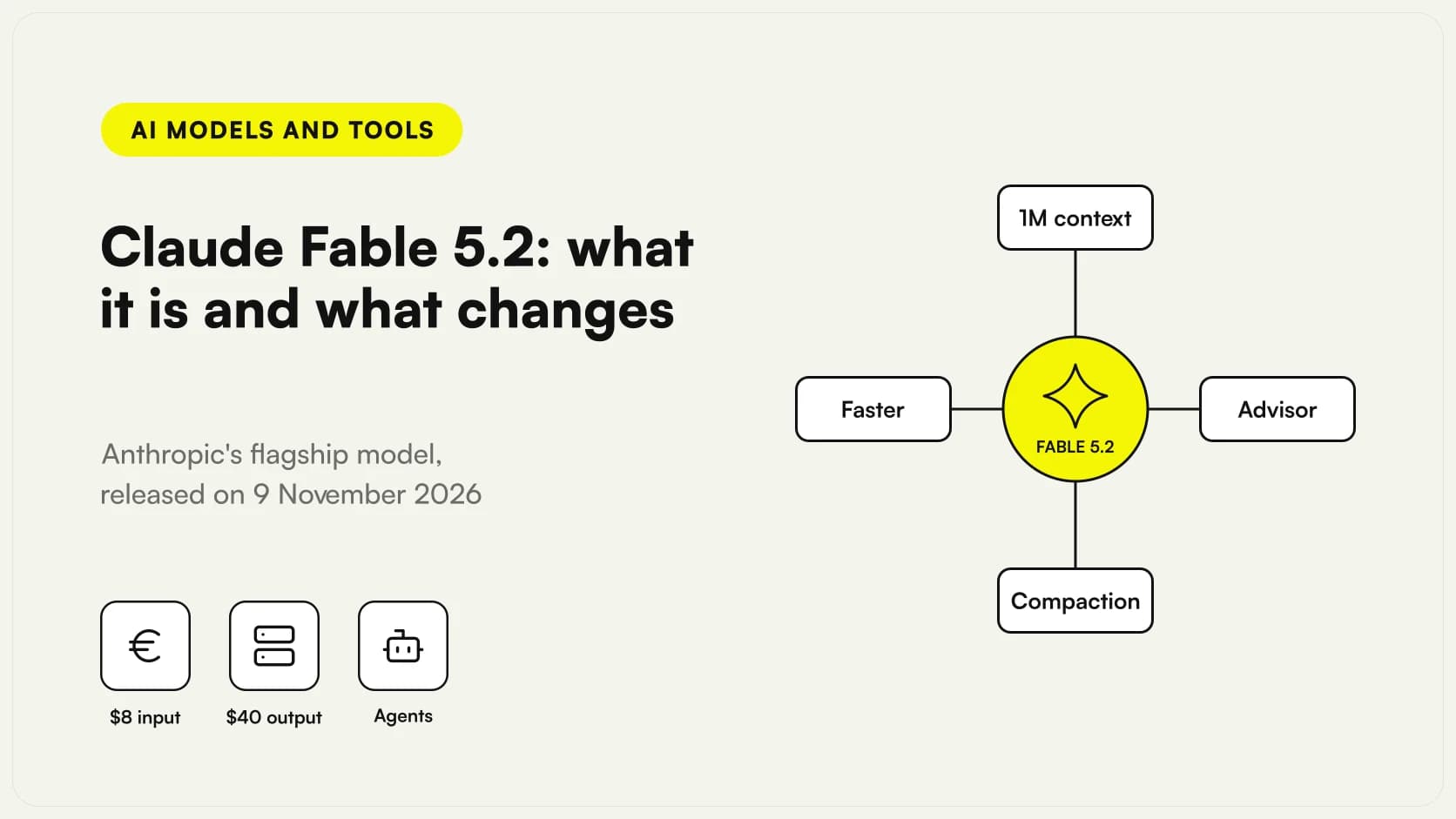
Claude Fable 5.2, released by Anthropic on 9 November 2026, is the most capable AI model now available to everyone in the Claude family. It sits above Claude Opus 5.5, costs $8 per million input tokens and $40 per million output tokens, handles a context of 1 million tokens and is built for the hardest work: agents that run for hours, multi-step research and analysis carried through to a finished document, spreadsheet or presentation. The data comes from the official model page and the Anthropic's announcement, both checked on 9 November 2026.
The name has two halves. Fable 5.2 is the version for everyone. Mythos 5.2 is the same model without the safeguards on cybersecurity and biology, reserved for verified organizations. For an Italian SME the rule is clear: use Fable 5.2 when a hard task cannot be solved with Opus 5.5, not as an everyday model. Anthropic itself says so, and we explain below.
In summary
- Claude Fable 5.2 was released on 9 November 2026 (official page), has the ID
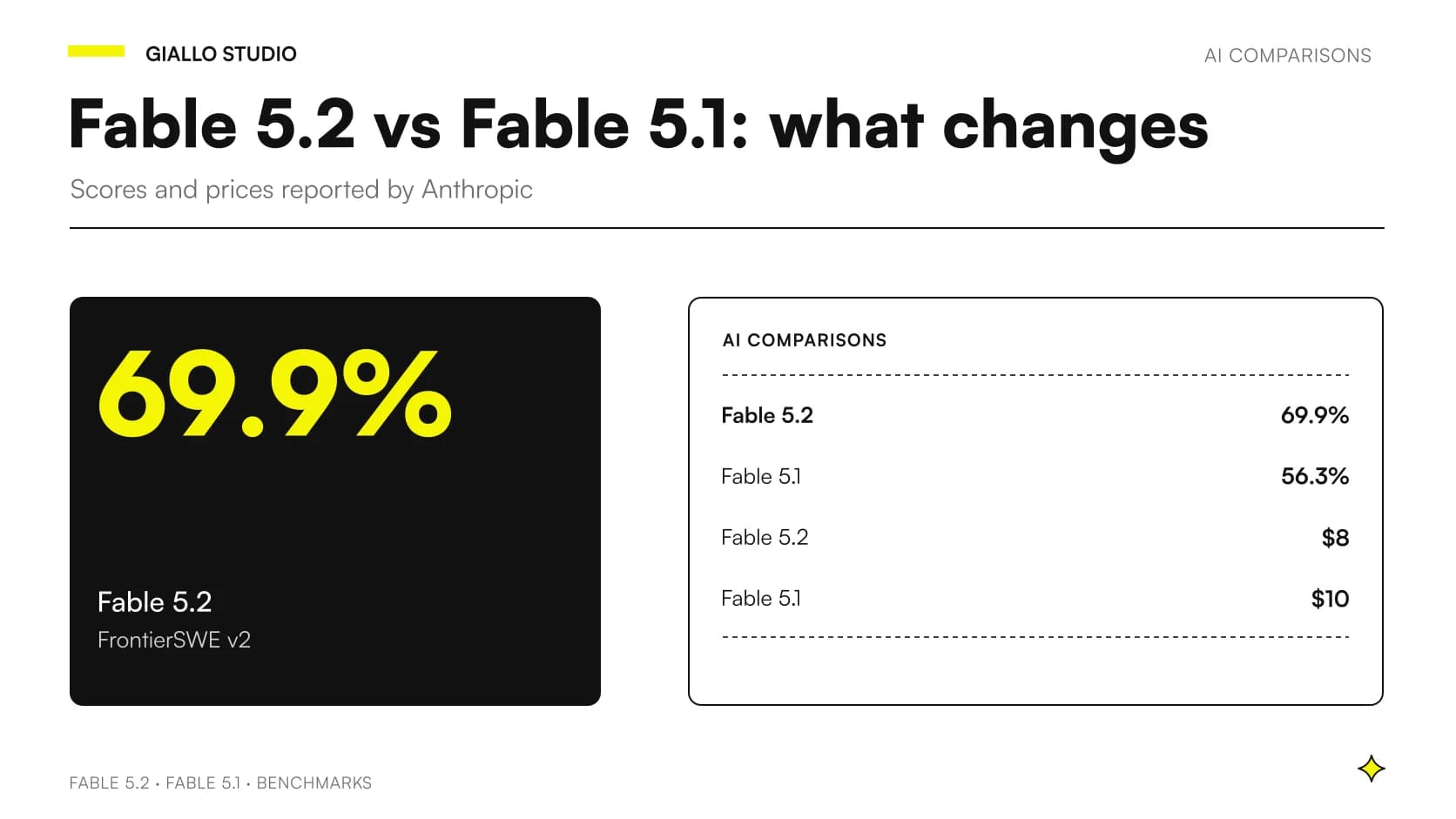
claude-fable-5-2, a context of 1 million tokens and a maximum output of 128K tokens. - It costs $8 per million input tokens and $40 per million output tokens, against $10 and $50 for Fable 5.1: the list price has dropped, while output speed rises by up to 30%.
- In the table Anthropic published it beats Opus 5.5 in almost every test, but these numbers are stated by the vendor and have not been replicated by third parties.
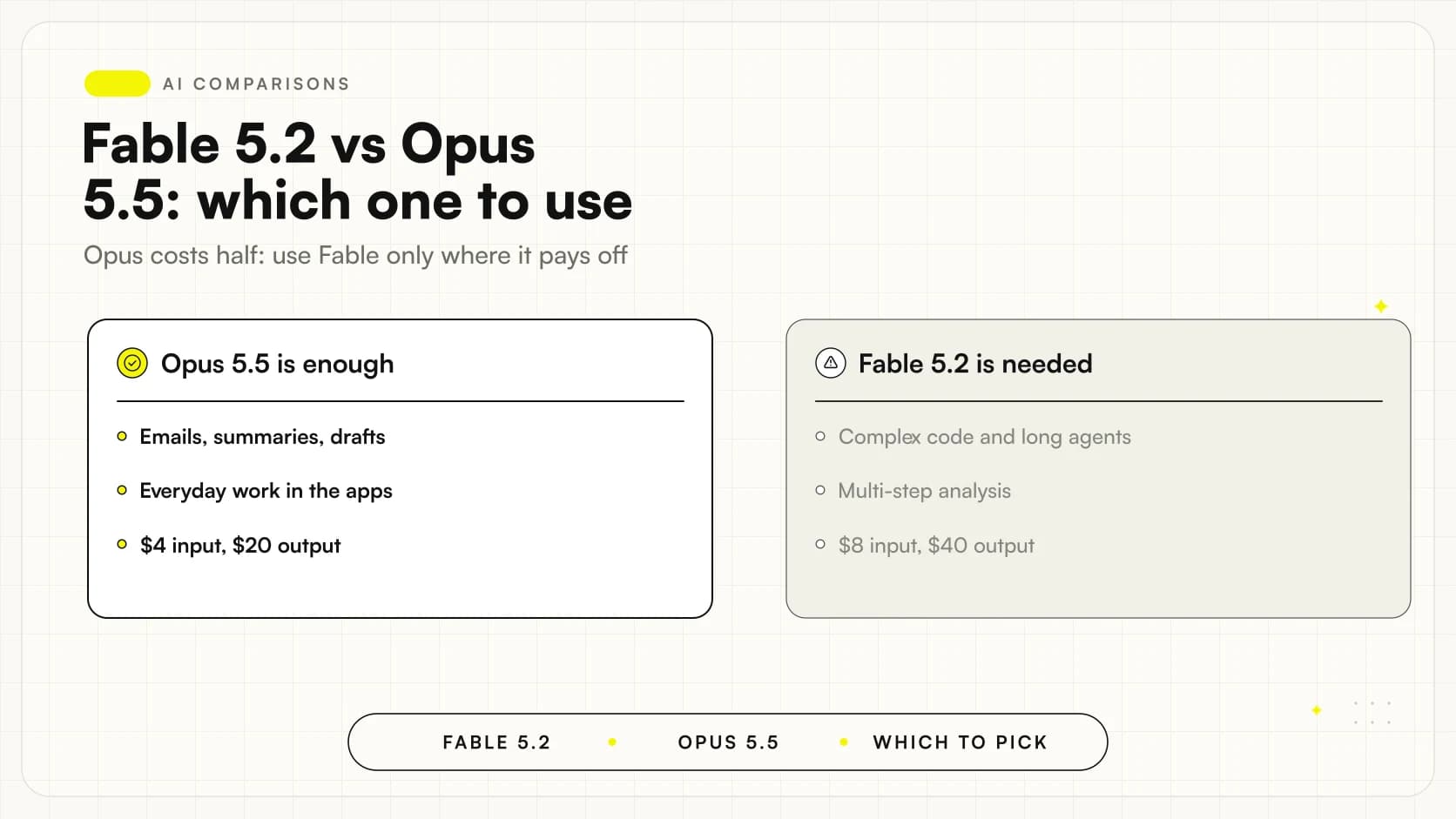
- Anthropic recommends Opus 5.5 as the everyday model and Fable for the most ambitious tasks: for many office tasks Fable costs more than necessary.
- Mythos 5.2 is the same model without the cyber and biology safeguards, open only to approved organizations: an SME almost never needs it.
- Data is retained for at least 30 days and zero data retention is not available without authorization: assess this before sending personal data.
What is Claude Fable 5.2 and where does it sit among Claude models?
Claude Fable 5.2 is Anthropic's flagship model for reasoning tasks and long-running “agentic” work, where the model plans, uses tools and checks its own work. The official page describes it for uses such as agent sessions lasting several hours, in-depth multi-step research and analysis carried through to a finished file.
The current Claude family has four tiers. A table shows it clearly, with data from the same official page:
| Model | Price per million tokens, input / output (dollars) | Background | Speed | Default effort (API) |
|---|---|---|---|---|
| Claude Fable 5.2 | 8 / 40 | 1M | Moderate | high |
| Claude Opus 5.5 | 4 / 20 | 1M | Moderate | medium |
| Claude Sonnet 5.5 | 2 / 10 | 1M | Fast | high |
| Claude Haiku 5.5 | from 0.10 / 0.50 | 1M | Fastest | medium |
All four have a maximum output of 128K tokens and knowledge current to June 2026. Fable 5.2 accepts text and images and responds with text. The official page states that the model will not be retired before 9 November 2027. For the whole family and for how to choose between the tiers, see the guide to Claude models compared; if you do not know the assistant yet, start from Claude AI: what it is and when to use it.
Where does Fable 5.2 come from?
Fable 5 and Mythos 5 were released on 9 June 2026, version 5.1 on 31 August 2026 and 5.2 on 9 November 2026: according to the Anthropic Covered Models page, these are the dates on which the models were designated as such. Three versions in five months mean something practical for anyone building on these models: the model ID changes often and integrations need to be retested at every step. For a direct comparison with the previous version, see Fable 5.2 vs Fable 5.1.
What changes with Fable 5.2 compared to version 5.1?
According to the official announcement, five things change that matter.
- Lower price. From $10 and $50 to $8 and $40 per million tokens.
- Faster. Output is generated up to 30% faster than with Fable 5.1 and Mythos 5.1.
- Fewer tokens for the same task. At medium effort, the default in the Claude apps and in Claude Code, Fable 5.2 completes demanding tasks with fewer tokens than Fable 5.1.
- Fewer needless blocks. Anthropic reports about 55% fewer blocks than 5.1 (about 60% fewer in cybersecurity, 40% in biology), in early tests on claude.ai, Claude Code and Cowork.
- More capability on long tasks. The jump in the benchmarks is large, especially on automated office work and code: we cover it in the dedicated section.
There is also a hidden cost for anyone who already has an integration. According to the “What's new” page of the documentation , there are four changes that can break code written for 5.1, including 400 errors if you modify the earlier turns of a conversation. If you have a developer, the path is in the guide Migrating to Fable 5.2: API changes and 400 errors. If you only use the Claude app, you do not need to do anything.
How much does Claude Fable 5.2 cost?
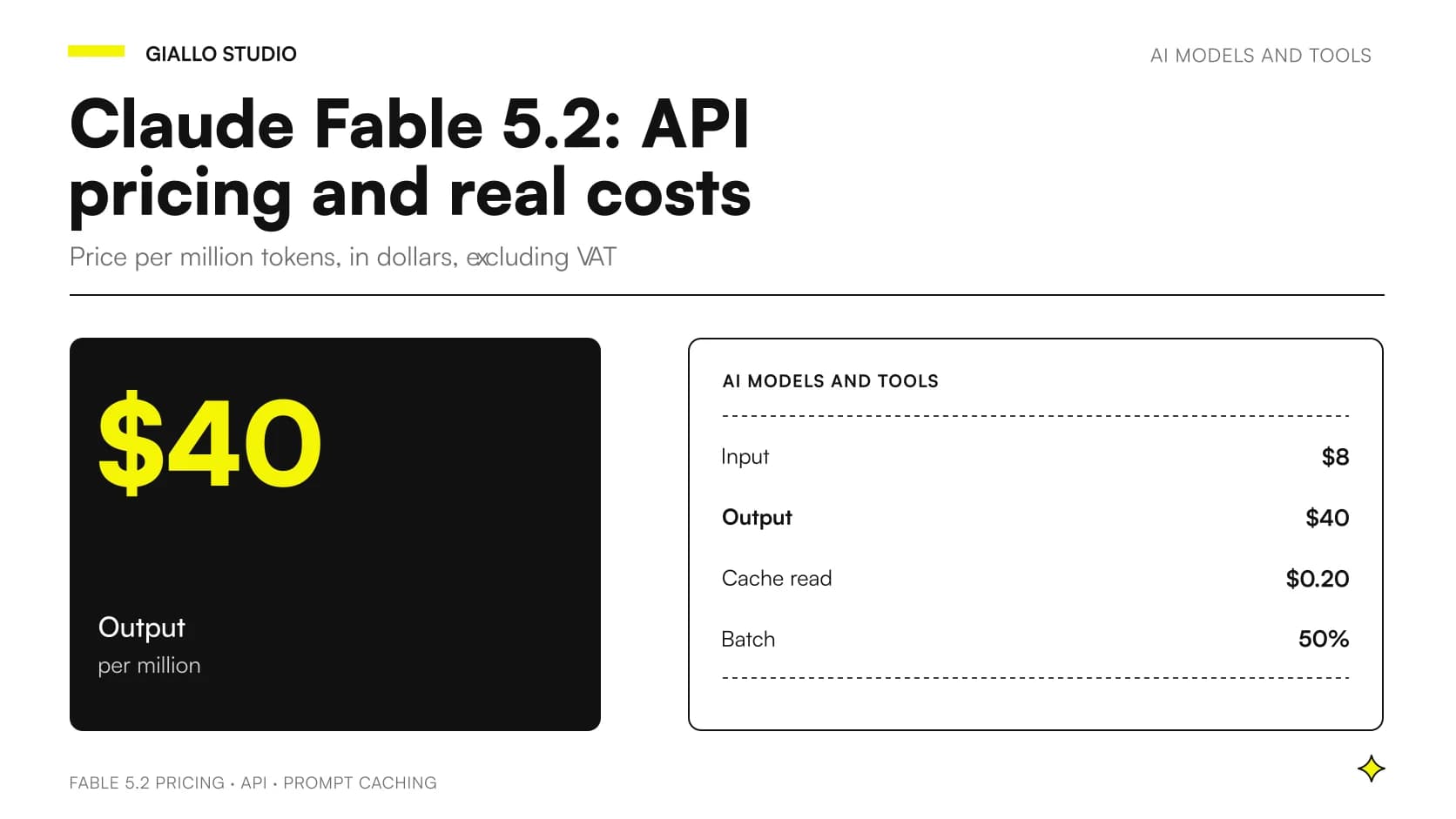
Pricing is in dollars and, for Italy, excludes VAT; the source is the official model pricing page, checked on 9 November 2026. As of 9 November we found no euro prices on the official pages, so we do not give any.
| Price item | Fable 5.2 (dollars per million tokens) | Fable 5.1 |
|---|---|---|
| Input | 8 | 10 |
| Output | 40 | 50 |
| Cache write (5 minutes) | 10 | — |
| Cache write (1 hour) | 16 | — |
| Cache read | 0,20 | — |
| Batch API (input / output) | 4 / 20 | — |
| Fast mode (input / output) | 16 / 80 | — |
Fast mode speeds up generation by up to 2.5 times, but costs twice as much and is available only on some platforms. The Batch API halves the price for jobs that do not need an immediate response. Reading from the cache costs 0.025 times the base input price, the same ratio as earlier versions.
An example, flagged as such, calculated on the official pricing: if a job uses 100,000 input tokens and 20,000 output tokens, the cost is 100,000 × 8 / 1,000,000 = $0.80, plus 20,000 × 40 / 1,000,000 = $0.80, for a total of $1.60. With Opus 5.5 the same tokens would cost $0.80. The real bill changes with caching, batch and above all with the tokens the model spends thinking. The full price list, with more worked examples, is in Claude Fable 5.2 API pricing and real costs; for the picture across the whole family, Claude model pricing: API rates and the cost of getting work done.
How good is it? The benchmarks explained without the fluff
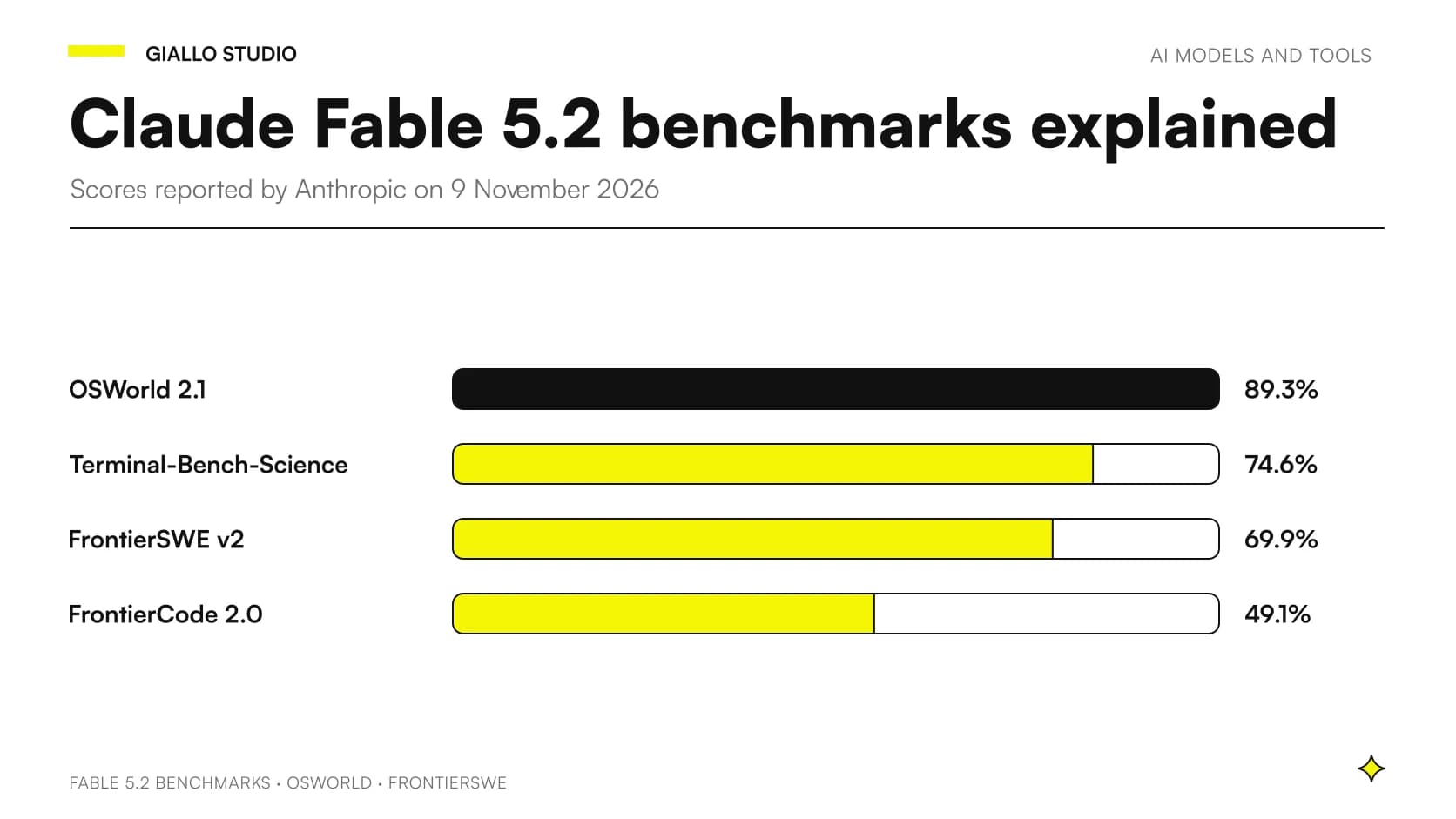
Anthropic publishes a table in which Fable 5.2 is “a step above” Opus 5.5 in almost all the capabilities evaluated. These are the scores reported in the official announcement for each test, each at the highest effort level available unless stated otherwise. Fable 5.2, Fable 5.1 and Opus 5.5 are shown with safeguards enabled.
| Test (what it measures) | Fable 5.2 | Fable 5.1 | Opus 5.5 | GPT-6 Astra | Gemini 4 Carbon |
|---|---|---|---|---|---|
| FrontierCode 2.0 (code changes that maintainers would accept) | 49,1 | 32,4 | 45,5 | 42,8 | 41,1 |
| FrontierSWE v2 (software engineering) | 69,9 | 56,3 | 62,3 | 65,5 | 61,2 |
| AutomationBench (business workflows) | 51,4 | 31,4 | 42,5 | 41,4 | 53,9 |
| Terminal-Bench-Science (agentic scientific research) | 74,6 | 52,6 | 58,7 | 68,1 | 64,8 |
| OSWorld 2.1 (computer use) | 89,3 | 83,5 | 87,2 | 79,5 | 81,5 |
| Humanity's Last Exam, with tools (expert knowledge) | 74,2 | 65,6 | 67,7 | 57,2 | n/a |
| Chartography, without tools (chart reading) | 73,4 | 44,8 | 64,4 | 71,0 | 72,5 |
The scores are percentages. Three honest readings:
- The numbers are Anthropic's. Nobody has independently repeated them, and as of 9 November 2026 we found no third-party reviews in the pages we checked. The FrontierCode score for Fable 5.2 is at Xhigh effort, as Anthropic specifies.
- It does not win everything. On AutomationBench Gemini 4 Carbon is ahead (53.9 against 51.4), and Gemini 4 Carbon, reserved for a small group of cyber defenders on 28 October 2026, has been available through the paid API since 10 November 2026, as we explain in our complete guide to Gemini 4 Carbon.
- The most useful figure is cost. Again according to Anthropic, on FrontierCode Fable 5.2 at High effort scores 45.3 against 45.5 for Opus 5.5 at Max effort, for about half the cost per task. This means Fable, at a reasonable effort, can cost less than its younger sibling pushed to the maximum.
Each test explained in plain words, with results on robotics, knowledge work and research, is in Claude Fable 5.2 benchmarks explained. For a detailed comparison with the competition, Fable 5.2 vs GPT-6 Astra and Fable 5.2 vs Gemini 4 Carbon.
Fable 5.2 or Opus 5.5: which should you use?
This is the question that matters to whoever pays. On the API what's new page, Anthropic says to start from the latest Opus model and move to Fable 5.2 when tests on Opus at a higher effort still do not meet the requirements. It is advice from the vendor against its own commercial interest, and it should be taken seriously.
When to choose Fable 5.2
- Long multi-step tasks where a mid-way error costs hours of work.
- Complex code, migrations, analysis of many documents that must be cross-referenced.
- Agents that work for hours and must reason well about hard choices.
- Cases where Opus 5.5 at high effort does not reach the quality you need, measured on your own examples.
When to stay on Opus 5.5 (or go lower)
- Writing, summaries, customer replies, email and document drafts.
- Everyday coding of medium difficulty.
- High volumes, where the cost per token weighs on your margin.
- Simple, repetitive tasks: Sonnet 5.5 or Haiku 5.5 are enough and cost far less.
The full comparison, with a “task → model” matrix, is in Fable 5.2 vs Opus 5.5. If you would rather see how the choice looked with the previous generation, Opus 5 vs Fable 5.1 and Claude Opus 5.5: what it is and to whom it suits retrace the path.
What is Mythos 5.2 and why don't SMEs usually need it?
According to the announcement, Fable and Mythos are the same base model. Fable has strong safeguards on cybersecurity and biology, and that is why it can be offered to everyone. Mythos 5.2 is available to organizations that work in those fields and have been approved through the Cyber Verification Program or the Life Sciences Verification Program. In the official model page you can read that it shares the specifications and price of Fable 5.2.
In practice Fable blocks high-risk cyber requests (for example penetration testing and exploit generation) and much biological research, and routes them to Opus 4.8 for cybersecurity and to Opus 5 for biology. Anyone working in cyber defense or biomedical research can request access; everyone else loses nothing. The full picture is in Claude Mythos 5.2: what it is and who can use it and in the comparison Fable 5.2 vs Mythos 5.2.
Where can you use Fable 5.2?
The official page lists these platforms, with the model ID:
- Claude API:
claude-fable-5-2. - Amazon Bedrock:
anthropic.claude-fable-5-2. - Claude Platform on AWS, Claude Models on Google Cloud, Microsoft Foundry:
claude-fable-5-2. - App Claude and Claude Code (listed in the announcement, not on the model page), by choosing the model from the selector.
Where the data is processed for European customers is not stated in the official pages we checked on 9 November 2026: if you need EU data residency, ask Anthropic or your cloud provider first.
For the apps there is a launch offer, described on the Anthropic support page: for one week, until 16 November 2026, Pro plans and standard seats on the Team plan can use Fable for up to 50% of weekly limits, plus one limit “reset”, while Max plans and premium seats get one to three resets. Free plans are excluded. The plan-by-plan detail is in Fable 5.2 on Pro, Max and Team: limits and offer.
If you develop with Claude Code, you will find practical guidance in Fable 5.2 in Claude Code: how to use it well.
What is new for agents and developers?
The technical changes, according to the documentation, are few but weighty for anyone building products.
- Adaptive thinking, always on. The model decides for itself how much to think and it cannot be turned off. You tune it with the
effortparameter, which has five levels: low, medium, high, xhigh and max. The default is high in the API and medium in the apps and in Claude Code. We go deeper in Fable 5.2: reasoning levels and effort. - Advisor and Orchestrator. Anthropic describes two roles: Fable as an advisor that smaller models (Haiku, Sonnet, Opus) turn to when they face a hard problem, and as an orchestrator that delegates simple tasks to cheaper models. The idea is to use the expensive model only where it is needed; we cover it in Fable 5.2 as Advisor and Orchestrator.
- Compaction on demand (beta). You decide when to replace the older turns with a summary, to keep long working sessions going.
- Computer use. The toolset
computer_toolset_20260801, already accepted by Fable 5.1, becomes the only route: the oldcomputer_20251124returns a 400 error on all platforms except Amazon Bedrock. For office uses, Fable 5.2 and computer use. - Preserved thinking for all accounts, a defense against illicit extraction of the model's reasoning.
What are its limits, and what do the docs say about safety and privacy?
The official documentation is unusually frank about behaviors you should know about. From the what's-new page:
- at medium effort or higher the model thinks even if you ask it not to, so for simple requests it is better to lower the effort;
- on long, multi-step tasks it may stop before it has finished, more often at low and medium effort;
- it follows style rules to the letter: a hard limit on sentence length can make the text choppy;
- and subagents can add a lot to the cost of a session.
The remedy for each is in Fable 5.2 known limitations and how to work around them, and for writing instructions that take them into account, Prompts for Claude Fable 5.2.
On the safety of the model, Anthropic says it rates the risk of misaligned behavior in high-impact situations as low, and cites external testing by the UK AI Security Institute, Frontier Design and METR. In the same pages it admits that the models report suspecting they are being evaluated more often than earlier ones, which makes real-world behavior harder to predict. These are the vendor's statements: for a business the usual rule applies, which is human checks on any step that has consequences. The privacy chapter, with the questions to take to your data protection lead, is in Fable 5.2 and privacy: data retained for 30 days.
How would an architecture firm in Bergamo use it?
An example, flagged as such: an architecture firm in Bergamo has to respond to a tender with many attachments. There are the specifications, the technical standards, the surveys and the reports from previous years, hundreds of pages in total.
To summarize the individual documents and prepare draft data sheets, Sonnet 5.5 or Opus 5.5 is enough: they cost less and the work is linear. The hard step is a different one: checking that the requirements in the specifications are consistent with the standards and the surveys, finding the contradictions and producing a report of open issues. Here the firm can measure Opus 5.5 at high effort against Fable 5.2 on five tenders already closed, for which it knows the correct answers. If Fable finds the inconsistencies that Opus misses, the higher cost per token pays for itself; if the results are equal, it makes sense to stay on Opus. Either way, the final report is signed by a professional, not by the model.
What mistakes should you avoid with Fable 5.2?
- Putting it everywhere. With a price list twice that of Opus 5.5, using it to summarize emails is money thrown away.
- Trusting benchmarks instead of your own tests. An open-source coding test says little about your management system or your contracts.
- Leaving effort at maximum out of habit. Anthropic itself indicates high as the starting point and reserves max for cases where time and tokens do not matter.
- Ignoring the 30-day retention. Anyone who chose Claude precisely for zero data retention should use the earlier models for those workflows, or ask about eligibility.
- Assuming it will finish the job. On long tasks, ask for an explicit completion criterion and check the result.
How to try it in your business in four steps
- Choose the hard task, not the most common one: a long analysis, a complex piece of code, a check across documents.
- Collect 15-20 real cases, anonymized, for which you know the right answer.
- Measure Opus 5.5 at high effort and Fable 5.2 at high effort, noting quality, time and cost per case.
- Decide by the numbers: Fable only where the jump in quality justifies the price, and a human reviewer on the steps that matter.
For owners who want the decision-oriented version, with the tasks that justify the spend, see Claude Fable 5.2 for SMEs: when it pays off.
Is Fable 5.2 worth the price? The practical answer
Fable 5.2 is a good model to keep as a “specialist”: few calls, on the jobs that no other Claude tier handles well. For everything else, the combination Anthropic recommends makes sense for a small business's finances too: Opus 5.5 as the base model, Sonnet and Haiku for volume, Fable for the hard cases and, in agent systems, as an advisor called only when needed.
If you want to understand where in your business a model of this level really changes a result, and where a standard plan is enough, our AI consulting starts with a test on real cases, before any subscription or integration choice. To choose the right model for each function, see also Claude models compared. Before deciding, always check the official Anthropic pages: versions, prices and offers change from month to month.
Giallo Studio guides: methodology and sources
Want to apply this to your business?In 30 minutes, free of charge: the first process to automate and its estimated return, in writing.
Book the free auditHow we apply it in the company
Related resources
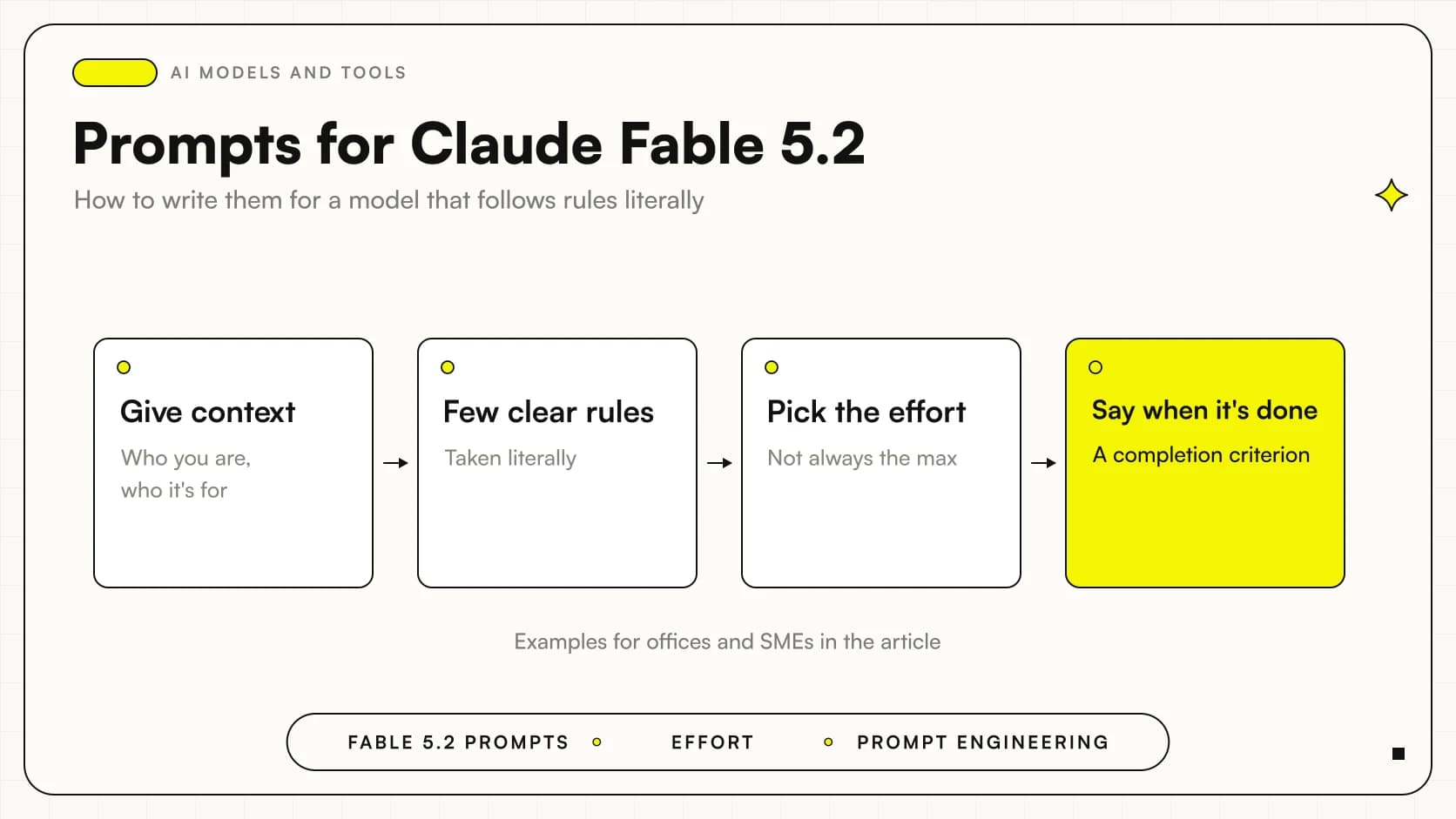 Claude Fable 5.2 prompts: how to write them, with 5 ready-made examples
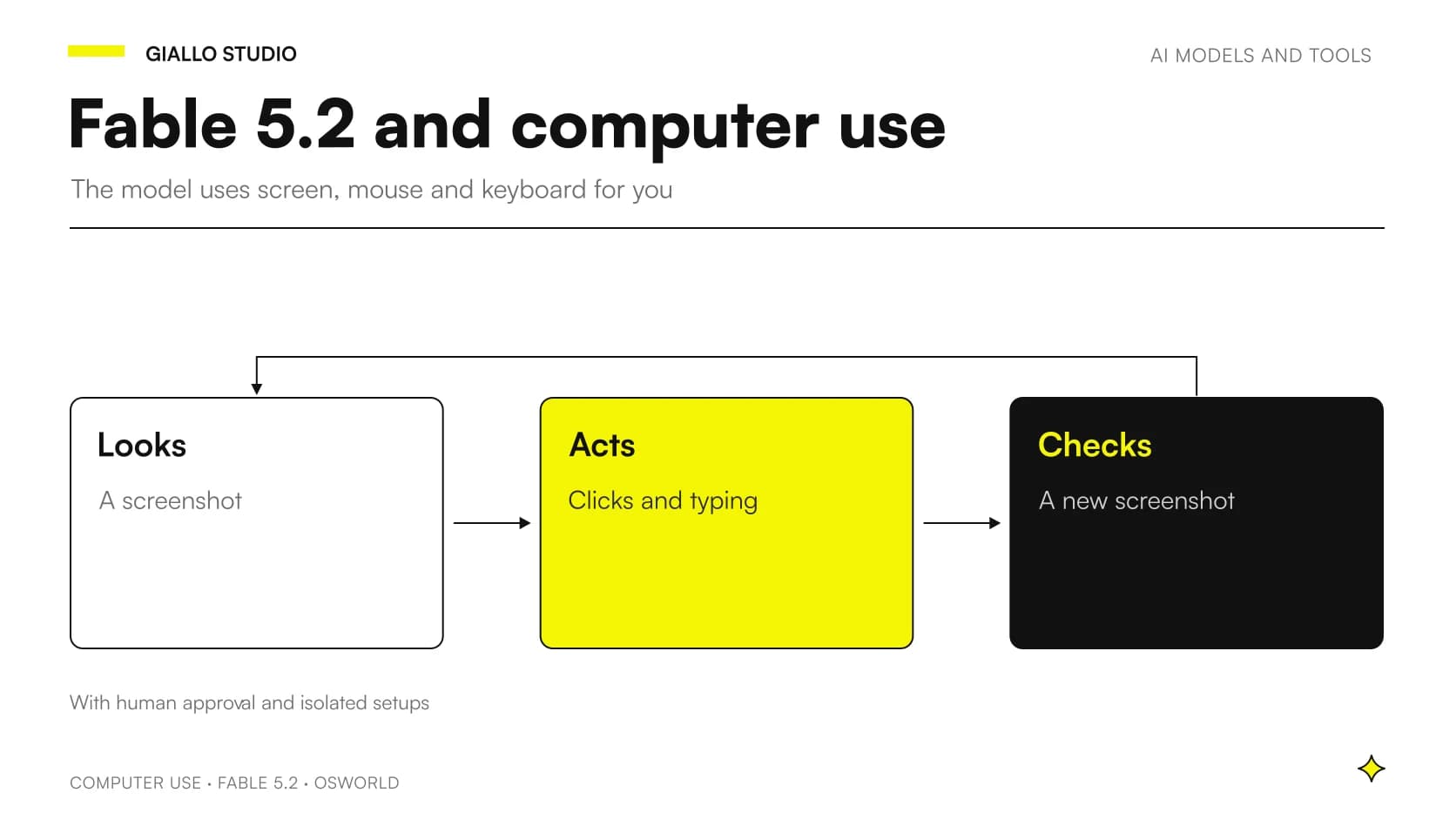 Claude computer use with Fable 5.2: letting the model operate a PC on its own
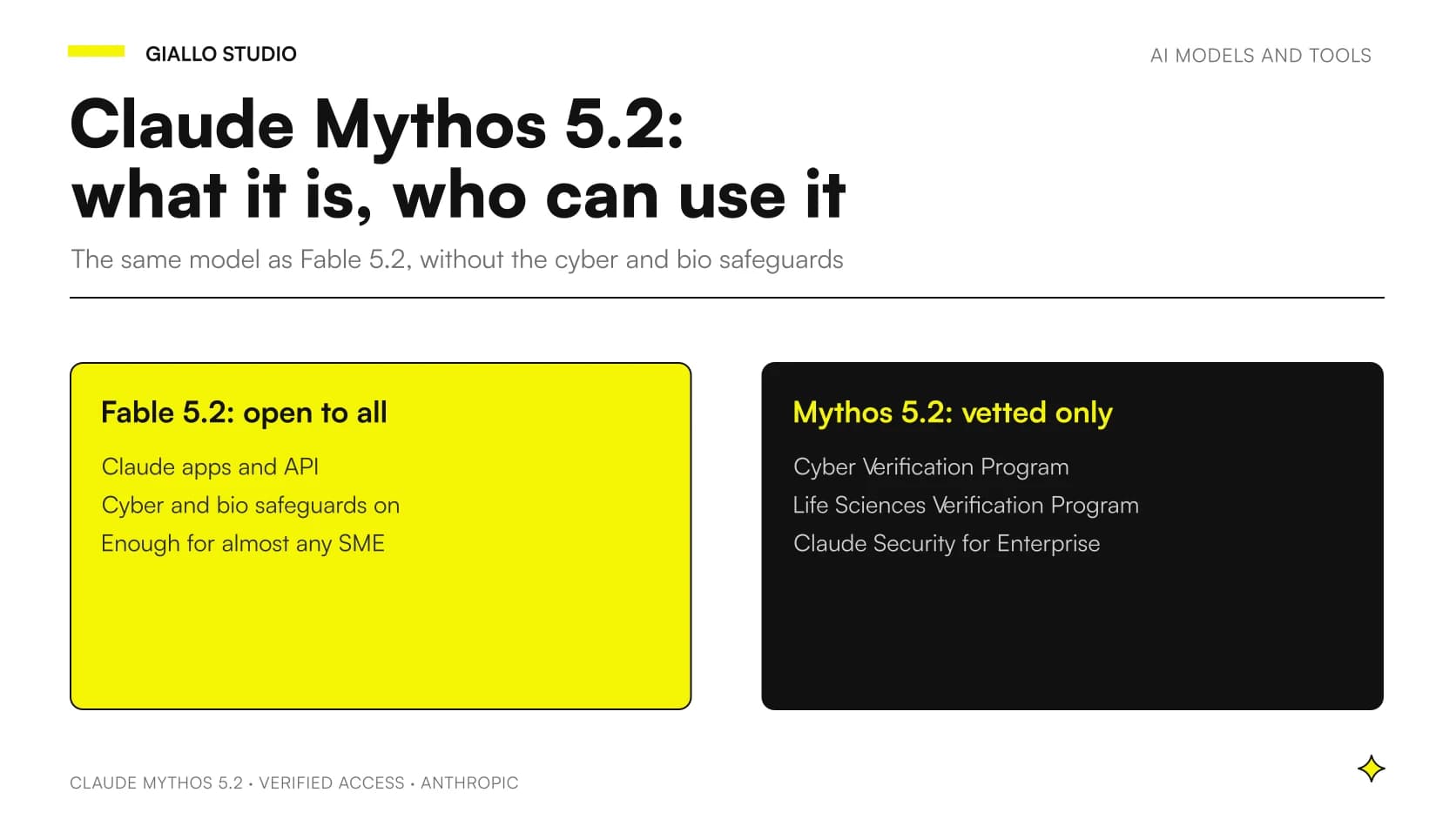 Claude Mythos 5.2: what it is and who can use it
 Fable 5.1 vs 5.2: what really changes and whether to upgrade
 Fable 5.2 vs Opus 5.5: which to use and when
 Claude Fable 5.2 Pricing: API Rates and Real Costs
 Claude Fable 5.2 benchmarks: what they measure and how to verify them
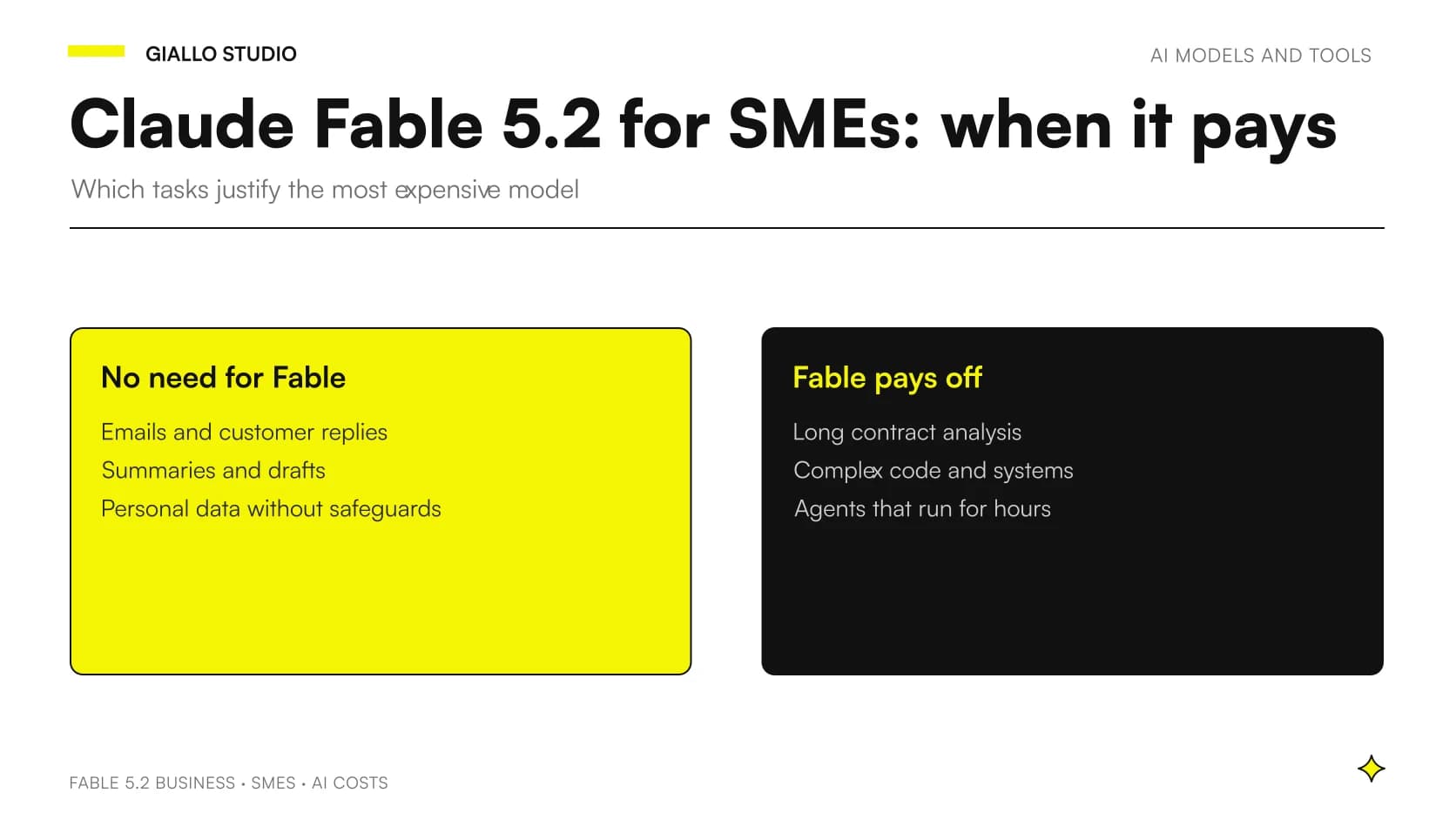 Claude Fable 5.2 for Business: When It Pays Off for SMEs
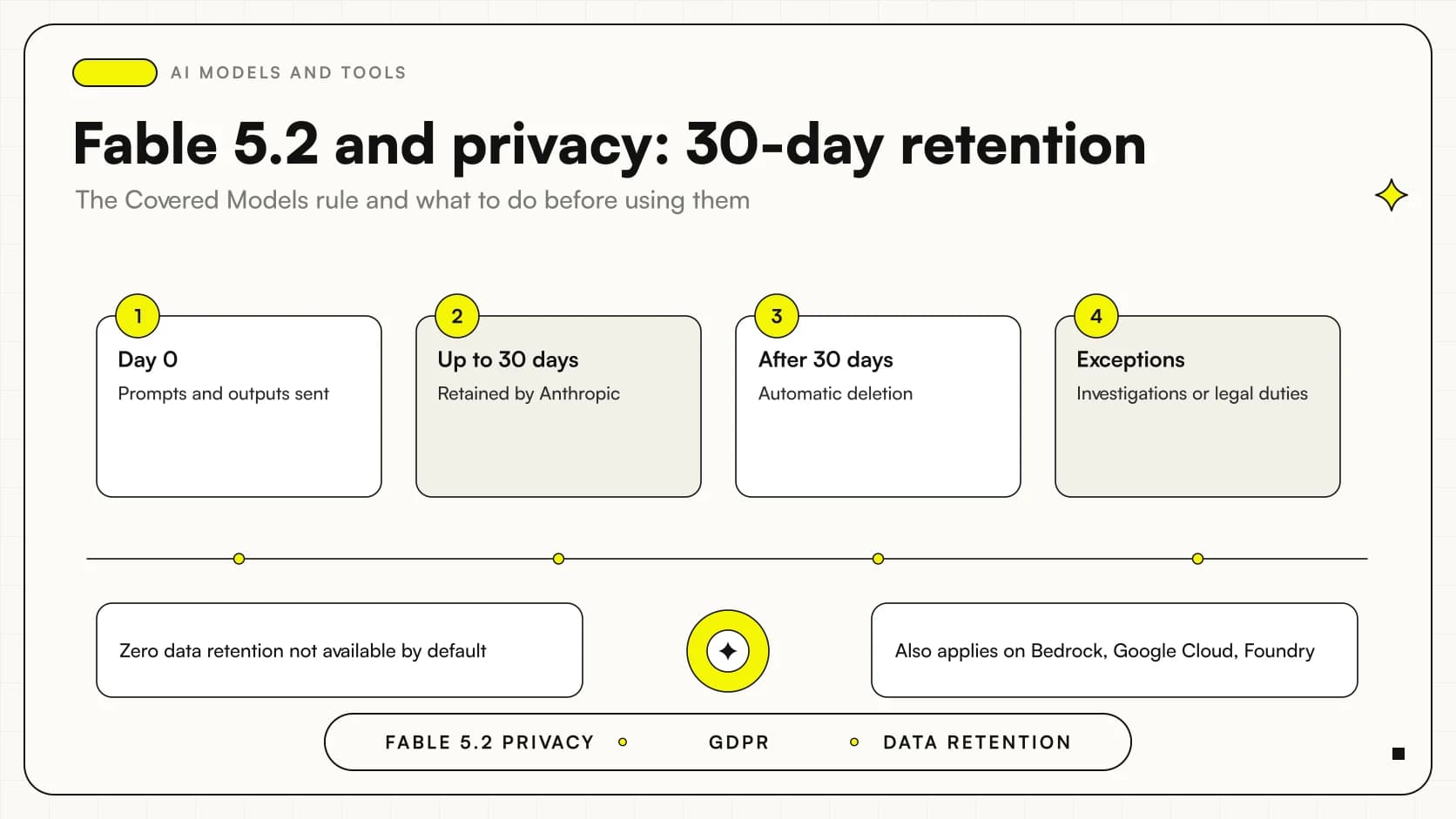 Fable 5.2 Privacy: 30-Day Data Retention and What an SME Should Do
 Claude Opus 5.5: what it is, what it changes and who it suits
FAQ
What is Claude Fable 5.2 and when was it released?
Claude Fable 5.2 is the top-tier AI model Anthropic released on 9 November 2026. It is built for the hardest, longest jobs: complex reasoning, agents that work for hours and multi-step research. It sits above Claude Opus 5.5 and is open to everyone, unlike Mythos 5.2, which is reserved for verified organizations.
How much does Claude Fable 5.2 cost?
It costs $8 per million input tokens and $40 per million output tokens, according to Anthropic's official page checked on 9 November 2026. Fable 5.1 cost $10 and $50. The Batch API halves the price and fast mode doubles it ($16 and $80). Prices are in dollars and exclude VAT for Italy.
Is Fable 5.2 better than Opus 5.5?
In Anthropic's own benchmarks, yes, in almost every test, but it costs twice as much per token: Opus 5.5 is $4 and $20. Anthropic itself recommends starting with Opus 5.5 for most code and knowledge work and moving up to Fable only for the most ambitious tasks. The practical rule is to try Opus at a higher effort first.
What is the difference between Claude Fable 5.2 and Claude Mythos 5.2?
They are the same model. Fable has strict safeguards on cybersecurity and biology and is available to everyone; Mythos has no such safeguards and is open only to organizations approved through Anthropic's verification programs. For an SME that does no security or biomedical research, Fable is almost always the right choice.
Where can you use Claude Fable 5.2?
In the Claude apps, in the Claude Platform (API) with the ID claude-fable-5-2, in Amazon Bedrock, in Google Cloud, in Microsoft Foundry and in Claude Platform on AWS. Anthropic states that it launched on all platforms on 9 November 2026. Processing regions for the European Union are not indicated in the pages we checked.
Does Fable 5.2 keep my customers' data?
Yes, for at least 30 days. Fable 5.2 is a “Covered Model”: prompts and responses are kept for at least 30 days and zero data retention is not available, unless Anthropic expressly authorizes it. For personal or confidential data you need a privacy notice, a data processing agreement and a review with your privacy consultant.
Should a business switch to Fable 5.2 right away?
Only if you have a task that Opus 5.5 cannot handle, even at high effort. For most office work it costs more than necessary. The safe way is to prepare 15-20 real cases, measure quality and cost on Opus 5.5 and on Fable 5.2, and choose by the numbers.