
CRM · Client area · SEO/GEO
KEY srl
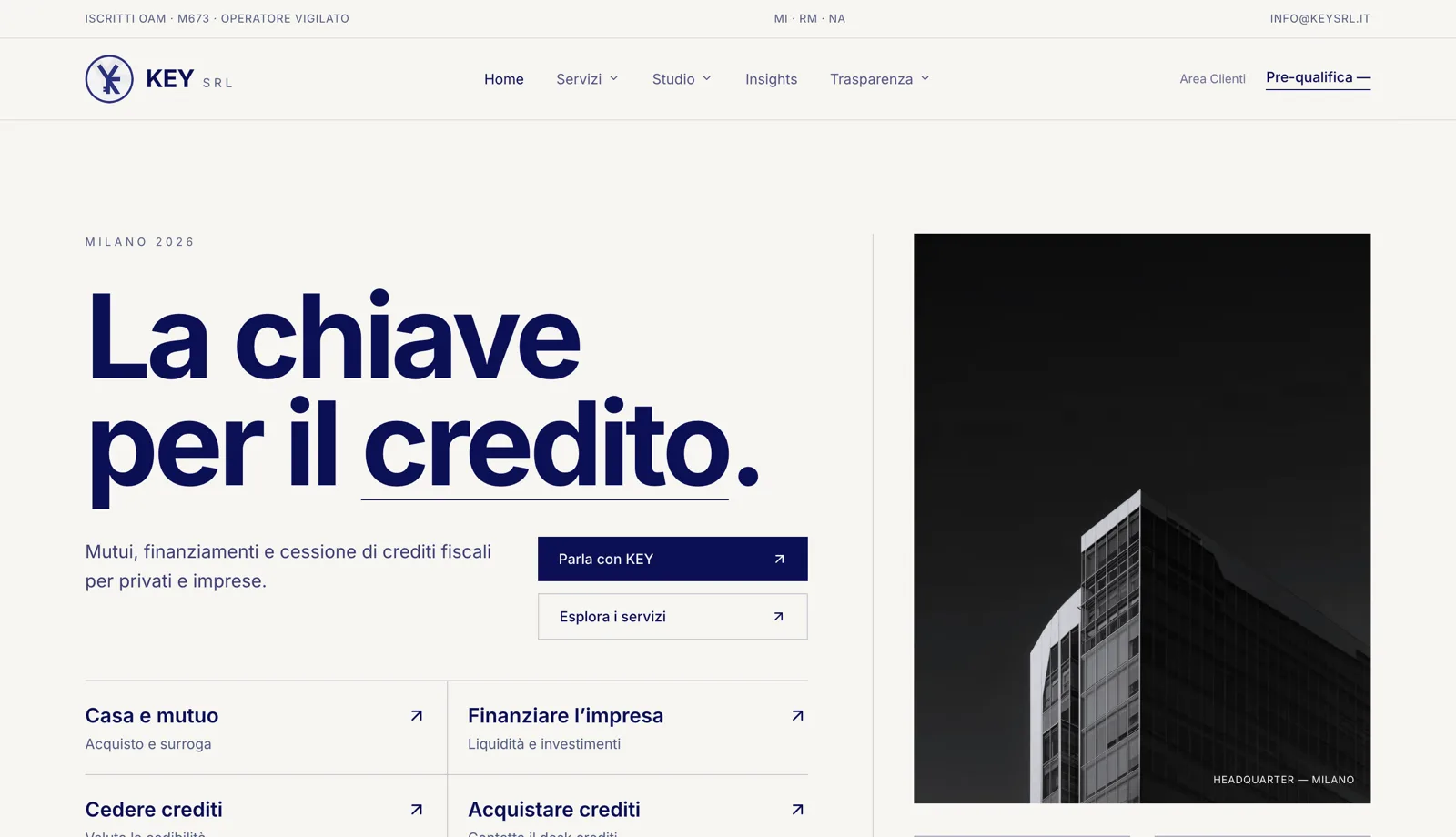
KEY srl is a Milan credit brokerage firm, registered with the OAM, that supports individuals and businesses with mortgages, loans and the transfer of tax credits. We rebuilt its CRM from scratch: an internal back office with distinct roles and boundaries, and a client area where each client follows the progress of their own cases in real time. On the website we carried out a complete SEO and GEO audit and revised the structure.
keysrl.it
The project at a glance
KEY srl is a credit brokerage firm based in Milan, listed in the OAM register of credit brokers under number M673. It supports individuals and businesses with mortgages, loans and corporate finance, and assists those who sell and those who buy tax credits, from the transferability assessment to document coordination. The work is made of long cases, documents to collect and clients who want to know where their request stands.
For KEY we rebuilt the CRM from scratch, with two connected sides: the internal back office, where the team works with distinct roles and permissions, and a client area where each client follows the progress of their own cases. Around the CRM we built the automations needed every day: leads that come in on their own, contracts generated from data, onboarding with electronic signature, document checklists, messages and calendar.
In parallel we reviewed the keysrl.it website with a complete SEO and GEO audit, from page structure to the technical side and content readable by answer engines, and we moved the whole project from a no-code builder to dedicated infrastructure in Europe. The public website footer states our role in the project.
The Context and Challenge
A credit brokerage case passes through many hands. A contact arrives from a campaign or the website, a consultant qualifies it, the back office collects the documents, the mandate is prepared, conditions are compared with partner institutions and the bank makes its decision. For the transfer of tax credits the path is different but just as full of steps: transferability checks, documentation, deed of transfer. Every step produces information needed by the next one.
The previous solution was built on a no-code platform. It worked to get started, but it made it hard to model roles precisely, automate document production and give clients a clear and secure view of their cases. In a regulated sector, where personal data and financial information are handled, control over who sees what and where the data lives is not a detail.
The challenge was therefore twofold: give the team a tool that followed its way of working, with clear boundaries for each role, and give clients transparency on progress without multiplying phone calls and emails. On the public side, the website had to become easier to understand and to find, both in traditional search and in the assistants that answer users' questions.
A CRM rebuilt from scratch, with two sides
We chose not to adapt an off-the-shelf product but to design the CRM around the case, which is KEY's real unit of work. Each case has a client, an assigned consultant, a type, a sequence of phases, its documents and its history. Everything else, from contracts to messages to the calendar, hooks into this shared structure.
The first side is the internal back office, used by the team to follow leads, clients and cases. The second is the client area, reachable from the public website, where the client accesses their own cases, uploads the requested documents, signs what is submitted to them and writes to the team. Both sides read the same data: what the consultant updates in the back office appears immediately in the client's view, with no manual steps and no copies to realign.
This choice removes duplicate work. There is no longer any need to communicate the status of a case separately or to resend a list of missing documents: the information lives in one place and everyone sees it from their own side, in the form they need.
Roles and boundaries: everyone sees their own
In the internal back office each person logs in with a role: administrator, consultant or back office. The role determines what can be seen and what can be done. A consultant sees only the clients and cases assigned to them; the back office has an overall view, because it coordinates documents, appointments and administrative steps across all cases; the administrator manages users, assignments and configuration.
Boundaries are enforced by the system, not left to goodwill or to an interface filter. If a consultant tries to open a case that is not theirs, the CRM does not show it. For a business that handles personal and financial data, this least-access principle protects clients and also the team, which works with less noise and only on the information it is responsible for.
Assignments change with one click, when a client moves to another consultant or when the workload needs rebalancing. The case history stays complete, so whoever takes over finds the context straight away.
The client area: the case as a timeline
The heart of the client area is the case timeline. Each case is divided into phases and steps, and from their dashboard the client sees where the request stands, what has already been done and what the next step will be. When the consultant updates the progress in the back office, the client's timeline updates in real time.
For anyone who has started a mortgage, a loan or a credit transfer, knowing where things stand matters as much as the outcome. The timeline answers the most frequent question before it is even asked, and the team can devote conversations to the matters that really need a person.
From the same area the client can submit new financing requests, consult signed documents and write to the KEY team. Messages stay linked to the client and the case, so anyone who steps in later finds the complete conversation.
Leads flow into the CRM on their own
Requests arrive from several channels: Meta Lead Ads campaign forms and the forms on the landing pages and the website. We connected all these sources to the CRM, so every contact enters the back office automatically, with no exports and no copy and paste, and carries the information about its origin.
Channel tracking shows where each lead comes from and lets the team organise its work accordingly. The list of contacts to call back can be filtered by channel, for example to call first those who filled in a form from a specific campaign. From the same view a lead is assigned to a consultant with one click and enters their scope of work.
The result is a faster and more orderly handover from request to first contact: no lead stays forgotten in an inbox or a spreadsheet, and every consultant finds their contacts already in the CRM.
Contracts and documents generated from data
Many documents in a case repeat information already in the CRM: personal details, amounts, transaction references. We automated their preparation, so the back office generates recurring documents as PDFs, such as mandates and deeds of transfer of tax credits, filling them in with the case data.
The team no longer rewrites the same information in several templates and reduces the risk of transcription errors. The generated document stays linked to the case and can be consulted at any time together with the rest of the documentation.
Onboarding, electronic signature and register
A new client's entry follows a guided path with an approval queue: registrations to the client area are checked by the team before they are activated. During onboarding the client electronically signs the required information documents, such as the information sheet and the privacy notice.
Each signature is recorded in an immutable register that keeps what was signed, by whom and when. For a supervised firm this means being able to reconstruct a client's document trail at any time, without relying on scattered folders or receipts in the mailbox.
The document checklist
Assessing a request requires specific documents: the tax records drawer, the company registry extract, the financial statements and the other attachments required by the type of case. In the client area each case has its own checklist, and each document has a clear status: to upload, under review, approved or to redo.
The client knows exactly what is missing and uploads files directly from their dashboard. The team reviews them from the back office and updates the status; if a document needs replacing, the client immediately sees it as to redo. Document collection, often the slowest part of a case, becomes a shared list instead of a continuous exchange of emails.
Calendar, web app and continuity
The CRM includes a calendar for appointments and deadlines, linked to clients and cases. The whole system is an installable web app (PWA): the team and clients can add it to their phone or computer home screen and use it like an application, without going through the stores.
We moved the project from the no-code platform to dedicated infrastructure in Europe, managed by us. This gives KEY control over where the data resides and how the software evolves, without depending on the limits of a generic tool. Data is saved every night with off-site backups, so the service can be restored even in case of serious problems.
The website: SEO and GEO audit and a new structure
On the keysrl.it website we carried out a complete SEO and GEO audit: page structure and internal links, technical SEO, content and structured data, readability of the information for answer engines and assistants that cite their sources. The audit led to a revision of the site architecture, with separate paths for individuals, businesses and tax credits.
The content explains in plain words what a credit broker does, how KEY works, what the costs and safeguards are, where the firm operates and how to verify its OAM registration. FAQs, transparency documents and service pages are linked to each other, so anyone looking for an answer also finds the next step, from pre-qualification to requesting a call.
Optimisation continues over time: we measure how the website ranks for relevant searches and work on pages and content based on the data. The goal is that anyone looking for a credit broker or a counterpart for the transfer of tax credits finds KEY and immediately understands how it can help.
What changes for KEY and its clients
For the team, daily work starts from a single tool: leads arrive in the CRM already tagged with their channel, they are assigned with one click, recurring documents are generated from data and each role sees only what concerns it. For clients, the case becomes visible: an up-to-date timeline, a clear document checklist, signatures and messages in the same place.
For the company, the project brings control and continuity: data on dedicated infrastructure in Europe, nightly backups, a signature register and software that can grow together with its services. If your business also manages cases, documents and clients who ask for updates, we can build a custom CRM with the same approach: start from the way you work and automate the steps that waste your time today.
New Project
We bring yours online as well.
Whether it's a site, an automation or an AI agent: tell us the goal and see how to get there.