
Claude Fable 5.2 benchmarks: what they measure and how to verify them
Claude Fable 5.2 benchmarks explained in plain English: FrontierCode, OSWorld, AutomationBench and more, with Anthropic's numbers and how to test them.
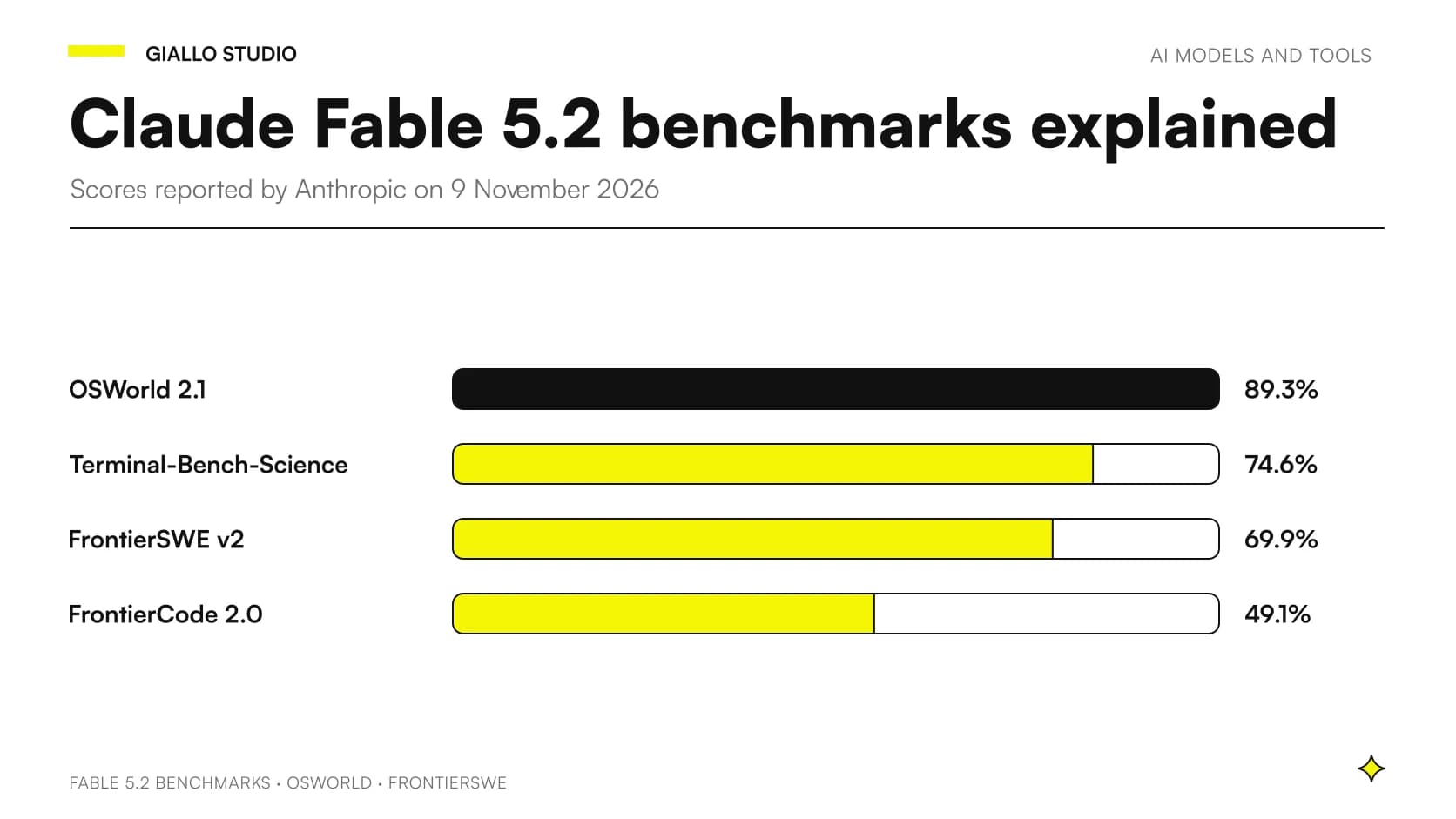
Claude Fable 5.2 is an Anthropic model released on 9 November 2026, and its claimed benchmarks place it above Opus 5.5 on almost every test in the official table. The most quoted figure is FrontierCode 2.0: 49.1% at Xhigh effort, against 32.4% for Fable 5.1 and 45.5% for Opus 5.5, according to Anthropic's announcement page accessed on 9 November 2026.
A percentage on its own does not tell you whether the model is right for you. In this guide we explain in plain English what each test measures, what scores Fable 5.2 achieved, how much it improved on 5.1, and why vendor-selected results should always be checked against your own documents. For the full technical profile, see our guide Claude Fable 5.2: what it is, pricing and what changes.
In summary
- Fable 5.2 scores 49.1% on FrontierCode 2.0 at Xhigh effort, the highest score among the released models Anthropic tested, according to the official page.
- Compared with Fable 5.1 it improves on every test in the table, with gains from 4.6 percentage points (AA-Briefcase, rubric score) up to 37.3 (RoboDojo Sim).
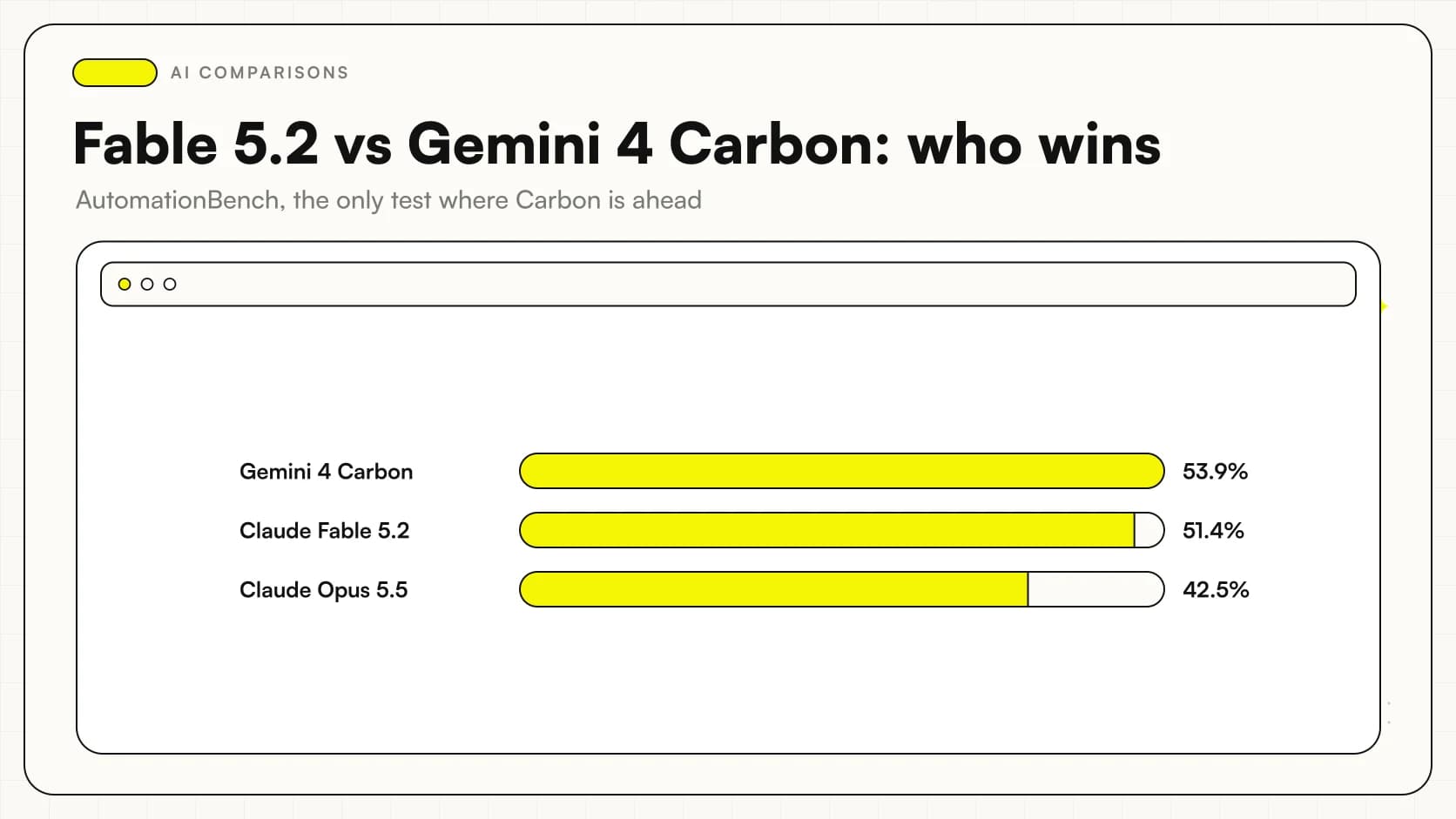
- It does not win everywhere: on AutomationBench Gemini 4 Carbon is ahead (53.9% vs 51.4%), a figure reported in the same table.
- The most useful comparison is score and cost together: at High effort, Fable 5.2 matches Opus 5.5 at its best on FrontierCode for about half the cost per task, as stated by Anthropic.
- All the numbers are chosen and run by Anthropic and have not been replicated by third parties: use them to narrow the choice, not to close it.
- The decisive test is yours: 20-30 real tasks, the same prompt, several models, and a count of errors, time and cost.
Which benchmarks has Anthropic reported for Fable 5.2?
Anthropic publishes a table with five columns: Fable 5.2, Fable 5.1, Opus 5.5, GPT-6 Astra and Gemini 4 Carbon. Here are the rows that can be compared across all the models, taken from the announcement page accessed on 9 November 2026.
| Benchmark (score in %) | Fable 5.2 | Fable 5.1 | Opus 5.5 | GPT-6 Astra | Gemini 4 Carbon |
|---|---|---|---|---|---|
| FrontierCode 2.0 (Fable at Xhigh) | 49,1 | 32,4 | 45,5 | 42,8 | 41,1 |
| FrontierSWE v2 | 69,9 | 56,3 | 62,3 | 65,5 | 61,2 |
| AutomationBench | 51,4 | 31,4 | 42,5 | 41,4 | 53,9 |
| Terminal-Bench-Science 0.1 | 74,6 | 52,6 | 58,7 | 68,1 | 64,8 |
| OSWorld 2.1 (offline set, partial) | 89,3 | 83,5 | 87,2 | 79,5 | 81,5 |
| Chartography (no tools) | 73,4 | 44,8 | 64,4 | 71,0 | 72,5 |
| AA-Briefcase v1.1 (rubric score) | 66,1 | 61,5 | 61,2 | 52,0 | 61,8 |
Other tests, again according to the same page, are compared against only some of the models: Humanity's Last Exam with tools (74.2% vs 65.6% for Fable 5.1, 67.7% for Opus 5.5 and 57.2% for GPT-6 Astra), WANDR (82.1% vs 68.7% and 72.3%) and Remote Labor Index (41.3% vs 17.9%, 21.3% and 20.8%).
Two caveats from the same page. First: the scores for Fable 5.2, Fable 5.1 and Opus 5.5 are with safeguards on, and each model is shown at the highest effort level available unless stated otherwise. Second: RoboDojo Sim was run internally by Anthropic. These are therefore not independent exams.
What does each benchmark measure, in plain English?
The name says little; the task says everything. Here are the tests in order of relevance for a business. Where the official page does not explain the method, we say so: for details Anthropic points to the system card.
| Benchmark | What it measures | What it tells you |
|---|---|---|
| FrontierCode 2.0 | Whether the code changes proposed by the model would be accepted by the maintainers of open-source repositories (Anthropic's definition) | Code quality on real projects, not on exercises |
| FrontierSWE v2 | Category “agentic coding”: programming carried out autonomously by an agent | Ability to carry multi-step development work through to the end |
| AutomationBench | Category “business workflows”: workflows inside a company | The test closest to a process automation |
| Terminal-Bench-Science 0.1 | Category “agentic scientific research”: scientific research carried out by an agent | Reliability on long technical tasks from the command line |
| OSWorld 2.1 | Category “computer use”: using a computer the way a person would | Useful if you want an agent that operates software and screens |
| Humanity's Last Exam | Expert-level academic knowledge and reasoning (Anthropic's definition) | Hard reasoning, with little connection to office work |
| Chartography | How well the model reads charts and figures (Anthropic's definition) | Useful for reports, financial statements and data sheets with charts |
| RoboDojo Sim | Control of a simulated two-armed robot from camera images (Anthropic's definition) | For now it matters for robotics, not for the office |
| AA-Briefcase v1.1 | Category “knowledge work”: office knowledge work | Tasks for an analyst or a skilled clerk |
| Remote Labor Index | Category “knowledge work”: remote work | How much real work a model gets done |
WANDR, cited by Anthropic in its cost curves, is a Perplexity test on large data-collection jobs: it concerns agents that search for and organize information on the web.
How much has Fable 5.2 improved on Fable 5.1?
The score goes up on every row of the official table. Calculating the differences from the data on Anthropic's page, the picture is this:
- Big jumps (data from Anthropic): RoboDojo Sim from 27.6% to 64.9%, Chartography from 44.8% to 73.4%, Remote Labor Index from 17.9% to 41.3%, Terminal-Bench-Science from 52.6% to 74.6%.
- Medium jumps: AutomationBench from 31.4% to 51.4%, FrontierCode 2.0 from 32.4% to 49.1%, FrontierSWE v2 from 56.3% to 69.9%.
- Small jumps: Humanity's Last Exam from 65.6% to 74.2%, OSWorld 2.1 from 83.5% to 89.3%, AA-Briefcase from 61.5% to 66.1%.
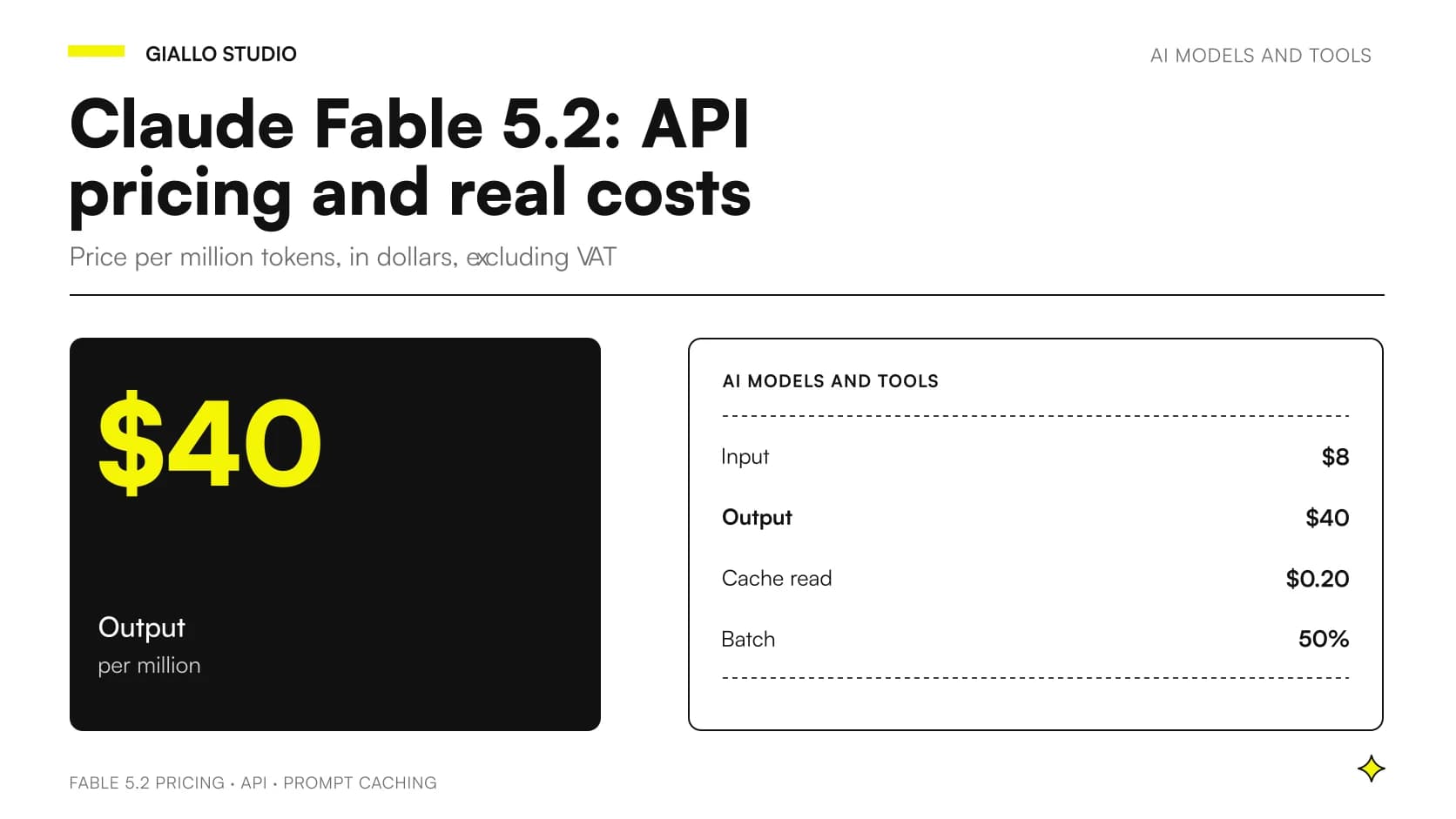
Meanwhile the price has dropped: $8 per million input tokens and $40 per million output tokens, against $10 and $50 for 5.1, according to the documentation overview. Anyone still on 5.1 therefore gets a higher score for less money. The full comparison is in Fable 5.2 vs Fable 5.1.
Where does Fable 5.2 not win?
Three points to keep in mind, all from the official table.
- AutomationBench: Gemini 4 Carbon scores 53.9%, Fable 5.2 51.4%. This is precisely the test on business workflows.
- AA-Briefcase: the rubric-based row puts Fable 5.2 in front (66.1 vs 61.2 for Opus 5.5), but the page also shows an Elo row, which compares models in pairs, with values from 1569 to 1800 and no label per column. If the order matches the columns, Opus 5.5 would have 1800 and Fable 5.2 1785: the gap would be small, but the same test would give different rankings depending on how it is read.
- Chartography: Fable 5.2 is ahead (73.4%), but Gemini 4 Carbon (72.5%) and GPT-6 Astra (71.0%) are close behind.
For the head-to-head with the other two models, see Fable 5.2 vs GPT-6 Astra and Fable 5.2 vs Gemini 4 Carbon. GPT-6 Astra's tests are analyzed in GPT-6 Astra: benchmarks, and Gemini's in Gemini 4 Carbon: benchmarks and comparison.
Do scores or cost per task matter more?
Cost. Anthropic itself presents results as “accuracy vs. cost” curves at the different effort levels, and the cases it cites are the most useful for whoever pays the bill. All declared by Anthropic on its announcement page:
| Benchmark | Fable 5.2 at effort | Declared result |
|---|---|---|
| FrontierCode 2.0 | High | 45.3% vs 45.5% for Opus 5.5 at its best, for about half the cost per task |
| WANDR | Medium | Matches Opus 5.5's best score, for about 40% of the cost per task |
| Humanity's Last Exam | Low | Matches Opus 5.5's best score, for less than one-tenth of the cost |
| Chartography | Medium | 66.4% vs 64.4% for Opus 5.5 at its best, for less than one-tenth of the cost |
| BenchCAD 2.1 | Max | 83.5 vs 65.3 for Opus 5.5 and 44.4 for Fable 5.1 (0-100 scale) |
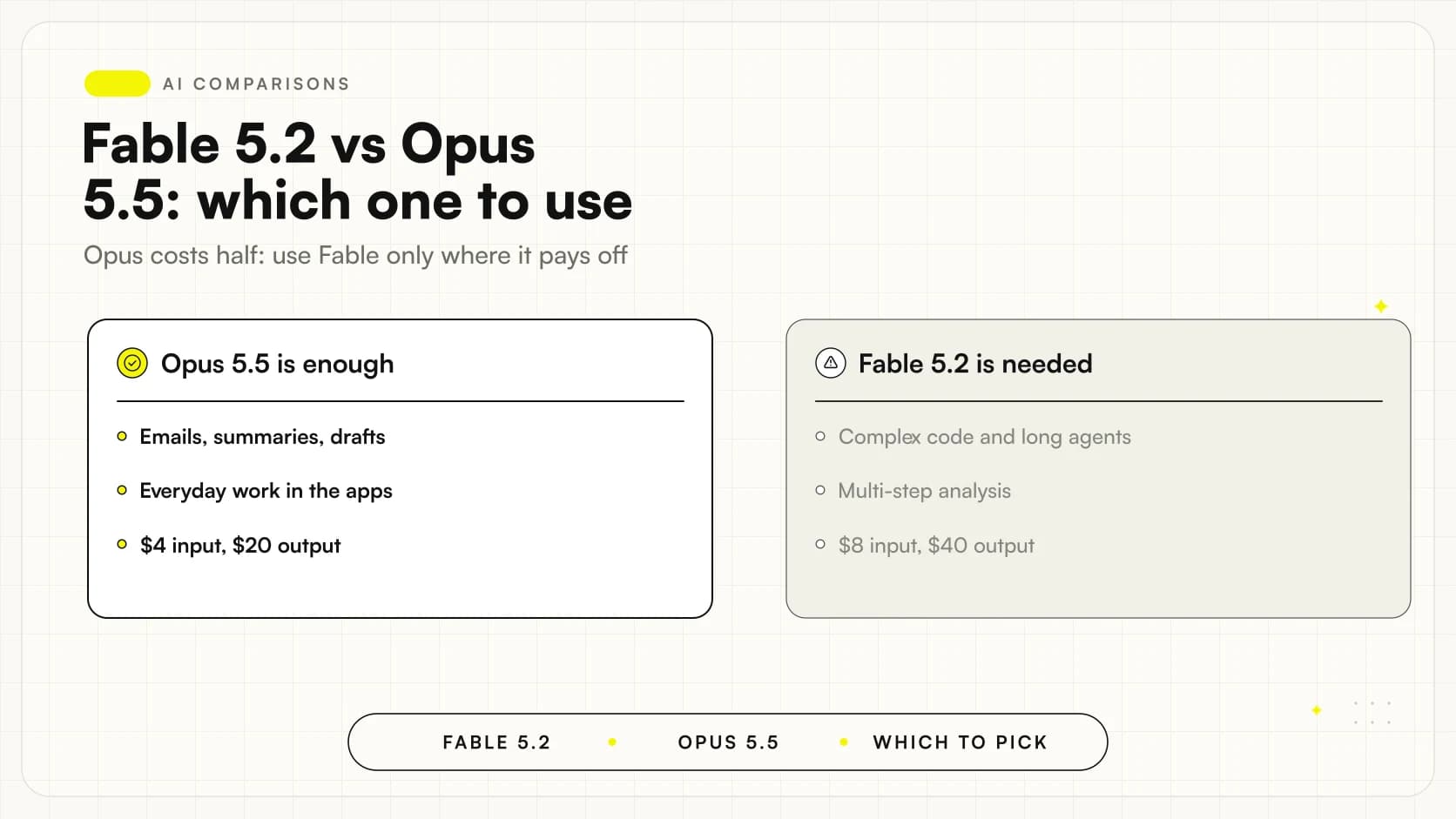
The practical takeaway is that the effort level changes the bill more than the model name does. We explain how to choose the effort in Fable 5.2: reasoning levels; for pricing in detail, see Claude Fable 5.2: API pricing. For a comparison by type of work, see Fable 5.2 vs Opus 5.5.
Why aren't the vendor's benchmarks enough?
Four concrete reasons, none of them an accusation: they apply to any vendor.
- Whoever chooses the tests chooses the story. The table contains what Anthropic considered representative.
- The effort level changes. Each model is shown at its highest available level unless stated otherwise: in daily use you will probably run a lower one. In the Claude apps and in Claude Code the default is Medium, according to the announcement page.
- Standard tasks are not your tasks. An open-source code benchmark does not tell you how the model reads your tender specification or a price list with odd formats.
- The real cost depends on how you work. More agents, more steps, more tokens: the known limitations of Fable 5.2 listed on the what's-new page include precisely the higher cost when many subagents are used.
Anthropic itself urges caution in the choice: for most coding and knowledge work it recommends starting from Opus 5.5 and moving up to Fable only if needed.
How can a business test Fable 5.2 on its own use cases?
An illustrative example: the technical office of a mechanical engineering company in Brescia wants to know whether a model can read customers' requests for quotation, extract materials, quantities and tolerances, and prepare a draft quote. The test goes like this.
- Collect the real tasks. Take 20-30 requests already handled by a person, including the messy ones: scanned PDFs, incomplete emails, drawings with handwritten notes.
- Write the right answer first. For each case, have the person who knows them prepare the correct solution and a clear criterion: right field, wrong field, missing field.
- Use the same prompt for all. One prompt, with no case-by-case tweaks, on Opus 5.5 and Fable 5.2. For Fable, try at least two effort levels, for example Medium and High.
- Count errors, time and cost. For each model and level, note the errors, the manual corrections needed and the cost per task, which you can find in token usage.
- Decide with a simple rule. If the cheaper model makes an acceptable level of errors, use it. Fable makes sense when an error costs more than the extra tokens.
A second example: an accounting firm that wants to use a model to check consistency between financial statements and notes. Here the test looks mainly at unreported errors: how many inconsistencies the model finds and how many it invents. These are two numbers that no official table reports for your documents.
Benchmarks are useful for
- Narrowing the choice to two or three models
- Understanding which family of tasks a model is strong in
- Estimating what it costs to move up an effort level
Benchmarks are not useful for
- Saying that a model will not make mistakes on your documents
- Estimating the real cost of a flow with many steps
- Replacing a test run by people who know the work
What mistakes should you avoid when reading benchmarks?
- Don't compare scores from different effort levels. Always check which level the number was obtained at.
- Don't trust the absolute winner. On AutomationBench Gemini 4 Carbon counts; on Chartography the gap is under one point.
- Don't ignore cost. One extra point of accuracy at double the cost is not always worth it.
- Don't mistake a lab test for an acceptance test. RoboDojo Sim is about simulated robots, not your warehouse.
- Don't skip the test on your own data. It is the only one that says anything about your case.
Where do you start, in practice?
Start with Opus 5.5 on a sample of tasks and move up to Fable 5.2 only where Opus gets it wrong. If the results are close, pick the cheaper one; if Fable solves tasks that Opus does not, work out what that avoided error is worth. For workflows with multiple agents, also see the best AI model for agents and the comparison Claude Opus 5.5: benchmarks and prices. On the organizational side, adoption in a company is covered in Claude Fable 5.2 for business.
If you want to set up this test on your own documents and not just read about it, the AI consulting by Giallo Studio prepares with you the sample of tasks, the evaluation criteria and the cost comparison, so the choice of model rests on your data and not on a vendor's table.
Giallo Studio guides: methodology and sources
Want to apply this to your business?In 30 minutes, free of charge: the first process to automate and its estimated return, in writing.
Book the free auditHow we apply it in the company
Related resources
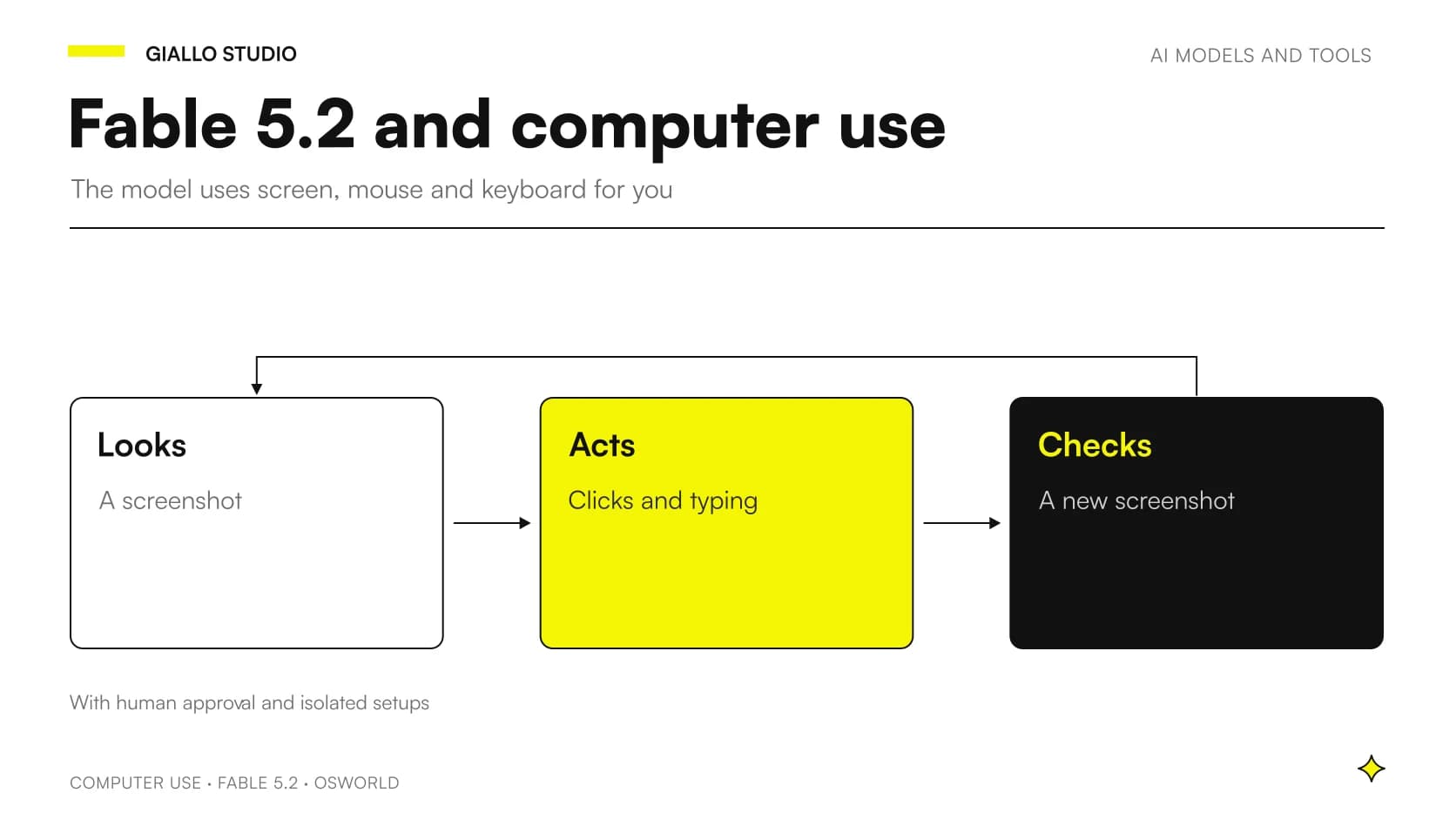 Claude computer use with Fable 5.2: letting the model operate a PC on its own
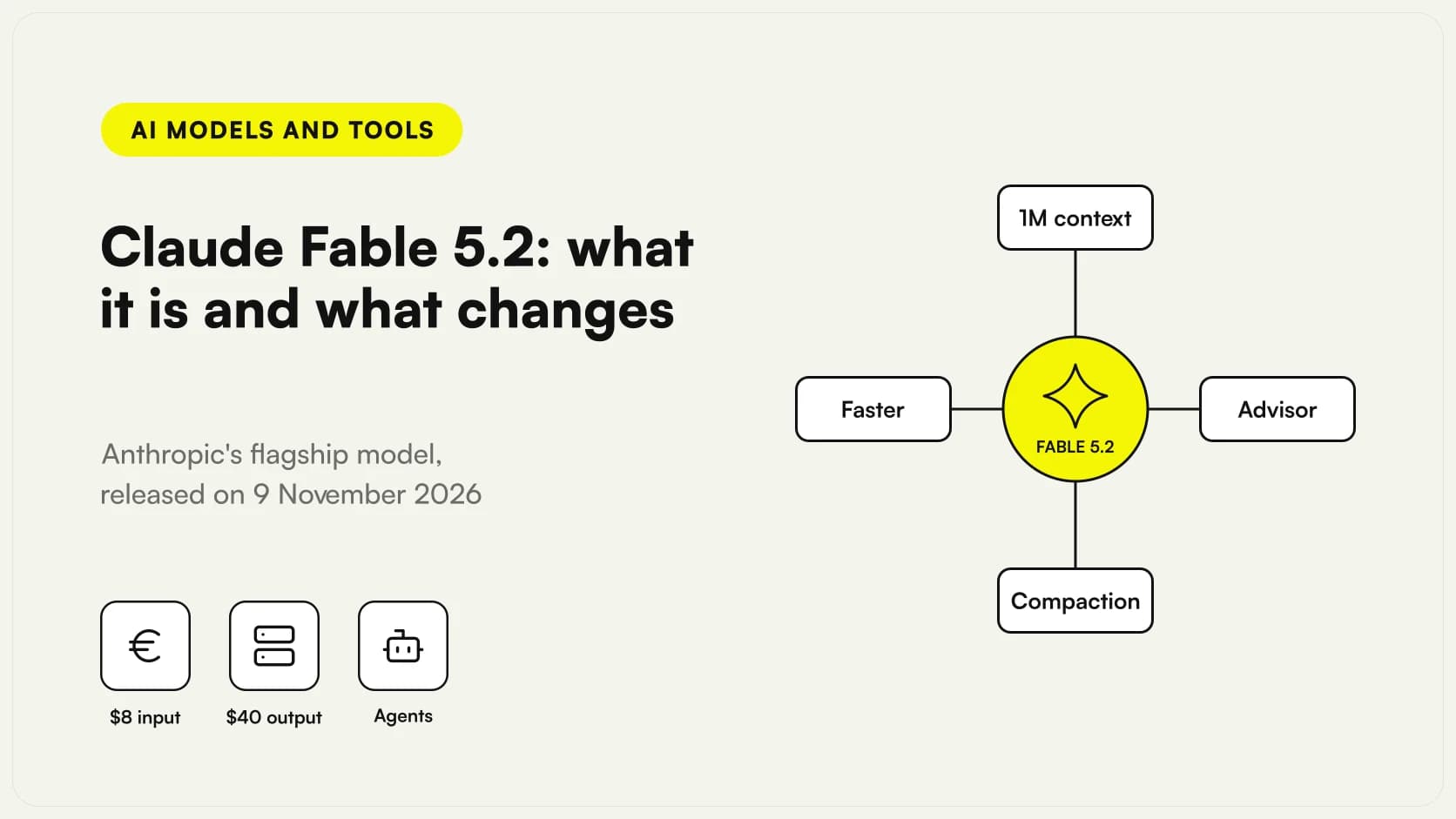 Claude Fable 5.2: What It Is, What Changed and What It Costs
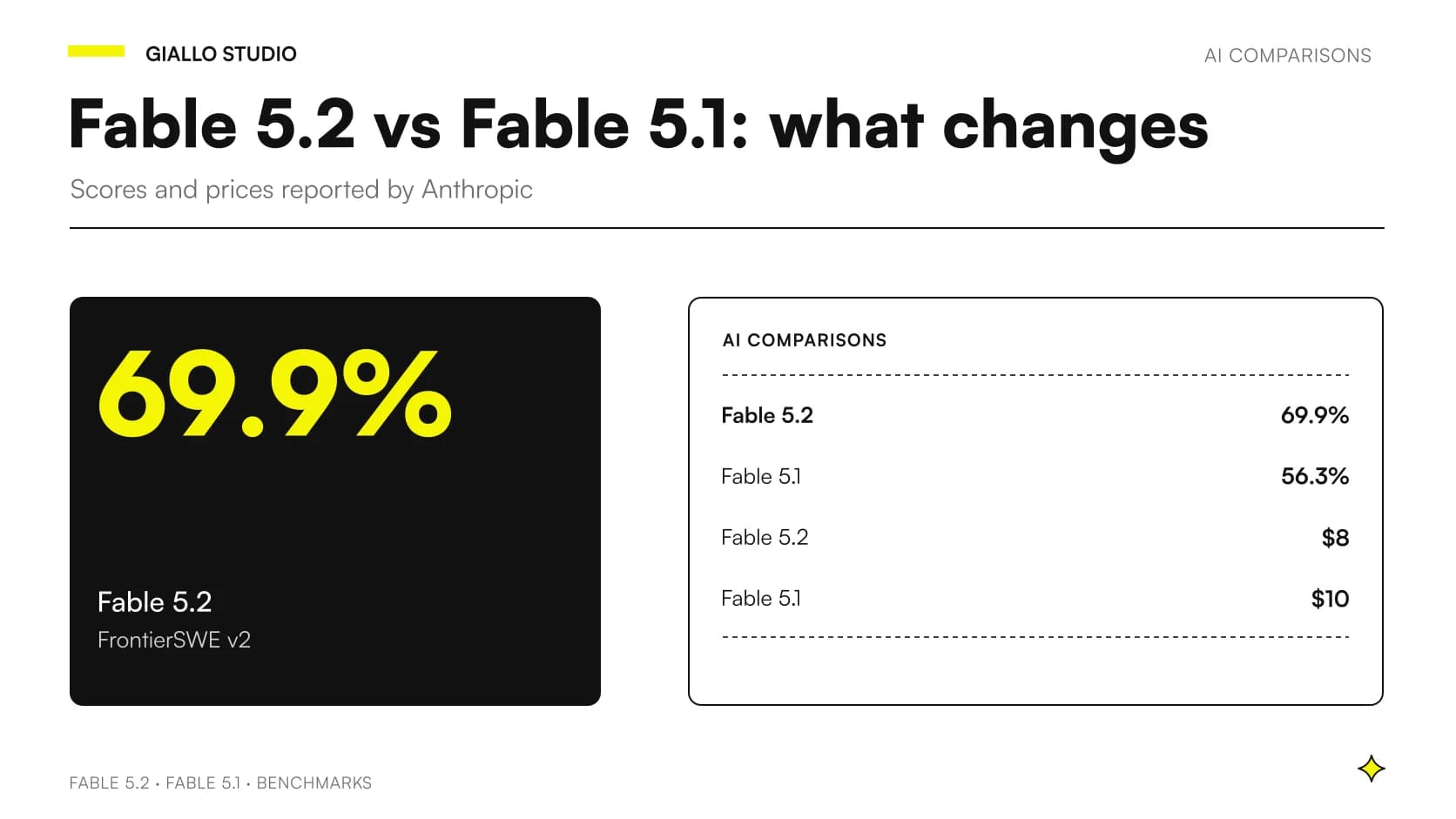 Fable 5.1 vs 5.2: what really changes and whether to upgrade
 Fable 5.2 vs Opus 5.5: which to use and when
 Fable 5.2 vs Astra: Claude and GPT-6 benchmarks and prices compared
 Fable 5.2 vs Gemini 4 Carbon: Which Wins Where?
 Claude Fable 5.2 Pricing: API Rates and Real Costs
 GPT-6 Astra: all official benchmarks
 Claude Opus 5.5: official benchmarks, prices and comparison with Fable 5.1 and GPT-6 Astra
FAQ
What are the Claude Fable 5.2 benchmarks?
In Anthropic's official table of 9 November 2026, Fable 5.2 scores 49.1% on FrontierCode 2.0 (Xhigh), 69.9% on FrontierSWE v2, 51.4% on AutomationBench, 74.6% on Terminal-Bench-Science, 89.3% on OSWorld 2.1, 74.2% on Humanity's Last Exam with tools and 73.4% on Chartography without tools. These figures are claimed by Anthropic and have not been replicated by third parties.
Is Fable 5.2 really better than Fable 5.1?
Yes, on every benchmark in the official table. The smallest gain is on AA-Briefcase (66.1 vs 61.5), the largest on RoboDojo Sim (64.9 vs 27.6). On FrontierCode 2.0 it goes from 32.4% to 49.1%. For a business, what matters most is the row that looks like its own work.
Does Fable 5.2 beat GPT-6 Astra and Gemini 4 Carbon?
In Anthropic's table, yes on six of the seven tests compared against both models, but not on AutomationBench: there Gemini 4 Carbon scores 53.9% against 51.4%. Anthropic chose the tests and ran them with its own settings, so the picture needs to be checked on your own use cases.
What does it mean that Fable 5.2 at High effort matches Opus 5.5 at Max?
On FrontierCode 2.0, Fable 5.2 at High effort scores 45.3%, almost the same as the 45.5% that Opus 5.5 reaches at its best, for about half the cost per task, according to Anthropic. It means the right comparison is not the score alone but score and cost together.
Are benchmarks enough to choose a model for a business?
No. They are standard tasks, chosen and measured by the vendor. Use them to narrow the choice to two or three models, then test those on 20-30 real tasks from your business, with the same prompt, and count errors, time and cost.
How do you run a test on your own use cases?
Collect 20-30 real tasks that a person has already done, define up front what a correct answer means, run them with Opus 5.5 and Fable 5.2 at several effort levels, and compare errors, time and cost per task. One afternoon of work is enough to get an indication far more useful than any leaderboard.