
Claude Mythos vs Fable 5.2: the real differences and who can use them
Claude Mythos vs Fable 5.2: same model, same price, different safeguards on cybersecurity and biology. See what changes and who can get Mythos.
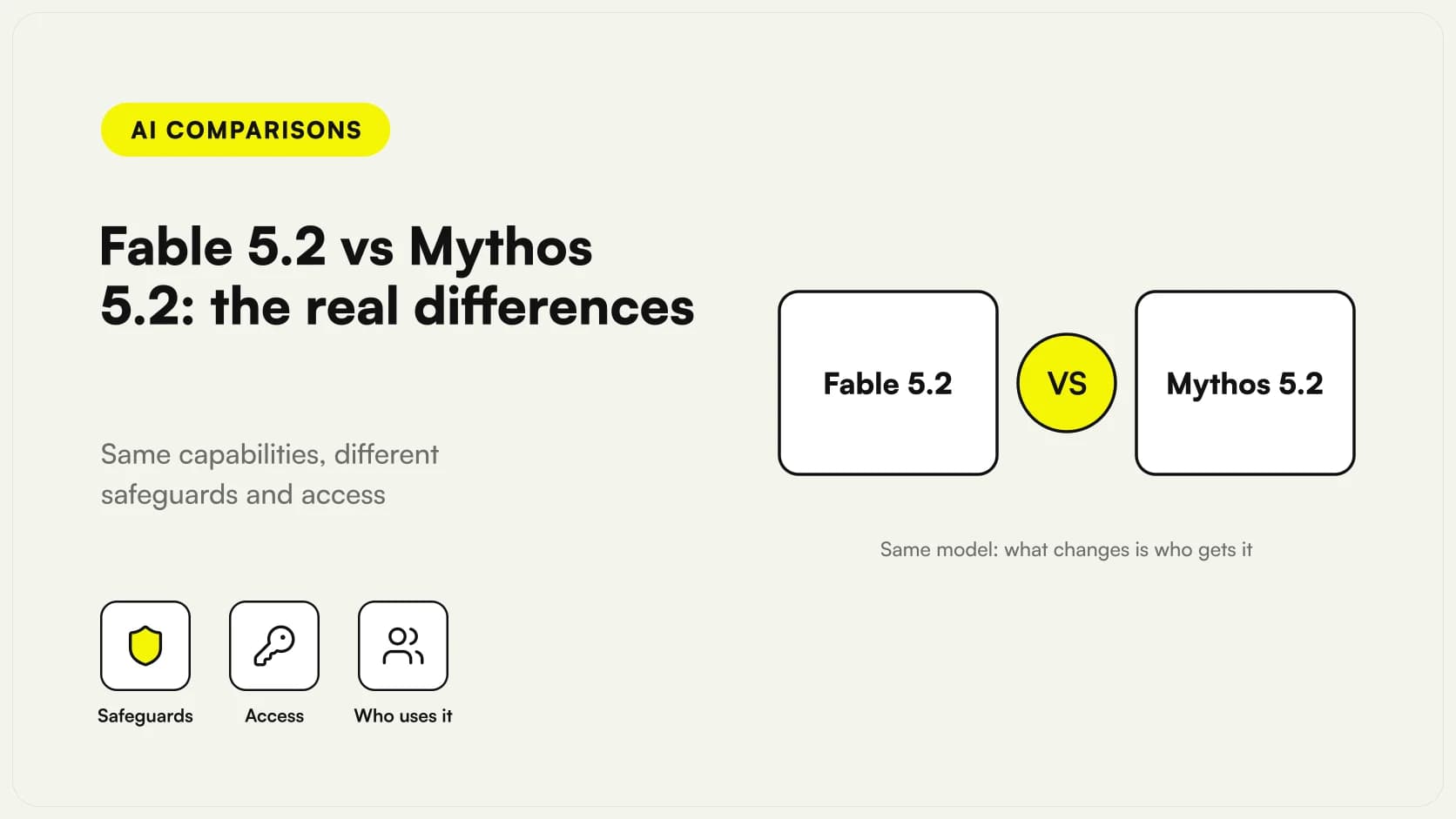
In the Claude Mythos vs Fable comparison, the difference is not the model but what it is allowed to do. Claude Fable 5.2 and Claude Mythos 5.2, announced by Anthropic on 9 November 2026, are the same base model: according to the official announcement, Fable has strong safeguards on cybersecurity and biology, which is why it is available to everyone, while Mythos is offered to verified organizations working in those two fields.
For an Italian SME the choice is almost always already made. If you do not do cybersecurity or biomedical research for a living, you use Fable 5.2, or more often Opus 5.5, and lose nothing. Here you will find what Fable blocks, what Mythos unlocks, what it costs, who can get it and how to decide. The full technical profile of Fable is in the guide to Claude Fable 5.2.
In summary
- Fable 5.2 and Mythos 5.2 are the same base model, according to Anthropic's announcement of 9 November 2026: only the safeguards on cybersecurity and biology differ.
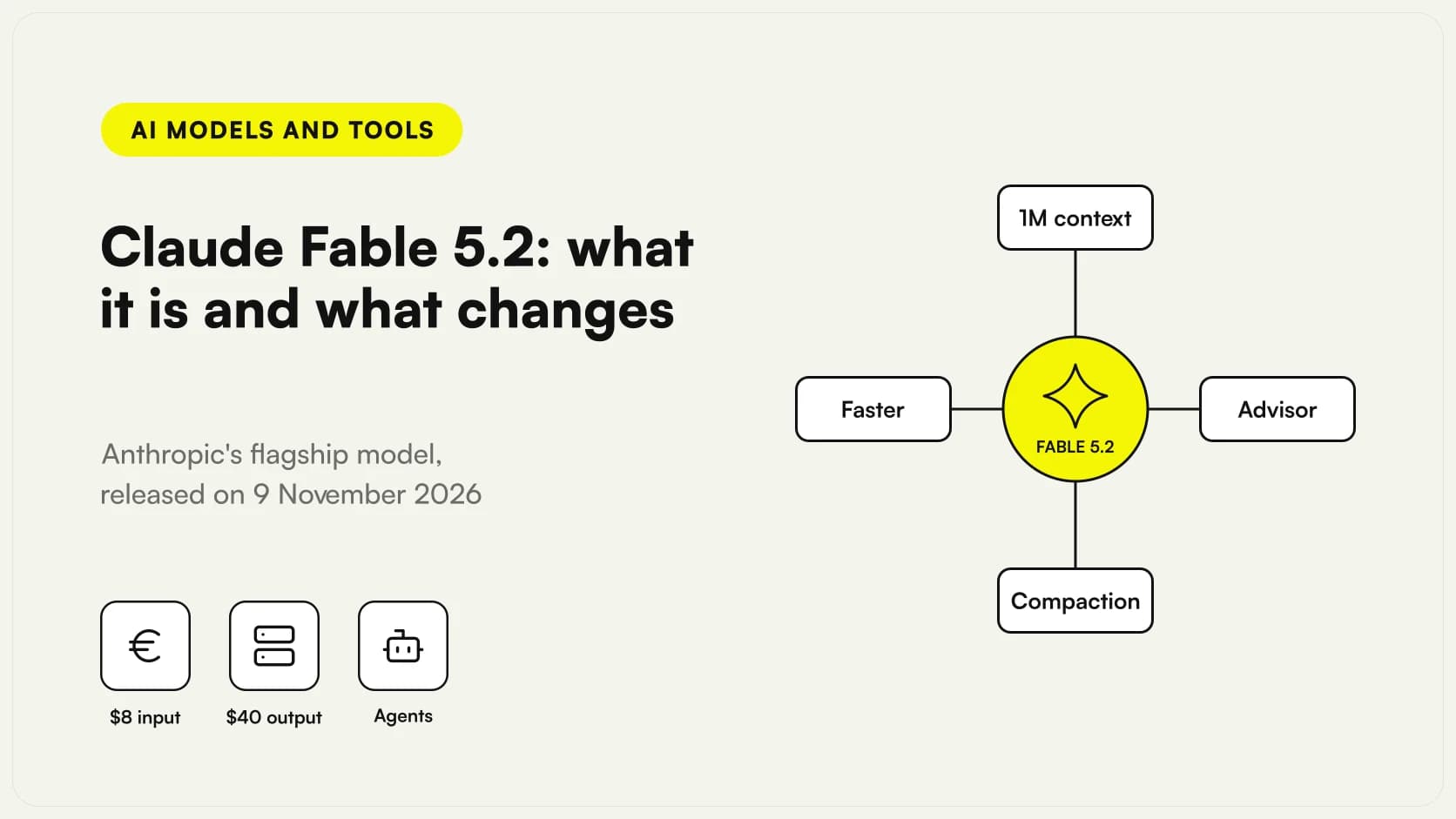
- The price is the same: the official page lists $8 per million input tokens and $40 per million output tokens for both, with a 1 million token context window.
- Fable blocks high-risk cyber activity and much of research biology, and hands them off to Opus 4.8 and Opus 5, with about 55% fewer blocks than Fable 5.1 (figure stated by Anthropic).
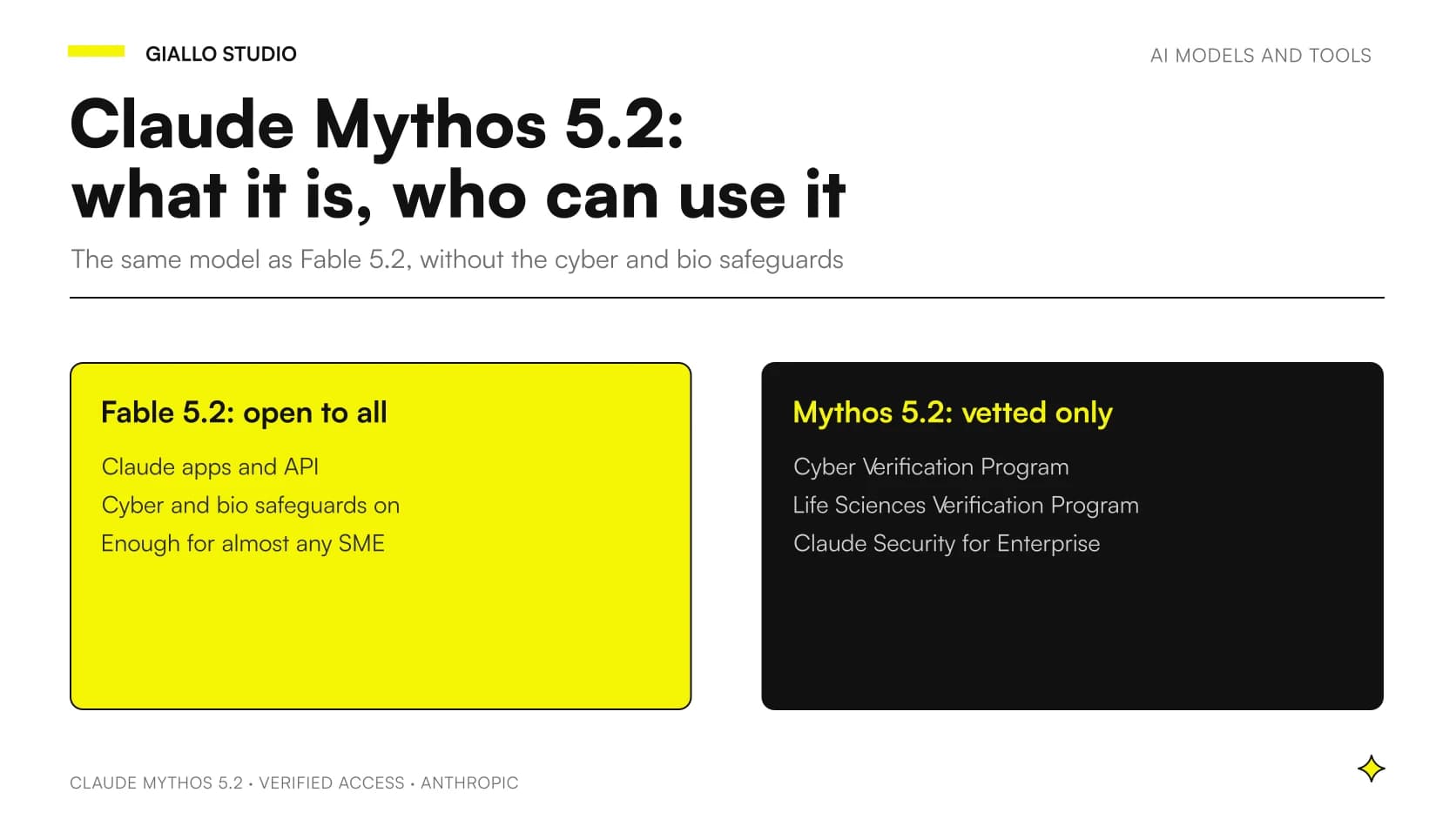
- Mythos 5.2 is accessible only to approved partners through the Cyber Verification Program, the Life Sciences Verification Program or the Anthropic account team.
- Fable is a Covered Model: it retains prompts and responses for at least 30 days, and the same rule applies to Mythos.
- For almost all office work, Mythos offers no practical advantage over Fable.
What is the difference between Claude Mythos and Fable, point by point?
Anthropic did not build two models; it built one and offers it in two configurations. The table shows data from the official pages consulted on 9 November 2026; the benchmarks cited further down are instead stated by the vendor.
| Appearance | Claude Fable 5.2 | Claude Mythos 5.2 |
|---|---|---|
| Base model | The same | The same |
| Who can use it | Anyone, including in the Claude apps | Verified organizations only (access limited to approved partners) |
| Cyber and biology safeguards | Active, with handoff to other models | Not applied |
| Input / output price ($ per million tokens) | 8 / 40 | 8 / 40 (same page) |
| Context / maximum output (tokens) | 1M / 128K | 1M / 128K |
| Fast Mode | Available | Only for those in the verification programs |
| Data retention | At least 30 days | At least 30 days |
| Model ID in the API | claude-fable-5-2 |
claude-mythos-5-2 |
The price information comes from the model card, which says Mythos “shares” its specifications and pricing with Fable. We found no euro prices on the official pages: the dollar prices exclude VAT for Italy. The ID claude-mythos-5-2 is listed on the API what's new page; there is no dedicated Mythos page, and the ID only works once access has been granted.
What does Claude Fable 5.2 block, and where do blocked requests go?
Fable 5.2 ships with safety classifiers that stop high-risk cyber activity, including penetration testing, exploit generation and vulnerability research starting from binaries, and most research biology tasks. This comes from the official announcement, which adds a useful detail: the blocked request does not disappear, it gets a response from another model. Opus 4.8 answers for cybersecurity, Opus 5 for biology.
The mechanism is visible in the API. The what's-new documentation explains that a refused request returns HTTP 200 with stop_reason: "refusal" and that you can enable automatic fallback to the two permitted models. Developers therefore need to handle this case, otherwise a refusal looks like an empty response. The technical steps are in Migrating to Fable 5.2.
How intrusive are these blocks? Anthropic states about 55% fewer blocks than Fable 5.1 (about 60% fewer in cybersecurity and 40% in biology), measured on claude.ai, Claude Code and Cowork in early tests, with safeguards as robust as before (announcement). It is an internal, sample-based figure: in your use case it may go differently.
What does Claude Mythos 5.2 unlock, and is it really worth it?
Mythos 5.2 does not apply the cyber and biology safeguards, so it accepts the work that Fable hands off: vulnerability analysis, bug reproduction and fixing, and the work of cyber defense teams. On the biology side, the announcement cites, among its results, a method for predicting the structure of a viral capsid used in gene therapies, obtained with Mythos 5.2.
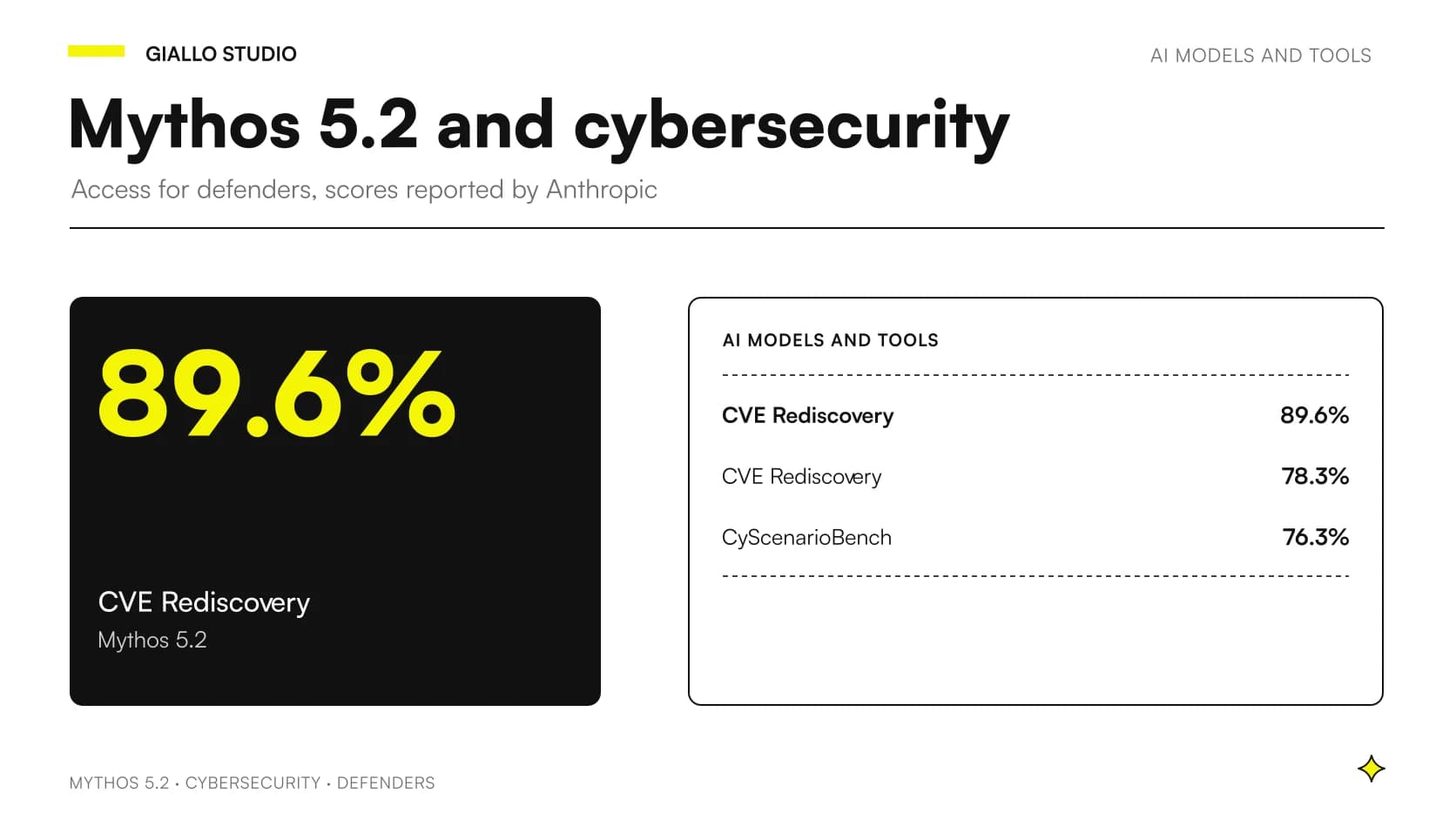
A line on the numbers, all stated by Anthropic and not replicated by third parties, according to the announcement: on CyScenarioBench Mythos 5.2 scores 76.3% against 61.7% for Mythos 5.1, and on CVE Rediscovery 89.6% against 78.3%. A footnote in the same text tempers the enthusiasm: the figures from a tester quoted in the text are raw counts from a single audit, while on internal evaluations vulnerability identification is roughly on par with Opus 5.5. The detail of the tests and of the access programs is in Mythos 5.2 for cybersecurity; for a comparison with a competitor on the same ground, Gemini 4 Carbon and cybersecurity.
A hint that the two really are the same model: in the official table, on Terminal-Bench-Science (agents for scientific research) Fable 5.2 scores 74.6% and Mythos 5.2 75.3% (announcement). A difference of 0.7 points does not support conclusions, and Anthropic draws none: we read it only as a hint that there is no gap in general capabilities.
Who can get Mythos 5.2, and how do you apply?
Mythos cannot be bought with a credit card. There are three routes, all described in the announcement and from model card:
- Cyber Verification Program for cybersecurity professionals and organizations. The support page provides for one application per organization through the Verification Portal, with a decision or a request for more information that Anthropic aims to give within seven business days. Individual researchers can apply, but for now they only get “Defense” access.
- Life Sciences Verification Program for those doing biomedical research. The eligibility criteria do not appear on the pages we consulted on 9 November 2026: they must be read on the program itself.
- Anthropic account team for organizations that have one.
One limit concerns service companies: according to the same page, access to the program covers work on your own organization's code and systems. Using it to work on clients' code requires a separate approval, currently open for managed services but not yet for products that clients interact with directly. Enterprise customers have a shortcut: Claude Security analyzes repositories with the most capable models, Mythos 5.2 included, even for those who are not in the program.
When is Fable enough, and when do you need Mythos?
Fable 5.2 is enough if...
- The work is documents, analysis or general programming and is not offensive security.
- You do not need penetration tests, exploits or binary analysis.
- You do not do experimental biological research.
- You can accept that some requests are handed off to Opus 4.8 or Opus 5.
Mythos 5.2 is needed if...
- Your work is cybersecurity and Fable's blocks stop activities that are part of the job.
- You are a biomedical research organization that can pass the verification.
- You can accept an approval process and the usage constraints that come with it.
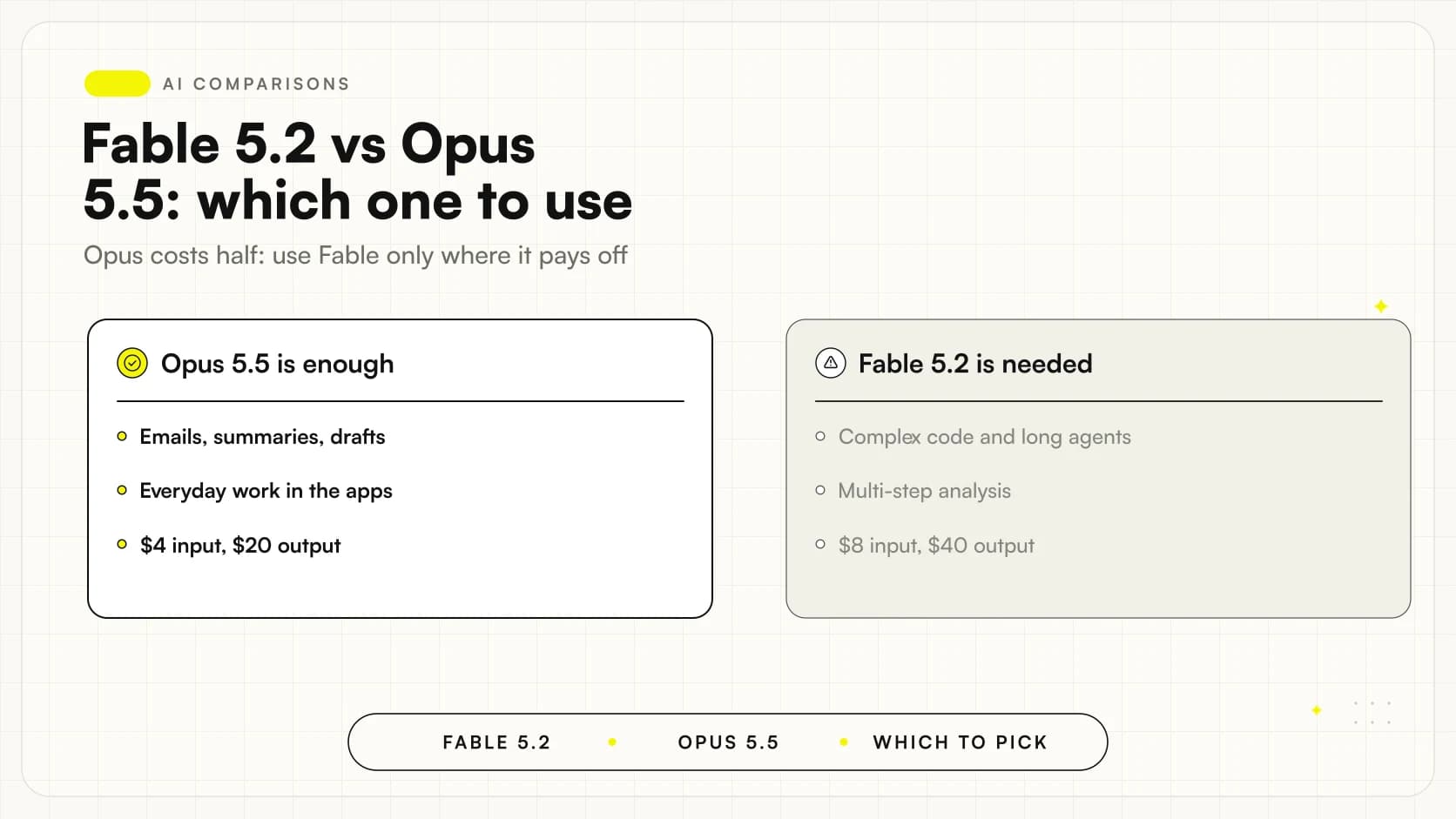
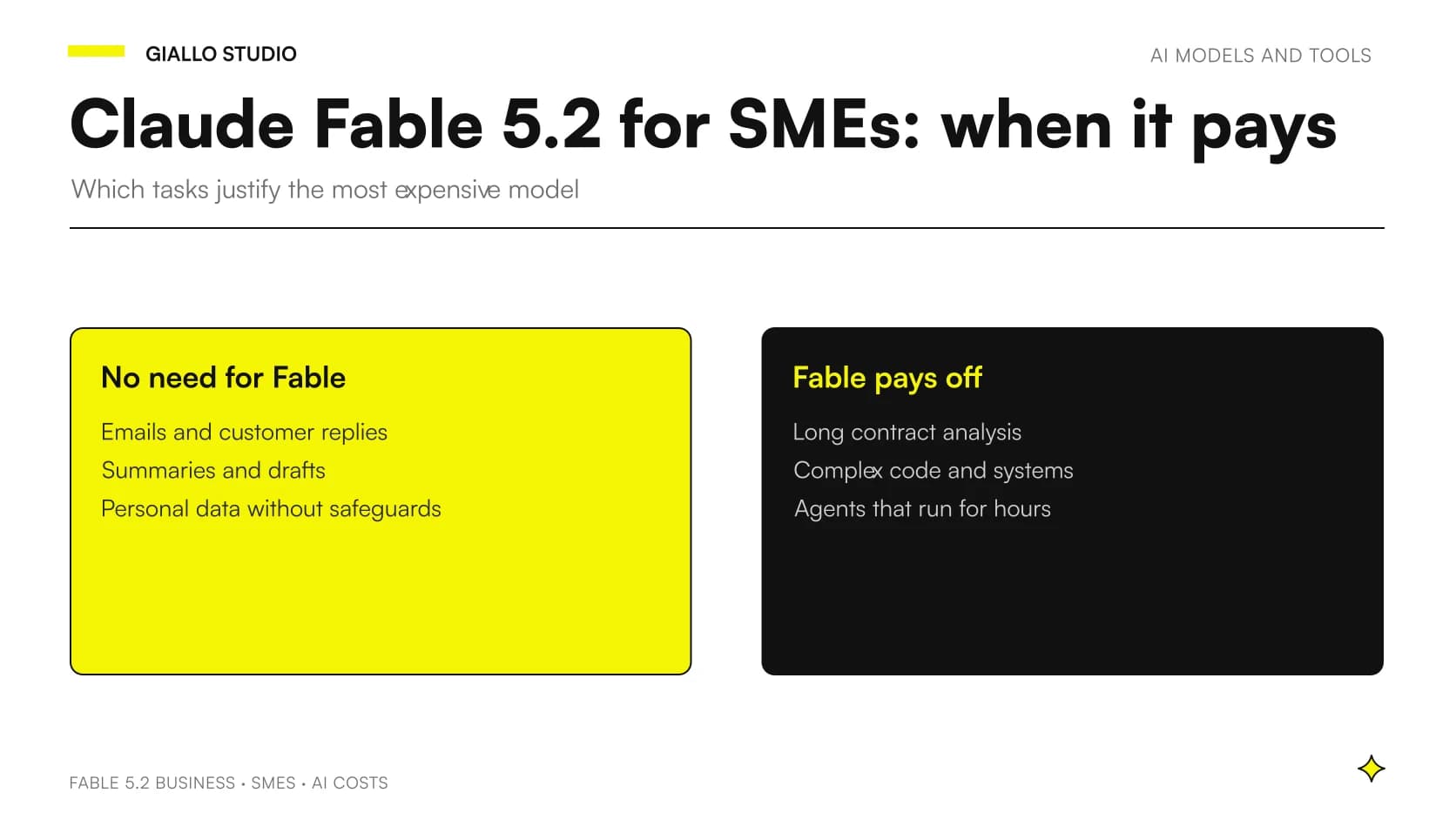
An example, declared as such: a diagnostic laboratory in Pavia wants to use AI to summarize reports, prepare its quality manual and answer referring doctors. None of this falls in the blocked categories, so it does not even need Fable 5.2: Opus 5.5, which Anthropic itself names as the everyday model, is probably enough. If, however, that laboratory started an experimental research project on proteins or viruses, its research biology requests would largely be handed off to Opus 5 and the only way forward would be to apply to the Life Sciences Verification Program. In any case, Mythos is no substitute for choosing your tools well. For the relationship with Opus 5.5, see Fable 5.2 vs Opus 5.5.
Do Fable and Mythos change anything for privacy?
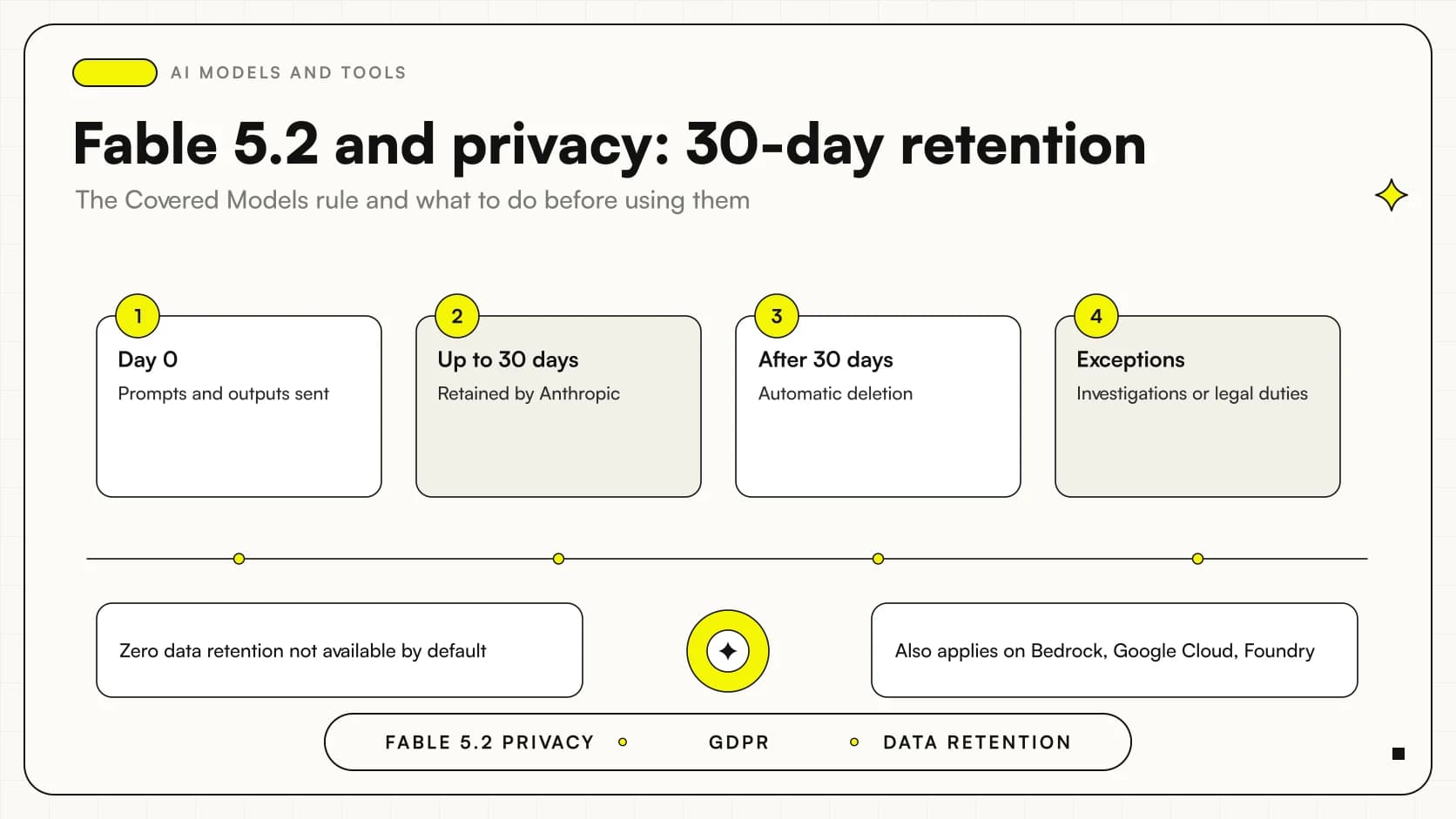
No, the rule is the same. Both models are on the list of Covered Models: the Anthropic support page states that prompts and responses are retained for at least 30 days and that zero data retention is not available, including in Enterprise organizations and on third-party platforms. Anthropic provides an alternative for eligible Enterprise customers, Enterprise Frontier Safeguards, currently in private beta and compatible with zero data retention (announcement). For personal data of customers or patients, an assessment upfront is therefore needed: we discuss it in privacy and data retention for Fable 5.2. This applies all the more to health data, like that of the laboratory in the example.
Four mistakes to avoid when choosing between Fable and Mythos
- Thinking Mythos is the “most powerful” model. It is the same model: it gives more freedom in two specific areas, not more general intelligence.
- Mistaking a refusal for a malfunction. If a request touches security or biology and the response changes style, it may be the handoff to Opus 4.8 or Opus 5. Check the response details; do not rephrase endlessly.
- Asking for Mythos out of curiosity. Verification programs are for those with a legitimate use case and an adequate security environment. An application without these foundations wastes your time and theirs.
- Forgetting the usage constraints. Mythos is covered by Anthropic's usage policy and the program rules, and Anthropic can restrict or withdraw access once granted.
How to proceed in your company: four steps
- Write down what actually blocks you, with examples of real requests: “analyze this log” and “generate an exploit” are two different things.
- Try the same requests on Opus 5.5 and on Fable 5.2, and note which ones are handed off.
- Only if the blocks stop legitimate, ongoing work, consider the right verification program.
- Before sending customer data, work out the legal basis and privacy notices with your privacy consultant, taking the 30-day retention into account.
If you do not know where to start, Giallo Studio does this triage in its AI Consulting, starting from your real cases to work out whether Opus 5.5 or Fable 5.2 is enough, without asking for access to what you do not need. If you already work with agents and automated flows, you can start from the page on AI agents. And if you want the picture of the whole family, there is the comparison between Claude models, while for the previous generation these remain useful: Opus 5 vs Fable 5.1 and Claude AI: what it is and when to use it. Versions and price lists change often: always check the official pages before deciding.
Giallo Studio guides: methodology and sources
Want to apply this to your business?In 30 minutes, free of charge: the first process to automate and its estimated return, in writing.
Book the free auditHow we apply it in the company
Related resources
 Claude Fable 5.2: What It Is, What Changed and What It Costs
 Claude Mythos 5.2: what it is and who can use it
 Claude Mythos cybersecurity: who can use it and what it really does
 Fable 5.2 vs Opus 5.5: which to use and when
 Fable 5.2 Privacy: 30-Day Data Retention and What an SME Should Do
 Claude Fable 5.2 for Business: When It Pays Off for SMEs
 Claude Opus 5 vs Fable 5.1
 Claude models compared: a guide to choosing
Other direct comparisons
The same criteria applied to other model pairs.
- Fable 5.2 vs Astra: Claude and GPT-6 benchmarks and prices compared
- Fable 5.2 vs Opus 5.5: which to use and when
- Fable 5.2 vs Gemini 4 Carbon: Which Wins Where?
- Gemini 3.6 Flash vs 3.5 Flash
- Fable 5.1 vs 5.2: what really changes and whether to upgrade
- Gemini 4 Argon vs ChatGPT and Claude: which should you choose?
- Claude Fable 5.1 vs Sonnet 5
- Gemini 4 Carbon vs Argon: differences and which to choose
- DeepSeek R1 Distill 32B vs Qwen3.8-27B locally
- Gemini 4 Carbon vs GPT-6 Astra and Claude: Which to Choose for Each Task
- Claude vs Perplexity
- Gemini 4 Hydrogen vs Carbon and Argon: which Gemini model to choose
FAQ
What is the difference between Claude Mythos 5.2 and Claude Fable 5.2?
None in the model, a lot in access. According to Anthropic they are the same base model: Fable 5.2 has strong safeguards on cybersecurity and biology and is available to everyone, while Mythos 5.2 has them removed and is reserved for verified organizations. Specifications and price are the same.
Is Mythos 5.2 smarter than Fable 5.2?
No. It is the same model, so general capability is the same. What changes is what the model agrees to do: Mythos does not block the cybersecurity and biology work that Fable hands off to other models. In the official table the two comparable scores are close (74.6 vs 75.3 on Terminal-Bench-Science).
What does Claude Fable 5.2 block?
It blocks high-risk cyber activity, including penetration testing, exploit generation and vulnerability research on binaries, and most research biology tasks. A blocked request is handed off to Opus 4.8 for cybersecurity and to Opus 5 for biology. Anthropic states about 55% fewer blocks than Fable 5.1.
Who can use Claude Mythos 5.2 and how do you request access?
Organizations that work in cybersecurity or biomedical research and have been approved by Anthropic. You apply to the Cyber Verification Program or the Life Sciences Verification Program, or contact your account team. For the cyber program, Anthropic aims to reply within seven business days.
Does Mythos 5.2 cost more than Fable 5.2?
No. The official model page says Mythos 5.2 shares Fable 5.2's specifications and pricing, which is $8 per million input tokens and $40 per million output tokens. Mythos fast mode, however, is reserved for organizations in the verification programs.
Does an Italian SME need Mythos 5.2?
Almost never. It is for those who do cybersecurity or biomedical research for a living and can pass a verification. For everyone else, Fable 5.2, or more often Opus 5.5, covers day-to-day work with nothing lost.