
Fable 5.2 vs Astra: Claude and GPT-6 benchmarks and prices compared
Fable 5.2 vs Astra: the benchmarks Anthropic reports, Claude and GPT-6 Astra API prices, and how to choose for your business with a test on your own cases.
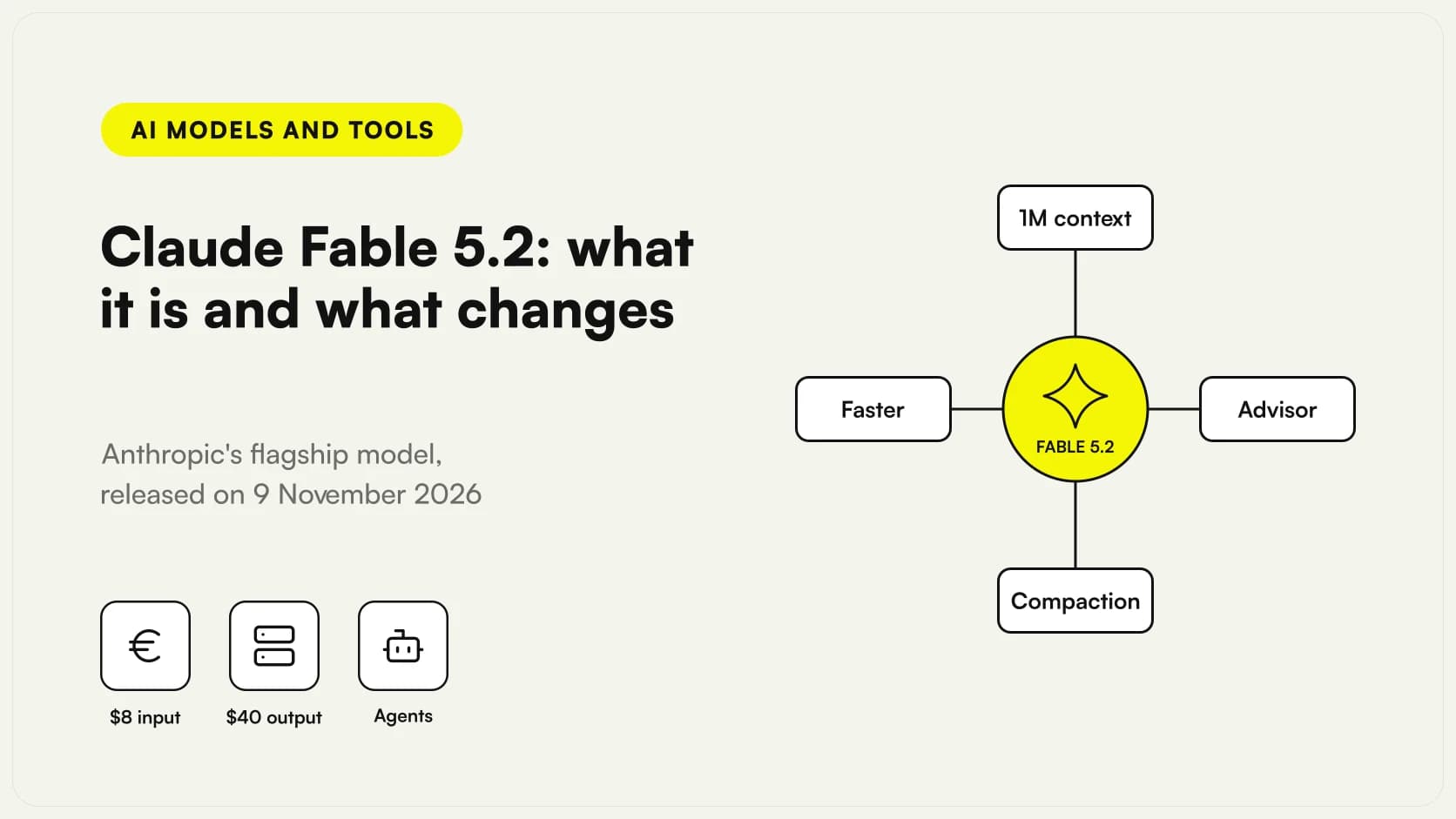
Fable 5.2 vs Astra is the comparison between two of the top-tier models you can buy today: Claude Fable 5.2, released by Anthropic on 9 November 2026, and OpenAI's GPT-6 Astra. In the table Anthropic published in the official announcement, Fable 5.2 has the highest score in all ten tests in which Astra appears. It also costs less per token: $8 and $40 per million tokens against Astra's $10 and $50, according to the official Fable 5.2 page and the model page in the OpenAI documentation, accessed on 9 November 2026.
The point not to miss is who wrote the table: Anthropic, the maker of one of the two models. The figures are reported by Anthropic and have not been replicated by third parties on the pages we consulted. This article reads them line by line, lines up the prices and gives a criterion for choosing. For the full spec sheet of Fable 5.2 there is the guide to Claude Fable 5.2; for Astra, see GPT-6 Astra: what it is and how it works.
In summary
- In the Anthropic's announcement of 9 November 2026, Fable 5.2 beats GPT-6 Astra in all ten tests with a figure for both, but the table comes from Fable's maker.
- Fable 5.2's list price is $8 for input and $40 for output per million tokens, Astra's is $10 and $50: Fable costs 20% less per token (OpenAI source).
- Astra applies a surcharge to prompts over 272,000 tokens; on the Fable pages we consulted there is no similar threshold.
- On code and computer use, Anthropic reports clear margins in Fable's favor; on chart reading the gap is 2.4 points.
- Mythos 5.2 is not a third competitor: it is Fable 5.2 without the cyber and biology safeguards, for approved organizations.
- To choose, you need 15-20 of your own cases tried on both models, measuring quality and cost per completed case.
How do Fable 5.2 and GPT-6 Astra perform on the official benchmarks?
Anthropic's table compares Fable 5.2 with four other models. The one below keeps only the rows where a score exists for Astra. Anthropic specifies that, unless otherwise stated, the scores show the highest effort level available for each model.
| Test | What it measures | Fable 5.2 (%) | GPT-6 Astra (%) |
|---|---|---|---|
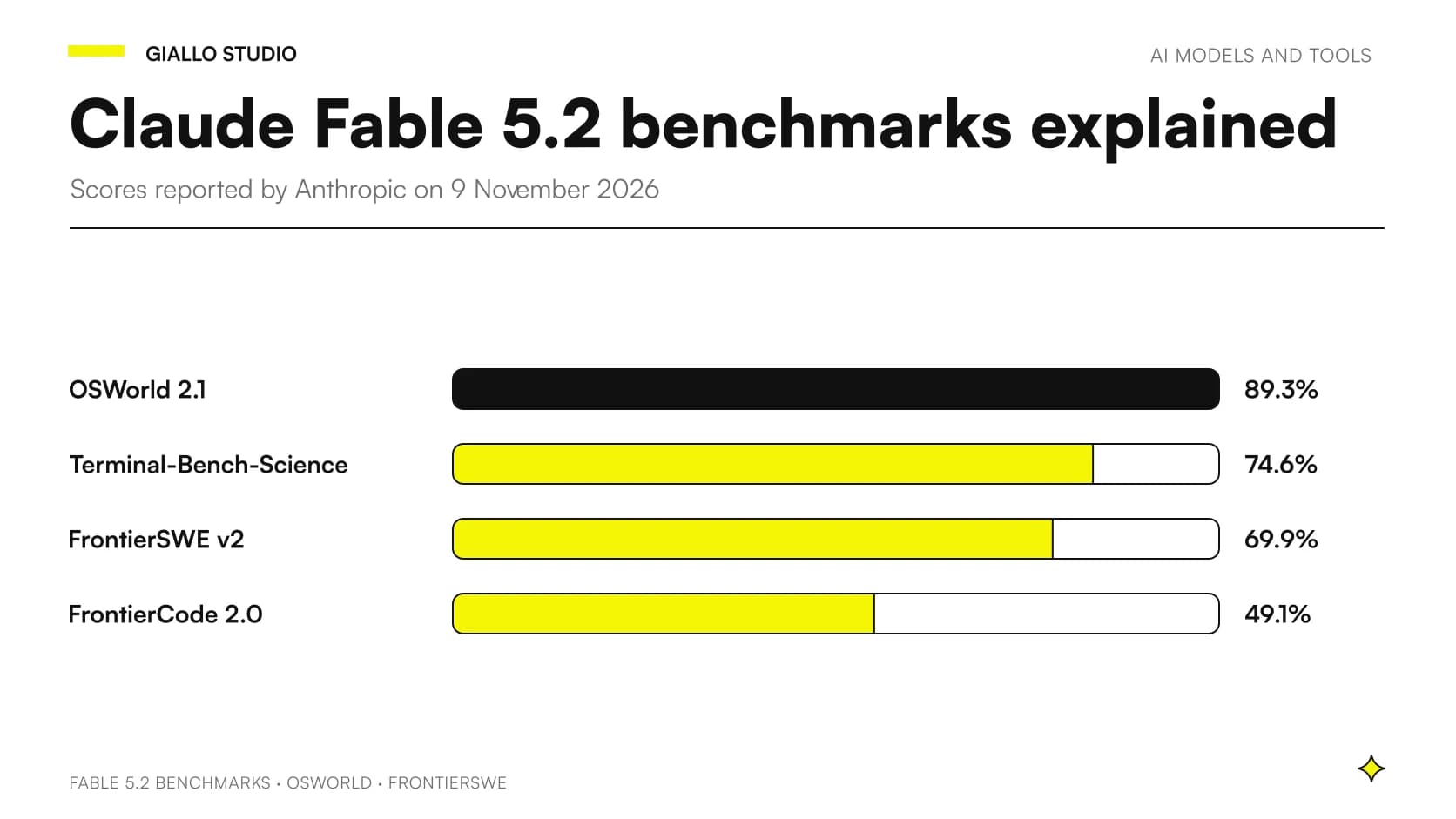
| FrontierCode 2.0 | code changes that maintainers would accept | 49,1 | 42,8 |
| FrontierSWE v2 | software engineering | 69,9 | 65,5 |
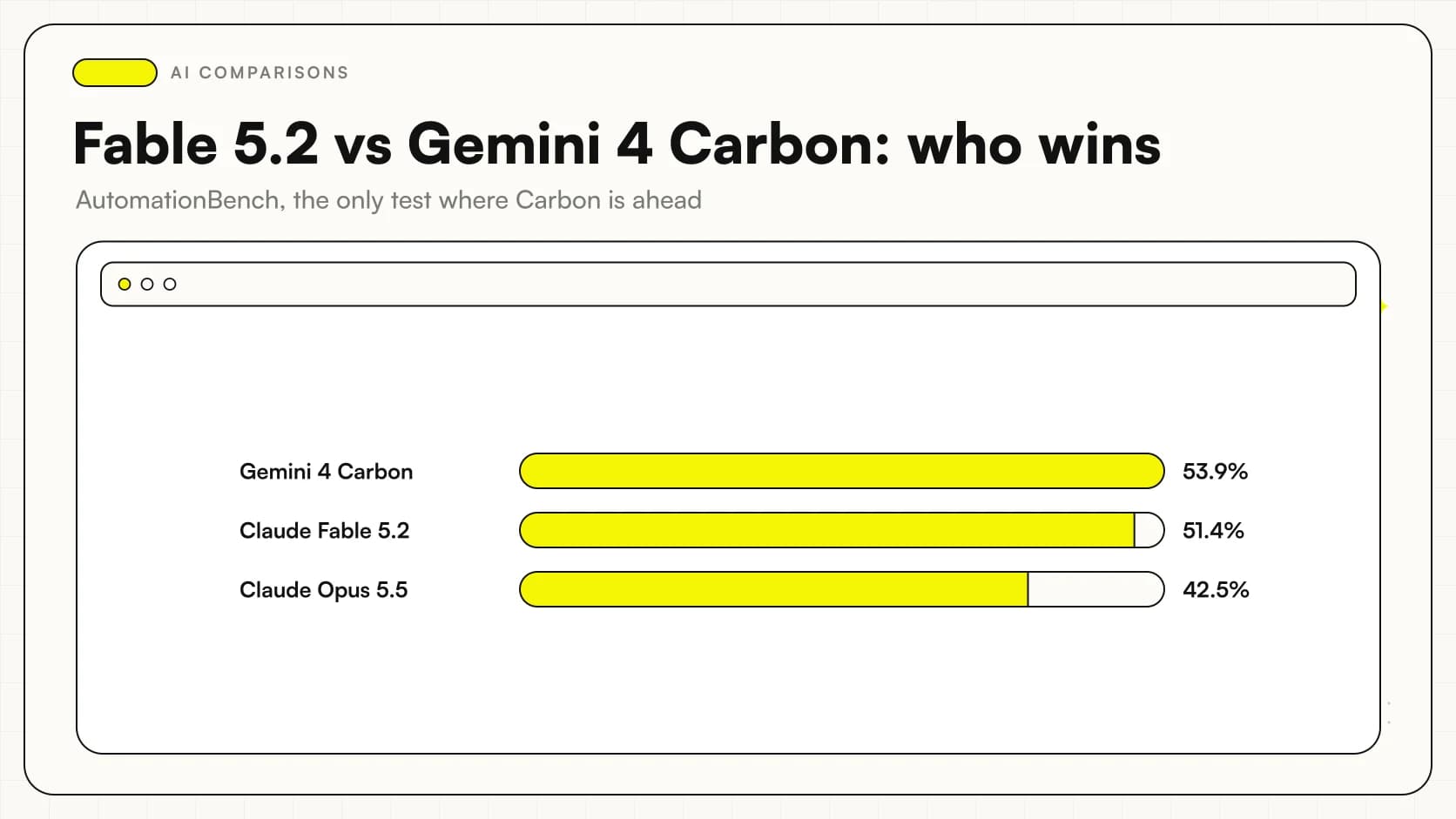
| AutomationBench | business workflows | 51,4 | 41,4 |
| Terminal-Bench-Science | agentic scientific research | 74,6 | 68,1 |
| OSWorld 2.1 | computer use | 89,3 | 79,5 |
| Humanity's Last Exam, with tools | expert knowledge | 74,2 | 57,2 |
| Chartography, without tools | chart reading | 73,4 | 71,0 |
| RoboDojo Sim | control of a simulated robot | 64,9 | 29,8 |
| AA-Briefcase v1.1 (rubric score) | office work | 66,1 | 52,0 |
| Remote Labor Index | remote contract work | 41,3 | 20,8 |
Source: Anthropic official announcement, accessed on 9 November 2026. Three cautions are needed to read it properly.
- The gaps are not all equal. Calculated from the scores in the announcement: on Chartography the difference is 2.4 points, on FrontierSWE 4.4. On OSWorld it is nearly 10 points, on AutomationBench exactly 10 points, on Humanity's Last Exam 17 points.
- Some rows are internal measurements. Anthropic writes that RoboDojo Sim was run internally, and that the Astra figures on that test are “our run”, meaning its own measurement. The score of 29.8% against 64.9% is the widest in the table, and also the hardest to verify from outside.
- A table from one side shows the strengths of whoever writes it. In our previous comparison of GPT-6 Astra and Fable 5.1, based on OpenAI's tables, Astra came out ahead on some terminal tests, on AutomationBench and on BenchCAD. The two labs' tables tell different stories because they choose different tests. For a broader picture, GPT-6 Astra: the official benchmarks lists the rows published by OpenAI.
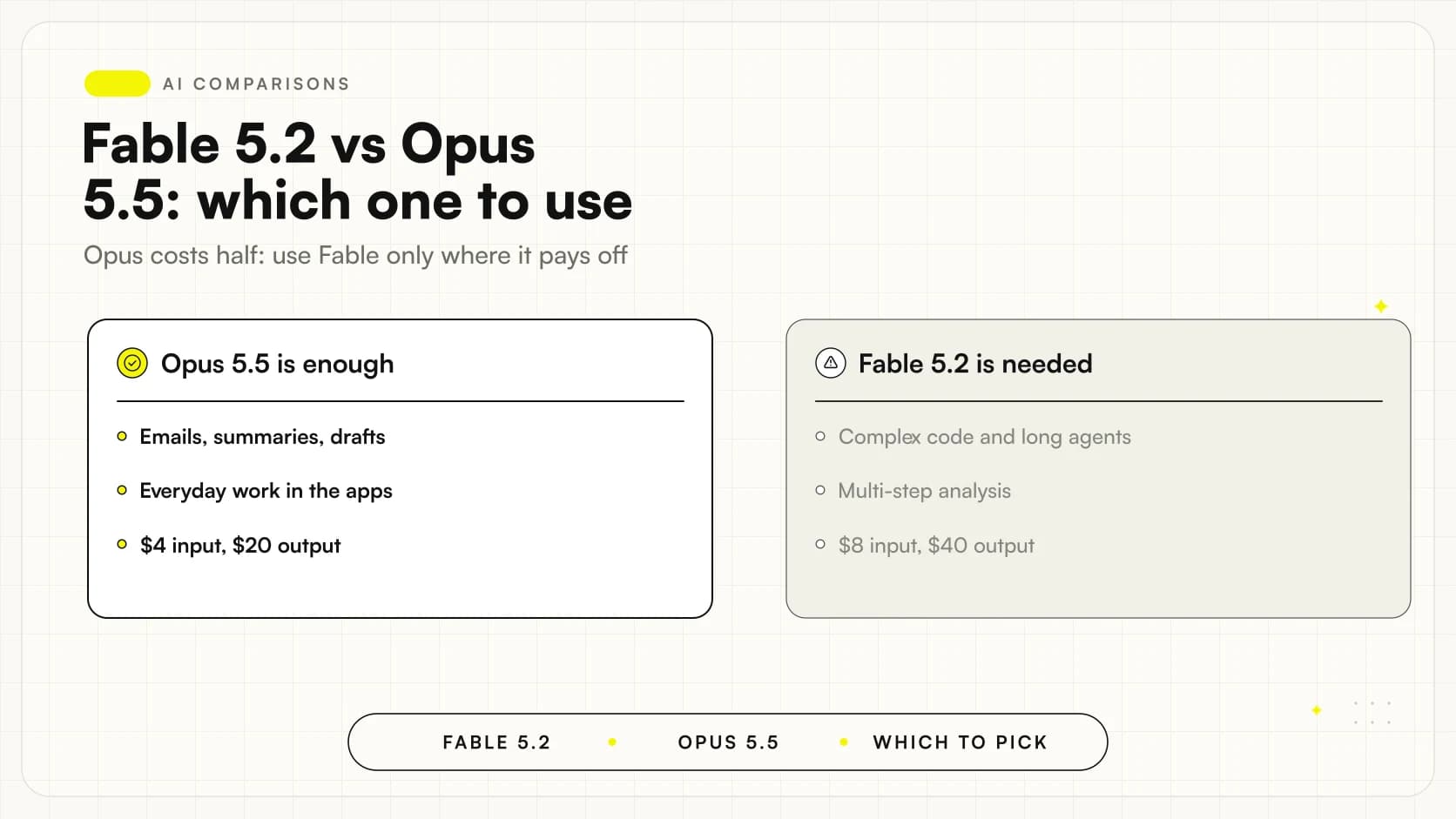
A three-way comparison with Opus 5.5, the model Anthropic recommends for everyday use, is in Fable 5.2 vs Opus 5.5; the individual tests are explained in Claude Fable 5.2 benchmarks explained.
The cost figure: FrontierCode at equal spend
In the announcement there is a chart of score against cost per task on FrontierCode 2.0. According to Anthropic, at High effort Fable 5.2 gets about the same result as Opus 5.5's best score (45.3% against 45.5%) for about half the cost per task, and is ahead of Astra's best score (42.8%) at about the same cost. At Xhigh effort Fable 5.2 reaches 49.1%, the highest value among the released models that Anthropic says it tested. It is the most useful piece of information in the table, because it ties quality to spend. It remains a vendor measurement on a single set of programming tasks.
How much do Fable 5.2 and GPT-6 Astra cost?
The two price lists have the same shape, with input, output, cache and a discount for deferred processing. The values and two rules differ.
| Price item | Fable 5.2 ($ per million tokens) | GPT-6 Astra ($ per million tokens) |
|---|---|---|
| Input | 8 | 10 |
| Output | 40 | 50 |
| Reading from the cache | 0,20 | 1 |
| Cache Writing | 10 (5 minutes) or 16 (1 hour) | 12,50 |
| Batch: input / output | 4 / 20 | 5 / 25 |
| Fast mode: input / output | 16 / 80 | 20 / 100 |
Sources: official Fable 5.2 page, “What's new” page and GPT-6 Astra page in the OpenAI documentation, all accessed on 9 November 2026. Astra's Batch and Fast mode values are calculated by us from the rules OpenAI states (Batch at 50% and Fast at double the applicable rates). Astra also has a Flex plan at 50% of the Standard rates.
Two differences matter beyond the price per token.
- Astra's 272,000-token threshold. The OpenAI documentation states that prompts with more than 272,000 input tokens are billed at double for input and cache and at one and a half times for output, on the whole request. On the Fable 5.2 pages we consulted we found no similar rule: before designing a system that sends very long documents, check Anthropic's full price list. Astra's details are in GPT-6 Astra: pricing, real costs and when it is worthwhile.
- Cache reads. They cost $0.20 on Fable 5.2 and $1 on Astra. For anyone who often reuses the same context, such as a catalog or a long instruction prompt, it is the line that moves the recurring bill the most.
For the other Fable 5.2 line items (cache, batch, fast mode), see Claude Fable 5.2 API pricing and real costs.
What changes for a cosmetics e-commerce store in Naples?
An example, labeled as such. A cosmetics e-commerce store in Naples uses an agent that prepares product pages, answers customers about ingredient compatibility and checks descriptions before publication. Let us assume 10,000 requests a month, 3,000 input tokens and 800 output tokens per request, with no cache and not counting reasoning.
- Fable 5.2 (price list from the official page): 30 million input tokens × $8 = $240, plus 8 million output tokens × $40 = $320. Total $560.
- GPT-6 Astra (price list from OpenAI): 30 million × $10 = $300, plus 8 million × $50 = $400. Total $700.
The difference is $140 a month, or 20% (an example calculated from the official Fable 5.2 prices and Astra's cited above), because the volumes are equal. It is a small figure compared with the time of whoever checks the texts. For this activity the right question is not “which of the two” but “do we really need a model of this tier”. For product pages and customer replies, cheaper models are often enough: within the Claude family, Anthropic recommends starting with Opus 5.5, and the comparison between Opus 5 and Astra is in Opus 5 vs GPT-6 Astra. The flagship model is justified on a hard, rare task, for example checking hundreds of product pages against cosmetics regulations. If the company also has a shop to build or improve, the technical side is handled with a custom e-commerce store.
When to choose Fable 5.2 and when GPT-6 Astra?
There is no winner for everyone. These are the criteria we at Giallo use to guide the choice, keeping in mind the limits of a one-sided table.
Lean toward Fable 5.2
- Complex coding tasks and agents that work for hours, where Anthropic reports the clearest advantage.
- Computer use, for example handling cases in management systems without APIs.
- Very long contexts, if the Astra surcharge above 272,000 tokens affects you.
- High-cache volumes, where a read costs $0.20 instead of $1.
Lean toward GPT-6 Astra
- You already have an OpenAI integration, ChatGPT in the company and a signed data agreement: switching costs more than the $140 in our example.
- You need OpenAI ecosystem tools you already use.
- Your tests show Astra wins on your task: that matters more than any table.
- You work on Amazon Bedrock with the model
openai.gpt-6-astra, as stated in the OpenAI documentation.
Each model's limits also matter. According to the OpenAI page, Astra does not support audio, video or fine-tuning. Fable 5.2 accepts text and images and responds with text, and has three behaviors to know from the official documentation: at medium effort or above it thinks even when told not to, on long tasks it may stop early, and it follows style rules to the letter.
What changes for customers' personal data?
This is the part benchmark comparisons usually skip. Fable 5.2 and Mythos 5.2 are “Covered Models”: the Anthropic page, accessed on 9 November 2026, indicates a minimum retention of 30 days and no zero data retention, including for Enterprise and third-party platforms, unless exempted. For Astra we have not verified the data retention terms today: we found no retention terms on the model page that we could read and summarize, so we do not report them. For personal or confidential data, ask both providers in writing about retention, processing regions and the data processing agreement. The chapter dedicated to Fable is in Fable 5.2 and privacy: data retained for 30 days.
Where does Mythos 5.2 fit in the comparison with Astra?
Many searches put Claude Mythos next to GPT-6 Astra, but the two are not direct rivals. According to the announcement, Fable and Mythos are the same model: Fable has strong cybersecurity and biology safeguards and is therefore offered to everyone, while Mythos is obtained through the verification programs for organizations working in those fields. For a company that does not do security or biomedical research, the useful comparison is the one with Fable. The picture of the two siblings is in Fable 5.2 vs Mythos 5.2.
On cybersecurity, the Anthropic table puts Mythos 5.2 next to “GPT-6 Cyber”, not Astra (76.3% against 61% on CyScenarioBench), with a note: each lab uses its own tasks. So it is not a like-for-like comparison. The OpenAI side is in GPT-6 Cyber.
How to decide in your business with a one-week test
- Pick a hard, recurring task, not the most common one: a cross-check between documents, a code change, a case in a management system.
- Collect 15-20 real cases, anonymized, for which you know the right answer.
- Run them on Fable 5.2 and on Astra with the same starting prompt and a comparable reasoning level (both have low, medium, high, xhigh and max).
- Record for each case the correct outcome, tokens consumed and minutes of human review.
- Divide the spend by the successful cases and decide. A saving on the price list does not count if one model gets one more case wrong out of every ten.
Which mistakes should you avoid in the comparison?
- Deciding from the maker's table. Anthropic's table captures the tests Anthropic chose. OpenAI's captures its own.
- Comparing models to different efforts. A score at Max is not comparable with one at Low: always look at the effort and the cost per task.
- Ignoring hidden pricing rules. Astra's 272,000-token threshold and reasoning billed as output change the bill more than the list-price difference.
- Switching provider for one benchmark point. Integrations, data agreements and already-tuned prompts have a cost that tables do not show.
- Use the top model for everything. For everyday office tasks, a lower tier costs far less; the overall picture is in the comparison of Claude, GPT and Gemini.
Fable 5.2 or Astra: the practical choice
On the tests Anthropic reports, Fable 5.2 is ahead, costs less per token and, on the pages we consulted, does not show Astra's surcharge on long prompts. These are three reasons enough to include it in your test, not to decide in place of the test. The same caution applies in reverse: if your cases favor Astra, the points in a table should not make you switch. The third competitor of this generation is covered in Fable 5.2 vs Gemini 4 Carbon.
If you want a comparison done on your documents and your management system, with cost per completed case and review time, the AI consulting by Giallo Studio starts with a test on real data and ends with a written, vendor-independent recommendation. Before signing any contract, check the official pages of Anthropic and of OpenAI: versions, prices and thresholds change from week to week.
Giallo Studio guides: methodology and sources
Want to apply this to your business?In 30 minutes, free of charge: the first process to automate and its estimated return, in writing.
Book the free auditHow we apply it in the company
Related resources
 Claude Fable 5.2: What It Is, What Changed and What It Costs
 Fable 5.2 vs Opus 5.5: which to use and when
 GPT-6 Astra: what it is, how to use it and its limitations
 GPT-6 Astra: pricing, real costs and when it is worthwhile
 GPT-6 Astra vs Claude Fable 5.1
 Claude Fable 5.2 benchmarks: what they measure and how to verify them
 Fable 5.2 vs Gemini 4 Carbon: Which Wins Where?
 Claude, GPT and Gemini in comparison
Other direct comparisons
The same criteria applied to other model pairs.
- Fable 5.2 vs Gemini 4 Carbon: Which Wins Where?
- Claude Mythos vs Fable 5.2: the real differences and who can use them
- Fable 5.1 vs 5.2: what really changes and whether to upgrade
- Fable 5.2 vs Opus 5.5: which to use and when
- Claude Fable 5.1 vs Sonnet 5
- Gemini 3.6 Flash vs 3.5 Flash
- DeepSeek R1 Distill 32B vs Qwen3.8-27B locally
- Gemini 4 Argon vs ChatGPT and Claude: which should you choose?
- Claude vs Perplexity
- Gemini 4 Carbon vs Argon: differences and which to choose
- Claude vs Gemini: Which to Use
- Gemini 4 Carbon vs GPT-6 Astra and Claude: Which to Choose for Each Task
FAQ
Is Fable 5.2 better than GPT-6 Astra?
On Anthropic's own table, yes. In the table Anthropic published on 9 November 2026, Fable 5.2 has a higher score than Astra in all ten tests in which the two are compared. It is a table from Fable's maker, not replicated by third parties, so it says where Fable is strong, not who will win on your tasks. To decide, you need a test on your own cases.
How much do Fable 5.2 and GPT-6 Astra cost?
Fable 5.2 costs $8 per million input tokens and $40 per million output tokens. GPT-6 Astra costs $10 and $50 on the Standard plan. Per token, Fable therefore costs 20% less. These are list prices in dollars: the real cost depends on reasoning tokens, caching and failed attempts.
Can Claude Mythos 5.2 be compared with GPT-6 Astra?
Not directly. Mythos 5.2 is the same model as Fable 5.2 without the cybersecurity and biology safeguards, and it is reserved for approved organizations. For cybersecurity, the competitor Anthropic points to is not Astra but GPT-6 Cyber, and the scores are not comparable because each lab uses different tasks.
Which of the two costs less for a coding task?
According to Anthropic, on FrontierCode 2.0 Fable 5.2 at High effort beats Astra's best score (45.3% against 42.8%) at about the same cost per task. The figure comes from the cost-performance chart in the announcement and is an Anthropic measurement. On your own code the ratio may be different.
Can I use GPT-6 Astra with audio or video?
No. The model page in the OpenAI documentation, consulted on 9 November 2026, lists text and image input, text-only output, and audio and video as unsupported. Fable 5.2 also accepts text and images and responds with text.
Is it worth switching providers to move to Fable 5.2?
As a rule, no, unless you have a task where your current model fails in a measurable way. Switching providers costs testing, prompt revision and a new data agreement. It is better to measure Fable 5.2 and Astra on the same 15-20 real cases and keep the model that wins on your workflow for cost and quality.