
Qwen3.8-27B locally: capabilities, limits and requirements
Qwen3.8-27B locally: model, license, images, context and memory. What to check before using it with your business documents.
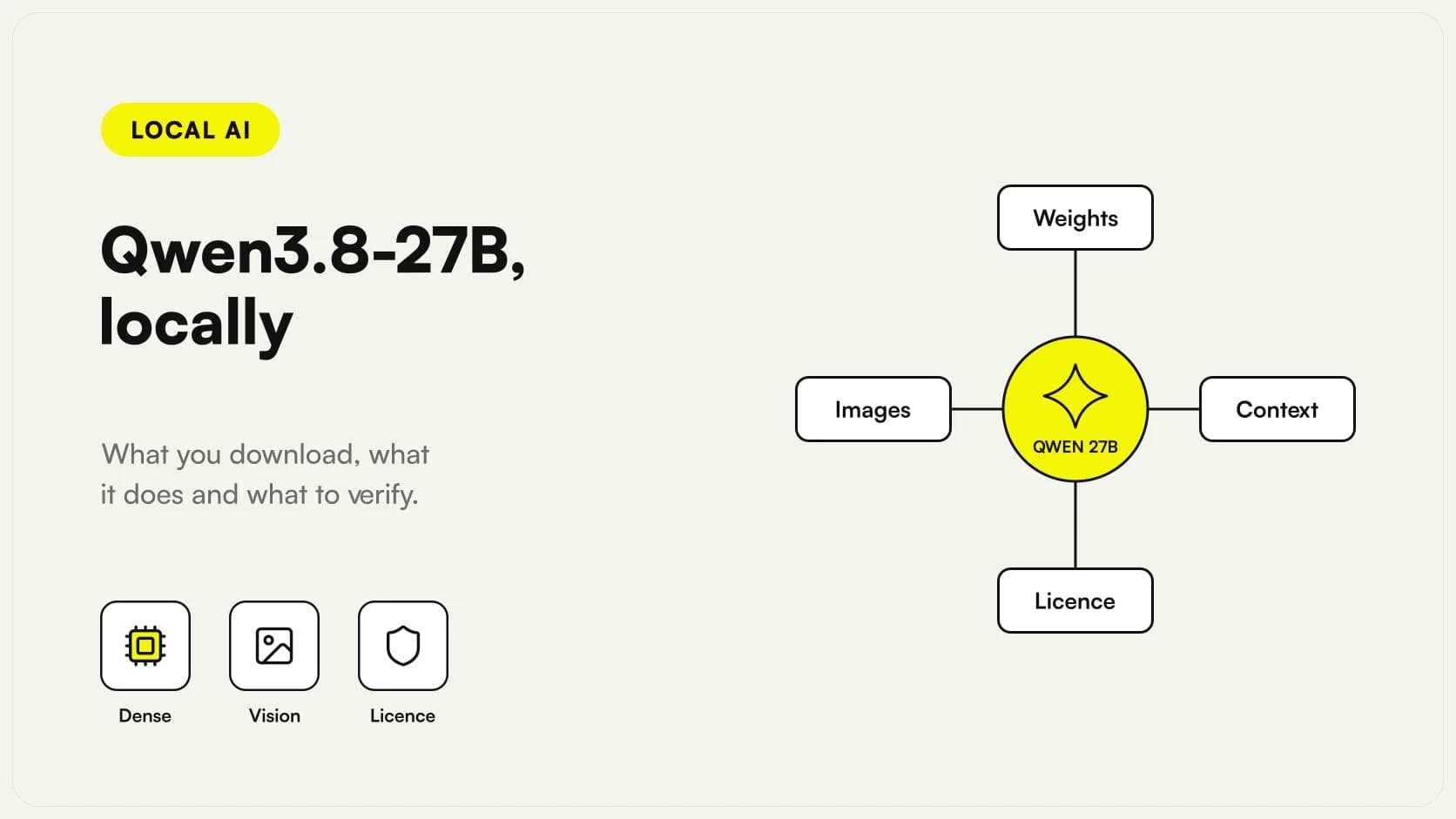
Qwen3.8-27B is a multimodal model with downloadable weights that you can run on your own hardware, provided you choose a compatible format and engine. It understands text, images and video, but there is no memory requirement that applies to every quantization, context window and computer. The specifications here come from the official Qwen model card, consulted on October 27, 2026.
For a small or medium-sized business, the choice mainly concerns the workflow: reading documents, drafting answers based on an archive or assisting software developers. A convincing chat response shows that the model can converse; reliability on deadlines, amounts or procedures needs separate verification. This guide distinguishes manufacturer specifications from operational assessments; it does not present benchmarks conducted by Giallo Studio.
In summary
- Qwen3.8-27B uses a dense language model with 27 billion parameters, alongside a vision encoder.
- The stated native context window is 262,144 tokens; extending it to one million requires suitable configuration.
- The official checkpoint is licensed under Apache 2.0.
- Actual memory usage includes weights, cache, vision components and runtime overhead.
- Local operation must be verified across the entire workflow, including documents, tools and external connections.
What kind of model is Qwen3.8-27B?
Qwen3.8-27B is a checkpoint in the Qwen family, distributed by the official Qwen organization on Hugging Face. Its language architecture is dense: it is not an MoE that selects only certain experts for each token. The card specifies 27 billion parameters for the language model and a vision encoder; the platform summary may round the total to 28B. These figures cover different components, rather than two equivalent versions. Source: Qwen model card.
To understand the terminology without confusing the model with the application, start with the guide to Local AI Models. The model generates responses; the program you use to run it determines how files are loaded, conversations are stored and other tools are connected. This distinction matters when you need the entire workflow to stay on the computer.
Are Qwen3.8-27B and Qwen3.8-Max the same?
No. A shared family name does not make checkpoints interchangeable. In the official Qwen3.8-Max announcement, Max is described as having 2.4 trillion total parameters and 95 billion active parameters. Its size and architecture differ from the dense 27B model covered here.
Before evaluating a result found online, check the full model name used in the test. A comparison involving Max does not show that the 27B will produce the same answer. A quantized or community-modified derivative may also behave differently from the original checkpoint. Record the author, repository name, revision and weight format: this small record helps you repeat the test and determine whether an update changed its behavior.
What can it read beyond text?
The card describes native image and video understanding. This makes the model a candidate for interpreting screenshots, photographs of documents, charts and visual sequences. Visual understanding does not guarantee exact extraction: a tiny digit, an overlapping stamp or a complex table may need specific checks. Source: Qwen3.8-27B capabilities.
A PDF may contain selectable text, scanned pages or both. The system must decide whether to extract text, render the pages or apply OCR, then preserve the connection to the original document. Our guide to local multimodal AI for PDFs and images explains which steps to verify. Before automating an order, always require the operator to be able to see the page from which each field was obtained.
How much context does it actually support?
The stated native context window is 262,144 tokens, extendable to 1,000,000 using the configurations described by the manufacturer. The maximum does not represent an amount of text that every computer can process comfortably. Runtime, memory, supplied images, response length and concurrent requests all matter. Source: Qwen context and scaling.
A very large context window does not replace relevant document selection. If you ask about a current procedure, adding every superseded version can create ambiguity. Supply the source, its validity date and instructions on which version takes precedence. The guide to RAG explains a different approach: retrieving useful passages from the archive rather than indiscriminately pasting everything into the conversation.
Another check concerns freshness. Knowledge learned during training does not guarantee current information about catalogs, availability or internal rules. If a question concerns the status of a case, you need an authorized, current source; the model must not reconstruct it from what seems plausible. Define which questions may use only attached documents and which require access to an information system. For the latter, specify what should happen when that system is unavailable. A lack of connectivity should produce an explicit limitation, rather than invented data to complete the answer.
How much memory does the checkpoint need?
A basic calculation only estimates the order of magnitude. For 27 billion parameters, 16-bit language weights alone amount to approximately 54 decimal GB; at 8 bits, around 27 GB; at 4 bits, around 13.5 GB. These are theoretical calculations, obtained by multiplying parameters by bits and dividing by eight: they are not measured requirements.
You still need to account for the vision encoder, quantization scales, context cache, buffers and operating system. Real formats do not necessarily assign the same bit width to every tensor. That is why the downloaded file size and memory observed during a request matter more than arithmetic on paper. The article on Qwen3.8-27B RAM and VRAM distinguishes loading, operating headroom and tests to run before buying hardware.
What should you check before installation?
Start by checking where the files come from. The official repository contains the card, configuration files and license link; a community conversion should be traceable to that source, without treating marketing descriptions or comments as technical documentation. The model configuration helps identify the checkpoint architecture and settings.
Also record the chosen engine and version. The card offers integrations with frameworks such as vLLM and SGLang; support for the downloaded format still needs to match the installed version. If a guide suggests a tag missing from your runtime catalog, do not replace it with a similar name. The procedure for installing Qwen3.8-27B locally starts by checking precisely this match.
Which business tasks are worth testing?
It makes sense to experiment where language and visual material need to be combined, or where you want control over a checkpoint. An initial test might cover summarizing manuals, categorizing internal requests or preparing drafts with references to supplied documents. Stated capabilities are a reason to test the model, not a certification of the workflow.
| Tasks | Useful Test | Acceptance criterion |
|---|---|---|
| Service manuals | Question referring to two versions | Cites the valid version and flags the conflict |
| Photographed Documents | Extraction of predefined fields | Every field points to the correct page |
| Internal answers | Request involving missing information | Abstains without inventing information |
| Coding assistance | Isolated change with an existing test | The test passes and the diff stays relevant |
These are design criteria, not results already achieved. For an overview of decision factors, also see how to choose an AI model.
How can a professional practice test it?
Hypothetical scenario: an engineering practice wants to draft a response about a case. The material includes a report, a floor plan and correspondence with subsequent changes. The test should ask the system to distinguish facts readable in the documents, uncertainties and questions for the responsible professional.
The most useful test is not “summarize everything.” It is a precise question, such as which revision contains a particular instruction and on which page. Include a document that does not contain the answer: the model must be able to say it is missing. The professional retains the final decision, while the system provides checkable references. If the interface makes it impossible to return to the page, the issue also concerns the product built around the model, not just generation quality.
How can a manufacturing SME evaluate it?
Second hypothetical scenario: a company wants to help its sales department read specifications and technical data sheets. The sensitive point is distinguishing a customer requirement from a feature already available in the catalog. A response that mixes them up can look precise while being operationally wrong.
Prepare questions where the two pieces of information appear in different documents, and require a table covering requirement, evidence, compliance and items to verify. Have someone who truly knows the products review the results. Do not allow the model to send quotations or update the ERP during the pilot: first establish which fields it extracts correctly. This test provides a much more useful comparison than a generic ranking built on problems far removed from the department’s work.
How do thinking and external tools work?
The card states that thinking is enabled by default and describes controls to disable it or adjust reasoning. Compare these options on the required task: simple classification and technical diagnosis do not involve the same trade-off between waiting time and depth. Source: official thinking controls.
Tools are a separate layer. The model can formulate a tool request; the application decides whether to execute it and with which permissions. For a business assistant, separate reading from writing, restrict accessible folders and require review before external actions. A local model can still use a tool that contacts a remote service: in that case, the complete workflow is not offline. Verification must follow the actual data path.
Which mistakes distort the initial evaluation?
The first mistake is comparing a quantized version against a result from the original checkpoint and attributing every difference to the model name. The second is allocating all available headroom to context, leaving no room to complete the request. The third is using only easy questions with available, unambiguous answers.
A fourth mistake involves prompts: changing instructions, documents and engine at the same time prevents you from knowing what improved or worsened the result. Finally, do not treat fluent Italian as proof of correctness. A nonexistent citation or an incorrect amount remains an error even in well-written text. For a stronger comparison, see the protocol in benchmarking local LLMs in Italian.
How should you check licensing and confidentiality?
The official Qwen3.8-27B checkpoint declares Apache 2.0; read the repository LICENSE file for applicable obligations. Do not extend this license to every model named Qwen: some variants have different terms. For conversions and derivatives, also check the information supplied by the author distributing the files.
Operationally, check where chats, documents, logs and backups are stored, as well as where inference runs. Remote embeddings or an external OCR service can send content outside the organization even when the final answer is generated on the company server. This alone does not resolve the issues discussed in the guide to AI and corporate privacy: data-flow controls must be accompanied by defined permissions, retention and responsibilities.
From a personal trial to a usable assistant
What record should you keep for each test?
Record the checkpoint and revision, weight provenance, quantization, runtime and version, machine, configured context, supplied documents and generation settings. For each question, keep the answer, displayed sources, identified errors and the process owner’s assessment. Use authorized test content and limit the data stored in logs.
Start with a narrow task, an owner who can assess the answers and an explicit criterion for stopping automation. If the model meets the task requirements, evaluate integration, support and operating cost; if it fails an essential requirement, compare it with an alternative rather than indiscriminately increasing context.
You can explore the differences with Gemma 4 31B and with Ministral 3 14B. To turn the trial into an assistant with verifiable sources and boundaries, AI consulting by Giallo Studio starts with the workflow and documents you will actually use; in The Lab you can explore other ways to bring AI into everyday work.
Giallo Studio guides: methodology and sources
How we apply it in the company
Related resources
 DeepSeek R1 Distill 32B vs Qwen3.8-27B locally
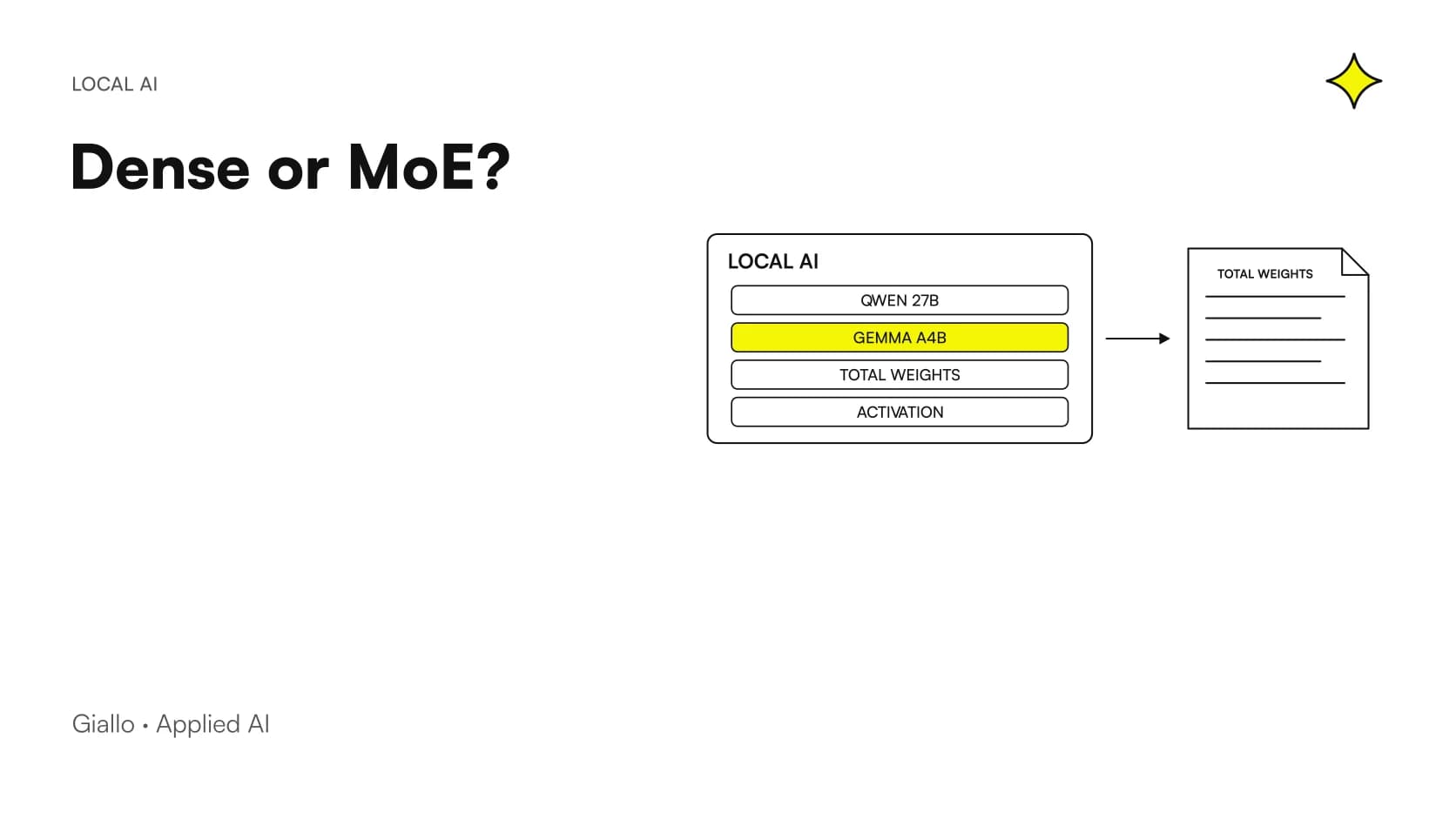 Qwen3.8-27B vs Gemma 4 26B A4B: dense or MoE?
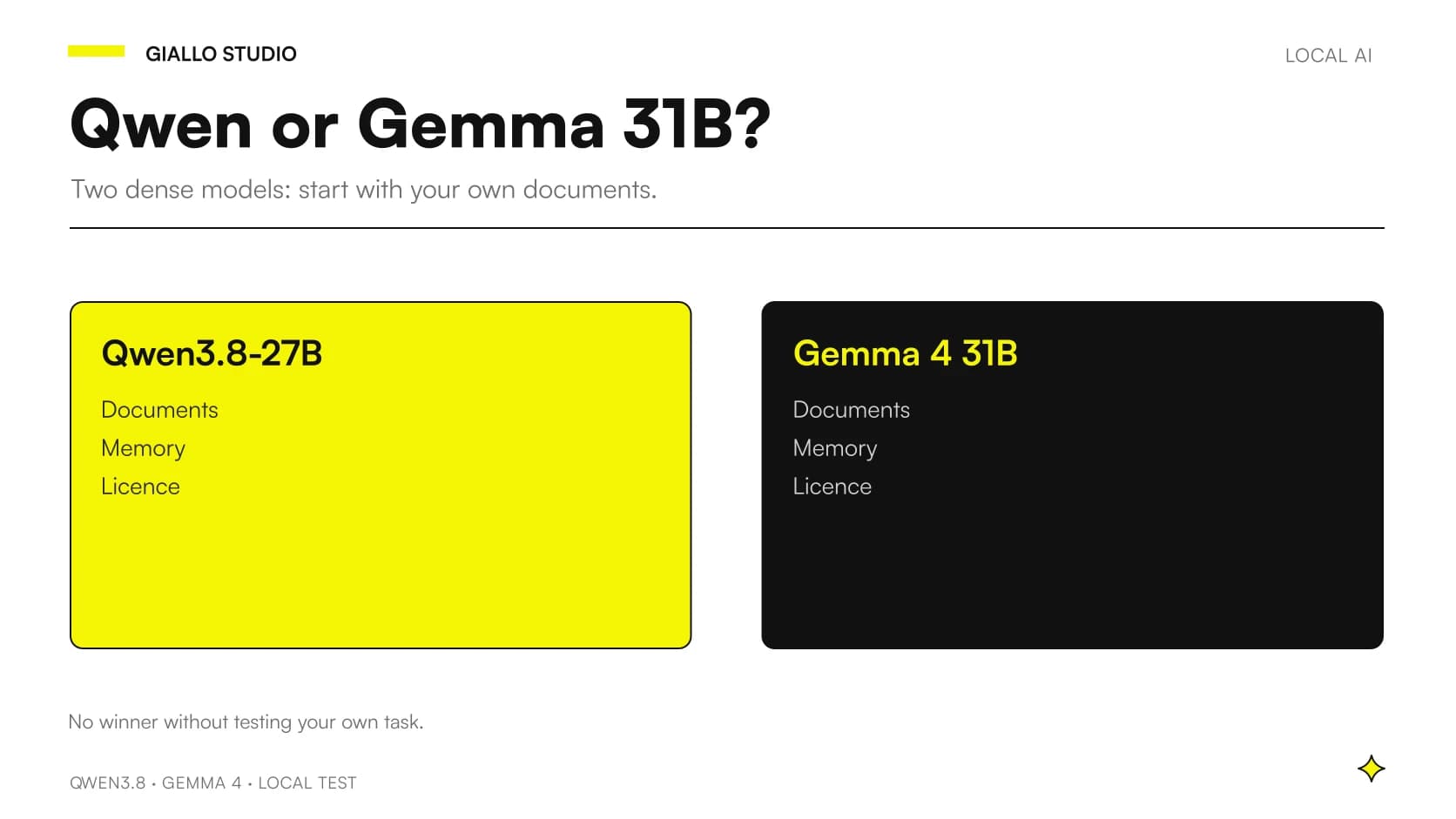 Qwen3.8-27B vs Gemma 4 31B for local deployment
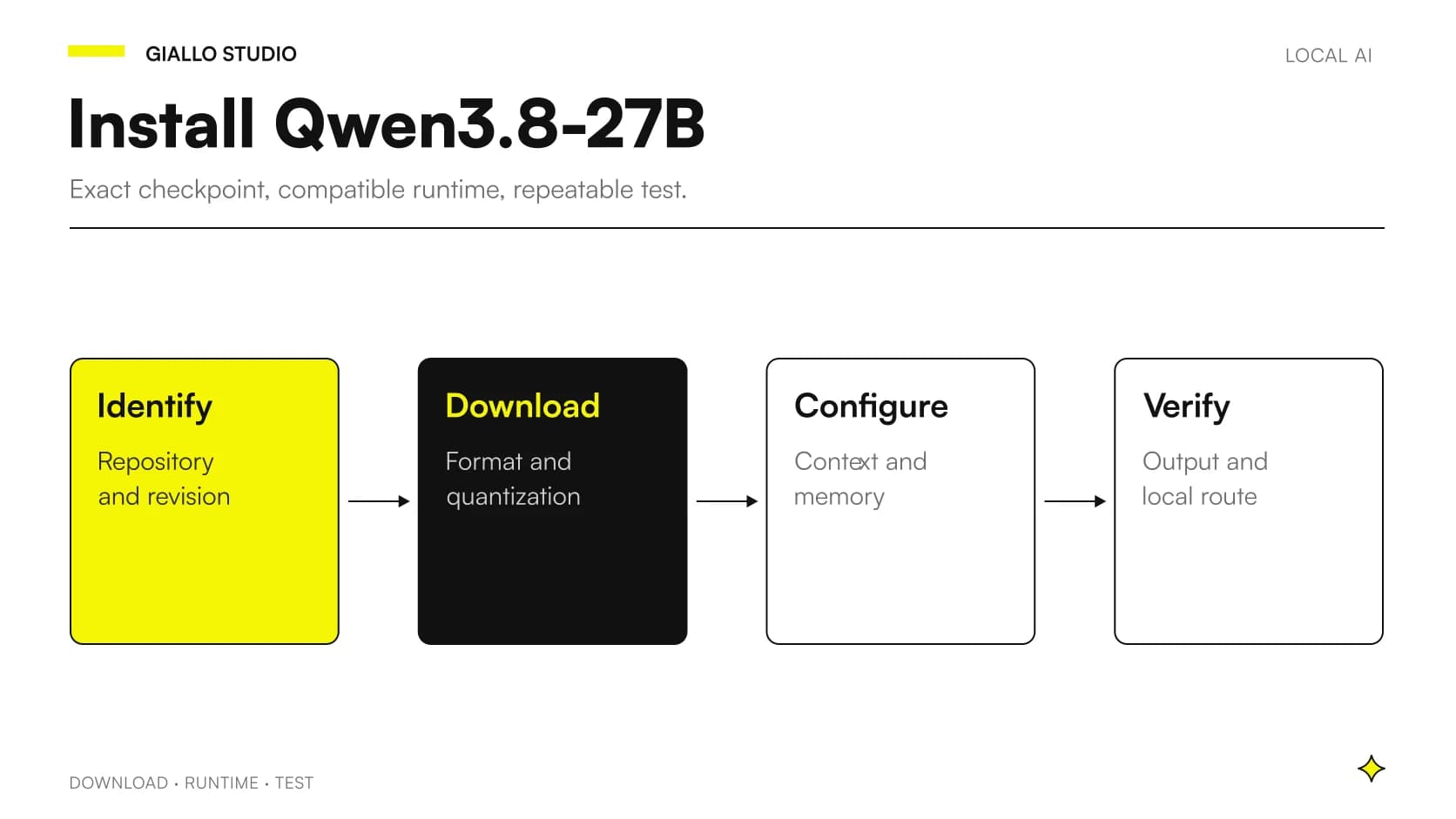 Install Qwen3.8-27B locally: checks and workflow
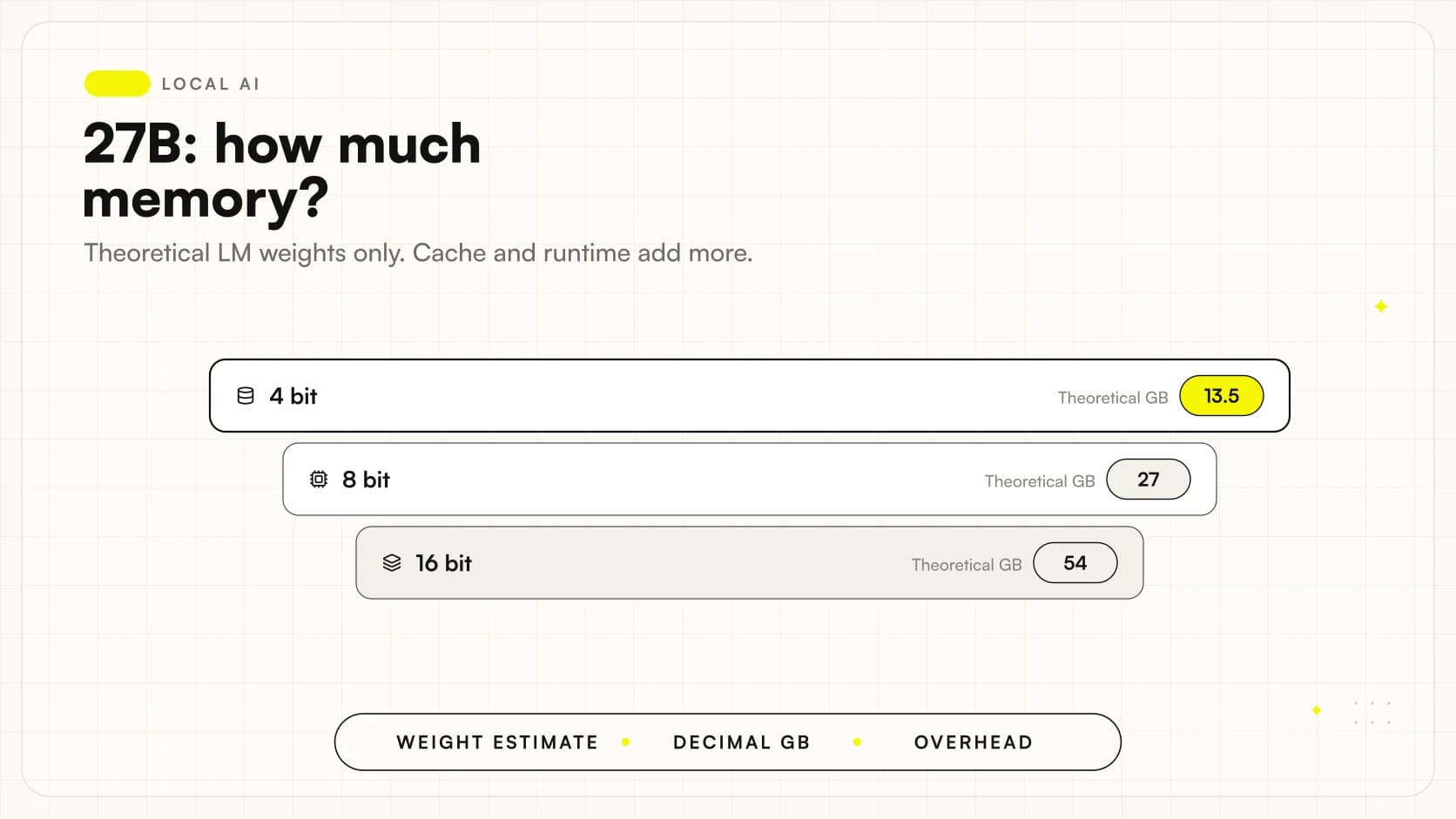 How much RAM and VRAM does Qwen3.8-27B really need?
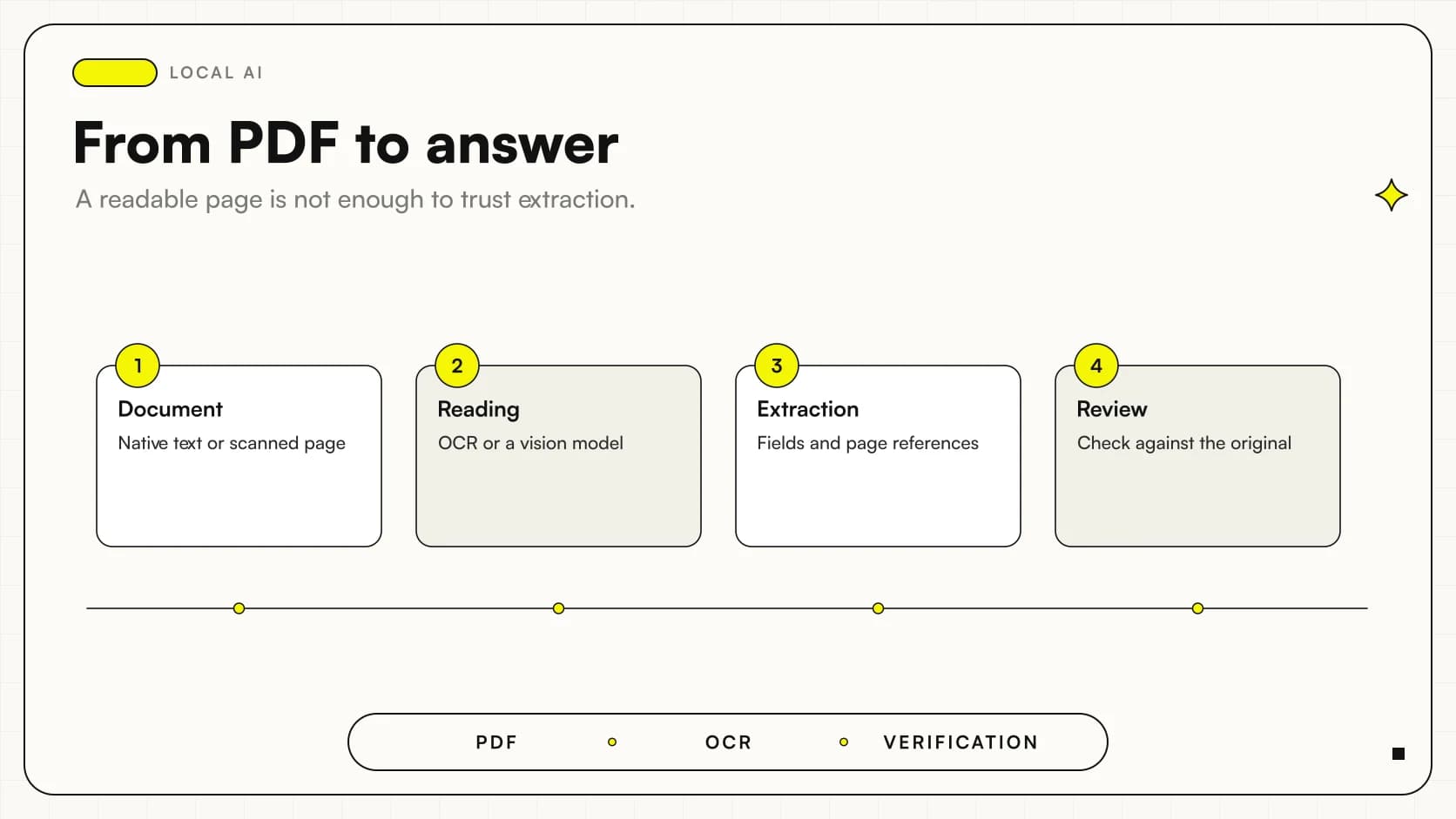 Local multimodal AI for business PDFs and images
 Local AI models: when they make sense
FAQ
Can Qwen3.8-27B run locally?
Yes, the official checkpoint weights are available to download. You need a compatible runtime, a supported format and enough memory for the intended workload.
Is Qwen3.8-27B dense or MoE?
The language model is dense, with 27 billion parameters in addition to its vision component. It should not be confused with MoE models in the Qwen family.
What is the native context window of Qwen3.8-27B?
The model card specifies 262,144 native tokens, extendable to one million with appropriate configuration. Usable capacity also depends on memory and runtime.
Can Qwen3.8-27B understand images and video?
The model card describes native image and video understanding. A PDF still needs a pipeline that prepares its content and preserves page references.
Is Qwen3.8-27B free for businesses?
The official checkpoint is distributed under Apache 2.0. Hardware, operation and integration still incur costs, and license obligations and requirements applying to the process must be respected.