
ChatGPT vs Perplexity: Research or Generation
ChatGPT vs Perplexity: one generates answers, the other searches and cites sources. When to use each and why to combine them.
Reading time: 10 min
Between ChatGPT and Perplexity There is no absolute winner: they solve two different problems. ChatGPT is a generation tool — writes, rewrites, reasons and reworks text from what he learned during training. Perplexity is a response engine — for each question he searches the web in real time, reads the pages and produces a summary citing the sources from which he drew it. The sentence to remember is simple: ChatGPT generates, Perplexity searches and quotes.
This difference changes everything in practical use. If you have to write an email, summarize a document you already have or set a reasoning, you want a generator. If you need to know an up-to-date data, legislation, news, and then cite its source, you want a search engine with a response. Confusing the two roles is the most common mistake: asking for "updated and verified information" to a pure generator brings straight to the hallucinations, that is, invented answers said with certainty.
In this guide we compare the two tools on the criteria that really matter for a professional or an SME — quality on the task, current events, quotation of sources, Italian, privacy — and see when to choose one, when the other and why often the right answer is use them together.
In summary
- ChatGPT generates: writes, rewrites and reasons; it is strong on creative and reworking tasks, but by itself it does not guarantee updated sources or data.
- Perplexity Searches and Quotes: starts from the web, synthesizes the answer and shows the links, so you can verify; it is designed for informational research.
- There is no absolute winner: it depends on the task. To write choose a generator, to search with sources choose a response engine.
- The winning combination is often only one: Perplexity to collect sources, ChatGPT to transform them in a finished text.
- Answers with sources also go verified: open the links and check that the source really says what is attributed to it.
What is the real difference between ChatGPT and Perplexity
The difference is not "brand" but of task architecture. To understand it just look at what happens when you ask a question.
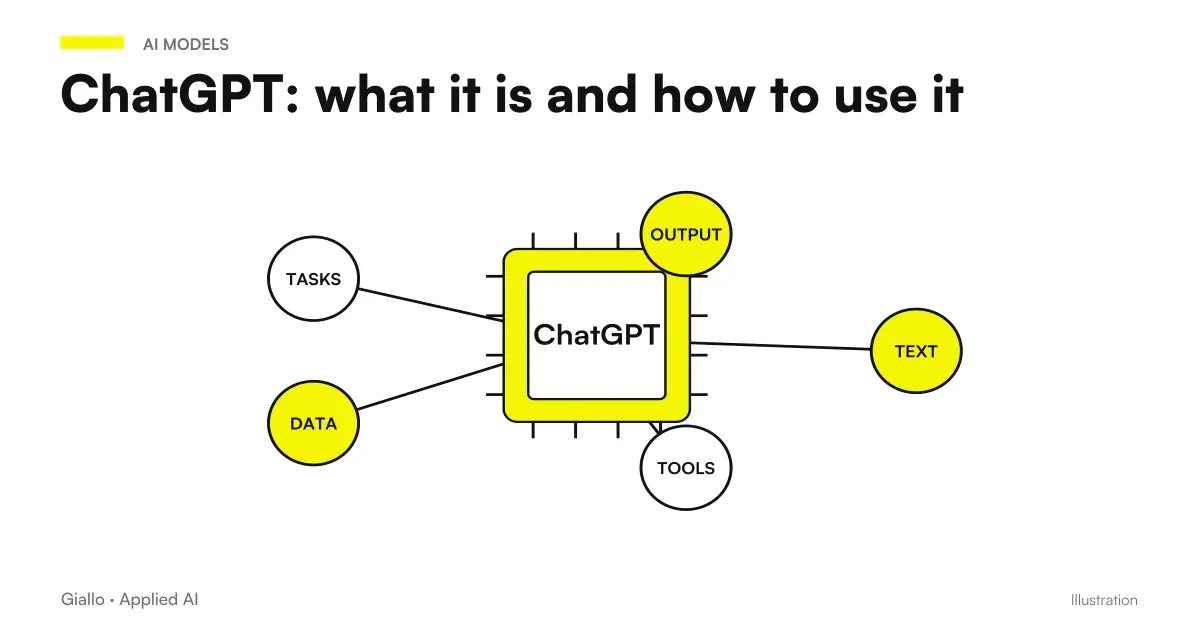
With ChatGPT, in the basic mode, the model responds by drawing on what it "compressed" during training: a statistical representation of huge amounts of text. He's not reading the web at the time, he's predicting the most likely response word after word. It is a very powerful mechanism for writing and reasoning, but it has two limits: it does not know what happened after its training and it does not have a "source" to show you, because the answer does not come from a precise page. If you want to understand this mechanism more thoroughly, it is explained in the guide What is ChatGPT.
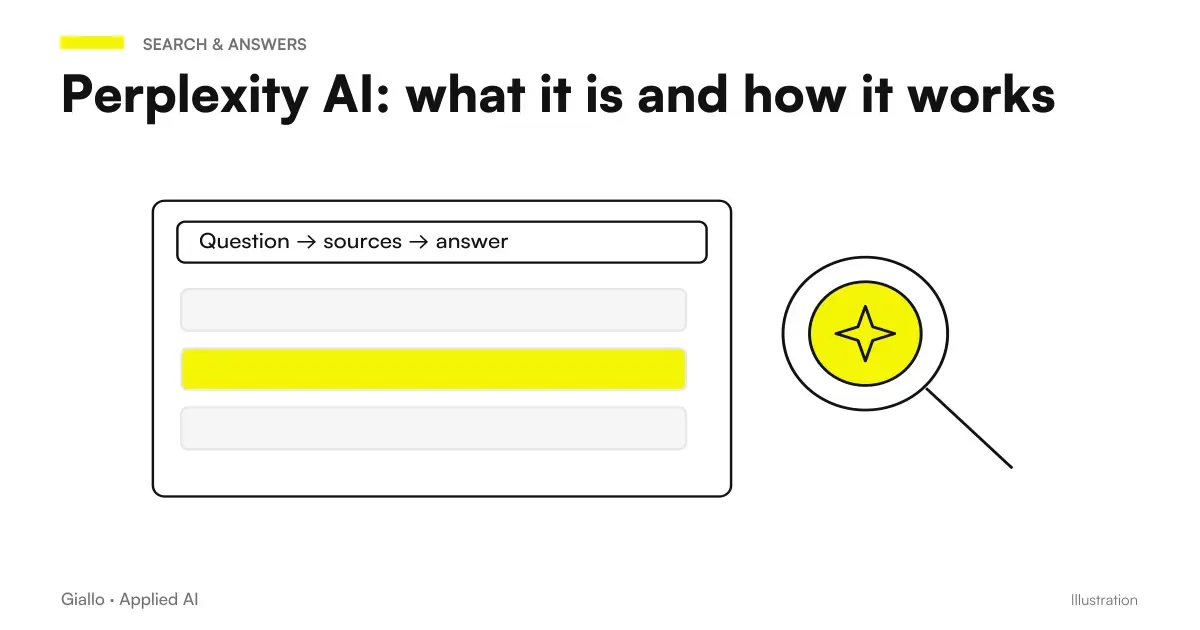
With Perplexity the flow is spilled. Search first: Turn your question into a query, query the web, retrieve some relevant pages. Then he reads and synthesizes: he uses a linguistic model to summarize those pages into a coherent response. Finally quote: it shows you the numbered links from which it took the information. It is closer to a Research Assistant that to an author. Find the complete picture in the guide What is Perplexity AI.
ChatGPT vs Perplexity: Comparison on Criteria That Matter
Here are the two tools compared on the practical criteria for those who work. It is not a ranking: it is a map to understand who to entrust to which task.
| Criterion | ChatGPT (generation) | Perplexity (search + sources) |
|---|---|---|
| What it does best | Writing, rewriting, reasoning, summarizing text you give him | Find information on the web and synthesize it with links |
| Sources cited | Only if it uses web search; basic not | Yes, normally for each answer |
| Updated data | Limited without active search | Yes, it starts from the web in real time |
| Risk of hallucinations | Higher in responses only "by heart" | Lower, but sources still need to be verified |
| Long and Creative Texts | Strength | Less oriented to extended writing |
| Verifiability | Difficult without links | Easy: open the cited sources |
| Typical use case | Email, content, drafts, code, brainstorming | Market research, regulations, news, source collection |
The table reading is clear: the two tools They don't compete on the same ground. ChatGPT wins where it needs to produce text; Perplexity wins where it needs to find and demonstrate information. If this scheme is useful for you to choose in general, find a structured method in the guide how to choose an AI model.
When to use ChatGPT and when Perplexity
Choose ChatGPT when
- You have to write or rewrite a text: emails, articles, descriptions, answers.
- You already have the material (a document, data) and you want to rework or summarize it.
- You need to think about a problem, brainstorm, structure a plan.
- Work on code or format transformations where sources matter little.
Choose Perplexity when
- Look for up-to-date information: news, prices, data, recent regulations.
- You must cite sources in a report, search, or due diligence.
- You want a quick summary of a topic with links to deepen.
- You are exploring a market or supplier and need a traceable starting point.
A practical rule that almost always works: if the question starts with "write me," it's ChatGPT; if it starts with "what's the data/source/news about...", it's Perplexity. When you realize you are asking a generator for information that you should be able to quote, it is the signal that you are using the wrong tool.
Why it is often better to use them together
The question "ChatGPT or Perplexity?" is almost always misplaced. Professionals who value it most put them in sequence, exploiting the strength of each: first the search with sources, then the generation of the finished document.
- Frame the question with Perplexity. Search for up-to-date data, sources, and facts. Gather the links you need to support the speech.
- Check the sources by hand. Open the main links and check that they really say what the summary states, especially about numbers, dates and norms.
- Pass materials to ChatGPT. Paste the verified facts and ask to turn them into a text: report, email, tab, post. Here counts the quality of the writing.
- You reread and correct. Keep final control over tone, accuracy and responsibility. AI prepares, the person decides.
This "search and cite → generate" workflow is the most robust way to use AI for knowledge work: it reduces the risk of hallucinations because the factual part comes from real sources, and maintains the writing quality because the writing is done by the generator. If you are looking for an overview of the tools oriented for this purpose, see Best AI for Research.
Practical examples
Three realistic scenarios of Italian professionals and SMEs, to see the comparison to the work.
1. Accounting firm — verification of a regulatory deadline. An employee needs to know if a certain facilitation is still in place and cite its source for circulating to customers. With a "memory" generator it risks a plausible answer but dated or invented. With Perplexity gets the most recent summary with links to official sources, which the study opens and verifies before writing the circular. Then the final draft, in the tone of the study, finishes it with ChatGPT.
2. E-commerce — market research for a new category. Before launching a product line, the holder uses Perplexity to collect trends, competitors and average prices with traceable sources. Once the data is verified, pass the material to ChatGPT to produce the first Product Descriptions and a draft editorial plan. Verifiable research on the one hand, fast writing on the other.
3. Consulting study — customer report. The consultant must deliver an analysis with updated data and bibliography. He builds the scaffolding of sources with Perplexity, check the links, and use ChatGPT to give structure, synthesis and coherent language to the final document. The preparation time drops, but the responsibility on the contents remains human.
In all cases the pattern is the same: Perplexity Brings Traceable Facts, ChatGPT Brings Shape. Neither, alone, covers both needs well.
The cited sources are not enough: always check
The fact that Perplexity shows links is a huge advantage over a "naked" answer, but it's not a guarantee of truth. It's worth fixing, because that's where you're most wrong.
- The summary can misrepresent the content of a page: says one thing, the source says another.
- You can quote weak sources (forums, pages not updated) next to authoritative sources, without distinguishing them.
- Can Mixing data from different years, making an old number seem current.
- Up Numbers, Dates and Standards error costs: they must be checked at the source, always.
In other words: the cited source gives you the possibility to verify, it does not relieve you from doing so. It is the reason why, in business processes, it is better to define where human verification is mandatory. On this the theme of AI Hallucinations explains how to reduce risk in a systematic way.
Mistakes to Avoid
- Asking sources to a pure generator. Without active search, ChatGPT can "invent" citations and links that look real. If you need sources, start from a search tool or explicitly activate web search.
- Trusting the summary without opening links. The presence of sources reassures, but the synthesis can be wrong. On critical data, open and read.
- Using Perplexity to write long, edited texts. It was born to search and synthesize, not to produce extensive content: for that a generator yields more.
- Choosing the "favorite" tool instead of the right one. The task decides, not the habit. The same user, on the same day, may need both.
- Pasting sensitive data without criterion. Entering personal data of customers in public tools can violate the GDPR. Rules are needed on what you can share and where.
How to apply it in the company
For an SME the value lies not in "choose the best tool", but in the assign to each process the appropriate tool with clear rules. It's a mapping job, not a buying job.
- List tasks where you need to search and quote (normative, market, suppliers) and those where you need to write (email, content, reports).
- Assign the right tool to each: search verifiable to a response engine, generation to a generator.
- Define where human verification is mandatory: numbers, dates, standards, customer communications.
- Write privacy rules: what data can never end up in a public instrument.
- Measure before and after: hours saved, mistakes avoided. Without numbers you don't know if it's working.
When these two tools get into the processes permanently —and there's no "personal proof" left —the efficiency leap becomes measurable. That's exactly the kind of work we do with the AI Consulting: understand which task to entrust to which tool, integrate it into the flows and define the rules of verification and privacy. If you want to see concrete experiments, take a look at the The Lab.
"Can I just use one to save money?"
You can, but you pay a compromise. With ChatGPT alone you lose ease of searching with traceable sources; with Perplexity alone you lose quality in long writing. For many realities the combination costs little and covers both needs. The choice depends on how much, in your work, the verifiable search weighs compared to the text generation.
Conclusion
ChatGPT and Perplexity are not rivals to be placed in the ranking: they are two different roles. One generate text and reasoning, the other search and quote information on the web. The right question is not "which one is the best", but "what do I have to do now": write or find a verifiable data. And often the most effective answer is to use them sequentially —Perplexity for sources, ChatGPT for form —always checking links on points that matter. From here you can continue with how to choose an AI model for a wider method of choice, and with Best AI for Research for research-oriented tools.
Do you want to understand what processes in your company can be automated with AI? Giallo Studio can help you turn the problem into a real workflow.
Giallo Studio guides: methodology and sources
How we apply it in the company
Related resources
 ChatGPT: what it is and how to use it
 Perplexity AI: what it is and how it works
 Best AI to do research
 AI Hallucinations: What They Are and How to Avoid Them
 How to Choose an AI Model
 AI quote automation: save hours on every offer
 AI prompts for lawyers: legal documents and communications
 AI marketing prompts: copy, campaigns and content
Other direct comparisons
The same criteria applied to other model pairs.
- ChatGPT vs Grok
- Claude vs DeepSeek: Which to Choose
- ChatGPT vs Gemini: practical differences
- Claude vs Gemini: Which to Use
- ChatGPT vs DeepSeek: Which to Choose
- Claude vs Perplexity
- ChatGPT vs Copilot: which to use in business?
- Claude Fable 5.1 vs Sonnet 5
- ChatGPT vs Claude: which one to choose
- Gemini 3.6 Flash vs 3.5 Flash
- ChatGPT Plus vs Claude Pro: which subscription to choose
- ChatGPT vs Gemini: which subscription is worthwhile in October 2026?
FAQ
What is the main difference between ChatGPT and Perplexity?
ChatGPT is a generation tool: it writes, rewrites and reasons starting from what it has learned in training. Perplexity is an answer engine: for every question it searches the web, reads the pages found and synthesizes an answer citing the sources. In short, ChatGPT generates, Perplexity searches and cites.
Does Perplexity always cite sources while ChatGPT does not?
By default, yes: Perplexity is designed to show links to the sources of its answer so that you can verify it. ChatGPT cites sources only when it uses web search; answers generated solely from the model’s memory contain no links and carry a higher risk of invented information. Always check the links anyway, because even an answer with sources can cite them incorrectly.
Is Perplexity or ChatGPT better for research?
To search for up-to-date and verifiable information (news, data, regulations, sources to cite) Perplexity is usually more direct because it starts from the web and shows links. To reason, write and rework a long text ChatGPT is more suitable. Many use them together: Perplexity to collect sources, ChatGPT to turn them into a document.
Can I trust Perplexity answers that include sources?
More than an answer without sources, but not blindly. The summary can misrepresent the content of the page, cite weak sources or mix data from different years. The rule is to open links and check that the source really says what the AI attributes to it, especially on numbers, dates and regulations.
Do ChatGPT and Perplexity use the same model?
Not necessarily. ChatGPT uses OpenAI models. Perplexity is a search layer that can rely on different models (from various providers) to generate the final summary. The point is not the model itself, but the approach: generating an answer versus searching for it on the web and citing it. Versions and models change frequently: check the official page.
Is it better for a company to adopt ChatGPT or Perplexity?
It depends on the task, not the company. To write emails, content and drafts a generator like ChatGPT is worth it; for market research, due diligence and collection of verifiable sources, Perplexity is worth it. The most sensible choice is to map processes and assign each one the right tool, with clear rules on privacy and data.