
Best AI for Translations: Tools and Comparison
Best AI translation tools in 2026: compare DeepL, Google Translate AI, ChatGPT and others for Italian SMEs and professionals.
Reading time: 8 min
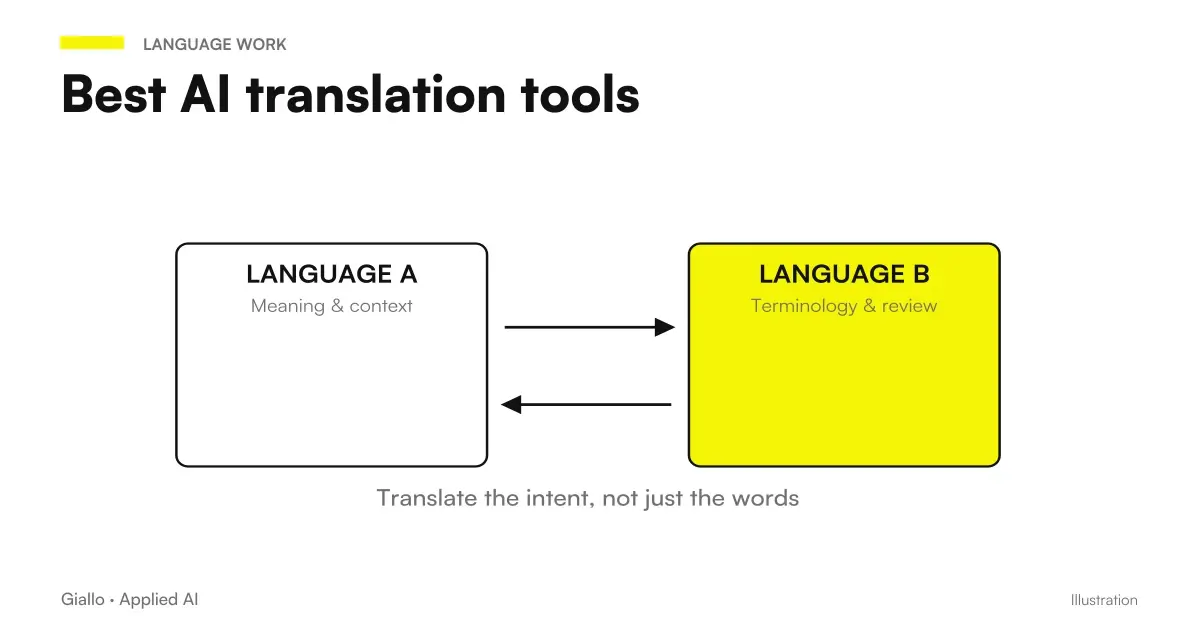
The best AI tools for translations In 2026, they do not just convert words from one language to another: they manage tone, register, sector terminology and, in some cases, the entire localization flow of a site or digital product. For an Italian SME that wants to expand abroad or receive foreign customers, choosing the right tool means saving time and reducing errors that damage the corporate image.
The difference between a generic AI translator and a professional tool lies in the context: modern models understand the domain (legal, technical, marketing) and can respect business glossaries and communication styles. The quality gap with human translation has narrowed significantly, but it is not zeroed — and knowing when to trust AI and when to rely on a professional is the most important skill.
This guide compares the tools most widely used in the Italian market, focusing on concrete use cases for SMEs, e-commerce, professional practices and agencies. We are not discussing which Model AI is more powerful than ever (that is a separate theme), but of which applications and products they work best to translate into daily practice.
- DeepL Pro is the quality standard for European languages, with customizable glossaries and APIs for business integrations.
- Google Translate It covers over 130 languages and is ideal for non-European languages or non-critical rapid translations.
- ChatGPT and Claude excel in contextual translations where you need to specify tone, sector or formal/informal register.
- Weglot and Lokalise AI are designed for website and app localization, with centralized multi-language content management.
- For legal documents, contracts and medical texts, Human review remains mandatory regardless of the instrument used.
- Integration via API (DeepL, Google Cloud Translation) allows you to automate translation into CMS, e-commerce and business management software.
What are the best AI tools for translations in 2026?
The market for translation AI tools is divided into three categories: autonomous translators (DeepL, Google Translate), generalist AI assistants used as translators (ChatGPT, Claude), and localization platforms (Weglot, Lokalise, Phrase). Each serves different needs.
DeepL is the most cited tool by European professional users for the quality of translations in the languages of the continent. The Pro version adds custom glossaries (fundamental for maintaining terminology consistency), native Word/PDF file translation, and integration APIs. The limit is language coverage reduced compared to Google: about 30 languages versus Google Translate's 130+. Check current plans and prices on the official website.
Google Translate remains the starting point for those who need to quickly understand a text in non-European languages. Quality for Italian, English, Spanish and French has improved a lot in recent years, but it tends to be more literal and less fluid than DeepL. The Google Cloud Translation API is widely used for integrations into large systems, thanks to scalability and broad language coverage.
ChatGPT and Claude as translators offer a unique advantage: the ability to give contextual instructions. You can ask "translate this press release into formal English for a North American audience, avoiding typically British terms" and get a result that no classical machine translator could produce. The limit is that they do not handle structured files (XLSX, XLIFF) and do not integrate natively into CMS.
Weglot is designed specifically for website localization: it installs as a plugin (WordPress, Shopify, Webflow) and automatically translates content using an AI engine, with the possibility of manual review. Manages multilingual SEO with hreflang and dedicated URLs. Plans vary according to word volume and active languages: check the updated prices on the site.
Lokalise AI is a professional platform for teams that manage localization of apps and digital products. Integrate AI for automatic translations, translation memories, glossaries, and revision workflows. It is more complex and expensive than DeepL or Weglot, but it is the right choice for those who manage thousands of strings in multiple languages with distributed teams.
Microsoft Translator (integrated into Azure and Microsoft 365) is relevant for businesses already in the Microsoft ecosystem: it natively integrates into Teams, Word, and Outlook, and supports real-time translation in meetings. The quality is comparable to Google Translate, with obvious advantages for those who use Copilot in business documents.
To learn more about how the underlying AI models affect the quality of translations, see the Guide to the main AI models. If you are considering Claude for long documents, its ability to handle extended texts makes it an excellent option even to translate manuals or technical reports.
Practical examples: how Italian SMEs use AI for translations
Case 1 — Fashion E-commerce Selling in Europe
An Italian e-commerce with 500 SKU wants to translate product cards into English, German and French. With DeepL Pro API built into management software, it automates the initial translation of each new card in seconds. An internal copywriter only revises the texts of the main collections (about 20% of the catalog), while the remaining 80% is published after a superficial revision. Result: translation time reduced from 3 weeks to 3 days for seasonal update, with marginal cost almost zero for standard volume.
Case 2 legale Law Firm with International Clients
A Milan law firm receives contracts in English and must respond with counterproposals in Italian. It uses Claude to translate incoming documents and quickly understand their contents (avoiding paying a translator for every preliminary draft). To understand how Law Firms Use AI, there are specific use cases that go beyond simple translation. Before signing any document translated with AI, the lawyer reviews or commissions a certified translation. Estimated savings: 60-70% on translation costs for internal documents, with zero risk on final legal documents.
Case 3 — Communications agency with clients in multiple countries
An agency that manages social media for Italian brands operating in 4 European markets uses ChatGPT to adapt the posts in a colloquial tone (not only translate, but locate the register). The agency's standard prompt includes instructions on brand voice, allowed emoji, and hashtags to maintain. This stream reduces the production time of each localized post from 30 minutes to 5-10 minutes.
AI tool comparison for translations
| Tool | Strengths | Limitations | Indicative price |
|---|---|---|---|
| DeepL Pro | Excellent European Language Quality, Glossaries, Native Files, API | ,30 languages, less effective for Asian languages | From )8-10 €/month (verify official website) |
| Google Translate | 130+ languages, free for basic use, scalable API | Less fluid than DeepL in EU, often literal tone | Free; API to consumption |
| ChatGPT Plus | Contextual instructions, customizable tone/sector, no practical length limit | No native CMS integration, no XLIFF file | $20/month |
| Weglot | Key-in-hand website localization, multilingual SEO, CMS plugins | Not suitable for standalone documents, cost scale with volume | From )15 €/month (check official website) |
| Lokalise AI | Workflow team, memory translation, glossaries, dev integrations | Learning curve, high cost for small SMEs | Business plans (verify official website) |
| Microsoft Translator | Integrated into M365/Teams, real-time meeting translation | Lower quality than DeepL for EU, less customizable | Included in Microsoft 365 plans |
- Quick translations of standard texts: e-mails, product cards, presentations
- High volume with need for API integration into enterprise systems
- Texts in non-European languages (Google Translate)
- When you need a native translated file (DOCX, PDF) with no intermediate steps
When to use ChatGPT or Claude as translators
- Creative texts, copy marketing, social posts where tone matters as much as words
- Technical documents in specific areas where you can specify terminology
- When you need to locate (adapt to market) not just translate
- Review and improvement of existing translations
Errors to Avoid When Using AI for Translations
1. Publish unreviewed AI translations for critical texts. Contracts, legal documents, medical texts and official press releases always require human review. An error in a contract translated by AI can have real legal consequences.
2. Ignore the corporate glossary. If your company has specific terminology (product names, brands, internal acronyms), you have to configure it in the tool. DeepL Pro allows custom glossaries; with ChatGPT you can insert them into the prompt. Without this configuration, the terminological coherence is random.
3. Rely on a single tool for all languages. DeepL is excellent for European languages but poor for Japanese. Google Translate handles Asian and African languages better. Using the wrong tool for the right language is a frequent mistake.
4. Do not consider the register and tone. "Translate" does not just mean replacing words: a formal text in Italian may be overly rigid in American English. If the tone counts, use a tool that allows contextual instructions.
5. Use AI translation for multilingual SEO without verification. Automatic translations do not consider keyword search volumes in the target language. A perfectly translated article could be optimized for keywords that no one is looking for. SEO localization requires separate keyword search for each market. If you are building a multilingual SEO strategy, see the Best AI Tools for SEO to complete the flow.
How to Choose the Right AI Translation Tool for Your Business
The choice depends on three main variables: volume, content type and budget.
For SMEs with occasional needs (some emails or documents per week), ChatGPT Plus or DeepL Free are sufficient. The cost is minimal and the quality adequate for most non-critical texts.
For e-commerce and websites that need to manage multilingual content in a systematic way, the optimal solution is DeepL API integrated into the CMS or Weglot if you want a managed solution. API integration eliminates manual copy-paste and reduces errors. See also how the AI supports e-commerce more broadly, from translation to personalization.
For Professional Studies (legal, accountants, consultants) who receive documents in foreign languages, the most effective combination is: DeepL or ChatGPT for quick understanding of the document, professional translator for final documents to be signed or registered.
For companies with international teams Managing software, apps, or technical documentation in multiple languages, Lokalise AI or Phrase are the most comprehensive platforms, with review workflows, translation memory, and integrations with development systems.
Always consider the total cost: a free tool that requires 2 hours of manual review can cost more than a paid tool that reduces the review to 20 minutes. It calculates the cost of time, not just software.
To understand how to integrate these tools into broader business flows, the page AI Tools provides a complete overview of the tools by category. If you already use ChatGPT for document analysis, you can extend the same flow to technical translation.
Conclusion
The best AI tools for translations in 2026 exist for different needs: DeepL for European quality and professional integrations, Google Translate for broad language coverage, ChatGPT and Claude for contextual translations and creative localization, Weglot for e-commerce sites. The choice is not "which is the best ever" but "which is the best for my specific use case".
The main risk is not using AI to translate, but blindly trusting the output without a revision proportionate to the importance of the text. For operational texts and daily communications, AI is already sufficient. For documents with legal or commercial value, human review is not optional.
AI becomes useful when it enters processes. Giallo Studio It helps SMEs and teams build concrete, measurable and sustainable automations — including translation and localization flows integrated into existing systems. If you want to understand how to automate the translation of your content without losing quality, Explore The Lab to see examples of real automations.
Giallo Studio guides: methodology and sources
How we apply it in the company
Related resources
 Best AI Tools: Complete Guide
 Best AI Models for Writing
 Best AI for long documents
 Best AI for email: tools to write and manage mail
 Best AI for business: which to choose in October 2026?
 The best AI model depends on the use case
 Copilot CLI finds local Ollama models: offline mode requirements and limits
 Kimi AI for Excel: Data Analysis and Controls
Comparisons by activity
Which tool suits the other tasks.
- Best AI for Students: Tools for Better Studying
- Best AI for Data Analytics: Tools and Platforms
- Best AI for social media: tools for content and management
- Best AI to Create Websites
- Best AI for SEO: Tools to Optimize Content
- Best AI for CRM: Sales Management Tools
- Best AIs to summarize PDFs and documents
- Best AI for Customer Care: Customer Service Tools
- Best AI for presentations: tools to create slides
- Best AI for email: tools to write and manage mail
- Best AI for Marketing: Tools and Platforms
- Best AI for Excel (October 2026): Copilot, ChatGPT, Claude or Gemini?
FAQ
What is the best AI for professional translations?
DeepL Pro is considered the standard for language quality in professional settings, especially for European languages. For technical or legal texts, it is advisable to combine DeepL with a human review. ChatGPT and Claude are valid alternatives for creative or contextual texts.
Are AI translations reliable for business documents?
For internal documents, e-mails, product sheets and informal communications, AI translations achieve an acceptable level of quality with rapid review. For contracts, legal documents or medical texts, the review of a professional translator or a native speaker is mandatory.
Is DeepL better than Google Translate?
DeepL outperforms Google Translate in fluency and naturalness for European languages, especially Italian, German, French and Spanish. Google Translate covers more languages (over 130 versus around 30 for DeepL) and is more effective for Asian and African languages.
Can I use ChatGPT as an AI translator?
Yes. ChatGPT translates with good quality and allows you to specify tone, register and sector terminology. The advantage over classic automatic translators is the ability to give contextual instructions: 'translate into formal Italian for the legal sector' or 'keep the colloquial tone'.
Are there AI tools for localising websites or e-commerce stores?
Yes. Tools like Weglot (with AI engine) and Lokalise AI automate the translation and management of multilingual content for websites, apps and e-commerce. DeepL API integrates into many CMS and platforms. For Shopify or WooCommerce stores there are dedicated plugins that take advantage of these engines.
How much does an AI translation tool cost?
DeepL Pro starts at around 8-10 euros/month for individual use. Google Translate is free for basic use, for a fee via API. Tools like Weglot or Lokalise AI have monthly plans varying according to word volume. ChatGPT Plus (20 $/month) includes unlimited translations. Always check updated plans on official sites.