
Copilot CLI finds local Ollama models: offline mode requirements and limits
Copilot Ollama simplifies local model detection. CLI requirements, explicit offline use and checks on code, network and hardware.
Reading time: 11 min
Copilot CLI can detect Ollama models on the local running server, but does not install the runtime and does not activate offline mode on its own. The novelty of October 7, 2026 introduces detection via /model and indicates as a requirement the CLI 1.0.94-0. Date, command and minimum version come from GitHub Official Changelog.
For an SME working on a reserved code it is an option to be carefully evaluated. The local model can change the path of the content, but the project must also verify network of tools, quality of responses and cost of the environment. Local describes where a component runs; offline describes a full path configuration. Confusing the two terms produces expectations that detection alone does not meet.
In summary
- The detection finds models already available on an active Ollama server.
- Runtime, model, and hardware remain to be prepared and maintained.
- Streaming and tool calling are requirements to be verified.
- Offline mode requires explicit choice.
- Quality, tool access and total cost must be measured on your project.
What changes in the model selection path?
The novelty reduces the work required to locate an Ollama model available in the CLI path. It is not equivalent to downloading the model, sizing the computer or verifying that the service responds correctly. The team must first set up a running runtime and choose a model compatible with the intended use. The selection command is the access point, not the preparation of the entire environment.
The GitHub documentation on BYOK models requires streaming and tool calling. A model capable of answering a question in chat may not handle tool calls and operational sequences in the same way. The test must therefore cover the flow of the agent, not just correctly generated text in a different interface.
The choice of model must be recorded along with the task. If an update changes behavior or requirements, the team must be able to compare outcomes. The guide to Local AI Models helps to read this difference between model availability and the system's ability to support concrete business work.
How do you distinguish the local model from offline mode?
Documentation indicates COPILOT_OFFLINE=true for explicit offline mode. A remote BYOK provider remains remote: using its own key does not move processing to the computer. These distinctions come from GitHub official guide and must be verified in the path taken by the company.
The team must describe the complete flow: client, runtime, model, tools, and destinations. A local model can be used by an agent who attempts to install dependencies or read online documentation. The possibility of working without a network therefore also depends on the task and preparation of the environment. A test run with everything already available does not prove that any future activity will be offline.
| Component | Question to ask | What not to infer |
|---|---|---|
| Model | Where is the inference performed? | That all tools are offline |
| Runtime Ollama | Is it active and managed properly? | That the detection installed it |
| BYOK Provider | Is it local or remote? | That a proper key means local |
| Offline mode | Has it been configured explicitly? | That the selection of the model suffices |
| Tools | What files and networks can they reach? | That they automatically follow the pattern boundary |
What capabilities to verify before using the model on a repository?
The first check is about understanding the task and producing a consistent diff. The second concerns the management of tools: reading files, interpreting errors and choosing the next steps. The third is about the ability to stop when information is missing. A model that produces plausible code but does not recognize a failed test requires more supervision than it looks in a demo.
The sample must contain changes of different difficulty and cases with a known outcome. It is also useful to observe how much context is needed and whether the environment maintains a latency compatible with the team's work. There is no uniform quality for all Ollama models: choice, configuration and hardware influence the result. Assessments must remain specific to the task being tested.
The comparison with a remote model must use the same definition of completion. If in the local test an operator manually corrects the diff, that time enters the cost. The quality accepted by the team is a condition of comparison, not a variable to be reduced to make a technical option look better.
How to choose hardware without promising untried performance?
The sizing starts from the selected model and the expected load. It is necessary to understand whether the computer should support only one developer, multiple sessions or a shared service. Available memory, loading times, and competition can become constraints. A machine that responds well to a short request may behave differently when the task requires multiple files and a sequence of tools.
Before buying hardware, test the environment already available or a suitable temporary configuration. The test should record the time needed to obtain an accepted result, resource usage and the human work required for corrections. These are proposed criteria, not benchmarks performed by Giallo. Without measurements, any estimate of performance or savings remains a hypothesis.
Total cost includes runtime management, upgrades, power, and service continuity. If the founder's computer becomes an indispensable component for the whole team, it is necessary to predict what happens when it is not available. The local-cloud comparison must consider this operational responsibility, not just the absence of a fee per token in the chosen local route.
Can a software house use it on proprietary code?
Hypothetical scenario. An Italian software house wants to evaluate a local model for small corrections on a proprietary management. The pilot uses a test repository, minimized data, and tasks with verifiable outcome. The agent prepares the diff and the operator revises it. The actual production code and credentials do not automatically enter the first experiment.
The sample includes a simple edit, a multi-file search, and a test that initially fails. The team observes whether the model corrects the cause or modifies the test to pass it. This behavior matters more than the ability to generate an isolated function. The result must meet the task and maintain the relevant controls.
The theme of Business Data and Privacy in AI remains applicable locally as well. Content can appear in logs, temporary files, and shared results. Reducing the transfer to a provider does not eliminate the need to define accesses, storage and recipients of the information generated by the system.
Can an SME automate internal scripts without depending on the cloud?
Second hypothetical scenario. A small commercial company wants to improve scripts that prepare reports from management software exports. The local pilot assists in editing the code and uses dummy files with the same structure. It does not directly perform operations on production data and does not replace the control of totals by the administration.
The test verifies missing fields, inconsistent encodings, and different formats. The model may propose error management, but the test must show that the report does not lose lines or alters matters. The company measures the time to arrive at a verified change and the ease with which a colleague manages to maintain it. A long code output does not in itself represent an advantage.
The offline path can be useful if the environment already contains necessary dependencies and documentation. If the script requires remote access to the management, the project must distinguish assistance with the code and execution of the business process. The local model does not automatically transform all connected systems into services on the computer.
What role does the sandbox play when the model runs locally?
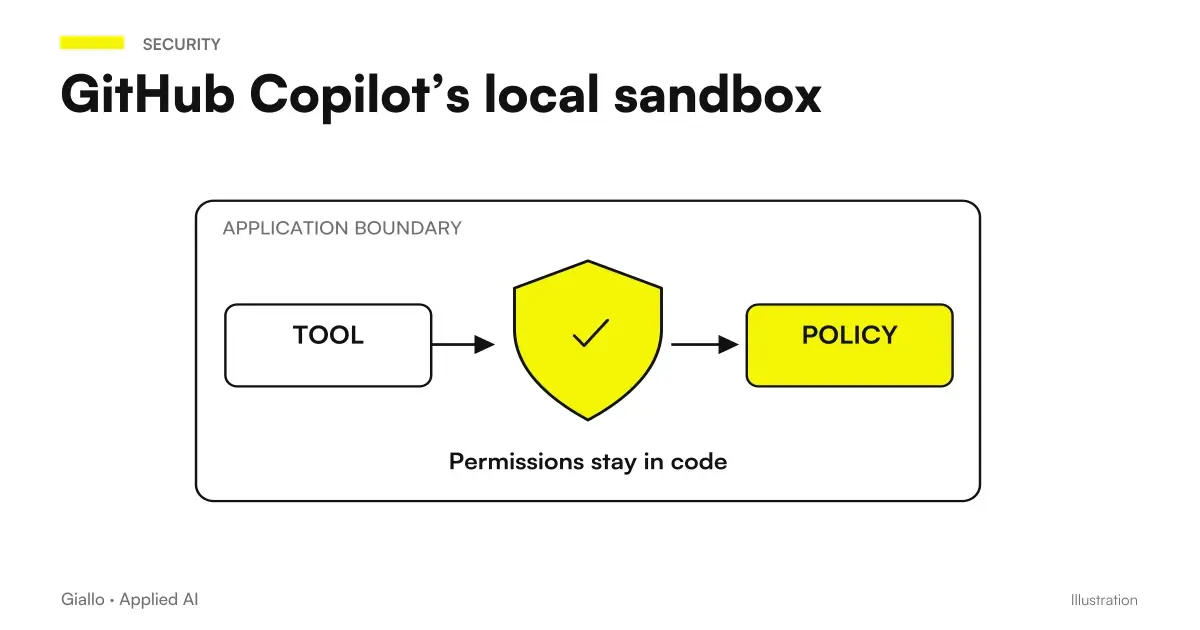
The model and tools have different boundaries. A local model can still propose or perform operations on file and network via the client. The GitHub Copilot local sandbox addresses the perimeter of the tools in the supported path; it is not an automatic consequence of the model being hosted by Ollama.
The project must try permitted and prohibited accesses with harmless material. You need to know if the agent can read foreign folders, write out of the repository or use credentials already present. The configuration must reflect the task, while an exception request must describe a concrete need. Opening the whole environment to pass a block reduces the value of the control.
The Guide on AI and Data Security connects these aspects to people's work. A local system may be an appropriate choice, but the responsibility to prepare and verify the environment remains with the company. The physical proximity of the computer does not automatically make the process correct.
How to manage browser or desktop tools in the same project?
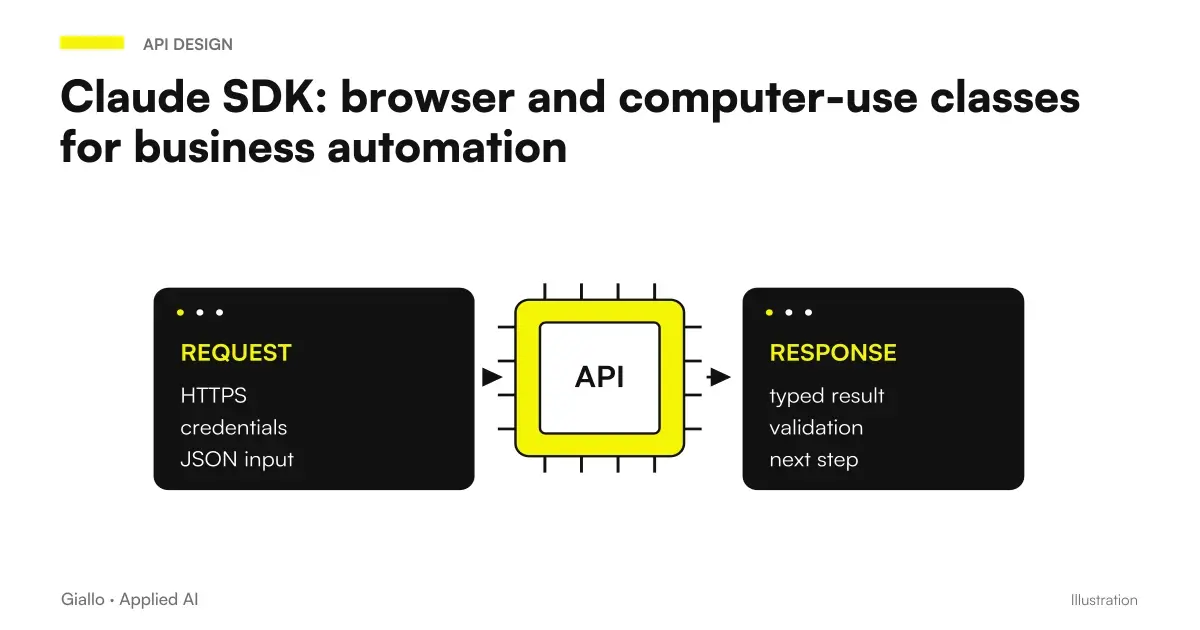
If the stream includes a browser, an authenticated session, or a portal, a specific control must be defined. The Claude SDK for browsers and computers use concerns another ecosystem, but highlights the separation between model and operating environment. Each component must have legible accesses and consequences, without importing guarantees from one product to another.
The availability of the local model may entice you to entrust it with more activities. Instead, it is advisable to initially maintain the same mandate and measure the result. Adding tools changes the risk and definition of completion. A code correction and sending a practice through a portal are different jobs, even if initiated by the same conversation.
The team must indicate which steps require human approval and how the operator can control the concrete action. Offline configuration is not an authorization to perform irreversible actions on local data. Files, results, and changes maintain the business value they had before the introduction of the assistant.
What to measure in comparison between local models?
The main result is the task accepted by the auditor, accompanied by total time and corrections. There are errors of understanding, invalid tool calls, and unnecessary attempts. It is useful to distinguish a model problem from a poorly prepared environment. Without this separation, an unstable runtime can discard a suitable model or an easy demo can hide important limits.
The in-depth study on ML Drift and local open source AI offers another point of view on maintaining behavior. For your project it is best to keep an evaluation sample and try it again after model or configuration changes. An update should not be considered automatically better just because it is newer.
The Guide to Copilot AI helps to read the product in its context. In this case we talk about the CLI for development and tools, not every service that uses the name Copilot. The comparison must be about the actual path the developers will use.
Before calling the pilot offline
Check model and runtime actually used. Check the explicit offline configuration and CLI requirements. Test the task with the expected dependencies and observe what tools require network. Check temporary files, logs, and credentials. It records what works without a link and what steps remain outside the perimeter, instead of using a generic label.
Who keeps runtimes and models after the first test?
A local environment needs operational responsibility. The team needs to know who installs the updates, who verifies that the correct model is available, and how a disruption is handled. A machine configured by a developer can work during the pilot and become difficult to restore if the steps are not documented. Continuity requires reproducible instructions, without including secrets in shared documents.
It is useful to record runtime version, selected model and configuration relevant to the test sample. When an item changes, you repeat representative tasks before extending the update. It is not necessary to block every evolution of the environment; it is necessary to be able to recognize which modification introduced a regression or a new hardware requirement.
The manager must also provide an alternative when the service is not available. The team can return to manual work or use another already authorized path, without automatically transferring reserved code to a remote provider to overcome a block. The restart mode must comply with the same constraints that motivated the local choice. In this way business continuity does not become an implicit exception to data rules.
What promises to avoid in the final decision?
Do not promise zero cost, universal compatibility or identical quality across all models. Intelligent routing between local and cloud, described as future development, must not be presented as a feature already guaranteed by this announcement. The absence of transfers outside the business must also be verified across the complete workflow, rather than inferred solely from selecting Ollama.
There is no Italian exclusion from the changelog, but client, runtime, model and hardware requirements remain concrete. To choose a local AI environment suitable for the code and data processed, the design of the Business Software can start from a test task, from the comparison between accepted results and from a map of the destinations actually reached.
Giallo Studio guides: methodology and sources
How we apply it in the company
Related resources
 GitHub Copilot: Local sandbox available, how it limits files, network and credentials
 Claude SDK browser and computer use classes: automating business software
 Local AI models: when they make sense
 Business Data and AI: What Happens to What You Write
 Copilot AI: what it is and how to use it
 AI and data security: concrete risks and how to manage them
 ML Drift becomes open source: Local AI on smartphones, browsers, and desktops
 Superintelligence, memory and RAG: getting to know the company
FAQ
Does Copilot CLI automatically install Ollama?
No. Detection requires a running Ollama server and an available model. Installation, management, and updates remain tasks to be performed.
Is any local model compatible?
No. Documentation requires capabilities such as streaming and tool calling. Compatibility and quality must be tested on the actual task.
Does using Ollama mean you are automatically offline?
No. Choosing a local provider and explicit offline mode are separate decisions. The tools the agent uses may also have network requirements that need checking.
Does a remote BYOK provider become local?
No. Bringing your own key does not change the provider's execution location. The project must identify who receives the content and under what conditions.
Does local mode eliminate all costs?
No. Hardware, management, energy, upgrades and people's time remain to be considered. Economic comparison must include quality of results and verification work.
Is automatic routing between local and cloud models already guaranteed?
It should not be presented as a current function based on this announcement. The intelligent routing described as future development remains separate from the available detection.