
ChatGPT Ads cost: CPC, CPM, minimum budget and welcome credit
ChatGPT Ads cost explained: CPM, CPC and conversion campaigns, the €15 daily minimum, billing, welcome credit and a worked test budget.
Reading time: 11 min
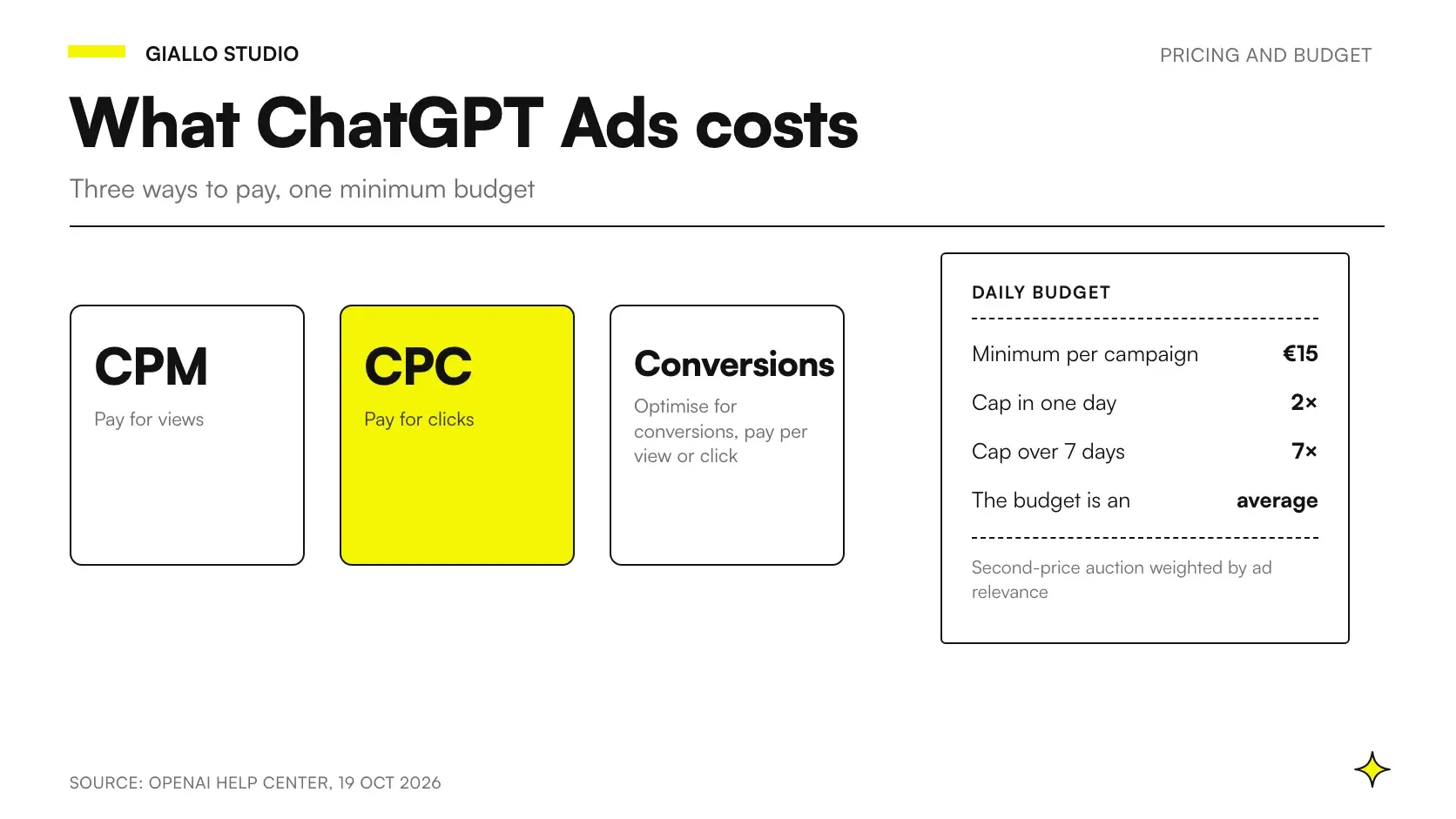
ChatGPT Ads cost is not in any price list: an auction decides the price. For an account in euros, the natural choice for an Italian business, every campaign requires a minimum daily budget of €15, and you pay either for views (CPM) or for clicks (CPC), according to the official campaign guide. With the conversions objective you choose whether to pay per impression or per click: never per conversion.
OpenAI does not publish average CPCs or CPMs in euros and says it does not yet have performance benchmarks (advertiser FAQ). The only official number on price is a recommendation: for click campaigns, start with a maximum bid of $3-5. The $60 CPMs you read about online come from the managed pilot in the United States, not from Italian self-serve.
The data below comes from the official pages checked on 19 October 2026. Who sees the ads and where they appear is explained in the complete guide to ChatGPT Ads.
In summary
- On ChatGPT Ads you buy by views (CPM), by clicks (CPC) or with the conversions objective, which is paid per impression or per click, never per conversion.
- The minimum daily budget is €15 per campaign for accounts in euros. It is an average over seven days, with a cap of double the budget on any single day.
- The price comes from a second-price auction in which the bid and the relevance of the ad count together.
- Payment is postpaid, by credit card, and for businesses in the European Economic Area (EEA) the contracting party is OpenAI Ireland Ltd.
- The Italian OpenAI Ads page offers new advertisers €500 in credit after €500 spent; unless the conditions say otherwise, credits expire after 90 days.
How do you pay for ChatGPT Ads: per view, per click or per conversion?
ChatGPT Ads offers three campaign objectives: each sets what you pay for and what the system optimizes. In Ads Manager they are called Views, Clicks and Conversions.
| Objective | What you pay for | What the system optimizes | Bid you set |
|---|---|---|---|
| Views (CPM) | Every thousand impressions | Broad reach and brand visibility | Maximum CPM per ad group |
| Clicks (CPC) | Every valid click | Clicks from users likely to engage | Maximum CPC per ad group |
| Conversions | Impressions or valid clicks, chosen at creation; never the conversion | People more likely to complete the chosen event | Bid Cap, meaning how much you are willing to bid for a conversion |
The definitions come from the campaign guide and from OpenAI's page on conversion-optimized campaigns, checked on 19 October 2026. Three details weigh on cost. Objective and payment method cannot be changed after creation: to switch from CPM to CPC, or from click to impression, you need a new campaign or a copy. The conversions objective requires active tracking, with Pixel or Conversions API, on a standard event. And for this objective, in the pages checked, OpenAI does not give a recommended bid.
OpenAI itself shows where the market is heading. In the first phase of the pilot you could only buy on CPM; CPC arrived on 5 May 2026 (OpenAI). On 31 August 2026 OpenAI reported that click bids and results-optimized bids now make up the majority of campaigns (OpenAI).
How is the price of a click decided in the ChatGPT Ads auction?
An auction decides it, not a price list. When several ads are eligible for the same response, OpenAI uses a second-price auction weighted by relevance (advertiser basics guide). In a second-price auction, as a rule, the winner pays less than its maximum bid: an amount tied to the competitor ranked next. Relevance changes the ranking, so an ad that fits the conversation can beat a higher bid. OpenAI does not publish the formula.
Three levers affect how much you spend per click:
- The maximum bid per ad group. For click campaigns OpenAI recommends starting from a maximum CPC of $3-5: that is a suggested ceiling, not an observed average cost, and the actual click may cost less. Ads Manager can flag when a bid risks limiting delivery.
- The bid strategy. For new eligible ad groups, “Maximize results” is the default; it adjusts bids automatically to get more results from the budget. It does not guarantee a target CPC: if you have a firm cap, choose the manual maximum bid (Help Center).
- Multipliers on custom audiences, from 0.1x to 10x, for people who appear in an uploaded customer list. Lists and minimum thresholds are covered in the guide to ChatGPT Ads targeting and privacy.
What is the minimum budget for ChatGPT Ads and how is it spent?
The minimum daily budget is €15 per campaign for accounts billed in euros, according to the table of minimums in the OpenAI campaign guide. In the pages checked on 19 October 2026, by contrast, no overall minimum spend commitment appears for self-serve.
There are two ways to set the budget. The total campaign budget fixes spend for the whole duration and is the strictest control. The daily budget is an average over seven days: with €20 a day a campaign can spend up to €40 on a single day, but no more than €140 in the week, from Sunday to Saturday in the account's time zone (daily budgets).
OpenAI recommends that newcomers start with the daily budget; switching from a total budget to a daily one, however, cannot be reversed. The advertising terms add that a pause or a change can take up to one business day to take effect, with accrued spend charged to the advertiser, and that access to Ads Manager does not guarantee delivery or results. Finally, for conversion campaigns OpenAI states that the aim is to improve results, not to use up the budget.
How do billing, credit card payments and taxes work on ChatGPT Ads?
The model is postpaid: you pay after the ads are delivered, with the credit card saved in Ads Manager (billing and payments). When you enter the card, the bank may show a temporary verification hold: it is not a charge and clears on its own, although it can stay visible for 8 days or more.
You are not charged at every click. Each account has a payment threshold: when unpaid spend reaches it, the card is charged, and at the end of the month any remainder is settled anyway. Thresholds start low and can rise with a history of regular payments; support does not change them. The threshold does not cap spending: budgets do that. If a charge fails, ads may stop.
The country, currency and time zone chosen at sign-up can no longer be changed: if they are wrong, you need a new account (account setup). The sign-up steps are in the guide to ChatGPT Ads Manager and your first campaign.
For businesses in the European Economic Area (EEA) the contracting party is OpenAI Ireland Ltd, under Irish law (Advertising Terms). Rates are exclusive of taxes: OpenAI charges and remits transaction taxes where the law requires it, and anyone who provides a VAT number for the reverse charge warrants that it is correct. Overdue amounts that are not disputed may incur a charge of 1.5% per month; disputes must be submitted within thirty days. The accounting treatment in Italy is not stated in the pages checked on 19 October 2026: it is a question for your accountant.
How does the welcome credit work and when does it expire?
The Italian OpenAI Ads page, checked on 19 October 2026, offers new advertisers this deal, in our translation: “Spend €500 and get €500 in free advertising credit” (ads.openai.com). The detailed conditions, such as any deadlines for reaching the required spend, should be read in the offer you accept in Ads Manager.
The general rules are in the ad credit terms, published on 29 July 2026. Unless the offer's conditions say otherwise, the credit expires 90 days after issue and any unused balance is lost. Four practical rules then apply:
- Real spend. Credits do not count toward the spend thresholds that offers require: the spend that unlocks the credit must be paid by card.
- Future costs only. The credit covers fees accrued after issue and before expiry, excluding taxes.
- Taxes on the net amount. VAT and similar taxes are calculated on fees net of the credit, unless the law provides otherwise.
- No stacking, no refunds. The credit cannot be combined with other discounts, has no cash value, is not transferable and can be revoked in case of policy violations.
In planning terms: the credit can double the budget of a first test, if you meet the conditions. It is worth deciding from the start what the second phase will do, for example trying new context hints or moving from CPC to the conversions objective.
Do the CPMs reported in the press apply in Italy too?
No. The most quoted prices online tell the story of the channel, not today's quote.
The same article noted that at the time the channel did not yet have an open auction. Other, lower figures that circulated in the same weeks have an unclear source. As of 19 October 2026 there is no independent data on actual CPCs and no prices in euros: anyone promising an “average Italian CPC” is estimating, not citing.
There is also the opposite mix-up: if you are searching for how much ChatGPT costs and mean the subscription, you will find the differences in the guide ChatGPT Free vs Plus.
CPC or CPM? The case of an online Excel course for companies
Example. A trainer sells an online Excel course for companies, with team licenses and a quote for large groups. Typical customers are HR managers who ask ChatGPT how to train staff on pivot tables and formulas.
With CPM you pay for every thousand impressions, even with no clicks; with CPC you pay only for valid clicks. To compare them, one formula is enough: effective CPC = CPM ÷ clicks per thousand impressions. With hypothetical numbers, a CPM of €12 and 4 clicks per thousand impressions equal €3 per click; with 8 clicks the cost drops to €1.50. Ads Manager reports average CPC, average CPM and CTR (basics guide), so you can redo the calculation with real data after the first few days.
When to choose CPC
- The goal is to bring HR managers to the course page or the quote request form.
- The click-through rate is still unknown and you do not want to pay for views that bring no visits.
When to consider CPM
- A new edition of the course is coming out and it matters to get known on a specific topic.
- The first data show many clicks per thousand impressions, and the formula gives a cost per click lower than the CPC you are paying.
oCPC becomes interesting when the site regularly records a standard event, such as a quote request: OpenAI warns that events that are too rare make performance hard to assess. With only a few requests per week, the prudent sequence is CPC first and oCPC later, in a new campaign. How to track those requests through to the CRM is explained in the article on measuring leads in ChatGPT Ads.
How much does ChatGPT Ads cost for a test? The math for an online coffee roaster
Example with hypothetical numbers. A craft coffee roaster sells whole-bean coffee, ground coffee and a monthly subscription online. It wants to know how much to invest in a first test. The starting point is not the price of a click, which nobody knows in advance, but the margin.
| Cost item | Example value | Where it came from |
|---|---|---|
| Minimum daily budget (€) | 15 | Official minimums table |
| Chosen daily budget (€) | 18 | Assumption: slightly above the minimum |
| Test duration (days) | 28 | Assumption: four full weeks |
| Expected spend for the period (€) | 504 | 18 × 28; the daily budget is an average over seven days (daily budgets) |
| Gross margin per order (€) | 14 | Assumption: average order of €35 with a 40% margin |
| Orders per 100 visits | 2 | Assumption based on the site's history |
| Break-even CPC on the first order (€) | 0,28 | 14 × 2 ÷ 100 |
The break-even CPC tells you how much you can pay for a click without losing money on the first order: here 28 cents, far below the starting bid of $3-5 suggested in the basics guide. That does not mean a click will cost $3, because the bid is a maximum and the auction decides the actual price. It means that on the first order alone the test is unlikely to pay for itself, and that it makes sense to think about the value of the customer over time. If a subscriber stays six months on average, again hypothetically, the margin rises to €84 and the sustainable CPC to €1.68.
Next, look at how much the budget lets you learn, in three price scenarios:
| Effective CPC (€) | Clicks the test budget can buy | Expected orders (2 per 100 visits) |
|---|---|---|
| 0,50 | 1.008 | about 20 |
| 1,50 | 336 | about 7 |
| 3,00 | 168 | about 3 |
With three orders you cannot decide anything; with twenty you begin to see a trend. Before spending, the roaster therefore sets two thresholds: the CPC above which it stops the campaign and the minimum number of orders for the test to be readable. The roaster's strong point is the subscription, which people choose after comparing blends: exactly the conversation in which an ad makes sense.
If spend reaches €504, the test passes the threshold of the welcome offer. If the account meets the conditions, the credit earned funds a second phase of similar length, to be used within 90 days of issue under the credit terms. For a hard cap, set the same €504 as the total campaign budget.
Which ChatGPT Ads costs do small businesses underestimate?
Beyond the price of a click, five items weigh on the result.
- Time before the first impression. Account verification and ad review go through a queue that OpenAI does not speed up: a campaign tied to a date must be prepared well in advance.
- Spend that shows up late. In reports, spend can arrive with a delay of 7-8 hours, according to the basics guide: a zero in the first hours does not mean you are not spending.
- The payment threshold mistaken for a cap. The threshold decides when the charge arrives, not how much you spend: the real control is the campaign budget.
- Landing page and tracking. The page must be readable by OpenAI's crawler and conversions must arrive through Pixel or Conversions API. Without them, the conversions objective is not available and the break-even calculation stays theoretical.
- A sector that is not allowed. Outside the United States, finance and healthcare are generally prohibited and legal services are excluded for now: before setting a budget, read the rules on which sectors are allowed in ads.
How do you fit ChatGPT Ads into your marketing budget without surprises?
For an Italian small business, advertising on ChatGPT has a low entry point and a price you only discover by buying. The prudent approach is to treat the first month as a purchase of information: margin and break-even CPC calculated beforehand, budget and stop thresholds written down, the welcome credit already built into the plan.
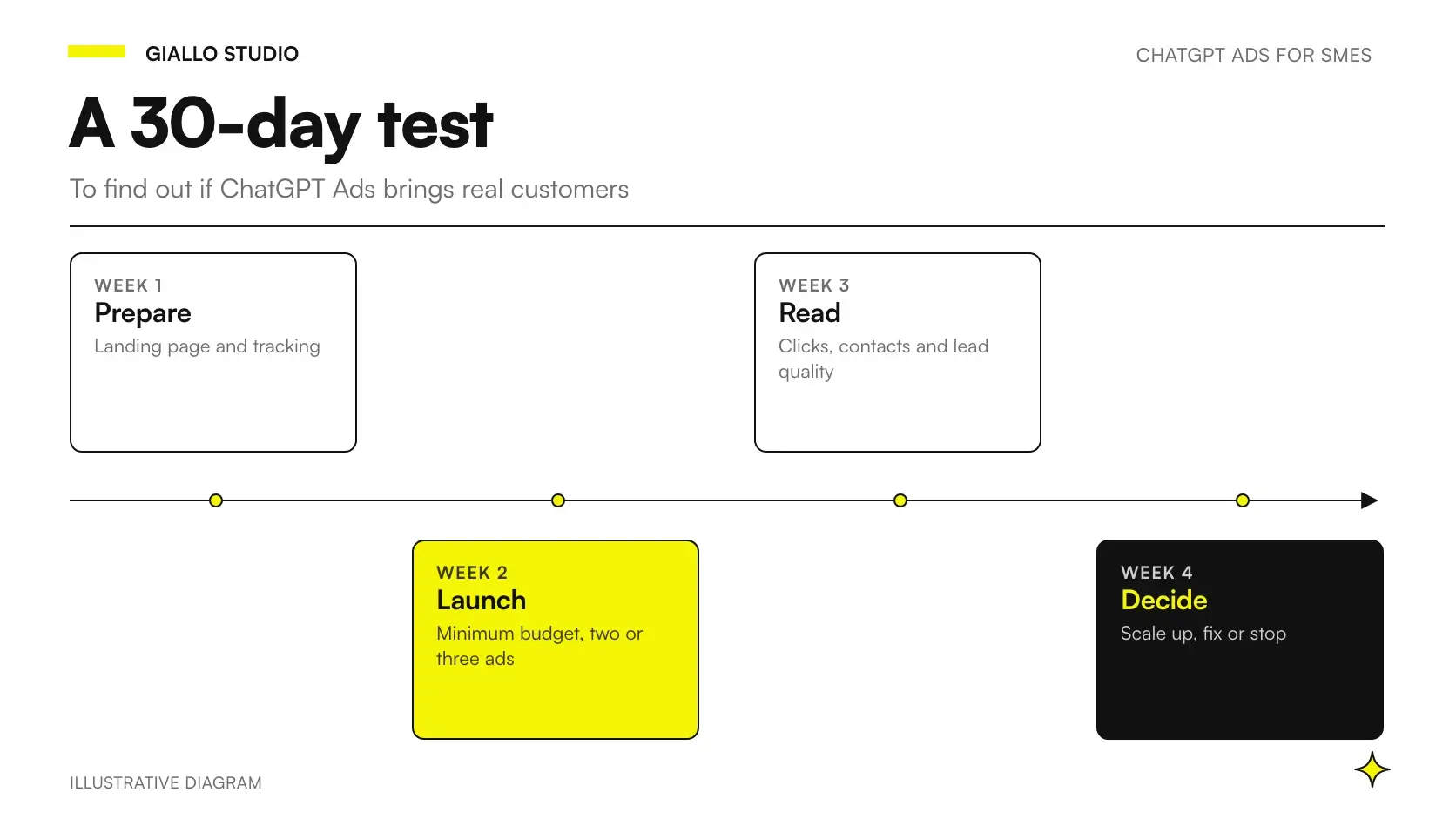
To fit the test into the annual plan, the discipline of every AI investment applies, described in the guide on how to set an AI budget for a small business; to read the results you need the ROI calculation for an AI project, with full costs and not just the spend in Ads Manager. If the question is where to put every euro across channels, see the ChatGPT Ads vs Google Ads comparison; if you need a calendar, there is the 30-day test plan for small businesses.
If you want to get to your first euro of spend with margins, thresholds and tracking already defined, Giallo Studio sets up the test plan with you starting from your company's numbers.
Giallo Studio guides: methodology and sources
How we apply it in the company
Related resources
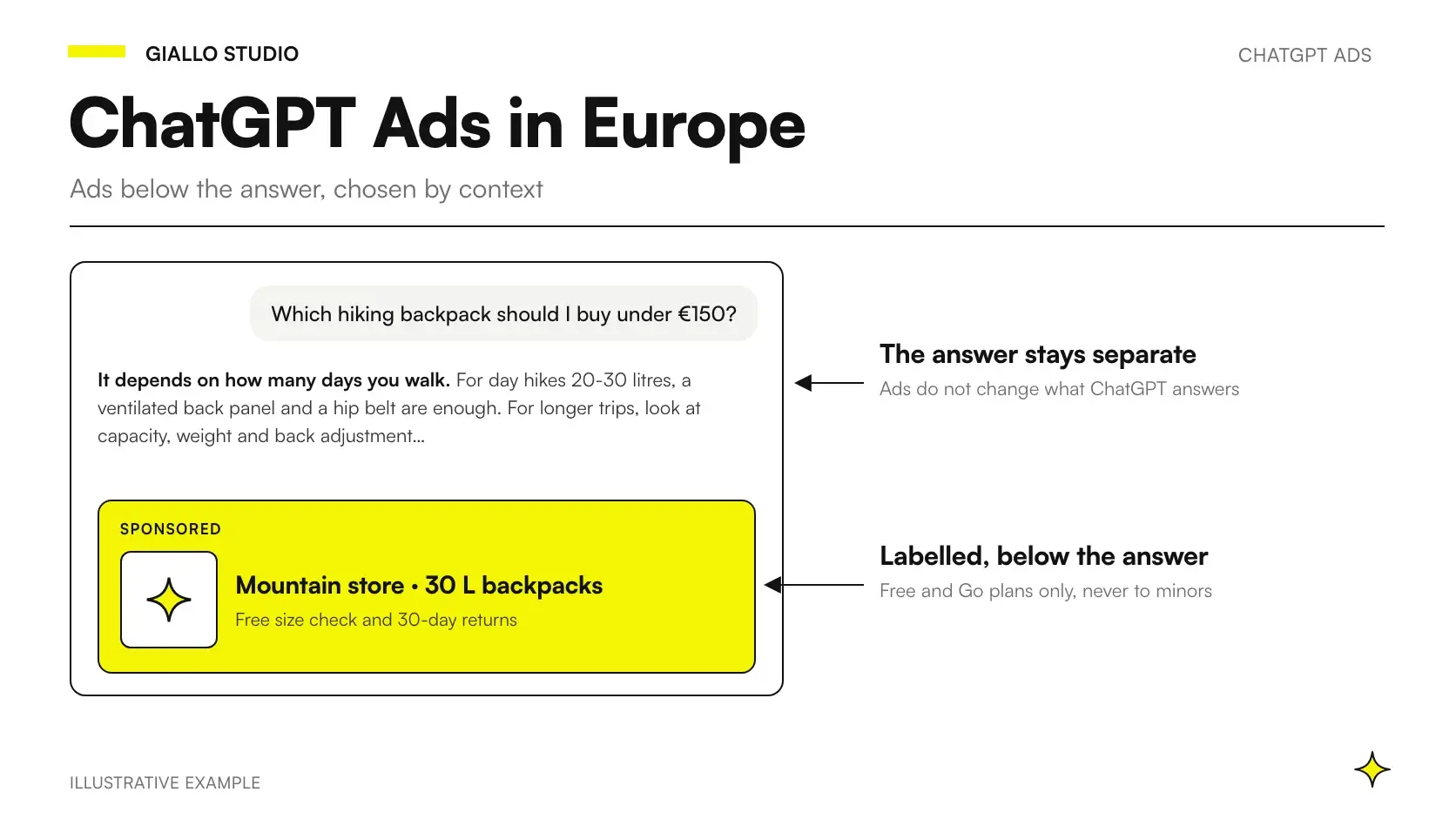 ChatGPT Ads: what it is and how advertising on ChatGPT works in Italy
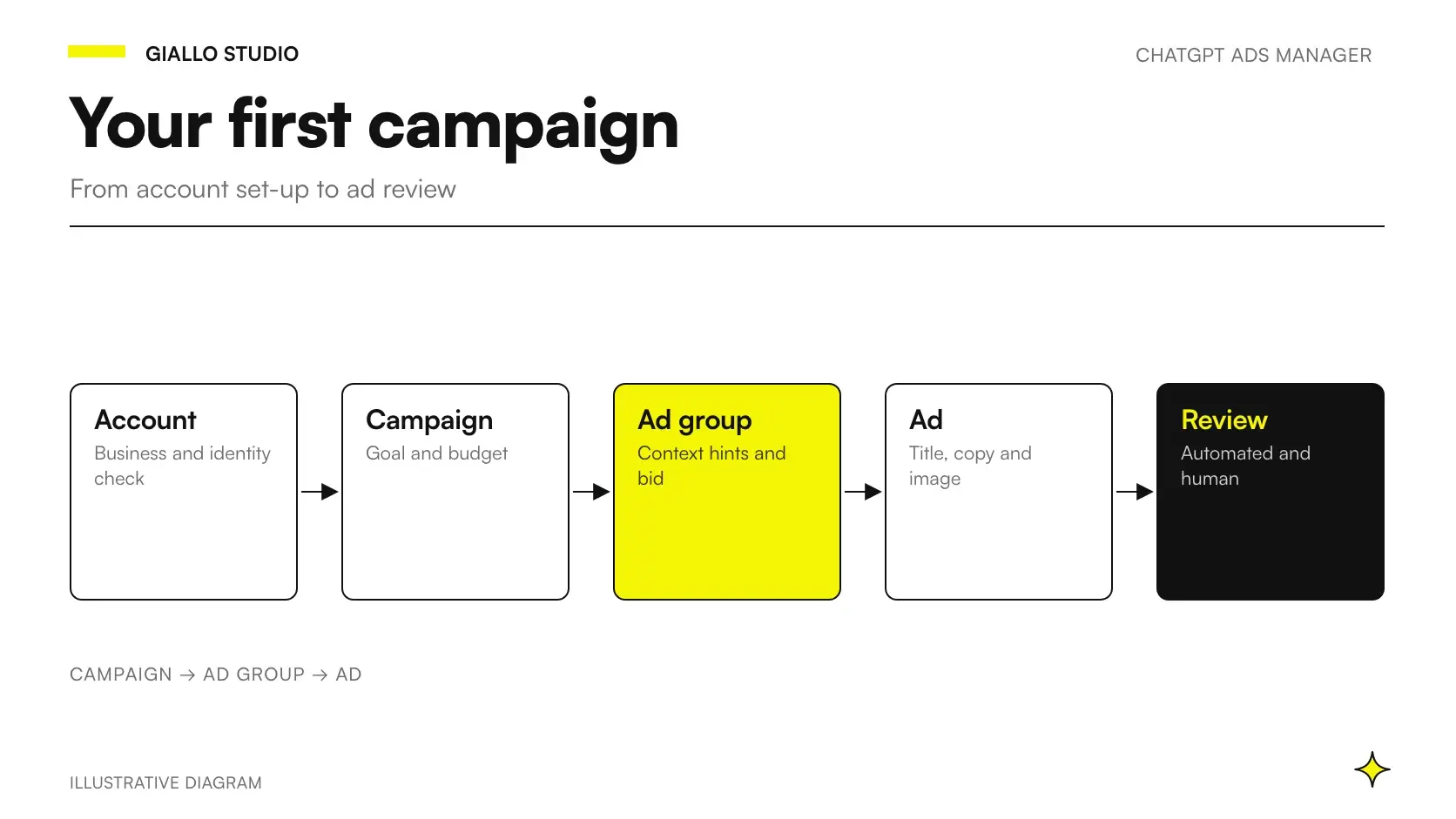 ChatGPT Ads Manager: how to create your first campaign, step by step
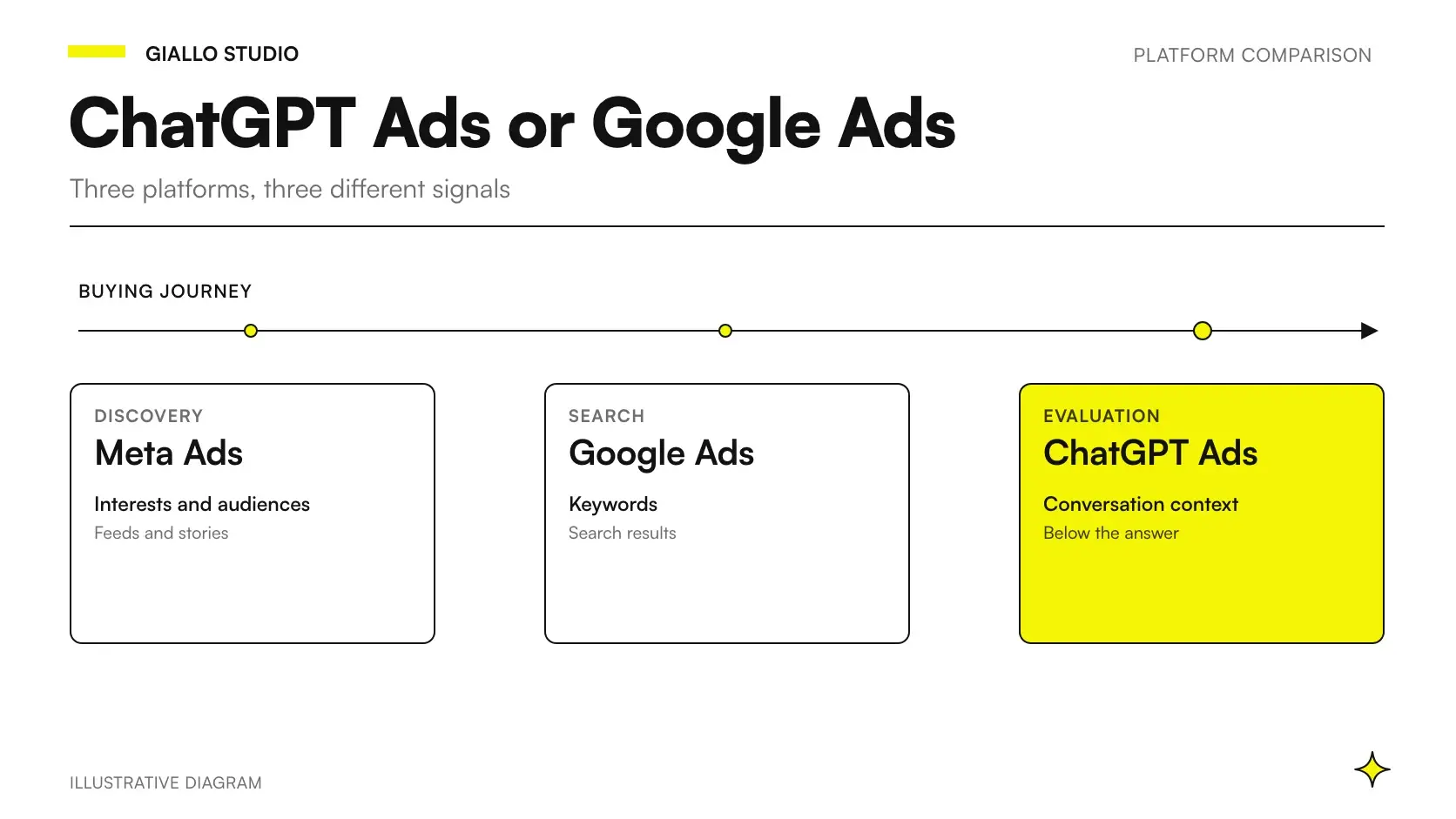 ChatGPT Ads vs Google Ads (and Meta Ads): differences and when to use each
 ChatGPT Ads for small business: is it worth it? Best-fit sectors and a 30-day test
 ChatGPT Ads: new formats, lead measurement and availability in Italy
 AI budget for SMEs: where to start
 ROI of an AI project: how to calculate it
 ChatGPT vs Grok
FAQ
How much does ChatGPT Ads cost per month?
There is no fixed fee: you pay what you spend in the auction. The minimum is a daily budget of €15 per campaign for accounts in euros, which is about €450 over 30 days with a single always-on campaign. The daily budget is an average over seven days, so spend on individual days can vary.
What is the minimum budget for ChatGPT Ads in Italy?
The minimum is €15 per day per campaign for accounts billed in euros, according to OpenAI's official guide. In the pages checked on 19 October 2026, no overall minimum spend commitment appears for self-serve.
Do you pay per click or per impression on ChatGPT Ads?
You can choose. With the Views objective you pay by CPM, meaning per thousand impressions; with the Clicks objective you pay for each valid click. With the Conversions objective the system optimizes toward an event such as a purchase, and at creation you choose whether to pay per impression or per valid click: never per conversion.
How much does a click on ChatGPT Ads cost?
There is no fixed price: a second-price auction weighted by relevance sets it. OpenAI recommends starting with a maximum bid of $3-5 per click, but it does not publish average CPCs in euros or industry benchmarks.
How does the €500 ChatGPT Ads credit work?
The Italian OpenAI Ads page offers first-time ChatGPT Ads advertisers €500 in credit after €500 of spend. Under the credit terms, unless the offer states otherwise, the credit expires 90 days after issue, covers only later costs and does not count toward the required spend.
Do the $60 CPMs the press talks about apply in Italy?
No. Those figures, reported by Digiday in April 2026, refer to the managed pilot in the United States, where minimum commitments fell from $250,000 to $50,000. Self-serve access, open in Italy since 31 August 2026, works as an auction, with a minimum of €15 per day per campaign.
Who is the contracting party for ChatGPT Ads in Italy?
OpenAI Ireland Ltd, the contracting party for advertisers in the European Economic Area (EEA). The contract is governed by Irish law. Payment is postpaid by credit card and rates are exclusive of taxes: for VAT treatment, check with your accountant.