
AI for technical firms: surveyors, architects and engineers
AI for surveyors, architects and engineers: lawful building status, permit and land record deadlines, quotes and BIM specifications. Uses and limits.
Reading time: 11 min
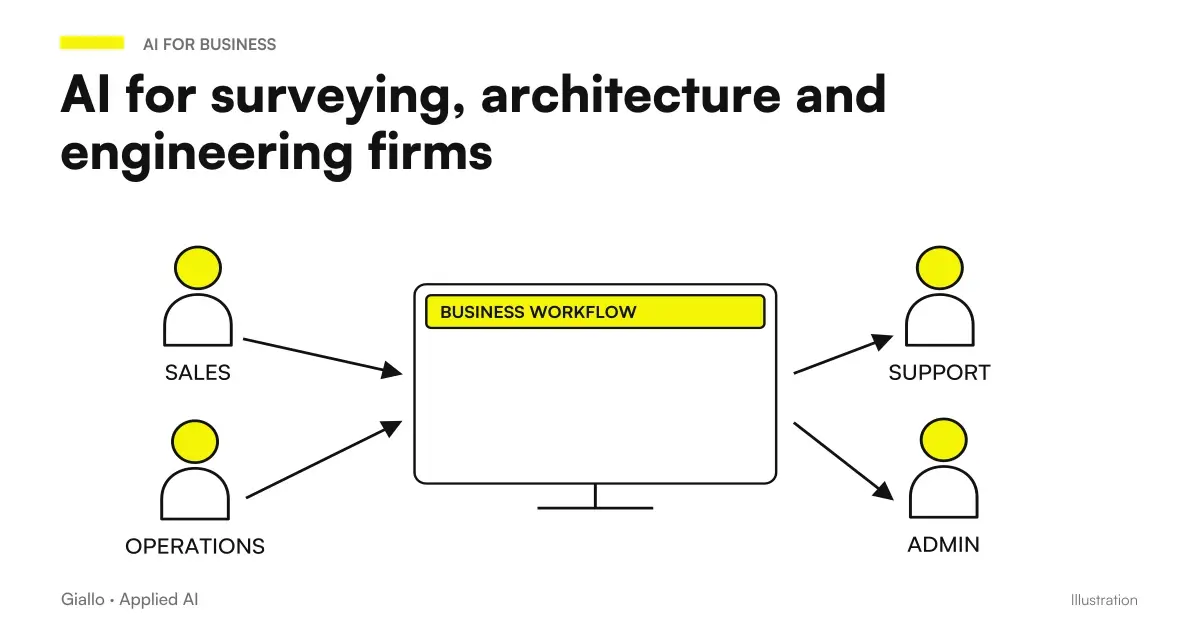
For surveyors, architects and engineers the AI for Technical Studies makes especially on the paper surrounding the project: reconstruct the building history of a building from the scans of the municipal archive, keep a timetable of permits, agility and cadastral variations, check that a quote contains what the law requires, derive from a BIM information document the list of requirements. Drawing, calculation and asseveration remain of the signing professional.
The border establishes it the personal responsibility of the technician. A relationship prepared with the help of a model and signed without control becomes, for all intents and purposes, your statement; the same applies to a miscalculated deadline or a skipped race requirement.
Below are the jobs where automation returns hours and those where it's best to keep it away, with the rules setting out the most common terms for a technical study.
In summary
- The work with the most return is the reconstruction of the legitimate state: read licenses, concessions and sanatoriums scanned and put them in chronological order, leaving the judgment to the technician.
- For works with SCIA the designer responds as an operator a service of public necessity: no report must be signed starting from an automatic summary.
- A practice-related schedule helps to comply with the terms of the building permit, the reporting of practicability, the DOCFA declaration and the validity of the EPA.
- The estimate of a professional enrolled in an order must be given in writing with cost items and policy data: the AI can verify that nothing is missing.
- In larger public tenders BIM is mandatory: AI helps read the information specifications, the model is built with dedicated software.
Surveyor, architect, engineer: where does the time go that is not billed
Technical studies do not look alike. Those who do above all cadastre and certifications for private individuals have a different load from those who run construction sites or participate in public competitions. Open the case closer to yours.
Surveyor's Study: Cadastre, EPA, Practices for Individuals
Many requests come from owners who ask "how much it costs to update the floor plan" or "I need the EPA to rent". The AI can answer the first question with the list of documents to be sent, collect visures and plant booklets, prepare the survey card. The surveyor remains the relief, the proposed classification and the signature of the attestation.
Architecture firm: building titles, project, works direction
The time is lost between access to the documents, reading of building regulations and technical standards of the plan, yard minutes and variants. Automation can reorder municipal archive documents, cite relevant articles of local regulations, draw from the survey notes a draft report. Project choices and compliance checks are not delegated.
Engineering study: facilities, facilities, public tenders
Here they weigh specifications, competition specifications and very long technical documentation. AI helps extract requirements, deadlines, and deliveries by referring back to the page. Structural calculation and plant sizing remain in the calculation software and in the responsibility of the engineer.
Many of these activities are common to other studios selling professional services: an overview is on the page on AI for B2B services.
Legitimate state: the building history of the building rebuilt from the archives
Before a CILA, an SCIA or a verification for the customer who wants to sell, you need to know what the legitimate state is. The Article 9-bis of DPR 380/2001, in the version in force since 28 July 2024, binds it to the title that provided for or legitimized the construction, or to the one that governed the last intervention on the entire property (provided that, in issuing it, the administration has verified the previous titles), supplemented by the subsequent titles for the partial interventions. For buildings built when the title was not mandatory, cadastral information of first plant or other evidential documents, such as photographic shots, cartographic extracts and archival documents, shall apply.
In practice, after access to the acts the study finds itself with dozens of scanned PDFs: licenses, concessions, variants, pardon practices. A well-set system reads them, extracts protocol, date, title and object, puts them in a time line and reports the cited titles that are not in the file. With typewritten copies and handwritten annotations the reading is more wrong, as explained by who worked on the Scanned PDFs and OCR limits: any uncertain field should be marked as such.
The system prepares the file, the technician judges it. Determining whether a difference detected at the site falls within the tolerances or requires a sanatorium is professional work, and no automatic summary replaces it.
Assured report bears your signature, not the software one
For works realized with certified reporting of the beginning of the activity, the Article 29, paragraph 3, of the Single Building Text gives the designer the status of a person providing a service of public necessity, referencing Articles 359 and 481 of the Criminal Code. If the report contains untrue statements, the administration notifies the professional body for disciplinary sanctions.
Within this perimeter the AI still has a lot to do. He can write the description of the state of fact starting from notes and photos of the inspection, check that surfaces and quantities coincide between relationship, tables and forms, recover from the building regulations and technical standards of the plan the articles to be verified. For this last job you need a knowledge base on the documents of the Municipality Answering by quoting article and version: A no-return response does not enter into a relationship.
From the law 132/2025 comes also an obligation of transparency towards the client: the Article 13 asks the professional to inform him about the artificial intelligence systems he uses, and limits their use to instrumental and supporting tasks. A clause in the disciplining of office resolves the first point; the second is a working rule for the whole study.
Permits, agility, cadastre, EPA: the study's schedule
The deadlines of a technical study almost always arise from a date that already exists in some document: the issue of a title, a communication of end of work, the issue of a certificate. Automation reads that date and builds the reminder; the technician confirms the term on the individual practice.
| Deadline | What the Standard Provides | Which document the reminder starts from |
|---|---|---|
| Start work with permission to build | Not more than 1 year after release, except for extensions and special cases (Art. 15 DPR 380/2001) | Release measure |
| Completion of work | Not more than 3 years from the beginning, then the permit lapses for the part not performed | Notice of commencement of work |
| Agibility | Report certified within 15 days of the end of the finishes, in the cases provided (Art. 24) | End of work of the Director of Works |
| Statement to the Cadastre | Within 30 days of the property being habitable or the variation being completed, with DOCFA (Revenue Agency) | End of work and inspection report |
| Energy performance certificate | Maximum validity of 10 years, to be updated if the intervention changes the class (art. 6 d.lgs. 192/2005) | Date of issue and subsequent interventions |
Two warnings. Under Article 15 Normattiva reports several extensions arranged in the years by successive decrees, some without prejudice to a different regional discipline: the system proposes, the technician checks. And the EPA can decay first: according to the Paragraph 5 of Article 6, if the efficiency checks of the thermal system are not complied with, the certificate shall expire on 31 December of the year following the first missed deadline. Crossing the plant booklet with the date of the certificate is a check that a machine does well.
For the cadastral part it recalls that DOCFA is transmitted electronically through Sister and that the Agency, after the acceptance checks, can carry out merit checks and rectify of its own motion. The office's response must therefore also be hooked to the practice.
The Professional's Quote: What the Law Asks and What the AI Can Control
For regulated professions in the ordistic system the Article 9 of Decree Law 1/2012 calls for the measure of compensation to be made known first, in written or digital form, with a general estimate. The professional must indicate the degree of complexity of the assignment, the charges assumed until the conclusion, the policy data for damages caused in the professional activity, and agree the compensation with all cost items, including expenses, charges and contributions.
AI works well on this repetitive part. From the site visit notes and the practice’s price list, it prepares the draft with the services separated out (survey, application, works supervision, land registry update), checks that the insurance policy details and pension contribution are present, and flags items without an amount. You can find how the transition from free text to a draft works in the case of automatic quotes from a message and in the demo of Automatic quotes with AI. It matters, however, you decide: the machine controls the shape, the value of the work determines who signs it. For the general method there is the guide to the AI to create quotes.
Competitions with BIM: read the information document without losing any requirements
From 1 January 2025, for the Article 43 of the Public Contracts Code, the contracting stations adopt methods and tools of digital information management for new constructions and for interventions on existing constructions with estimated cost of works exceeding 2 million euros, with a different threshold for buildings protected by the code of cultural heritage. Ordinary and extraordinary maintenance operations are excluded, unless they concern works already carried out with these methods. The tools must use interoperable platforms with non-proprietary open formats, and Annex I.9 sets the minimum content of the information specifications.
For a study that participates in competitions, the first obstacle is reading: informative specifications, specifications and annexes are long documents that refer to each other. The AI turns them into a list of requirements with the return to the page (delivery formats, required roles, deadlines of information deliveries) and signals those that the study does not cover today. To choose the instrument suitable for such long texts there is the comparison on the best AI for long documents. AI functions inside BIM software often change: before buying them, check the manufacturer's official page.
Two example cases: a restructuring to close and a tender to evaluate
The surveyor who closes a renovation
Think of a surveyor who directed the renovations of an apartment, with a new internal distribution and the boiler replaced. When loading the end-of-work communication into the system, the schedule opens three entries: to assess whether the intervention requires the alert of agility, to present the cadastral variation with the new plan, to verify if the energy class has changed and the EPA needs to be redone. For each it prepares the list of documents to ask the client.
The surveyor discards the first entry because in the concrete case it does not apply, confirms the other two and sends the customer the ready-made request. In this example no decision has passed to the machine; the difference is that no term depends more on the memory of those who followed the construction site.
The Engineering Study Evaluating a Race
A study with four engineers evaluates a race for the redevelopment of a school, with amount above the threshold of BIM. The system reads informative and disciplinary specifications, extracts about fifty requirements with the page number and marks three that the study does not meet on its own, including a professional figure required for information management. The members decide whether to participate in grouping or let go, with the full picture in front before rereading everything from scratch.
Where AI is wrong in a technical study
The most frequent errors are not about the technology but about the use it makes:
- ask a generic chatbot if an intervention goes into CILA or SCIA, without providing it with regional and municipal standards: the model mixes old and new versions and responds with confidence;
- trust the shares read from a scanned table, especially in projects prior to digital printing;
- use a text assistant for structural verifications or sizing, which require computing software and the responsibility of the engineer;
- upload plans with names, addresses and tax codes into personal accounts, without a data processing contract;
- make the client promise times of the Municipality or the Agency that no study controls.
How to Start in Your Technical Studio
- Choose only one stream. The open practice schedule is the easiest to measure: how many deadlines were handled in advance and how many at the last day.
- Put the sources in order. Building regulations and technical standards of the municipalities where you work most, the practice’s price list, report templates and engagement agreement templates.
- Test on closed practices. Have the system work on cases where you already know the outcome and compare what signals with what happened.
- Extend wisely. After the schedule comes the reconstruction of the legitimate state and the quotes; the automatic responses to the customers last.
If you want to link your firm's paperwork and estimates in a single stream that leaves signatures and evaluations to you, we can design it together from the practices you opened today: find the method on the page on automation of business processes.
Giallo Studio guides: methodology and sources
How we apply it in the company
Related resources
 AI for business knowledge bases: find the information you need
 Creating quotes with AI: how to speed up the process
 Best AI for long documents
 Read PDF traffic fines automatically: text, OCR and limitations
 AI for renovation firms: changes, SAL progress reports and site documents
 AI for veterinary clinics: recalls, prescriptions and pet owners
AI by sector
The same reasoning, applied to the other areas we follow.
- AI for medical practices: reception, appointments and reminders
- AI for removals: inventory, quotes, permits and damage
- AI for wellness centres and spas: admissions, gift vouchers and packages
- AI for staff shift scheduling
- AI for renovation firms: changes, SAL progress reports and site documents
- AI for veterinary clinics: recalls, prescriptions and pet owners
- AI for restaurants: reservations, allergens and responses to reviews
- AI for wedding planners: suppliers, deadlines and guest data
- AI for human resources: concrete uses
- AI for procurement and supplier management
- AI for business reporting: fewer hours, the same data
- AI for marketing agencies: content, reports and AI labels
FAQ
Can I get AI to write the certified technical report of an SCIA?
You can have it prepare the descriptive section and a list of regulations to verify, with references to the articles. The certification remains your responsibility: for works under a SCIA, the Consolidated Building Act grants the designer the status of a person performing a service of public necessity, and untruthful declarations are reported to the professional body. Reread every reference before signing.
Can AI tell me whether work is permit-free, requires CILA, or requires SCIA?
It can find and quote the relevant articles of the consolidated law and the building regulations of the Municipality that you have provided to it. However, the classification depends on regional laws, local urban planning tools and changing versions of the norms, and remains an evaluation of the technician. A reply without article and update date should not be used.
How do I avoid missing deadlines for permits, occupancy certification, and land registry filings?
With a deadline calendar based on dates already present in the files: issue of the authorisation, notices of work starting and ending, and the APE date. AI reads those dates from documents and creates reminders; the technician confirms deadlines for each case, because several decrees have extended building permit deadlines over time.
Can I upload clients’ floor plans and registry extracts to an artificial intelligence service?
Only on an instrument with a contract that governs the processing of data, because plans, addresses and titleholders identify people. Avoid personal accounts and remove names and tax codes when they are not needed for the job requested.
Is AI useful for BIM in public tenders too?
It is mainly useful for reading the information requirements and tender rules and extracting a list of requirements with page references. The information model is produced with BIM software, and the public contracts code requires interoperable platforms using open, non-proprietary formats. Check the manufacturer’s official page for AI features in individual software products.
What must the estimate that AI helps me prepare contain?
For the professions governed by professional orders the decree law 1/2012 asks for a general estimate in written or digital form, with the degree of complexity of the assignment, the hypothetical charges, the data of the professional insurance policy and the cost items including expenses, charges and contributions. The AI can check that no element is missing; the amounts are decided by you.
Do I have to tell the client that I use AI in the studio?
Yes. Law 132/2025 asks intellectual professionals to inform the client about the artificial intelligence systems used, in clear language. Just an understandable clause in the engagement agreement, updated when changing tools.