
Claude Opus 5.5: what it is, what it changes and who it suits
What Claude Opus 5.5 is: changes from Opus 5, features, access and use cases. Learn when it makes sense and when a lighter model is enough.
Reading time: 12 min
Claude Opus 5.5 is the model that Anthropic released on September 22, 2026, the first of the new 5.5 family. The news is not that it is the most powerful ever — on this Anthropic itself is prudent — but that it brings the level of Claude Fable 5.1 at a 40% lower cost to that of Opus 5, with a 30% faster text generation.
For those who use AI in the company, something concrete changes: the top model begins to cost like a mid-range model from a year ago. only verified data on the official announcement and benchmark table published by Anthropic, including tests where Opus 5.5 is not first. Verified data 23 September 2026.
In summary
- Same level as Fable 5.1 on most tasks, according to Anthropic.
- API Price 4 $ / 20 $ per million tokens: one-fifth less than Opus 5.
- Running costs −40%, because it also uses fewer tokens to finish a task.
- Five levels of reasoning; always think and decides for himself how much.
- Beats GPT-6 Astra on code and office work, but not on everything.
- First Opus with Fable-level security filters: some messages come hijacked on a previous model.
What has changed compared to Opus 5?
Three things, in order of weight for those who use it.
The long work. Anthropic describes Opus 5.5 as a model capable of carrying out tasks in multiple steps for hours with little supervision. In practice: you give him a whole goal in a message, you tell him what "finished" means, and he proceeds without asking you for confirmation at every step.
The automatic reasoning. Opus 5.5 always thinks before answering and decides for itself how much. The old instructions like "reason step by step" are no longer needed: removing them reduces the wait without losing quality. The detail is in Opus 5.5 Reasoning Levels.
Reading long images and documents. It reads graphs, patterns, and slides more accurately than Opus 5, especially when the meaning depends on where things in the image. And in the long documents he finds contradictions: a date that falls on the wrong day, a graph that does not come back with the numbers of the table.
How much does Claude Opus 5.5 cost?
| Voice (per million tokens) | Opus 5.5 | Opus 5 | Difference |
|---|---|---|---|
| Input | 4 $ | 5 $ | −20% |
| Output | 20 $ | 25 $ | −20% |
| Reading from the cache | 0,20 $ | 0,50 $ | −60% |
| Cache Writing | 5 $ | 6,25 $ | −20% |
| Fast mode input / output | 8 $ / 40 $ | — | up to 2.5× Faster |
The −40% in operating cost is not a miscalculation relative to the −20% in the price list: Anthropic says the model consumes fewer tokens to finish the same task, and the two effects add up. The actual impact depends on how your system is built; for the calculation based on your volumes, see price per million tokens, explained.
The drop in the cache is the one that moves systems to production the most, where the system prompt is sent back identical to each call. Always check the price list on the official page: it changes often.
Benchmarks, in two lines
In Anthropic's published table, Opus 5.5 leads in code and terminal tasks (Terminal-Bench 66.4%), professional work (GDPval-AA 1846 Elo) and computer use. GPT-6 Astra remains ahead on AutomationBench — by one and a half points — and on Terminal-Bench-Science. One independent result: on Artificial Analysis' Intelligence Index, it scores 58 against Fable 5.1's 53.
The complete tables, methodological notes — Terminal-Bench at different stress levels between Opus and Astra — and the line-by-line comparison are in Claude Opus 5.5: benchmarks, prices and comparison. Here the point is another: What changes for those who use it.
Opus 5.5 or Fable 5.1: Which one to choose?
Anthropic holds Fable 5.1 as a model for the most difficult work and places Opus 5.5 just below, "at the same level on most tasks". The useful question is not which is better, but for which task the difference is seen.
Opus 5.5 is enough when
- The task is repetitive and has a clear correctness criterion
- You need to read long documents and find inconsistencies
- You need to write or review code in an already set project
- Volume is high and cost per task counts
Fable 5.1 still pays off when
- The task is rare, open, without a written procedure
- Scientific or technical research is the heart of work
- A mistake costs more than the price difference
- You have already measured that Opus 5.5 on your cases is not enough
Practical rule: start from Opus 5.5, measure out of fifty real cases, and go up to Fable only where the numbers ask for it. The comparison between the Claude bands, with the costs, is in Claude models in comparison.
What hasn't changed
- It's not a brand new model: it is an improvement of the Opus line, and Anthropic places it under Fable for the most difficult job.
- Does not eliminate human control: on long tasks it remains necessary to define what can and cannot be done, as for any AI agent in the company.
- Safety filters are more stringent, not less. It is the first Opus with bio and cyber protections at the Fable level, and this produces some false positives on legitimate work: when a message is reported, the app switches to an earlier model. What to do in that case is in Claude moved on to an earlier model: why.
Where is it used
In the plans Claude Pro, Max, Team and Enterprise, via API with identifier claude-opus-5-5, and on Amazon Bedrock, Google Cloud Vertex and Microsoft Azure. Fast mode is available in Claude Code and on the developer platform, preview: details in Fast mode of Opus 5.5.
A novelty that affects everyone in Europe: the text generated brings a watermark (watermark) provided by the AI Act. It does not change the content, does not add tokens, does not cost anything. The framework of obligations is in AI Act: Business Guide.
Practical examples
Consulting firm, 8 people, Bergamo. He used Opus 5 to rewrite technical reports from consultants' notes, about 300 documents a month. Turning to Opus 5.5 the cost per document drops for two reasons added up: lower list and less tokens consumed. The real job of migration was to remove from prompts the lines "reason carefully before writing", which with the new model only slow down.
Commercial company, 25 employees, Padua. He wanted automatic control over quotes before they were sent: dates, totals, product names consistent across pages. It is exactly the kind of task that Opus 5.5 has improved upon —finding contradictions in long documents —and the prompt is one line: "check that there are no contradicting numbers, dates or names in this document; quote every problem and tell me where it is." The light model was not enough, the leading one before cost too much to do on every quote.
Mistakes to Avoid
- Passing everything to Opus 5.5 because it came out. To sort mail or rank requests just a light model, which costs ten times less: see the Mixed Model Strategy.
- Keeping the old prompts. Instructions on reasoning should be removed, not updated.
- Reading benchmarks as a ranking. Count your task, measured on your data, not the average score.
- Ignoring reported messages. If the app switches to a previous model without you noticing, the quality changes silently.
- Activating fast mode anywhere. It costs twice as much: it only makes sense where someone waits in front of the screen.
How to apply it in the company
- Locate where you use a top model today and how much you spend each month. There, the −40% is immediate.
- Locate where you are using an average model today because the top model was too expensive. These are the cases where Opus 5.5 opens up new possibilities: long contracts, documents to check, images to read.
- Parallel Test on the same fifty cases, with the same criterion of correctness, before changing.
- Clean up prompts from instructions on reasoning and tricks designed for earlier models.
- Leave the light models where they are enough. The real savings comes from using the right model for each task.
Conclusion
Claude Opus 5.5 is not the news of the strongest model: it is the news of the flagship model that costs as an average. For an SME it means that automations excluded by budget a year ago today are in the accounts — as long as the process is already described, measured and verifiable, because the model remains the last cost item. The first is to connect it to what you already have.
If you want to go from testing with ChatGPT to an AI system integrated into business processes, Giallo Studio custom designed agents and automations.
Giallo Studio guides: methodology and sources
How we apply it in the company
Related resources
 Claude Opus 5.5: official benchmarks, prices and comparison with Fable 5.1 and GPT-6 Astra
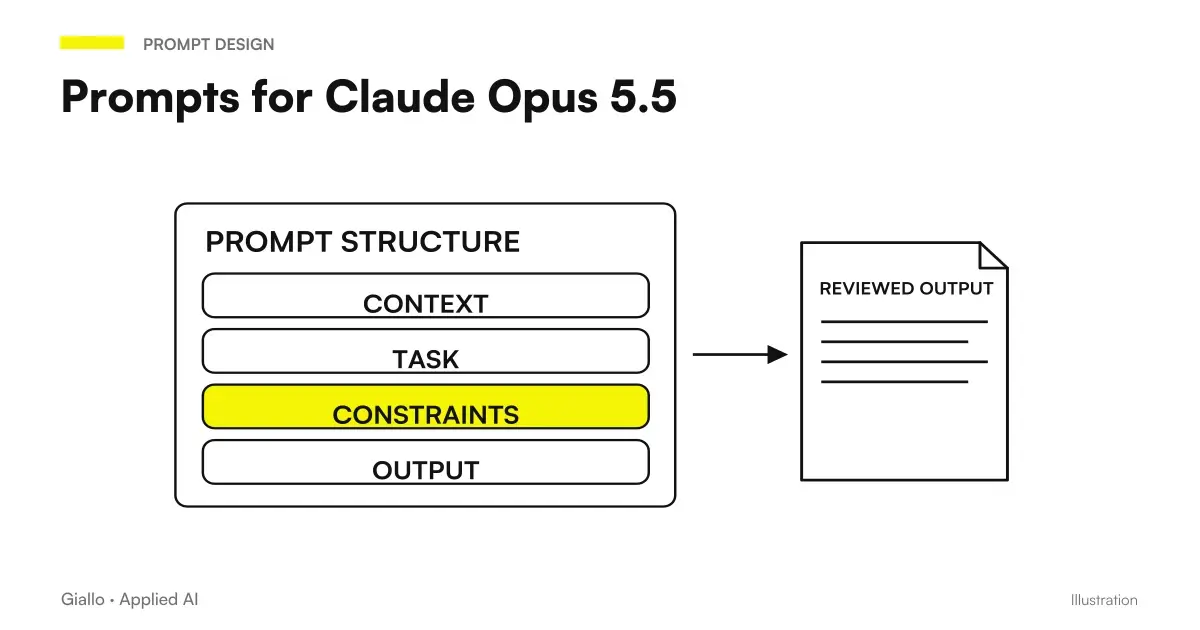 Claude Opus 5.5 prompts: what to remove, what to add and examples
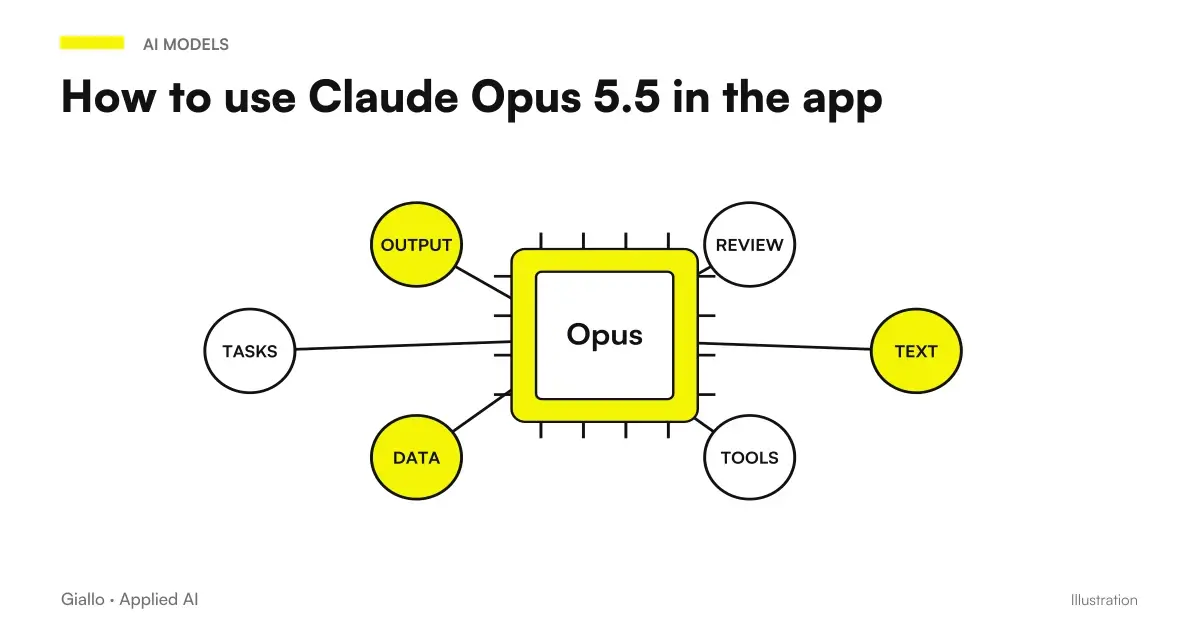 How to use Claude Opus 5.5 in the app: images, long documents, finished files
 Claude Opus 5.5 for an SME: five concrete uses and when not needed
 Claude AI: what it is and when to use it
 GPT-6 Sol vs Claude Opus 5.5: the official numbers and when to use which
 Google Playground: games with AI, access and limits in Italy
 Mistral Large 4: what the preview offers and what to evaluate before using it
FAQ
What is Claude Opus 5.5?
It is the model released by Anthropic on September 22, 2026, the first in the 5.5 family. Anthropic presents it at the same level as Claude Fable 5.1 on most tasks, with an operating cost of 40% lower than Opus 5 and a 30% faster text generation.
How much does Claude Opus 5.5 cost?
Via the API, it costs $4 per million input tokens and $20 per million output tokens, compared with $5 and $25 for Opus 5. Cache reads fall to $0.20, which is 60% less. Fast mode costs $8 and $40.
Is Opus 5.5 better than GPT-6 Astra?
On the table published by Anthropic is front on code, terminal, professional work and computer use; Astra stays ahead on AutomationBench and Terminal-Bench-Science. Depends on the task: the complete tables are in the article dedicated to benchmarks.
Where is Claude Opus 5.5 used?
In the plans Claude Pro, Max, Team and Enterprise, via API with the identifier claude-opus-5-5, and on the cloud platforms Amazon Bedrock, Google Cloud Vertex and Microsoft Azure.
What are the reasoning levels of Opus 5.5?
There are five: low, medium, high, xhigh and max. The model always thinks before answering and decides for itself how much, for this reason it is no longer necessary to write 'reason step by step' in prompts. The default level is medium.
Do I have to switch from Opus 5 to Opus 5.5 right away?
If your system already works well, switching is worthwhile for the price, not because you need to rush: test in parallel for a week on the same cases, check the results and then switch. Remove reasoning instructions from prompts, as this model does not need them.