
Price per million tokens explained
What pricing per million tokens means, what a token represents, why output costs more and how to estimate actual spending.
Reading time: 9 min
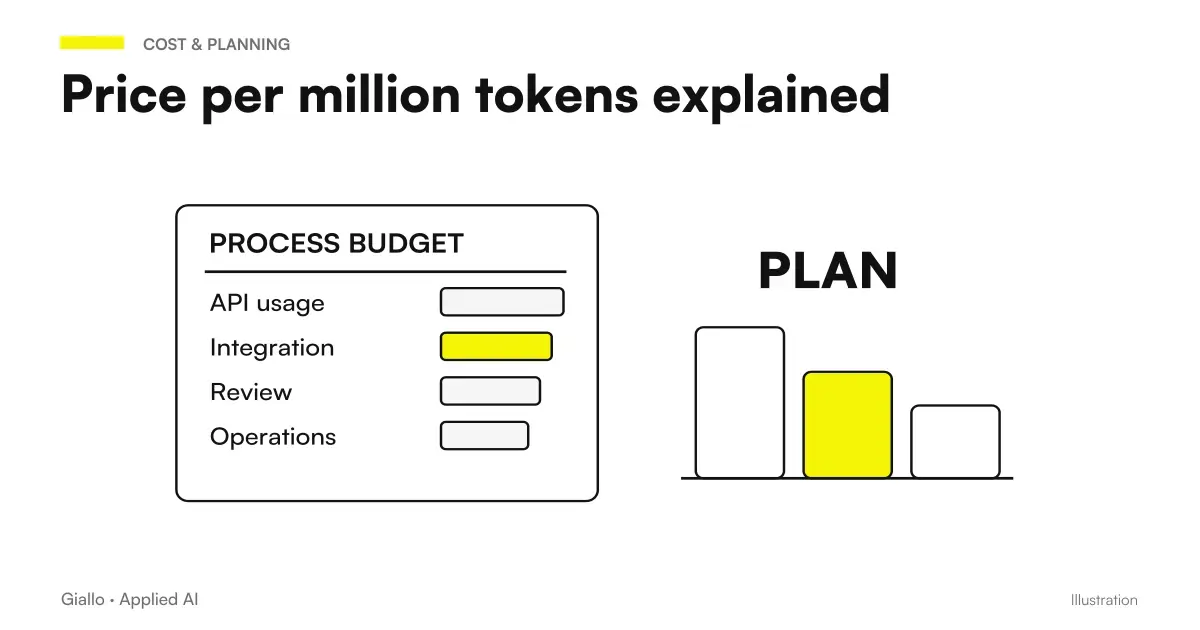
All AI model price lists use the same unit: the price per million tokens. It is a way of measuring that seems simple and that in practice generates wrong estimates with considerable regularity.
This guide explains what that number really means, what's in it and what's not, and how to get to an estimate that holds up the comparison with the invoice.
In summary
- A token is a text fragment, not a whole word.
- One million tokens is in the order of Hundreds of thousands of words.
- The output costs more than input: often five times.
- They Pay both the text you send and the one you receive.
- The Price List underestimation systematically the actual expenditure.
- Serious estimate is made measuring, not multiplying.
What is a token
A token is the unit with which models measure text. It does not match a word: it can be a whole word, a part of a word, a space or a punctuation mark.
For a budget estimate you don't need to know the exact mechanism. You need the order of magnitude, and this can be fixed with some practical reference.
| Content | Order of magnitude in tokens |
|---|---|
| A Short Question | Tens |
| An email | A few hundred |
| A page of text | A few hundred |
| A 20-page contract | A few thousand |
| A technical manual | Tens of thousands |
| One million tokens | Hundreds of thousands of words |
It is worth noting that Italian tends to consume a little more tokens than English with equal content. It is not crucial for a budget, but it is useful to know when comparing numbers referring to texts in different languages.
You pay twice, at different rates
The point that escapes most often: you pay both the text you send to the model and what the model produces, with different rates. Before transferring this formula to another service, check which invoice items really; the JEV API Cost keeps separate technical units and the cost of the process.
The input is the input text: the question, the system instructions, the reference documents, the history of the conversation. The output is what the model generates.
Output costs more, because generating requires more processing than reading. On different price lists the ratio is five to one, but it varies from supplier to supplier and needs to be verified.
The three items that the price list does not contain
The calculation that almost everyone makes at the beginning —requests for expected length per price —produces a systematically too low estimate. The reasons are three and add up.
The repeated system prompt. Each request carries with it the instructions that govern the behavior of the model. Those instructions are paid for to every single call. A prompt of 2,000 tokens out of 50,000 monthly requests is 100 million input tokens per month: often more than the user produces.
The reasoning tokens. Models that process before responding generate intermediate tokens that, on most price lists, are paid as output. A three-line response can cost thirty.
Failed attempts. Any call that does not produce a usable result is still paid for. If a task requires an average of two steps, the real cost is twice the quote.
| Voice | Does it appear in the price list? | Typical Impact |
|---|---|---|
| User text | Yes | Base |
| System prompt | No, but you always pay | Often the major voice |
| Reasoning Tokens | Partially | Variable, even very high |
| Failed Attempts | No | Proportional to steps |
| Human review time | No | The Greatest Voice Ever |
The last line is not an API entry but is the one that determines whether a project makes sense. If each outcome requires two minutes of control, out of 50,000 cases per month are over one thousand six hundred hours: no price difference per token approaches.
A complete example
Let's take an extraction system: 20,000 documents per month, 1,500 token system prompt, 2,000 document, 400 response. Let's use a $2 input model and 10 output.
| Voice | Monthly tokens | Cost |
|---|---|---|
| System prompt | 30M | 60 $ |
| Documents | 40M | 80 $ |
| Answers | 8M | 80 $ |
| Base Total | — | 220 $ |
| With 20% retempts | — | 264 $ |
Two observations. The first: the system prompt costs almost as much as documents, while still being the same text. The second: attempts add a fifth, and in many systems the real percentage is higher.
How to Really Estimate
- Take one hundred real cases of your process
- Run them on the candidate model, without shortcuts
- Read the Tokens actually consumed, do not estimate them
- Count the cases concluded correctly
- Divide the total expenditure by that number
- Add the review time estimated
The third point is what makes the difference. Providers report the actual consumption of each call: using it instead of estimating eliminates the error at once on system prompt, reasoning and verbosity.
In practice the result is often three to ten times the estimate made at the table. It is not a fault of the price list: it is that the price list measures one thing and the project includes four.
Where You Save
Effective levers
- Shorten the system prompt
- Asking Concise Answers
- Select context instead of sending everything
- Use a lower band where enough
- Lowering reasoning on simple tasks
Overrated levers
- Changing pattern within the same band
- Optimize the price list by ignoring attempts
- Reducing quality to save cents
- Comparing suppliers without measuring
The first line on the left is the one with the highest return and the lowest cost: an hour's work that reduces an entry paid millions of times. In systems that have been in production for a long time there are almost always written instructions to correct behavior of models that are no longer in use.
The price lists in comparison, to orient yourself
To give a concrete reference for the scale of costs, here are some verified official prices. Anthropic and OpenAI on 19 August 2026, Google on 3 September 2026 on the Standard plan.
| Model | Input | Output | Report |
|---|---|---|---|
| Claude Fable 5.1 | 10 $ | 50 $ | 5× |
| GPT-6 Astra | 10 $ | 50 $ | 5× |
| Claude Opus 5 | 5 $ | 25 $ | 5× |
| Claude Sonnet 5 | 2 $ | 10 $ | 5× |
| GPT-5.6 Terra | 2 $ | 12 $ | 6× |
| Gemini 3.6 Flash | 1,50 $ | 7,50 $ | 5× |
| Claude Haiku 4.5 | 1 $ | 5 $ | 5× |
| Gemini 3.5 Flash-Lite | 0,30 $ | 2,50 $ | ~8× |
| GPT-5.6 Luna | 0,20 $ | 1,20 $ | 6× |
The last column shows that the ratio of output to input is not the same everywhere: it moves between five and eight times. On a system that generates a lot of text, that difference matters more than the input price.
The overall gap is of fifty times between the first and last line in input. This is why the choice of the band weighs much more than the choice of the model inside the band.
Why Quotes Are Always Wrong in the Same Direction
There is a regularity in the estimates of AI projects: they are almost always too low, never too high. The reasons are structural, not random.
Whoever estimates starts from the ideal case —a request, an answer, all at the first stroke —because it is the only scenario that can be imagined at the table. Everything added in production goes in one direction: more context than expected, more attempts than expected, longer than expected responses.
- The system prompt grows over time, it does not shorten
- The difficult cases emerge only with real traffic
- The Defensive Instructions accumulates after each error
- The Historical conversations grow out of control
- The volumes increase when the system works
The fifth point is what surprises the most: a successful AI project generates more traffic than expected, because people start using it for things that weren't in the plan. It's a good problem, but it needs to be taken into account in the budget.
Practical examples
Study evaluating an internal assistant. A few hundred requests a month. At these volumes the difference between the bands is worth a few euros a month: time must be invested in the quality of the documents, not in the optimization of the price list.
Company with data extraction from invoices. Twenty thousand papers a month. Here the system prompt, multiplied by the volume, costs as much as the documents themselves — and it is the entry that no one puts in advance. To shorten it by half is an hour's work that pays off every month.
System with long conversations. The historian grows with each exchange: on the tenth message the model receives nine questions and nine previous answers. Consumption grows more than linearly, and should be measured on a long conversation, not a short one.
Mistakes to Avoid
- Multiplying to Table instead of measuring the real tokens.
- Forgetting the system prompt, which is paid for at every call.
- Not counting failed attempts, which you pay anyway.
- Ignoring reasoning tokens in the estimation of output.
- Excluding People's Time from the calculation of the total cost.
- Not measuring again as the volumes grow.
How to apply it in the company
The procedure that produces a reliable quote takes one afternoon and replaces any table calculation.
Take a hundred real cases and run them on the candidate model. Read the tokens actually consumed, which the providers report for each call: it is the only way to capture in a single shot prompt of system, reasoning and verbosity. Add up everything, including attempts that have not produced anything usable, and divide by the number of cases concluded correctly.
Then add the entry that does not appear in any price list and that is almost always the largest: the human review time, calculated as minutes per case multiplied by the monthly volume.
With that number you can finally compare suppliers that structure the price lists differently and figure out if a lower band is enough, according to the criterion of when an economic model is enough. The complete reasoning on hidden voices is in cost per task or price per token.
If you want a cost estimate made on your numbers and not on a list, Giallo Studio can help you turn the problem into a real workflow.
Three readings to close the picture. If you are still choosing the band, the operating criterion is in Mixed model strategy: light and powerful. For the calculation of real expenditure —the one that includes repeated context, failed attempts and human review —the reference is how to read AI benchmarks. And when traffic is uneven, the setting that gives the best relationship between quality and cost is described in when it is best to change the AI model.
Conclusion
The price per million tokens is a clear measure of one thing: how much does the passing text cost. It does not contain the repeated prompt, reasoning tokens, failed attempts, or people's time.
For a quote that holds only one number, the cost per task completed, and is obtained by measuring a hundred real cases instead of multiplying at the table. The complete reasoning is in cost per task or price per token.
If you want a cost estimate made on your numbers and not on a list, Giallo Studio designs AI automations tailored for SMEs.
Giallo Studio guides: methodology and sources
How we apply it in the company
Related resources
FAQ
What is a token?
It is the unit in which AI models measure text: a fragment that can correspond to a whole word, a part of a word or a punctuation mark. Prices are expressed per million tokens.
How much is a million tokens?
As an order of magnitude, a few hundred thousand words: much more than a book. A typical business request often stands between a few hundred and a few thousand tokens.
Why does output cost more than input?
Generating text requires more processing than reading it. On many price lists the output price is five times that of input, but the ratio varies from supplier to supplier.
Does Italian consume more tokens than English?
Generally yes, for the same content. For a budget estimate the difference is not decisive, but it should be kept in mind when comparing numbers referring to texts in different languages.
Does the list price match the expense?
No, it systematically underestimates spending. You must add the system prompt repeated with every call, reasoning tokens and failed attempts, which are still charged.
How do you estimate the budget of a project?
By running a hundred real cases on the candidate model, adding up the tokens actually consumed and dividing by the number of cases successfully concluded.