
Mixed model strategy: light and powerful
Combine a lightweight and a powerful AI model: handoff criteria, checks and how much you actually save.
Reading time: 10 min
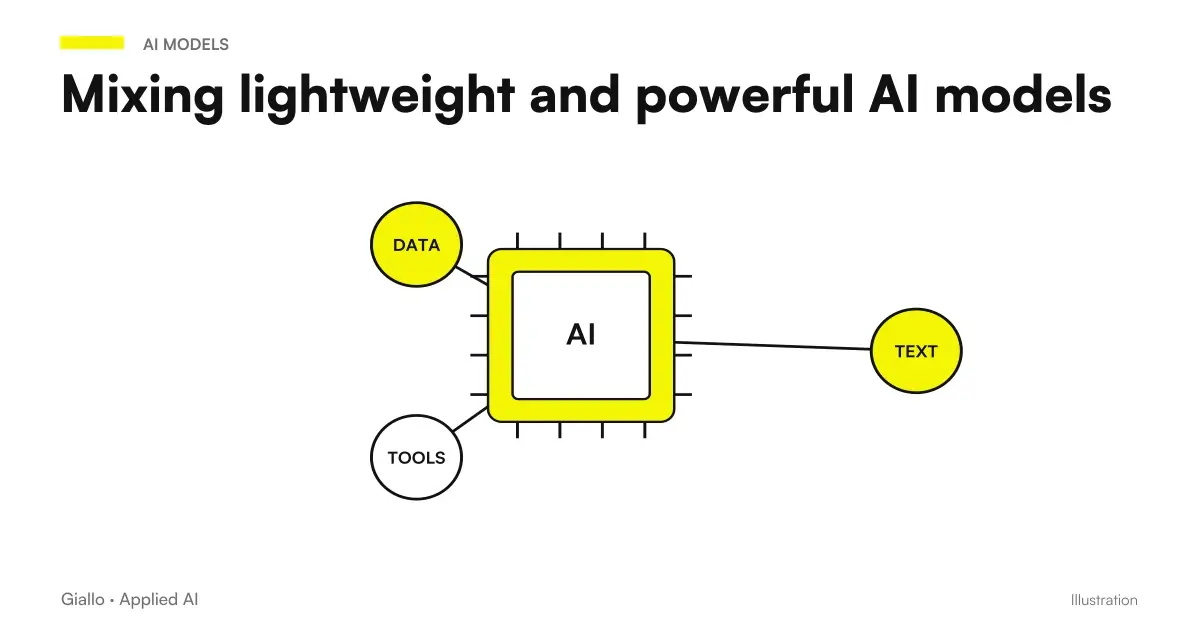
The question ‘which AI model to choose’ often has a surprising answer: two. An economic model that handles the bulk of traffic and a more capable one that intervenes only on difficult cases.
It is the setting that in practice gives the best relationship between quality and spending, and this guide explains how to build it and what to check for why it really works.
In summary
- The light model receives All traffic.
- Only cases doubt or complex rise to the capable model.
- With 10% of cases difficult, spending remains Close to Economic.
- Indispensable condition: the light model admits he doesn't know.
- It serves a explicit criterion passing through, not an intuition.
- It almost always also needs a Third Level Human.
Why it works
The principle is simple and applies in almost every business process: the difficulty of the cases is not evenly distributed.
Out of a thousand invoices, nine hundred are ordinary — known format, fields present, nothing ambiguous. Eighty have some irregularities. Twenty are true cases, which even a person must look at twice.
Using the same model for all a thousand means paying the rate of the twenty difficult cases even for the easy nine hundred. It is the most widespread waste in AI projects, and it is corrected by separating the flows.
Architecture, in concrete
- The first level receives every request
- Produce an outcome and an indication of confidence
- A explicit criterion Decides whether to close or raise
- The second level treats past cases
- A Third Level Human receives what no one closes
- Everything Comes recorded to be able to calibrate
The second point is the one that distinguishes a setting that works from one that seems to work. It is not enough for the model to produce a response: it must also produce a signal about how reliable that response is.
In practice this is achieved by explicitly asking the model to declare uncertainty, and —more reliably still —to quote the point of the document from which it draws each statement. If he can't cite, the case goes up.
The Condition That Decides Everything
There is one way this setting fails, and it is silent: if the light model Securely close cases that he didn't understand, those cases never get to the second level.
The result is worse than not having the second level at all, because the system gives the impression of having a safety net that never actually clicks.
| Light Model Behavior | Consequence on the system |
|---|---|
| Declare uncertainty | Case goes up, the system works |
| Returns an empty field | The case is interceptable |
| Invent a plausible value | Case closes, error passes |
How to define the passing criterion
The criterion should not be decided by intuition: it should be chosen from measurable options and then calibrated to the true data.
Confidence declared. The model indicates how safe it is; below a threshold the case rises. It is the most flexible criterion, but requires verifying that the declared confidence really corresponds to correctness.
Case category. Some types always go up, regardless. It is the most predictable and the easiest criterion to explain to those who have to trust the system.
Characteristics of the document. Length beyond a threshold, unrecognised format, missing fields. It is the easiest criterion to implement.
Outcome of the first attempt. If the model does not close, the case rises. It is the most direct criterion but also the most expensive, because it always pays two steps on difficult cases.
In practice they combine: a rule about critical categories, plus a confidence threshold for everything else.
How much you really save
We take 200,000 cases per month, 1,500 input tokens and 300 outputs. We compare three configurations with an economic model at $0.20/1.20 and one capable at $5/25.
| Configuration | Estimated monthly expenditure |
|---|---|
| All about the capable model | ~3.000 $ |
| All about the economic model | ~132 $ |
| Mixed, 10% on difficult cases | ~420 $ |
The middle line is the one that everyone would like and that hardly anyone can afford in terms of quality. The third offers the quality of the first on the cases that require it, at one-seventh of the cost.
The full calculation of the real cost, which includes repeated context and failed attempts, is in cost per task or price per token.
The Third Level: People
In almost all business processes a small percentage of cases should not be closed automatically. Designing it from the start is cheaper than adding it after an accident.
What must come to a person
- Cases that neither level closes
- Critical categories defined in advance
- Abnormalities with respect to historical data
- A random sample, for control
How it's to arrive
- With the context already prepared
- With an indication of what is doubtful
- Inside the tool that the person already uses
- In a manageable queue, not in a barrage
The last row of the right column is the one that determines whether the system will be used. If it requires opening another tool or changing habits, adoption collapses within a few weeks — regardless of how good the model is.
Mistakes to Avoid
- Not checking that the lightweight model admits when it does not know.
- Defining the criterion to intuition instead of data.
- Not checking a sample cases closed to the first level.
- Setting the threshold once and never return it.
- Forgetting the third level human.
- Not recording outcomes: without data it does not optimize.
The third point is the security check of the entire setting. It serves to notice if the first level is closing cases that it should have moved on, and it is the only way to discover silent failure before it produces damage.
How to calibrate the threshold
The threshold of passage is not guessed: it is found with the data, in three steps that require a few weeks of operation. If the first level uses a decision-making model, it is necessary to check how to interpret the uncertainty; confidence and review with JEV deepens the choice of thresholds without treating them as a guarantee of correctness.
First: cautious parties. At first it's better to raise more cases than necessary. It costs something more, but it avoids discovering the problem from complaints instead of data.
Second, it records everything. For each case you need the outcome of the first level, the declared confidence, if it has risen and — where available — the correct outcome. Without this data there is no calibration possible.
Third, look at the two mistakes. There are two ways of mistaking thresholds, and they need to be measured separately because they have different costs.
| Error Type | What Happens | Cost |
|---|---|---|
| Threshold too high | Cases rise that the first level closed well | Unnecessary Expenditure |
| Threshold too low | Cases that needed to be investigated are closed | Unintercepted errors |
The second line costs much more than the first, and this should guide the calibration: Better to bring up a few too many cases than to let an incorrect one through. The cost of an extra case at the second level is fractions of a cent; the cost of incorrect data entering business systems is orders of magnitude higher.
When the mixture doesn't suit
It's not always the right answer, and it's worth saying to avoid adding complexity where it's not needed.
Low volumes. Under a few thousand cases a month, the difference in spending between configurations is modest and does not justify the work of building and maintaining two levels. Better a single model, chosen well.
Homogenous cases. If all cases are similar, there is no hard minority to separate. Mixed strategy exploits just the inhomogeneity: without that, it has nothing to work on.
High-risk tasks. If each individual case has significant consequences, it is better to use the most capable model directly and focus optimization elsewhere — on the prompt, on the context selection, on the human review.
First project. Building a two-tier system first adds complexity before you understand the problem. Better start simple, measure, and introduce the second level when the data shows that it is needed.
| Situation | Recommended setting |
|---|---|
| High volumes, uneven cases | Mixed at two levels |
| Low Volumes | One model, chosen well |
| High risk for each case | Capable model + revision |
| First Project | Simple, then evolves |
The last line is a tip that applies in general: a simple system that works and is measured is the best basis for any subsequent optimization. The complexity added before having the data is almost always wasted complexity.
Practical examples
Accounting firm, extracting from supplier invoices. Eight thousand documents a month, four hundred suppliers with different formats. The economic model closes about ninety percent; seven percent rise to the second level and two to one person. From eight thousand documents to look at one hundred and sixty, with an API expense in the order of tens of euros.
E-commerce, first response to customers. The lightweight model recognises recurring intents and answers from the document collection. Messages outside the expected pattern — those where the customer describes an ambiguous situation or is angry for a reason not yet explained — are not resolved at all costs: they escalate to the second level and, if necessary, to an operator.
Manufacturing company, classification of a historical archive. Hundreds of thousands of documents to label, without urgency. Here the second level is especially useful for documents that the first one cannot classify with confidence: leaving them unclassified is better than putting them in the wrong category, because a mislabeled document becomes unavailable.
How to apply it in the company
The setting is built in three stages, and the first is the one that protects all the others.
Check the condition. Before anything else, prove that the light model recognizes its own limitations: give it a case that lacks the required information and look at what it does. If it invents a plausible value, the whole setting doesn't hold up, because those cases will never go up to the second level.
Define the pass criterion. Not to intuition but between measurable options: confidence declared below threshold, category of case, irregularities of the document, first attempt that does not close. In practice they combine —a rule on critical categories plus a threshold for the rest.
Tara on data. Start cautiously, raising more cases than necessary, and record everything. After a few weeks you will have the numbers to tighten the threshold. Wrong for excess costs fractions of a cent per case; wrong for defect costs unintercepted errors.
The expected savings calculation, with the numbers of the different bands, is in how much you save with a lightweight model; the criterion to understand which band to use as the first level is in when an economic model is enough.
If you want to design an AI system that uses the right model at the right time, Giallo Studio designs agents and automations tailored to SMEs.
To complete the reasoning. The method for building the test bench is in how to read AI benchmarks. The calculation of cost per completed task, which is the number on which you really decide, is in when it is best to change the AI model. To understand when it is advisable to question the configuration, the criterion is in because vendor benchmarks are not comparable.
Conclusion
Mixed model strategy is the most effective way to reduce the expense of an AI system without losing quality, and takes advantage of a true property of almost all processes: most cases are ordinary.
But it rests on a condition that must be verified before, not after: the light model must recognize its own limits. Without that, the second level does not trigger and the system fails silently.
If you want to design an AI system that uses the right model at the right time, Giallo Studio It builds agents and automations tailored to SMEs.
Giallo Studio guides: methodology and sources
How we apply it in the company
Related resources
 Cheap AI Models Compared
 When a low-cost AI model is enough
 Price per million tokens explained
 AI models for high volume work
 GPT-6 Astra for developers: code, API and computer use
 Time to first token: what it is and why it decides the perception of speed
 Claude Opus 5.5 for an SME: five concrete uses and when not needed
FAQ
What is a mixed model strategy?
A setup in which a low-cost model handles all traffic and passes only cases it recognises as complex or uncertain to a more capable model, achieving high quality at a contained cost.
How much is saved?
It depends on the proportion of difficult cases. If they make up ten per cent of traffic, spending approaches that of the low-cost model while retaining the capable model's quality for cases that require it.
What is the condition for it to work?
The lightweight model must recognise its own limits. If it confidently closes cases it has not understood, they never reach the second tier and the entire setup fails silently.
How do you decide when to escalate a case?
Using an explicit, measurable criterion: low confidence stated by the model, case category, document length or irregularity, or an initial attempt that does not complete the case.
Can different suppliers be used for the two levels?
Technically yes, but it adds management complexity. Staying in the same provider simplifies credentials, monitoring and maintenance, and should be preferred except for specific reasons.
Do we also need a third human level?
In almost all business processes yes. A small percentage of cases should not be automatically closed and must reach a person, with the context already prepared by the system.