
Google Playground: games with AI, access and limits in Italy
Google Playground creates games from prompts. Changes since its 7 October 2026 launch: US access, costs, export and practical scenarios for Italian SMEs.
Reading time: 12 min
Google Playground is an experimental platform for creating video games by describing them at AI, try them and share them from the browser. Google announced it on October 7, 2026: the novelty concerns the creation of games, not a new site generator or a generic chat with models. The source is the Google official announcement.
For those seeking Google Playground in Italy, the limit comes before the prompt: as of October 8, the supported access is in the United States, for adults. No Italian date is published. This guide is based on official documentation: it does not tell a direct test nor results obtained by an Italian company. The updated requirements are in the Playground Help Center.
For an SME the interesting question is concrete: could a small game help someone understand a product, practice a procedure or participate in an initiative? Let's see how to reason about these possibilities, distinguishing announced functions, actual access and necessary work before a company publication. The novelty is part of our AI review of 2–8 October 2026.
In summary
- Google Playground starts from the game: description, proof, correction and sharing form the creative path.
- Italian availability is not announced: before planning a project verify the official requirements of the product.
- A prototype should be judged by playing: Understandable rules and usable controls matter as much as the visual appearance.
- The business scenarios proposed here are hypotheses: no sales growth or training effectiveness is guaranteed.
- To start you need an observable goal: What must the person understand or be able to do after the game?
What allows Google Playground to be done?
The Google Labs page has a conversational interface, with starting genres such as trivia, tower defense and racing, or creation from scratch. The point is to be able to express an idea without manually setting up a game engine. It is an application of the Generative AI to an interactive result: the content must respond to the actions of the user.
The ad describes the ability to modify physics, rules, characters, and environments through subsequent requests. For a project, it is better to translate these categories into verifiable questions: does the jump reach the platform? Does an error return a useful message? The game ends when it should? They are more productive questions of “make it more engaging,” because they indicate what to check after the change.
We propose separating the first result from the version to be shown outside the workgroup. In the first one, you try to figure out if the idea works. In the second, you also check clarity, readability, content, and behavior in limit cases. The fact that a game starts does not prove that a person can use it without assistance.
A simple criterion: ask a colleague who does not know the project to start a game. Observe where he hesitates and what rules he misinterprets. He avoids continually explaining what he should do: those explanations reveal information that is probably missing in the interface. The test report becomes the list of changes to be requested.
Google Playground in Italy: who can access it and how much does it cost?
The Official FAQs distinguish free catalog and creation with weekly tokens. For free accounts the creation comes in stages, with waiting list; a Google One AI plan unlocks immediate access and larger thresholds. The page does not indicate sufficient quantities to build a precise quote. Always check the official page before signing up for a subscription: geographic availability remains a separate requirement.
For an Italian company we therefore suggest preparing the brief without making the launch dependent on a date that Google has not announced. The useful work today is clarifying recipient, rules, materials and approval criteria. These elements remain usable even if the project requires another dedicated tool or development.
In the project budget it separates the availability of the product from the cost of the entire initiative. The item to be estimated is not just "how many generations are needed": include content preparation, game review, publication, and the responsibility to maintain it. We do not attribute these services to Playground: they are activities that we recommend to plan when the result represents a company.
To orient yourself between instruments with different objectives, use the overview of Best AI Tools as a starting point. Choose the category according to the required result: demo game, content, web page or operating software. The “AI” label alone does not determine whether a tool is suitable for the project.
How to write the prompt of a game that can be evaluated?
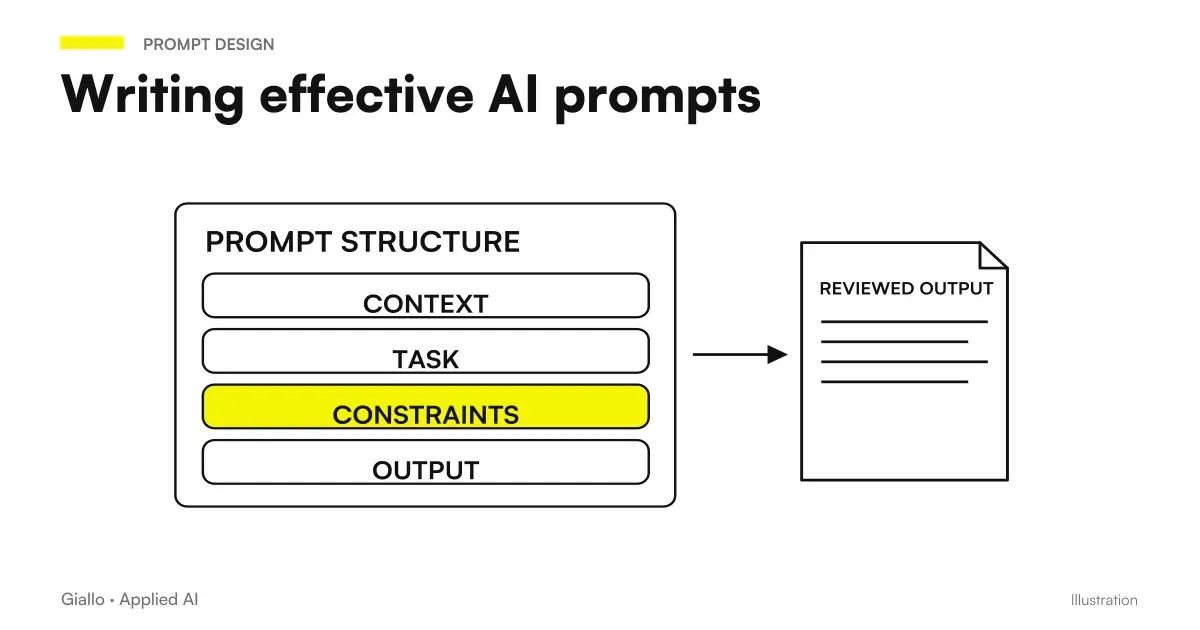
Our suggestion is to start with a short project document, then turn it into a prompt. Writing the rules first also helps those who have to approve the work: it makes it obvious if the company wants a quiz, a simulation or just an interactive decoration. The Guide to AI prompt deepens how to explain context, result and constraints.
As a hypothetical example, imagine a game for a roaster: the player must choose a mixture based on preferences stated by invented characters. The first brief could be this:
Create a small multiple-choice game set in an imaginary roaster. Each customer describes the taste they seek. The player chooses from mixtures with features provided in the text. It explains why a choice is consistent or inconsistent. Use original characters, readable buttons, and a command to start over. Do not enter prices, health promises or personal data collection.
This is a example of request to be adapted and verified, not a tried prompt on Playground. The characteristics of mixtures should be written and approved by roasting; it is not appropriate to delegate to AI the invention of the information that the game must teach. If the actual product changes, the interactive content should also be reviewed.
During the iteration we propose separate requests. First correct the wrong rule, then the difficulty, then the presentation. After each intervention, try the same situation again: if you change rules and appearance at the same time it becomes difficult to understand which change solved the problem. Preserves a list of expected behavior examples, especially for wrong answers, reboots, and completions.
Open a track to prepare your minigame brief
Recipient: Who plays and what does he already know? Objective: What choice does he have to learn to make? Central rule: What action will he repeat? Feedback: How will he understand a mistake? End: When does the game end? Verification: What behaviors always have to work? Materials: who approves texts, images and rights? Fill out these points before asking for more elaborate graphics.
How do sharing, export and Unity Spark work?
Google describes games that you can play on your phone or laptop, with the ability to keep them private, share them via links, or publish them in the Explore gallery. The publication involves security checks. They are documented modes in the Playground announcement; does not amount to a content verification for the company that uses it.
The Export FAQ indicates a ZIP archive with HTML, JavaScript, CSS and assets. For a project intended for a company site we suggest having that package verified before planning its integration. We have not tried exporting and do not infer from the presence of files that every platform function remains available elsewhere.
Unity Spark represents a future step announced by Google, with more advanced possibilities for 3D and mechanics. The Unity Spark official page presents the coming soon state and a waiting list. To choose today, we propose to consider only what the team can actually use and verify, keeping future functions out of the commitments made with a customer.
The distinction matters especially when moving from gaming to a business experience. Who will respond if the result is not loaded? Where will the instructions be updated? Who will decide to withdraw it when a promotion ends? Even a small experience deserves a manager and a closing criterion before being included in a campaign.
When can an AI game serve an Italian SME?
The following scenarios are Hypothetical Project Examples, no case studies or applications to start today from Italy on Playground. They are used to assess whether a playable format would make sense when access is compatible with the project, or with other tools.
A store wants to explain the choice of a product
Let's imagine a bike shop wishing to explain the difference between accessories for different uses. The game features invented situations: urban displacement, transport of an object, exit in the rain. The participant chooses a combination and receives an explanation approved by the store.
The proposed goal is not to "increase the time on the site": it is to understand whether the person can recognize the accessory consistent with a need. To verify this, have the game play out and then present a new situation, out of the game. If the participant can explain the choice, you have a useful signal to improve the project; it is not yet a proof of sales increase.
In this scenario I would keep the request for quote on the normal page of the store, with clear information and contacts. I would not assign to the game a safety board or technical recommendation that requires professional evaluation. Instructions must accurately indicate the scope of the example.
An enterprise wants to exercise an internal procedure
Let's think of a distributor preparing a drill on routing requests for assistance. The player receives invented synthetic messages and must choose the correct department. After each decision the reason appears, derived from an internal procedure already approved.
For the first prototype I would propose completely fictitious data, so as to work on understanding the rule. The training manager should check every outcome, including ambiguous cases: if a request can legitimately go to two departments, the game must explain it instead of penalizing a reasonable response.
The criterion of approval could be this: the colleague recognizes when he can decide and when he has to ask for help. It is not enough to get a high score by repeating the same question. To deepen the drawing of the exercise, find criteria and organization in the article on AI for Internal Training.
A brand prepares a business for an event
An artisan workshop could imagine a visual game that recomposes an object from its catalogue, using authorized materials. Before the graphics, we would propose to decide where and how it will be played: on the visitor's phone, on an assisted screen or through a link following the event.
Practical verification changes with context. On a public screen you need understandable instructions without a long explanation; on the phone the controls must be usable with the available space. I would also schedule an alternative version of the activity for those who can't or don't want to play. Contact with the enterprise must remain easily accessible.
Playground, website or custom software: which path to choose?
This table is a design decision grid, not a performance ranking. The starting point is the task you want to entrust to the experience.
| Objective of the project | Path to evaluate | Question to be answered before leaving |
|---|---|---|
| Exploring a game mechanic | Prototype with Playground, if accessible | Do you understand the rule without external explanations? |
| Presenting services and receiving requests | Project of the company site | Are the main information and contact easy to find? |
| Exercise a procedure | Training prototype with review of the manager | Does the feedback correctly reproduce the approved procedure? |
| Connecting an experience to internal data and processes | Tailored software analysis | What data, permissions, and controls do you need? |
| Preparing a Public Campaign | Prototype followed by editorial and technical verification | Who approves of the result and who maintains it? |
If you are mainly looking for an online presence, the comparison on Best AI Tools to Create Websites It addresses a different need. A game can become an element of the project, but the choice must be made along with the information that the visitor must find and the actions that he must be able to complete.
The distinction between interactive prototype and product interface also helps to read updates on ChatGPT, GPT-6 and Intelligent UI. To evaluate them we suggest the same question: what happens after the first convincing demonstration? In the business phase, responsibilities, correct content and continuity of service enter, as well as the ability to produce a visible result.
What mistakes to avoid before publishing a business game?
The first mistake is confusing announced availability and usable team access. In the project write how you will verify the requirements and what choice you will make if the product is not available. Avoid promising a date by relying on a geographic expansion with no calendar.
The second is to approve only the home screen. We suggest checking the entire game, reboot, errors and alternate paths. If the first test works, ask a different person to repeat it without receiving instructions. An ambiguous command is an issue even when the code does not generate errors.
The third concerns materials. The Official terms Playground, updated September 20, 2026, prohibit the unauthorized use of other people's intellectual property and require consent for images of people. Google does not claim ownership of the games created, but retains rights to its services and assets. For the campaign we therefore propose an inventory of the materials and their permissions: characters, photographs, texts and music must be verified before publication.
The fourth is to measure only how many people open the game. For a tutorial, see if the procedure is understood; for a product demonstration, see if the participant can explain a useful difference. Define the behavior to be observed first, otherwise a number of games can look like a result without telling you if the goal has been achieved.
Which decision to start from after the announcement of Playground?
For an Italian SME the useful choice today is to prepare an experience hypothesis and a verification criterion. Write recipient, central rule, authorized content, and desired end behavior. Put the product access requirement next to it. This way you can decide whether to wait for an extension, choose another path or give up the game because a simpler explanation solves the problem better.
You can explore examples of interactive experiences in The Lab and find the context of the ads in the AI Review of the Week. The criterion remains practical: a person must be able to do or understand something that has value to the enterprise.
If you want to turn that brief into an experience connected to your site and your processes, we design the custom software starting from the rules to be validated and the path that will have to work after the first demo.
Giallo Studio guides: methodology and sources
How we apply it in the company
Related resources
 AI news, 2–8 October 2026: what changes for SMEs
 GPT-6 and Intelligent UI in ChatGPT: what changes at work?
 Best AI to Create Websites
 AI for internal business training
 AI prompts: a complete guide to effective instructions
 Best AI Tools: Complete Guide
 EmbeddingGemma 2: Local AI search in business documents
 ML Drift becomes open source: Local AI on smartphones, browsers, and desktops
FAQ
What is Google Playground?
It is Google Labs’ experimental platform for creating, playing and sharing video games described through prompts. Google announced it on October 7, 2026.
Is Google Playground available in Italy?
As of October 8, 2026, supported access is limited to users in the United States aged at least 18. No date has been announced for Italy.
Is Google Playground free?
The catalog is free. Free creation includes weekly tokens and a waitlist rollout; a Google One AI plan provides immediate access and higher limits.
Can you export a game from Google Playground?
Yes. The Export command in the Creation Studio downloads a ZIP archive with HTML, JavaScript, CSS and generated assets.
Does Google Playground require programming skills?
No. Games are created through descriptions and requests in natural language. For a business campaign, we still recommend checking technical aspects, content and rights.
Is Unity Spark already integrated into Playground?
The October 7 announcement describes the integration as a future development. Unity Spark is being tested, with a closed beta on the way: it must not be treated as an already available feature.