
AI agents for business: when they are useful and how to adopt them
Which business processes suit AI agents, what to prepare, costs and how to measure results. A practical guide for Italian SMEs.
Reading time: 14 min
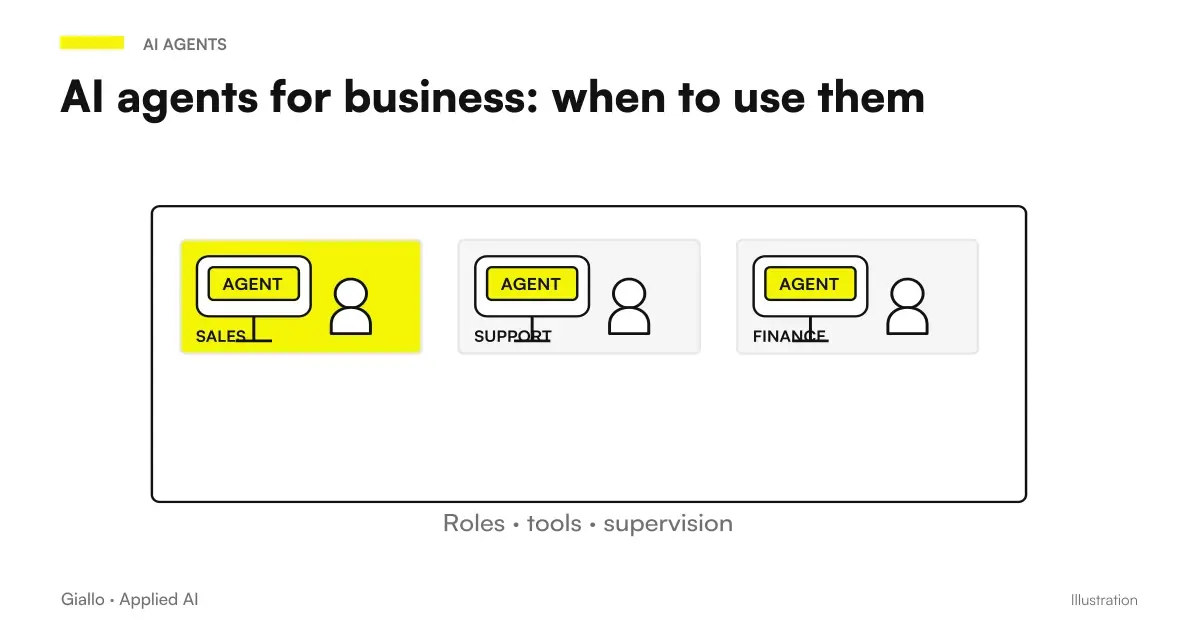
A AI Agent is not an assistant to ask questions: it is a component that completes a recurring task by deciding the intermediate steps on its own. It reads a request, consults company systems, performs an action — writes a row in the business management software, prepares a quote, replies to a customer — and reports the result.
The difference with a chatbot is all here: the chatbot responds, the agent acts. And it is also the reason why adopting it is a business project, not the activation of a subscription: it touches on the systems, data and responsibilities of those who work there.
This guide answers the questions that come before technology: what processes really hold up an agent, what it takes to have in the house before you leave, how much it costs, how you understand if it works and when you should let it go instead.
In summary
- An agent acts on systems; a chatbot merely responds.
- Suitable processes have high volume, written rules and verifiable outcome.
- The heaviest cost item is almost always integration, not the model.
- Without a measurement of the first You'll never know if it worked.
- It serves a Human Control on high-impact cases, per project.
- It starts from a process only, with a pilot of weeks.
What an AI agent does that a chatbot doesn't do
A chatbot receives a question and produces a text. An agent receives a goal and produces a effect: an updated record, an email sent, a generated document, a ticket sorted to the right person.
To do this he needs three things that a chatbot does not have:
- Tools. Concrete access to systems: read customer records, write in CRM, search a document store, send a notification.
- A perimeter. What can it touch and what can not, with what credentials, within what limits of amount or volume.
- A log. A trace of what he has done and why, otherwise when he errs nothing can be reconstructed.
If you remove these three elements it remains a chatbot, with all the limits of the case. For extended definition and technical differences see What are AI Agents; here the cut is decision-making.
What Business Processes Really Hold an Agent
Not all processes deserve an agent, and mistaking the choice of the first process is the most common way to burn a budget. Good candidates share four characteristics.
| Feature | Why It Counts | How to verify it |
|---|---|---|
| High Volume | Under a certain frequency the savings does not pay off the project | How many times a month does that happen? Under 50, think about it. |
| Existing rules | The agent must be able to learn from something written | Is there a procedure, a type mail, a shared policy? |
| Verifiable outcome | We need to be able to tell if he did right or wrong. | Can a person say in 30 seconds if it's right? |
| Impact content of an error | The first trial doesn't have to be what sues you | What happens if he misses once in twenty? |
Processes that Work
- Sorting incoming requests to the right person or office
- Extracting data from recurring documents (invoices, DDT, standard contracts)
- Estimates generated by repetitive specifications
- First level of assistance on questions already seen a thousand times
- Updating tabs and master data from free text
Processes not to be touched first
- Decisions with legal or health responsibility
- Rare cases, where each time is different from the previous
- Processes that no one can describe in words
- Activity where error is discovered months later
- Negotiations and relationships that apply to the human relationship
What you need to have before you leave
The right question is not "which model do we use" but "are we ready?". Four prerequisites, in order of how often they are missing.
The data must be reachable. If the information is in heads, messy shared folders, or poorly scanned PDFs, the agent cannot work on it. This is the real bottleneck in most SMEs, and often the first piece of work is putting order, not installing AI.
The process must be describable. If you ask three people how you do it and you get three different answers, it's not ready to be automated: first you have to decide what's the right way.
There has to be a handler. A person who responds to the quality of the output and who has the authority to say "this case the agent does not touch it". Without it, the project dies as soon as the initial enthusiasm ends.
We need a measure of the former. How long it takes today, how many mistakes you make today, how much it costs today. If you don't measure it first, you won't be able to prove anything when you're finished — and that's the most common reason AI projects are closed even when they're working. On this you see Why AI Projects Fail and which KPIs to measure.
How much does an AI agent cost for a company
There are four voices, and their proportion almost always surprises.
| Voice | What it includes | Typical Weight |
|---|---|---|
| Design | Process analysis, rules, limit cases | One-time, significant |
| Integration | Link to management software, archives, mail, CRM | Often the most expensive |
| Model consumption | What You Pay at Every Execution | Recurring, usually the minor |
| Maintenance | Corrections, process changes, updates | Recurring, must be budgeted |
The counterintuitive point: model is almost never the dominant voice. The real cost lies in getting the agent to talk to the systems you already have, especially if they are old or closed. For the details of the accounts see how much does an AI agent cost; to understand how to read consumption, What Are Tokens.
And a cost item that hardly anyone includes in the quote: the time of your people, to explain the process, review the outputs in the first weeks and correct. It is real time and should be counted.
How do you measure if it's working
Three numbers, measured before and after, on the same perimeter:
- Coverage — out of a hundred cases, how many the agent closes them alone without intervention
- Quality — on those closed, how many are correct according to who knows the process
- Saved time minuti minutes per practice, before and after, multiplied by volume
A low cover but with high quality is a good starting point: it widens. High coverage with uncertain quality is dangerous, because the error goes unnoticed and accumulates. To set up verification see how to calculate the ROI of an AI project.
Who watches him
An agent is designed by assuming that will be wrong. There are three countermeasures and they must be decided before, not after the first accident. The system can propose an additional verification before an action, keeping the permits in the services; guardrails of agents with JEV clarifies the role and the limit of this control.
- Confidence threshold. Under a certain level of certainty the agent does not decide: he passes the hand to a person.
- Human control over high-impact cases. Above a certain threshold —of amount, customer criticality, irreversibility —you need approval.
- Full register. What he read, what he decided, what he wrote. Without it, any dispute is lost at the start.
Then there is the question of data: what comes out of the company, where it is processed and with what guarantees. It must be clarified before signing, not after. See Business Data and AI.
The choice can start from the tools in which the team already works. The integration between Rovo, OpenAI, Jira and Confluence shows how the context of projects can enter the assistant: before adoption, the functions available must be distinguished from the developments still announced.
The announcement of Gemini Agent for Companies should be evaluated in the same way: which systems can use, which context preserves and who controls the actions. Availability and conditions cannot be deduced from the presentation of the product alone.
Build it custom-made or take a tool ready
There is no valid answer always, but there is a criterion: how much the process is yours.
| Tool Ready | Custom Agent | |
|---|---|---|
| Standard and widespread process | Agrees | Wasteco |
| Process that is your advantage | It forces you to bend | Agrees |
| Very closed or old systems | Often it does not integrate | Fits |
| Low initial budget | More accessible | More challenging |
| Cost over time | Grows with users | Predictable |
Many SMEs do well to start with a tool ready on a standard process, and to consider the Custom Software only where the process is really specific. If the systems to be connected are different from each other, the real work is integration with what you already have.
How long does it take to put it into production
A pilot on a single process is measured in weeks, not in months, and it serves exactly to decide whether to continue. The phases have quite predictable durations:
| Phase | Typical duration | What Stretches It |
|---|---|---|
| Process description | Days | No one can tell how it really is done |
| Access to data and systems | Days or weeks | Closed business management systems, suppliers slow to provide the keys |
| First working version | Weeks | Too many limit cases put in right away |
| Side by Side Verification | Weeks | No one has time to review outputs |
| Enlargement | Continuous | — |
The phase that almost always skips the times is the second: obtain accesses. If the management software is third-party and the provider has to enable an interface, that time does not depend on you or who builds the agent. It must be asked before setting any date.
What to Ask a Supplier Before Signing
Six questions that separate those who have already done this work from those who are learning about your budget:
- What numbers do we measure before we leave? If there is no answer, there is no plan.
- What happens when the agent makes a mistake? There must be a threshold, a human check and a register.
- Where is our data processed? And with what contractual guarantees.
- Whose is it that is built? Prompts, rules and integrations: clarify it before it avoids sticking together.
- How much does it cost to keep it in a year? Maintenance is recurrent, initial estimate is not.
- What do we need? A dedicated internal timeless project does not come to an end.
Practical examples
Studio accountant, 9 people, province of Brescia. Every month hundreds of accounting documents arrive from customers, by email, in different formats. The agent reads the annex, recognizes the type of document, extracts the fields, loads it into the management software and reports only doubtful cases. High-volume process, written rules, verifiable outcome in seconds by those who deal with it: all four features are there. Human control remains on the documents above a certain amount threshold.
Plant company, 24 employees, Milan hinterland. Quote requests arrive as free text, often vague. The agent reads them, retrieves price lists and installation times from the archive, prepares a draft quote and passes it to the owner, who corrects and sends it. No quote goes out without a human signature: the gain is in the draft, not the decision.
In both cases the project started from a process only, with a pilot of a few weeks and a number to beat. For how you set it, see the AI Pilot Project.
Mistakes to Avoid
- Starting from three processes together. You end up not taking any home, just one, all the way.
- Choosing the most complicated process to "demonstrate" that works. It's the best way to prove otherwise.
- Not measuring the before state. Without starting numbers, the result will be a matter of opinion.
- Giving the agent broader access than necessary. The perimeter tightens at the beginning and widens afterwards, never the other way around.
- Forgetting maintenance. Processes change; an agent left to itself silently worsens.
- Buying the technology before describing the process. The right order is always the opposite.
How to apply it in the company
A path that works in most SMEs:
- List recurring processes that take up more hours, without thinking about AI. Only volume and time.
- Filter with the four features (volume, rules, verifiability, error impact). Usually there are two or three left.
- Measure the first on the best candidate: time for practice, errors, monthly volume.
- Make a pilot of a few weeks on that process only, with human control over everything.
- Compare Numbers and decide: enlarge, correct or stop. Stopping is a legitimate outcome.
- Widen by degrees, reducing human control only where quality is demonstrated.
The difficult part is not technical: it is choosing the right process and agreeing to measure it. If you want to see how such automations behave before commissioning one, you can try them in The Lab.
Are autonomous agents and superintelligence the same thing?
An agent can choose the next step and use tools within an agreed perimeter. This autonomy describes the operational process; it does not demonstrate the general superhuman competence discussed in superintelligence research. The comparison AI and superintelligence agents for SMEs helps to translate the label into a concrete delegation: available data, allowed actions and verifiable result.
When autonomy increases, it is also necessary to decide who controls the work, how the actions are recorded and what interrupts the flow. Superintelligence, Agent Alignment, and Control links the problem of supervision to current technical requirements. An operator who approves a proposal without being able to verify the source remains a weak control, even when the model produces a convincing response.
Conclusion
An AI agent agrees when there is a repetitive, describable and verifiable process, and when someone in the company takes responsibility. It's not convenient when you're starting with technology and looking for a problem to feed it.
The method consists of three lines: a single process, a number to beat, a human check on the cases that matter. The rest —which model, which platform —are details that you decide later, and that weigh much less than it seems.
If you want to go from testing with ChatGPT to an AI system integrated into business processes, Giallo Studio custom designed agents and automations.
Giallo Studio guides: methodology and sources
How we apply it in the company
Related resources
 AI agents: what they are and how they work
 How much does a custom AI agent cost
 AI Pilot Project: How to Set It Up
 AI project KPIs: what to measure
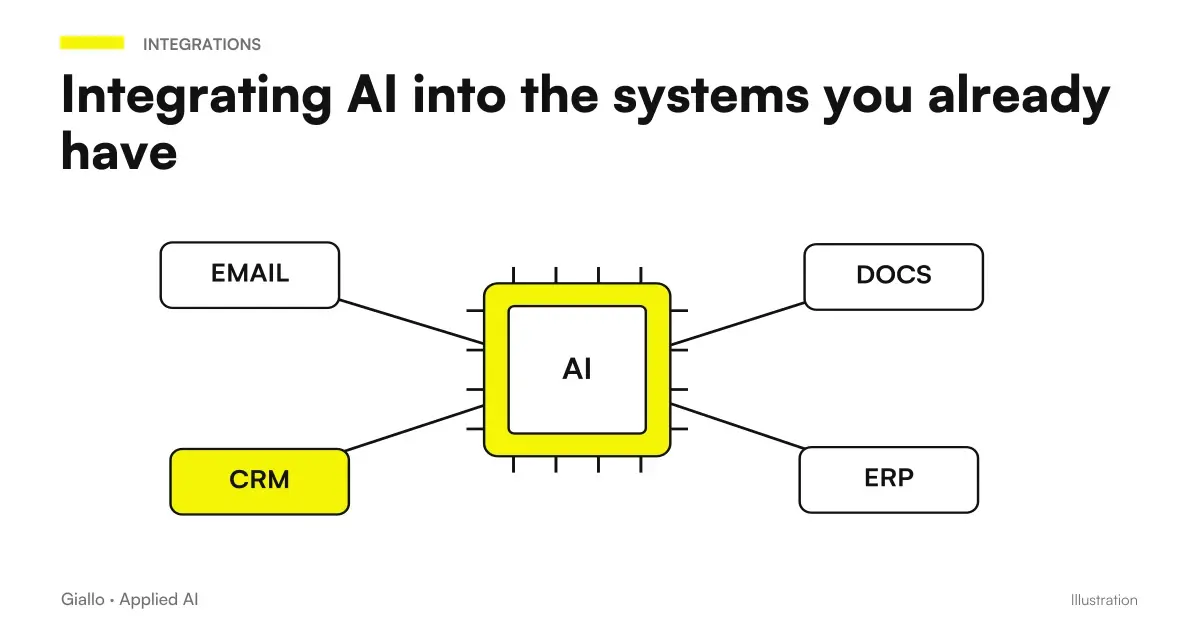 Integrating AI into the systems you already have
 Claude Opus 5.5 for an SME: five concrete uses and when not needed
 Win property listings with AI: lawful channels and limits
 ElevenAgents Architect: designing and correcting voice agents with tests and drafts
FAQ
What does an AI agent do in a company?
It completes a recurring task by deciding for itself the intermediate steps: it reads a request, consults business systems, performs an action and reports the result. The difference with a chatbot is that it acts on systems, it doesn't just respond.
What business processes are suitable for an AI agent?
High-volume processes with documented rules and a verifiable outcome: routing requests, extracting document data, preparing quotes from specifications and first-line support. Rare processes or those requiring legal responsibility are unsuitable.
How much does an AI agent cost for an SME?
There are four cost components: design, integration with existing systems, model usage and maintenance. In most projects, the largest cost is integration with business management software and data stores, rather than the model.
Do I need to replace my business management software to use an AI agent?
Almost never. An agent works on top of existing systems through their programming interfaces or, where those are unavailable, periodic exports. Replacing business management software to adopt AI is a sign that the project has been set up poorly.
How long does it take to put it into production?
A pilot for one process is measured in weeks rather than months, and its purpose is to decide whether to continue. If a supplier proposes a project lasting months before any verification, you bear the risk.
Can an AI agent be wrong?
Yes, and it should be designed with mistakes expected. There are three safeguards: human review of high-impact cases, a record of what the agent did, and a confidence threshold below which it hands over to a person.