
Superintelligence: the technologies of OpenAI, Claude and Google
Superintelligence technologies: models, tools, memory and verifiers at OpenAI, Anthropic, Google and Meta. Choose an architecture for an SME.
Reading time: 14 min
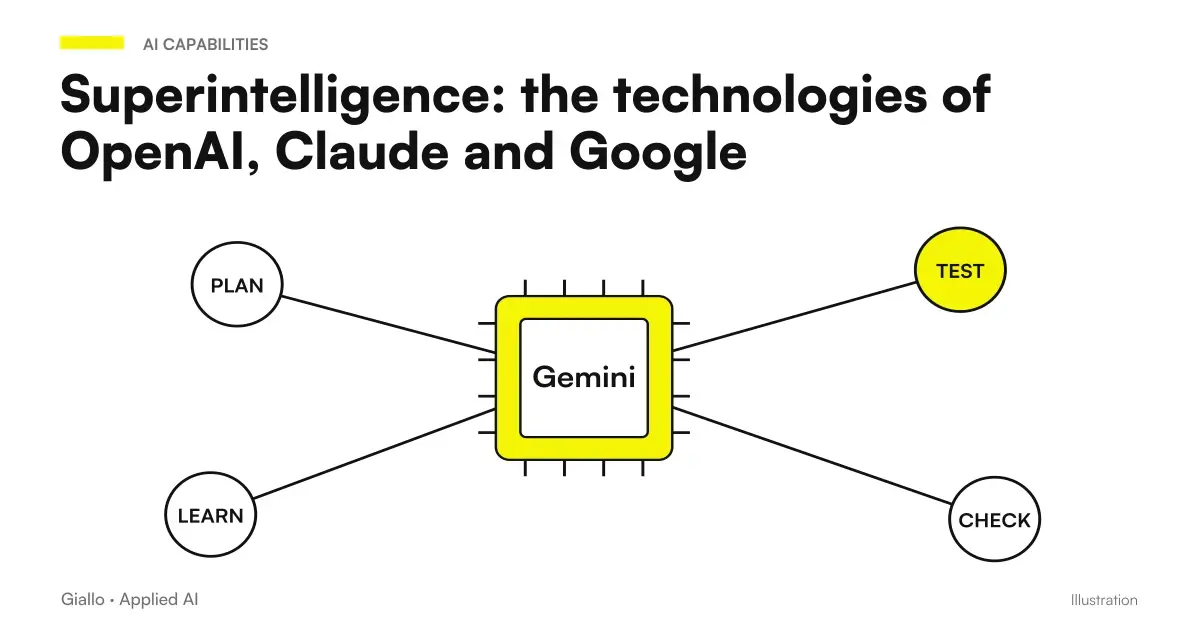
The superintelligence technologies are not a single ingredient. In the public cases of OpenAI, Anthropic, Google DeepMind and Meta we find models that reason, tools to act in software, systems that preserve work and verifiers that control proposals. Each component faces a different problem; assembling them is not enough to prove an ASI.
«Super intelligence» is an English variant of superintelligence, not a new name for the whole AI. Artificial superintelligence is about superhuman general capabilities; available artificial intelligence can be useful in delimited tasks without meeting that definition. The general reference remains the guide to what is artificial superintelligence.
This article compares documented architectural components and choices, verified on sources cited on October 10, 2026. It is not an exhaustive catalog of the latest releases nor a ranking of the best chatbots. For an SME the useful comparison starts from what it takes to complete a task, including the conditions under which the system has to stop.
In summary
- Model and complete system are different levels: the second includes tools, sources and permissions.
- Reasoning longer, exploring alternatives, and verifying a result are different choices.
- A persistent session serves continuity; it does not prove superior general intelligence.
- Supplier cases show compatible components, not four exclusive roads.
- The business architecture must be chosen on the delivery and constraints of the process.
What components are needed in addition to the AI model?
The model interprets requests and generates proposals. The complete system must also bring the right information, offer usable tools and decide how to manage outcomes. An instruction such as ‘prepare the summary of the order’ seems simple, but it depends on where the data is, which version of the document prevails and who can read the result.
We can represent the work through some levels. The sources They contain the facts. The model elaborates those facts. The tools allow you to read or edit software. The orchestration decides the sequence of the passages. The session retains the status of the job. The verification shall determine whether the result meets the requirements. It is a proposed practical breakdown to analyze a project, not a universal list imposed on laboratories.
A problem may require only some of these layers. Turning an approved text into a draft may need only a call to the model. Checking an open job may require multiple sources, a comparison of statuses and a review step. Adding complexity without an observable need makes it harder to understand where an error comes from.
The distinction between the set path and the model's initiative is explained by Anthropic in Building effective agents. For terminology on the site, the guide to AI agents allows to deepen the operation without confusing it with an ASI certification.
What does computer use show in the OpenAI case?
The page of GPT-6 Astra documents professional activities and computer use. Here Astra is a historical example of September 2026: the update of the same page of September 29 refers to the most recent GPT-6.1 Sol. The services communicated are attributed to OpenAI; we do not obtain a current ranking or an ASI test.
The architectural interest lies in the relationship between reasoning and software interface. A business process can go from a screen because the management software does not offer a direct link for the requested operation. In that case the system must recognize elements, interpret states and understand if the action has succeeded. The ability of the model is only part of the solution.
Before choosing this path it is advisable to ask if there is an appropriate API. A direct link can return a structured state, while an interface requires interpreting what is visible. It does not mean that a route is always better: the choice depends on access, available operations and expected maintenance.
In both cases it is necessary to distinguish ‘I have tried to save’ from ‘the system has recorded the result’. An independent check of the final state helps not to swap the sequence of clicks for completion. The Guide to AI API deepens the technical link; the comparison here concerns the role of the instrument in the complete work.
What does a persistent session add in Anthropic’s case?
In the document Scaling managed agents, Anthropic distinguishes persistent session, agent execution cycle and working environment. The session keeps events out of the model context window. The service also documents a separation of credentials from environments running generated code. It is system engineering, not a demonstration of superintelligence.
For an SME the theme is continuity. An interrupted machining should not restart as if no steps had already taken place. At the same time, retaining a conversation does not guarantee that the model will retrieve all important information when it needs it. Storage and proper use of knowledge should be tried separately.
Let's imagine a draft prepared, revised and then modified after a new instruction. The system should know which version has been approved and which is still in the works. An indistinct memory of all messages can leave this point ambiguous. The state of the process must be represented in a verifiable manner.
A clear responsibility is also needed here when a collaborator intervenes. What can he resume? From what passage? With what sources? The Agent Memory and Business Context develop the conceptual limit: remembering an event does not mean having learned a general skill, and does not automatically resolve permissions between people.
Why does the verifier count in the case of Google DeepMind?
In the February 2026 paper on Gemini Deep Think and Scientific Research, DeepMind describes Aletheia through generation, verification and review. The corpus includes activities with different levels of human intervention and expert evaluations. It is not correct to turn all those cases into fully autonomous scientific research.
For an enterprise, the transferable principle is to ask which property is verified. A software can check that all the fields in a document are present; this does not prove that the values correspond to reality. It can verify a sum; it does not automatically decide whether the entries entered are correct. The quality of the control depends on what it can observe.
Separating proposal and control makes the process more readable. The generator suggests a result; the control produces a reason for acceptance, revision, or shutdown. If both of them merely say ‘seems correct’, the second passage adds little evidence. It is necessary to know which source or rule supports the judgment.
The self improvement via AlphaEvolve addresses a different case, in which the search for algorithms is guided by automatic evaluations. The two examples share the importance of verification, but should not be presented as the same product or method.
What changes with parallel reasoning in the Meta case?
Meta describes for Muse Spark an orchestration of agents who reason in parallel in the Contemplating mode. It is a choice documented in the April 2026 technical announcement. Claims about the benefit belong to the supplier; they do not indicate that any business activity requires multiple agents.
Parallel reasoning can be understood as exploring alternatives. In a project, some leads could be examined separately and then compared. But the agreement between several proposals is not, on its own, a test: if the tracks use the same incomplete information, they can converge on the same error.
The business demand therefore concerns the useful diversity of work. Are we exploring actually different alternatives? Do we have a rule for comparing them? Does the final step preserve uncertainties or erase them to produce a single response? Without these requirements the plurality of attempts can increase the outputs to be controlled without improving delivery.
In the piece on the Meta Personal Superintelligence separate model, application experience and rollout. Here only the architectural component is concerned: parallelism can coexist with tools, memory and verifiers, and does not define an entire business strategy.
How to compare components without classifying laboratories?
The table summarizes the operational implications of the cases just mentioned. The applications are proposed criteria for their project, not measured performance of Italian SMEs.
| Observed component | Problem he may face | Question to bring into the project |
|---|---|---|
| Computer Use and Tools | Operate in the required software | What final state proves that the pass succeeded? |
| Persistent Session | Resuming activities and preserving their history | Which version and which state are valid for recovery? |
| Verification distinct from the proposal | Check Observable Requirements | What errors can the verifier really recognize? |
| Parallel Reasoning | Exploring different tracks | How are alternatives compared? |
| Source recovery | Bringing up-to-date facts to the model | Which document prevails in the event of a conflict? |
| Action limits | Keeping the job within the mandate | What steps require confirmation? |
The components can live together. A system with persistent session can use the computer; one with verifier can examine parallel alternatives. Public cases do not exhaust the search for each laboratory, so it would not be correct to assign only one box to each manufacturer.
For a comparison of products there is the Guide to the main AI models. The architectural choice comes first: it describes the work that the model will have to perform within a system.
When is more reasoning needed and when is a simple passage enough?
Devoting more processing to a response can make sense when the problem requires alternatives, controls, or interdependent steps. It does not authorize a universal promise of correctness. A well-described process allows one to observe whether the more complex configuration solves errors that the simple one leaves open.
Let's take a classification with clear categories and a design proposal with conflicting constraints. In the first case we might want above all a coherent and fast decision; in the second we might accept a more articulated work. The configuration must follow this difference, instead of always imposing the maximum reasoning available.
It is also necessary to establish how uncertainty can be managed. The system can ask for a missing data, present options or stop. A long answer that hides the problem is less useful than a short question that makes it visible. The requirement should reward the appropriate behavior, not the amount of text produced.
The Anthropic Agent Assessment Guide distinguishes result, path and operational aspects such as cost and latency. For SMEs these become items to be observed in their own process; not percentages of improvement to be deduced from ads.
What architecture would evaluate a carpentry in Parma?
Hypothetical scenario, not client case. A carpentry in Parma wants to prepare the start-up card of a clerk starting from request, drawing and technical notes. The system must organize the available data and indicate the missing data. It cannot approve a processing or modify the production plan.
The first choice concerns sources. The revised design must prevail over the previous version; informal notes can add questions, not replace an approved requirement. If this rule is not defined, a more capable model could still build a card based on the wrong document.
The second is about control. A structured verifier can check for mandatory references and fields. Technical feasibility assessments remain with the manager, who must clearly see what information is extracted and what assumptions are made. The AI step cannot automatically declare verified what the control does not observe.
The third is management software. If there is a suitable link, a draft can be prepared via API; otherwise it is evaluated if it is needed to operate in the interface. The test must check the final state and keep the draft separate from the approved tab.
A simple architecture could suffice for this perimeter. Parallelism would only make sense if it were necessary to compare definite alternatives, not because the system must resemble an advanced demo. The required properties are correct sources, visible uncertainty and verifiable delivery.
What is the use of a furniture showroom in Bolzano?
Second hypothetical scenario. A furniture showroom in Bolzano wants to prepare an internal comparison between compositions for an exhibition space. The team provides demonstration measures, authorized catalogues and set-up constraints. The system must propose alternatives to discuss, without buying products or promising availability.
Here exploring separate tracks might be helpful. One proposal prioritizes the passage of visitors, another the visibility of materials, another the flexibility of the set-up. The value of parallelism would lie in the difference in criteria, not in the number of agents. Each proposal should state which constraints it complies with and which ones require confirmation.
The comparison phase needs common data. If one track uses updated measurements and another uses an old design, the comparison is invalid before discussing aesthetics. References should be normalized and the control should report inconsistencies, leaving the team the final choice.
A persistent session would be useful to resume after a review. It should retain which proposal was chosen and which changes are still open. Retaining all conversations without a clear state is not enough: the collaborator who resumes the work must understand what is decided.
The distinction between autonomy and superintelligence The system can help to explore and organize; authorization to buy or confirm an order is a decision of the process, separate from the quality of the reasoning.
If the system is wrong, which component should be checked?
If it cites an outdated catalog, check the selection of sources. If it misinterprets a correct measure, it analyzes the model processing and the clarity of the request. If you prepare the right document but save it in the wrong place, check tools and destination. If you resume an already discarded draft, check status and session. Changing the model before identifying the faulty step may leave the cause of the error intact.
What mistakes to avoid when comparing technologies?
Reduce each laboratory to a technique It's the first mistake. Selected publications show components, not the entire research portfolio. A useful case to explain persistence does not authorize saying that that provider only works on memory.
The second mistake is mixing up dates and versions. Astra is used for a documented example; the reference to the later GPT-6.1 Sol avoids presenting it as the latest release. The same caution applies to announcements from Google, Meta and Anthropic: before choosing a product, check the current official page again.
The third is to exchange a supplier's assessment for a promise on your own process. Results may be informative, but they do not automatically include SME documents, integrations and errors. The in-depth study of evidence of superintelligence in 2026 develops the limit of inferences on ASI.
The fourth is adding agents and passes for no reason. Each component must solve an identifiable requirement. If we don't know what mistake it should prevent or what delivery it should make possible, it's probably too early to enter it.
The fifth is to evaluate the generator and overlook the control. A result accepted by a weak verifier may be wrong. The theme is linked to alignment and supervision of agents, which distinguishes greater capacity and greater control.
How to turn this map into project requirements?
It starts with a precise delivery and its acceptance criteria. «Preparing a card with sources and doubts» allows verification; «using the most intelligent AI» leaves almost everything open. The process manager must be able to read the result and recognize whether it meets the purpose.
You then list dependencies: documents, software, work status and permissions. For each dependency you ask which component is needed. Document recovery may require a RAG System; an action on management software may require a tool; a subsequent review may require persistence.
Finally, a set of tests is prepared that includes the normal case and the relevant exceptions. A missing document, a contradictory source, and an unavailable tool help to determine whether the architecture stops in an understandable way. There is no need to turn the evidence into a forecast of the ASI's arrival date.
This map allows you to compare technical proposals on the same need. The supplier can explain what components they use, what controls remain human, and what behavior to expect when something is unavailable. The discussion becomes more concrete than the choice by brand.
What component is missing from your AI process?
The useful question is where the work loses quality or is interrupted. An updated source, a stable link, a readable state, or a control capable of recognizing relevant errors may be missing. The model is central, but delivery depends on the system around it.
To evaluate the next step you can link this map to the choice between Current adoption and expectation of superintelligence. When instead the problem consists of looking for better algorithms with measurable criteria, the case AlphaEvolve offers a focused deepening.
If you have a process to complete and you want to identify the necessary components, we can turn it into requirements and acceptance tests in the path of custom software.
Giallo Studio guides: methodology and sources
How we apply it in the company
Related resources
 Artificial superintelligence: meaning and applications
 Does superintelligence already exist? Evidence in 2026
 Meta Personal Superintelligence: What Muse Spark Does
 AI that improves itself? How does AlphaEvolve work
 AI Agents and Superintelligence: What Changes for an SME
 Dots for marketing an SME: content and materials always up to date
 Perplexity vs Google: response with sources or link list
FAQ
What technologies are associated with superintelligence?
The research and products examined combine models, reasoning, tools, orchestration, session memory and verification. These components perform different functions and may coexist in the same system. Their presence does not automatically demonstrate ASI capabilities.
Do OpenAI, Anthropic, Google and Meta follow incompatible paths?
No. Public cases show different emphasis, but do not describe the entire research of each laboratory. Use of tools, reasoning and verification can be combined. It is incorrect to reduce each supplier to a single technique.
Does Reasoning Longer Always Make AI Better?
This cannot be guaranteed for every task. For a business process, check whether the result improves enough to justify the waiting time and cost. A simple activity may not benefit from the same configuration suited to a complex problem.
Does a verifier eliminate all errors?
No. It can only control the properties that its criteria and tools can observe. If an essential requirement is missing, a proposal can pass the test remaining unsuitable for real work. The verifier must be evaluated together with the system.
Why is GPT-6 Astra cited if there is a newer Sol?
Astra is used as a documented example from September 2026, rather than a description of the latest available model. Since 29 September, its official page has pointed to GPT-6.1 Sol. Recheck versions and availability before choosing a product.
How does an SME choose among these architectures?
It starts with the deliverable, required sources and permitted actions. It then tests the necessary components on representative cases and exceptions. The choice concerns a system that completes the process well, rather than a universal ranking of brands.