
AI that improves itself? How does AlphaEvolve work
Superintelligence and self-improvement: how AlphaEvolve searches for better algorithms, who defines tests and why optimisation does not prove general ASI.
Reading time: 13 min
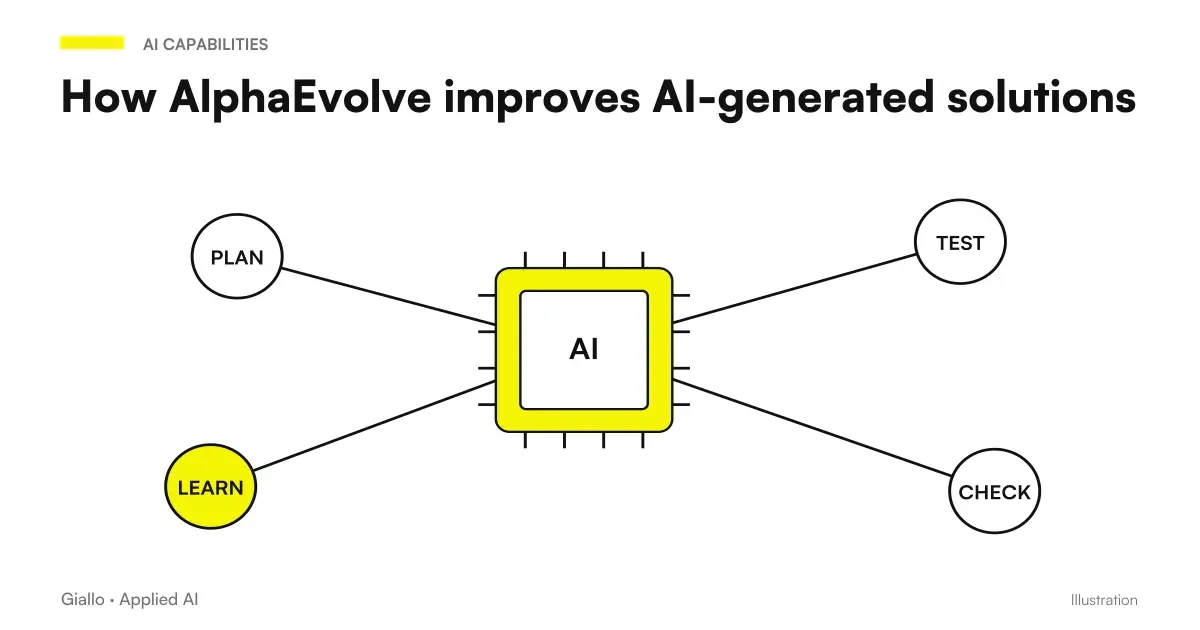
The relationship between superintelligence and self-improvement requires a distinction: improving an algorithm does not mean making a system generally smarter. AlphaEvolve, from Google DeepMind, searches for better programs through proposals, evaluations and selection. DeepMind also describes contributions to components of the AI infrastructure, but this alone does not demonstrate general recursive improvement or an ASI. Official presentation of AlphaEvolve.
«AI that improves itself» can refer to different phenomena: correcting a response, modifying a program, optimizing a training process or increasing general abilities. Before discussing the outcome, it is necessary to clarify which of these changes took place. The Word Super Intelligence does not rename all AI: the broader meaning is explained in the guide to Artificial superintelligence.
The sources cited were verified on October 10, 2026. The method of AlphaEvolve is of interest to SMEs because it makes explicit an often hidden problem: to find something ‘better’, someone must define what matters as improvement and what constraints cannot be sacrificed.
In summary
- Optimizing a component and demonstrate superior general intelligence are different conclusions.
- In the project it is necessary to define the desired result and a control capable of measuring it.
- A better score is not enough if the system neglects essential requirements.
- The cases reported by DeepMind do not automatically provide for the return of an Italian SME.
- Before the tool are given, constraints, comparison solution and tests on new cases.
How does AlphaEvolve work and what does the user prepare?
AlphaEvolve uses language models to propose changes to programs, submits them to evaluations, and retains promising alternatives to fuel research. original paper specifies the user's contribution: problem definition, initial program and automatic evaluation mechanism. It is therefore not a system that autonomously decides which business goal to pursue.
To understand the cycle, let's imagine an illustrative project looking for a better way to sort tasks. The proposal produces a sequence. The test checks whether it meets the constraints and calculates its quality according to the chosen criteria. The selection retains a useful solution for the next comparison. The diagram represents this principle in a simplified form, not the complete product architecture.
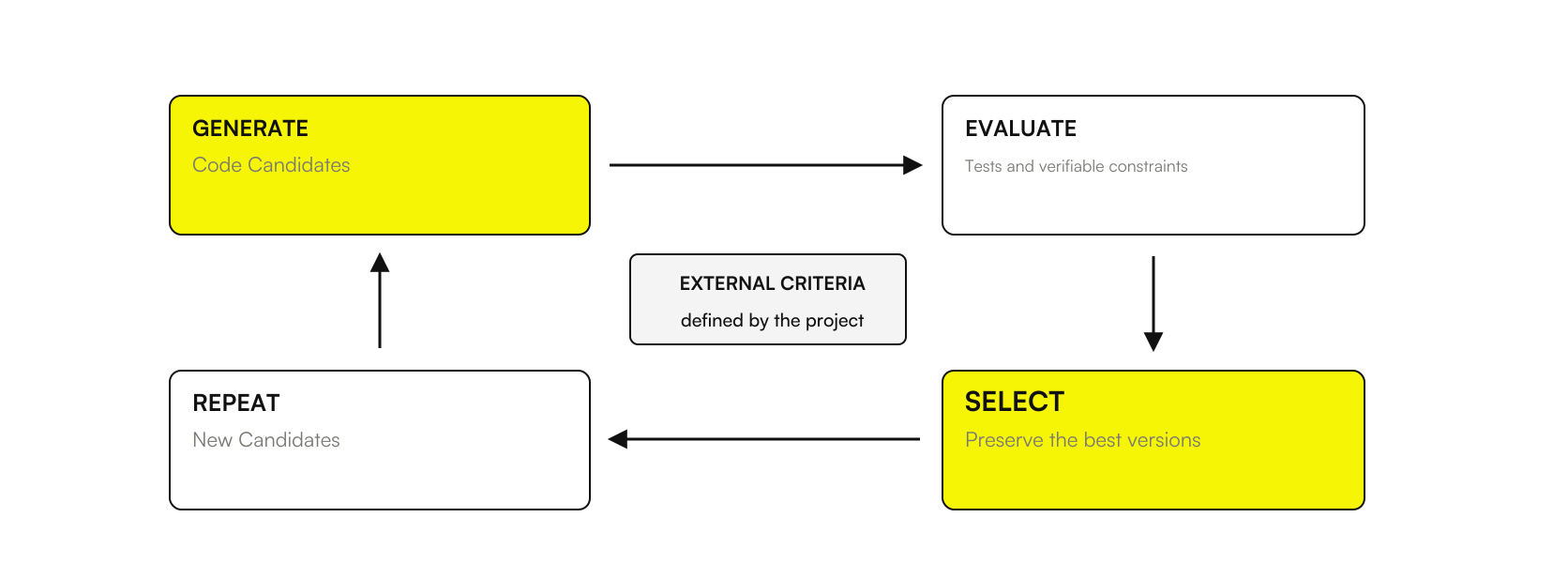
The decisive point, for those who design the illustrative test, is that the control must know what makes a sequence acceptable. If a constraint remains in the head of the manager, the score cannot represent it. The program could be better for metrics and worse for real work.
The map of technologies towards superintelligence places this case next to tools, memory and verifiers. Here the focus is narrower: the search for algorithms through observable criteria.
What improvements in AI has DeepMind documented?
In the 2025 presentation DeepMind describes applications to computing infrastructure, chip design and training processes. In May 2026 update communicates further applications, including commercial logistics optimizations. They have been published by the supplier in their own context; they are not a prediction of the benefits of each enterprise.
The link with AI concerns the modified component. Making an operation used in training more efficient can contribute to the system that produces models. To determine what has changed, however, it is necessary to distinguish the efficiency of the infrastructure, the quality of an algorithm and the capacity of the final model. They are different measures.
For an SME it is a lesson in reading evidence. If a software proposal uses fewer resources on the chosen test, we observed a result on those resources and that test. We do not yet know if it will be better with other data, whether it will be easier to maintain or if it will respect an operating constraint not included in the evaluation.
The distance between specific result and general conclusion is deepened in Does superintelligence already exist?. The AlphaEvolve case is also relevant without attributing properties to it that the sources examined do not demonstrate.
Are optimization and self-improvement the same thing?
In current language, "it improves" may indicate a rewritten draft after feedback. For a software system it may indicate a program replaced with a more effective version. The hypothesis of recursive self improvement is more challenging: it concerns a cycle in which capacity improvement contributes to the production of further improvements.
This hypothesis requires evidence about changing capabilities, the role of the system in change, and the conditions of the cycle. A local outcome does not authorize inferring unlimited growth. It is also not enough that the optimized program belongs to an AI infrastructure: the transition to general capabilities must be demonstrated separately.
The framework Levels of AGI distinguishes generality and level of performance. It is a useful proposal to prevent a specialized success from being transformed into an ASI classification, not a universal certification. The comparison between AI, AGI and ASI Develop the terms.
| Change observed | What we can verify | Conclusion That Requires More Evidence |
|---|---|---|
| An answer is corrected | New response meets requirements | The model has acquired a general capacity |
| An algorithm changes | The variant exceeds the defined comparison | All similar problems will be solved better |
| An AI component is optimized | The component improves under measured conditions | The final model is generally smarter |
| A process uses feedback | Feedback Orients Research | The cycle produces limitless improvements |
| A program passes a test | The properties included in the test are satisfied | Every operational requirement has been checked |
How to define a goal of optimization useful to the company?
The question ‘can it improve the process?’ is too broad. You need to specify a delivery and a comparison. "Proposing an order of the workings that respects the precedents and reduces the changes of equipment" is already more verifiable. It does not imply that the result will be achieved: it indicates what properties must be observed.
Then they stand out. Mandatory constraints and preferences. A technical precedence may be imperative; the convenience of grouping some activities may be a preference. If both become just points in a sum, the system could compensate for a serious breach with an advantage elsewhere. The person responsible must decide what conditions make a proposal unacceptable.
A reference solution is also needed. It can be the current procedure, a simple algorithm or a plan already approved, as long as it is tested under the same conditions as the proposal. Without reference it is easy to call a result better just because it seems plausible.
Finally, the context of use is specified. A demonstrative plan can help a discussion; an executed plan modifies people's work. For the former a preliminary check may suffice; for the latter a revision and a recovery mode are needed if conditions change. The difference between agents and superintelligence clarifies why operational delegation remains a separate choice.
What would control an industrial laundry in Prato?
Hypothetical scenario, not client case. An industrial laundry in Prato wants to evaluate an algorithm that proposes the sequence of the lots. In the demonstration model they count compatibility of the processes, available times and need to change configuration. No economic result is assumed and this scenario is not used to attribute performance to AlphaEvolve.
The production manager prepares synthetic data representing normal batches and problem cases. Some processes are incompatible; some have a precedence; others can be moved. These rules must be translated into controls, keeping the reason why a proposal is rejected recognizable.
The system that generates alternatives must not be able to change the definition of a compatible batch to obtain a higher score. The evaluator remains separate from the proposals and is tested on deliberately invalid sequences. If it accepts a prohibited sequence, the test is not ready to choose the best programme.
Comparison with the reference procedure uses the same batches and rules. A proposal that reduces configuration changes but violates a precedence is not rewarded. A valid but fragile proposal on exceptions requires further evidence. The goal is to understand where the algorithm helps and where it loses robustness.
Before taking him into real work, the manager examines plans on new data. It also maintains an understandable way to return to the previous procedure. The useful principle is evidence-driven research; not the promise that an AI will autonomously solve every productive constraint.
How would an algorithm evaluate a spare parts distributor in Padua?
Second hypothetical scenario. A spare parts distributor in Padua wants to study the assignment of items to picking locations in a demonstration warehouse. The goal could be to reduce unnecessary paths while maintaining compatibility and accessibility. The project requires a warehouse model and consistent data; it is not enough to ask for a better arrangement in a conversation.
The first work is about representation. Some positions are not suitable for certain articles. Some routes are not usable. Some combinations need manual verification. This information must be explicit before giving meaning to a proposal's score.
The team could try variants of an assignment algorithm in a simulator. For each it collects a result on the path and the list of constraints respected. Then it uses different demonstrative orders to understand whether the proposal only works on the initial sample or maintains quality when the composition of the demand changes.
A variant that optimizes simpler orders but worsens those with bulky items may be unsuitable. Even a seemingly valid proposal could be difficult for operators to use. Automatic testing and team review observe different aspects: neither should be presented as a complete verification of the other.
Finally, the manager prepares a circumscribed test, without automatic displacements or irreversible changes. Any application would require an operational decision. The logistic results communicated by DeepMind suggest a field of research; they do not anticipate the performance of this hypothetical distributor.
Why should the evaluator be checked before proposals?
In the method documented by AlphaEvolve, the ability to automatically evaluate solutions is a requirement and a limit. The paper circumscribes the approach to problems for which this control can be arranged. Not all business objectives have a reliable ready-to-use measure.
In our illustrative project, we can try the evaluator with deliberately wrong results. A sequence with a breached precedence must be rejected. A program that returns an incomplete output must fail. A solution that only works by ignoring an input must not receive a positive judgment. These tests check the meter before using it.
It is then advisable to ask what aspects remain out. The test may not catch the maintenance difficulty or a condition that rarely occurs. Declaring these limits makes the review more useful: the manager knows where to concentrate human control instead of assuming that the score covers everything.
The relationship between capacity and supervision is developed in the article on superintelligence, alignment and control. For an SME the concrete point is to prevent the generator from silently redefining the rules by which it is judged.
The score gets better, but the process gets worse: what to check?
Checks whether the metric includes all mandatory constraints, whether the comparison uses the same data, and whether the simulator represents the relevant exceptions. Then check if the proposal changes the input, rules, or evaluator to be better. A positive change in score is a track to be examined; it becomes a decision only after the process requirements are checked.
Is a simulator enough to know if the optimization will work?
A simulator makes certain conditions repeatable. It allows you to compare proposals without immediately applying them to real work. However, the result remains linked to the representation used: if the process model omits a rule, even the comparison can ignore it.
For this reason, in the SME project, it is necessary to document what the simulator represents. What events do you treat as possible? How do you describe unavailability and schedule changes? What data do you consider certain? A system that optimizes a simpler world than the operating one could propose a plan that no one can execute.
Another check concerns new data. Repeating the same cases all the time can make a variant that only fits the initial sample look robust. It is advisable to keep some verification scenarios separate and include relevant exceptions. This is a design criterion, not a percentage of reliability attributed to the system.
Finally, compare the result with those who work on the process. An undocumented constraint may emerge during review: a sequence is valid on paper but prevents an intermediate check, or a layout makes similar items difficult to identify. The observation becomes a requirement to incorporate and test again.
What mistakes turn self-improvement into an empty promise?
The first is Don't tell what gets improved. Program, infrastructure, response, and general capacity are different objects. A precise statement must indicate the component and the comparison, instead of letting the word AI cover each step.
The second is to confuse optimization and ASI testing. The specialized result may be relevant; to support superhuman generality, other evidence is needed. Evidence from 2026 It helps to keep the conclusion proportionate.
The third is to copy a supplier's result into the company's estimate. A case of another infrastructure does not prove the return of the local project. Data, constraints, evaluation costs and integration possibilities can be completely different.
The fourth is to start by generating code before preparing the measurement. If we can't recognize a better proposal, producing more alternatives increases the review work. The most useful approach starts with the problem and control, then chooses how to explore the proposals.
The fifth is to automatically introduce a winning variant. The score responds to the test; putting it into use also requires accountability, observability, and recovery. The distinction between selected algorithm and approved program must remain visible.
What optimization problem is worth preparing in an SME?
A useful candidate is a repeatable problem with clear inputs and explicit constraints. It doesn't necessarily have to be complex. It must allow a proposal to be compared with a reference procedure and an invalid result to be recognised. If these conditions are missing, the first work is about the data and the description of the process.
The problem card should indicate who owns the requirement, what output it serves, and what conditions make the result acceptable. It should distinguish measurable aspects from those that require human review. If the goal remains to ‘increase quality’ without an observable definition, it is difficult to build a serious comparison.
Then you decide how much it costs to evaluate a proposal. A test that requires a lot of resources or a long review can limit the search. The enterprise needs to know how much effort it can devote to exploration before choosing the algorithm, without inferring a budget from DeepMind cases.
The AI Automation Guide helps to understand where an orderly procedure can already solve the problem. The comparison between adoption of AI and expectation of superintelligence Instead, it helps to decide when to test, when to prepare the basics, and when to postpone that specific case.
What to bring from AlphaEvolve research to business project?
The useful lesson is to make improvement verifiable. First, you define results and constraints. Then you check the rating meter. Only then do you explore alternatives and confront them under the same conditions. This method retains value even when the chosen tool is not AlphaEvolve.
Optimizing a component is a concrete goal. Demonstrating general superintelligence is another question, which is not solved by the name of the product or a single success. The map of technologies and the guide to Agent Controls help to place the project within its perimeter.
If you have a sequence, assignment, or rule problem that is solved by hand today, we can turn it into data, constraints, and proofs through a project of automation of business processes.
Giallo Studio guides: methodology and sources
How we apply it in the company
Related resources
FAQ
Is AlphaEvolve an AI that improves itself?
AlphaEvolve looks for better algorithms and can help optimize components used in AI. This is not the same as demonstrating unlimited overall self-improvement. You need to specify which component changes and how the improvement is measured.
How does AlphaEvolve work?
It combines code proposals from models with automated evaluations and selection of promising alternatives. The search operates within a defined problem. The user sets up the objectives and evaluation mechanism.
What does recursive self-improvement mean?
It refers to the hypothesis of a system improving the capabilities it uses to produce further improvements. It should not be confused with a single optimised algorithm or a draft corrected after feedback. Supporting it requires evidence about the cycle and the capabilities that change.
Does AlphaEvolve prove that superintelligence exists?
The search for algorithms described in the sources is not sufficient evidence of superhuman general capabilities. Optimization and ASI classification answer different questions. Results should be read in the documented perimeter.
Who decides if a proposed algorithm is better?
The result depends on the criteria and tests chosen for the project. A better score is only useful if the evaluator correctly represents goals and constraints. Unmeasured requirements can remain out of control.
Can an SME apply this principle to its processes?
It can evaluate a circumscribed problem with measurable data, constraints, and results. It does not mean that it should use AlphaEvolve or that it will get the results communicated by DeepMind. The choice of tool comes after the definition of the problem and the tests.