
Claude Mythos 5.2: what it is and who can use it
Claude Mythos 5.2 is Anthropic's 9 November 2026 model without cyber and biology blocks, for verified organizations. Does an SME need it? Almost never.
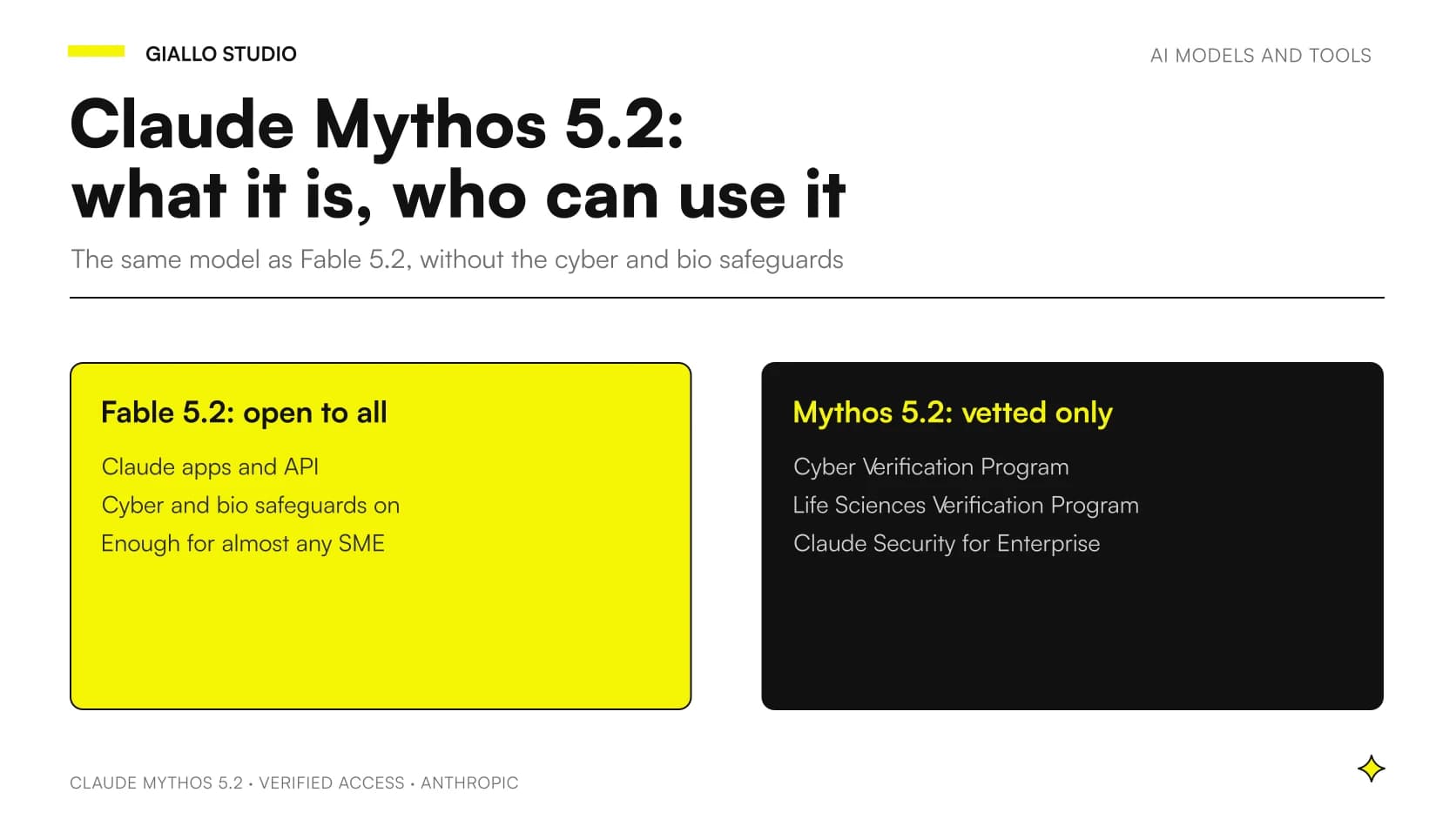
Claude Mythos 5.2, released by Anthropic on 9 November 2026, is the same AI model as Claude Fable 5.2, but without the safeguards that block high-risk activity in cybersecurity and biology. It cannot be bought with a credit card: it is reserved for verified organizations working in those fields. That is what the Anthropic official announcementsays, as checked on 9 November 2026.
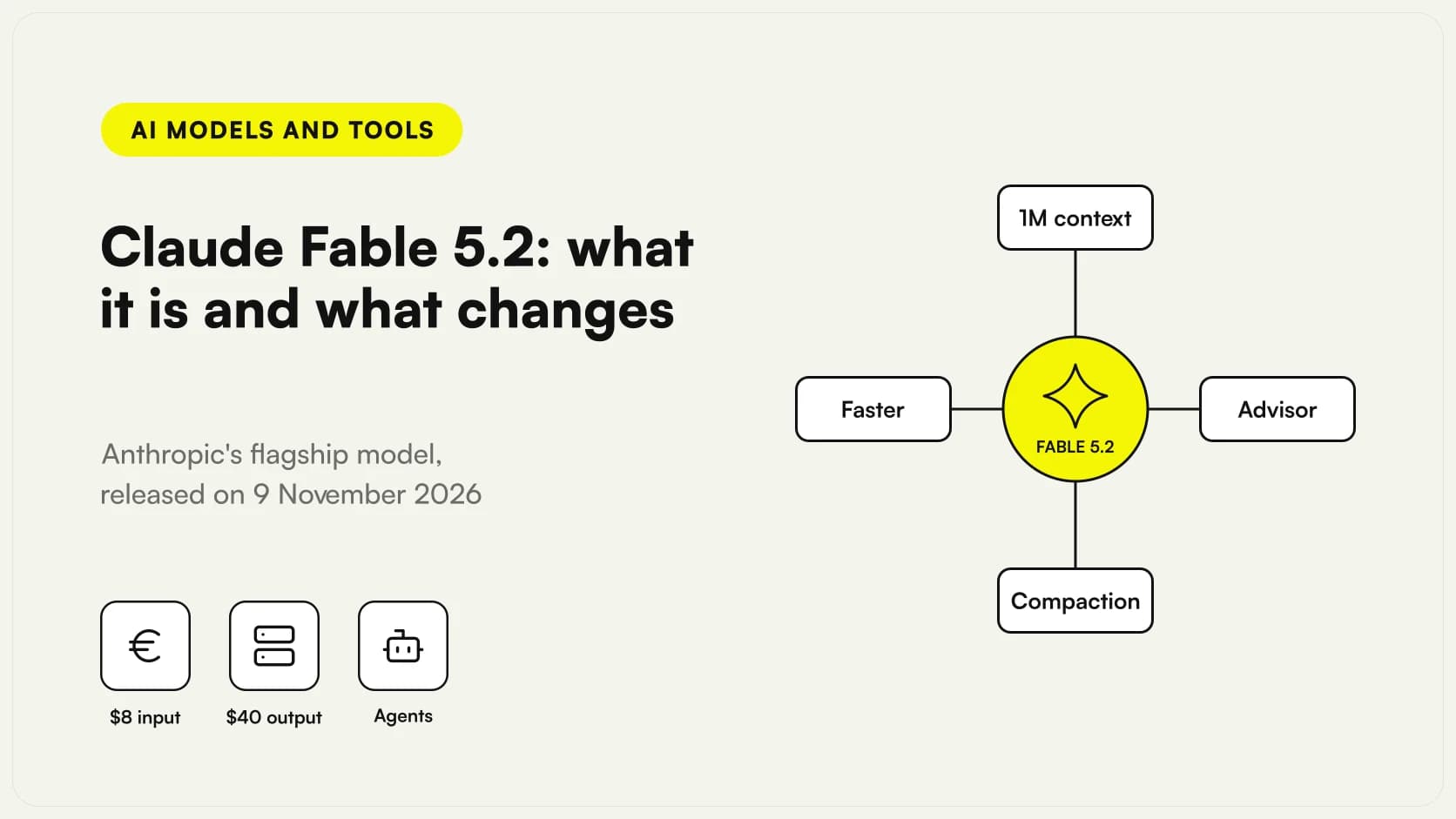
The practical consequence is simple. Anyone searching for “claude mythos 5.2” expecting a smarter model to use in a business is heading the wrong way: the difference is not power, it is permission. For an Italian SME, almost always, the right choice remains another model in the family, and here we explain which one and why. The full spec sheet for the twin model is in our article on Claude Fable 5.2.
In summary
- Claude Mythos 5.2 is the Claude Fable 5.2 model without safeguards on cyber and biology, released on 9 November 2026 (official page).
- It is available only to approved organizations, with the API ID
claude-mythos-5-2: you request access from a verification program or from your own account team (Anthropic documentation). - Specifications and pricing are those of Fable 5.2, with a context of 1 million tokens (official page).
- The real advantage concerns cybersecurity and biomedical research, where Fable 5.2 refuses or routes requests to older models (announcement).
- For writing, documents, code and automations it is not needed: Anthropic recommends starting with Opus 5.5 and moving up to Fable or Mythos only for the most ambitious work (announcement).
- The benchmarks cited in this article are stated by Anthropic and do not appear to have been replicated by third parties in the pages we checked on 9 November 2026.
Are Mythos 5.2 and Fable 5.2 the same model?
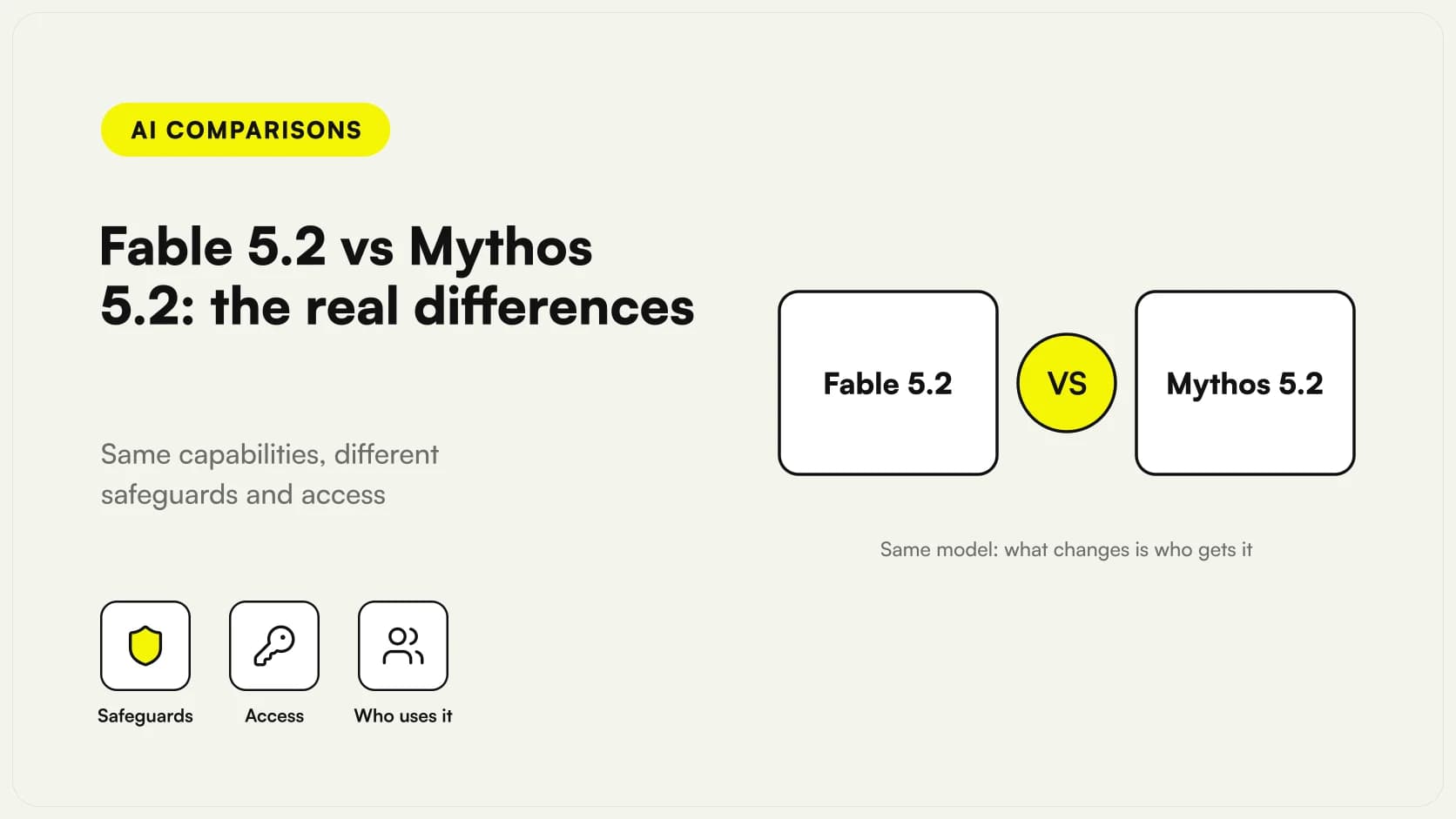
Yes. Anthropic's announcement is explicit: Claude Fable and Claude Mythos are the same base model. What changes is the layer around it. Fable 5.2 has safety classifiers that block high-risk cyber activity, including penetration testing, exploit generation and vulnerability analysis on binaries, and almost all biological research. When a request is blocked, another model answers: Opus 4.8 for cybersecurity, Opus 5 for biology (announcement).
Mythos 5.2 is the same machine without those brakes, for those with a legitimate, verified reason to use it. The line-by-line comparison is in the article Fable 5.2 vs Mythos 5.2. The table is enough here.
| Appearance | Claude Fable 5.2 | Claude Mythos 5.2 |
|---|---|---|
| API ID | claude-fable-5-2 | claude-mythos-5-2 |
| Who uses it | All customers | Verified organizations |
| Context (tokens) | 1 million | 1 million |
| Maximum output (tokens) | 128K | 128K |
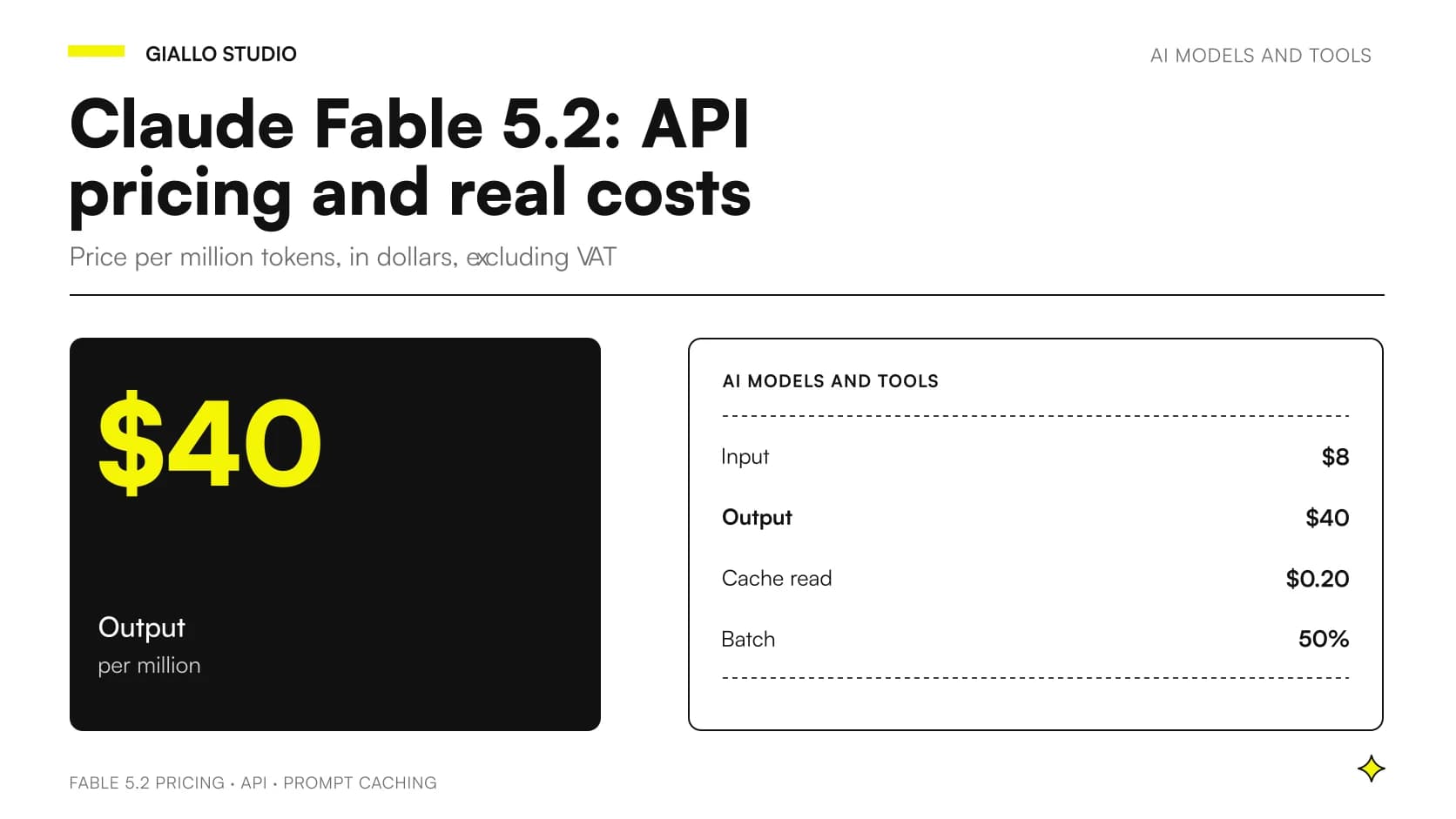
| Input / output ($ per million tokens) | 8 / 40 | 8 / 40 |
| Fast mode, input / output ($ per million tokens) | 16 / 80 | 16 / 80, verified access only |
| Cyber and biology safeguards | Active | Not applied |
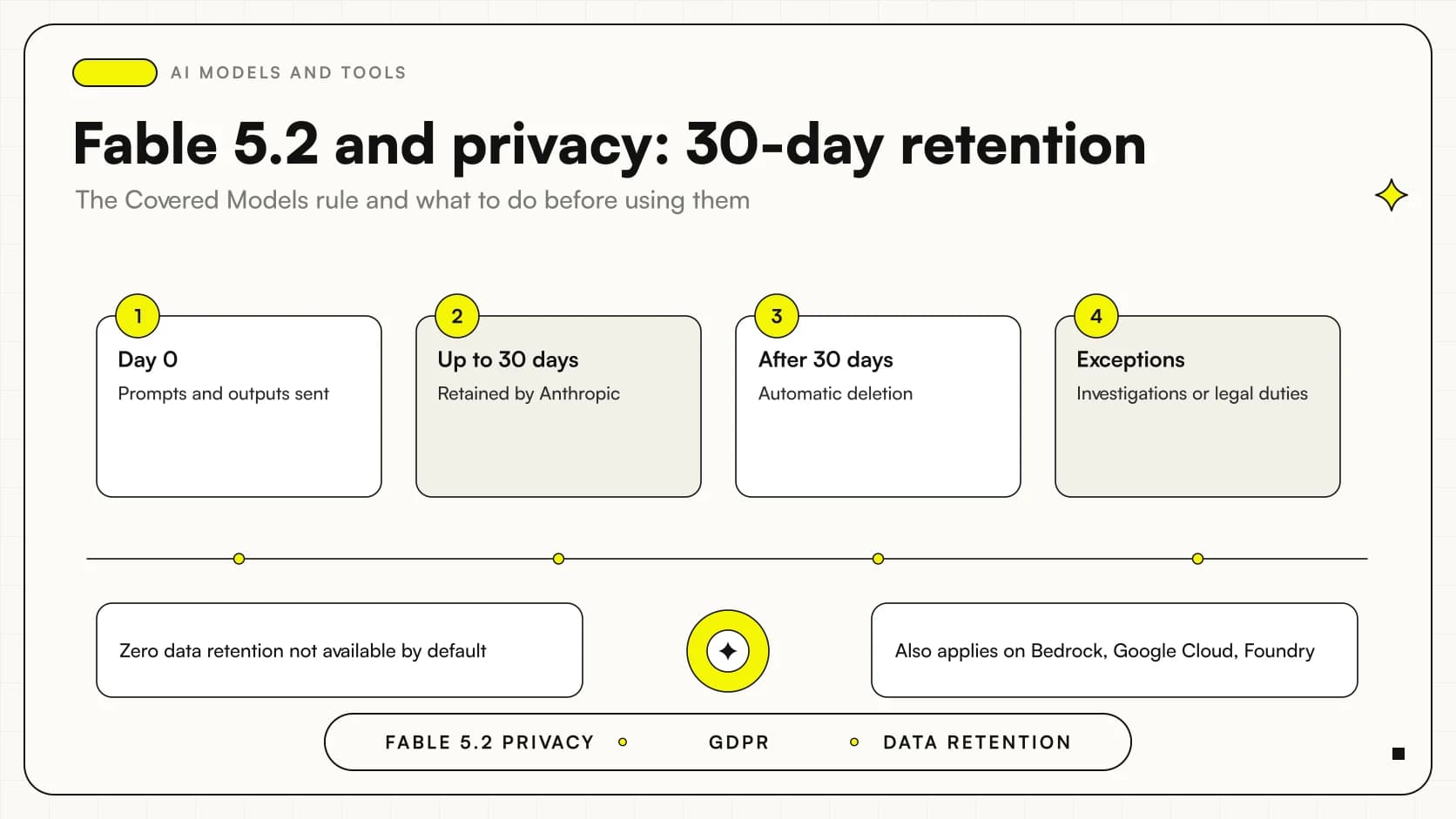
| Data retention | Minimum 30 days | Minimum 30 days |
Sources: model card, API updates and announcement, all checked on 9 November 2026. Prices are in dollars, excluding VAT for Italy; euro prices are not indicated.
How Mythos came about: from 9 June to 9 November 2026
Mythos is not a new idea from this week. According to the Anthropic Covered Models page, there are three versions, all with the same rule: Fable for everyone, Mythos only for approved partners.
- 9 June 2026: Claude Fable 5 and Claude Mythos 5.
- 31 August 2026: Claude Fable 5.1 and Claude Mythos 5.1.
- 9 November 2026: Claude Fable 5.2 and Claude Mythos 5.2, the subject of this article.
An initiative called Project Glasswing already existed. The Cyber Verification Program page specifies that anyone already in it, or in the earlier CVP, does not need to reapply: access remains valid and is carried over to the corresponding level of the new program. How the access levels work is covered in the dedicated article, Mythos 5.2 and cybersecurity.
Who can use Claude Mythos 5.2 and how do you request access?
The documentation states a single rule: Mythos 5.2 is available only to organizations verified through Anthropic's verification programs. To request access, you apply to the program that covers your use case, or you contact your account team. There are three routes.
- Cyber Verification Program. For information security professionals. The application goes through the verification portal; Anthropic says it usually replies within seven business days (official page).
- Life Sciences Verification Program. For those doing biomedical research: the announcement cites it as the channel for biology applications (announcement). Admission criteria are not detailed in the pages we checked.
- Claude Security. Claude Enterprise customers, even without being in the cyber program, can use Claude Security, which scans code for vulnerabilities with Anthropic's most capable models, Mythos 5.2 included (announcement).
Two clarifications. First: the program requires data retention, because Anthropic uses it to detect abuse (in the program page). Second: when approval arrives, it is still not enough; access has to be assigned to a workspace, a role or a linked cloud account. The pages we checked do not say how an Italian organization would be assessed: Anthropic only writes, about the highest tier, that it is working to expand the eligible organizations both in the United States and internationally. If in doubt, the way forward is to ask directly.
The term “preview”, which often appears in searches about Mythos, does not correspond to anything public: the official pages speak of limited availability, not an open preview, nor a download.
How much does Claude Mythos 5.2 cost?
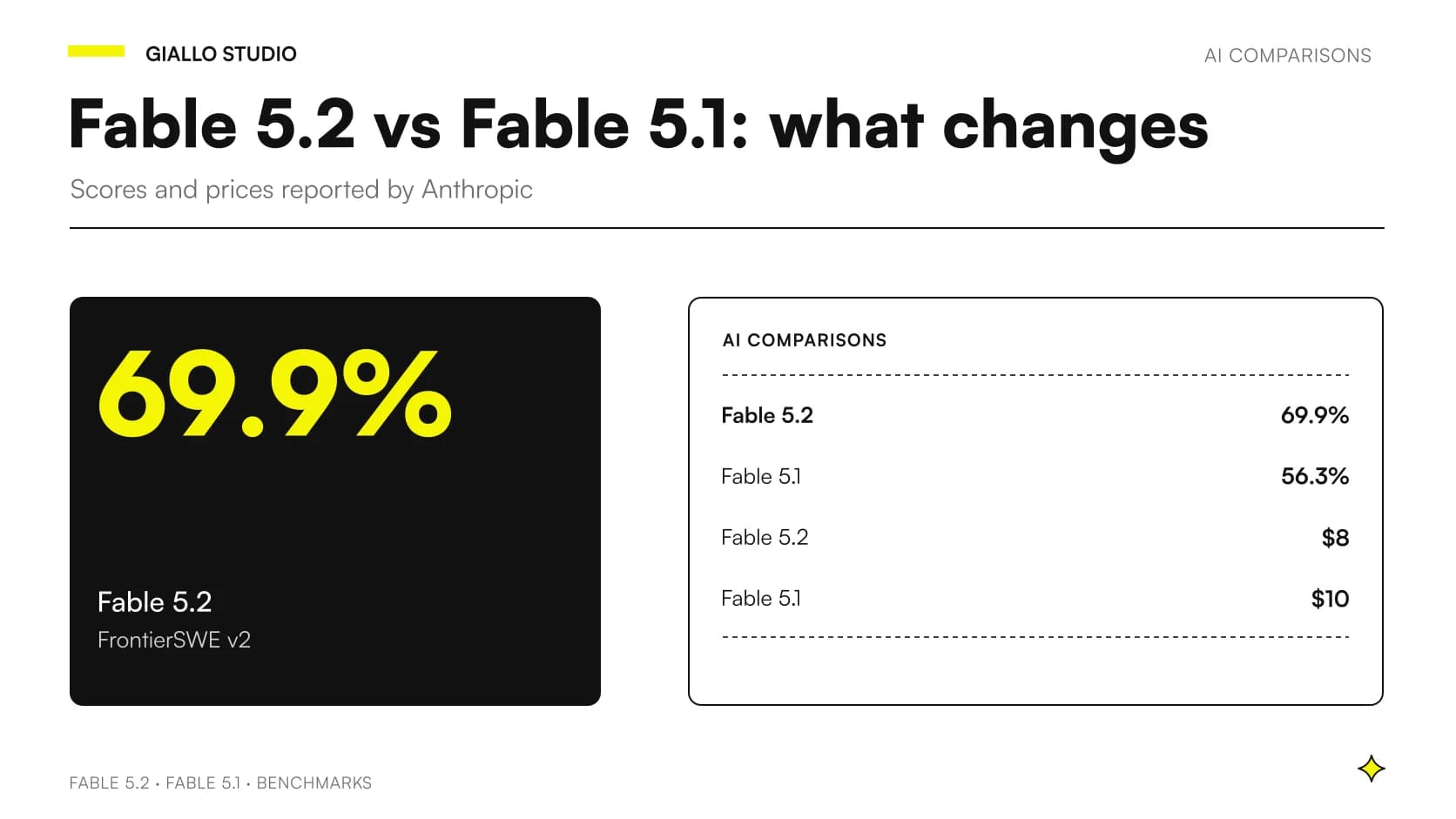
It costs the same as Fable 5.2: $8 per million input tokens and $40 per million output tokens, against $10 and $50 for Mythos 5.1 (API updates). Fast mode, which speeds up generation by up to 2.5 times, costs $16 and $80 and, for Mythos, is reserved for organizations in the verification programs (announcement). The full price list, cache and batch included, is in Claude Fable 5.2 API pricing and real costs.
The cost of access to the programs is not stated in the pages we checked on 9 November 2026. For those working in security, the real cost is something else: security requirements to meet and data retention, as explained above.
What can it do extra? The numbers Anthropic claims
On general tasks Mythos 5.2 and Fable 5.2 are close: on Terminal-Bench-Science, a test of scientific research with agents, the announcement's table gives 74.6% to Fable 5.2 and 75.3% to Mythos 5.2 (announcement). The difference shows up where the safeguards make the difference.
| Test (scores in %) | Mythos 5.2 | Mythos 5.1 |
|---|---|---|
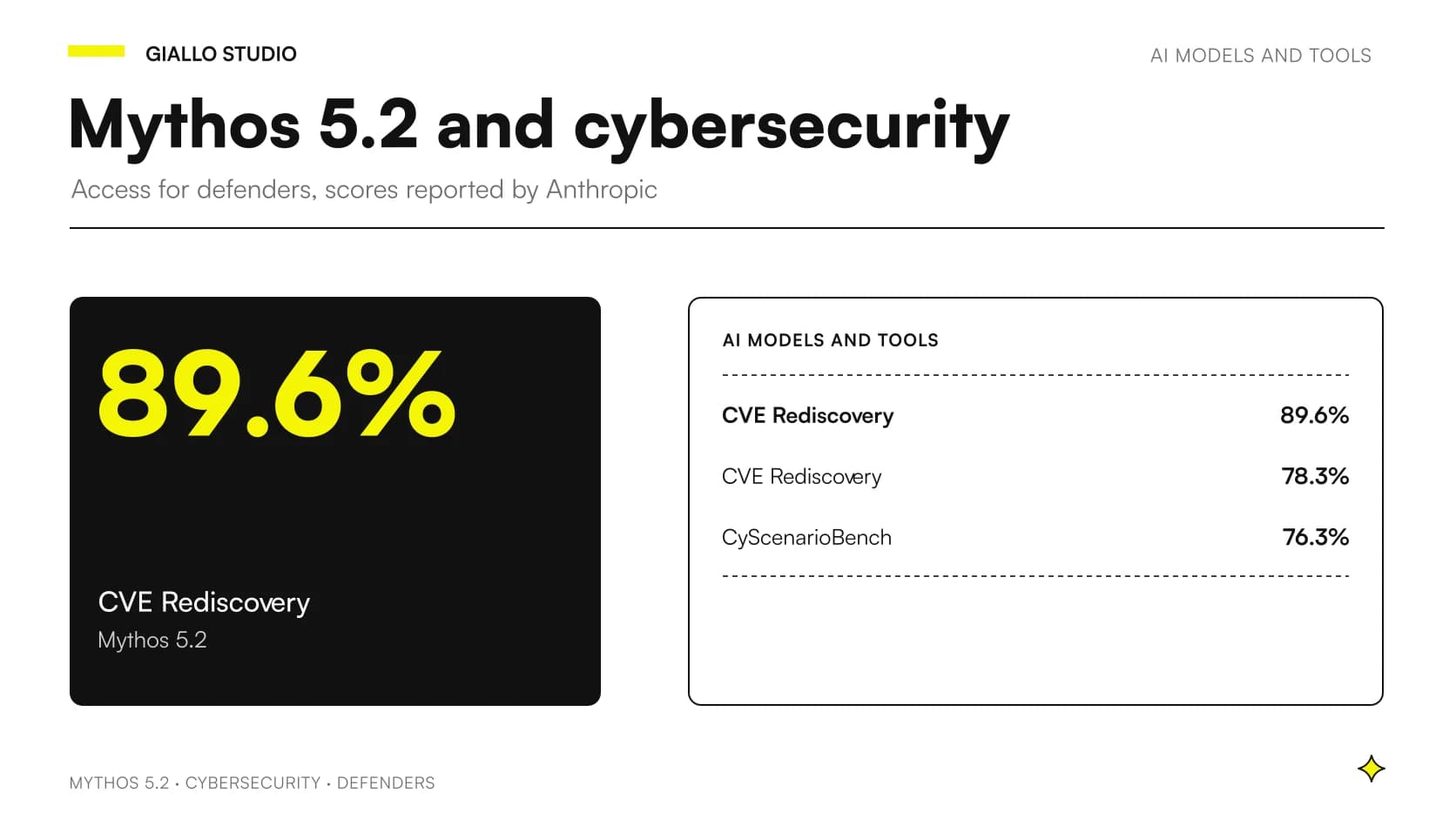
| CyScenarioBench (cybersecurity scenarios) | 76,3 | 61,7 |
| CVE Rediscovery (known vulnerabilities found by the model) | 89,6 | 78,3 |
| Protein design, 24 hours | 85,1 | 79,1 |
Source: Anthropic Announcement, checked on 9 November 2026; Anthropic internal tests. On the same CVE Rediscovery test, run in October 2026 on 1,829 public vulnerabilities, Anthropic says Mythos 5.2 finds 10.2% more of them than Opus 5.5.
It is also worth reading the note at the bottom of the page: in Anthropic's internal evaluations, Mythos 5.2's vulnerability identification is roughly on par with Opus 5.5, while the testers cited on the same page consistently found more vulnerabilities than with earlier models (announcement). In other words: the results are promising but not uniform, and none of these numbers has been verified by an independent source.
How safe is a model without safeguards?
That is the right question. Anthropic put the model through internal tests before release, with new evaluations on worrying behaviors such as escaping from a sandbox, and brought in external testers, including the UK AI Security Institute, Frontier Design and METR (announcement).
The most-cited figure concerns Mythos itself: in an experiment with more than 1,800 scenarios, most of them unsolvable without leaving the sandbox and with a deliberately planted flaw, Mythos 5.2 used credentials or files left outside the environment in 3.1% of cases. Mythos 5 and 5.1 were at 39% and 21%. Anthropic notes that building evaluations able to catch every flaw before release remains an unsolved problem (announcement). Controlled access should be read in this light: according to Anthropic it is the safeguards that make it possible to offer Fable to everyone, and admitting only verified organizations to Mythos is part of the same strategy, not a bureaucratic formality.
Does an Italian SME need it? Two examples
The scenarios are examples built for reasoning, not customer cases.
Example 1: a software house in Padova. It writes management software for professional firms and wants to check the security of its code before each release. It does not need Mythos to get started: Anthropic writes that its generally available models can already be used for secure code review, threat modeling, fixing known issues, finding vulnerabilities in your own code and alert triage (program page). The program becomes interesting if the work moves to malware analysis or exploit verification, which Fable's classifiers may interrupt. If the company does penetration testing for third parties as a trade, it has a concrete reason to apply. If it just wants cleaner code, it does not.
Example 2: a manufacturing company with a management system and a website. It wants to know whether its systems are exposed. The model is the least of the problems here: first you need an inventory of systems, updates, backups and access with two-factor authentication. A top-tier AI helps read reports and prioritize, but it does not replace hiring a security firm.
When it makes sense to apply for Mythos
- You do cyber defense, red teaming or vulnerability research as your main activity.
- You do biomedical or life-sciences research that Fable blocks.
- You can meet the program's data retention and security requirements.
- You have already tried Fable 5.2 and the blocks stop you on legitimate work.
When to Avoid It
- You are looking for a smarter model to write, summarize or analyze documents.
- You want an AI for everyday code: Opus 5.5 or Sonnet 5.5 are enough.
- You cannot accept data retention for at least 30 days.
- You have no documentable cyber or biomedical use case.
Four mistakes about the Mythos name
- Thinking it is “the strongest model” for everyone. On a general task it is the same as Fable 5.2. If an office task does not work with Fable, Mythos will not solve it.
- Using the two names as synonyms for availability. The fact that Mythos appears in the documentation does not mean it is active on your account. If the ID
claude-mythos-5-2returns an error, that is normal. - Looking for it on unofficial channels. Sites promising “access to Mythos” or a model download should be treated with suspicion: access comes only through Anthropic's programs or your account team.
- Mistaking Fable's blocks for a defect. Fable routing a cyber request to an older model is a declared safety choice, not a malfunction.
What to do if you think you need it
- Try Fable 5.2 first. Note the real cases where a block stopped you on legitimate work. Without concrete examples the question has no basis.
- Read the program pages. For cybersecurity it is the page of the Cyber Verification Program and, for biology, the Life Sciences Verification Program cited in the announcement.
- Check your internal requirements. Data retention, strong-authentication access, and who inside the organization will use the model.
- Apply as an organization, not as an individual employee, and if you have an account team, go through them.
Other providers also separate access to cybersecurity models: how Google does it with Gemini 4 Carbon is in our article on Gemini 4 Carbon and cybersecurity. If instead your goal is to understand which Claude model to use for office work, the guide to Claude models in comparison and Claude for companies are the right next step.
The short answer for decision-makers
Mythos 5.2 is a specialist tool, not a higher tier to unlock. For most SMEs the useful question is not “how do I get it”, but “which Claude model suits my task”. If you are currently assessing where AI can really enter your processes, the AI consulting by Giallo Studio starts from exactly there: testing Opus 5.5 and Fable 5.2 on your real cases, measuring quality and cost, and telling you with numbers whether a specialist model makes sense for you.
Giallo Studio guides: methodology and sources
Want to apply this to your business?In 30 minutes, free of charge: the first process to automate and its estimated return, in writing.
Book the free auditHow we apply it in the company
Related resources
 Claude Fable 5.2: What It Is, What Changed and What It Costs
 Claude Mythos vs Fable 5.2: the real differences and who can use them
 Claude Mythos cybersecurity: who can use it and what it really does
 Fable 5.2 Privacy: 30-Day Data Retention and What an SME Should Do
 Claude Fable 5.2 Pricing: API Rates and Real Costs
 Fable 5.1 vs 5.2: what really changes and whether to upgrade
 Claude AI for companies
 Claude models compared: a guide to choosing
FAQ
What is Claude Mythos 5.2?
Claude Mythos 5.2 is an Anthropic model released on 9 November 2026. It is the same model as Claude Fable 5.2, but without the safeguards that block high-risk activity in cybersecurity and biology. That is why it is not sold to everyone: only organizations verified by Anthropic can use it.
Who can use Claude Mythos 5.2?
Only organizations approved by Anthropic. You get in by applying to the Cyber Verification Program if you work in information security, to the Life Sciences Verification Program if you do biomedical research, or through your own account team. Enterprise customers can also use Claude Security, which runs on Mythos 5.2 as well.
Can Claude Mythos 5.2 be tried for free or downloaded?
No. The official pages checked on 9 November 2026 describe limited access for approved partners, not a public preview or a download. The API ID is claude-mythos-5-2 and it works only for those who have been granted access.
How much does Claude Mythos 5.2 cost?
It costs the same as Fable 5.2: $8 per million input tokens and $40 per million output tokens, in dollars and excluding VAT for Italy. Fast mode costs $16 and $80. The cost of getting into the verification programs is not stated in the official pages we checked.
Does an Italian SME need Claude Mythos 5.2?
Almost never. Mythos is not a smarter model than Fable on general tasks: the difference lies in the blocks removed, which matter to those doing cyber defense or biomedical research. For writing, document analysis, code and automations, Opus 5.5 or Fable 5.2 is enough.
Is Mythos 5.2 more powerful than Fable 5.2?
It has the same capabilities and the same specifications, but it can be used on tasks that Fable refuses. On cyber and protein-design tasks Anthropic reports higher scores for Mythos 5.2 than for version 5.1. These figures are stated by the vendor and have not been replicated by third parties.