
Claude AI for companies
Claude for business: real uses for documents, writing, code and analysis, Team and Enterprise plans, data privacy and API integration into business processes.
Reading time: 11 min
Claude is Anthropic's AI assistant, and is particularly strong in the work that revolves around the text: reading long documents, summarizing, writing carefully and analyzing information. For a company the question is not "Is Claude good?" but "Where does it save me hours without adding risk?". The answer lies in four concrete areas — documents, writing, code, analysis. plus business plans and data privacy rules.
The difference that matters for the job is this: in business plans (Team, Enterprise and via API) the content you send are not used to train models. It is the main reason why Claude enters many companies instead of remaining a personal toy. To this is added the API, which allows you to transform Claude from a chat to an integrated component in your processes.
In this guide we see Claude's business use cases, how to choose between Team and Enterprise plans, what to really know about data privacy and when to stop at chat or instead build a custom system.
In summary
- Claude for companies excels on four fronts: long document reading, edited writing, code support, and text and data analysis.
- In Business Plans (Team, Enterprise, API) Conversation data is not used to train models: it is the condition that makes Claude usable on work material.
- Team serves small/medium groups; Enterprise adds SSO, centralized controls and broader context for large organizations.
- The API It transforms Claude from chat to component into CRM, management software and sites: it is the bridge to agents and automations.
- It remains a linguistic model: it produces the most likely, unverified response. It always serves Human Review on critical points.
What Claude is used for in the company
Claude does not serve to "do futuristic things": he serves to remove repetitive manual work on content and to do the first draft of tasks that today steal time from qualified people. The most solid cases cluster into four areas, which often combine into a single workflow.
| Area | What Claude does | Business example |
|---|---|---|
| Documents | Reads, summarizes and extracts data from long texts | Summary of a 40-page contract with highlighted attention points |
| Writing | Produces drafts that are accurate and consistent with the required tone | First version of a business proposal or newsletter |
| Code | Explain, write, and correct code | A script that cleans an export and loads it into the management software |
| Analysis | Rank, compare, and reason on information | Analysis of 200 reviews to extract recurring themes |
The common thread is that Claude manages the part repetitive and low risk, while the person maintains the final decision. When this balance is clear, the return becomes measurable in saved hours and avoided errors. If you want a broader overview of how AI enters processes, start from the guide AI for businesses; to understand what Claude is and how he stands out from other assistants, read Claude AI: what it is and when to use it.
Long papers: where Claude gives his best
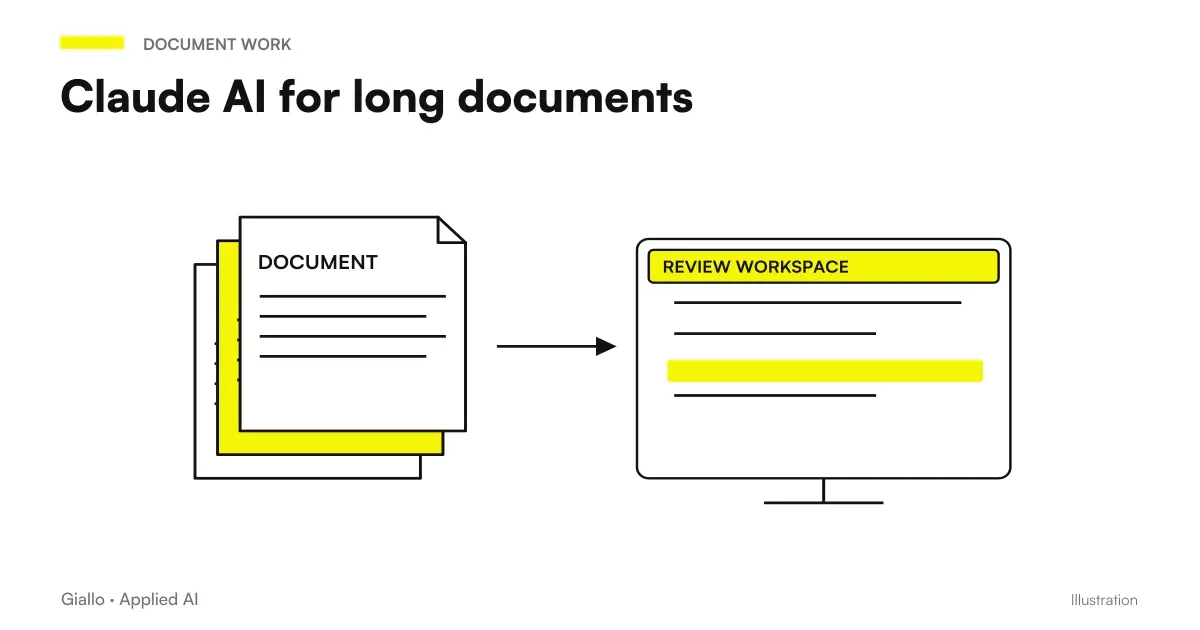
The most cited strength of Claude is the ability to work on very long texts without losing the thread: contracts, specifications, budgets, manuals, email collections. Instead of reading 60 pages, paste the document and ask for a targeted summary ("what clauses do they provide for penalties?", "summarise the terms of payment"). For a professional firm or purchasing office this changes the time of a practice from hours to minutes.
It is such a relevant use that it deserves a dedicated in-depth study: see Claude for long documents for practical methods and limits. However: synthesis is a starting point, not a guarantee. On legal clauses, amounts and deadlines, the original text must always be verified.
Writing and analysis: the first draft, not the last
For writing, Claude is appreciated for a more orderly and less "robotic" style on long texts: reports, internal documentation, articulated responses to customers. For analysis, he is good at extracting structure from chaos — turning 200 reviews or 50 tickets into a frequently recurring theme table. In both cases the same AI rule applies in the company: first draft from AI, decision and responsibility from the human.
Claude Team and Enterprise: how to choose the plan
In addition to individual plans, Claude offers plans designed for group work. The practical difference is not just the price: it changes who can manage users, what controls there are and — most importantly. how data is processed. Here is an orientation comparison (details change often, check the official page before deciding).
| Appearance | Individual Plans | Team | Enterprise |
|---|---|---|---|
| Designed for | Single person | Small/medium groups | Large Organizations |
| User Management | No | Yes, shared account | Yes, centralized |
| Business Login (SSO) | No | Limited | Yes |
| Data used for training | Depends on the settings | No | No |
| When it makes sense | Personal use, testing | Team working on content | Strong IT and security requirements |
The logic of choice is simple. If you are few and want to start using Claude on real work, Team is almost always the right starting point: it ensures that the data does not end in training and gives basic user management. Enterprise serves when serious IT requirements come into play —unique business logins, centralized controls, larger context windows —typical of structured realities or regulated sectors.
Data privacy: the question that blocks (or unlocks) adoption
It is the question that every IT owner and manager asks first: "Is my data being used to train AI?". The correct answer for business plans is no, and this deserves to be understood well because it is what makes Claude usable on corporate material.
- In the plans Team and Enterprise Conversation content is not used to train models.
- Also through API the data sent does not feed the training, unless explicit consent.
- In the plans consumer the settings can be different: you have to check before entering work data.
- The policy may change: always check the updated terms on the official page before uploading sensitive data.
Translated into practice: "not used for training" does not mean "you can load anything without thinking about it". For the personal data of customers remain the obligations of the GDPR: minimization (charges only what is needed), a legal basis for processing and — when using a provider such as Anthropic — signing a data processing agreement (DPA). This is the part where many companies stop on their own; it is also where consulting makes the difference between "we use it in secret" and "we use it in good standing".
The API: from chat to component of your processes
As long as you use Claude from chat, a person must always open the conversation, paste and copy the result.API breaks this limit: it makes Claude a callable piece inside your software. A system reads an incoming email, passes it to Claude to extract key data and writes the result into CRM — without anyone opening a chat.
This is where Claude stops being a personal assistant and becomes part of the process. To understand the mechanism of integrations well worth reading AI APIs: what they are and how they work: an API is simply the way two softwares talk to each other, and Claude's API allows yours to "ask" something about the model and receive a structured response.
Concrete example: from email to CRM without copy-paste
A request for a quote by email arrives. An automation intercepts it, sends it to Claude's API with the instruction to extract company, required product and quantity in a precise format. Claude returns the structured data, which is written directly as a new lead in the CRM, already ready for commercial. The person does not open any chats: he only intervenes to check and send the quote.
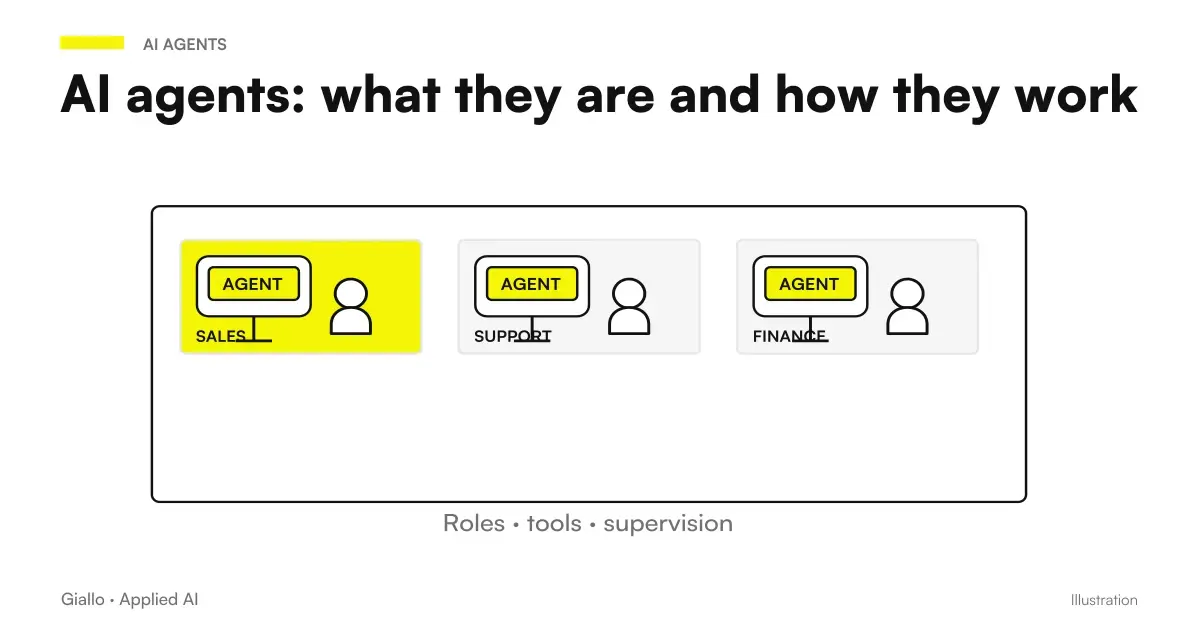
When integration is not limited to "read and answer" but must perform actions in sequence towards a goal — read, decide, update, notify — you enter the territory of AI agents. It is the next step, and it must be designed: an agent acting autonomously requires clear rules, limits and points of human control.
Practical examples
Two realistic scenarios of Italian realities, to make the speech concrete.
1. Professional study — document analysis. A firm of accountants receives dozens of contracts and specifications to read each week. With Claude on Team plan, the professional glues the document and gets a targeted synthesis with attention clauses, deadlines and amounts. It checks for critical points on the original, but starts from a map instead of blank pages. Typical result: the time of first reading of a practice drops sharply, and no document is loaded into tools that would use its content for training.
2. Manufacturing SMEs — estimates via API. A components company receives free-text quote requests by email. An automation connected to Claude’s API extracts product, quantity and terms, and creates the lead in the management software with fields already filled in. The salesperson corrects the prices and sends it. Here Claude is not a chat: it is an invisible cog in a workflow that previously required manual copying and pasting. Getting there requires some technical work, and this is the kind of project in which the automation of business processes turns a generic instrument into a measurable result.
In both cases the point is not "Claude does everything", but "Claude does the first draft or extraction, the human decides". It is the model that works.
When chat is enough and when a custom system is needed
Just Claude in chat (Team/Enterprise)
- Use is occasional and a person initiates it when needed.
- The volume is low: few documents or texts per day.
- There is no need to write the result in other software automatically.
- You want to leave now and figure out where AI really helps.
We need a custom system (API/Agents)
- The task is repeated many times a day, always the same.
- The result must end in CRM, management software or site without copy-paste.
- You need actions in sequence, not just an answer.
- You want to take the person completely out of the mechanical steps.
Practice rule: starts from chat, moves to integration only when the volume justifies it. Building automation makes sense when the process is already defined and repetitive. If it is still confused, it should first be fixed by hand — the AI does not fix a broken process, it only accelerates it. When the time comes to jump, the work of designing AI agents and automations requires specific expertise on which steps to automate and where to keep human control.
Controls in delegated workflows
When multiple agents work on the same project, it counts where the rule is recorded and which event the task ends. Hooks, subagent and team separates these moments and avoids attributing to plugins the same rules as personal subagents.
Mistakes to Avoid
- Treating output as truth. Claude produces the most likely answer, not the verified one: he can invent data or quotes. On numbers, clauses and customer data always needs a human check.
- Confusing "not used for training" with "GDPR in place". They are two different things. For personal data we still need legal basis, minimization and DPA signed with the provider.
- Using a consumer plan for work data. The privacy settings of individual plans may differ from business plans: for company material parts from Team or Enterprise.
- Wanting to integrate everything immediately. Building automations via API on a still confusing process means accelerating chaos. First chat and measurement, then integration.
- Never reading the official page. Plans, limits, and policies often change. Deciding on old information leads to surprises about cost and privacy.
How to apply it in the company
Introducing Claude in a sensible way is a short and repeatable path, not a big project.
- Choose the right data plan. To use Claude on work material start from Team (or Enterprise if you have strong IT requirements), so the data does not end in training.
- Start with the documents. The safest and most impactful use case is the reading and synthesis of long texts: high value, low risk if you check the original.
- Define what does NOT load. Write an internal rule about personal and sensitive data: what you can paste and what you need to anonymize first.
- Measure before and after. Hours for practice, mistakes, response times. Without numbers you don't know if Claude gives you value or just the impression of modernity.
- Integrate only when needed. When a task repeats many times a day, it evaluates the API and automation to remove the copy-paste.
This is exactly the kind of work for which there is a AI Consulting: understand where Claude really agrees, choose the correct plan for privacy and — when the volume justifies it — design integration without spending on systems that no one will use. If you want to compare Claude to the more common alternative, read also ChatGPT for companies and AI chatbots: what they are to understand where an assistant becomes customer service.
For updated numbers and model by model comparison, Which Claude model to choose for your case, Claude Opus 5 vs Sonnet 5 and Migrating from Opus 4.8 to Opus 5.
Conclusion
Claude for companies It makes sense when you frame it on its strengths —long documents, edited writing, text analysis.and when you choose a business plan that doesn't use your data for training. From there the path is clear: you start from the chat on a safe use case such as document synthesis, you measure, and only when the volume justifies it you move to the API to integrate Claude into the processes. The jump towards AI agents and Automation is the point where a generic instrument becomes a measurable result.
AI becomes useful when it enters processes. Giallo Studio helps SMEs and teams build concrete, measurable and sustainable automations — starting with the time-consuming process, not the fashion tool.
Giallo Studio guides: methodology and sources
How we apply it in the company
Related resources
 Claude AI: what it is and when to use it
 ChatGPT for companies
 AI for businesses: a complete guide to getting started
 AI agents: what they are and how they work
 Claude AI for long documents
 Claude Opus 5.5 for an SME: five concrete uses and when not needed
 Claude Opus 5.5: what it is, what it changes and who it suits
 AI for business reporting: fewer hours, the same data
FAQ
What makes Claude suitable for companies?
Claude is an AI assistant good at working on long text: it reads substantial documents, summarizes, writes carefully and analyzes data. For companies, two things matter above all: Team and Enterprise plans with team controls, and the fact that in business plans conversation data is not used to train models. Always check the details on the official page.
Does Claude use business data to train its models?
In business plans (Team, Enterprise and via API) the content you submit is not used to train models, unless you explicitly consent. In consumer plans the settings may be different. This is a policy that can change, before uploading sensitive data always check the updated terms on the official Anthropic page.
What is the difference between Claude Team and Claude Enterprise?
Team is designed for small and medium workgroups: shared account, user management, higher usage limits. Enterprise adds controls for large organizations, such as integration with enterprise login (SSO), centralized management and larger context windows. Details and prices change: check the official page before deciding.
Do you need to be able to program to use Claude in the company?
No. Most uses (writing, summarizing documents, analyzing texts) happen by chatting in natural language, without code. You only need a minimum of technical expertise if you want to integrate Claude into your software through API or build automations: in that case you rely on a developer or consultancy.
Can I connect Claude to the software I already use?
Yes, through the API and integration tools. With the Claude API it becomes a component within your processes: it can read an email, analyze a document and return a structured result to a CRM, business management software or website. When integration has to take actions independently you enter the field of AI agents and process automation.
Can Claude make mistakes or invent information?
Yes. Like every language model, Claude produces the most likely answer, not verified truth: it can invent data or citations (hallucinations). In a business, human review must always be retained for critical points, especially numbers, regulations and customer data.