
Claude model pricing: API rates and the cost of getting work done
Updated Claude model prices: Haiku, Sonnet and Opus 5.5, Fable 5.1. API price list, 100K threshold and a transparent calculation to estimate the budget.
Reading time: 12 min
The prices of Claude models current depend on the model, the volume of tokens and the conditions of the request. 9 October 2026, the standard API list includes Claude Haiku 5.5, Sonnet 5.5, Opus 5.5 and Fable 5.1. Haiku has a specific threshold over 100K prompt tokens; the lowest rate does not indiscriminately describe each long document. Official catalogue Anthropic.
To estimate an application you must distinguish the cost of calls from the cost of delivering a usable result. An extraction may require a single step, correction or human review: the number of operations changes the account. The figures in this guide are in USD per million tokens, not subscription prices, amounts in euros or quotes of Giallo. No paid calls were made to produce comparisons.
In summary
- The API price list distinguishes input and output.
- Haiku 5.5 changes band over 100K prompt tokens.
- Cache, tools, and configuration must be counted separately.
- A router can add more calls to the same case.
- Economic choice also requires quality criteria and review.
What is the updated Claude price list?
The table shows the standard prices of the current cards. Each line connects the primary source: before committing a budget, it also checks the provider and the mode actually used. A base price does not automatically describe additional services or contract-specific conditions.
| Model | USD / 1M token input | USD / 1M Token Output | Condition |
|---|---|---|---|
| Haiku 5.5 | 0,10 | 0,50 | Prompt up to 100K token |
| Haiku 5.5, long context | 0,50 | 2,50 | Prompt over 100K tokens |
| Sonnet 5.5 | 2 | 10 | Standard Price |
| Opus 5.5 | 4 | 20 | Standard Price |
| Fable 5.1 | 10 | 50 | Standard Price |
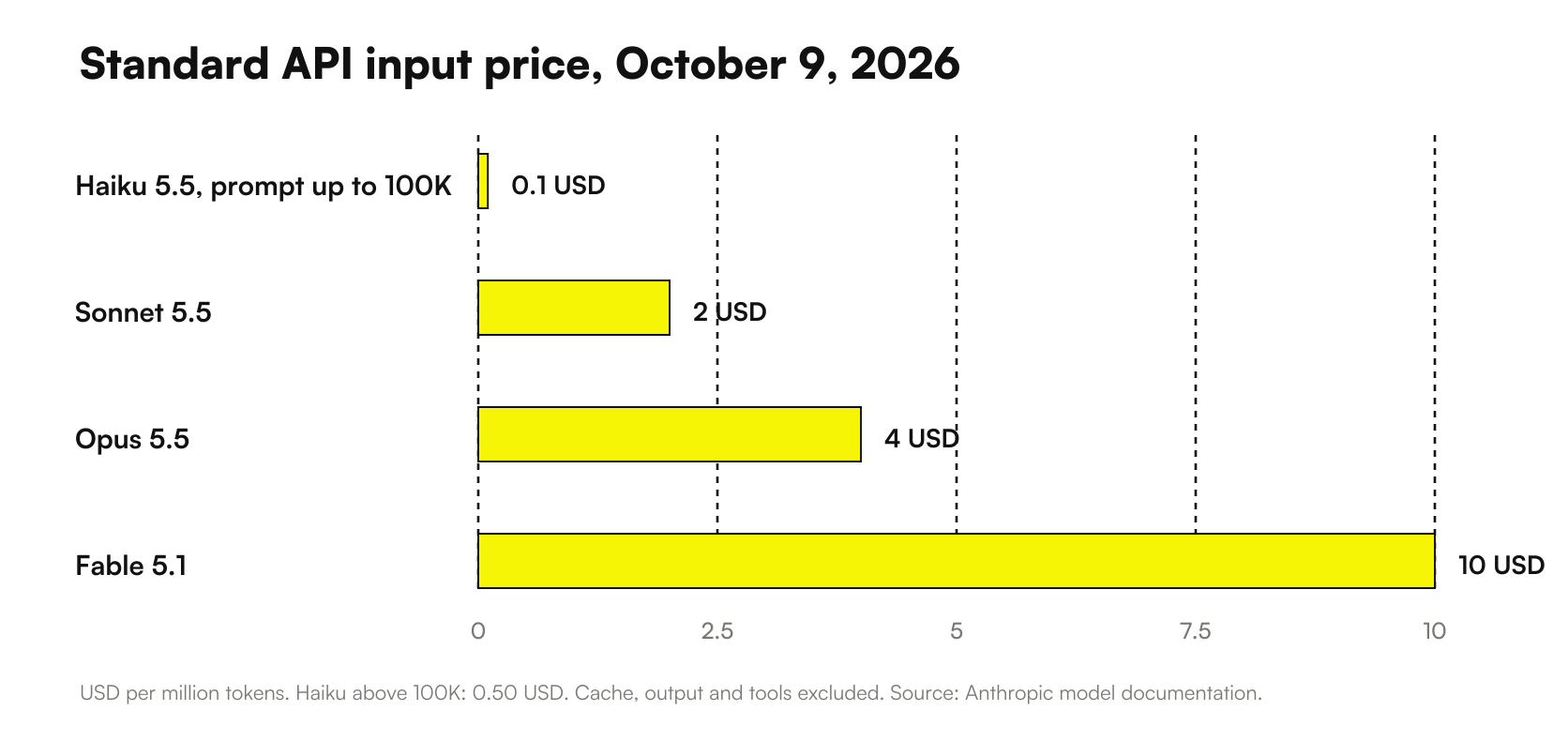
All four state context from 1M token and maximum standard output from 128K token. They are limits of demand, not promises of quality on input of any length. To compare capacity and intended use, read which model Claude to choose.
Do not describe the list as a scale where each band doubles the previous one: current values do not follow that rule. The relationship between prices is an arithmetic result related to the tariff, while reliability and latency require evidence on the process. A list difference does not authorize a conclusion on the number of errors.
How much do 20,000 requests cost with defined input and output?
Hypothetical example of a budget, untested: we consider 20,000 requests, each with 3,500 total input tokens and 400 output tokens. Suppose the counts are valid for each model. We exclude additional caches, tools, attempts, and reasoning tokens. The total is 70M input token and 8M output. This isolated comparison does not prove that the models perform the task with the same quality.
| Configuration | Input calculation | Calculation of output | Total hypothetical USD |
|---|---|---|---|
| Haiku 5.5, up to 100K | 70 × 0,10 = 7 | 8 × 0,50 = 4 | 11 |
| Sonnet 5.5 | 70 × 2 = 140 | 8 × 10 = 80 | 220 |
| Opus 5.5 | 70 × 4 = 280 | 8 × 20 = 160 | 440 |
| Fable 5.1 | 70 × 10 = 700 | 8 × 50 = 400 | 1.100 |
The rates are those of the cards Haiku, Sonnet, Opus and Fable. The fixed output hypothesis serves the calculation: real consumption, especially with reasoning, must be read in the use of the model.
Moving to the business budget requires measuring actual requests, not just multiplying the number of documents. A document can generate multiple calls. The path price per million tokens and cost per task It clarifies this distinction.
Which tokens enter the prompt to be measured?
Model input can include instructions, question, selected documents, examples, and tool data already available in context. The length of the original file does not necessarily coincide with the length of the sent prompt. If the software adds material before the call, that material should be included in the measure.
Do not use a universal conversion between pages and tokens. Tables, code, Italian text and structured content can be represented differently. The Haiku 5.5 tab also signals a tokenization difference from Haiku 4.5: the price per token and the cost of the same document are therefore distinct comparisons. Specifications Haiku 5.5.
To estimate the distribution, keep input and output counts by task categories. A single media can hide a very long small class of documents. The guide Haiku 5.5 deepens the candidate by classification and extraction; the budget must still use the actual tokenizer and path.
What changes over 100K tokens with Haiku?
The card distinguishes the band up to 100K prompt tokens from the band over 100K, with prices respectively 0,10/0,50 and 0.50/2.50 USD per million token input/output. The threshold concerns the prompt of the request: not the sum of all calls of the month and not the number of pages in the archive. Haiku 5.5 pricing.
The budget must identify which requests belong to each band and apply the documented conditions. Do not estimate all consumption with the minimum price just because most messages are short. At the same time, the presence of a large archive does not imply that each application must send it in full.
A system can select relevant documents before the call, as long as it does not delete necessary information. Selection is a requirement of correctness, as well as economic. Context and Comparison Window helps to distinguish maximum capacity, useful material and organization of information.
Cache and reasoning: what voices to keep distinct?
The cache has its own write and read rates, which are listed in the price list. Its advantage depends on the reused material and the conditions of validity. Do not apply a discount to total spending without distinguishing which tokens are actually read from the cache and which remain new input or output. Official Pricing.
For Sonnet also consults prompt caching and prices. A favorable read rate may be useful to a repetitive stream, but it does not describe the cost of a document produced once on its own. Test requests must use the same cache strategy as in production.
Opus 5.5 and Fable 5.1 have adaptive reasoning always active. Do not propose its deactivation as a universal saving lever. Configuration, depth and consumption must be verified for the specific model. Opus 5.5, Fable 5.1. Fixed output computing remains a didactic simplification, not an expected invoice.
A 90/10 router costs as much as two separate groups?
It depends on the call path. Hypothetical example not tested: on the same volume of 20,000 requests, suppose that 18,000 are sent directly to Haiku and 2,000 directly to Opus, with the counts of the previous example. They are disjointed groups: the cost is 9,90 + 44 = 53.90 USD, before any classification costs or infrastructure.
If instead all 20,000 requests pass first from Haiku and 2,000 also require a full call to Opus, the simplified account becomes 11 + 44 = 55 USD. The second call may have different input or include the result of the first: the actual data should be measured, not automatically obtained from the table.
The router must also recognize the cases to be forwarded. A percentage chosen for the calculation does not demonstrate that capacity. The Mixed Model Strategy requires routing criteria, anomalous cases and verification of closed requests at the first level. An eventual classifier adds more calls to count.
How to include tools and verifications in the cost?
An agent can read documents, use tools, correct a result, and reevaluate the task. Its cost must be described through this sequence. Don't confuse "a user request" with "an API call". For each path it counts how many invocations take place, what external services are used, and what results are usable.
Mods by Claude and Claude Code Hooks customize parts of the development workflow. They can organize controls and feedback, but they do not automatically eliminate model consumption, testing and review. A prompt hook or agent verifier can introduce additional work; a local script has other prerequisites.
In the budget you distinguish what belongs to the execution of the application from what belongs to its construction and maintenance. A check on the repository files is not the same cost as a scanner run on each client document. This separation makes the quote understandable and allows you to update one entry without rewriting all the others.
Two Italian estimates with quality to verify
Hypothetical example, untested: a spare parts distributor in Brescia wants to normalize product cards. Defines mandatory fields and prepares synthetic documents with missing code, discordant drives, and duplicate descriptions. Haiku 5.5 is a candidate to try for extraction; the team measures consumption, correct fields and cases passed to the review. It does not assume that the minimum price makes each card usable.
Hypothetical, untested example: a professional studio in Bologna prepare internal responses from approved procedures. It evaluates Sonnet and Opus on normal questions, contradictory sources and absent information. The budget also includes the time required to verify citations and correct drafts. Any difference in quality should be observed in the results, instead of being attributed a priori to the most expensive range.
The two processes have different criteria: structured fields in the first, response supported by sources in the second. There is no tariff that certifies both alone. The comparison of Claude models helps define a test before choosing.
How to calculate the cost per accepted task?
Define “accepted” first: correct mandatory fields, absence of invented information, valid format and uncertainty management. Sums the calls made for the sample, including those discarded or repeated. Divide the expense for tasks that reach the criterion, keeping visible even those who require human intervention.
Do not delete failures from the report to get a more favorable average. Separate them by category: incomplete input, broken format, content error, unavailable tool. The project must know if the cost arises from an unsuitable model, a prompt or a service that has not completed the operation.
What should a verifiable budget sheet contain?
Record model and configuration, input and output tokens, applied band, additional calls, service cost, and task status. Add required revision and error category. Keep credentials and confidential content not necessary for calculation out of the sheet.
Human time should not be automatically declared the dominant voice. It should be measured in the specific process. The economic comparison includes API spending, review, infrastructure, and consequences of relevant errors, with assumptions distinguishable from the data collected.
What mistakes to avoid before committing the budget?
The main ones are confusing API and subscription, applying the minimum rate beyond its threshold, ignoring duplicate calls, using prices from previous versions and transferring a cache benefit to the entire project. It is just as fragile to promise the same result with a less expensive model without proof.
Do not arbitrarily multiply the estimate by a universal factor. Build scenarios with readable assumptions: volume, length, retentives, and revision. A more challenging scenario must result from possible cases of your process, not a rule such as "each project costs three to ten times more".
When changing the model, reread tokenization and configuration. The guide when it is best to change the AI model describe the decision; Opus 5.5 deepens a current candidate. Budget review must be linked to observed changes, without promising a universal interval or duration.
How to move from the price list to a business decision?
A useful decision identifies the task, the candidate, the quality criterion and the measured cost of the route. Keep used rates with a verification date and update them when the configuration changes. The list is an input to the calculation; the outcome of the process determines whether the expense makes sense.
To build an estimate on an internal flow, the path of AI agents may include test sample, consumption and review rules. The final choice must be able to be explained with operations and results: which cases are completed, which ones require attention and which costs have actually been counted.
Giallo Studio guides: methodology and sources
How we apply it in the company
Related resources
 Claude models compared: a guide to choosing
 Price per million tokens explained
 Claude Haiku 5.5: API prices and when to use it in business processes
 Claude Opus 5.5: what it is, what it changes and who it suits
 Sonnet 5.5 halves cache read cost: how much the API bill changes
 Mixed model strategy: light and powerful
 Claude Code Hooks: a practical guide in Italian
 Creating a Claude Code Mod in TypeScript: the first project
FAQ
How much do the APIs of current Claude models cost?
The standard pricing verified on October 9, 2026, in USD per million input/output tokens, is 4/20 for Opus 5.5, 2/10 for Sonnet 5.5 and 10/50 for Fable 5.1. Haiku 5.5 costs 0.10/0.50 up to 100K prompt tokens and 0.50/2.50 over 100K. They are API rates, distinct from subscriptions and project cost.
Why does Haiku 5.5 have two price bands?
The official page distinguishes requests with prompts up to 100K tokens from requests above that threshold. To estimate the cost of processing a document, measure the complete prompt using the model’s tokenisation, including instructions and context. The lowest price tier must not be applied indiscriminately to every input.
Does a Claude subscription cover all API usage?
Apps, subscriptions and APIs have different conditions. Any credits or programs available for an account must be verified separately and do not turn APIs into unlimited consumption. The budget must distinguish app use and calls made by the software.
Does a lower-priced model always reduce the cost?
No. Expenditure also depends on repeated requests, tools, reasoning, verifications and human review. The useful comparison measures the cost of the task reaching the required criteria, not just the unit price.
Can I turn off Opus and Fable's reasoning to save money?
Opus 5.5 and Fable 5.1 have adaptive reasoning always enabled, according to their official model pages. Check the configuration for the specific model; it is incorrect to propose disabling it as a universal measure. The budget uses the actual usage of the selected configuration.
How to estimate a router with Haiku and Opus?
Distinguish requests routed directly to a model and requests that first execute Haiku and then Opus. In the second route the calls of the forwarded cases add up. Also add the cost of a possible classifier and check the quality of the route.