
Claude Fable 5.2 limitations: the known ones and how to work around them
Claude Fable 5.2 limitations stated by Anthropic: it thinks even when told not to, stops early, costly subagents. Read what to do about each one.
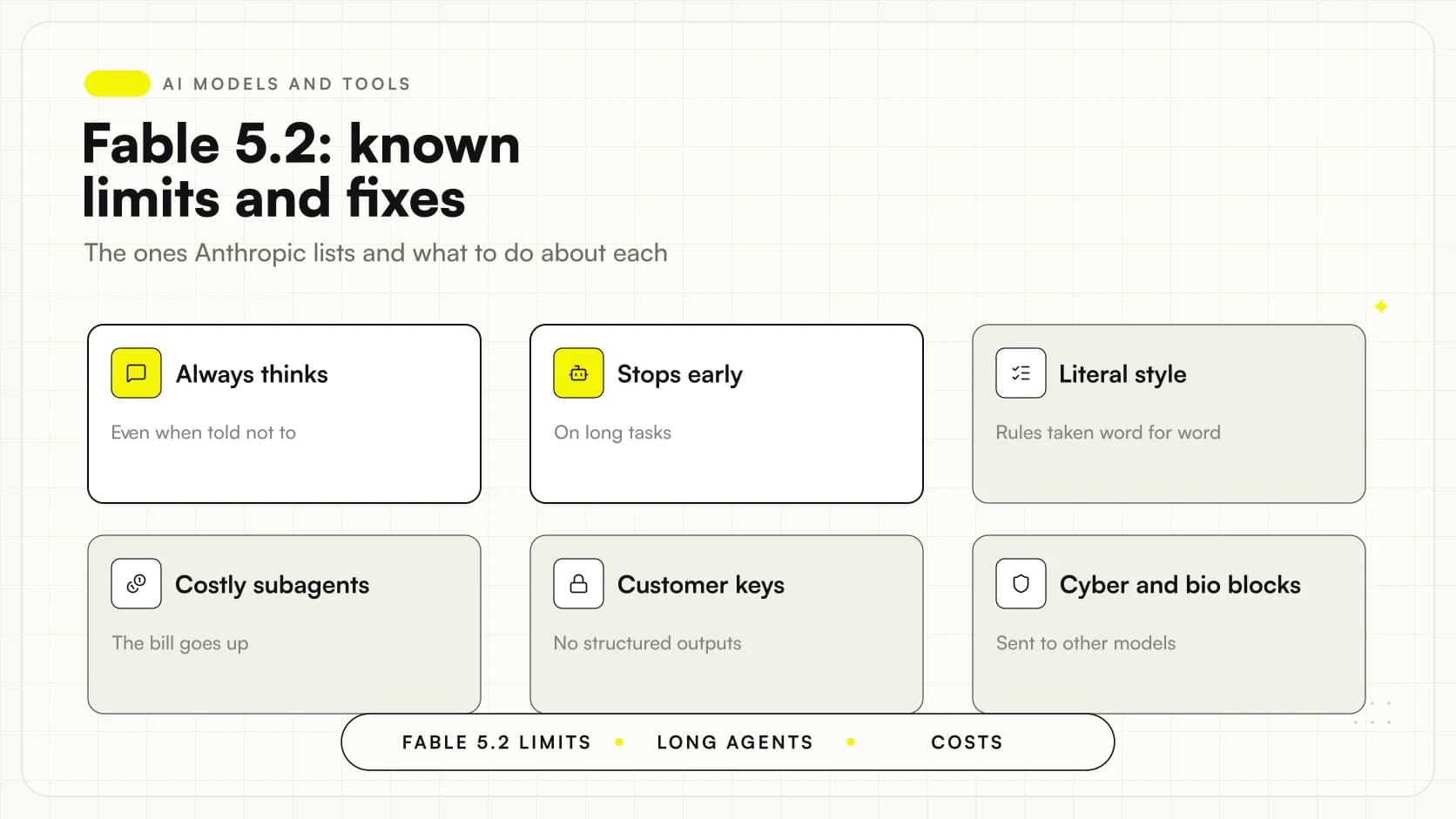
The known limitations of Claude Fable 5.2, the model released by Anthropic on 9 November 2026, are few and well described: it thinks even when asked not to, it can end a long job before it is done, it follows style rules literally, it can push costs up through subagents, and it does not support structured outputs with customer-managed encryption keys. These are the points the “What's new” page of the documentation lists, accessed on 9 November 2026. Almost all can be worked around with an effort setting or three lines of prompt.
Here you will find the limitations one by one: what happens, why, and what to do. For the model's technical profile, see the Claude Fable 5.2 pillar guide. We do not report opinions from forums or Reddit: on release day they cannot be verified. Independent tests are also left out, as none appear to be available yet.
In summary
- Fable 5.2 thinks before almost every answer at effort high and above, and according to Anthropic a prompt line asking it not to reason does not stop it at effort medium and above.
- Reasoning cannot be switched off: a request with thinking disabled returns a 400 error, and a forced tool_choice (
anyortool) also returns 400. - On long tasks it may end the turn with a list of what remains or an offer to continue: more often at effort low and medium.
- It follows style rules literally: a hard limit on sentence length can make the prose choppy.
- Subagents can weigh heavily on the cost of a session, and with customer-managed encryption keys structured outputs are not available.
- The cybersecurity and biology classifiers route requests to Opus 4.8 and Opus 5; Anthropic states about 55% fewer blocks compared to Fable 5.1.
The benchmarks cited by Anthropic are stated by the vendor and not replicated by third parties. They matter less here: we are talking about behaviors, not scores.
Why does Fable 5.2 think even when I tell it not to, and what can I do?
With Fable 5.1, a line such as “answer directly, without deliberating” usually worked. With Fable 5.2, in Anthropic's tests, it is not enough at effort medium and above: at high and beyond, the model reasons before almost every answer. Adaptive thinking is always on and cannot be turned off. A request with thinking: {"type": "disabled"} returns a 400 error, and the same goes for budget_tokens.
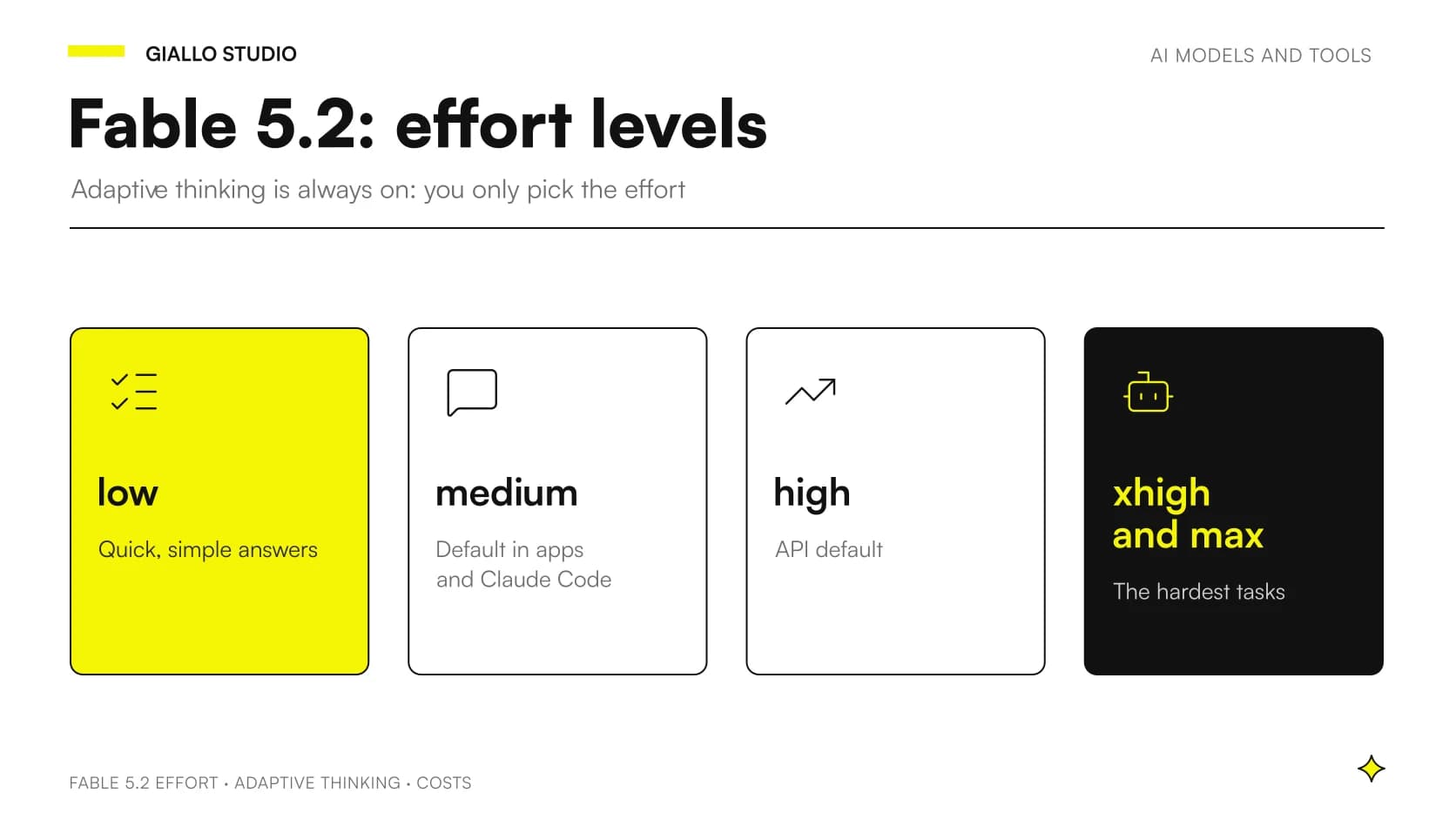
What to do. Do not fight the prompt: choose a lower effort for easy turns. The API default is high; for short summaries, classifications and field extraction, low makes more sense. The full guide to the levels is in the article on Fable 5.2 effort levels; for the previous model, see the one on Opus 5.5 Reasoning Levels.
An example, labeled as such. The newsroom of a local newspaper uses the model for two jobs: writing headlines for and classifying incoming press releases, and preparing a weekly investigation into the city council's budgets. The press releases need fast answers and little reasoning: low. The investigation needs more steps and checks: high, or xhigh if a test on your own cases shows an advantage. A single level for everything means overpaying for the press releases or getting too little on the investigation.
Why does Fable 5.2 stop before it has finished?
Anthropic describes the behavior like this: on long, multi-step tasks, the model sometimes ends the turn with a list of what is missing, with an offer to continue, or with a stop at an ordinary obstacle. It happens more often at effort low and medium. It is not an API error: the response is valid, just incomplete compared with what you expected.
What to do, in order of cost:
- Raise the effort for that task, for example from medium to high. It is the simplest lever.
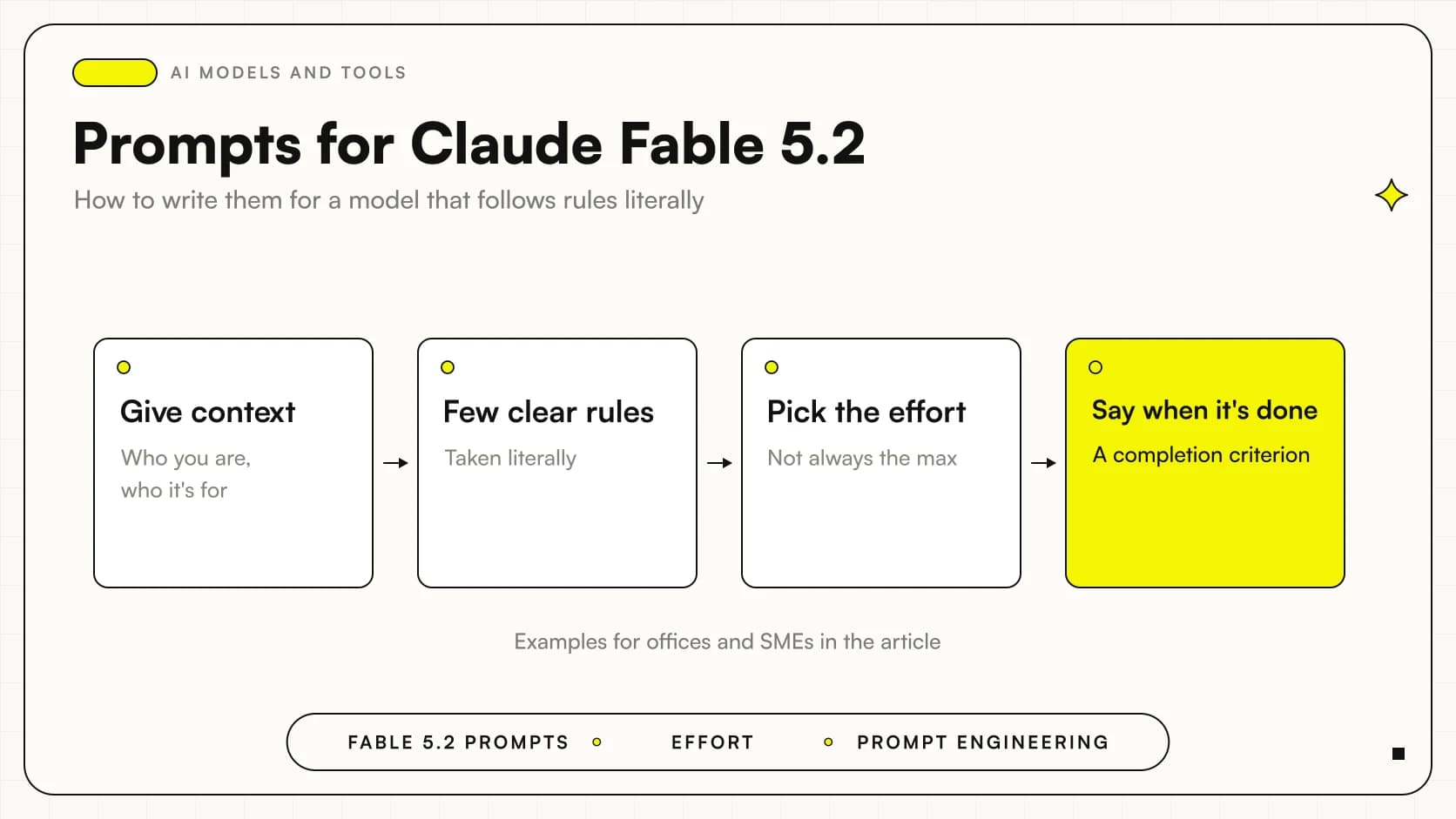
- Write the completion criterion into the prompt: “the task is finished when all 40 files are processed and the report is saved; if you hit an obstacle, resolve it or choose an alternative and note it, without stopping to ask.”
- For long jobs, have the end verified from outside: a script that checks whether the file exists or the list is empty, and relaunches the model if something is missing.
The second and third points are our own practice, not a rule written by Anthropic on the cited page. The documentation points to a dedicated section of the prompting guide. To write better instructions, see the article with the prompts for Claude Fable 5.2; for the basics, see the Claude prompting guide.
Why does it ignore a style rule, or apply it too much?
Fable 5.2 follows style rules closely. The upside is that your tone-of-voice rules are respected. The downside, Anthropic writes, is that a hard limit on sentence length can make the prose choppy. If in the instructions for an earlier model you had written “sentences of at most 15 words” to compensate for a wordy style, the text can now come out in jerks.
What to do. Review the instructions written for earlier models. Replace numeric limits with intent (“short, direct sentences, with some variation in rhythm”) and test on three real texts. A rule you forgot in a system prompt now carries more weight.
The same goes for code. In Anthropic's tests on small tasks, when the prompt did not say who the code belonged to, the model tended to add to the existing structure and flag nearby problems instead of fixing them. If you want it to fix them, say so: “this repository is yours, also fix the defects you find along the way.”
Subagents push costs up: how can I keep them under control?
How much Fable 5.2 delegates to subagents depends on your environment and tasks. In a coding product whose prompts encourage delegation, it delegates readily, and subagents can make up a significant part of the cost of a session. The list price is another part: $8 per million input tokens and $40 per million output tokens, for every agent that works.
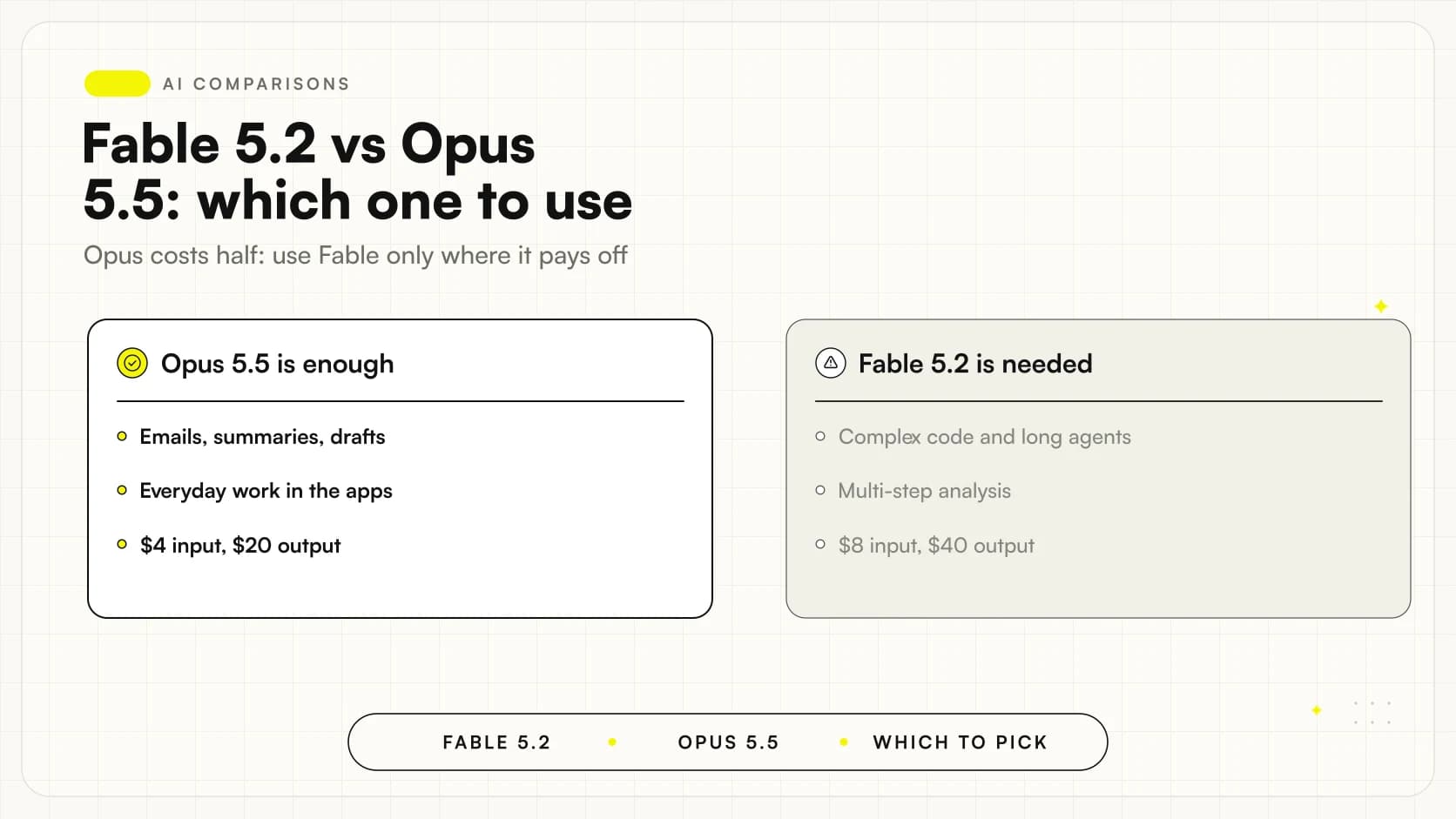
What to do. Set the rules yourself: when to delegate (genuinely independent tasks), how many subagents and with which model. A cheaper model can handle the repetitive sub-tasks. Measure the cost of a typical session before extending it to the whole team. The comparison with the lower model is in the article on Fable 5.2 and Opus 5.5; to choose the right model for agents, see the guide to the best AI model for agents.
The model works silently: how do I get updates?
In long jobs with many tool calls, Fable 5.2 may produce little text for the user, and make the first call without saying what it is about to do. For an agent running in the background this is irrelevant; for a colleague watching the screen it is annoying.
What to do. Ask for updates at intervals: “before each phase write one line on what you will do; at the end of the phase one line on the result.” It costs few tokens and makes the work verifiable.
Which requests get blocked, and where do they go?
Fable 5.2 has safety classifiers. They block high-risk cyber activity, including penetration testing, exploit generation and vulnerability analysis on binaries, and most biology research tasks. According to the Anthropic's announcement, a blocked request instead gets a response from Opus 4.8 for cybersecurity and from Opus 5 for biology. Anthropic states about 55% fewer blocks than Fable 5.1, about 60% fewer on cybersecurity and about 40% fewer on biology, in early tests.
Via the API, a refusal arrives with HTTP 200 and stop_reason: "refusal", with a stop_details object that indicates the policy area. To retry on another model you can use server-side fallback (beta), an SDK middleware or your own new attempt. If the refusal arrives before any output, billing depends on the category, and in any case it counts toward rate limits.
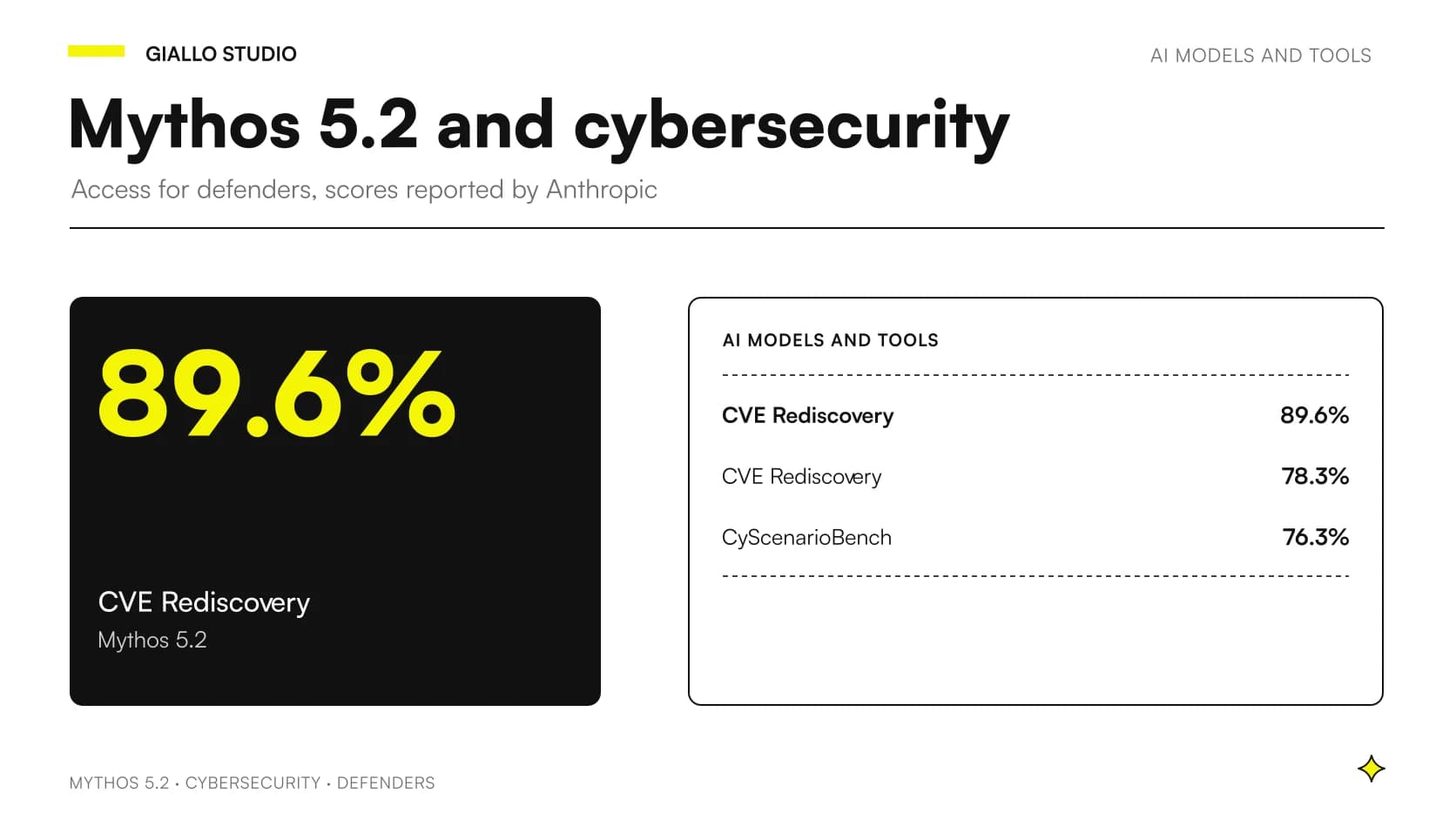
What to do. A company that does not do offensive security or biological research will rarely run into them. Those who genuinely work in these areas should look at Mythos 5.2 and cybersecurity: it is the same model without those safeguards, with access through the verification programs. If you see a flagged message in the app, the article on how to read a flagged message explains what happened (written for Opus 5.5).
Which technical constraints make requests fail?
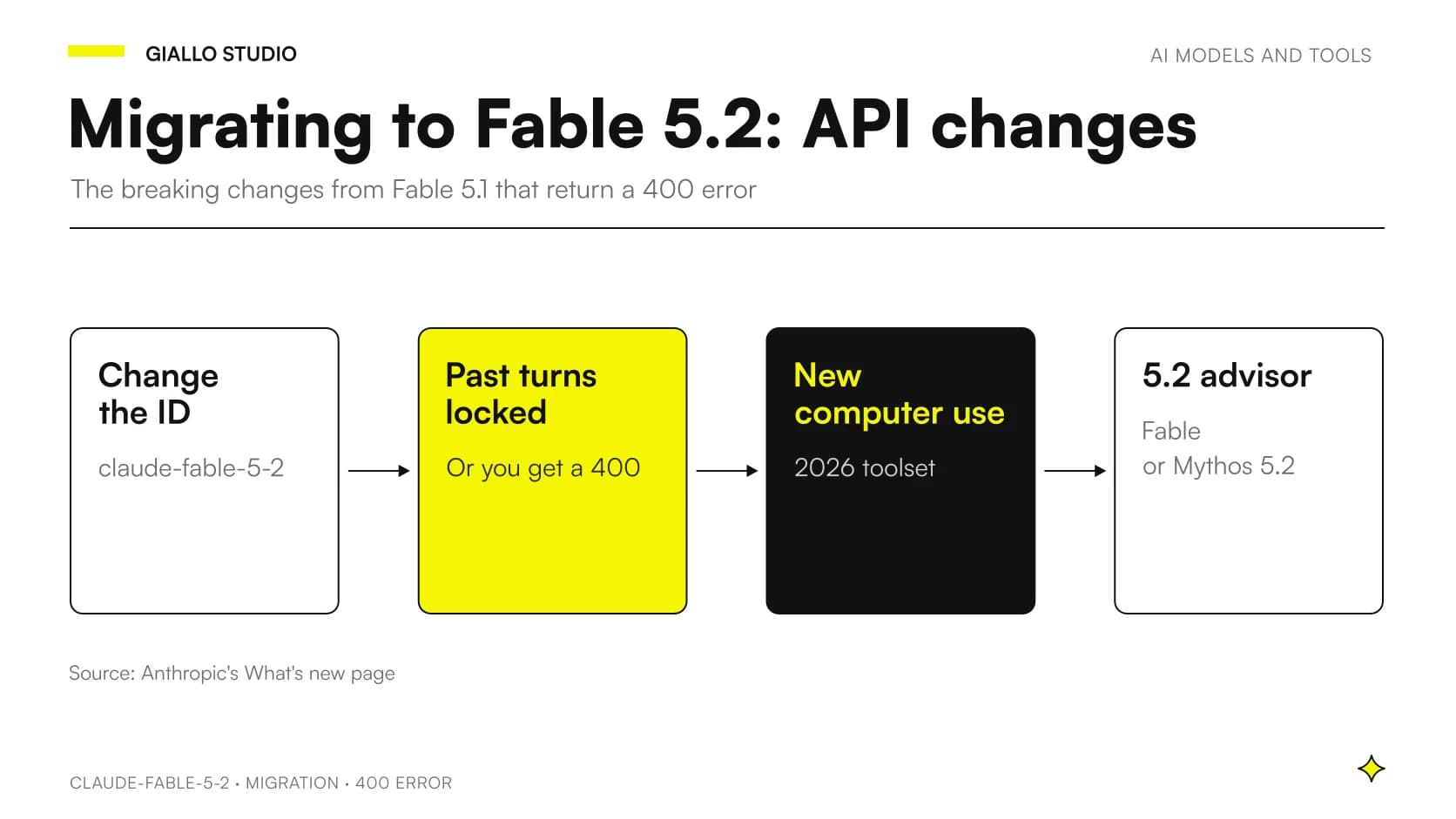
Some limitations are not about behavior: they are API rules that produce 400 errors. The topic is migration, and the full treatment is in the API migration guide. Here is the list of what you run into most often, all taken from the “What's new” page:
| Limit | What Happens | What to do |
|---|---|---|
| Thinking disabled | 400 error | Omit thinking and use effort |
tool_choice set to force a tool (any or tool) |
400 error | Use car with strict: true, or use JSON outputs |
| Editing earlier turns | 400 error on the prefix check | Only append to the conversation, never edit |
Tool computer_20251124 |
400 error (except on Amazon Bedrock) | Switch to computer_toolset_20260801 |
| Advisor other than Fable 5.2 or Mythos 5.2 | 400 error | Set the advisor model to claude-fable-5-2 |
| Customer-managed encryption keys | Structured outputs not available | Omit strict and validate in your own code |
One last effect concerns model switches. Fable 5.2's reasoning blocks are read only by Fable 5.2 and Mythos 5.2: if a router moves the conversation to Opus 5.5 or another model, the reasoning from those turns is lost. The request does not fail and the discarded blocks are not billed, but the next model starts with less context.
What about data? There is no zero data retention
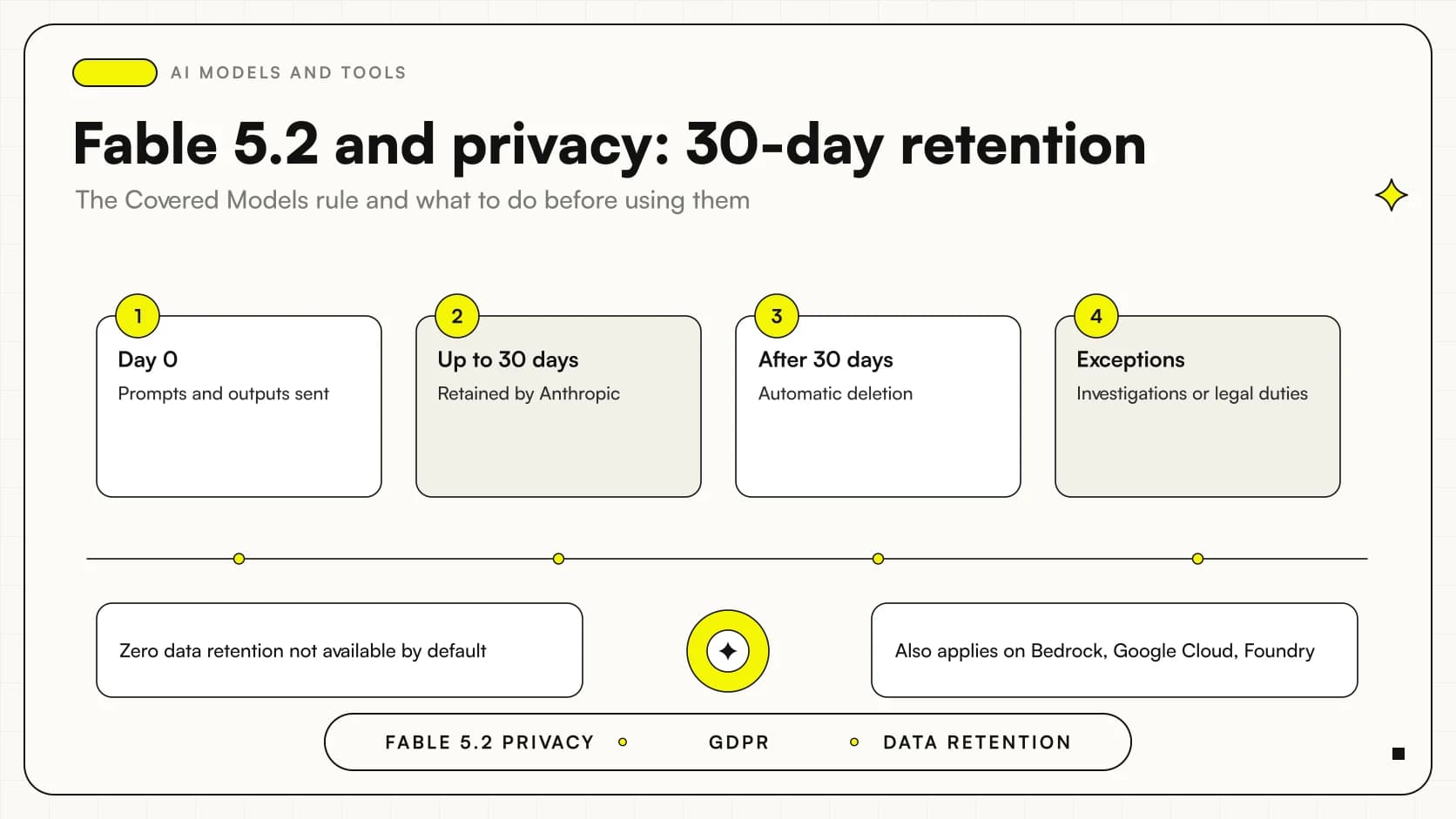
A non-technical limitation, but a decisive one for many SMEs. Fable 5.2 and Mythos 5.2 are Covered Models: they require at least 30 days of data retention and are not available with zero data retention, unless Anthropic expressly authorizes it. This applies to Enterprise customers and third-party platforms too. Anyone already on zero data retention can continue with the earlier models.
If you process personal data of customers, patients or employees, you need an assessment before the first test, not after. EU processing regions are not indicated in the official pages consulted on 9 November 2026. The details are in the article on privacy and data retention.
When do the limitations matter, and when do they not?
The limitations matter little if
- The task is long and hard and you can leave effort at high or above.
- The model works inside a process with a final check, not on its own.
- Your data is not subject to zero-retention requirements.
The limitations matter a lot if
- You make thousands of simple requests a day and pay for reasoning on each one.
- You have code that edits the history or forces tool_choice.
- You are on zero data retention by contract or internal policy.
Mistakes to avoid with Fable 5.2
- Using it for everything. Anthropic itself recommends starting with the latest Opus and moving to Fable when tests at a higher effort are not enough. An email classifier does not need Fable.
- Fixing the thinking with the prompt. If simple requests cost too much, lower the effort: the “do not reason” line is not the right lever.
- Leaving a long job without a final check. A turn that ends early looks like a normal answer. Verify the end with an automatic check.
- Carrying over old prompts without rereading them. Rigid style rules and instructions designed for less obedient models can produce odd results.
- Forgetting about data. Sending sensitive data without checking the retention of at least 30 days is the costliest mistake, because it cannot be fixed afterwards.
How to try it without surprises
Take 15-20 real cases from your work and run them on Opus 5.5 and on Fable 5.2, at different effort levels. Note quality, cost and how often the model stops before it should. The cost and capability differences between the two models can only be understood this way. After the test you will have a choice based on your own numbers, not on a vendor benchmark.
If you want help designing that test, or building an agent that uses the right model for each task with an end-of-work check, Giallo Studio designs AI agents for SMEs starting from your real processes. For a preliminary assessment of costs and data constraints, see our AI Consulting.
Giallo Studio guides: methodology and sources
Want to apply this to your business?In 30 minutes, free of charge: the first process to automate and its estimated return, in writing.
Book the free auditHow we apply it in the company
Related resources
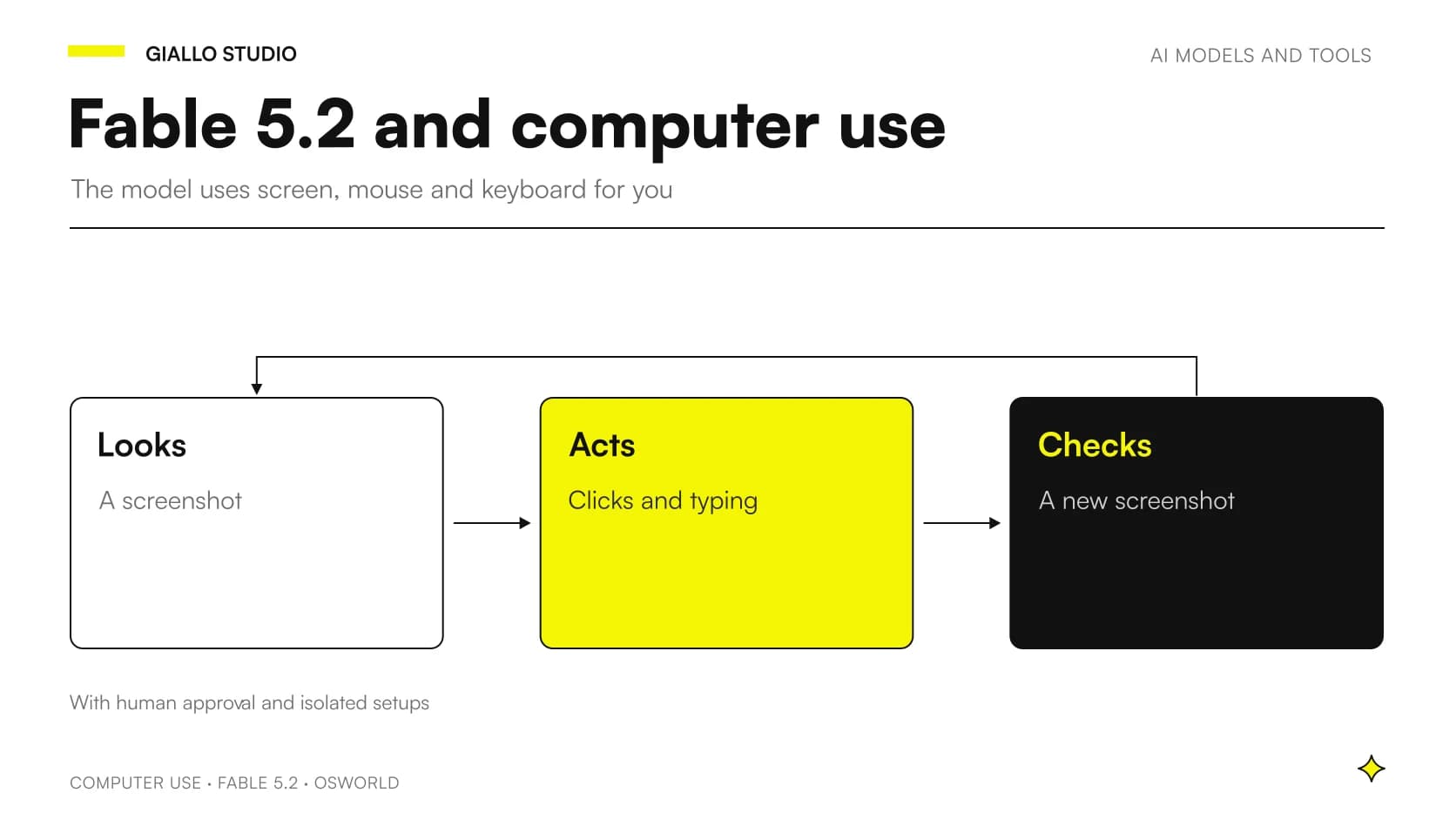 Claude computer use with Fable 5.2: letting the model operate a PC on its own
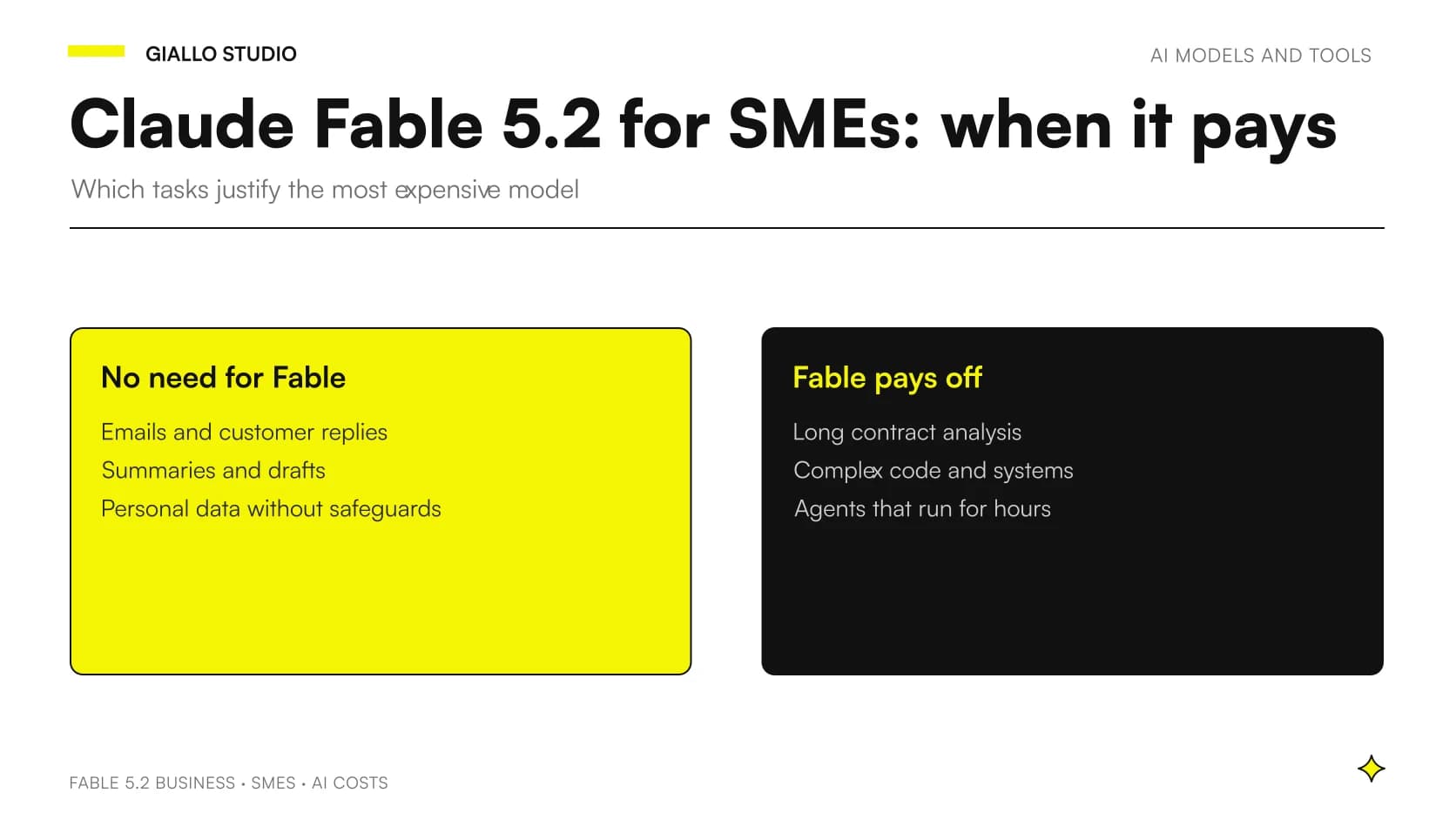 Claude Fable 5.2 for Business: When It Pays Off for SMEs
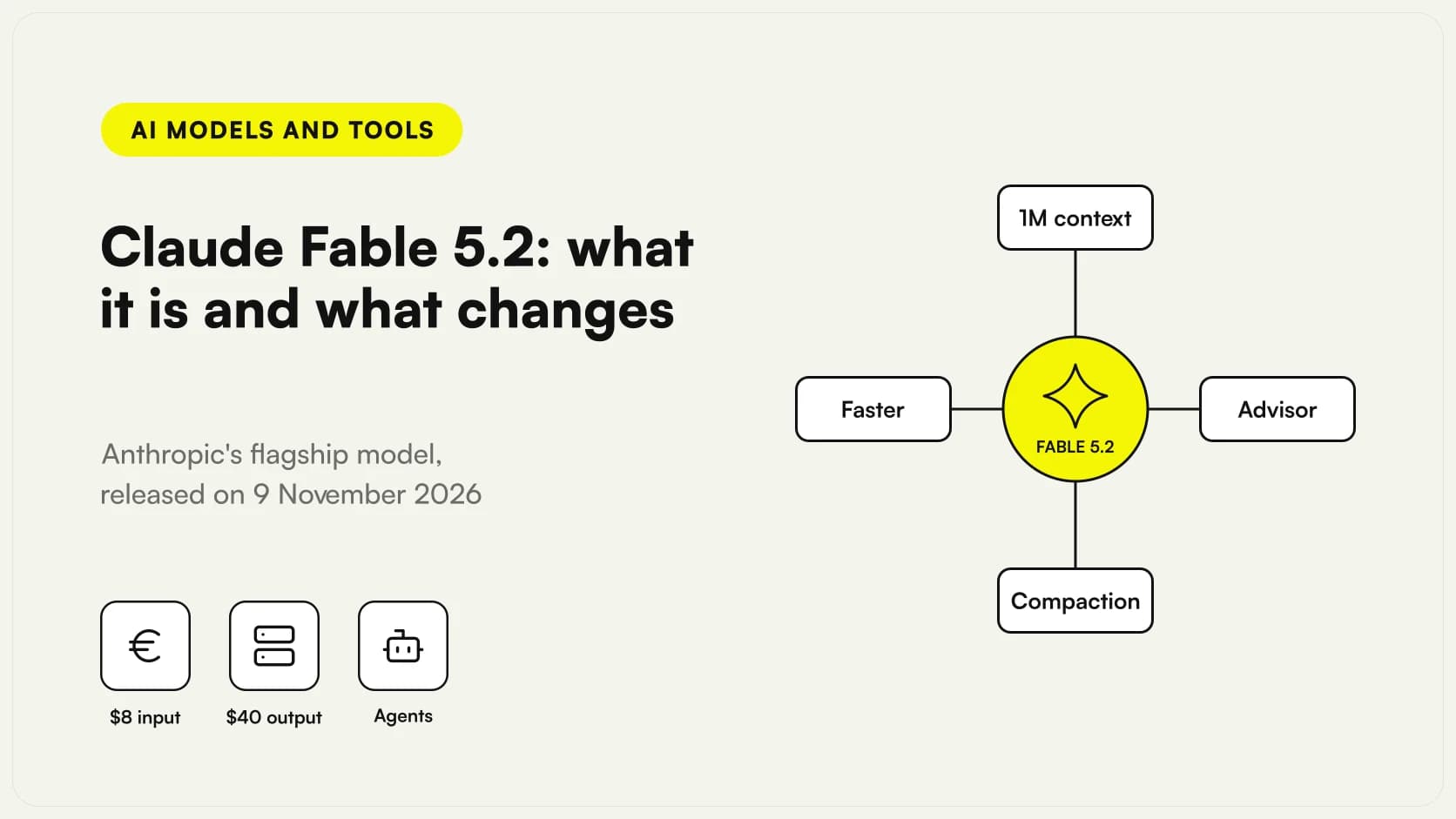 Claude Fable 5.2: What It Is, What Changed and What It Costs
 Fable 5.2 effort levels: what they mean and how to choose
 Fable 5.2 migration: what changes in the API and why you get 400 errors
 Claude Fable 5.2 prompts: how to write them, with 5 ready-made examples
 Fable 5.2 Privacy: 30-Day Data Retention and What an SME Should Do
 Claude Mythos cybersecurity: who can use it and what it really does
 Fable 5.2 vs Opus 5.5: which to use and when
 Claude switched to an earlier model: why it happens and what to do
FAQ
What are the known limitations of Claude Fable 5.2?
According to Anthropic's “What's new” page, accessed on 9 November 2026, there are five main ones. The model thinks even when the prompt asks it not to, can end a turn before the work is finished, follows style rules literally, can delegate heavily to subagents and drive up costs, and does not offer structured outputs with customer-managed encryption keys. On top of these come the classifier blocks on cybersecurity and biology.
Why does Fable 5.2 stop before it has finished?
Anthropic describes the behavior like this: on long, multi-step tasks, the model sometimes ends the turn with a list of what remains, with an offer to continue, or by stopping at an ordinary obstacle. It happens more often at effort low and medium. The countermeasures are to raise the effort and to write the completion criterion into the prompt.
Can I turn off reasoning in Fable 5.2?
No. Adaptive thinking is always on, and a request with thinking disabled returns a 400 error. You control depth with the effort parameter: for simple requests, use a lower level. Anthropic notes that a prompt line such as “answer without reasoning” is not enough at effort medium or higher.
Why does Fable 5.2 refuse some cybersecurity or biology requests?
Because Fable 5.2 has classifiers that block high-risk cyber activity, such as penetration testing and exploit generation, and most biology research tasks. The blocked request is routed to Opus 4.8 for cybersecurity and to Opus 5 for biology. Anthropic states about 55% fewer blocks than Fable 5.1; those who genuinely work in these areas can request Mythos 5.2 through the verification programs.
Can Fable 5.2 be used with zero data retention?
No, unless Anthropic expressly authorizes it. Fable 5.2 is a Covered Model and requires at least 30 days of retention, even for Enterprise customers and on third-party platforms. Customers who are in zero data retention today can keep using the earlier models.
What are the problems with Fable 5.2 on Reddit and in forums?
In this article we do not report forum opinions that cannot be verified. We rely on the limitations Anthropic states in its official documentation, accessed on 9 November 2026, the day of the release. Independent reviews and third-party tests are not yet available: it is best to try the model on your own use cases.