
How much does a custom AI agent cost
How much a custom AI agent costs: price ranges, what affects the quote and how to assess whether your use case is simple or complex.
Reading time: 10 min
A custom-made AI agent costs approximately 3.000 – 15.000 €. It is a wide range, and the reason is that very different things fall under the same name: an assistant who prepares response drafts on an email box has nothing to do with a system that reads documents, interrogates management software and communicates with customers on multiple channels.
This article explains what the position within the range depends on, so you can figure out where your case falls before you even ask for a quote.
In summary
- Reference Range: 3.000 – 15.000 € for development.
- The most important factor is the number of integrations with existing systems.
- The second is the degree of autonomy: Proposing costs less than acting.
- API consumption is a cost separate and recurring, proportional to use.
- The exceptions of the process are the most underrated item of the estimate.
- Starting from a use case only and expanding after is almost always the cheapest route.
What You're Really Buying
Before the numbers it is better to clarify what makes up an agent, because the cost is distributed differently than you imagine. The "intelligence" part is the one that costs the least: models are a service that is consumed. The work is around.
| Component | What it entails | Weight on the project |
|---|---|---|
| Process Analysis | Understand what is happening today, with the exceptions | High |
| Agent logic | What it does, in what order, when it stops | Medium |
| Integrations | Link to management software, CRM, mail, e-commerce | High |
| Error Management | What happens when something doesn't respond | Middle-high |
| Interface | Where people see and control it | Medium |
| Testing | Evidence on real cases, corrections | Medium |
| Model AI | The service that reasons about the texts | Low |
The last line always surprises. The model is the most visible and the least expensive part: you pay on consumption and the choice between one model and the other moves the account much less than you move an extra integration. The operation is explained in AI Agents: What They Are and How They Work.
The two factors that decide the price
The integrations. Every system to be connected is a piece of a project: understanding how it exposes data, managing credentials, dealing with cases where it doesn't respond, keeping it when it changes. An agent who lives inside an email box just lies at the bottom of the range. One who reads from the mail, checks on the management software, updates the CRM and answers on WhatsApp has four contact points and sits at the top.
The degree of autonomy. It is the variable that companies do not weigh at the request stage.
Proposes (cost less)
- Prepare the answer, one person sends it
- Report anomaly, someone decides
- Compile draft, operator corrects
- Error is intercepted before exiting
It acts (costs more)
- Send to customer alone
- Update record without confirmation
- Book, order, confirm
- We need thresholds, logs, switch, traceability
The jump from the left column to the right is not a check: it requires checks, limits, error management and verifiability. It is real work, and it is also the choice that changes the risk profile of the system, as explained in How to Assess the Risks of an AI System.
The Exceptions: The Voice That No One Preempts
When you describe a process, you tell it in its clean form. «The request arrives, we check availability, we send the estimate». Then, during the analysis, the «except when» emerge.
- Except when the customer is already in the registry with different conditions
- Except when the request arrives in English
- Except when the item is not in stock and must be ordered
- Except when it is a historical customer and we apply another price list
- Except August, which we do differently
Each line of these is development and testing work. A process with five exceptions doesn't cost twice as much as one with two: it costs a lot more, because exceptions interact with each other and must be tested in combination.
What it costs after release
The development cost is one-off, but the agent lives. The typical recurring entries:
- API Consumption: proportional to how many requests it processes and how long they are. See cost of AI API.
- Hosting: where the system runs, normally contained.
- Maintenance: corrections, adjustments when changing a connected system.
- Evolution: new exceptions that emerge, cases that were not there before.
Point 4 is not a design flaw: it is normal. An agent who manages a real process will encounter new situations, and the system needs to be updated. The detail is in how much it costs to maintain an AI system.
Practical examples
Agent on email box, professional practice. Read incoming requests, rank them, prepare a draft response for recurring cases. One integration, "propose" mode, few exceptions. Lower part of the range: around €3,000-5,000. Monthly consumption negligible to the volumes of a study.
Agent for e-commerce on two channels. It responds to customers on site chat and WhatsApp, checks the order status on the management software, handles return requests according to rules. Two channels, a significant integration, mixed mode. Central part: around 7,000-10,000 €. Here monthly consumption becomes an item to estimate, because the conversations are many.
Agent who manages the entire budgeting cycle. It reads the request, queries price lists and availability, calculates, generates the document, sends it and records the follow-up. More integrations, high autonomy, many exceptions in the price lists. Upper end of the range. In a case like this, it is almost always better to split the work: start with generating the draft, and add automatic sending only after months of verification.
How the estimate is broken down, in practice
When you get an offer for an agent, ask for it to be broken down. A single amount doesn't tell you where the job is and it makes it impossible to figure out what you can take off to get back into the budget.
A typical breakdown, on a project in the middle of the range:
| Voice | Indicative share | What it contains |
|---|---|---|
| Flow analysis and drawing | 15-20% | Process mapping, exceptions, acceptance criteria |
| Integrations | 25-35% | System connections, credentials, unavailability management |
| Agent logic | 20-25% | What does he do, in what order, when he stops and asks |
| Error Management and Controls | 10-15% | Limit cases, thresholds, logs, switch |
| Interface and testing | 15-20% | Where you check, evidence on real cases |
This breakdown serves two purposes. The first is to understand if the supplier has considered everything: if the error handling is worth zero, that job will appear later. The second is to have real levers to fit into the budget — and the right lever is almost never to ‘use a cheaper model’, but to reduce the perimeter: a channel instead of two, ‘proposes' mode instead of ‘acts' mode, fewer exceptions handled in the first version.
Why the same agent costs differently in two companies
It often happens that two companies apparently ask for the same thing and receive very distant quotes. The reasons are almost always these four, and none depends on the supplier.
- The state of the data. A clean registry and an orderly archive save days. Duplicates, free fields and different nomenclatures per department make them spend.
- Accessibility of systems. A modern management system with documented interfaces connects in a short time. A closed system, or accessible only through manual exports, requires bypasses that cost.
- The clarity of the rules. If decisions today are made by a "feeling" person, someone will have to turn them into explicit rules. It is a work of analysis that must be done anyway, but someone has to pay for it.
- Internal availability. A contact person who responds in the day shortens the project; an untraceable one lengthens it and makes it cost more.
Point 3 is the one that generates the most surprises. Many companies discover during analysis that the process they believed standardized actually depends on a specific person's experience. It's valuable information regardless of AI, but it needs to be taken into account: making those rules explicit is part of the project.
Mistakes to Avoid
- Asking for "an AI agent" without describing the process. The estimate will be wide.
- Hiding exceptions to get a lower price. They re-emerge as variants, at a higher cost.
- Wanting full autonomy from the start. It costs more and makes it harder to figure out what's not working.
- Ignoring the operating cost. A widely used agent consumes more than one little used.
- Not planning for who will look after it. An agent without an internal contact person degrades.
- Confusing him with a chatbot. They are different things with different costs, see how much does an AI chatbot cost.
How to apply it in the company
To get a tight quote instead of a range, prepare this information:
- The process written in ten lines, with the exceptions listed
- How many times a month it happens and how long it takes today
- The systems to be connected, with name and version
- What do you want the agent to do on his own and what must remain to a person
- Who in the company will follow it after release
The last question is what serious suppliers do and companies don't expect. An agent without an internal referent is a project that slowly shuts down, and no quote can compensate for it.
The full cost picture is in how much AI costs in the company, and the choice between ready-made and customized solution in AI by subscription or customized.
Conclusion
An AI agent costs between 3,000 and 15,000 € and the difference makes it integrations, autonomy and exceptions. not the chosen model. The "intelligent" part is the least expensive; the job is to connect systems and handle anything that can go wrong.
The cheapest way is almost always the same: a use-only case, "propose" mode, measurement for a few months, then extension. Whoever starts from the complete system pays more and learns less.
If you want to go from testing with ChatGPT to an AI system integrated into business processes, Giallo Studio designs custom-made agents and automations. You can see some working in The Lab.
Giallo Studio guides: methodology and sources
How we apply it in the company
Related resources
 How much does AI cost in the company: a guide to real prices
 How much does an AI chatbot cost for companies
 How much does it cost to automate a business process
 The hidden costs of AI projects
 How much does it cost to maintain an AI system
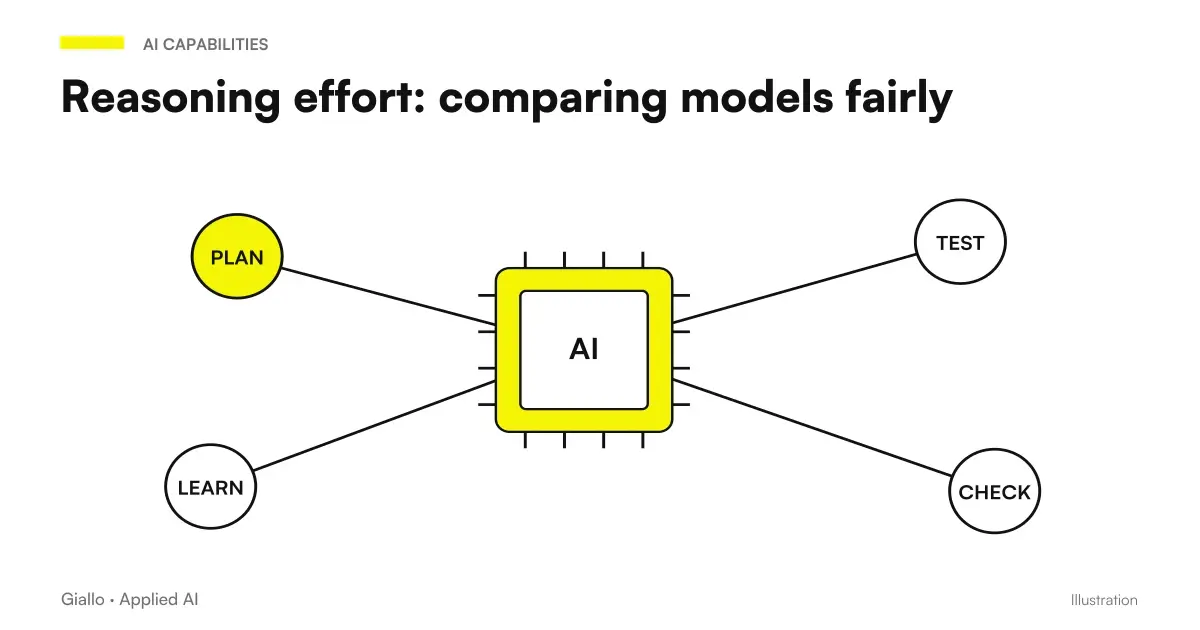 Reasoning effort: what changes in model comparisons
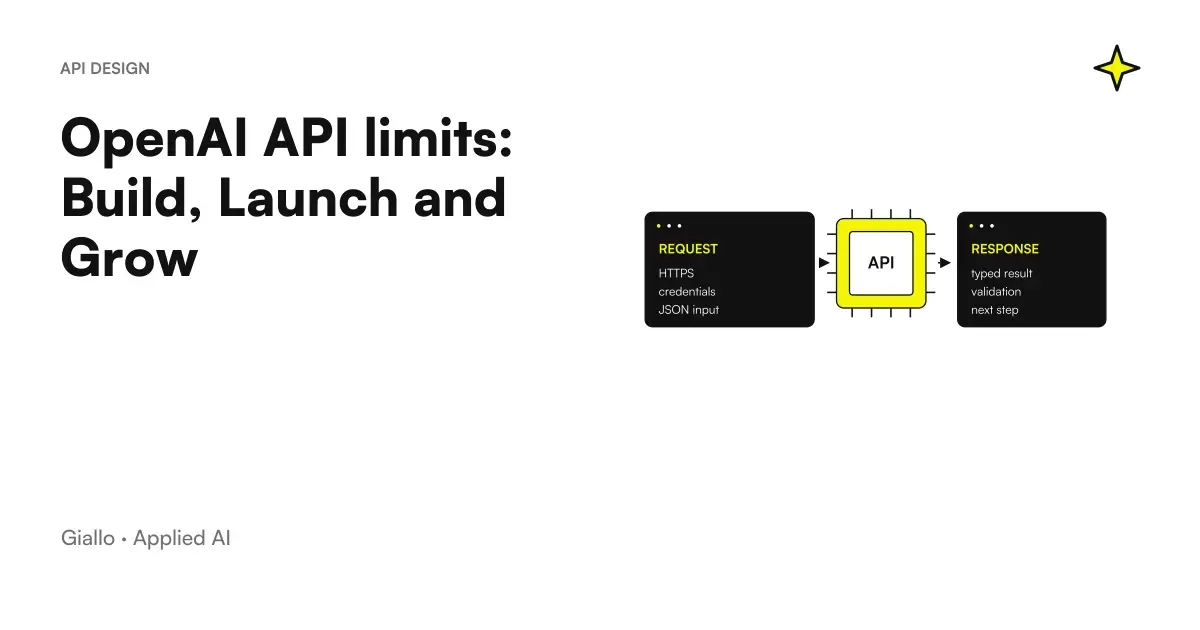 OpenAI API limits: Build, Launch and Grow arrive, what changes for automations
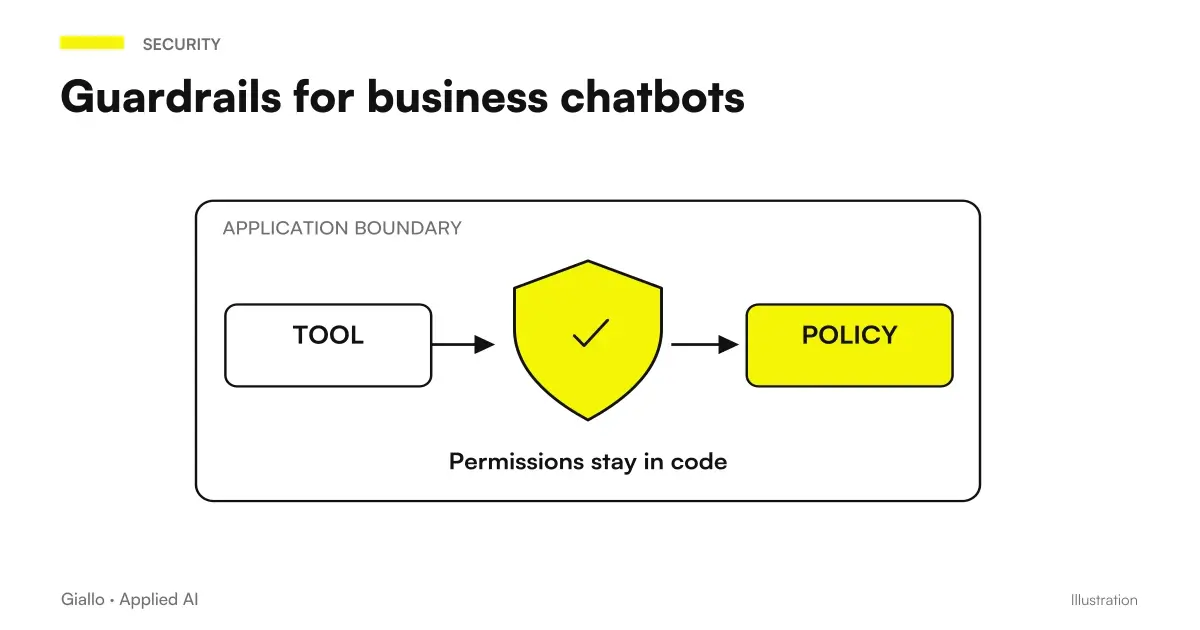 Business chatbot guardrails: where to use Jev AI
FAQ
How much does a custom AI agent cost?
The approximate range is €3,000–15,000, with the position within that range determined mainly by two factors: how many integrations with existing systems are needed, and how much the agent must act autonomously rather than merely propose actions. An agent on a single channel, with one integration and human review, falls near the lower end.
Why does an agent cost more than a chatbot?
Because it does different things. A chatbot answers questions; an agent performs actions: reads a document, updates a record, sends a communication or makes a booking. Each action requires an integration, error handling and checks. The shift from answering to doing changes the cost.
Does the price include API consumption?
As a rule, no: consumption is a separate operating cost, proportional to use. For average business volumes it is often a few tens or hundreds of euros per month, but it should be estimated during the project phase because it is the only item that grows with the success of the system.
How long does it take to make it?
For an agent handling a bounded process with one or two integrations, the approximate duration is a few weeks, with a significant portion devoted to analysis and testing. Much shorter estimates generally exclude exception handling, which determines whether the system holds up in production.
Can I start with a simpler agent and expand it later?
It is the recommended approach and it is also the cheapest. An agent that handles well a single use case, measured for a few months, says much more than an ambitious system built on assumptions. The next extension costs less because the basic integrations are already done.
What happens if I change the management system later?
The integration must be rebuilt or adapted, and this must be budgeted for. This is one reason to isolate the part that communicates with external systems during project design: if it is properly separated, changing a management system affects a limited component rather than the entire system.