
ChatGPT Ads creative: how to write your ads and what OpenAI's policies prohibit
ChatGPT Ads creative: character limits, title and text examples, product feeds and what OpenAI's policies ban in Italy, from finance to health.
Reading time: 11 min
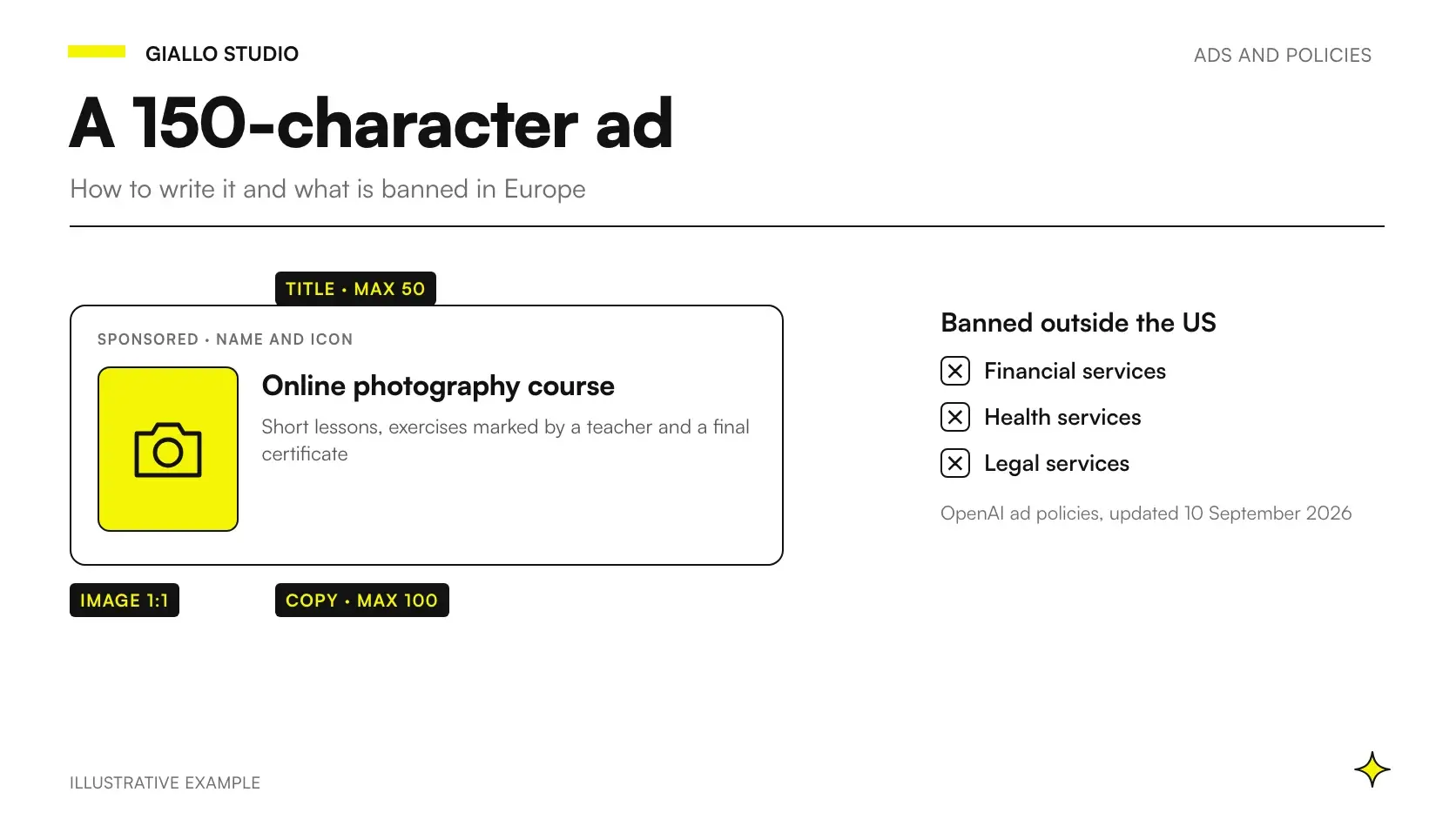
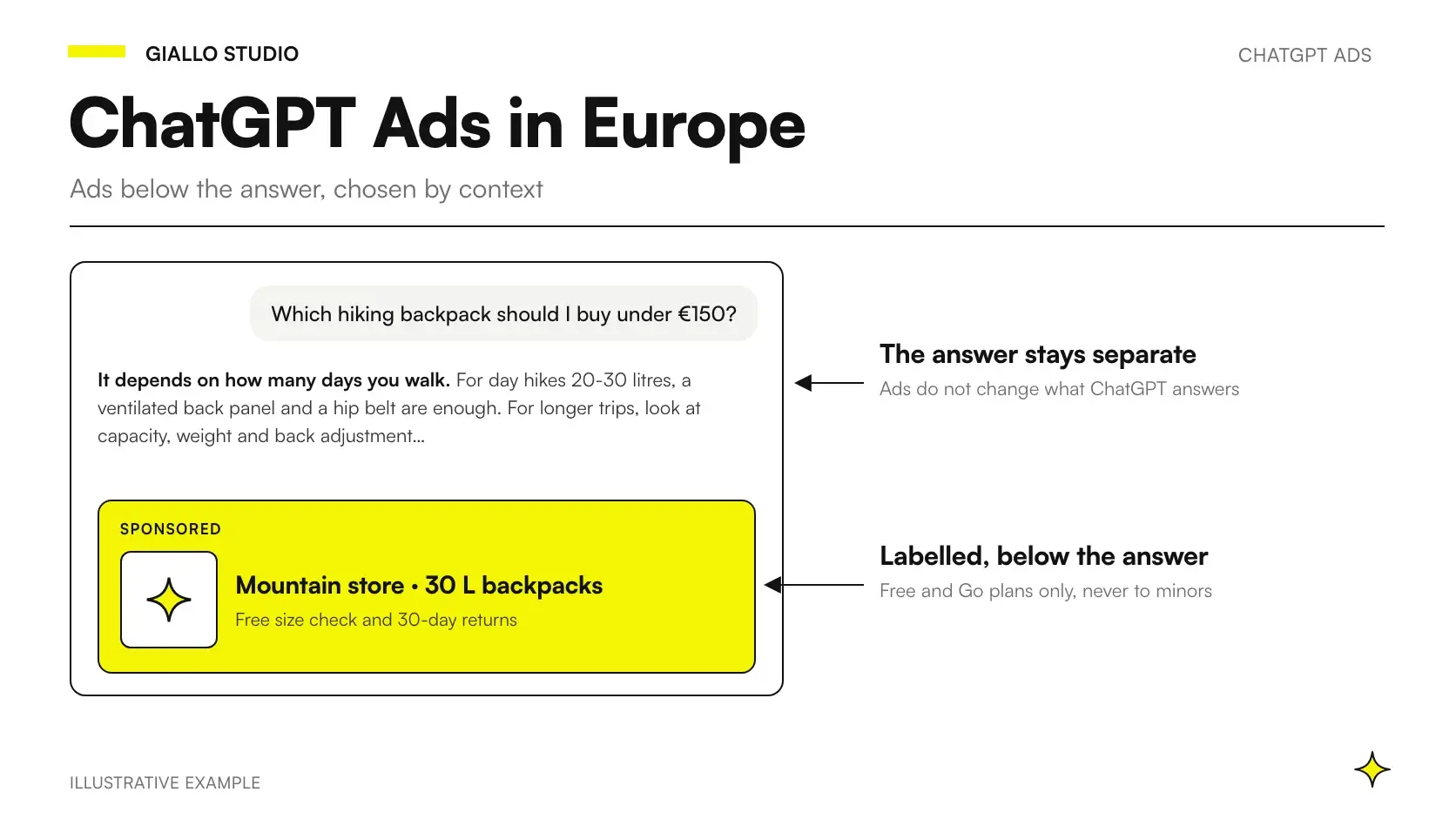
ChatGPT ads are sponsored units that appear below a ChatGPT answer, with the advertiser's name and logo, a title, text, an image and a link to the destination page. The system matches the ad not to a keyword but to the context of the conversation, so ChatGPT ad creative works when it explains precisely what you offer, who it is for and when it is useful.
The rules matter as much as the writing. OpenAI's advertising policies, updated on 10 September 2026, focus the initial phase on consumer and household goods, local services, travel and experiences, digital products and training. Outside the United States, ads for financial and health services are “generally prohibited” and ads for legal services are “currently prohibited”. Every ad goes through an automated review with human oversight that checks the title, text, image and landing page.
This guide has three examples: an online photography course, a hotel on Lake Como and a bike shop with product feeds. The big picture is in the complete guide to ChatGPT Ads.
In summary
- A ChatGPT ad has six elements: advertiser name, favicon, title, text, destination page and image.
- OpenAI recommends titles of 16-24 characters and text of 32-48, with a maximum of 50 and 100 characters.
- The ad image must be square, in PNG or JPG, at most 1200×1200 pixels.
- OpenAI's policies prohibit ads for alcohol, tobacco, gambling, adult content, politics and recreational drugs in all markets.
- Outside the United States, the policies generally prohibit ads for financial and health services, and for now those for legal services.
- OpenAI says it cannot speed up ad review, so it is best to submit ads that have already been checked.
What does a ChatGPT ad look like?
The basic guide for advertisers lists six elements. Two are not written in the individual ad: name and logo come from the account settings; they must be entered exactly as they should appear, and ads will not run without them (account setup).
| Item | Rule or limit | What matters for the writer |
|---|---|---|
| Advertiser name | Set in the account, the same for all ads | The brand the customer recognizes on the website |
| Favicon | The account logo | Legible even at a very small size |
| Title | Maximum 50 characters, 16-24 recommended | Says right away what you offer |
| Text | Maximum 100 characters, 32-48 recommended | Adds information the title does not give |
| Image | PNG or JPG, square, up to 1200×1200, public URL | Simple and consistent with the title and text |
| Destination page | Valid, reachable, open to the OAI-AdsBot crawler | The most relevant page, not the home page |
Limits and formats come from the bulk upload checklist and from OpenAI's campaign launch guide.
The recommended range is tight: “Online photography course” already counts 25 characters. The maximum is binding; the range points to a style, that of an informative label rather than a slogan. OpenAI does not state any rules on the language of the ad in the pages consulted on 19 October 2026.
How do you write the title and text for someone chatting with ChatGPT?
The person who sees the ad has just told ChatGPT what they want to do. The OpenAI guide to creating ads asks for ads that are clear, specific and focused on the benefit, that say what you offer, who it is for and when it is useful. The title makes the value obvious with concrete details; the text completes it with benefits or use cases, without repeating it.
The same guide asks for coverage: many variants per offer, each with a different angle, to be matched with more conversations. This is a departure from the habit, common in search campaigns, of repeating the keyword in every title: the differences are covered in the comparison ChatGPT Ads vs Google Ads.
Example: an online photography course
A school sells an online photography course for beginners. Someone asks ChatGPT how to stop using auto mode on the DSLR they have just bought. Two versions of the ad, side by side:
Relevant ad
- Title: “Manual mode photography” (23 characters).
- Text: “Video lessons, exercises reviewed by the teacher” (48 characters).
- Variant: “Learn light, from scratch” with “Exposure, light and composition, at your pace”.
- Landing page: the basic course page, with syllabus, duration and price.
Weak ad
- Title: “Become a professional photographer in a month” (45 characters): promises a result the course cannot prove.
- Text: “Italy's best photography course. Enroll now, last spots!” (56 characters): an unsupported superlative and generic urgency.
- Landing page: the home page with all the courses.
The weak version is not just less useful: the policies prohibit unsubstantiated claims about results or comparisons, and an “Italy's best course” with no supporting evidence exposes the ad to exactly that risk. Four habits take away relevance:
- Writing in ChatGPT's voice. A title like “Here's the right course for you” sounds like the assistant's reply; the policies prohibit ads that imitate its look, functions or voice to the point of seeming part of the product.
- Repeating the title in the text. Two identical lines waste the most valuable space.
- Using slogans. “Capture your passion” does not say what you sell or who it is for.
- Stopping at one variant. With a single message, the ad is eligible in fewer conversations.
To produce variants by angle (level, problem, available time) you can start from the marketing copy prompts and then check them against the policies.
How do context hints, the ad and the destination page fit together?
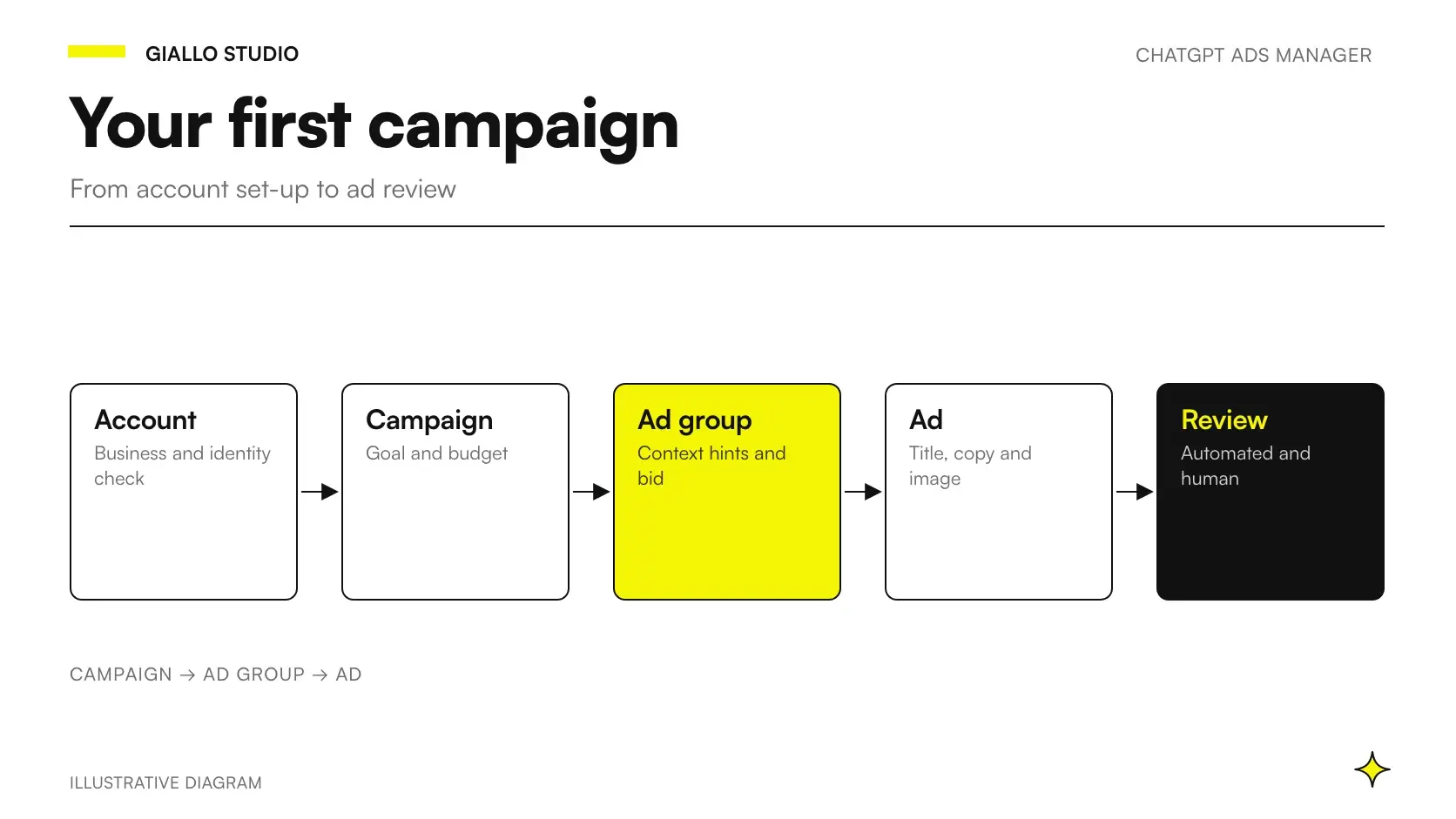
In the ad group, the advertiser writes the context hints, descriptions of the topics and needs in which the offer is relevant, which the system reads together with the title, text and landing page. The ad groups guide defines them as broad thematic signals, not exact matches, useful for adding context that the ad does not cover.
For the photography course, consistent hints would be “choosing the manual settings on your first DSLR”, “understanding shutter speed, aperture and ISO” or “a photography course to follow in the evening after work”. “Christmas gifts for tech enthusiasts” widens the range but breaks consistency with an ad about lessons: for different topics OpenAI recommends separate groups, and the step-by-step structure is in the guide to your first campaign with ChatGPT Ads Manager.
The landing page matters too: OpenAI visits it to check the policies and may use its content to decide when to show the ad (crawler guide), so the page for the specific product mentioned is the better choice.
How can a hotel on Lake Como get bookings from a ChatGPT ad?
A hotel on Lake Como falls under travel and experiences, an allowed category. Someone planning a weekend asks ChatGPT where to stay with a lake view: the ad must lead straight to the booking.
One possible version: title “Weekend on Lake Como” (20 characters), text “Lake-view rooms, breakfast on the terrace” (41), landing page on the booking engine with the lake-view rooms filtered. A variant: “Lake-view hotel on Lake Como” with “Book on our site, free cancellation”, only if free cancellation really applies to the rates shown.
Three details, drawn from the policies, can block a hotel's ad:
- Wine at the center of the offer. Ads that promote alcohol are prohibited; marginal references are tolerated only if alcohol is not the focus. A restaurant mentioned in passing is fine; a package built around a winery tasting risks rejection. And an approved ad cannot lead to a page that introduces prohibited content.
- The spa with health claims. General wellness is allowed without medical claims; “treatments that cure insomnia” becomes a health claim, generally prohibited outside the United States.
- The booking engine that rejects bots. CAPTCHAs, JavaScript checks, logins or unsupported redirects can lock OAI-AdsBot out, and an ad with a landing page that cannot be evaluated is not eligible.
How do product feed ads work on ChatGPT?
The product feed ads format is built by uploading the catalog to Ads Manager and shows image, title, stars, price, sale price and brand (feed guide). OpenAI says they are among the best-performing ads in the program, without publishing any numbers.
Example: a bike shop with product feeds
An online bike shop has a few hundred models across city bikes, gravel bikes and e-bikes. Here the catalog is what you write: titles and descriptions come from the feed, and the ad template for the group currently lets you choose only the image. “Aluminum gravel bike, 1x12, size M” is clear to someone comparing models, a code like “GRV-AL-12-M” is not; the preview before launch shows the result. Four checks:
- Automatic updates. Items expire after two weeks: OpenAI recommends a hosted URL or an automatic SFTP upload instead of a manual CSV.
- Groups by product line. Filters and the field
ads_metadata, for example an “e-bike” line, separate the groups by topic. - Prices aligned with the product page. The sale price must match the one on the landing page: the policies prohibit misleading price claims.
- Explicit exclusions. Feed products are eligible by default: a model that is nearly sold out must be marked as ineligible.
Complete product pages and clean catalog data matter here as they do in other channels: that is the subject of the guide to AI for e-commerce.
What do OpenAI's ad policies prohibit?
The policies, at version 1.6 of September 2026, work on two levels. The first is the baseline standards, which apply even when the category is allowed:
- Misleading ads. No unsubstantiated claims about capabilities, prices, results, affiliations or comparisons, and no fake testimonials.
- Offensive language, including in product or brand names.
- Discrimination and harassment of people or groups on the basis of protected characteristics.
- Imitating the interface. Ads must be clearly distinguishable from ChatGPT.
The second level is the prohibited or restricted categories, summarized in the table below. All the rules apply to text, images, video and landing pages. The advertiser matters too: a company whose main business falls in a prohibited or restricted category may be found ineligible even when promoting an allowed product. Version 1.6 also clarifies that OpenAI may reject ads that conflict with its commercial interests or competitive position.
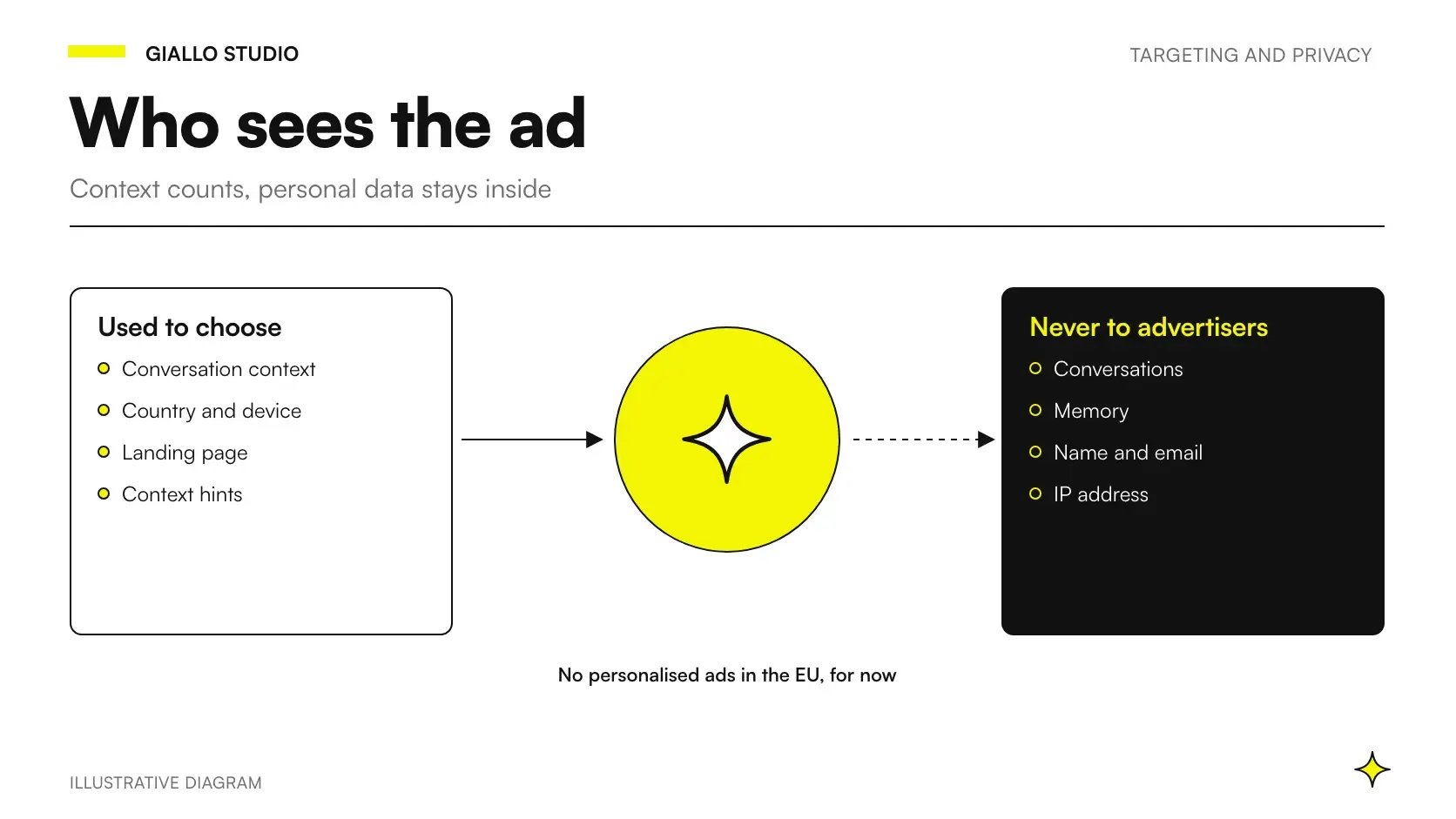
The policies also exclude some conversations, such as those about personal and mental health or politics: the effect on audiences is covered in the guide to ChatGPT Ads targeting and privacy.
Which industries are banned on ChatGPT Ads, and what is allowed in Italy?
The table summarizes the status of each category for an Italian advertiser according to the advertising policies as consulted on 19 October 2026. “Allowed” means that the category is part of the initial phase, not that every ad will be approved.
| Category | In Italy | Policy notes |
|---|---|---|
| Consumer and household goods and local services | Allowed | Initial-phase categories |
| Travel and experiences | Allowed | Alcohol only as a marginal reference |
| Digital products and training | Allowed | Unsubstantiated result promises are prohibited |
| Financial tools that do not sell products | Generally allowed | For example budgeting apps and financial education courses |
| Financial services | Generally prohibited outside the US | Case by case in the US, with possible proof of license |
| Health services and medical products | Generally prohibited outside the US | General wellness is possible without medical claims |
| Legal services | Prohibited for now outside the US | Legal education without services is possible |
| Alcohol and tobacco | Prohibited | Including e-cigarettes and nicotine products |
| Gambling, adult content and dating | Prohibited | Games without real money and underwear in a normal retail context are possible |
| Politics and controversial social issues | Prohibited | Also applies to elections, referendums and public policy |
| Wellness with health claims | Prohibited if the claims are not substantiated | General nutrition sold through major channels is possible |
Recreational drugs, counterfeits, scams, individual property listings and job offers are also prohibited. Banks, insurers, clinics and law firms therefore cannot count on this channel today: which small businesses have room is the subject of the guide to ChatGPT Ads for small business.
How does the review work and why is an ad rejected?
The review checks the advertiser, then the title, text, image and landing page of each ad, and finally the placement. According to the policies most reviews are automated, using language models and classifiers, and serious or uncertain cases go to a person. Checking continues after approval, including through user reports.
OpenAI says it cannot, for now, speed up either the account review or the ad review (account setup). If an ad shows as “Not serving” in Ads Manager (the label as it appears in the English interface), hovering over the status shows the reason (Official FAQs).
OpenAI does not publish rejection statistics; the most predictable reasons can be drawn from the policies:
- Category not allowed, in the ad or in the main business.
- Landing page that changes the offer, with prohibited content the ad does not show.
- Unsubstantiated claims about results, prices or superlatives.
- Resemblance to ChatGPT, in tone or in an image that reproduces a chat.
- Landing page that cannot be evaluated, because robots.txt, a firewall, a CAPTCHA or a login blocks OAI-AdsBot.
- Other people's trademarks used without authorization.
After you unblock the landing page, the crawler guide says to reload or resubmit the ads if the status does not update on its own.
Can you use Ads Manager's AI tools to write ads?
Yes, but with a specific responsibility. Since 16 September 2026 OpenAI has been rolling out in Ads Manager suggestions for text and images based on the landing page and the objective, which the advertiser reviews before using them. An optional personalization adapts titles and descriptions to the conversation and translates them into the user's language. OpenAI does not specify in which countries these tools are active: check in your own account.
Then there is the contract. The OpenAI advertising terms, updated on 25 August 2026, make the advertiser solely responsible for the campaign, including AI-generated results and tools that are on by default. The same section asks for all rights to images, trademarks and testimonials. For the hotel on Lake Como, automatic translation for foreign guests is convenient, but the hotel is answerable for text that nobody has reread. If the ad image comes from a generator, it is worth understanding copyright for AI-generated content.
What should you check before sending ads for review?
- Category verified against the policies in force, including for the main business.
- Account name and logo set up as they should appear in the ad.
- Title within 50 characters and text within 100, with several variants for different angles.
- No unsubstantiated claims and no resemblance to ChatGPT in tone or graphics.
- Square image in PNG or JPG up to 1200×1200, with a public URL that opens the file without a login.
- Specific, consistent landing page, open to OAI-AdsBot and, as OpenAI recommends, to OAI-SearchBot.
- Complete context hints: in bulk upload, the list you send replaces the existing one; it does not add to it.
- Static UTMs for each creative, to tell the variants apart; Pixel and leads are explained in the article on measuring leads in ChatGPT Ads.
How do you go from the rules to your first set of ChatGPT ads?
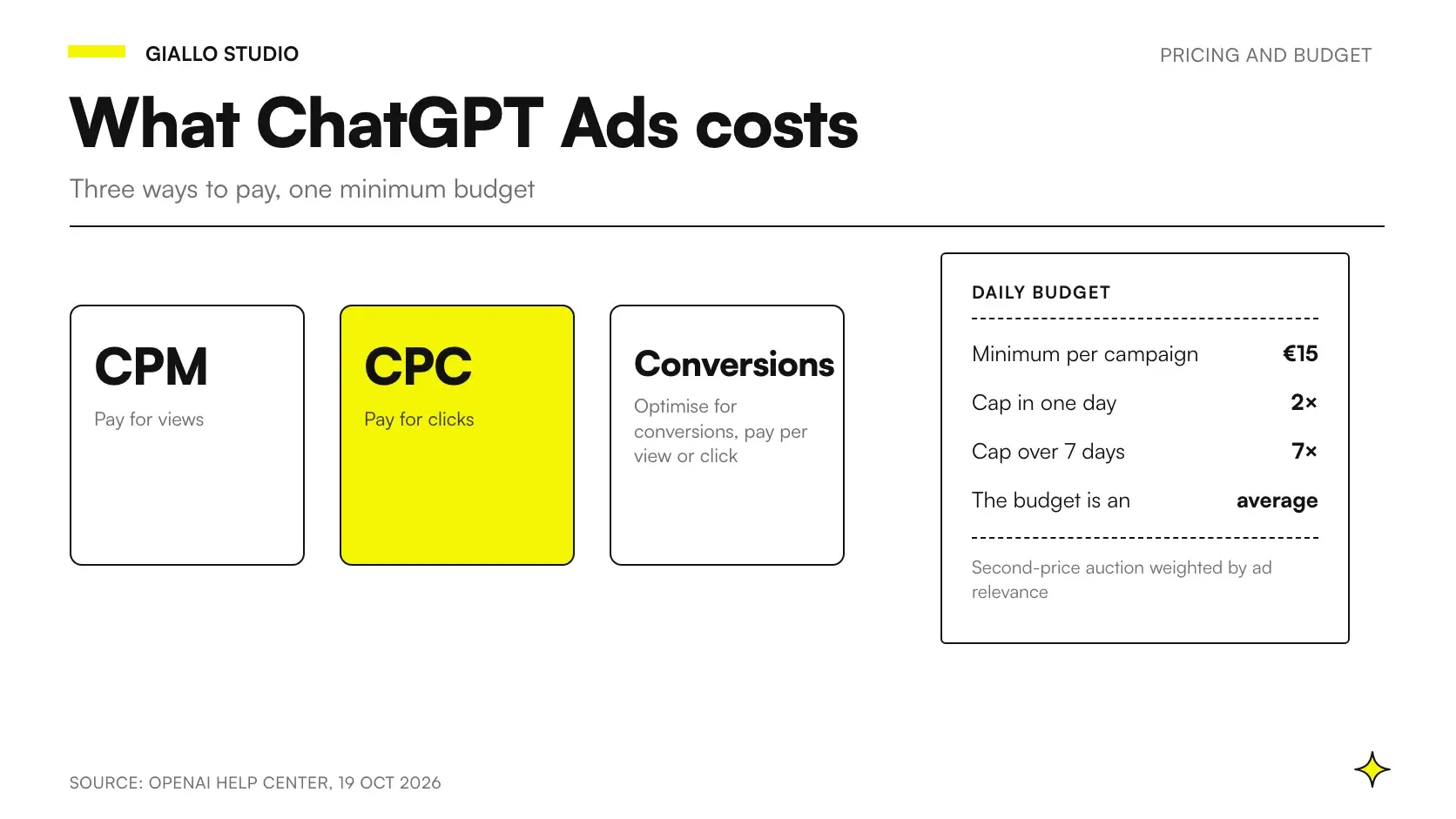
Writing ChatGPT ads is closer to writing a good product page than a slogan: precise information, a verifiable promise, a page that delivers what the title says. To start, all you need is one ad group per offer, several variants, one landing page per topic and a policy check. Bids and test budgets are covered in the guide to how much advertising on ChatGPT costs.
If the weak point is the landing page, for example a generic product page or a booking engine that rejects crawlers, our Giallo Studio website creation service builds landing pages that match the ad and can be read by OAI-AdsBot; for catalogs, our e-commerce service sets up product pages and feeds that update themselves.
Giallo Studio guides: methodology and sources
How we apply it in the company
Related resources
 ChatGPT Ads: what it is and how advertising on ChatGPT works in Italy
 ChatGPT Ads Manager: how to create your first campaign, step by step
 ChatGPT Ads cost: CPC, CPM, minimum budget and welcome credit
 ChatGPT Ads targeting: context, audiences and privacy in Europe
 ChatGPT Ads for small business: is it worth it? Best-fit sectors and a 30-day test
 ChatGPT Ads: new formats, lead measurement and availability in Italy
 AI marketing prompts: copy, campaigns and content
 Copyright and AI-generated content
FAQ
How many characters can a ChatGPT ad have?
The title can be up to 50 characters and the text up to 100. OpenAI recommends titles of 16-24 characters and text of 32-48, though. The image must be square, in PNG or JPG, at most 1200×1200 pixels.
Can you run ChatGPT ads for financial, health or legal services in Italy?
In practice, no. Outside the United States, OpenAI's policies classify ads for financial and health services as generally prohibited and ads for legal services as currently prohibited. Financial tools that do not sell products, wellness without medical claims and legal education remain possible, with caution.
How long does it take to get a ChatGPT ad approved?
OpenAI does not state a review time in the pages consulted on 19 October 2026. It does say it cannot speed up either the account review or the ad review. So it is best to submit ads that have already been checked against the policies.
Can I use AI to write ChatGPT ads?
Yes. Ads Manager suggests text and images based on the landing page and the objective, and an optional feature adapts and translates the text to match the conversation. Under OpenAI's advertising terms, however, the advertiser stays responsible for that text.
Can a hotel advertise a wine-tasting package on ChatGPT?
Only if the wine is not the focus of the offer. The policies prohibit ads that promote alcohol consumption and tolerate marginal references. A stay with dinner is a travel ad; a package built around the tasting risks rejection, even if the wine only appears on the landing page.
Why does my ChatGPT ad show “Not serving”?
Usually because the review is not complete, the account is not verified, the budget is used up, the campaign has ended or there is a payment problem. In Ads Manager, hovering over the status shows the specific reason.
Can ChatGPT ads show prices and discounts?
Yes, as long as they are accurate and match the destination page. The policies prohibit unsubstantiated price claims. In product feed ads, the price and sale price come directly from the uploaded catalog.