
Qwen3.8-27B vs Qwen3.6-35B-A3B: local AI trade-offs
Qwen3.8-27B vs Qwen3.6-35B-A3B: dense, MoE, memory and compatibility. Checking whether a model change really improves your workflow.
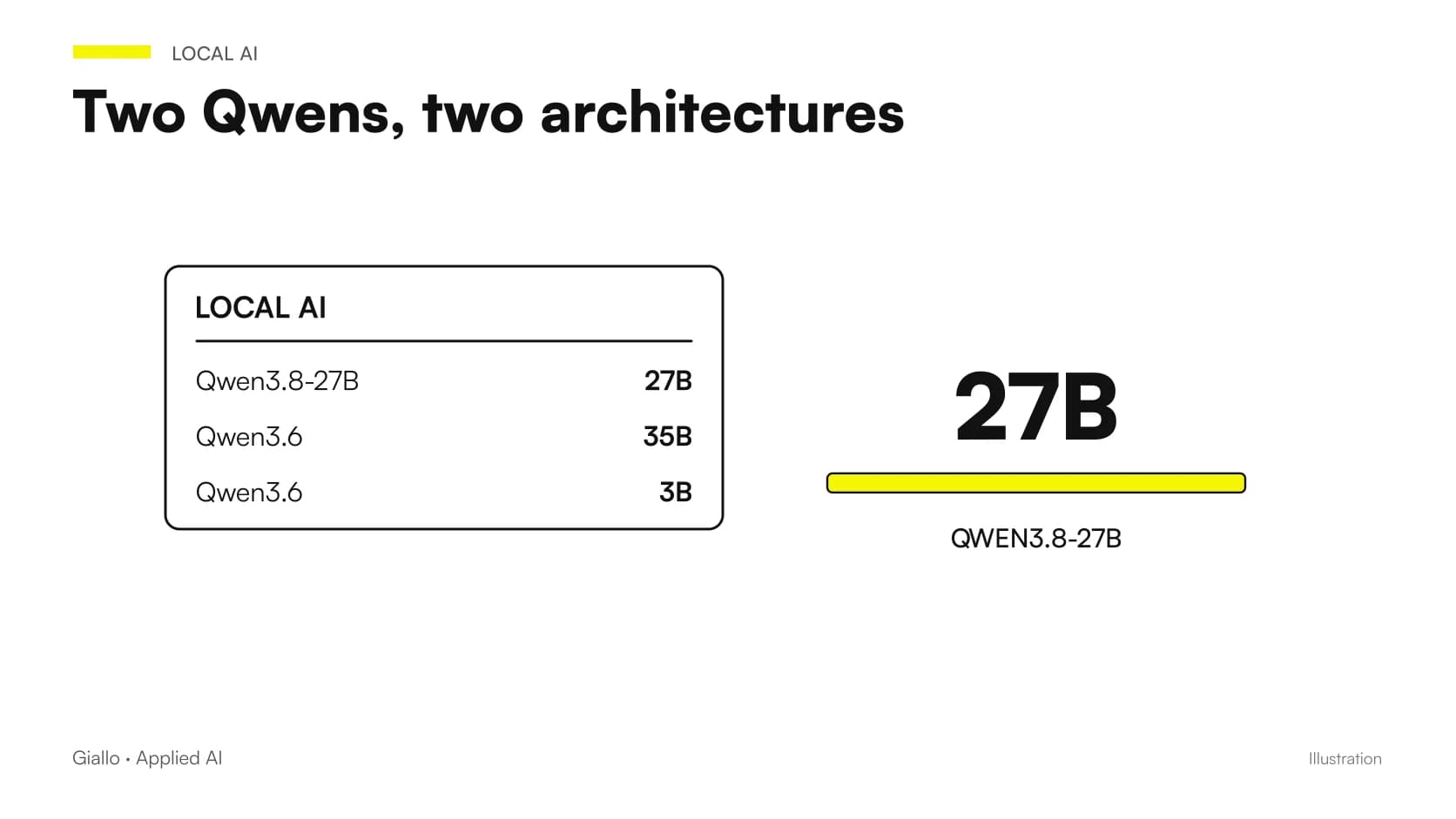
Qwen3.8-27B and Qwen3.6-35B-A3B differ mainly in architecture: the former is dense, the latter MoE. Switching between them is not automatically an improvement for a local system: total weights, active computation and configuration checks differ. The official cards specify 27B language parameters and 35B total with 3B active language parameters respectively. Sources: Qwen3.8-27B, Qwen3.6-35B-A3B.
This comparison concerns anyone choosing a checkpoint or replacing an integrated model. Both cases need evidence from the work: a newer version number can justify a trial, but does not remove accuracy, compatibility and memory checks. This guide uses primary sources consulted on October 27, 2026 and does not describe tests performed by Giallo Studio.
In summary
- Qwen3.8-27B is dense; Qwen3.6-35B-A3B is MoE, with 35B total language parameters and 3B active.
- Both have a vision component and a stated native context window of 262,144 tokens.
- The 35B-A3B’s active parameters do not represent the complete weights to load.
- File, template and tool-parser compatibility must be checked in the runtime version used.
- A reliable migration retains the previous configuration and regression cases.
Why can a 27B have a newer version label than a 35B?
Generation and parameter numbers measure different things. “3.8” identifies a model series; “27B” describes a size. “35B-A3B” distinguishes total from active parameters in the MoE checkpoint. No rule automatically converts these labels into a single quality ranking.
The Qwen3.6-35B-A3B card presents the model as a variant focused on coding workflows and operational stability; the Qwen3.8-27B card describes improvements across multiple tasks in the newer series. These are manufacturer descriptions. Your assistant needs a different question: which checkpoint, in the available configuration, best meets your defined requirements? You can also read the Qwen3.8-27B decision guide before planning the test.
What changes between dense and MoE?
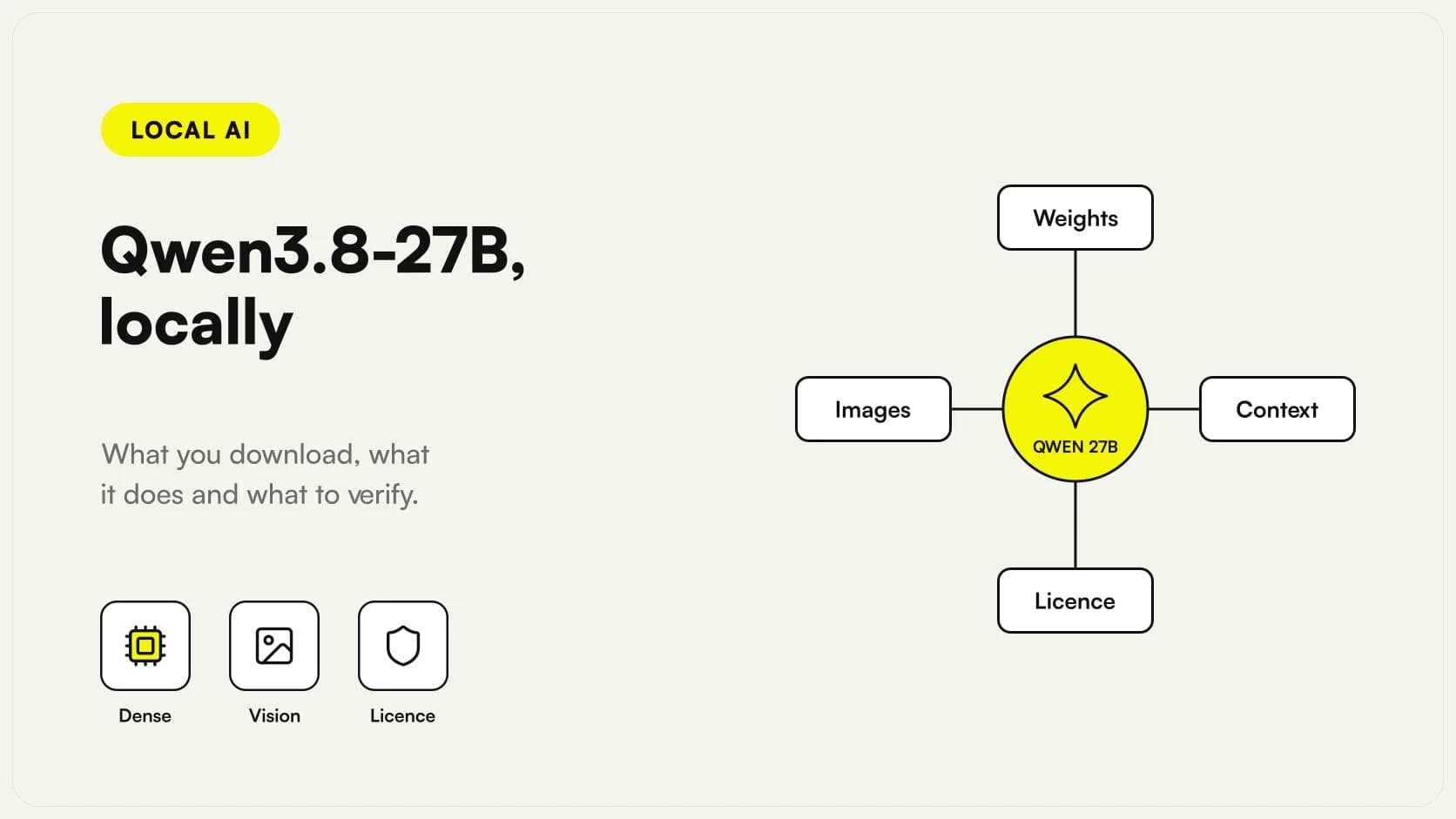
Qwen3.8-27B uses a dense language model; Qwen3.6-35B-A3B selects experts during processing and states 3B active out of 35B total language parameters. Both include a vision encoder, so the size label is not a complete count of every checkpoint component. Sources: 27B card, 35B-A3B card.
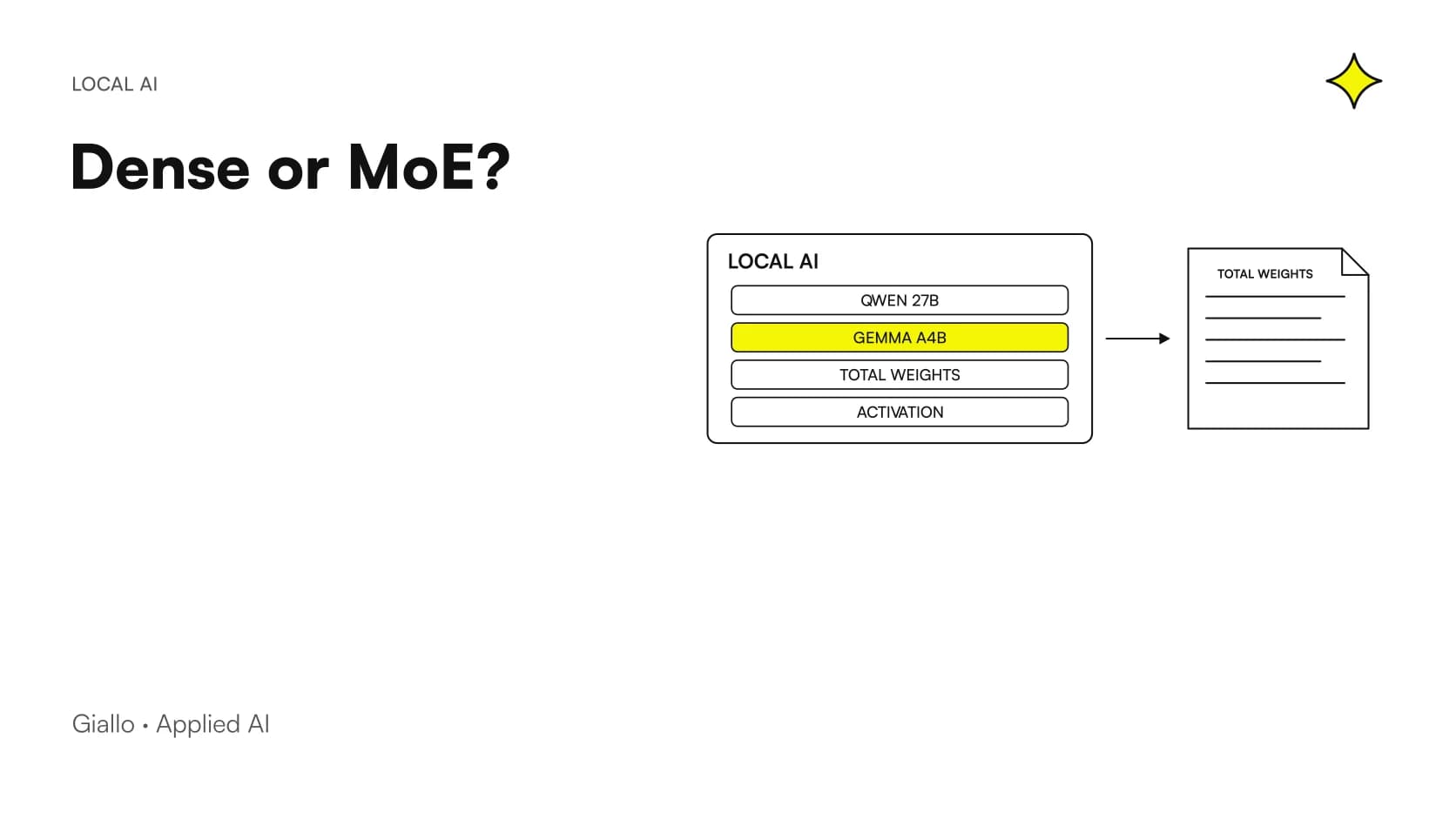
This distinction can change computation per token and how the runtime uses hardware. It does not justify treating the MoE as a 3B model when estimating weight memory. Experts inactive in one step must remain available for subsequent ones. To compare the same trade-off outside the family, see Qwen3.8-27B vs Gemma 4 26B A4B.
Which specifications are shared and which are not?
Both cards list 262,144 tokens of native context and visual understanding. The 27B describes extension to 1,000,000 tokens; the 35B-A3B to 1,010,000. These are extension configurations, not a promise of operation at that maximum on any machine. 27B source, 35B-A3B source.
| Feature | Qwen3.8-27B | Qwen3.6-35B-A3B |
|---|---|---|
| Language architecture | Dense | MoE |
| Language parameters | 27B | 35B total / 3B active |
| Vision | Present | Present |
| Native context | 262,144 tokens | 262,144 tokens |
| Stated license | Apache 2.0 | Apache 2.0 |
| Actual operation on your hardware | To be verified | To be verified |
| Replacement without checks | Avoid | Avoid |
Similar nominal capabilities make the comparison sensible, but do not guarantee that an application can replace the model name without other changes.
Does the 35B MoE need less memory than the dense 27B?
Active parameters cannot establish that. Considering language weights alone at 4 bits, 35B theoretically amounts to around 17.5 decimal GB and 27B to around 13.5 GB. The calculation is parameters multiplied by bits divided by eight; it is neither a real requirement nor a comparative measurement.
The actual format can use mixed precision and adds metadata, vision components and other resources. Memory during a request also includes cache, buffers and system headroom. An engine may move some weights between devices, changing its operational profile: observe this rather than inferring it from the name. To distinguish theoretical size from the real environment, see Qwen3.8-27B, RAM and VRAM and GGUF quantization for local models.
How important is the inference engine to the choice?
Sharing a family does not guarantee the same support level in every engine version. The cards document framework integrations and specific settings; the official Qwen series repository is another reference for current guidance. Always check instructions for the exact checkpoint rather than applying a generic guide found for an earlier version.
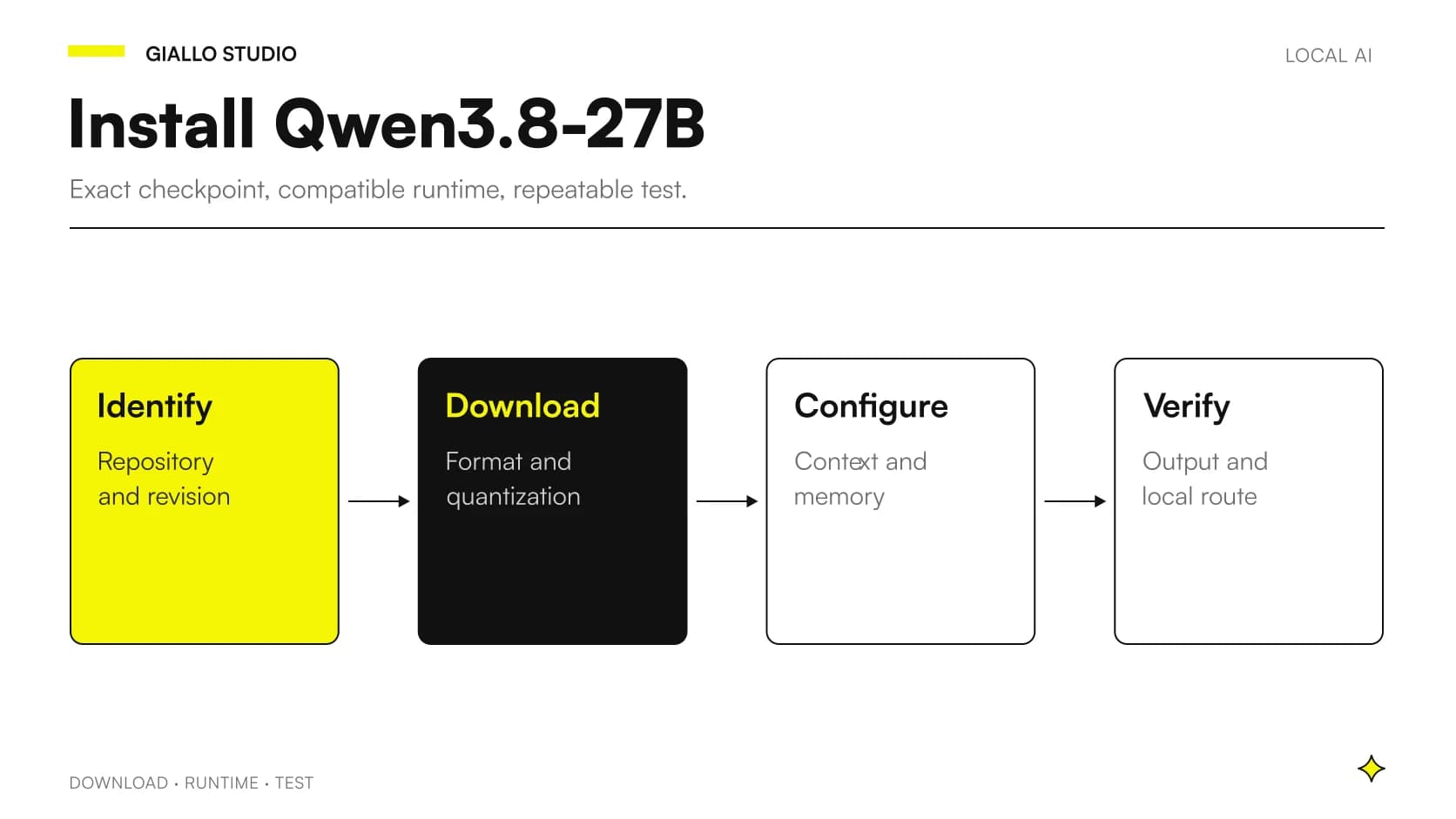
Before evaluating answers, run a minimal text test, then an image test and finally a tool call if the project requires one. Loading, template or parser errors can compromise results before quality comparison begins. Record the working version; an environment that changes automatically during testing makes the cause of a problem difficult to reconstruct.
How should you compare task-completion ability?
Choose an activity with an observable result: extracting fields with sources, drafting under constraints or editing code covered by tests. Include ordinary cases and conditions where the model must stop. A generic conversation without an expected answer encourages judgments about style rather than correctness.
If the task has multiple steps, assess every transition. Did the system request the right document? Recognize missing authorization? Correct an error without introducing an unrelated change? A card may describe agentic capabilities, but application behavior also depends on available tools and the execution loop. For a reusable rubric, see the protocol for benchmarking local LLMs in Italian, avoiding aggregate scores that hide blocking errors.
How should you test both models on business code?
Hypothetical scenario: an internal software team wants a narrowly scoped change to business software. The test should use an authorized repository, a clear requirement and an existing verification procedure. The outcome is not just generated code: it includes tests, modified files and consistency with the requested behavior.
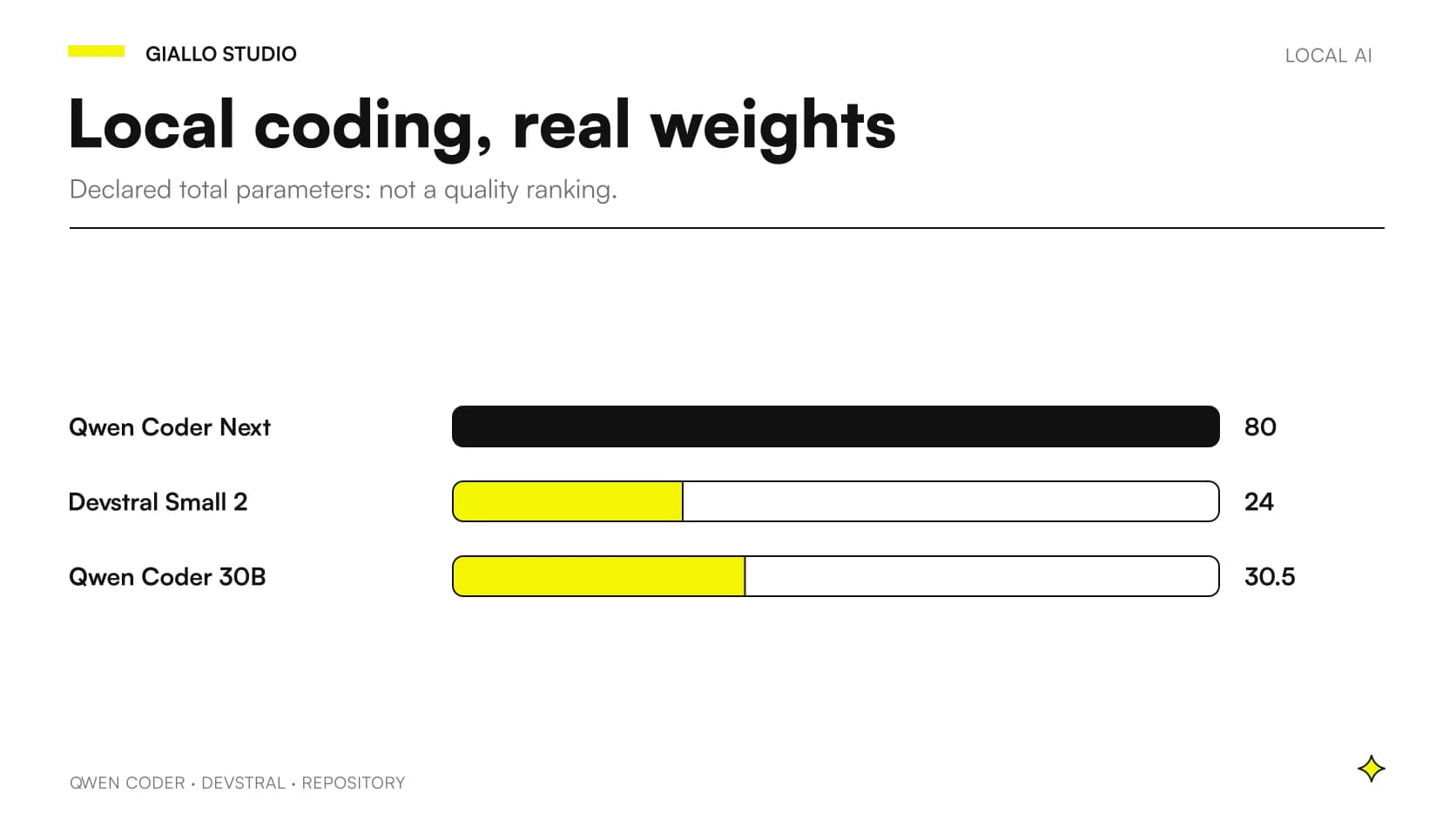
Give both the same tools and operating time, or explain configuration differences. If one edits unrelated files, disables tests or requests unnecessary credentials, record the problem even if the feature looks correct. Do not attribute benchmark figures from other Qwen models to the smaller checkpoint. For a programming-focused choice, also see Qwen3-Coder-Next vs Devstral Small 2 and the guide to AI models for programming.
What about technical data sheets and internal procedures?
Second hypothetical scenario: a company wants to answer questions about product sheets, component images and maintenance instructions. Here, text must connect to the correct source version. Vision in both models makes testing plausible, but does not prove accurate reading of every detail.
Prepare readable images and cases with an incomplete identifier. Include two procedures with different revisions and explicitly ask which applies. The system must show a reference and flag uncertainty when identification is impossible. If retrieval supplies the wrong sheet, record the pipeline error. The guide to local multimodal AI helps isolate page reading, information selection and answer generation.
What should you check in thinking and conversation history?
The cards describe settings for reasoning and conversation-context management. Qwen3.6 also offers an option to preserve reasoning from earlier messages; read each version’s documentation before reusing an integration. Source: Qwen3.6-35B-A3B, Qwen3.8-27B source.
For the pilot, checking only the first turn is insufficient. Test a user correction, withdrawal of an assumption and a replacement document. The system must update its answer without retaining the initial error as fact. Record how the runtime sends history and what is excluded as context grows. A regression here may appear to be a limitation of the new model while actually arising from the form of messages sent by the application.
Which migration is easier to verify?
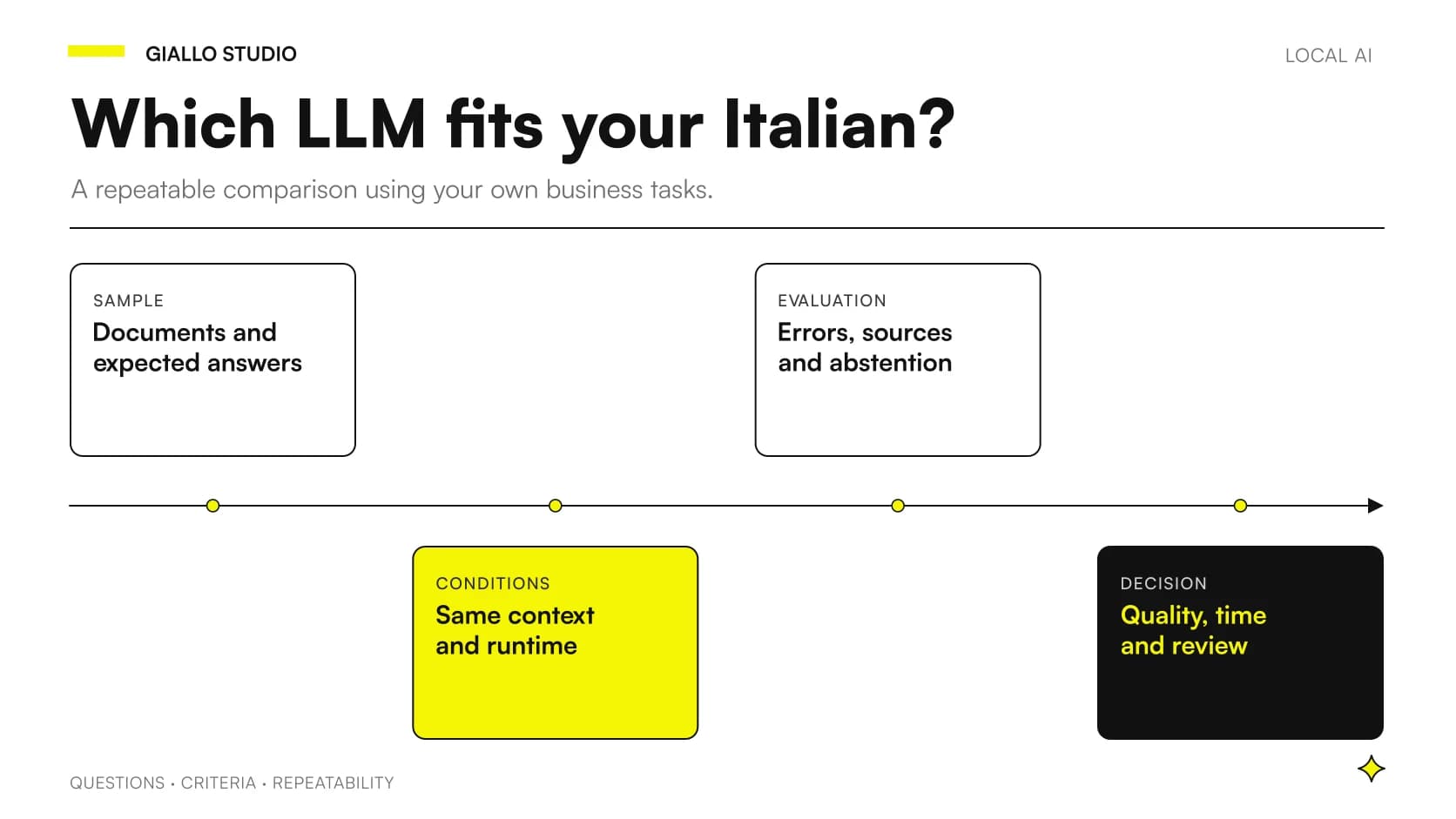
Keep the previous system available and prepare a test environment with the same authorized sources. Have the candidate process the sample without permission to write to live systems. Compare answers, errors and memory, then review cases where results diverge. Disagreement does not automatically mean the new model is wrong: you need a source to decide.
Define in advance when to proceed and when to revert to the previous configuration. It may be essential not to worsen cases involving amounts, codes or conflicting instructions, even if summaries improve. Keep the earlier weight revision and working settings. A rollback plan reduces the cost of a failed update, but does not replace testing: the owner must know which results motivated the decision and which limitations remain.
Also check contracts with downstream software. If the previous assistant returns structured fields, the new one must respect their names, types and meaning, or the integration must be explicitly updated. A correctly formatted code associated with the wrong item is not a successful migration. Use an independent validator and retain rejection reasons. When the system cannot answer, the application must also handle its abstention format: free text inserted into a numeric field can break the workflow without the model inventing data. Compatibility includes these error conditions.
Which mistakes make the new model appear better?
One is using slightly modified questions for the new checkpoint and comparing them with old answers obtained under different instructions. Another is selecting only successful examples while omitting interruptions or required corrections. A third is attributing an improvement from updated OCR or more precise retrieval to architecture.
Also avoid judging tone: greater confidence does not guarantee greater fidelity. Where possible, ask reviewers to see evidence and results before the model name. Keep the sample fixed, separating new cases used to improve prompts from those reserved for final verification. If you optimize and assess on the same set without disclosure, you risk choosing a system suited mainly to your examples.
Does a shared license mean the same data boundaries?
No. The official checkpoints compared here declare Apache 2.0, as shown in their cards and the 27B LICENSE. This does not describe the path taken by chats, images or tools. An application can use local inference while sending documents elsewhere for other steps.
During migration, recheck endpoints, logs, upload folders and backups. They may change alongside the engine, introducing a difference not visible in the model name. If the service must stay isolated, use a network test and authorized test content; do not rely on an interface label. For a map of components to check, read local AI and privacy: verifying offline operation. Tool-call permissions must also remain consistent with the user’s role.
When should you keep the already working model?
Which signs justify postponing migration?
The candidate fails essential cases, requires unplanned manual intervention, is unstable in the selected runtime or shows no useful advantage over the previous system. In these conditions, retain evidence, correct the identified problem and repeat the comparison before changing the service used by the team.
Keeping a checkpoint that meets workflow needs can be reasonable. Changing is worthwhile when the advantage is verifiable and integration cost sustainable. The criterion remains correctly completed work, not the need to always have the newest label.
For a comparison with another family, see Qwen3.8-27B vs Ministral 3 14B. If you are updating an assistant already used by colleagues, Giallo Studio designs AI agents with workflow controls, including regression tests and an operational rollback defined before release.
Giallo Studio guides: methodology and sources
How we apply it in the company
Related resources
Other direct comparisons
The same criteria applied to other model pairs.
- Qwen3.8-27B vs Ministral 3 14B: choosing local AI
- Qwen3-Coder-Next vs Devstral Small 2: local coding
- Qwen3.8-27B vs gpt-oss-20b: vision, text and memory
- RPA vs AI automation: differences, costs and when to use which
- Qwen3.8-27B vs Gemma 4 31B for local deployment
- Voice AI or chatbot: which channel to choose
- Qwen3.8-27B vs Gemma 4 26B A4B: dense or MoE?
- Subscription or custom AI: which makes sense?
- Custom business PWA: when it makes sense over off-the-shelf software
- DIY AI or agency: how to decide
- Perplexity vs Google: response with sources or link list
- Local AI vs cloud: comparing business costs
FAQ
Is Qwen3.8-27B a direct upgrade from Qwen3.6-35B-A3B?
They differ in architecture and size. The first is dense, the second MoE: switching requires checks on compatibility, memory and workflow quality.
Does Qwen3.6-35B-A3B have only 3B parameters?
No. The card states 35B total language parameters and 3B active per token, plus a vision component. The active figure does not represent all weights to manage.
What is the native context window of both models?
Both cards specify 262,144 native tokens. Documented extensions need appropriate configuration and do not guarantee the maximum on every hardware setup.
Which model uses less memory?
This needs checking on the actual format and workload. The 27B has fewer total language parameters, but quantization, encoder, cache and runtime affect memory requirements.
How should you verify migration between Qwen models?
Keep the previous system and test a fixed sample with sources and expected answers. Compare errors, memory and compatibility before changing the service used by the team.