
Qwen3.8-27B vs Gemma 4 26B A4B: dense or MoE?
Qwen3.8-27B vs Gemma 4 26B A4B: active parameters, memory, documents and testing. Assessing dense and MoE without false promises.
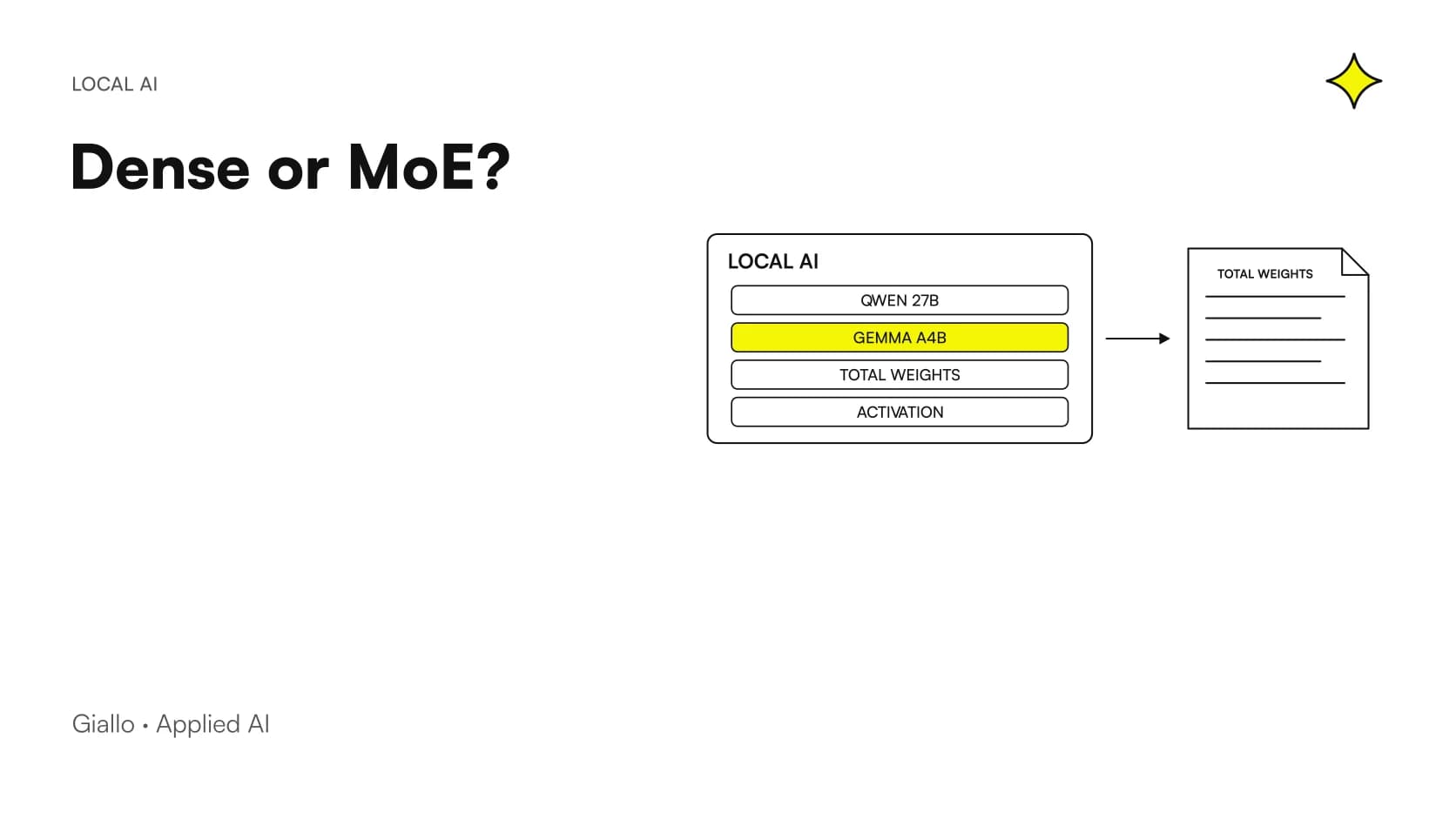
Qwen3.8-27B is dense; Gemma 4 26B A4B is an MoE that activates only some of its parameters for each token. This difference can change computation, but it does not establish that Gemma needs the memory of a 4B model or is always faster. Specifications are documented in the official cards from Qwen and Google, consulted on October 27, 2026.
This comparison is for people who want control over a model and need to decide how to use available memory. A useful answer separates three questions: how many weights to load, how much computation generation requires and which answers are correct in the workflow. These dimensions affect one another but are not interchangeable. Here you will find criteria and tests to set up, rather than a ranking based on measurements we have not performed.
In summary
- Qwen3.8-27B has a dense 27B language model with a vision encoder.
- Gemma 4 26B A4B specifies 25.2B total and 3.8B active parameters, plus the vision component listed in its card.
- Fewer active parameters do not remove the remaining weights that must be stored and made available.
- Actual memory usage also depends on format, cache, context and runtime.
- A valid comparison distinguishes capabilities, required resources and errors in business tasks.
What does dense mean for the 27B Qwen model?
In this comparison, dense means that the model does not select only a group of experts to perform computation in its language blocks. Qwen3.8-27B is described as a dense model with 27 billion parameters and a separate vision encoder. The commercial size label should therefore not be used as an exact count for the complete multimodal package. Source: Qwen3.8-27B card.
For business decision-makers, understanding this term helps avoid misleading comparisons. A “27B dense” and a “26B with around 4B active” do not necessarily perform the same work for each token, even if their totals look close. This does not automatically identify a winner: inference engine, memory and input data remain part of the evaluation. For general checkpoint characteristics, see the guide to running Qwen3.8-27B locally.
What does A4B mean in the Gemma name?
In Gemma 4 26B A4B, A refers to active parameters. The official Google card lists 25.2B total, 3.8B active, a vision encoder of around 550M and a pool of experts from which a subset is selected per token. This architecture distinguishes the variant from dense Gemma 4 31B.
The model retains the ability to route different tokens to different experts. Selection reduces active computation, not checkpoint size to the A4B figure. A specification sheet must therefore list both total and active parameters. If a supplier presents a system as “4B” while omitting the rest, ask which file it loads, where the weights reside and how much memory remains free when the service is ready to answer.
Which specifications can we compare without inference?
Both checkpoints declare text and vision capabilities and Apache 2.0 licensing. Qwen documents 262,144 native tokens; Gemma specifies 256K for the 26B A4B variant. The Google model covered here does not have the native audio input listed for other Gemma 4 sizes. Sources: Qwen, Google.
| Criterion | Qwen3.8-27B | Gemma 4 26B A4B |
|---|---|---|
| Architecture family | Dense | Mixture of Experts |
| Stated language parameters | 27B | 25.2B total / 3.8B active |
| Vision component | Present | Present, approximately 550M |
| Stated native context | 262,144 tokens | 256K tokens |
| Native audio input | Not specified for this checkpoint | Not present |
| Full memory usage during execution | To be measured on the workload | To be measured on the workload |
| Quality on business procedures | To be verified | To be verified |
The table describes the starting point. The final two rows require testing and cannot be derived from the earlier ones.
Why does an MoE need more than the active experts’ memory?
Experts not selected for one token may be needed for the next. The system must therefore store them and make them accessible through device memory or a transfer mechanism supported by the runtime. Moving some weights elsewhere changes execution; it does not make them disappear.
This distinction matters when considering a machine with limited memory. You cannot estimate Gemma 4 A4B loading by multiplying only 3.8B by the quantization bit width. Start with the full package actually distributed, then add other required resources. The guide to GGUF, Q4 and Q8 quantization explains why even two files described as “4-bit” may differ in size and behavior. An MoE label alone will not rescue a test that fails on a long document.
Which memory estimates are available for Gemma?
In the Gemma 4 documentation, Google estimates approximately 57.7 GB BF16, 28.8 GB SFP8 and 14.4 GB Q4_0 for loading the 26B A4B variant, including an indicative 20% overhead. The page states that figures may change with the environment and tool. This is manufacturer-estimated memory, not a Giallo Studio test.
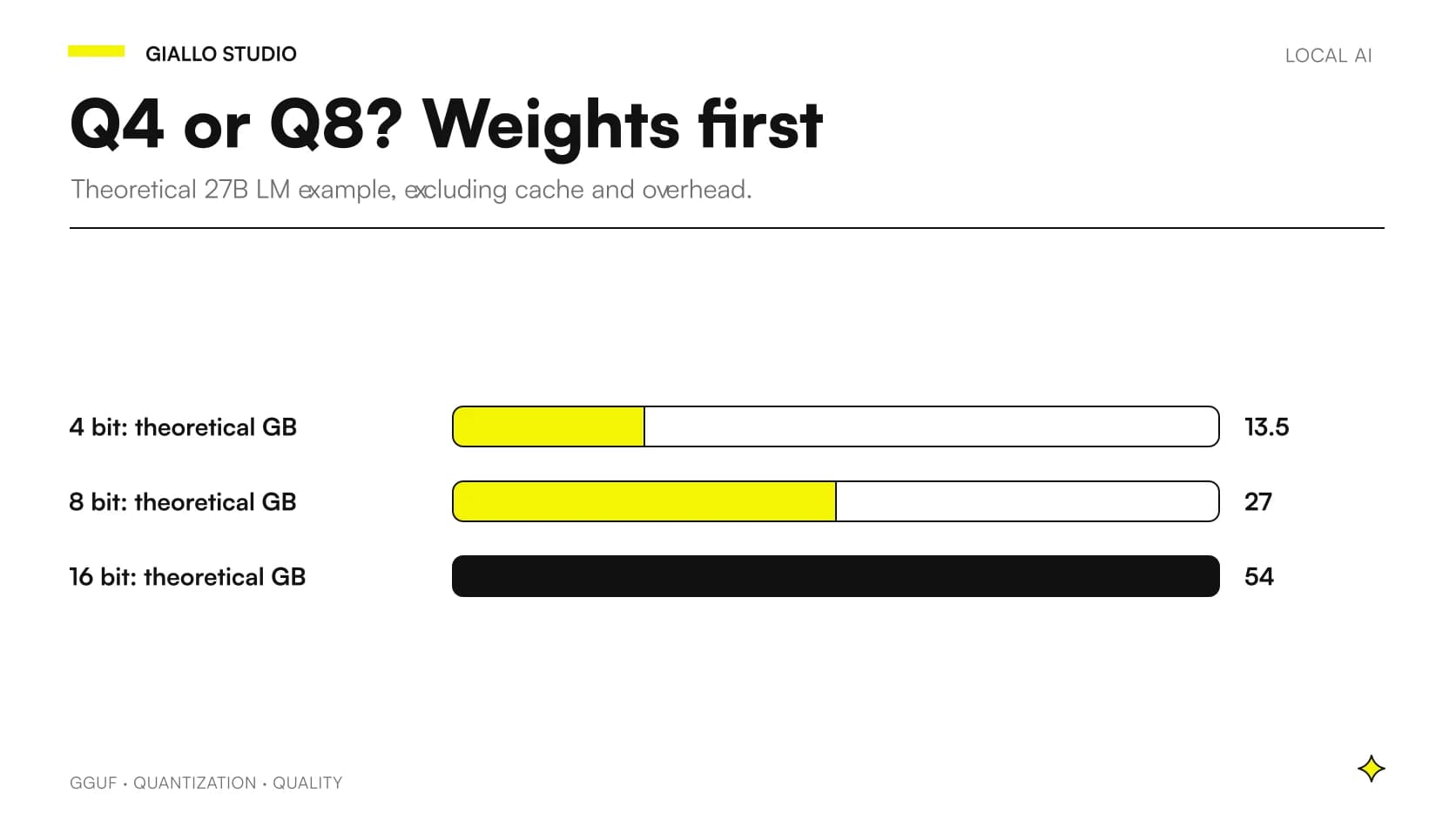
For Qwen3.8-27B, a theoretical calculation covering only its 27B language weights at 4 bits gives around 13.5 decimal GB. The scope differs: it does not include everything the system needs and is not directly comparable with Google’s estimate. Before buying, observe the actual file under the same context and pipeline. The guide to Qwen RAM and VRAM requirements separates these levels of calculation.
Does an MoE always respond faster?
We cannot promise that for a configuration we have not measured. Active parameter count describes part of the computation, while perceived time also depends on implementation, hardware, transfers, input length and generated output. Google’s documentation presents the architecture as designed for efficient execution; this is a characteristic to check in your environment, not a universal tokens-per-second figure. Source: Gemma 4 architecture.
Separate measurement into loading, input preparation, first token and completion. A request containing a photograph may have a different profile from a short question. Also assess correct answers over an operating interval: faster generation that often needs repeating can make the department’s work worse. Do not combine all these conditions into a context-free number.
How does the comparison change with very long documents?
The stated context describes the supported window, not a guarantee that all evidence will be used correctly. A document can contain extensive repetition, conflicting attachments or obsolete instructions. Comparison quality depends on identifying the relevant passage without hiding inconsistencies.
Use one question whose answer is at the start of the document, another in the middle and another near the end; also include an unanswerable request. Keep text preparation stable. Qwen also documents context extension, but it should not be enabled indiscriminately: the configurable maximum is not the pilot’s objective. Qwen source. To consult a complex archive, consider local RAG for business documents, preserving the date and version of every source.
What test is useful for a quality-management archive?
Hypothetical scenario: a manufacturing company wants to query quality procedures, work instructions and nonconformity reports. The aim is not a long answer, but establishing which documents govern the case and what information is missing. The test must include a valid procedure and an earlier version with the same title.
Ask both models to provide an answer, source, revision and any uncertainty. Have the quality manager assess results without initially seeing the model name. If one systematically confuses withdrawn documents, that problem matters more than good answers to simple questions. After choosing, keep the sample as a regression test: when updating weights or runtime, repeat cases that previously caused difficulties.
What test is useful for a sales network?
Second hypothetical scenario: a small sales network wants to prepare product answers using authorized technical data sheets and price lists. The critical capability is distinguishing an available feature from an option, current availability from historical information and an approved price from an unrestricted calculation.
Build cases where the requested product is missing from the price list and where a photograph shows only part of a label. The system must request the missing information, rather than fill it in by analogy. Also verify that the assistant does not automatically turn a draft into a quotation sent to the customer. A local model can help prepare work, but external actions require permissions and controls in the surrounding software. Dense or MoE architecture does not define those boundaries.
How do you avoid a comparison biased by settings?
Keep a record of checkpoint revisions, conversions, quantization, runtime and machine. Decide whether to compare manufacturers’ recommended configurations or those fitting the same operating constraint; either test can be useful if declared. Do not give one model reduced context and the other all necessary sources, then attribute the difference to architecture.
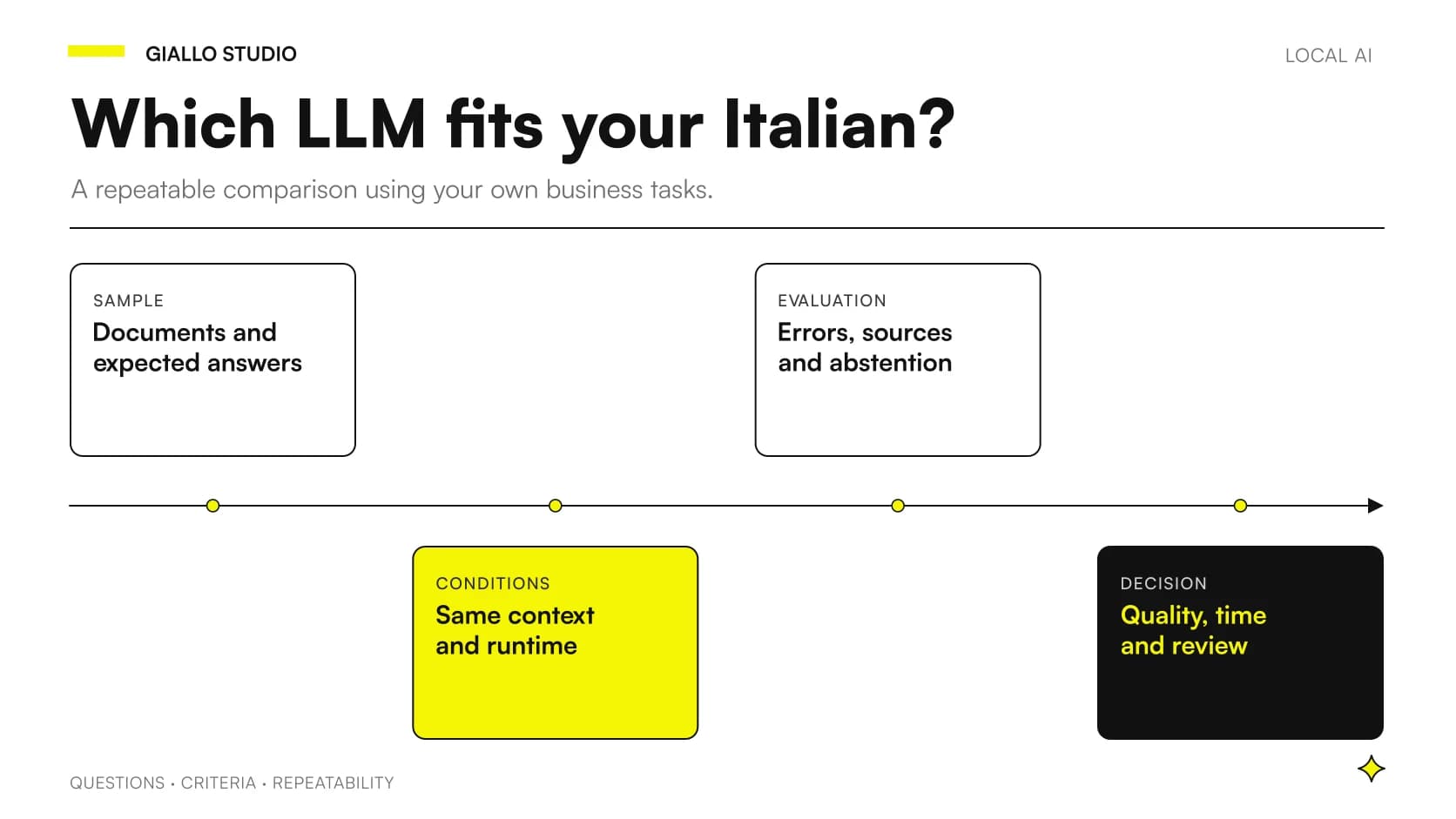
Response budget matters too. An answer interrupted before its conclusion may be unusable even if it identified the evidence correctly. Record truncations, repeated attempts and manual corrections. The protocol for comparing local LLMs in Italian helps separate correct outcomes, appropriate abstention and invented answers. Choose the rules before reading results, so the test remains open to scrutiny and repeatable.
Which costs remain beyond computation per token?
Architecture does not summarize service cost. Consider hardware purchase or availability, updates, archive integration, monitoring and staff support. If the system frequently needs intervention to correct sources or restart the runtime, lower theoretical computation per token is not enough to make it sustainable.
Calculate cost per outcome accepted by the workflow, keeping human correction separate. An economic comparison must use volumes and hours from your actual case, or explicitly state that it is simulating a scenario. The article local AI vs cloud and business costs lists items to connect to the quotation. We do not include current GPU prices or payback periods here, because without a machine, usage level and energy tariff those figures would have no basis.
Which interpretation errors should you recognize immediately?
“Four billion active, so four gigabytes is enough” confuses parameters, precision and resources. “Twenty-seven is greater than twenty-six, so Qwen is better” treats total parameters as a quality score. “Both Apache, so all components are free and usable in the same way” improperly extends licensing to interfaces, services and derivatives.
Check the Qwen LICENSE and the license linked from the Gemma 4 card. Family and generation matter: do not transfer Gemma 3 terms to Gemma 4 or the 27B terms to another Qwen. For data, even local inference can be accompanied by remote OCR or search: the documents’ entire path must be checked.
To isolate dense versus MoE within the same family, continue with Qwen3.8-27B vs Qwen3.6-35B-A3B. That comparison focuses on a possible checkpoint change: first measure memory, then check regressions on a sample from your own workflow.
When should you choose either as the first candidate?
How can you order the pilot without declaring a winner?
Start with the model already compatible with your environment, if it meets required input modalities and licensing. Then prepare the same sample for the alternative, measure memory and quality, and record errors that block the workflow. If you are specifically assessing the dense/MoE trade-off, make changes in resources and settings explicit.
Gemma 4 26B A4B is worth testing when you want to evaluate its balance between total weights and active computation; Qwen3.8-27B when the dense checkpoint and its multimodal path match your project. The outcome should remain a choice explained by evidence, not an absolute claim about the best local model.
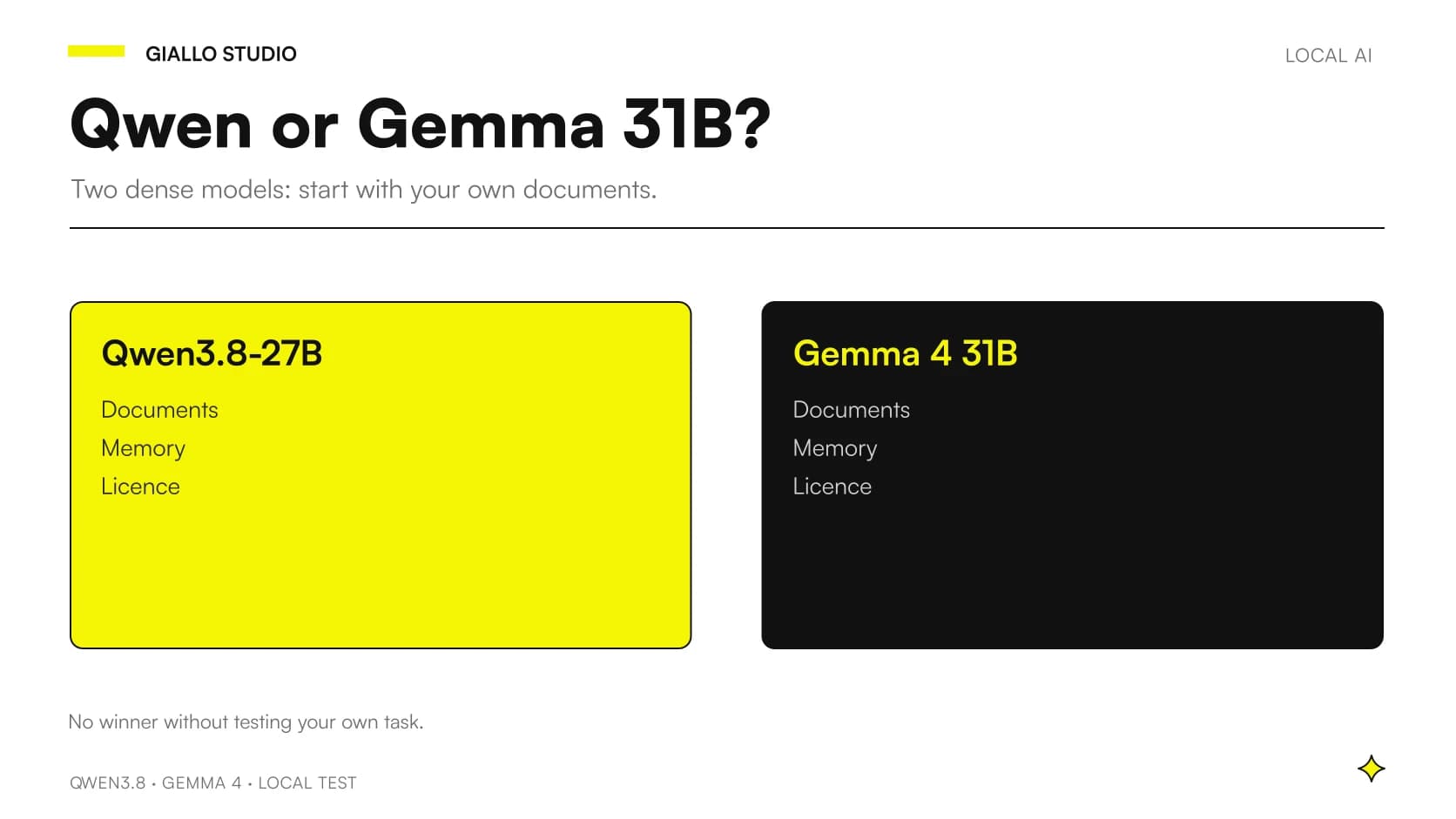
To compare two dense models, see Qwen3.8-27B vs Gemma 4 31B. To build a pilot with documents, metrics and access boundaries, Giallo Studio develops custom AI software: the starting point is a work-related question the team can verify.
Giallo Studio guides: methodology and sources
How we apply it in the company
Related resources
 Qwen3.8-27B vs Qwen3.6-35B-A3B: local AI trade-offs
 Qwen3.8-27B locally: capabilities, limits and requirements
 Qwen3.8-27B vs Gemma 4 31B for local deployment
 GGUF quantization: Q4 or Q8 for local LLMs?
 Local RAG for business documents: a practical design
 Local LLMs in Italian: comparing without misleading tests
Other direct comparisons
The same criteria applied to other model pairs.
- Custom business PWA: when it makes sense over off-the-shelf software
- Qwen3.8-27B vs Gemma 4 31B for local deployment
- Perplexity vs Google: response with sources or link list
- Qwen3.8-27B vs gpt-oss-20b: vision, text and memory
- Claude Opus 5 vs Sonnet 5
- Qwen3.8-27B vs Ministral 3 14B: choosing local AI
- Claude Opus 5 vs GPT-6 Astra
- Qwen3.8-27B vs Qwen3.6-35B-A3B: local AI trade-offs
- Claude Opus 5 vs Gemini 3.1 Pro
- Qwen3-Coder-Next vs Devstral Small 2: local coding
- Claude Opus 5 vs Fable 5.1
- RPA vs AI automation: differences, costs and when to use which
FAQ
How do Qwen3.8-27B and Gemma 4 26B A4B differ?
Qwen is a dense 27B language model with a vision component. Gemma 4 26B A4B uses MoE: its card specifies 25.2B total and 3.8B active parameters, plus the listed vision encoder.
Does Gemma 4 A4B need the memory of a 4B model?
No. Active parameters describe the work selected per token, while the complete weights must be stored and made available by the system.
Does MoE mean the model is always faster?
No. Actual speed also depends on hardware, runtime, format, transfers and request type. It must be measured in the intended configuration.
Which is better for business documents?
You need a sample of representative documents and expected answers. Evidence accuracy, version handling and abstention when a source is missing are what matter.
Are both licensed under Apache 2.0?
Yes, the official checkpoints considered here declare Apache 2.0. Check the terms of conversions, applications and services you will use separately.