
Qwen3.8-27B vs Gemma 4 31B for local deployment
Qwen3.8-27B vs Gemma 4 31B: images, documents, context and memory. Verifiable criteria for choosing a local business model.
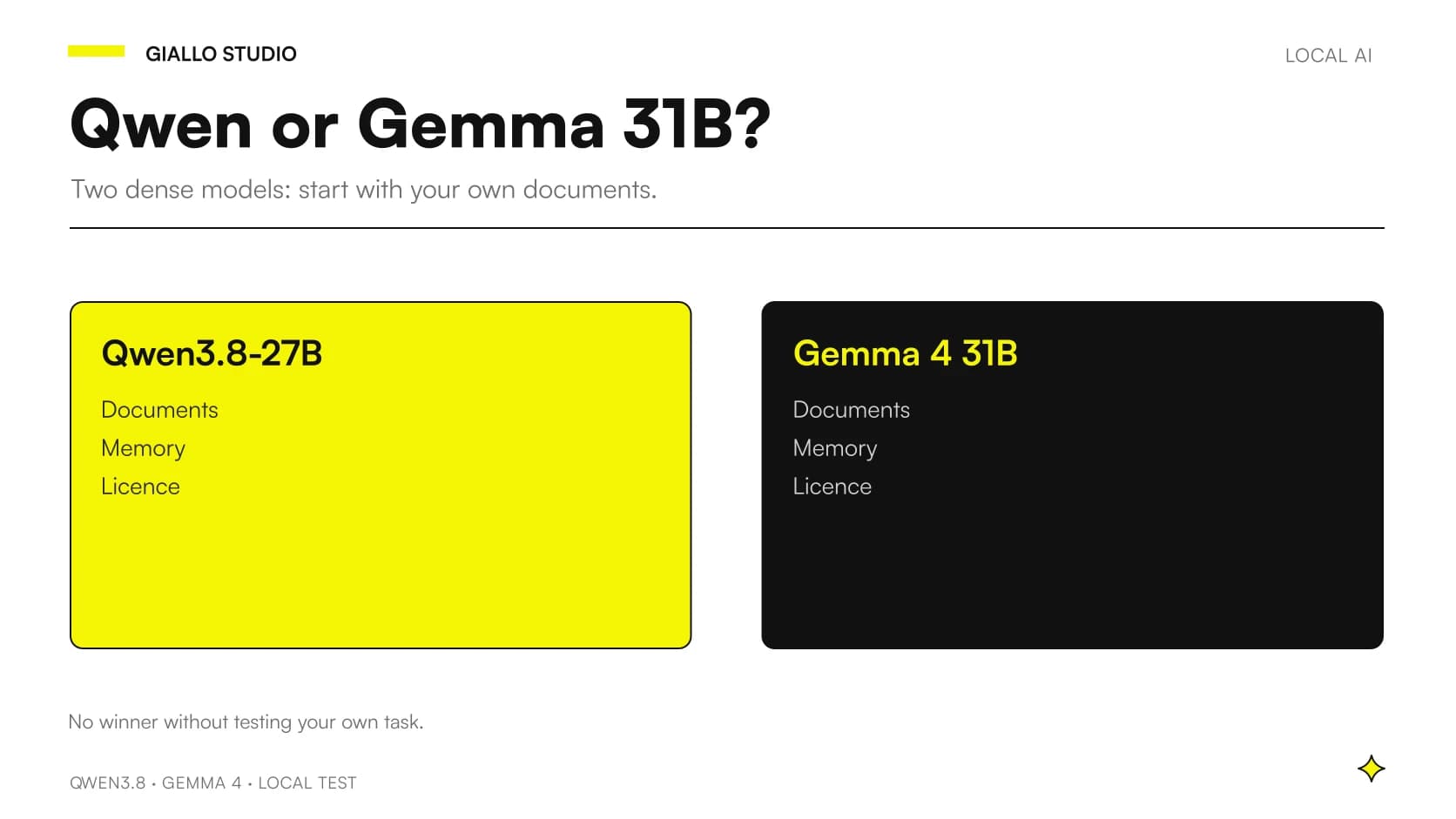
Qwen3.8-27B and Gemma 4 31B are two candidates for a local assistant that needs to understand text and images; we have no measured winner on your documents. The useful differences emerge by comparing checkpoints, memory, source handling and quality in the actual workflow, rather than just parameter counts. Specifications come from the official cards published by Qwen and Google DeepMind, consulted on October 27, 2026.
Both let you control the version running on your own hardware. This can help a small or medium-sized business build a verifiable document assistant, provided the components preparing documents and retrieving information are also local. Choosing the model is part of that project: it does not replace archive organization, permissions or answer verification.
In summary
- Qwen3.8-27B and Gemma 4 31B use dense architectures and understand images.
- Qwen specifies 262,144 native tokens; Gemma 4 31B specifies 256K.
- Gemma 4 31B does not include the audio input available in other Gemma 4 sizes.
- For both, a comparison must specify the weight format, runtime and actual context window.
- The decision depends on which errors the workflow can tolerate, as well as available memory.
Which versions are we comparing?
The first model is the official checkpoint Qwen/Qwen3.8-27B, with a dense 27B language model and a vision encoder. The second is Gemma 4 31B, which Google describes as 30.7B dense, with a vision encoder of approximately 550M parameters. These figures are published by the respective manufacturers: their scope needs careful reading. Sources: Qwen, Gemma 4 model card.
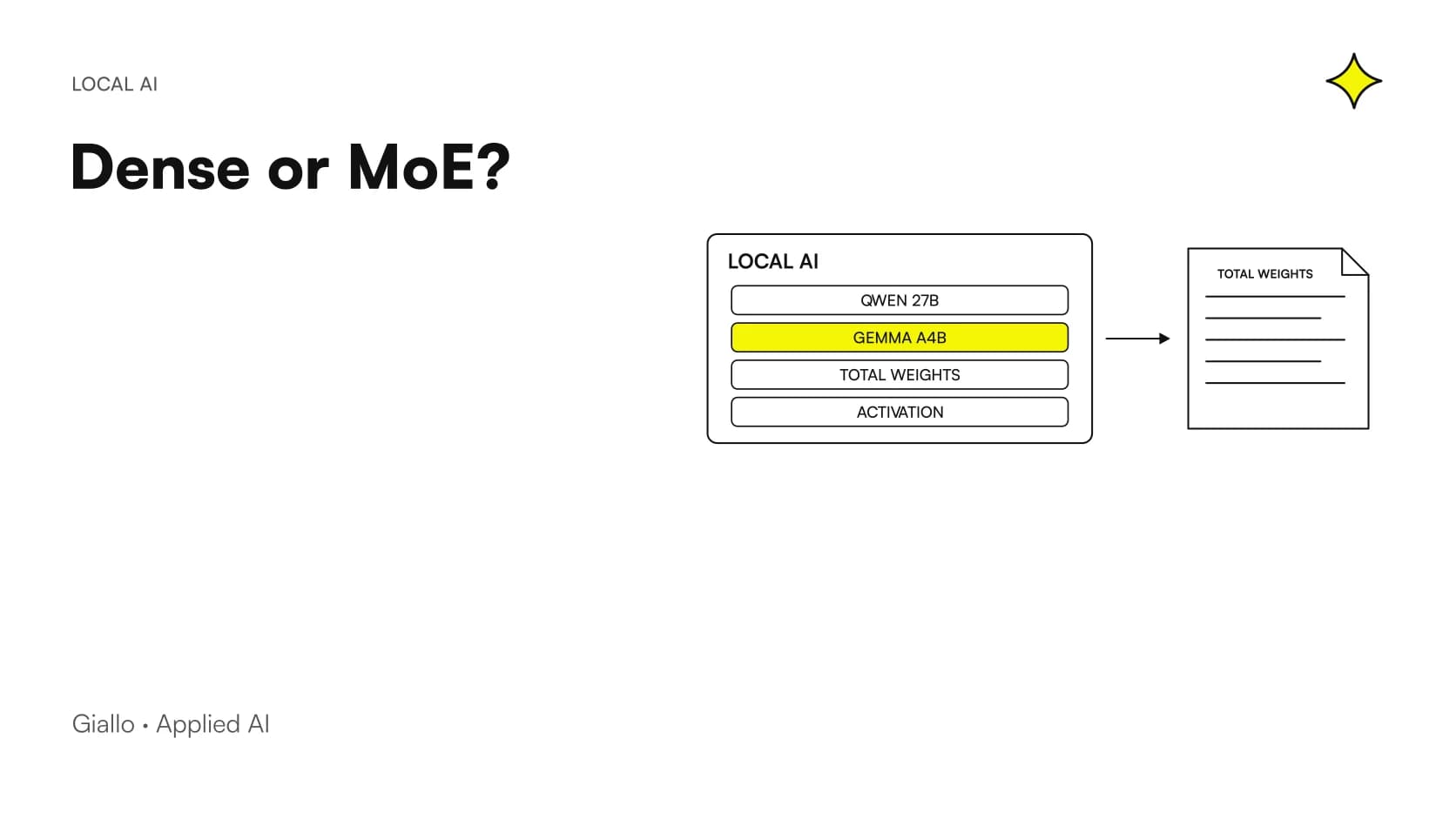
We are not comparing Qwen3.8-Max or Gemma 3 27B. Gemma 4 26B A4B is also a different variant, with a MoE architecture: that comparison is covered in the guide Qwen3.8-27B vs Gemma 4 26B A4B. Recording the full name avoids decisions based on results obtained with different weights.
Which differences are already documented?
The table summarizes stated specifications without turning them into a quality ranking. Qwen describes image and video understanding; for Gemma 4 31B, the modalities table lists text and images, with text output. Capabilities of other Gemma sizes should not be attributed to it by association. Qwen card, Google card.
| Criterion | Qwen3.8-27B | Gemma 4 31B |
|---|---|---|
| Language architecture | Dense | Dense |
| Stated size | 27B language model | 30.7B dense |
| Vision component | Vision encoder | Vision encoder, approximately 550M |
| Stated native context | 262,144 tokens | 256K tokens |
| Native audio for this variant | Not specified in the card as an input modality | Not present |
| Checkpoint license | Apache 2.0 | Apache 2.0 |
| Results on your documents | To be verified | To be verified |
The final row is decisive. A specification may rule out an unsuitable model; on its own, it rarely proves which will handle your archive better.
Does a larger model mean better answers?
No: parameter count does not directly measure the accuracy of a business answer. For this decision, it is more useful to ask whether the model finds the right passage, distinguishes conflicting versions and stops when evidence is missing. Even a more detailed answer can harm the workflow if it introduces information absent from the source.
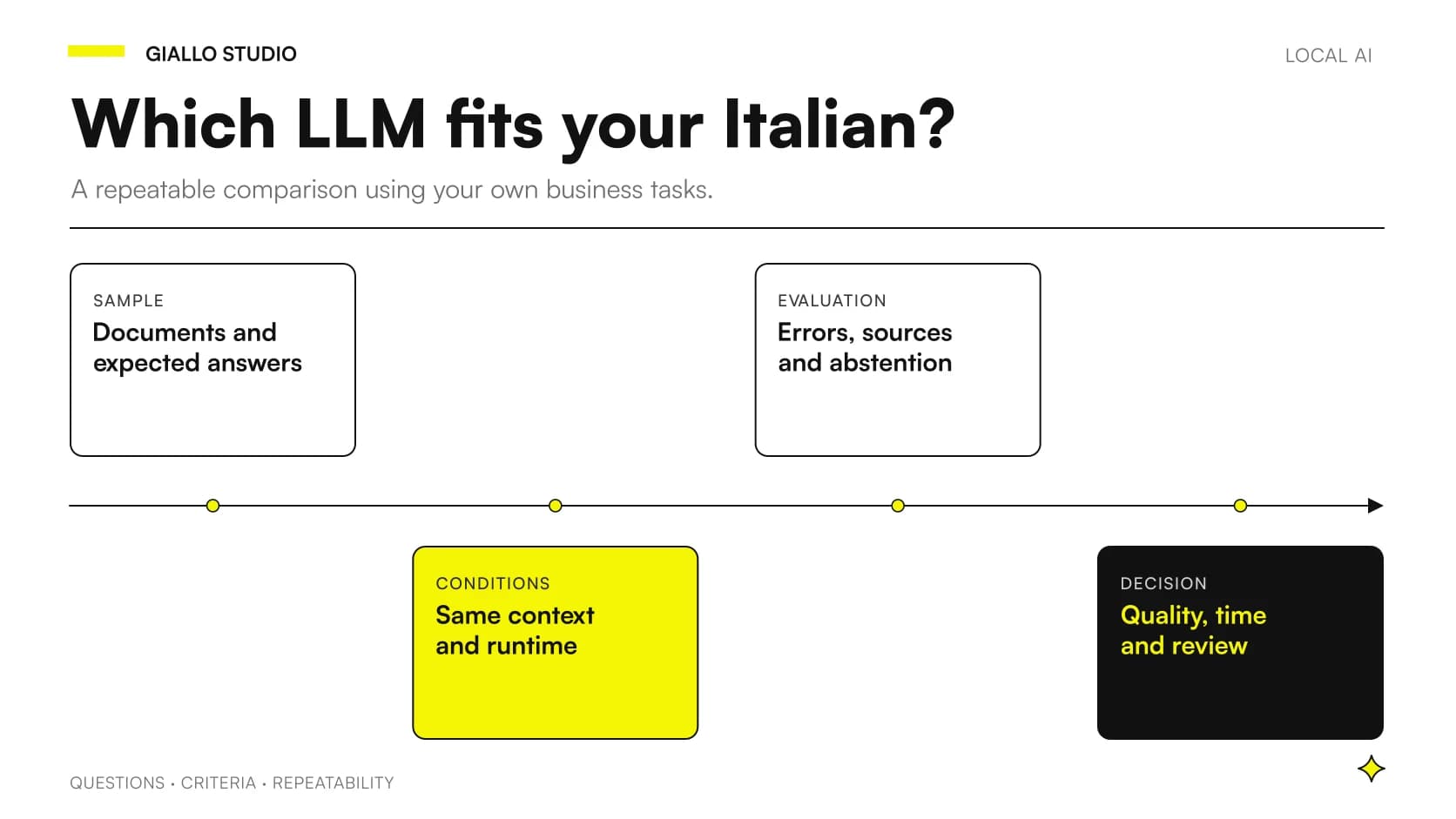
Manufacturers publish benchmarks with specific methods and objectives. We do not combine them into an overall score or present them as Giallo Studio tests. If a metric looks relevant, record the benchmark name, version, configuration and permitted tools. For the operational decision, then build an authorized internal sample: manuals actually used, recurring questions and expected answers agreed with people who know the work.
How much do weights contribute to memory usage?
For Qwen, 27B parameters at 4 bits theoretically amount to around 13.5 decimal GB of language weights alone. This excludes the encoder, quantization scales, cache and buffers, and is not a sufficient requirement. Memory for a quantized file must be checked against the actual format, rather than inferred solely from its name.
For Gemma 4 31B, Google publishes loading estimates of approximately 69.9 GB BF16, 34.9 GB SFP8 and 17.5 GB Q4_0, including an indicative 20% overhead. These are environment-dependent manufacturer estimates; they are not measurements from our testing or a promise of full-context operation. Source: Gemma 4 overview.
Do not directly compare Qwen’s theoretical 13.5 GB with Gemma’s estimated 17.5 GB as if they covered identical components. To explore the method, read how much RAM and VRAM Qwen3.8-27B needs.
Does similar context capacity mean the same experience?
The stated native windows are similar in scale, but that does not guarantee identical memory usage or quality on distant passages. Architecture, engine and cache format affect execution. Qwen also documents a configurable context extension to one million; this should not be confused with immediate availability of that capacity on any machine. Qwen source.
For a document assistant, first assess how much material really needs to enter each request. A large archive can be consulted by retrieving relevant passages, as explained in the guide to local RAG for business documents. Filling the entire window with superseded documents makes errors harder to diagnose and can waste resources without improving the answer.
How should you compare PDF and table reading?
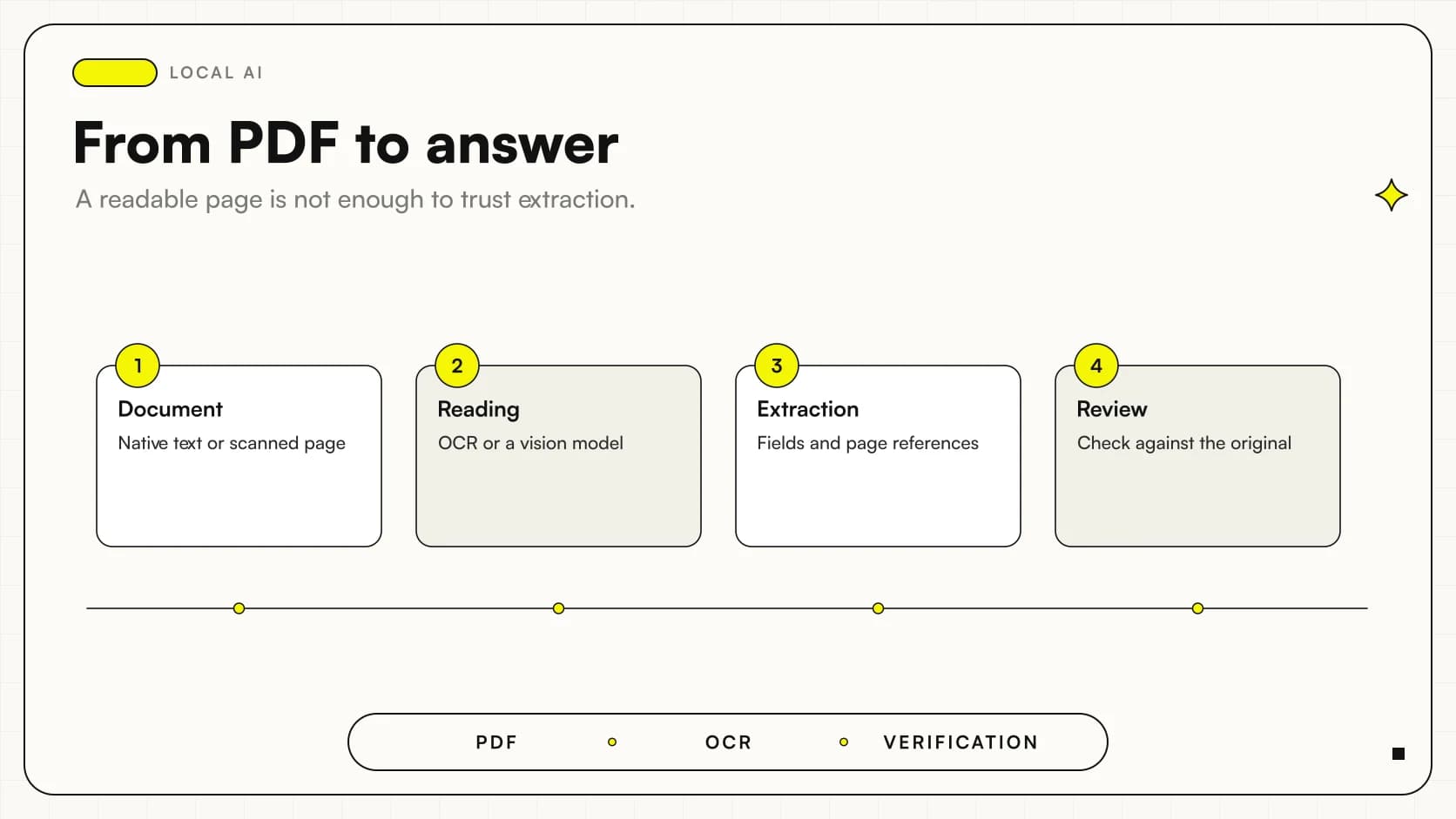
Use the same original document and check which representation each model receives. If Qwen sees the page image while Gemma receives only extracted text, you are comparing two pipelines, not just two models. That can be useful when choosing a complete product, but it must be stated in the test record.
Prepare documents with different characteristics: clean text, tilted scans, tables with merged cells and footnotes. Ask for specific fields and verifiable references. In a specification document, for example, a note may change the meaning of a table row: a simple list of extracted values is not enough. The guide to local multimodal AI for PDFs and images explains how to separate preparation, recognition and answer errors.
Which model should you choose for internal technical support?
Hypothetical scenario: a small or medium-sized business receives requests from its maintenance department and wants to suggest the correct procedure. The sample should include faults with similar descriptions, different machine models and withdrawn instructions. The expected result is a documented path with references, rather than a confident autonomous diagnosis.
Have both models answer using the same sources, and ask a technical specialist to assess the results. Record device identification errors, missing instructions, incorrect citations and failures to abstain separately. Define in advance which errors disqualify the system. If a potentially dangerous answer is hidden by a high overall average, the metric is not representing the workflow’s risk. The selected model should improve consultation while keeping the technician responsible for verification.
What changes for a purchasing department?
Second hypothetical scenario: a purchasing department compares quotations received as PDFs. Here, the model must distinguish price, quantity, terms, exclusions and supplier references. A phrase such as “shipping included” can be wrong even when all amounts were transcribed correctly.
Ask for a table linking every difference to its source, with a column for information not specified. Include a quotation using different units or an attachment changing the original terms. The person responsible must be able to verify the result without searching the entire archive again for every sentence. Compare not only correct data, but also the work required to check it. Do not claim time savings before actually measuring them on a representative workflow.
How should you assess Italian, abstention and instructions?
A useful language test goes beyond grammar and style. Check whether the model preserves technical names, interprets negation correctly and distinguishes an obligation from a possibility. Also use requests written in colleagues’ actual language, with abbreviations and incomplete references. The system should ask for clarification when a reference changes the answer’s meaning.
To assess abstention, prepare questions unanswered by the material, requests involving a missing version and genuinely contradictory passages. A partly correct answer with an invented conclusion must remain identifiable as an error. The guide to benchmarking local LLMs in Italian offers a reusable evaluation structure. The comparison must distinguish a model error from one caused by missing or poorly retrieved sources.
Also evaluate the output format. If an answer must enter business software, readable prose is not enough: you need recognizable fields and rules for flagging unknown values. Provide validation outside the model that can reject an impossible date or a code absent from the catalog. The comparison should count answers accepted by the validator and distinguish those correct only after manual correction. Do not let a field filled with a plausible string be mistaken for verified data.
Which settings need to remain comparable?
Record the machine, runtime, model revision, weight format, context, instructions and documents. Where options do not align perfectly, document the difference. For example, a comparison allowing extended reasoning for only one model may describe a plausible product choice, but it does not demonstrate superiority independent of generation budget.
You do not need to force identical numerical settings when manufacturers recommend different configurations; you do need to explain the chosen criterion. You can run one test using recommended configurations and another under the company’s actual constraint, such as available memory and acceptable wait. Each result must remain associated with its conditions. Avoid changing the model, prompt and PDF preparation simultaneously: you would lose the explanation for any improvements.
Also measure the complete experience: opening the document, preparation, waiting for the first content and completion of the answer. Fast generation does not necessarily compensate for lengthy initial processing. Report these times only after observing them, separating cold starts from an already loaded model. For an office with few daily requests, the first condition may be common; for an always-on service, stability under multiple requests may matter more. These are distinct operating situations, not two ways of presenting the same figure.
Do the licenses allow business use?
Both checkpoints considered here declare Apache 2.0. For Qwen, check the official license file; for Gemma 4, the link is in the Google model card. Terms for any commercial applications and downloaded derivatives still need to be read separately.
The license does not determine where data travels. An application can host the model on the computer while using remote services for OCR, search, telemetry or backups. The operational comparison must therefore include the documents’ path, not just the executable producing the answer. The guide to local AI, privacy and offline operation lists the checks to connect to an actual network test.
Which shortcuts lead to the wrong choice?
One shortcut is choosing the most elegant prose. Another is selecting a model because it loaded once, without testing a long document or a second concurrent request. Comparing “Q4” and “8-bit” as complete descriptions also hides differences in format and conversion.
Avoid samples made up only of public cases already available online: they may not represent your working language. Do not select cases after seeing which model handles them better. Define the sample, error criteria and threshold before reading the results. Keep difficult cases discovered during use separately and add them to future tests: this allows a checkpoint update to be checked against concrete problems already encountered, rather than starting again with an improvised chat.
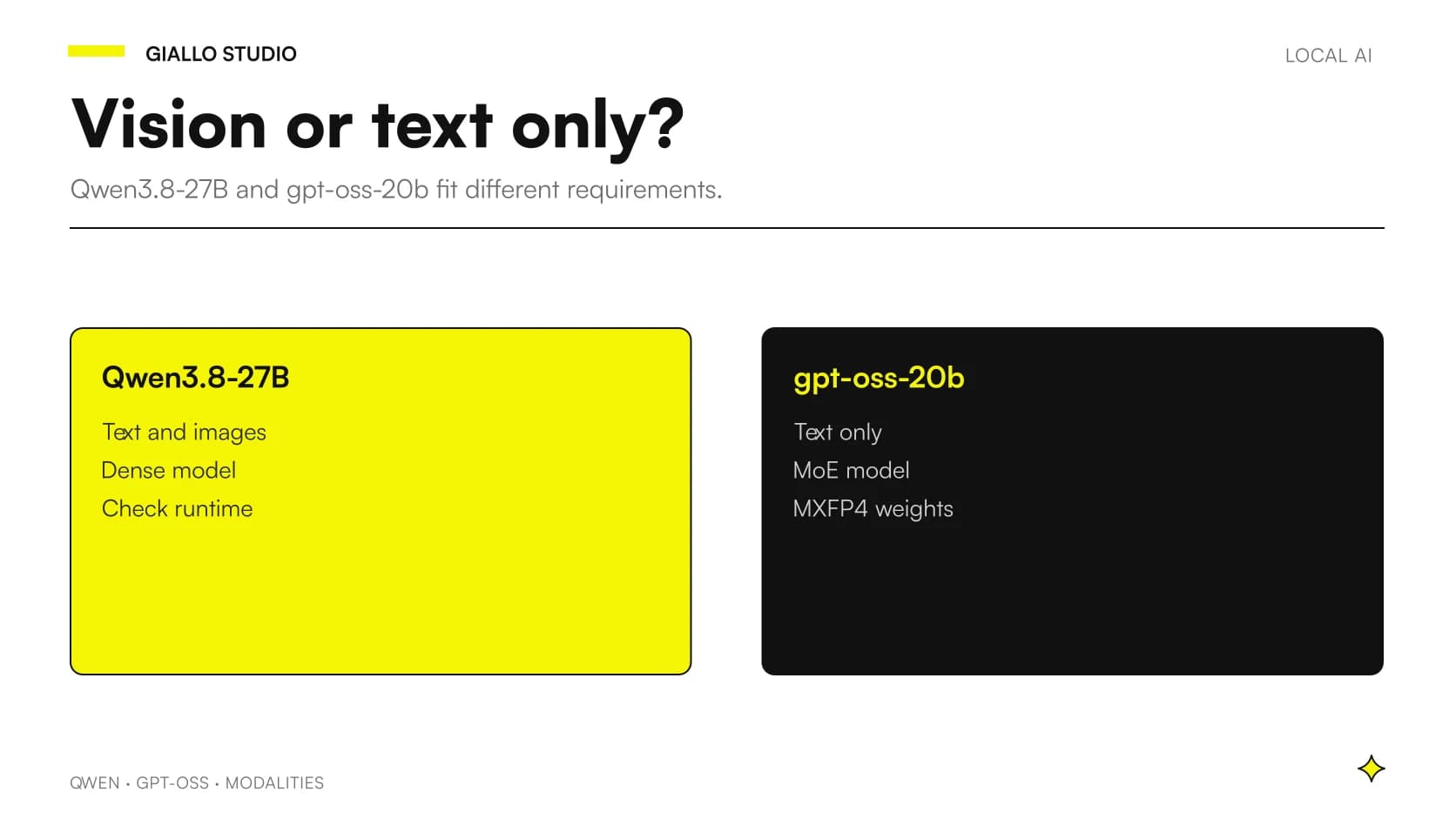
For a text-only workflow, consider another alternative: the comparison between Qwen3.8-27B and gpt-oss-20b distinguishes visual support, architecture and weight format. It helps narrow the candidates before investing in a document pipeline.
How can you reach a reasoned decision?
Test Qwen3.8-27B first
- You specifically want to evaluate the Qwen checkpoint and its multimodal path.
- You already have a compatible integration and can control conversion, context and sources.
Test Gemma 4 31B first
- Your environment already supports the Google variant and its formats.
- The memory estimates fit a machine that still needs checking on the actual workload.
These are criteria for ordering the tests, not performance verdicts. If neither passes essential checks, consider another model or narrow the delegated task; workflow correctness comes before preference for a family.
For a more compact alternative, read Gemma 4 12B vs Ministral 3 14B. To build a comparison using your manuals or supplier quotations, Giallo Studio designs an AI consulting pilot starting with sources, questions and criteria your team can verify.
Giallo Studio guides: methodology and sources
How we apply it in the company
Related resources
Other direct comparisons
The same criteria applied to other model pairs.
- Qwen3.8-27B vs Gemma 4 26B A4B: dense or MoE?
- Qwen3.8-27B vs gpt-oss-20b: vision, text and memory
- Custom business PWA: when it makes sense over off-the-shelf software
- Qwen3.8-27B vs Ministral 3 14B: choosing local AI
- Perplexity vs Google: response with sources or link list
- Qwen3.8-27B vs Qwen3.6-35B-A3B: local AI trade-offs
- Claude Opus 5 vs Sonnet 5
- Qwen3-Coder-Next vs Devstral Small 2: local coding
- Claude Opus 5 vs GPT-6 Astra
- RPA vs AI automation: differences, costs and when to use which
- Claude Opus 5 vs Gemini 3.1 Pro
- Voice AI or chatbot: which channel to choose
FAQ
Is Qwen3.8-27B or Gemma 4 31B better?
There is no verified winner for every use case. The choice requires testing the same documents while recording configuration, errors, references and actual memory usage.
Does Gemma 4 31B understand audio?
The 31B variant specifies text and image inputs and text output. Native audio in the family applies to other sizes, such as E2B, E4B and 12B.
Are both models MoE?
No, Qwen3.8-27B and Gemma 4 31B are dense variants. Gemma 4 26B A4B is a separate MoE variant.
Which requires less memory?
Comparing names is not enough. You must consider the actual weight format, quantization, cache, context and runtime; theoretical estimates are not sufficient requirements.
Can I use them locally with business documents?
Yes, with compatible infrastructure. You must also check PDF preparation, document retrieval, permissions and external services used by the application.