
Qwen3.8-27B vs Ministral 3 14B: choosing local AI
Qwen3.8-27B vs Ministral 3 14B: size, memory, images and business tasks. Choosing without inventing speed figures or requirements.
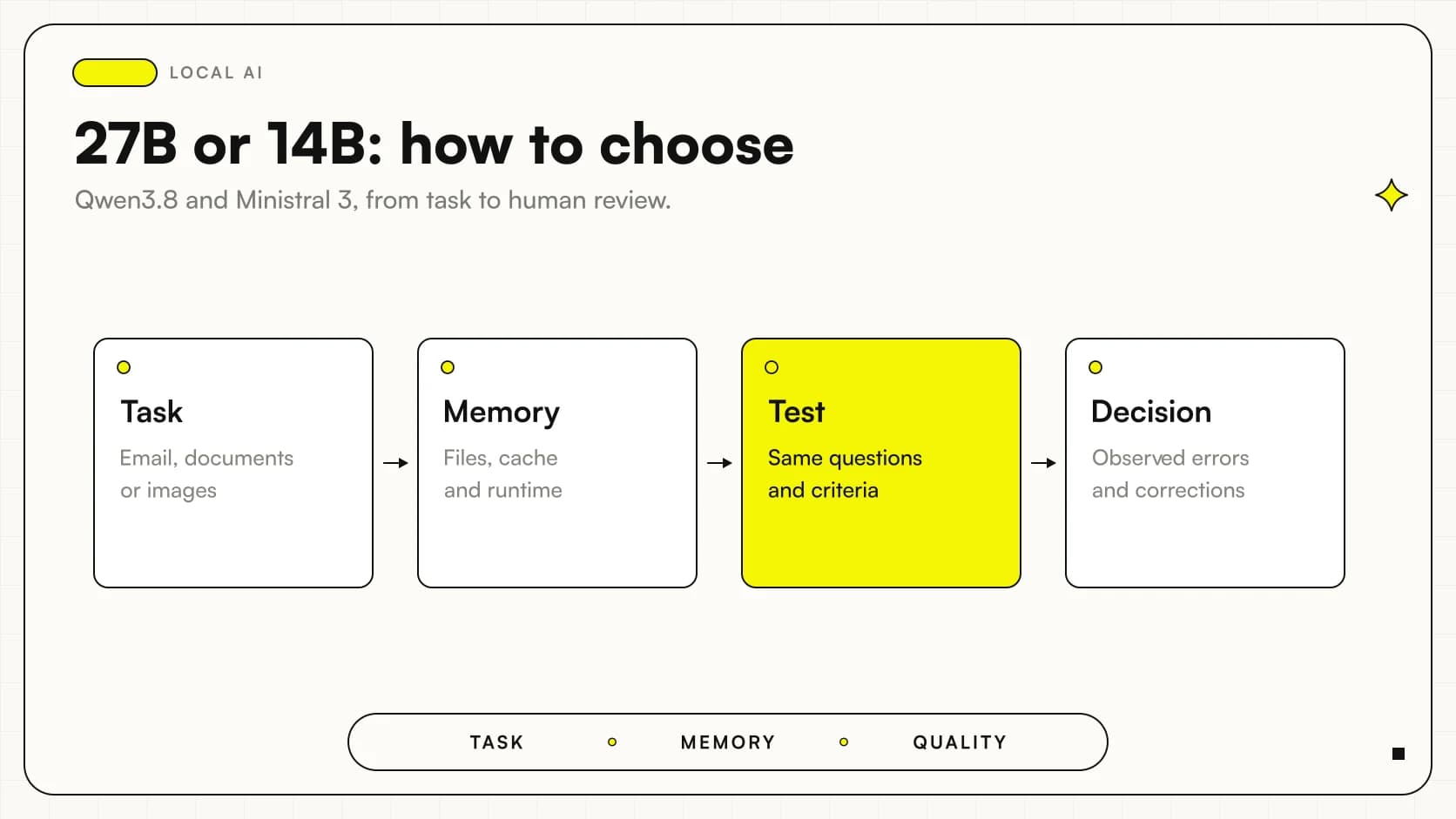
Qwen3.8-27B and Ministral 3 14B are local models with vision capabilities, but differ in the weight resources they require. Ministral is the more compact candidate here; we cannot infer that it is always faster, or that Qwen is automatically more accurate on your work. Specifications come from the official repositories of Qwen and Mistral, consulted on October 27, 2026.
The practical question is whether a smaller model already meets the workflow requirements. If it needs to classify internal requests, a larger size may not improve results enough to justify more demanding infrastructure. For complex documents, the comparison changes: identify which errors arise from the model, file preparation or incomplete instructions. This page helps design that decision without presenting estimates as measurements.
In summary
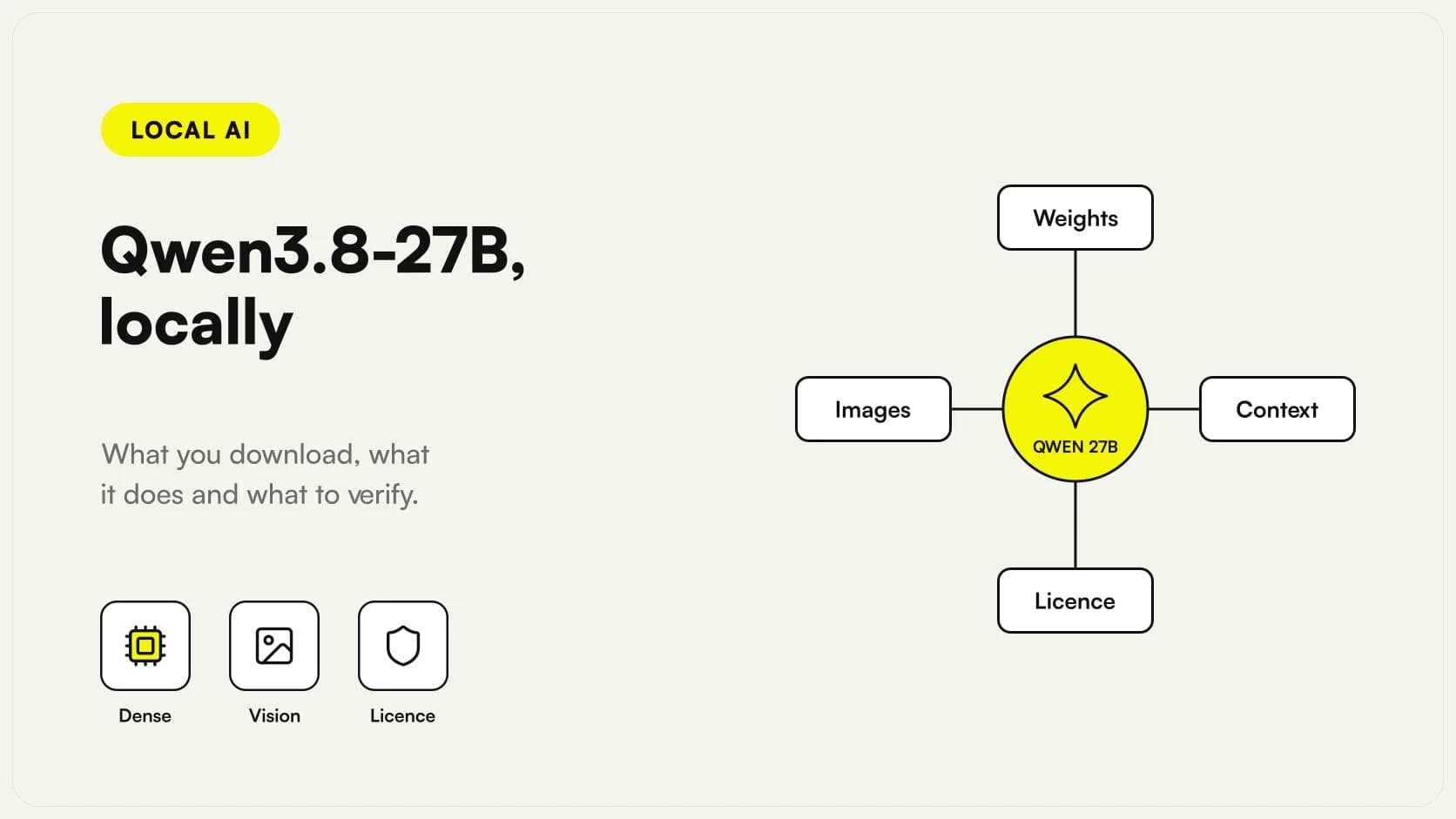
- Qwen3.8-27B includes a dense 27B language model plus a vision encoder.
- Ministral 3 14B combines a 13.5B language model with a 0.4B vision encoder.
- Both official checkpoints considered here declare Apache 2.0.
- Instruct, Reasoning and Base identify variants to select and record separately.
- A smaller model is worthwhile when it passes task checks while keeping resources and operation sustainable.
Which Ministral 3 14B are we comparing?
The main reference is Ministral-3-14B-Instruct-2512, focusing on the BF16 distribution and available official conversions. The family includes Base, Instruct and Reasoning variants: they should not be treated as identical behavior under different names. The Instruct card describes a post-trained instruction-following version with vision capabilities and function-calling support. Source: Mistral card.
For an assistant used by colleagues, explicitly select the variant to test and retain its revision. “Ministral” alone is not enough. The Mistral 3 introduction also distinguishes the small dense models from the family’s large MoE model. This avoids attributing performance published for a much larger checkpoint to the 14B.
Where does the size difference come from?
Qwen specifies 27B for the language model; Ministral specifies 13.5B for language and 0.4B for its vision encoder. In both cases, distinguish the text-generating component from the complete package needed to process an image. Sources: Qwen3.8-27B, Ministral 3 14B.
This order of magnitude suggests that Ministral may be an easier starting point when memory is the main constraint. It is not a complete hardware requirement and does not establish answer quality. To read about the larger candidate without repeating the entire comparison, see Qwen3.8-27B locally. Keep the decision connected to the workload, rather than the appeal of a size label.
Which characteristics are comparable?
Both cards declare text and image understanding. Qwen also describes video capabilities. The stated native context is 262,144 tokens for Qwen and 256K for Ministral 3 14B; this does not mean unrestricted access to the maximum on every computer. Sources: Qwen card, Ministral card.
| Criterion | Qwen3.8-27B | Ministral 3 14B Instruct |
|---|---|---|
| Language model | Dense, 27B | Dense, 13.5B |
| Vision | Encoder present | Stated 0.4B encoder |
| Native context | 262,144 tokens | 256K tokens |
| Licence | Apache 2.0 | Apache 2.0 |
| Candidate size | Larger | More compact |
| Performance on the workflow | To be verified | To be verified |
| Actual available memory | Depends on configuration | Depends on configuration |
These characteristics eliminate some incompatible options. To choose among those remaining, you need documents, questions and shared criteria.
What do we know about Ministral requirements?
Mistral states that the 14B variant can fit within 32 GB VRAM in BF16 and less than 24 GB RAM or VRAM when quantized. The official BF16 card presents these as deployment possibilities: they are not Giallo Studio measurements or guarantees about full context, concurrency or your computer.
A quantized format must be identified precisely. The official GGUF repository contains a distribution different from BF16: choosing the right file is part of configuration. Before buying a machine, check required space, supported runtime and headroom during a representative request. A model that loads without errors may still lack resources for a long scan or a second session.
How can you estimate Qwen without promising a fictional minimum?
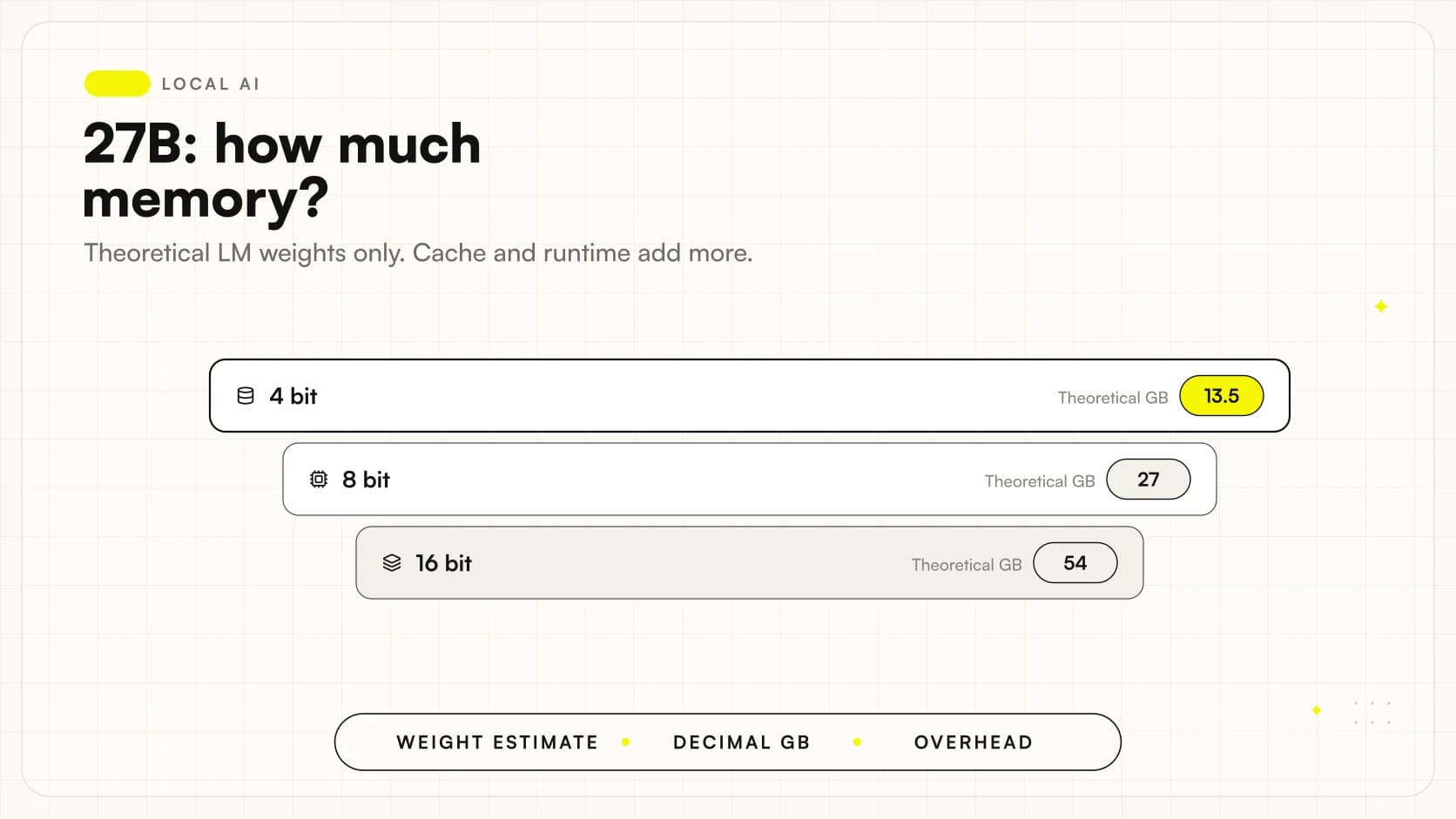
For 27B parameters, a theoretical calculation of language weights alone gives approximately 54 decimal GB at 16 bits, 27 GB at 8 bits or 13.5 GB at 4 bits. The formula multiplies parameters by bits and divides by eight. It excludes the encoder, quantization metadata, context cache, buffers and system memory.
These figures help rule out an impossible expectation, but do not justify claims such as “16 GB is enough.” The real file may use mixed precision, and the workload can add substantial resource needs. The guides to Qwen3.8-27B RAM and VRAM and GGUF quantization help separate theoretical calculation, download size and observed behavior. Useful requirements must be stated alongside the configuration that produced them.
When can a 14B be the more sensible choice?
A compact model is a reasonable candidate when the task has clear boundaries: assigning a category, extracting fields from regular text or drafting to a schema. It must pass the workflow’s checks. There is no need to buy more memory in pursuit of general capabilities the application will not use.
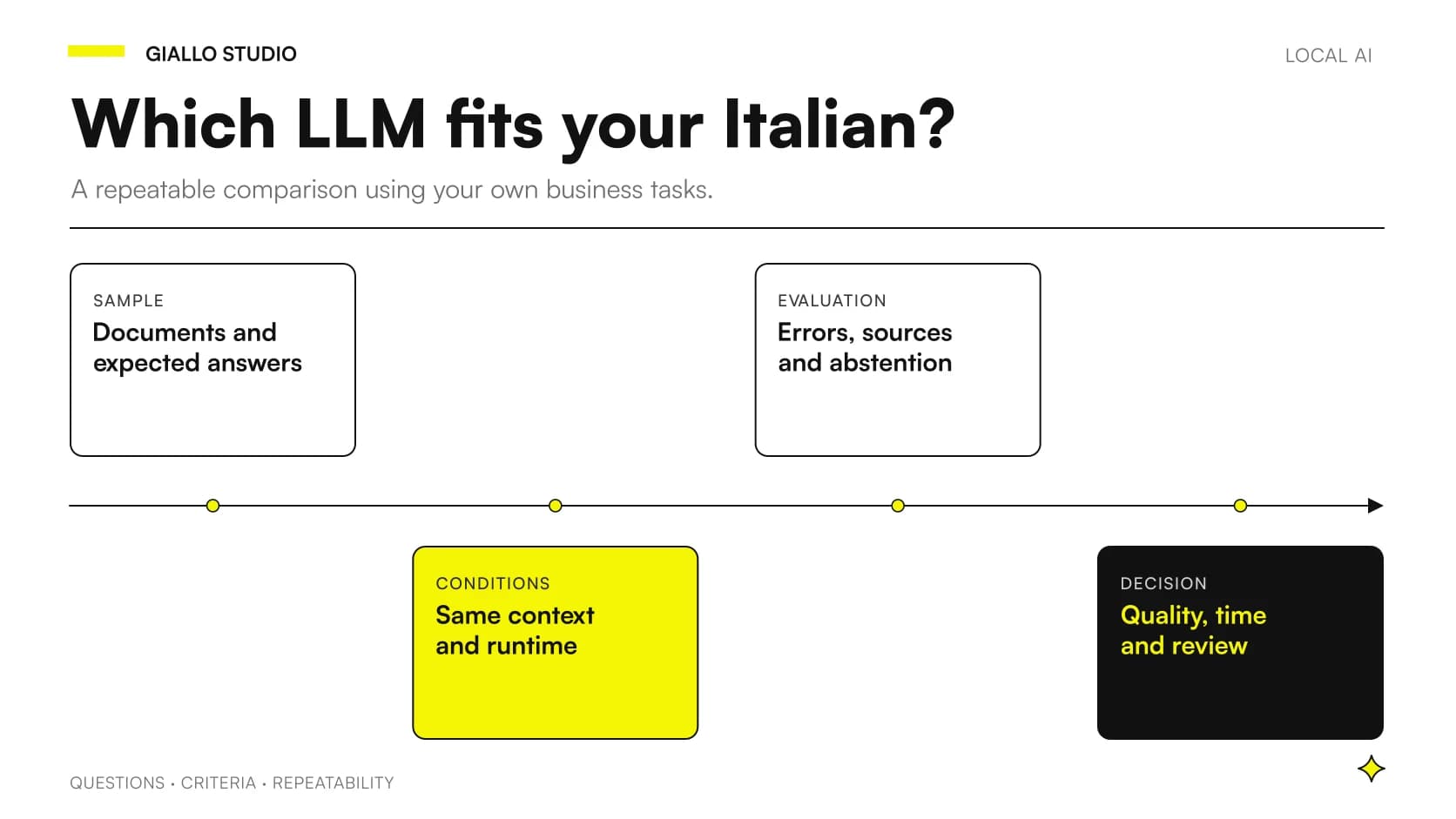
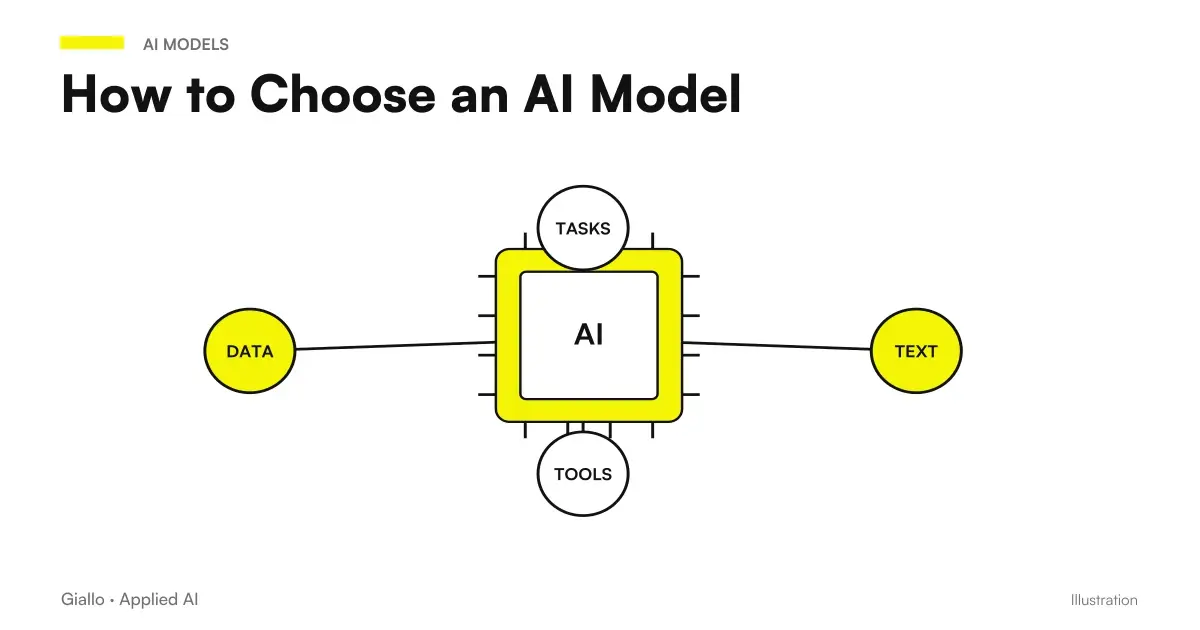
Start with a sample containing exceptions as well as ordinary cases. For request routing, include ambiguous text, messages covering two topics and requests outside every category. Define when the system must leave the decision to a person. The criterion is not the number of generated answers, but how many are acceptable without substantial correction. This follows the approach in how to choose an AI model.
When is testing the 27B worthwhile too?
Qwen deserves an additional trial if the smaller candidate makes errors on the essential task and the pipeline has already been checked. Before changing models, verify that the required information actually reached the system: no size fixes a passage omitted during document extraction.
Prepare problematic cases without rewriting them to favor the alternative. Keep sources and objectives unchanged, then check whether the 27B fixes errors or introduces new ones. Increasing size may help; it is not a guaranteed upgrade. If source selection is the problem, improve document retrieval. The guide to local RAG for business archives addresses the connection between a question and the relevant passage, which often determines the result before generation.
What would a test for a workshop look like?
Hypothetical scenario: a workshop wants to draft internal responses using manuals and nameplate photographs. The test must check whether the system identifies the exact model, distinguishes procedures for similar versions and flags an unreadable photograph. The aim is not to delegate sensitive technical decisions to the assistant.
Have a competent employee assess each answer and require a reference to the manual page. An error in the machine identifier may matter more than several good summaries. Compare the models when the photo is missing or the code partly obscured too. Abstention is correct when it prevents a procedure being matched to the wrong device. Keep the source data alongside the draft so a colleague can verify it without repeating the search from scratch.
What about an office handling support requests?
Second hypothetical scenario: an SME receives emails about deliveries, returns and maintenance. An initial use could classify the message and suggest documents to open, without replying directly to the customer. A smaller model that follows categories well might be sufficient here.
Use a category list with definitions and exclusions. If a request contains a complaint and a technical question, the system must flag both or apply the agreed rule. Assess classification, extracted fields and draft separately. Do not treat fluent wording as proof that routing is correct. To extend the project to AI agents, add permission controls: checking order status, changing it and sending a communication are actions with different consequences.
How should you compare Italian and structured outputs?
Ministral’s card lists multilingual support including Italian; Qwen documents language capabilities for its family. These claims justify testing, but do not establish reliability on your company’s terminology. Source: Ministral language support, Qwen source.
Use actual terminology, acronyms and names that staff should not see paraphrased. For data entering software, require a schema and validate results outside the model: date formats, permitted codes and required fields. Formally valid JSON can contain an invented value; syntactic correctness and source fidelity must be counted separately. Do not give full credit to an answer that fills an unknown field merely to satisfy the schema.
Which conditions make a test credible?
Decide whether to compare the best formats the machine can support or two configurations under a common constraint. In the first case, you are selecting the most useful system on your hardware; in the second, you are isolating a specific trade-off. State which objective guides the work and do not mix the results.
Record runtime version, checkpoint, revision, quantization, context, instructions and documents. Measure the complete request wait, separating cold starts from an already ready model. If the larger candidate forces weight transfers that the other avoids, that cost belongs to the real experience. For consistent rubrics and judgments, use the protocol in benchmarking local LLMs in Italian. We do not report tokens per second here because we have not performed a comparable test on a specified machine.
A single workstation or a shared service?
An individual trial does not automatically describe group use. When the model loads on one person’s computer, the application may compete with video calls, the browser and work software. If exposed as an internal service, request queues, concurrent access and conversation isolation become relevant. A useful requirement must specify the intended situation.
To compare candidates, also prepare a long request while a short question arrives. Observe whether the system completes both and whether the wait remains acceptable for staff. You do not need a general ranking: you need to identify the configuration meeting the agreed service. If the compact model leaves more headroom, verify that this actually translates into stability. If the larger model handles difficult cases better, consider reserving it for those rather than every message.
Which licensing, offline and update mistakes should you avoid?
The official checkpoints considered here declare Apache 2.0, but application or conversion licenses need separate checks. Read the Qwen LICENSE and the terms linked from the Ministral card. Do not automatically transfer rights or capabilities to similarly named variants.
Also avoid calling a workflow offline without checking it. PDF preparation, embeddings, tools and backups can use the network. A local choice requires a data-path map, as described in local AI and business privacy. Finally, do not update indiscriminately during evaluation: if you change weights or runtime, keep the previous configuration and repeat essential cases before using the new version.
How can you bring the comparison into everyday work?
Define a process owner, a verifiable sample and a review method. Start with reading and drafts only, collect errors and expand integration only once the team recognizes conditions in which the assistant must stop. Size comparison helps decide how much hardware to commit; document testing helps decide how much work to delegate.
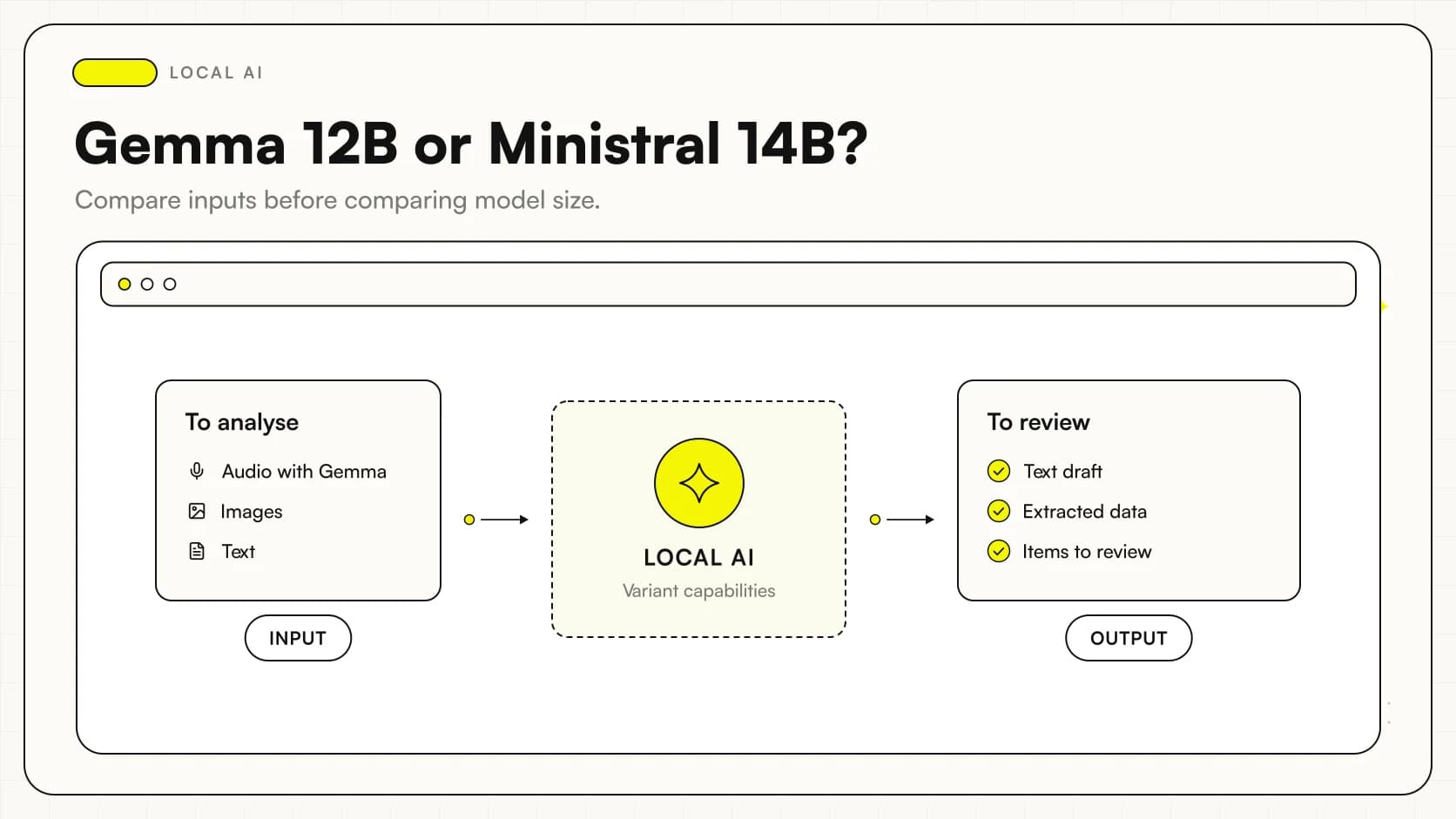
For a compact variant that also includes audio, read Gemma 4 12B vs Ministral 3 14B. If choosing between a workstation and a shared internal service, Giallo Studio's AI consultancy can frame the comparison around your request flow and existing resources.
Giallo Studio guides: methodology and sources
How we apply it in the company
Related resources
Other direct comparisons
The same criteria applied to other model pairs.
- Qwen3.8-27B vs gpt-oss-20b: vision, text and memory
- Qwen3.8-27B vs Qwen3.6-35B-A3B: local AI trade-offs
- Qwen3.8-27B vs Gemma 4 31B for local deployment
- Qwen3-Coder-Next vs Devstral Small 2: local coding
- Qwen3.8-27B vs Gemma 4 26B A4B: dense or MoE?
- RPA vs AI automation: differences, costs and when to use which
- Custom business PWA: when it makes sense over off-the-shelf software
- Voice AI or chatbot: which channel to choose
- Perplexity vs Google: response with sources or link list
- Subscription or custom AI: which makes sense?
- Claude Opus 5 vs Sonnet 5
- DIY AI or agency: how to decide
FAQ
Is Ministral 3 14B smaller than Qwen3.8-27B?
Yes. Ministral’s card specifies 13.5B language-model parameters and a 0.4B vision encoder; Qwen specifies 27B for its language model plus the vision component.
Does the smaller model always respond faster?
No. Time depends on hardware, runtime, format, context and generated text volume. Measurement in the intended configuration is necessary.
Which Ministral 3 14B should you use for business chat?
The Instruct variant is a starting point for instruction following. Base and Reasoning are distinct checkpoints: always record the full name, format and revision before comparison.
Can both read images?
Yes, the official checkpoints considered here declare vision capabilities. Accuracy on scans, nameplates and tables must be checked using documents representative of the workflow.
When should you choose a smaller local model?
When it meets essential task requirements with sustainable resources and operation. The comparison must include exceptions, abstention and correction work, rather than only easy answers.