
Qwen3.8-27B vs gpt-oss-20b: vision, text and memory
Qwen3.8-27B vs gpt-oss-20b: vision, text, MXFP4, memory and Italian. Comparing two local models with verifiable criteria.
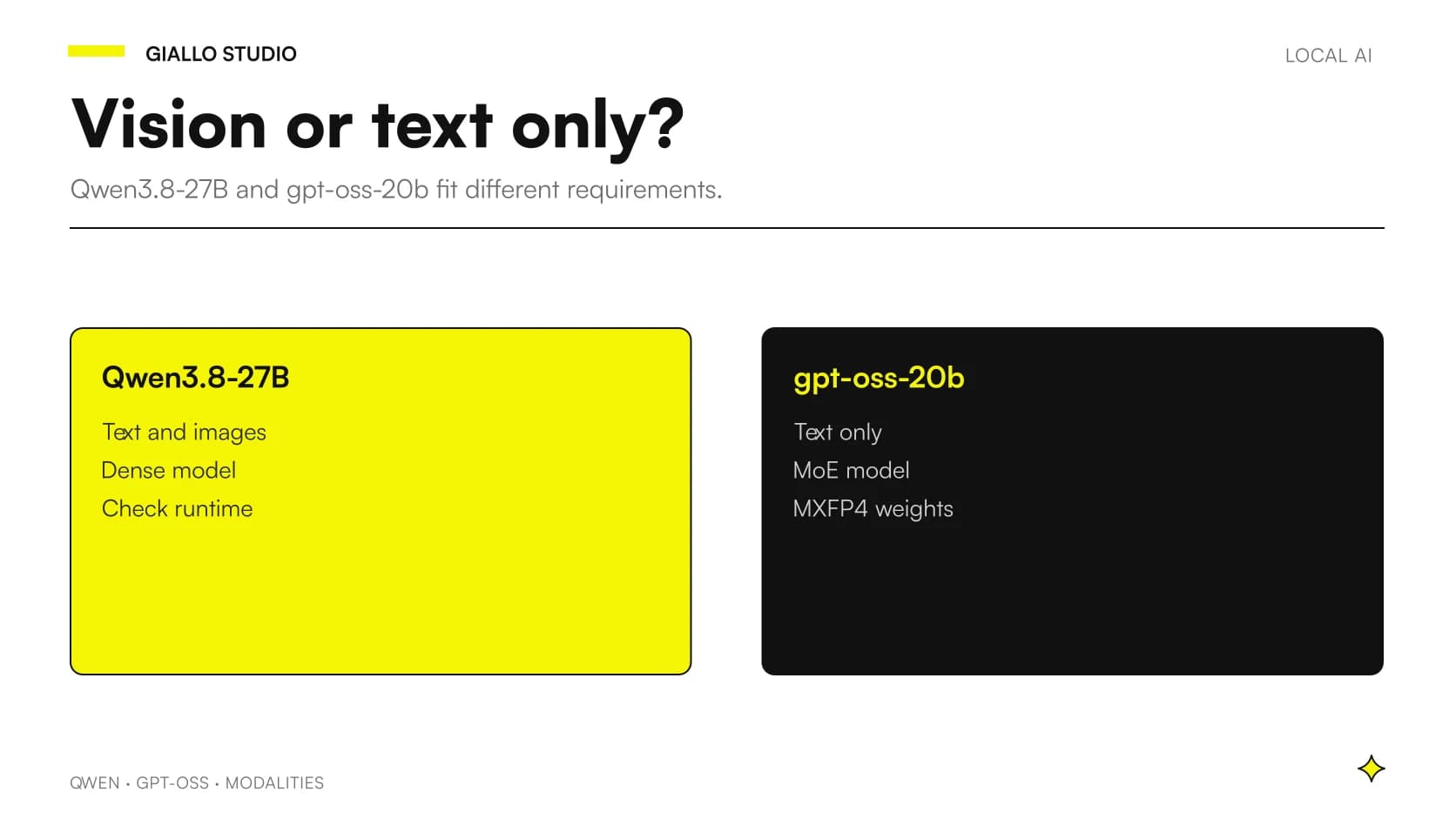
Qwen3.8-27B is multimodal, while gpt-oss-20b is a text model: this is the first difference to consider for local use. Neither can be declared universally better without a comparable test on the required work. If you need to interpret an image directly, the candidates do not offer the same input modality; for already prepared text, the comparison can be relevant. Sources: Qwen card, gpt-oss announcement.
The OpenAI name does not make gpt-oss a local copy of ChatGPT. It is a downloadable checkpoint to run on compatible infrastructure and evaluate independently. Here we separate architecture, format, memory and Italian-language quality using primary documentation consulted on October 27, 2026. We do not present Giallo Studio benchmarks or a universal hardware requirement.
In summary
- Qwen3.8-27B understands text, images and video; gpt-oss-20b works with text.
- Qwen has a dense 27B language component; gpt-oss-20b is MoE with 21B total and 3.6B active.
- gpt-oss is distributed with MXFP4 quantization and requires the Harmony conversation format.
- The manufacturer’s 16 GB figure for gpt-oss-20b does not guarantee every context or application.
- Italian and business sources need testing: family reputation does not replace results.
What do you download with gpt-oss-20b?
You download the weights of an OpenAI open-weight model, distinct from ChatGPT services and model families offered through APIs. The official gpt-oss repository contains reference implementations and execution guidance; the 20b checkpoint card identifies the smaller variant without attributing the 120b’s size to it.
The difference is operational. With a local model, you control the version, files and engine configuration; document management, tools and interface depend on the software you build or choose. You cannot assume that a feature seen in ChatGPT is included in gpt-oss weights. To clarify terms before deciding, see Local AI Models and Open Weight AI Models.
Where do vision and text diverge?
Qwen’s card describes native image and video understanding. The OpenAI announcement instead describes models trained on text data, predominantly in English. A gpt-oss system can receive text obtained from a scan using OCR, but that preparation happens in a separate component.
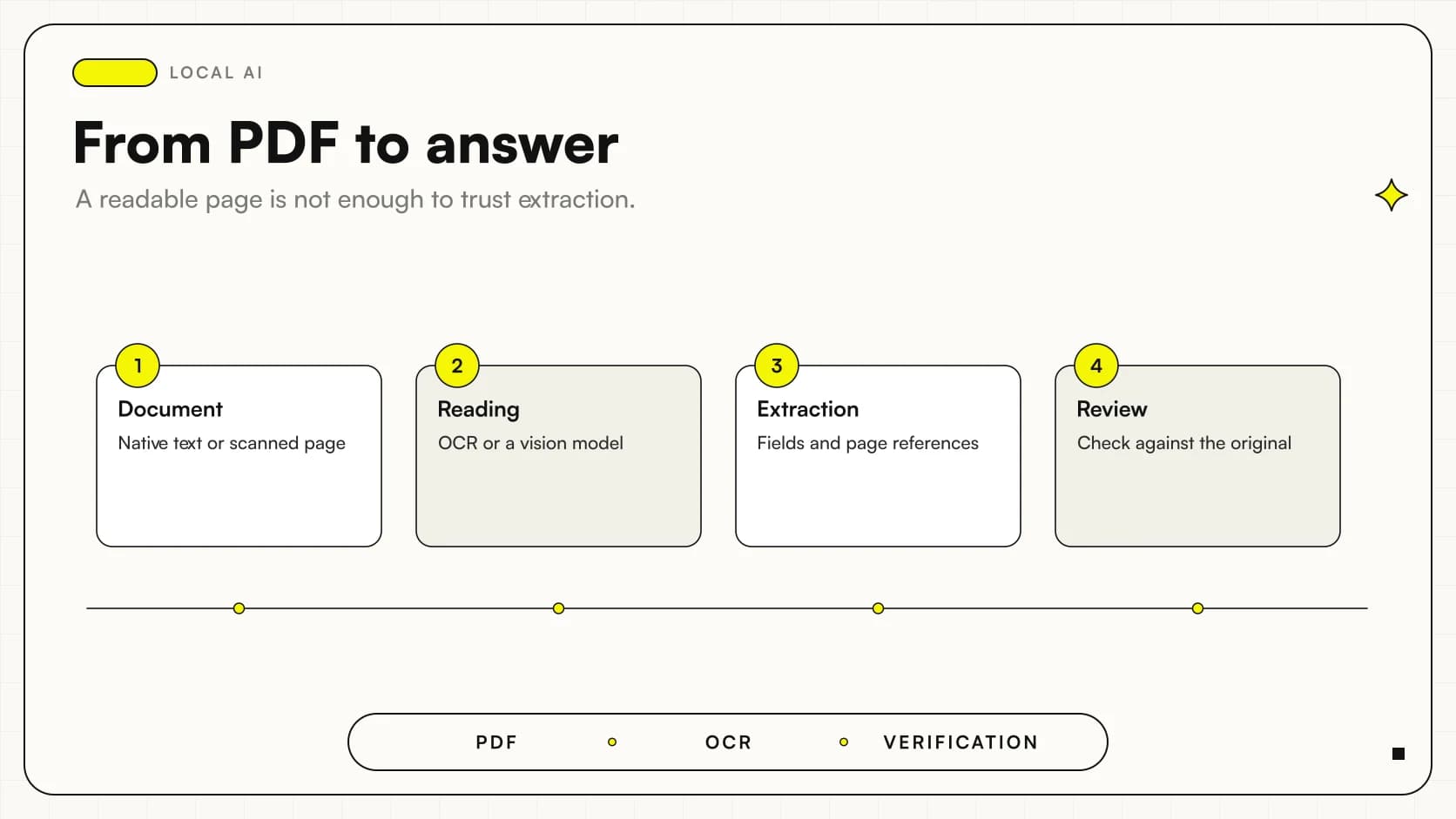
This matters if you need to read a photograph, table or margin note. Extracted text can lose order, relationships between cells or graphic elements; a vision model can try to interpret them directly, without thereby becoming infallible. The guide to local multimodal AI for PDFs and images explains how to check the path from page to answer. Before comparing quality, establish whether you are assessing the model alone or the entire reading system.
Which numbers describe the two models?
Qwen’s dense language component is stated as 27B, plus a vision encoder. For gpt-oss-20b, the commercial name corresponds to around 21B total and 3.6B active parameters per token, with a MoE architecture. Stated native context windows are 262,144 tokens and 128K respectively. Sources: Qwen3.8-27B, gpt-oss architecture.
| Feature | Qwen3.8-27B | gpt-oss-20b |
|---|---|---|
| Architecture | Dense | MoE |
| Stated parameters | 27B language parameters plus vision | 21B total / 3.6B active |
| Native visual input | Yes | No |
| Native context | 262,144 tokens | 128K tokens |
| Relevant distribution format | Depends on checkpoint and conversion | Official MXFP4 |
| Licence | Apache 2.0 | Apache 2.0, with usage policy to consult |
| Italian-language quality on the workflow | To be verified | To be verified |
The active parameters in gpt-oss do not represent the total weights that must be made available to the engine.
What does MXFP4 mean for memory?
MXFP4 is the quantized format OpenAI uses to distribute gpt-oss weights, designed to limit memory requirements. In the official announcement, OpenAI states that gpt-oss-20b can run with 16 GB of memory. This is a manufacturer claim about the model and its distribution, not a measurement performed here.
Do not turn that figure into a guarantee for every 16 GB laptop, runtime or full context window. Some memory may be used by the system and other applications; the workload adds cache and buffers. Format support also depends on the engine. Before purchasing, verify the actual file and configuration. The guide to local LLM quantization distinguishes precision, container and conversion: similar names do not make weights automatically interchangeable.
Why is comparing 16 GB and 13.5 GB insufficient?
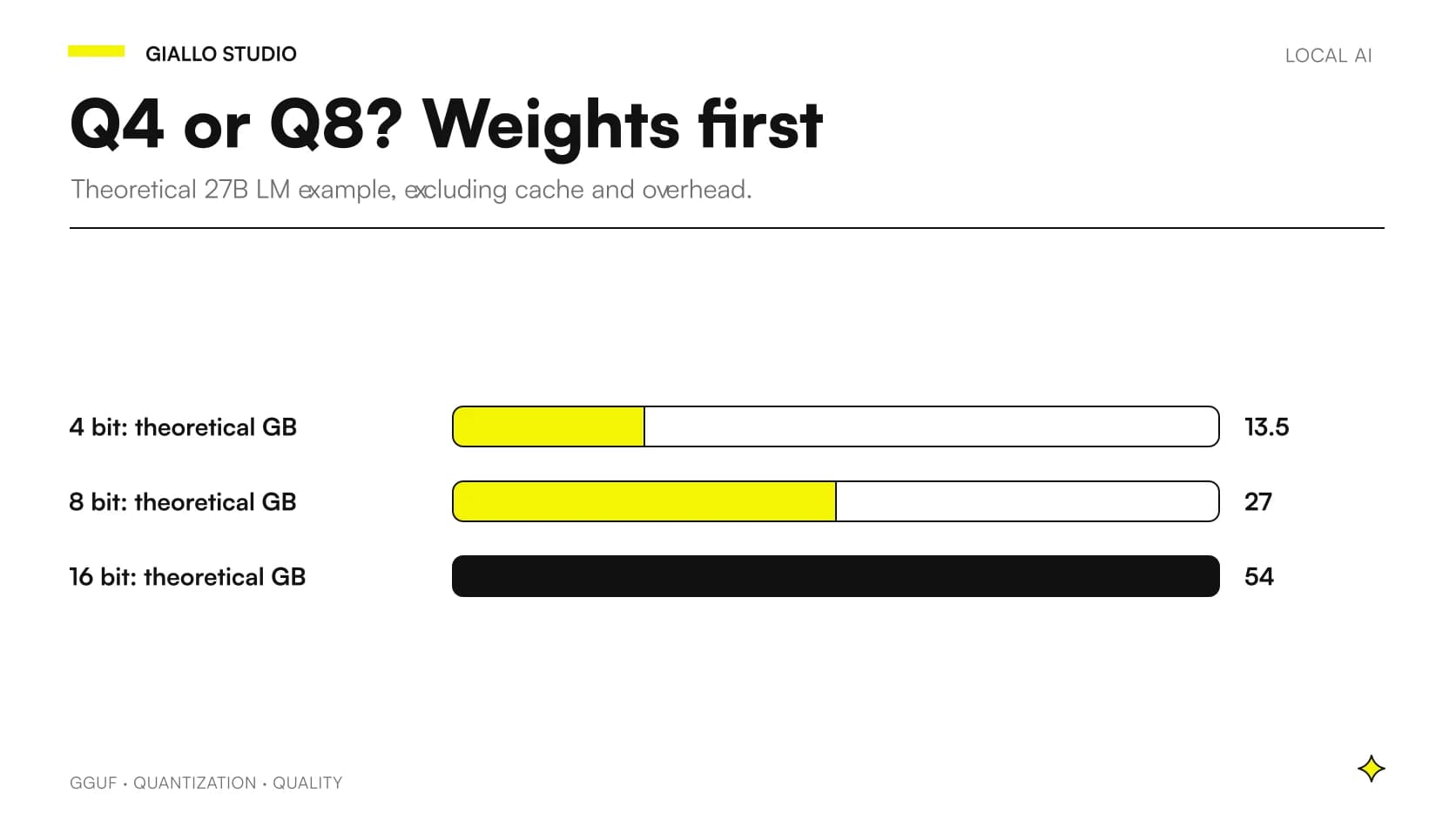
The approximately 13.5 GB obtained for 27B parameters at 4 bits is a theoretical calculation of Qwen language weights alone. It excludes the vision component, quantization scales, cache and engine overhead. Multiplying the parameter count by the bit width and dividing by eight estimates the order of magnitude, not a complete requirement.
OpenAI’s 16 GB figure concerns a distribution and manufacturer execution guidance; its scope differs. Presenting these side by side as “required RAM” would be misleading. For Qwen, see how much RAM and VRAM it really needs. In an operational test, observe memory at loading and during the most demanding intended request, keeping headroom for the system, documents and other activities. Opening an empty chat is not enough.
Is Harmony a negligible detail?
No. The gpt-oss card specifies that the model must use the Harmony format to work correctly. The official Harmony repository describes conversation structure, channels and tool calls. A compatible inference solution may handle the format in software; if you develop an integration, verify it explicitly.
Strange output does not immediately prove the model is incapable: it may indicate an incorrect template or poorly handled conversion. Before judging quality, check that roles, turn endings and final responses are interpreted as intended. Code separating a tool-directed message from one shown to the user must also follow the protocol. Avoid improvised fixes that remove parts of the response without understanding what they represent.
How can you compare reasoning without confusing budgets?
gpt-oss supports reasoning levels; Qwen documents thinking controls. Settings guide the trade-off between depth and waiting time, but do not form an identical scale across manufacturers. Sources: gpt-oss-20b card, Qwen controls.
For a useful comparison, first try recommended configurations, then those meeting the department’s constraint. Specify which test you describe and record the response budget. A correct conclusion after a very long output may be unsuitable for frequent classification; a short answer may omit an essential condition. Do not treat reasoning length as a measure of correctness. Final judgment must consider verifiable outcomes and workflow boundaries.
What test is useful for an archive of clean text?
Hypothetical scenario: a consulting practice wants to query internal instructions already available as selectable text. Qwen’s multimodal advantage may not be decisive here. Testing can focus on source retrieval, version handling and the ability to avoid filling information gaps.
Prepare requests about the current procedure, an excluded case and missing information. Both receive the same passages and must cite the reference. Have answers assessed without awarding points for brand familiarity. If the system must consult a large archive, include retrieval quality: a good model given the wrong document can produce an inapplicable answer. The guide to local RAG for business documents explains how to separate this component from generation.
What changes with photographed forms and mixed attachments?
Second hypothetical scenario: an SME receives requests with photos, forms and handwritten text. Qwen can be tested directly on the visual path; gpt-oss requires another component to convert the material into text. A fair comparison must disclose these steps and include their errors and resources.
Keep the original page and record where OCR lost a digit or table order. Do not attribute an error already present in the received text to gpt-oss; do not credit Qwen with success if an operator corrected the page beforehand. Evaluate unreadable fields too: the system should flag them without inventing content. A workflow can use different paths for different documents, but each must be verified and preserve the source reference checked by the operator.
How can you verify that its Italian is suitable for work?
The predominantly English training declared for gpt-oss does not justify calling it unsuitable for Italian, but makes testing in the working language necessary. The same applies to Qwen: language support and quality on your terminology are not identical. Use questions phrased like staff requests, with acronyms, abbreviations and incomplete references.
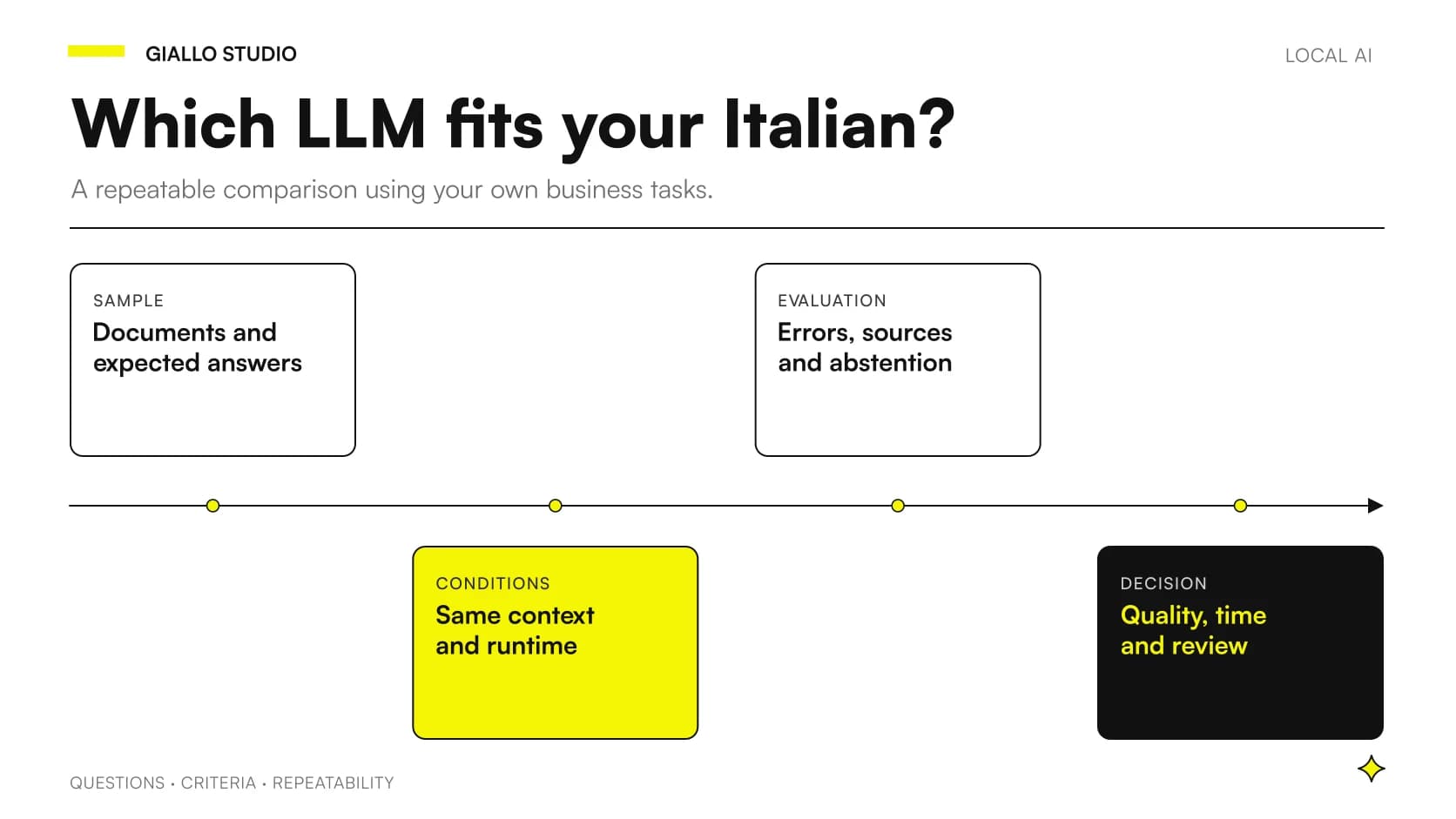
Watch negations, units and conditions. “Not applicable” must not become a recommendation; a product identifier should not be creatively translated. Also verify that the model asks for clarification when an ambiguous word changes the operational meaning. The protocol for benchmarking local LLMs in Italian helps document corrections and abstentions. If an answer appears better only because it reads more naturally, recheck every fact before assigning a judgment.
Also prepare expected answers that allow more than one wording. If a document says a request requires manager approval, several ways of expressing this are acceptable; skipping approval is not. A useful rubric separates required facts, prohibited additions and references to display. This reduces dependence on readers’ preferences and lets two reviewers discuss a specific error. When reviewers disagree, retain the disagreement and refine the rule before choosing the model. Ambiguous criteria do not become objective simply because a comparison produces a percentage.
Which tools can reach beyond the machine?
A tool call does not become local because the model is local. A system may consult a remote search engine, cloud archive or OCR service. The gpt-oss reference implementations include examples of tool integration: these are software possibilities, not proof of automatic isolation. Source: gpt-oss repository.
For a confidential pilot, list all steps and decide which may use the network. With authorized content, check whether the application continues to work when external connections specified by the policy are blocked. Also check logs, attachments and backups. The guide local AI and privacy covers the complete flow. Do not describe the system as offline solely because its generation endpoint has a local address.
Which mistakes distort the choice between them?
The first is expecting gpt-oss to include ChatGPT application features. The second is calling gpt-oss “a 3.6B model” while omitting total weights. The third is judging visual capability by comparing Qwen with unchecked OCR, without distinguishing what read the page from what generated the answer.
A fourth mistake is using an incompatible conversation template and interpreting the issue as a quality limitation. Finally, do not treat a permissive license as authorization for any data use. Read the Qwen LICENSE, the license and the gpt-oss usage policy. Runtime or hosted-service terms remain additional items to verify for the chosen configuration.
Which criterion should guide the final decision?
Visual documents as a requirement
Test Qwen’s multimodal path and check accuracy, references and handling of unreadable details. Compare alternatives including the complete document preparation process.
Already prepared text as a requirement
Put both on the same sample and assess source fidelity, Italian, memory and total wait. Vision earns no points if the workflow does not use it.
Define an answer owner, a review method and actions prohibited during the pilot. If neither candidate meets requirements, change the assistant’s scope or consider other options; do not turn model selection into a promise of autonomy.
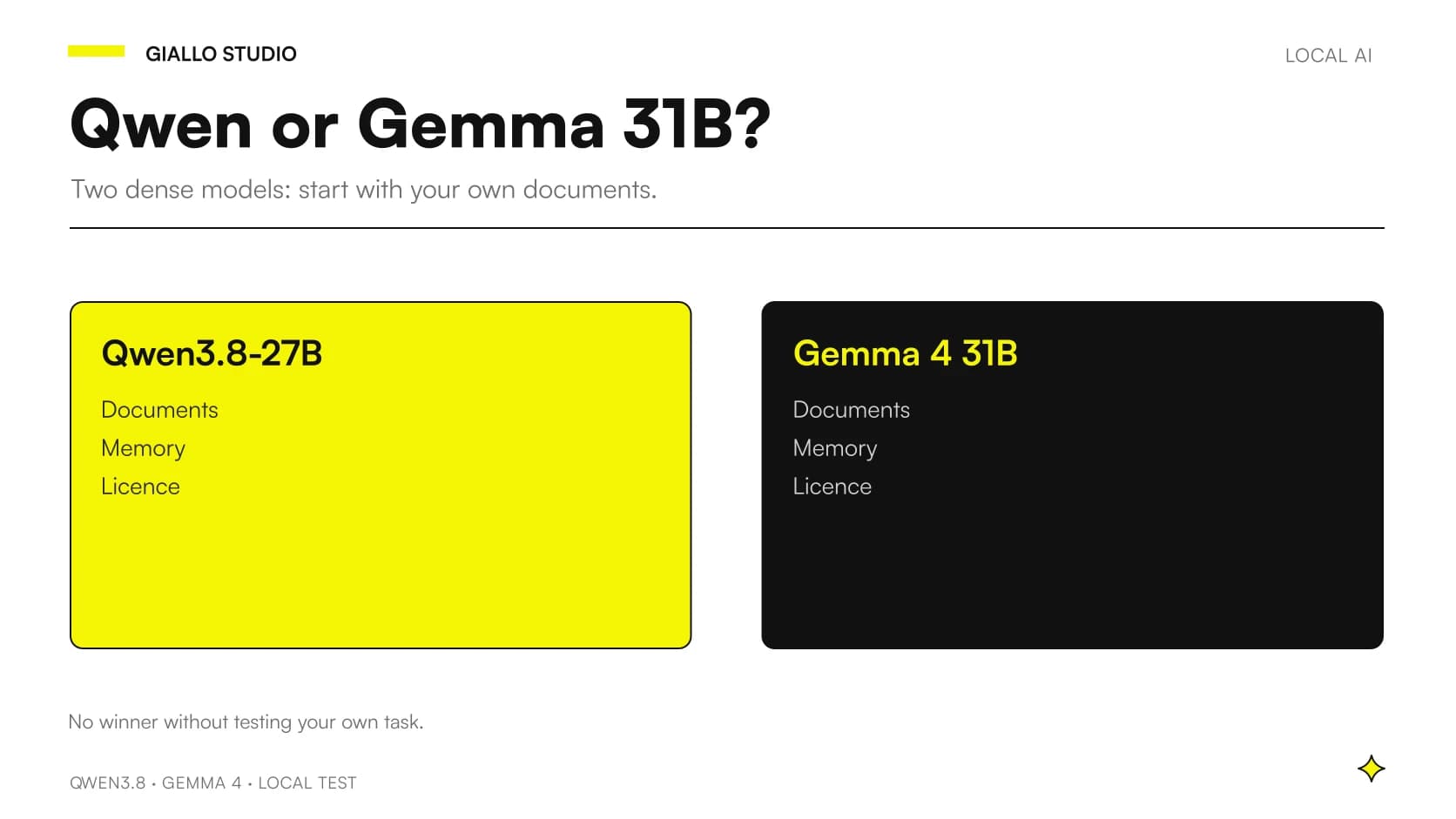
You can also compare Qwen with Gemma 4 31B. To connect a local model to your archive without losing source traceability, Giallo Studio designs custom AI software starting with the documents and checks your team will use every day.
Giallo Studio guides: methodology and sources
How we apply it in the company
Related resources
Other direct comparisons
The same criteria applied to other model pairs.
- Qwen3.8-27B vs Gemma 4 31B for local deployment
- Qwen3.8-27B vs Ministral 3 14B: choosing local AI
- Qwen3.8-27B vs Gemma 4 26B A4B: dense or MoE?
- Qwen3.8-27B vs Qwen3.6-35B-A3B: local AI trade-offs
- Custom business PWA: when it makes sense over off-the-shelf software
- Qwen3-Coder-Next vs Devstral Small 2: local coding
- Perplexity vs Google: response with sources or link list
- RPA vs AI automation: differences, costs and when to use which
- Claude Opus 5 vs Sonnet 5
- Voice AI or chatbot: which channel to choose
- Claude Opus 5 vs GPT-6 Astra
- Subscription or custom AI: which makes sense?
FAQ
What is the main difference between Qwen3.8-27B and gpt-oss-20b?
Qwen is multimodal and understands images and video; gpt-oss-20b is text-only. For scanned documents, gpt-oss needs separate preparation, such as OCR.
Is gpt-oss-20b ChatGPT installed on your PC?
No. It is a model with downloadable weights, distinct from ChatGPT. Interface, tools and document handling depend on the inference software and application.
How many parameters does gpt-oss-20b have?
OpenAI specifies around 21 billion total and 3.6 billion active parameters per token. It is an MoE: active parameters do not represent the entire checkpoint to manage.
Is 16 GB always enough for gpt-oss-20b?
OpenAI indicates that it can run with 16 GB in the intended distribution. This is not a guarantee for every machine, context window, runtime or concurrent workload.
Can I compare them in Italian?
Yes, using the same sources and questions representative of the work. Assess data fidelity, technical terminology and abstention, not just fluency.