
Gemini 4 Hydrogen: What It Is, How It Works, Where to Use It
Gemini 4 Hydrogen explained: Google's fast model from 12 November 2026. Specs, availability by product, pricing, Search and Italy.
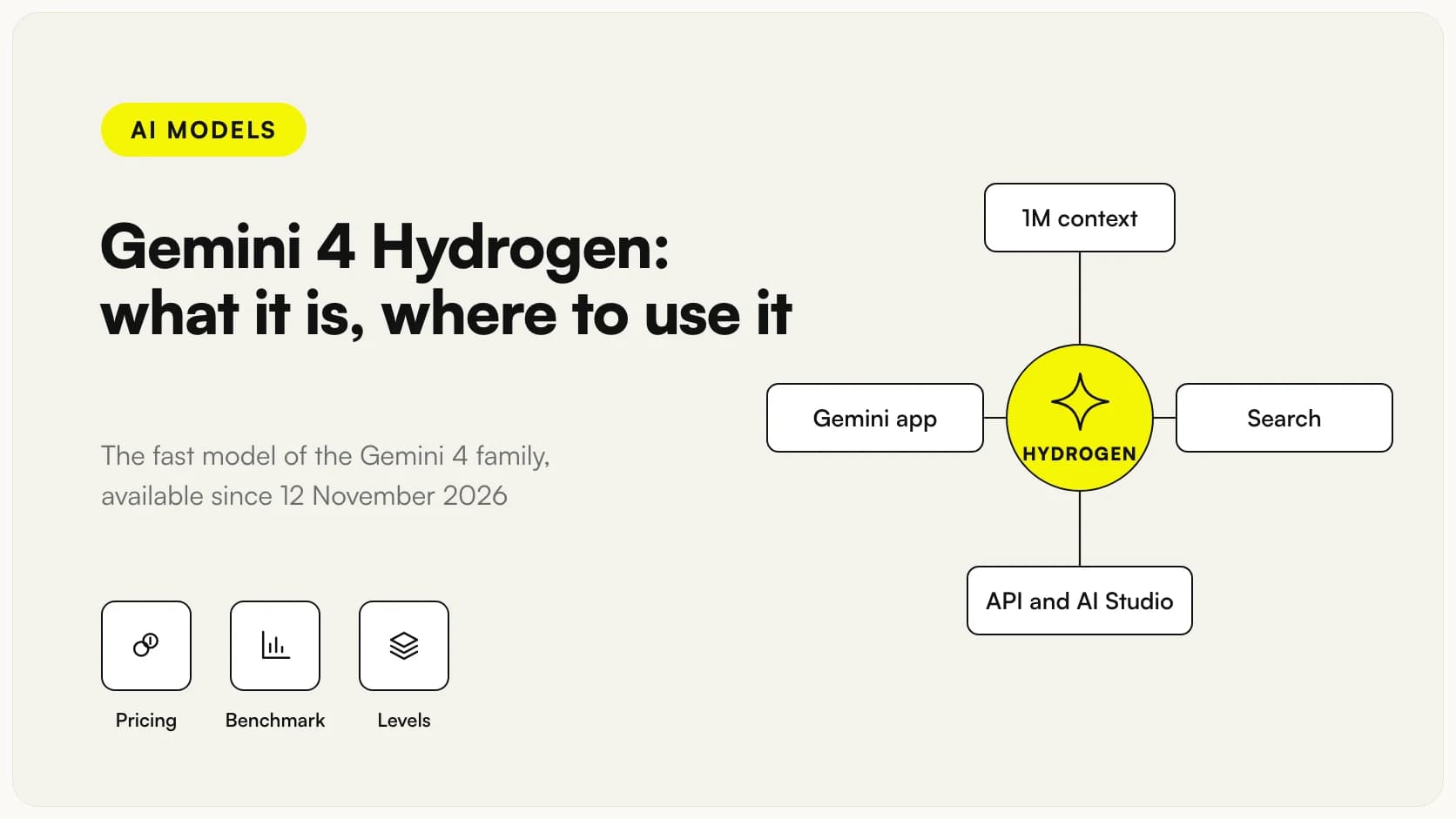
Gemini 4 Hydrogen is Google's model, announced on 12 November 2026, for running everyday coding and agentic workflows quickly. It is rolling out now in the API, the Gemini app, Google Search, Google Sheets and Antigravity, at a paid price of $1.50 per million input tokens and $7.50 per million output tokens (price list). Google presents it as the model “bringing Gemini 4 to everyone”, alongside the two most powerful models in the family, Carbon and Argon.
This guide is based on official Google sources, all consulted on 14 November 2026: the 12 November announcement, the DeepMind model card, the guide What’s new in Gemini 4 Hydrogen, the Gemini API price list and the Agent Platform page.
For an owner or an IT manager, the useful question is not “how good is it?” but “where can I use it, on what terms and with what data?” Here you will find the answers, with what Google has published kept separate from what it has not yet published. The performance figures are Google's claims: Giallo has not rerun them.
In summary
- Gemini 4 Hydrogen (API ID
gemini-4-hydrogen) was announced on 12 November 2026 and is, according to Google, the Gemini 4 model for fast execution, adapted from Gemini 4 Carbon. - It has a single 1,048,576-token window shared across input, reasoning and output, four reasoning levels (
low,medium,high(default),xhigh) and a knowledge cutoff of March 2026. - Via the API it costs $1.50 per million input tokens and $7.50 per million output tokens on the paid tier (price list), at a flat price across the whole window; a free tier also exists.
- It is rolling out globally in AI Studio, Android Studio, Gemini for business, the Gemini app, Google Sheets, Google Search and Antigravity (developers with a paid Google AI Pro or Ultra subscription; for businesses also through Gemini for business); on Agent Platform it is GA, also with the regions
usandeu. - For Italy, the Gemini API is confirmed; no country list for the Gemini app has been published, nor explicit support for Italian in Search.
- Anyone with integrations on Gemini 2.5 Pro or 2.5 Flash should watch 1 December 2026: from that day Google automatically routes those requests to other models.
What is Gemini 4 Hydrogen, in plain English?
Gemini 4 Hydrogen is a generative AI model from Google, part of the Gemini 4 family, designed to quickly carry out multi-step work: writing and fixing code, using tools, reading documents, filling in and verifying. Google describes it as “built for rapid execution”, unlike Carbon and Argon, which excel at deep reasoning on the hardest problems. Source: Google announcement of 12 November 2026.
It is not an app and not a subscription: it is the engine behind different products. The same model answers in the chat of the Gemini app, works in Google Sheets, powers Google Search and is called by external software through the API. For the big picture of Google's products, you can start from Gemini AI: what it is and how it works.
What sets it apart from the others? Three things, stated by Google in the announcement and in the model card:
- It is adapted from Carbon. The model card lists it as “adapted from Gemini 4 Carbon” and refers to Carbon's model card for architecture, data and hardware.
- It is built for speed. Google says that at the “high” reasoning level it finishes tasks 2.5 times faster than Gemini 3.8 Flash.
- It has a flat price. $1.50 for input and $7.50 for output per million tokens across the whole window (price list), less than Carbon and Argon.
For anyone coming from Gemini 3.8 Flash, Google speaks of a “recommended upgrade”, as stated in the guide What’s new.
Where does Gemini 4 Hydrogen sit in the Gemini 4 family: Carbon, Argon and Hydrogen?
In the Gemini 4 family, Carbon and Argon are the “frontier” models and Hydrogen is the execution model. Carbon, announced on 28 October 2026 (announcement), is available via paid API from 10 November 2026. Anyone who wants the story of each will find Gemini 4 Carbon: what it is and Gemini 4 Argon: what it is.
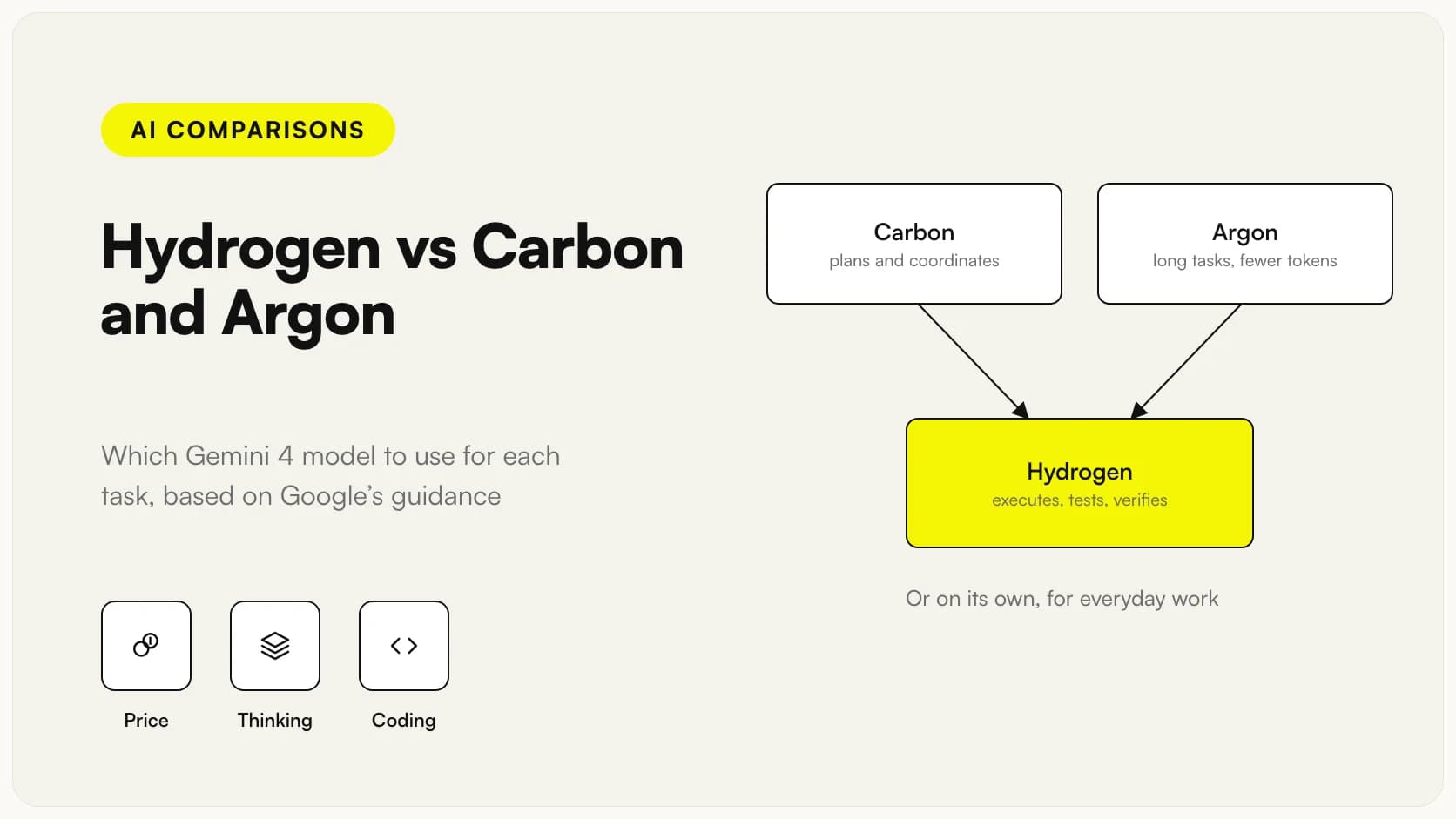
Google's idea is that a complex job should not be done entirely by the most expensive model. A large model plans and judges; a faster one writes, runs the tests and verifies. That is why the announcement introduces the Orchestrator in Google Antigravity, which switches from one model to another, for example from Carbon to Hydrogen, within the same session. On Terminal-Bench 4.0, Google states (source: announcement) that the Orchestrator reached “near-Carbon” success rates, meaning almost on par with Carbon, while using on average 24% less quota and finishing the work 19% faster.
For workflows with several agents in parallel, Google describes Carbon as the coordinator and Hydrogen as the engine of the subagents that write and verify changes in separate workspaces. The point-by-point comparison, with the “task → model” decision table, is in Gemini 4 Hydrogen vs Carbon and Argon.
What are the key specifications of Gemini 4 Hydrogen?
The technical specifications that matter to decision-makers are summarized below. Google published them in the guide What’s new, in the model card and in the Agent Platform page.
| Feature | What Google says |
|---|---|
| Model ID in the API | gemini-4-hydrogen (What’s new) |
| Context Window | 1,048,576 tokens shared across input, reasoning and output (What’s new) |
| Output per request | up to 65,536 tokens; beyond that, up to 1,048,576 minus the input tokens, with “long decode” (What’s new) |
| Reasoning levels | low, medium, high (default), xhigh; minimal returns an error (What’s new) |
| Input | text, images, audio, video (model card); the Agent Platform page also lists Office and OpenDocument documents, in addition to PDF and text (model page) |
| Knowledge cutoff | March 2026 (model card) |
| Caching | implicit only, from 4,096 tokens, with a 95% discount on cached tokens; explicit caching is not supported (What’s new) |
| Sampling parameters | custom temperature, top_p and top_k values are ignored if within limits; outside the limits the request returns a 400 error (What’s new) |
Two details deserve an explanation.
There is only one window. In Gemini 3.8 Flash the input and output budgets were separate; in Hydrogen the three consumers, that is, the instructions you send, the internal reasoning and the answer, draw from the same million tokens. On tokens: AI tokens: what they are and context windows compared.
“Long decode” is for very long outputs. To go beyond 65,536 tokens in a single operation, Google points to the background: true mode in the Interactions API, or to continuation handled by your own software.
What does “reasoning level” mean, and which one should you choose?
The reasoning level (also called thinking level) decides how much the model “thinks” before answering: the more it thinks, the more accurate it is on hard problems, but the slower it is and the more tokens it uses, and therefore the more it costs. Hydrogen has four, and Google describes the recommended uses like this in the guide What’s new.
| Level | When Google recommends it |
|---|---|
low |
minimal latency and fewer tokens: fast chats, high volumes |
medium |
interactive coding, interface prototypes, responsive chats |
high (default) |
recommended for most tasks |
xhigh (new) |
hard problems where high is not enough; it can think too much, or overthink, on simple prompts |
The Artificial Analysis index cited by Google is 51 at high and 54 at xhigh: three more points, but reasoning tokens are billed as output. A general guide is reasoning effort: what changes.
In the Gemini app the visible levels are Low, Medium and High, according to the help page.
Where can you use Gemini 4 Hydrogen? The availability table
As of 14 November 2026, Gemini 4 Hydrogen is rolling out across the API, developer tools, and products for businesses and consumers. The announcement says “rolling out globally” for the developer, enterprise and consumer surfaces. The table summarizes who can use it where.
| Surface | Who can use it | Source |
|---|---|---|
| Gemini API in Google AI Studio | all tiers, free and paid | announcement, What’s new |
| Android Studio | developers building with the Gemini API | announcement |
| Google Antigravity | developers with a paid Google AI Pro or Ultra subscription; for businesses, according to the announcement, also through Gemini for business | announcement, developer post |
| Gemini for business | via the API or from the model menu | announcement |
| Gemini in Google Sheets | eligible business subscriptions; for consumers, starting from Google AI Pro and Ultra | announcement |
| Gemini App | depends on the plan (table below) | help page |
| Google Search | all users | Search announcement |
| Gemini Enterprise Agent Platform (formerly Vertex AI) | GA stage since 12 November 2026; availability global and multi-region us and eu |
model page |
In the Gemini app, the model appears differently depending on the subscription. The Google help page, which warns that its content may change without notice, says the following. The table applies to personal Google accounts: with a work or school account, models and features depend on the Workspace license.
| Google plan | Chat mode | Task mode |
|---|---|---|
| No plan | Auto or Flash-Lite | not available |
| Google AI Plus | Flash-Lite and Hydrogen | not available |
| Google AI Pro | Flash-Lite, Hydrogen, Pro, Argon | Hydrogen and Argon |
| Google AI Ultra | Flash-Lite, Hydrogen, Argon, Carbon | Hydrogen, Argon, Carbon |
Without a subscription, with automatic selection on, prompts that require more reasoning “may use Hydrogen”, in Google's wording; with selection off, all answers use Flash-Lite. The announcement confirms the same behavior for free users. When you reach your plan's limit, the chat continues with Flash-Lite.
Is Gemini 4 Hydrogen available in Italy?
Yes, for the Gemini API: Italy is on the official list of available countries. The announcement also describes a global rollout, but for other surfaces Google publishes neither a list of countries nor a confirmation specific to Italy.
- Confirmed: Italy is among the Gemini API countries; Agent Platform is available with the multi-region
euandusregions, with data residency, customer-managed encryption keys (CMEK) and VPC Service Controls for online requests, batch requests and the cache, according to the model page. - Confirmed, with a caveat: to serve users in the European Economic Area, Switzerland or the United Kingdom with applications built on the Gemini API, only paid services can be used, according to the additional terms.
- Not published: the list of countries for the Gemini app for Hydrogen; explicit support for Italian in Search (Google only writes that the improvement applies to “all supported AI Mode languages”, meaning all the languages AI Mode supports); the standard limits on requests and tokens per minute for Hydrogen, which the limits page refers to AI Studio; pricing on Agent Platform, which the model page refers to a separate pricing page and which we have not verified.
For an Italian SME, the clearest route today is the paid API, or Agent Platform if you need a European region and data residency.
How much does Gemini 4 Hydrogen cost? The short answer
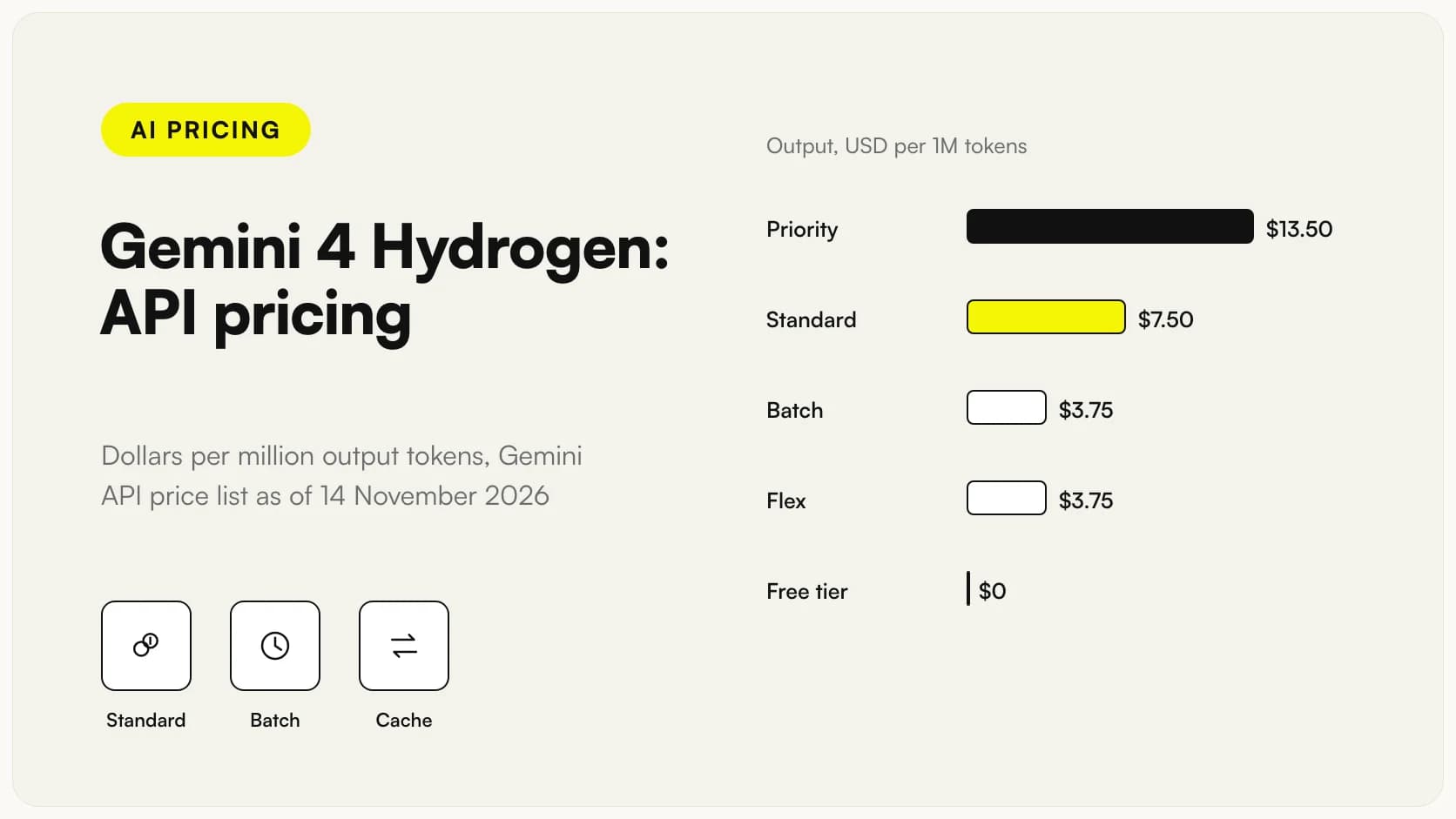
According to the Gemini API price list, Hydrogen costs $1.50 per million input tokens and $7.50 per million output tokens on the paid Standard tier, at the same price across the whole one-million-token window. A free tier also exists, with input and output at zero cost. All processed tokens are billed, including reasoning tokens.
The price list lists $0.75 for input and $3.75 for output on Batch and Flex, and $2.70 and $13.50 on Priority; Carbon and Argon cost $2 and $10 until 30 November 2026 and $4 and $20 from 1 December. The full calculations, with monthly spend examples, are in the guide Gemini 4 Hydrogen pricing; to learn how to estimate a cost in general, see how to calculate the cost of an AI API.
What performance does Google claim for Gemini 4 Hydrogen?
Google says Hydrogen beats Argon on the Artificial Analysis Intelligence Index at the default level (51 vs 50) and reaches 54 at xhigh, while on Terminal-Bench 4.1 it scores 57% against 18.2% for Gemini 3.8 Flash. These figures come from the announcement, not rerun by Giallo.
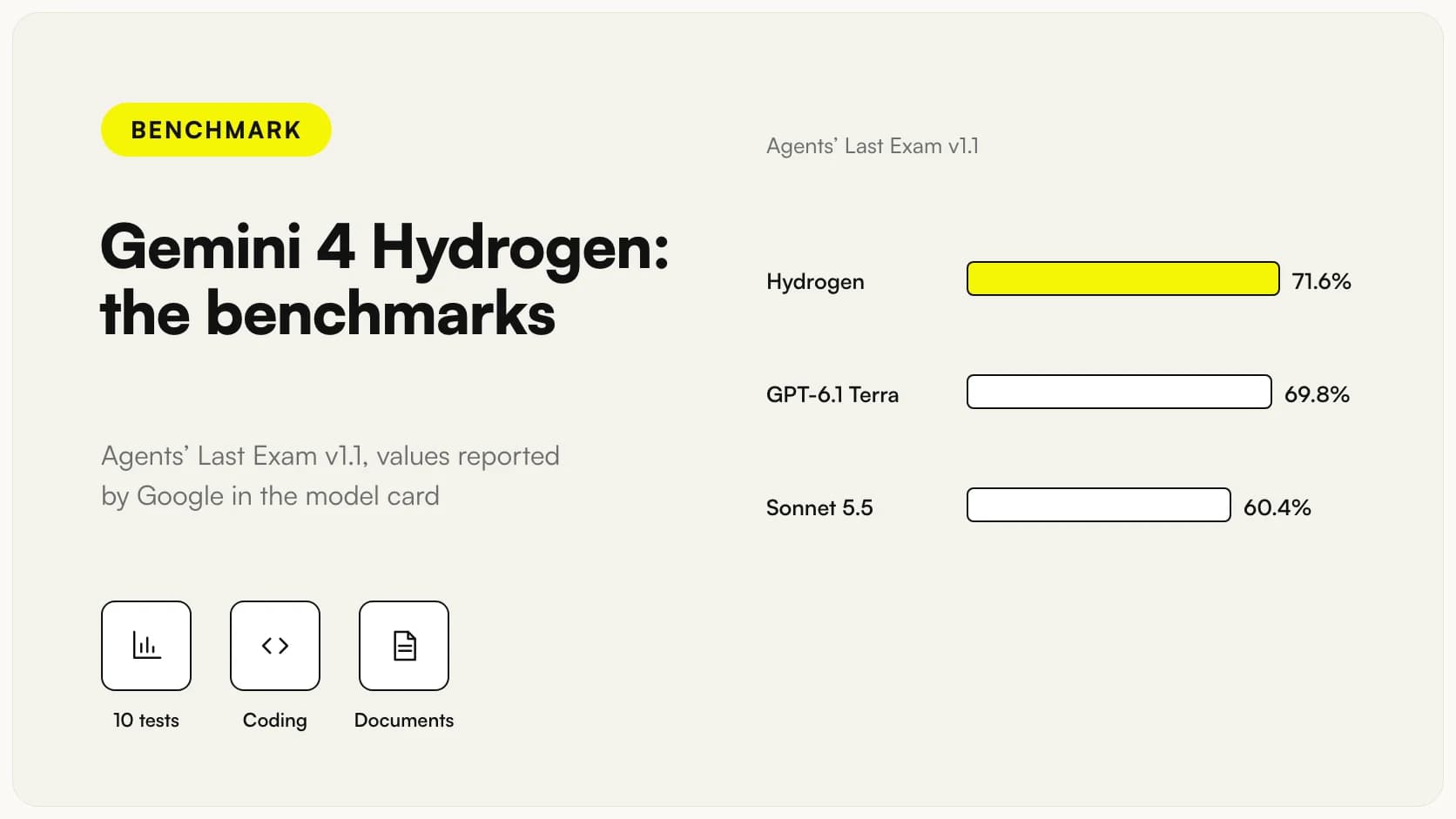
In the model card Google compares Hydrogen with Claude Sonnet 5.5 and GPT-6.1 Terra on ten tests. The model comes first on some, for example HLE-Diamond (58.8%) and Vending-Bench 2, but not on all: on Terminal-Bench 4.1 Sonnet 5.5 is first, and so it is on OSWorld-2.1. The competitors' numbers are mostly stated by the vendors or taken from public leaderboards, and on some tests calculated by Google itself, so they should be read as a direction. The full table, explained test by test, is in Gemini 4 Hydrogen benchmarks.
A method for rerunning the test on your own cases is in Migrating to Gemini 4 Argon: evaluation and testing, and it works for Hydrogen too.
What changes in Google Search with Gemini 4 Hydrogen?
Google has brought Hydrogen to Search for all users and calls it “the biggest model upgrade to Search yet”, the largest model update to Search so far. It states three changes, reported in the Search announcement of 12 November 2026:
- Better understanding of intent: Search handles multi-part questions, typos and very specific requests.
- More visual answers: more images, structured answers, comparison tables and custom tools.
- Broader query fan-out: with query fan-out Google means the technique by which a question is broken down into several simultaneous searches on the various subtopics. With Hydrogen, Google writes, it leads to a broader set of links and helps find sites you might not otherwise have discovered.
Why does it matter for an SME's website? This is our reading: if a multi-part question is broken down into several searches, even a site that answers only one part well can appear among the links. Google does not promise traffic or rankings and does not publish data on the effect in Italy. For the SEO side, see best AI tools for SEO.
How do you use Gemini 4 Hydrogen in daily work? Examples stated by Google
In the announcement, Google cites some concrete uses: they are Google demonstrations, not customer results.
- Complex documents and data. Hydrogen pairs a one-million-token input with an output of up to one million (always within the same shared window) to condense dense PDFs, spreadsheets, charts, and recorded audio and video into reports with citations and structured documents (source: announcement).
- Google Sheets. With Gemini in Sheets, Google says financial data can be turned into interactive models that change based on different forecast scenarios, with outputs more than 30% faster than previous models in the Sheets canvas. For the basics of the product, see Gemini for Google Sheets.
- Drafts and documents. In the Gemini app, Google writes, emails, flashcards and rewrites come back already in the requested format and tone; it can also draw on Gmail and Drive and on connected apps such as Airtable and Dropbox.
- Coding and prototypes. Targeted changes to a repository, debugging, web interfaces and interactive prototypes in fewer prompts. For Google's products for businesses: Gemini for Companies.
- Agents that use tools. Google speaks of a model that picks the right tool and adapts if a call fails or a search comes back empty. What an agent is, is explained in AI Agents: What They Are.
Example costs and privacy rules for an SME are in the guide Gemini 4 Hydrogen for business.
What does Google say about the safety and reliability of Gemini 4 Hydrogen?
Google states that, compared with Gemini 3.8 Flash, Hydrogen cuts overreach in agentic tasks (doing more than was asked) by up to 81% and under-service (doing less) by up to 79%; that it is more than 2.3 times more resistant to indirect prompt injection on the Gray Swan IPI benchmark (Google does not say compared with which model); and that unjustified refusals on HealthBench Pro stay below 0.4%. Source: Google announcement.
The model card is more nuanced. In automated evaluations against 3.8 Flash, safety on images paired with text improves by 7.00 points, while text (+0.80) and multilingual (+1.10) safety stays, according to Google, within confidence margins; unjustified refusals rise by 5.57 points, mostly with multimodal prompts: more useless refusals means, in practice, more legitimate requests that the assistant does not carry out. Among the known limitations, Google lists possible hallucinations, occasional slowness or timeouts, and more tokens consumed at high reasoning levels.
The full safety report is still listed as “coming soon” as of 14 November 2026.
Which terms do you need to read the Gemini 4 Hydrogen announcement?
Six terms recur in the announcement. The definitions are ours, based on the Google pages cited above.
Reasoning level (thinking level)
The setting that controls how much the model “thinks” before answering: low, medium, high (default) or xhigh. Higher means more accuracy on hard tasks, but more time and more tokens paid as output.
Long decode
The mode for generating an output longer than 65,536 tokens, up to 1,048,576 minus the input tokens, via background: true in the Interactions API or with continuation on the software side.
Implicit caching
The automatic reuse of instructions already sent, from 4,096 tokens, with a 95% discount on input (What’s new). Explicit caching, managed by the developer, is not supported.
Query fan-out
The technique by which Google Search breaks a question down into several simultaneous searches on the subtopics. With Hydrogen, Google says, it leads to a broader set of links.
Subagent
A secondary agent to which a coordinator hands part of the work, such as writing or verifying a change. In Google's scheme, Carbon coordinates and Hydrogen powers the subagents.
Context Window
The tokens the model keeps in view in a request. In Hydrogen it is a single window of 1,048,576, shared across input, reasoning and output.
How do you test Gemini 4 Hydrogen on a real process in five steps?
An SME does not need to switch models because a new one has come out: it needs to know whether the new model improves a process that already costs time. The sequence we propose is short and works with any model.
- Choose a process: a repetitive job with a verifiable result, such as summarizing tender specifications, comparing quotes in a spreadsheet or preparing draft replies.
- Collect 15-20 closed cases: with the correct outcome known, including two or three messy or incomplete cases. Do not use personal data on the free tier unless you have checked the terms of your account.
- Test Hydrogen at two reasoning levels: for example
mediumandhigh, and compare quality, time and tokens consumed with what you use today. The cost details are in Gemini 4 Hydrogen pricing. - Check data and permissions: where the documents end up, who can read them, what the agent can do without human confirmation. The GDPR rules are summarized in AI and GDPR.
- Decide with the numbers: if Hydrogen does not improve the process, stay with your current model; if it does, plan the integration.
Anyone with integrations on Gemini 2.5 Pro, 2.5 Flash or Argon should pay particular attention to 1 December 2026 (for 3.8 Flash the date is 1 January 2027, when the price rises to $1.50 and $7.50): from then on, according to the model list, requests automatically move from gemini-2.5-pro to gemini-3.8-flash and from gemini-2.5-flash to gemini-3.5-flash-lite. An automatic model switch is a risk to quality and costs: the checklist is in migrating to Gemini 4 Hydrogen.
How can you evaluate Gemini 4 Hydrogen with Giallo Studio?
Hydrogen is interesting for businesses for a practical reason: it combines a low price, a million tokens of context and adjustable reasoning levels in a model that can be used both through the API and inside widely used products such as Google Sheets and the Gemini app. For complex decisions and very long tasks, Google points to Carbon and Argon.
If you have a candidate process and want to know whether Hydrogen is worth it, with costs calculated on your volumes and a test on real cases, Giallo Studio can prepare a guided evaluation with you: we choose the process together, build the test set, compare Hydrogen with what you use today and hand you numbers and a recommendation. If the goal is instead an agent that works on your tools, the route is Custom AI Agents, with permissions and controls defined before writing code.
Giallo Studio guides: methodology and sources
Want to apply this to your business?In 30 minutes, free of charge: the first process to automate and its estimated return, in writing.
Book the free auditHow we apply it in the company
Related resources
 Gemini 4 Hydrogen pricing: how much the API costs and how to estimate spend
 Gemini 4 Hydrogen vs Carbon and Argon: which Gemini model to choose
 Gemini 4 Hydrogen benchmarks: how it compares with Claude Sonnet 5.5 and GPT-6.1 Terra
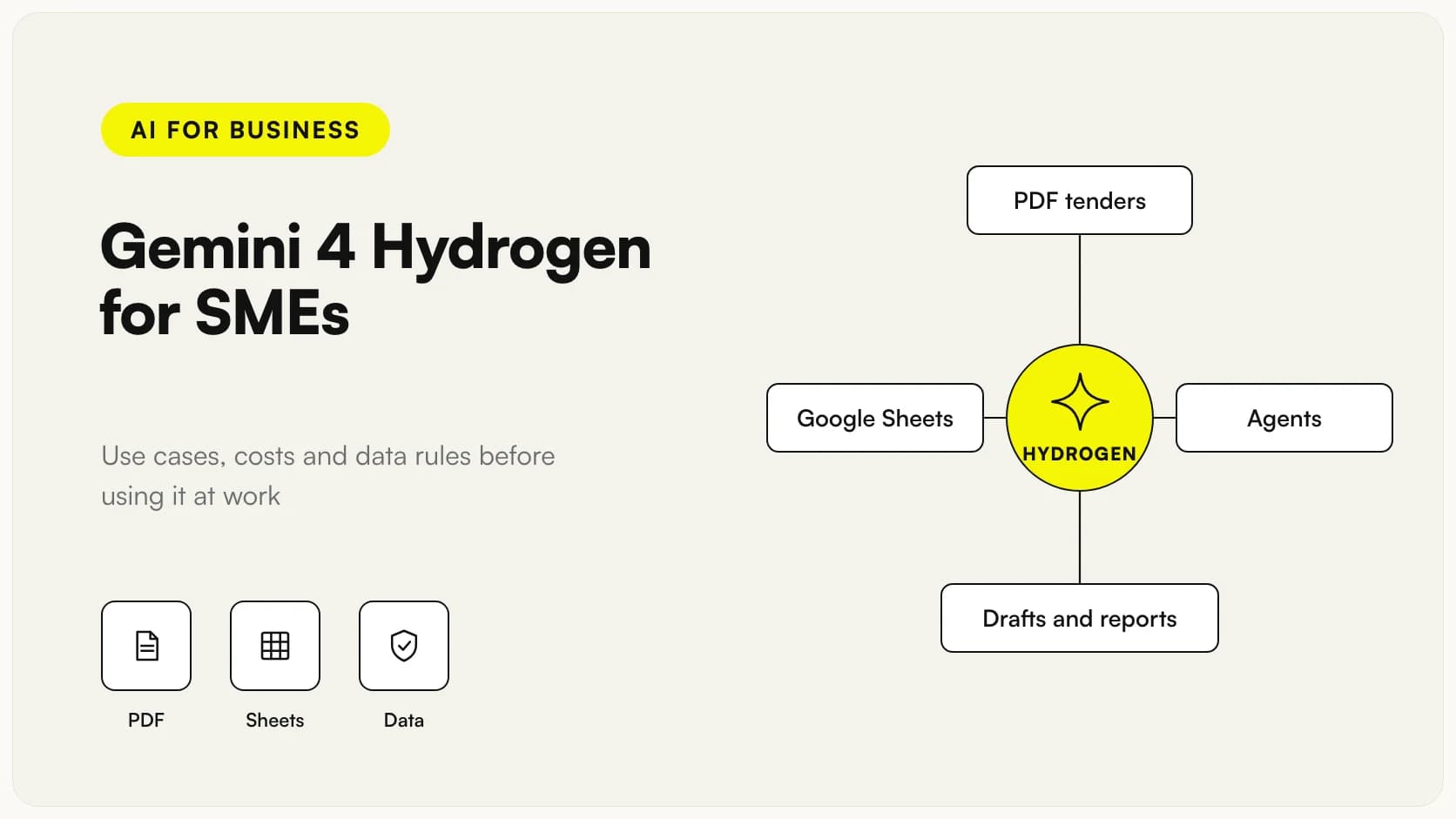 Gemini 4 Hydrogen for business: use cases, costs and data privacy for an SME
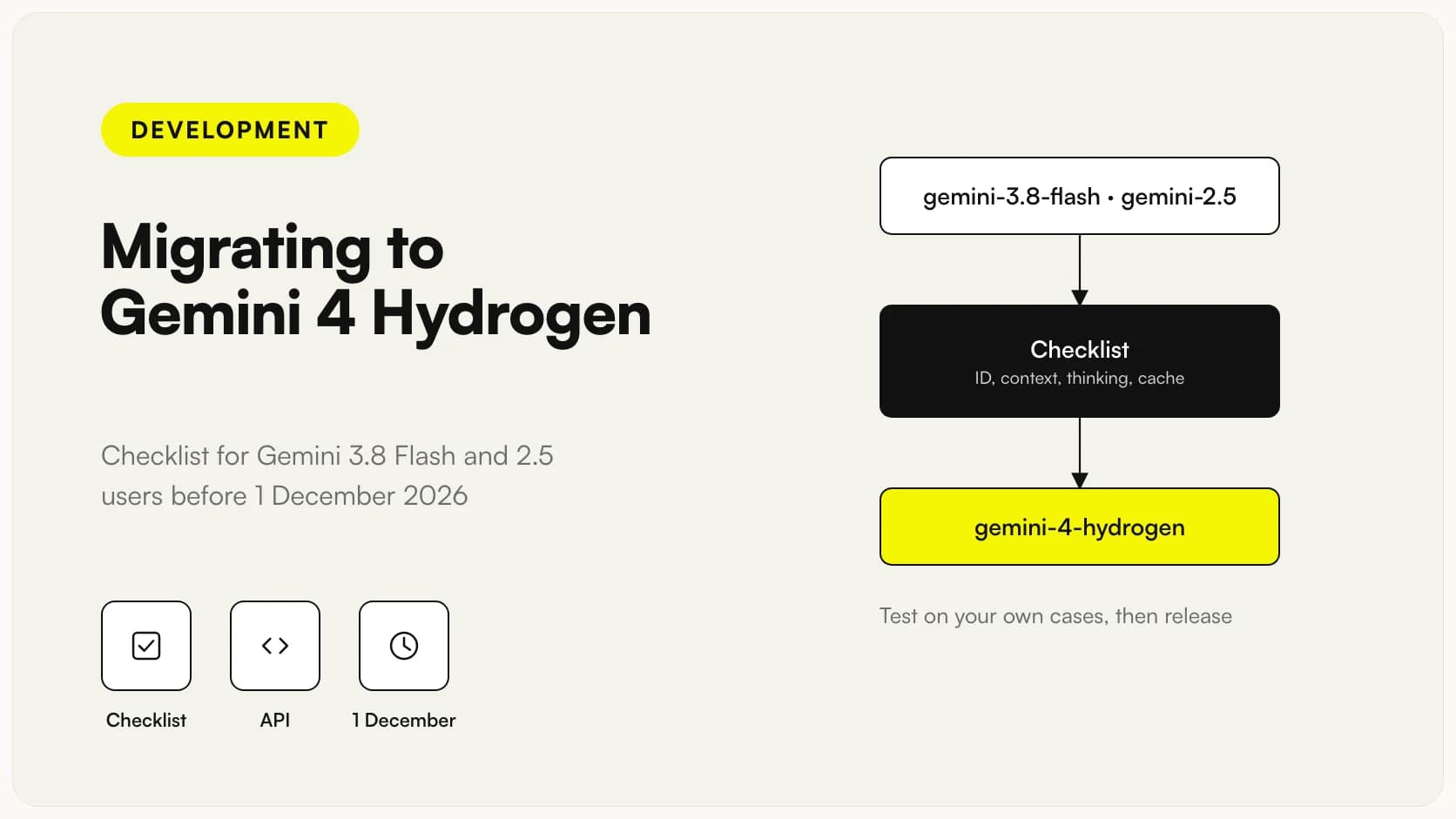 Migrate to Gemini 4 Hydrogen: Checklist From Gemini 3.8 Flash and 2.5 Before 1 December
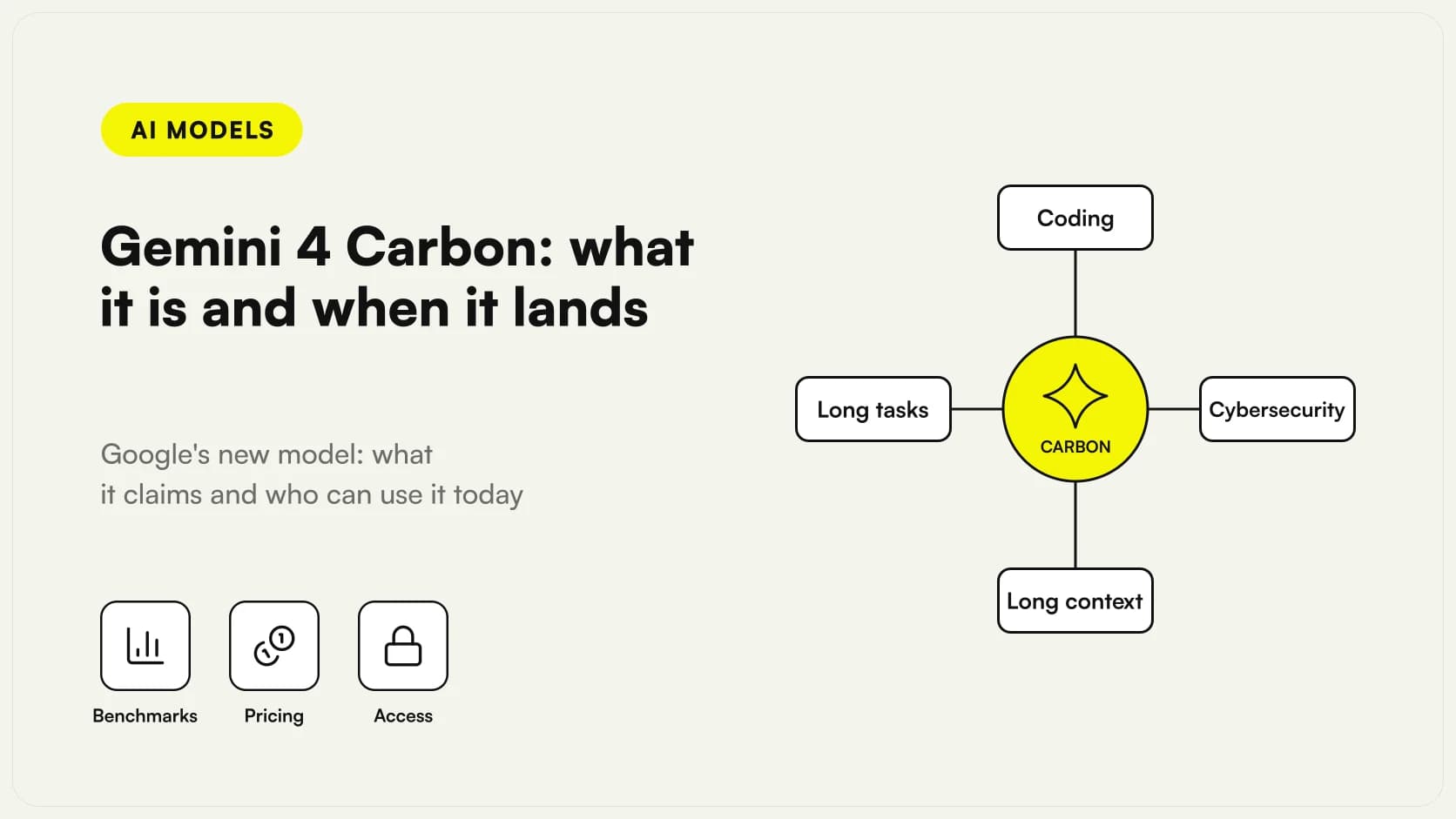 Gemini 4 Carbon: what it is, where it is used and what it costs today
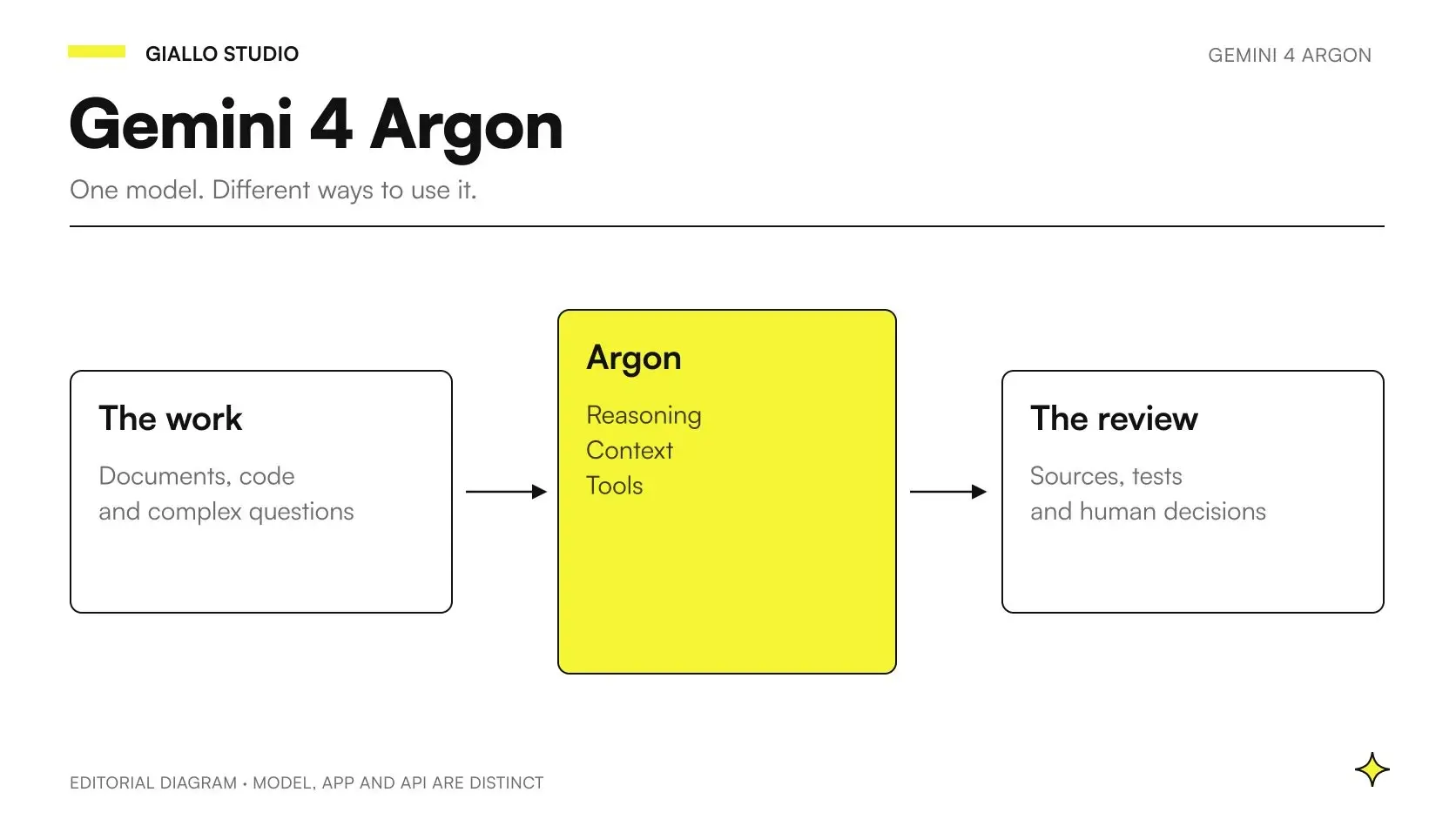 Gemini 4 Argon: what it is, what it does and when to use it in business
 Gemini vs Copilot: Which to Choose
FAQ
What is Gemini 4 Hydrogen?
Gemini 4 Hydrogen is Google's model announced on 12 November 2026, built for rapid execution in everyday coding and agentic workflows. Google describes it as adapted from Gemini 4 Carbon and positions it alongside the two “frontier” models, Carbon and Argon, designed for deeper reasoning.
Is Gemini 4 Hydrogen free?
Partly. The Gemini API has a free tier with input and output at zero cost, but without grounding with Google Search. The paid tier costs $1.50 per million input tokens and $7.50 per million output tokens. In the Gemini app, access depends on the plan: without a subscription, it is reached only through automatic model selection.
Is Gemini 4 Hydrogen available in Italy?
Yes, for the Gemini API: Italy appears in the official list of available countries, and Google speaks of a global rollout for Hydrogen. However, no country list has been published for the Gemini app, nor a specific confirmation of Italian for Google Search, where Google writes “all supported AI Mode languages”, meaning all the languages AI Mode supports. On Agent Platform, the “eu” multi-region is available.
What is the difference between Gemini 4 Hydrogen, Carbon and Argon?
Carbon and Argon are the “frontier” models, for deep reasoning and long tasks. Hydrogen is built to execute quickly, on its own or paired with Carbon and Argon. On the Artificial Analysis index, Google reports 51 for Hydrogen and 50 for Argon, at a lower price: $1.50 and $7.50, against Argon's introductory $2 and $10, which becomes $4 and $20 from 1 December 2026.
How much does Gemini 4 Hydrogen cost via API?
On the paid tier, $1.50 per million input tokens and $7.50 per million output tokens, at the same price across the whole one-million-token window. Reasoning tokens count toward the bill too. The details of the Batch, Flex and Priority tiers are in the pricing guide.
Does Gemini 4 Hydrogen replace Gemini 3.8 Flash?
Google names it as the recommended upgrade from Gemini 3.8 Flash and from the earlier Gemini 3 and 2.5 models. But it is not a zero-cost swap: the model ID, default reasoning level, output handling and caching all change. Before moving an integration to production, test it on your own cases.
What changes in Google Search with Gemini 4 Hydrogen?
Google has brought Hydrogen to Search for all users and calls it the biggest model upgrade to Search yet. It claims better understanding of multi-part questions, more visual answers and a “query fan-out” that links to a wider set of sites. It promises neither traffic nor rankings to any site.
Is company data safe with Gemini 4 Hydrogen?
It depends on the service. In the paid Gemini API services, Google states that it does not use prompts and responses to improve its products and that it processes the data as a processor, under the Data Processing Addendum. In the European Economic Area, Switzerland and the United Kingdom, the paid-service terms also apply to the free tier, but personal and confidential data should still be avoided until you have checked your own case.