
Gemini 4 Hydrogen pricing: how much the API costs and how to estimate spend
Gemini 4 Hydrogen pricing: $1.50 input and $7.50 output per million tokens, Batch at half price, worked examples and spend caps.
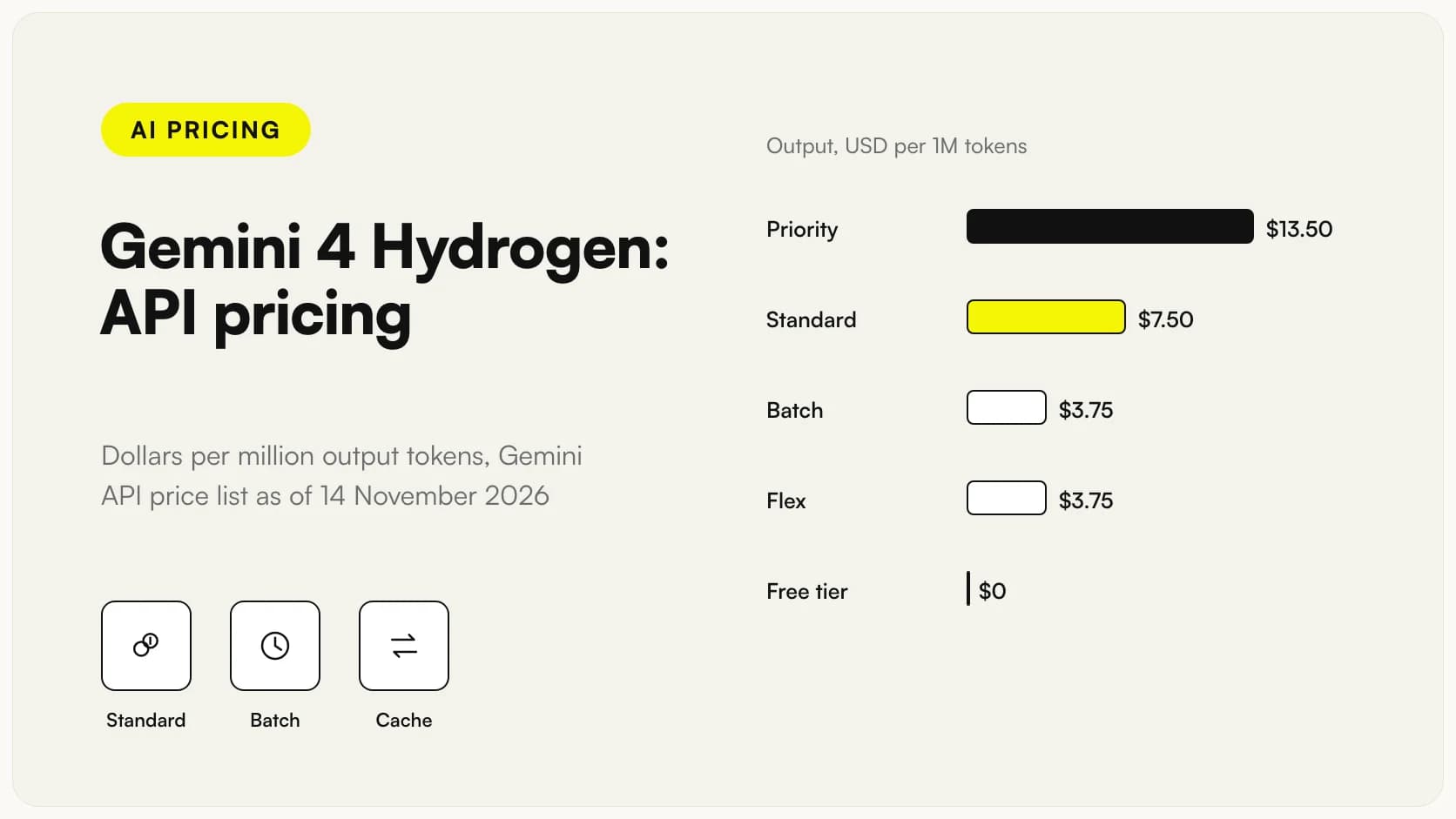
Gemini 4 Hydrogen pricing: in the Gemini API price list checked on 14 November 2026, the model costs $1.50 per million input tokens and $7.50 per million output tokens on the paid Standard tier, with a flat price across the whole 1,048,576-token window and a free tier. Google announced Hydrogen on 12 November 2026. Batch costs half.
The data comes from the official Gemini API price list, the what's-new guide for Hydrogen, the page on usage limits and the additional terms, all checked on 14 November 2026. The model price alone is not enough to predict the bill: reasoning, cache, tools and caps all matter. Prices are in dollars, as in the price list, with no conversion to euros.
In summary
- Hydrogen Standard costs $1.50 per million input tokens and $7.50 for output; input read from the cache costs $0.075.
- Batch and Flex cost $0.75 for input and $3.75 for output; Priority costs $2.70 and $13.50.
- Reasoning tokens are paid for too, counted as output: the reasoning level affects spend.
- Carbon and Argon go up to $4 and $20 on 1 December 2026, while Gemini 3.8 Flash reaches $1.50 and $7.50 on 1 January 2027.
- On the free tier Hydrogen costs nothing, but Batch, Flex and grounding are not available, and data is handled under different rules depending on the country.
To understand what the model is, see Gemini 4 Hydrogen: what it is; for a capability comparison, see Hydrogen vs Carbon and Argon.
How much does the Gemini 4 Hydrogen API cost, tier by tier?
The price list has five tabs for Hydrogen (Standard, Batch, Flex, Priority and Contributor), each with a free-tier column and a paid one. Prices are per million tokens, with input and output separate, and caching applies only in its implicit form. Source: Gemini API price list, 14 November 2026.
| Level | Input | Output (reasoning included) | Cache input |
|---|---|---|---|
| Free | free | free | free |
| Paid Standard | 1,50 $ | 7,50 $ | 0,075 $ |
| Batch | 0,75 $ | 3,75 $ | 0,0375 $ |
| Flex | 0,75 $ | 3,75 $ | 0,0375 $ |
| Priority | 2,70 $ | 13,50 $ | 0,135 $ |
Batch and Flex are not available on the free tier, and the price list states that Batch is 50% cheaper than Standard. There is also a “Contributor” tier, in private preview by invitation, at $0.75 and $3.75: on that tier content is used to improve Google products even if you pay, so it is not a choice for business data.
The price list does not explain what Flex and Priority change in practice for timing and guarantees: read the linked documentation before choosing them. For many SMEs the choice is between Standard, for what is needed right away, and Batch, for bulk jobs.
How do you calculate spend: reasoning tokens, context and tools?
The spend on a request is the sum of three items: input tokens times the input price, output tokens times the output price and, where present, tool requests. The reasoning tokens (the ones the model uses to reason before answering) are not free: the price list counts them as output, and specifies that the internal system instructions of tools and function declarations are also billed when you use grounding.
The first effect is on the reasoning level. Hydrogen has four levels: low, medium, high, the default, and the new xhigh. Google says that xhigh uses more tokens and that on simple prompts it can reason more than necessary (known as overthink). The minimal level returns an error. Source: what's-new guide. The default high is also a cost choice: on simple tasks a lower level reduces output tokens, which cost five times as much as input. Further reading: reasoning effort.
The second is on context. Input, reasoning and output share a single 1,048,576-token window and the price is flat across the whole window, as stated in the announcement of 12 November 2026; the single 1,048,576-token window is also in the what's-new guide. A very long context costs in proportion, with no higher price band, and every token is paid for on every request unless it ends up in the cache. Further reading: AI tokens and context window.
The third is on tools. Grounding with Google Search is not available on the free tier. On the paid tier the first 5,000 requests a month are included, shared across all Gemini 3 and later models; beyond that you pay $14 per 1,000 requests, with a cap of 1,500 requests per day. Grounding with Google Maps has 5,000 shared monthly requests, then $14 per 1,000.
cachedContents): there is only implicit caching, on by default for prompts of at least 4,096 tokens, with a 95% discount on tokens read from the cache. The price list does not say how many prompts will end up in the cache: in your quotes, also calculate the no-savings scenario. Source: what's-new guide.Is Gemini 4 Hydrogen free? What changes with the free tier and with data
Hydrogen is on both the free and the paid tier of Google AI Studio and the Gemini API; on the free tier input, output and cache cost nothing. Source: what's-new guide and price list. The free tier's request and tokens-per-minute limits are not stated on the usage limits, a page that points to AI Studio, where you can see them for your own project.
The price, though, is only half the answer. For the free tier the price list says “Used to improve our products: Yes”, meaning Google can use content and responses to improve its products, and for unpaid services the terms add that human reviewers may read and annotate inputs and outputs. Google asks users not to submit sensitive, confidential or personal information. Source: additional terms.
There is, though, an exception that directly concerns Italy: in the European Economic Area, Switzerland and the United Kingdom, the paid-services terms “How Google uses Your Data” apply to all services, including AI Studio and the free API quota. Under those terms Google does not use prompts, files and responses to improve its products and handles the data under its Data Processing Addendum, with Google acting as processor. For API-based applications serving users in these countries, the terms allow paid services only. Source: additional terms, 14 November 2026.
The free tier is fine for trying things out with test text; for customer data or public applications you need a project with billing enabled. Privacy for businesses: Gemini 4 Hydrogen for business and AI and GDPR. In the Gemini app the model depends on the plan and is not an API price: see Google guide, which applies to personal Google accounts; with a work or school account, models and features depend on the Workspace license.
How does Hydrogen pricing compare with Carbon, Argon, Gemini 3.8 Flash and 3.5 Flash-Lite?
Hydrogen costs less than Carbon and Argon, but it is not the cheapest in the price list. The comparison needs two dates in mind: 30 November and 31 December 2026. Paid Standard prices, per million tokens. Source: price list, 14 November 2026.
| Model | Input | Output | Free tier |
|---|---|---|---|
| Gemini 4 Hydrogen | 1,50 $ | 7,50 $ | Yes |
| Gemini 4 Carbon | $2.00 until 30 November 2026, then $4.00 from 1 December 2026 | $10.00, then $20.00 | no |
| Gemini 4 Argon | $2.00 until 30 November 2026, then $4.00 | $10.00, then $20.00 | no |
| Gemini 3.8 Flash | $0.75 until 31 December 2026, then $1.50 from 1 January 2027 | $3.75, then $7.50 | Yes |
| Gemini 3.5 Flash-Lite | 0,30 $ | 2,50 $ | Yes |
Three takeaways. First: from December, Carbon and Argon cost $4 and $20, which is 2.67 times Hydrogen on both input and output (4 / 1.50 and 20 / 7.50, our calculation). Second: from 1 January 2027 Gemini 3.8 Flash costs the same as Hydrogen, while until 31 December 2026 it costs half; Google lists Hydrogen as the recommended upgrade from 3.8 Flash. Third: 3.5 Flash-Lite is the cheapest of the models in the table, at $0.30 and $2.50, and Google describes it as its fastest and lowest-cost model; it is, however, a model from a different tier, for high volumes and simple tasks.
The price per token, though, is not the cost of the work: different models use different amounts of reasoning tokens for the same task. Google states that, in early partner tests on complex graphs, SQL and data-heavy enterprise workflows, Hydrogen reduced tokens by 12-23% compared with 3.8 Flash (figure from the announcement, not re-run by Giallo). The real cost is measured on your own cases. To choose a model, see Hydrogen vs Carbon and Argon; the price lists for the other two are in Carbon pricing and Argon costs.
How much does it cost to regenerate 2,000 e-commerce product pages in Batch?
This is an example calculation, with token counts we assumed, not a real case or a measured result. Prices from the price list of 14 November 2026.
An online store rewrites 2,000 product pages, once. Assumptions: each request has 1,200 input tokens (instructions, style rules and product data) and 2,000 output tokens, of which 600 are the page text and 1,400 are reasoning. Totals: 2,000 × 1,200 = 2,400,000 input tokens; 2,000 × 2,000 = 4,000,000 output tokens.
| Item (example calculation) | Calculation | Total |
|---|---|---|
| Batch, input | 2.4 million × $0.75 | 1,80 $ |
| Batch, output | 4 million × $3.75 | 15,00 $ |
| Batch, total | 1,80 $ + 15,00 $ | 16,80 $ |
| Standard, input | 2.4 million × $1.50 | 3,60 $ |
| Standard, output | 4 million × $7.50 | 30,00 $ |
| Standard, total | 3,60 $ + 30,00 $ | 33,60 $ |
| Carbon from December, total | 2,4 × 4 $ + 4 × 20 $ = 9,60 $ + 80,00 $ | 89,60 $ |
| Flash-Lite, total | 2,4 × 0,30 $ + 4 × 2,50 $ = 0,72 $ + 10,00 $ | 10,72 $ |
How to read it. With Batch the rewrite costs $16.80, or $0.0084 per page (16.80 / 2,000); with Standard it costs $33.60. Almost the whole bill is output ($15.00 of $16.80): cutting unnecessary reasoning is worth more than shortening the instructions. Carbon and Flash-Lite use the same assumed tokens, which in reality would differ.
Two caveats on limits. For Hydrogen the queued-token cap in Batch is 3,000,000 at Tier 1, 400,000,000 at Tier 2 and 1,000,000,000 at Tier 3 (usage limits): the 2.4 million input tokens are under the Tier 1 cap, but the page does not explain whether output is also counted, so to be safe output is counted too: 6.4 million tokens in all, and two batches of 1,000 pages would have 3.2 million each, over the cap. Split it into three batches of about 670 pages (about 2.1 million tokens each, output included), launched one after another: the cap applies to all active jobs together. And on Standard the Tier 1 spend limit is $10 every 10 minutes: at $0.0168 per page (3.60 + 30.00, divided by 2,000 requests) that is about 595 pages every 10 minutes. A bulk job on Standard therefore has to be spread over time; the page does not say whether the spend limit also applies to Batch.
How much does an internal document assistant cost with implicit caching?
This is also an example calculation with our own assumptions. An assistant answers employees' questions on manuals and procedures. Assumptions: 150 questions a day for 22 working days, or 3,300 questions a month; each request has 40,000 input tokens, of which 30,000 are always the same block of manual; output is 1,000 tokens, reasoning included. Totals: 3,300 × 40,000 = 132,000,000 input tokens; 3,300 × 1,000 = 3,300,000 output tokens. All on Standard, price list of 14 November 2026.
| Scenario (example calculation) | Calculation | Monthly Total |
|---|---|---|
| No cache hits, input | 132 million × $1.50 | 198,00 $ |
| Output, in both scenarios | 3.3 million × $7.50 | 24,75 $ |
| No cache | 198,00 $ + 24,75 $ | 222,75 $ |
| With cache, 30,000 tokens per request cached | 3,300 × 30,000 = 99 million × $0.075 = $7.43 | 7,43 $ |
| With cache, 10,000 tokens per request not cached | 3,300 × 10,000 = 33 million × $1.50 | 49,50 $ |
| With cache | 7,43 $ + 49,50 $ + 24,75 $ | 81,68 $ |
The result: $81.68 against $222.75, a saving of $141.07 a month under the most favorable assumption, in which every request finds the block in the cache. Per question: $0.0675 without cache, about $0.0248 with cache. Amounts with cache are rounded to the cent.
Two caveats. Implicit caching switches on by itself and the price list does not guarantee when: the result depends on how similar the requests are. A document assistant has costs beyond the model, such as searching the archive: see RAG: what is it.
Which spending caps and limits should you plan for?
The Gemini API has usage levels (tiers) that depend on billing and spending history. Source: usage limits, 14 November 2026.
| Level | Requirement | Tier spend cap | 10-minute spend limit |
|---|---|---|---|
| Free | active project or trial | not applicable | not applicable |
| Tier 1 | billing account linked and active | 250 $ | 10 $ |
| Tier 2 | $100 paid and 3 days since the first payment | 2.000 $ | 200 $ |
| Tier 3 | $1,000 paid and 30 days since the first payment | from $20,000 to over $100,000 | 200 $ |
The 10-minute limit applies over a rolling window. If you exceed it, the API responds with 429 RESOURCE_EXHAUSTED: Google suggests waiting and retrying, reducing expensive requests or asking for an increase. The page specifies that how these limits are enforced depends on billing history and account status.
For an SME this means two things: production software must handle the 429 error with a delayed retry, and a peak like the 2,000 product pages must be planned, because at Tier 1 the limit of $10 in 10 minutes is reached quickly. General method: cost of AI API. Prices on Gemini Enterprise Agent Platform are not covered.
How do you estimate monthly Hydrogen spend in five steps?
- Measure the tokens of a typical request. Run 20 representative requests in AI Studio (with test data, or from a project with billing enabled) and note input, reasoning and output: the average is the basis of the calculation, not an assumed number.
- Choose the reasoning level for each task. Try
low,mediumandhighon the same cases and keep the lowest level that holds up on quality; usexhighonly where needed. - Multiply by volume. Tokens per request × requests per month / 1,000,000 × price, keeping input and output separate as in the examples above.
- Separate what can go to Batch. Everything that is not needed right away (rewrites, classifications, overnight summaries) costs half, in Batch.
- Add tools and margin. Grounding beyond the 5,000 monthly requests, a margin for peaks and a comparison with the cap of your tier (usage limits).
Which estimation mistakes blow the budget?
Five mistakes come up again and again in estimates.
- Counting only the visible output. Reasoning tokens are paid for as output: a 600-token answer can cost 2,000.
- Counting on a cache that is not there. With implicit caching only, the 95% saving depends on the shape of the requests.
- Budgeting on the introductory price. Carbon and Argon's $2 and $10 end on 30 November 2026, and 3.8 Flash's $0.75 and $3.75 on 31 December 2026: an annual budget uses full prices.
- Sending customer data to the free tier. It costs nothing, but outside the EEA, Switzerland and the United Kingdom the data may be used to improve products, and for apps aimed at users in these areas the terms allow paid services only: see the terms.
- Ignoring the limits. Without handling of the 429 error, a bulk job stops halfway.
Where should you start with Hydrogen and costs?
The price list says $1.50 and $7.50 per million tokens, half that in Batch; the real cost is decided by reasoning, cache and volumes. It is best to measure on 20 real cases, choose the lowest reasoning level that holds up and only then multiply. The benchmarks are in Gemini 4 Hydrogen benchmarks; if you already have integrations to update, including for the automatic switch of Gemini 2.5 Pro and 2.5 Flash on 1 December 2026, you will find the steps in migrating to Gemini 4 Hydrogen. For the budget of an AI project, see how much AI costs a business, and for the technical side, see AI APIs: What They Are.
Giallo Studio guides: methodology and sources
Want to apply this to your business?In 30 minutes, free of charge: the first process to automate and its estimated return, in writing.
Book the free auditHow we apply it in the company
Related resources
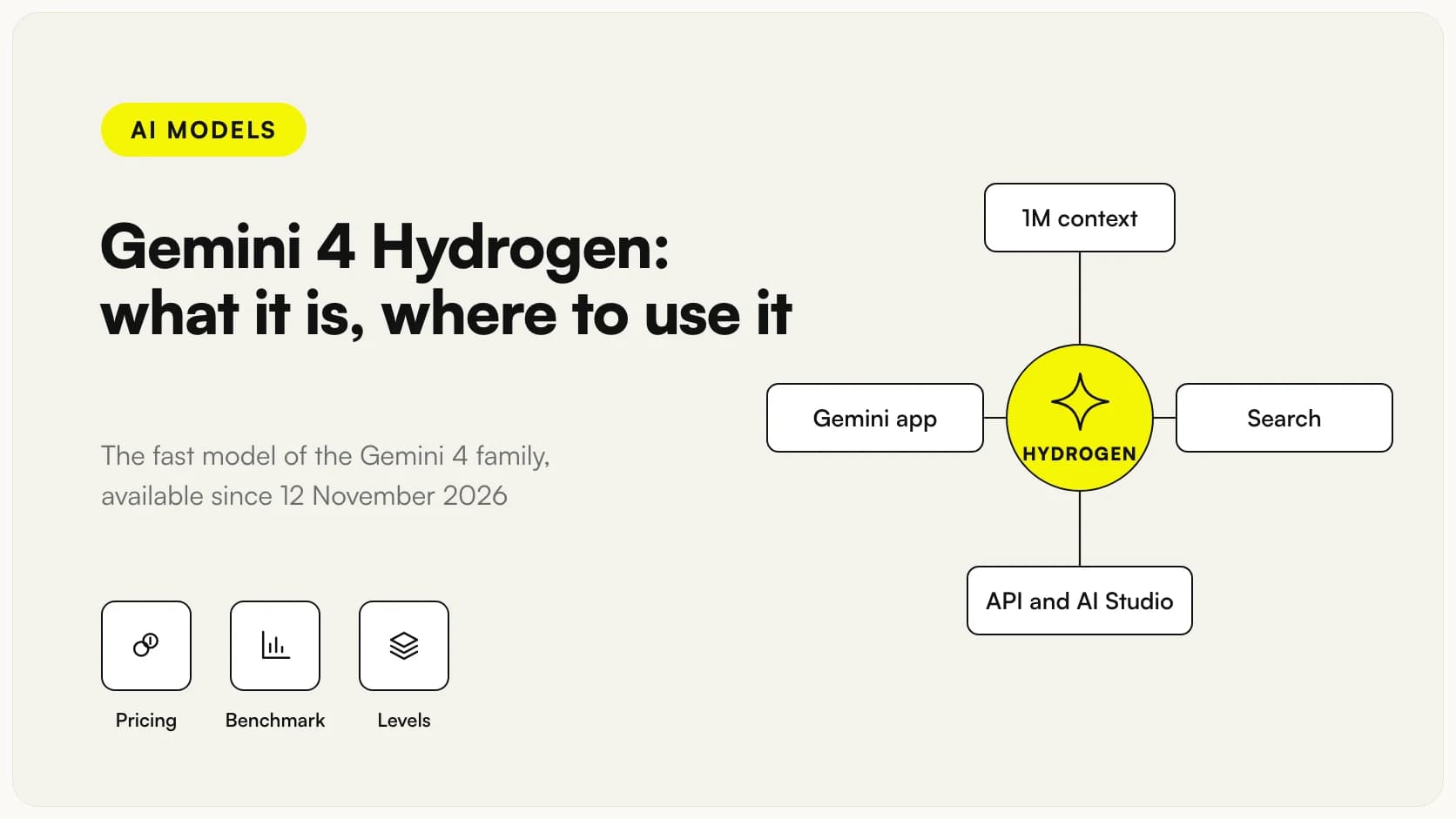 Gemini 4 Hydrogen: What It Is, How It Works, Where to Use It
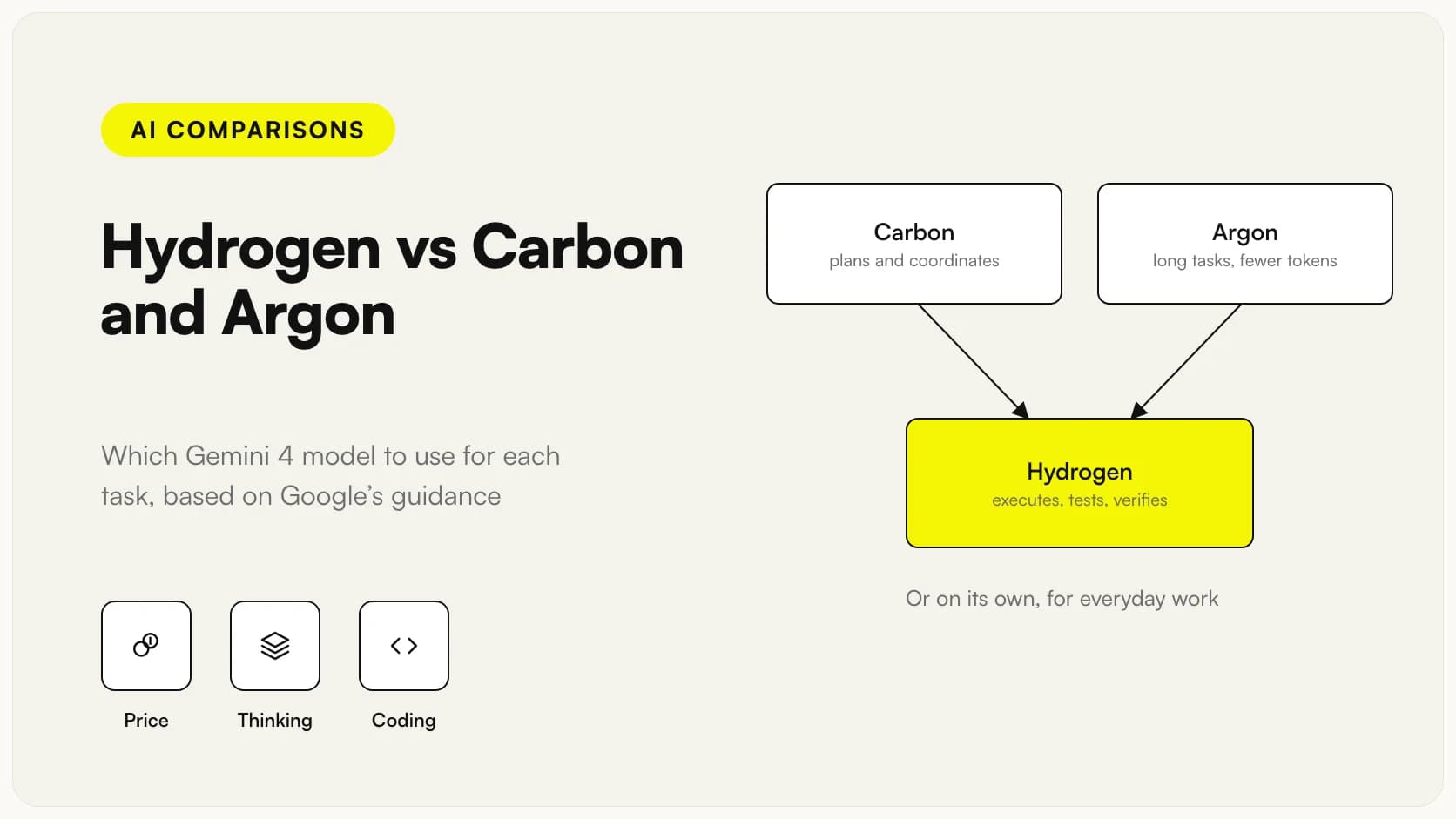 Gemini 4 Hydrogen vs Carbon and Argon: which Gemini model to choose
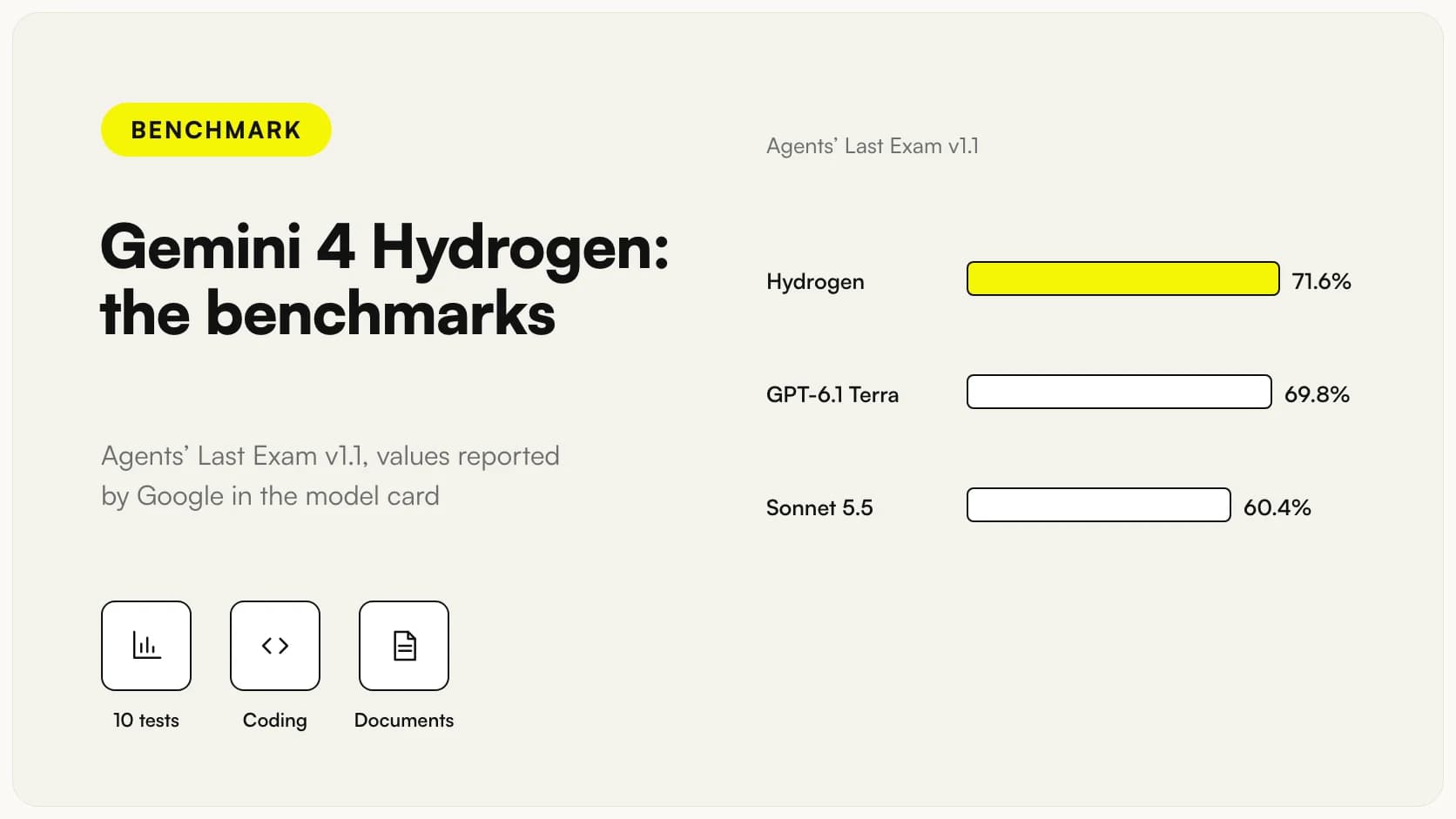 Gemini 4 Hydrogen benchmarks: how it compares with Claude Sonnet 5.5 and GPT-6.1 Terra
 Gemini 4 Hydrogen for business: use cases, costs and data privacy for an SME
 Migrate to Gemini 4 Hydrogen: Checklist From Gemini 3.8 Flash and 2.5 Before 1 December
 Gemini 4 Carbon pricing: API cost per million tokens and comparison
 Gemini 4 Argon: API pricing and business cost calculations
 AI API costs: how to calculate them
FAQ
How much does the Gemini 4 Hydrogen API cost?
On the paid Standard tier it costs $1.50 per million input tokens and $7.50 per million output tokens, reasoning included. Tokens read from the cache cost $0.075. The Google price list checked on 14 November 2026 applies no different price bands above a certain context length.
Is Gemini 4 Hydrogen free?
Partly, yes. The Gemini API and Google AI Studio have a free tier, with limits you can read in AI Studio. The free tier does not include grounding with Google Search and Maps, nor Batch and Flex. In the European Economic Area the paid-services terms on data apply anyway.
How much does Gemini 4 Hydrogen cost in Batch?
It costs $0.75 per million input tokens and $3.75 for output, half the Standard price. Cache in Batch is $0.0375. Batch is not available on the free tier.
Are reasoning tokens paid for?
Yes. Google counts and bills every token the model processes, including reasoning tokens, which fall under the output price. That is why the reasoning level you choose (low, medium, high, xhigh) changes the bill as well as the quality.
Is Gemini 4 Hydrogen cheaper than Carbon and Argon?
Yes. At $1.50 and $7.50 it costs less than Carbon and Argon, which from 1 December 2026 go to $4 for input and $20 for output; until 30 November 2026 their introductory price is $2 and $10. The final cost also depends on the reasoning tokens each model uses.
How much does grounding with Google Search cost for Hydrogen?
On the paid tier, 5,000 requests a month are included, shared across all Gemini 3 and later models. Beyond that, the price list shows $14 per 1,000 requests, with a cap of 1,500 requests per day. Grounding is not available on the free tier.
What happens if I exceed the API spend cap?
If you exceed the 10-minute spend limit ($10 at Tier 1), the API returns a 429 RESOURCE_EXHAUSTED error; whether and how it applies depends on billing history and account status. Each tier also has a spend cap ($250 at Tier 1, $2,000 at Tier 2): the limits page does not describe what happens when it is reached.
Can I use the free tier with customer data?
No. Outside the European Economic Area, Switzerland and the United Kingdom, the free tier may use content and responses to improve Google products. In the European Economic Area the paid-services terms apply to the free tier too. For customer data, it is still prudent to move to a project with billing enabled.