
AI tokens: how they are counted and priced in October 2026
AI tokens explained with an Italian-language test: how many words 1,000 tokens represent, October 2026 per-million prices and how to estimate costs.
Reading time: 10 min
The AI tokens are the pieces of text in which a linguistic model such as ChatGPT, Claude or Gemini breaks everything it reads and writes: whole words, fragments of words, spaces and punctuation. Tokens measure two concrete things: how much text the model holds in a request and how much you pay using it via API.
A clarification, since the word is the same: here we talk about the tokens of language models, not the tokens of cryptocurrencies, which are digital tokens registered on a blockchain and with artificial intelligence do not have anything to do with it.
For Italian we measured three business texts with the OpenAI's official tokenizer: 1,000 tokens were about 580 words. Below you will find the test, the prices of October 2026 and the formula for estimating the expenditure before leaving.
In summary
- A Token is a fragment of text: the short and frequent words are worth one token, the others are broken into several pieces.
- In our test 1,000 tokens correspond to about 610 Italian words; the same email in English required a quarter less tokens.
- The context window is the cap of tokens per request, including response: in October 2026 the main models reach about one million.
- Via API you pay apart from the Input token and those outgoing, more expensive; reasoning is paid for as an exit.
- Monthly spending is estimated first: requests per month per token on demand per price.
What are AI tokens, concretely
A language model does not read letters or words. Before processing a text it converts it into tokens, i.e. recurring character sequences taken from a fixed vocabulary, each with a number that identifies it (OpenAI tokenizer page). Very frequent sequences become a token only, the others are broken.
An example measured on October 3, 2026 with the OpenAI tokenizer, setting 'GPT-5.x & O1/3':
- Italian, «The updated quote is attached to the invoice.»: 13 tokens, i.e. Il . prevent . ivo . update . ato . is . in . alleg . ato . alla . fatt . ura and the final point.
- English, «The updated quotas is attached to the invoice.»: 9 tokens, one per word plus the point.
The length of the word is not enough to predict the bill. Half sentence «automatically» is a token only (with the capital at the beginning of the sentence becomes two), while «Good morning» is worth four (Bu . ong . ior . no): it weighs how often a sequence appeared in the texts used to construct the vocabulary.
Each model family has its own tokenizer: Anthropic, for example, writes that the one introduced with Claude 4.7 produces about 30% more tokens than the previous one at the same text (prices Claude). The answer is also born one token at a time, so it appears in pieces on the screen. The rest of the mechanism is in What are LLMs.
How many Italian words are 1,000 tokens?
The manufacturers' practical rules are written for English. OpenAI indicates about 4 characters per token, i.e. 100 tokens for about 75 words (OpenAI tokenizer). Google writes that 100 tokens are worth 60-80 English words (tokens in Gemini). Anthropic gives 0.75 words per token in English and warns that the count varies by language (prices Claude). In the official pages that we have consulted no one publishes a value for Italian.
So we measured the three typical texts of an SME, plus the same email translated into English, with the OpenAI tokenizer (option ‘GPT-5.x & O1/3’) on October 3, 2026.
| Test text | Words | Tokens | Tokens every 100 words | Words for every 1,000 tokens |
|---|---|---|---|---|
| Email to a customer about a maintenance contract | 123 | 199 | 162 | 618 |
| Product sheet of an e-commerce | 95 | 165 | 174 | 576 |
| Contract Confidentiality Clause | 99 | 153 | 155 | 647 |
| Total of the three Italian texts | 317 | 517 | 163 | 613 |
| The same email in English | 127 | 148 | 117 | 858 |
Three practical readings. In Italian 1,000 tokens are worth between 575 and 650 words, depending on the type of text. To switch from words to tokens just multiply the words by 1.6-1.7. And the same email cost 199 tokens in Italian versus 148 in English, 34% more: the Italian words, longer and full of endings, are broken more often (counting with the OpenAI tokenizer).
These remain estimates because Claude and Gemini use different tokenizers. For an actual quote, count tokens with the chosen provider’s tool: Anthropic’s token-counting API (Claude context windows) or the functions described by Google in the aforementioned page.
What is the context window (and why it matters)
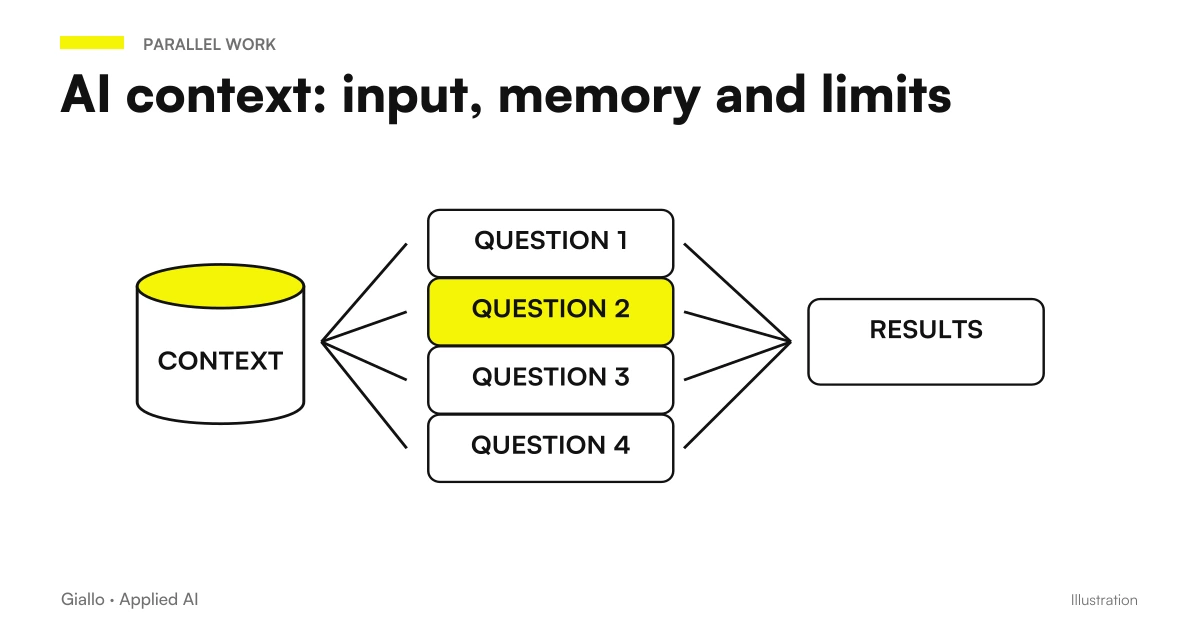
The context window is the maximum number of tokens a model considers in a single request: instructions, previous messages, attached documents and images and response, including reasoning (Claude context windows). If the input alone exceeds the limit, the API rejects the request with the error "prompt is too long"; chat apps can instead get older parts of the conversation out of the window.
| Models, October 2026 | Context Window | Maximum response | Source |
|---|---|---|---|
| GPT-6 Astra, GPT-6.1 Sol, GPT-6 Luna | 1,050,000 tokens | 128,000 tokens | OpenAI Models |
| Claude Fable 5.1, Opus 5.5, Sonnet 5.5 | 1,000,000 tokens | 128,000 tokens | Models Claude |
| Claude Haiku 4.5 | 200,000 tokens | 64,000 tokens | Models Claude |
| Gemini 3.1 Pro (Preview), Gemini 3.8 Flash | 1,048,576 tokens | 65,536 tokens | Gemini 3.1 Pro, Gemini 3.8 Flash |
A million tokens is a lot: Anthropic estimates it in about 555,000 words with its current tokenizer (Claude models). Images and audio also become tokens: Gemini counts 258 tokens for an image up to 384 pixels on the side and 32 tokens for each second of audio (tokens in Gemini), while for Claude a photo from 1000 per 1000 pixels is worth 1,296 tokens (Vision in Claude).
Filling the window, however, is not free or always useful: Anthropic warns that, with the growth of tokens, accuracy and ability to recall details worsen, a phenomenon that calls context rot (context windows). How much context you really need is the theme of context window: how much it really matters.
How tokens determine the cost of AI APIs
When a model works inside a software, an automation or an agent, it is paid on consumption with two rates: the Input token (instructions, question, documents, history) and the Outgoing Token (the answer), which cost five or six times as much. The mechanism, voice by voice, is in price per million tokens explained.
Prices in dollars per million tokens, verified on the official pages on October 3, 2026: they are those of the guide to Best Artificial Intelligence, plus three economic models.
| Model | Entrance | Exit | Long Background |
|---|---|---|---|
| GPT-6 Astra (OpenAI) | 10 $ | 50 $ | over 272,000 tokens: $20 / $75 |
| GPT-6.1 Sol (OpenAI) | 2 $ | 10 $ | over 272,000 tokens: $4 / $15 |
| GPT-6 Luna (OpenAI) | 0,10 $ | 0,50 $ | over 272,000 tokens: $0.20 / $0.75 |
| Claude Fable 5.1 (Anthropic) | 10 $ | 50 $ | same price up to 1 million |
| Claude Opus 5.5 (Anthropic) | 4 $ | 20 $ | same price up to 1 million |
| Claude Sonnet 5.5 (Anthropic) | 2 $ | 10 $ | same price up to 1 million |
| Claude Haiku 4.5 (Anthropic) | 1 $ | 5 $ | 200,000 Token Window |
| Gemini 3.1 Pro, preview (Google) | 2 $ | 12 $ | over 200,000 tokens: $4 / $18 |
| Gemini 3.8 Flash (Google) | 0,75 $ | 3,75 $ | until December 31, 2026, then $1.50 / $7.50 |
Sources: OpenAI prices, prices Claude, Gemini API Pricing. Lists change often: before a quote check the official page. Prices and caches of GPT-6 Sol, the previous version of 6.1 Sol, and GPT-6 Luna are in GPT-6 Sol and Luna pricing.
Three details affect the bill more than list prices:
- Reasoning is paid for as an exit, both from OpenAI and Anthropic, even when you don't see it (OpenAI, Anthropic); on Opus 5.5 it is always active and adjusts with effort, as the guide to Opus 5.5 Reasoning Levels.
- The cache costs a lot less. On Claude rereading from the cache a text already sent costs 10% of the entry price on Sonnet 5.5 and Haiku 4.5, 5% on Opus 5.5 and 2.5% on Fable 5.1 (prices Claude); on GPT-6.1 Sol 0.10 $ instead of 2 $ (OpenAI prices).
- Non-urgent jobs cost half as much: OpenAI and Anthropic discount batch processing by 50%, with deferred results (same price pages).
How do you estimate the cost of an SME case?
The formula is only one:
costo al mese = richieste al mese × (token in ingresso × prezzo ingresso + token in uscita × prezzo uscita) ÷ 1.000.000
Let's take an example: a spare parts distributor receives 3,000 emails a month to the commercial address and wants AI to sort them (order, claim, request for quote) and prepare a draft response. Hypothesis: 1,000 incoming tokens per email, including 600 instructions and 400 messages, and 200 response tokens. In a month they make 3 million tokens in input and 600,000 in output.
| Model | Input, 3 million tokens | Release, 600,000 tokens | Total per month |
|---|---|---|---|
| GPT-6 Luna | 0,30 $ | 0,30 $ | 0,60 $ |
| Gemini 3.8 Flash | 2,25 $ | 2,25 $ | 4,50 $ |
| Claude Haiku 4.5 | 3 $ | 3 $ | 6 $ |
| GPT-6.1 Sol or Claude Sonnet 5.5 | 6 $ | 6 $ | 12 $ |
| Claude Opus 5.5 | 12 $ | 12 $ | 24 $ |
| GPT-6 Astra or Claude Fable 5.1 | 30 $ | 30 $ | 60 $ |
The calculation tells us two things. There is a factor of one hundred between the cheapest and most expensive models, so model choice matters more than any fine-tuning of the prompt. Even in the most expensive case, token spending remains modest: in a real project, development, checks and the time spent reviewing drafts usually cost more. Two caveats: reasoning models produce more than the 200 visible output tokens, and from January 2027 Gemini 3.8 Flash doubles its price (Gemini API Pricing).
For a more detailed calculation, with evidence and margins, there is cost of AI APIs: how to really calculate; to choose the model of each step, best AI model for use case and the overview of Main AI Models.
Three office jobs measured in tokens
Study of accountants, summaries of contracts. A 10,000-word contract, at the average ratio measured in our test (about 1.6 tokens per word), is worth about 16,000 tokens. Summarizing 200 per month means 3.2 million incoming tokens: with Claude Sonnet 5.5 is $6.40 plus the answers. If a search system switches to the model only the clauses it serves, say 2,000 tokens per contract, the entry drops to $0.80. The method is called RAG and also helps quality, because the model reads less irrelevant text.
E-commerce, product cards. For 800 cards of 120 words you need about 168,000 tokens out, at 1.75 tokens per word as in our test card: with Claude Haiku 4.5 they are $0.84 in all. Here the yield counts, not the expense: better to invest tokens in a well-written example card inside the prompt, which the model imitates.
Service company, customer assistant in chat. Each new message sends the entire history back to the model (Claude context windows). With instructions of 1,500 tokens and 300 tokens more at each exchange, the requested tenth starts from 4,500 tokens and the whole conversation consumes 31,500, not the 18,000 that would be multiplying the first by ten. On Claude Sonnet 5.5 the instructions read from the cache cost a tenth (prices Claude).
Reuse of context can change the cost of read tokens, but you need to measure the readings actually served by the cache. Claude Sonnet 5.5 prompt caching price is about cache reading: ordinary input, writing, and output remain distinct entries.
Where Tokens Waste Without Realizing It
- Counting words instead of tokens. In our test 100 Italian words are worth 155 to 174 tokens: a quote made on the words underestimates the expense.
- Attach the entire document to each call. A fifty-page PDF sent back to each question multiplies the entry: just the relevant pages, or the cache, are enough.
- Forgetting exit and reasoning. They are the most expensive part of the bill: a cap on response length (max_tokens in Anthropic’s APIs, max_output_tokens in OpenAI’s) is the first way to save.
- Use the top model for everything. To sort messages it is better to try the small model first and only go up if it is wrong.
- Ignore long context thresholds. With the GPT-6 models over 272,000 incoming tokens the entry costs double and the exit one and a half times, with Gemini 3.1 Pro the threshold is at 200,000 tokens, while Claude maintains the standard price up to one million (OpenAI prices, Gemini API Pricing).
How to keep tokens under control in a business project
- Measure twenty true requests with the provider's tool: OpenAI's tokenizer, Claude's counting API or Gemini's.
- Apply the formula with the prices of the day and add a margin for spikes and reasoning.
- Assign a model to each task: sorting and extracting data to the economic model, the delicate decisions to the flagship one.
- Reduce Context: only the useful parts of the documents, and cache instructions that do not change.
- Check real consumption in the first month: APIs report the tokens of each response, compare them with the estimate.
To write short instructions that do not lose precision helps the prompt engineering; to understand how a model enters a management software or a site there is the guide to AI API.
For very circumscribed tasks, the comparison may include APIs dedicated to the decision. Perplexity Decider to classify tickets returns structured choices or scores: the model rate is only a part of the cost, along with verifications, errors and human escalation.
The account to be made before connecting a model
Tokens decide how much text you can give to a model at once and how much you pay at the end of the month. In Italian they need more than in English, about 1.7 per word in our test, and between one model and another the price also changes a hundred times. The first step of a serious project is a written estimate: volumes, tokens per request, model for each task. Costs and priorities of wider adoption are in the guide AI for businesses; how the same models differ in speed explains it time to first token.
If you are evaluating an assistant or agent and want to know how much it will cost you each month first, Giallo Studio starts right from this calculation, with your actual volumes, before writing a line of code.
Giallo Studio guides: methodology and sources
How we apply it in the company
Related resources
 Price per million tokens explained
 Context Window: How Much It Really Matters
 AI API costs: how to calculate them
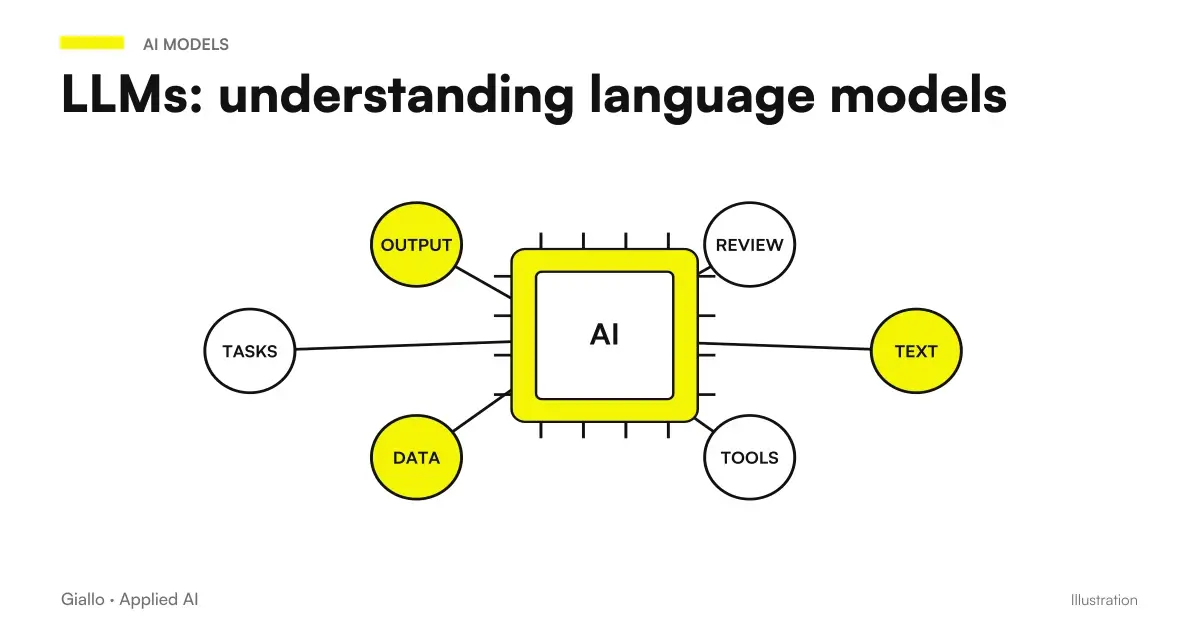 LLM: What Language Models Are
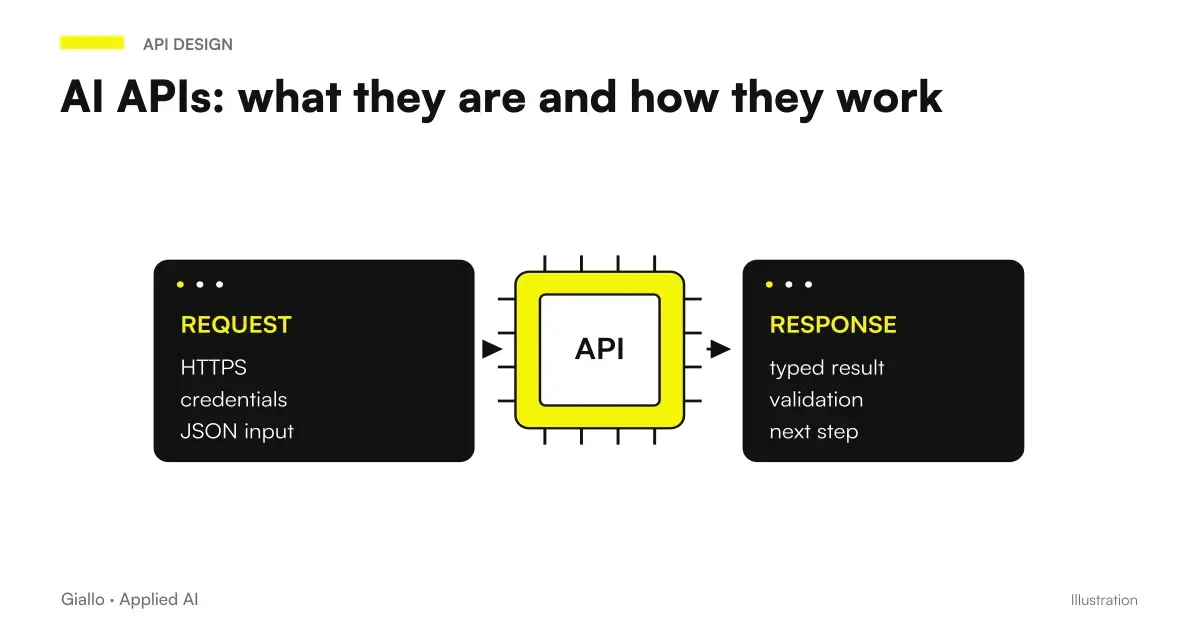 AI APIs: what they are and how they work
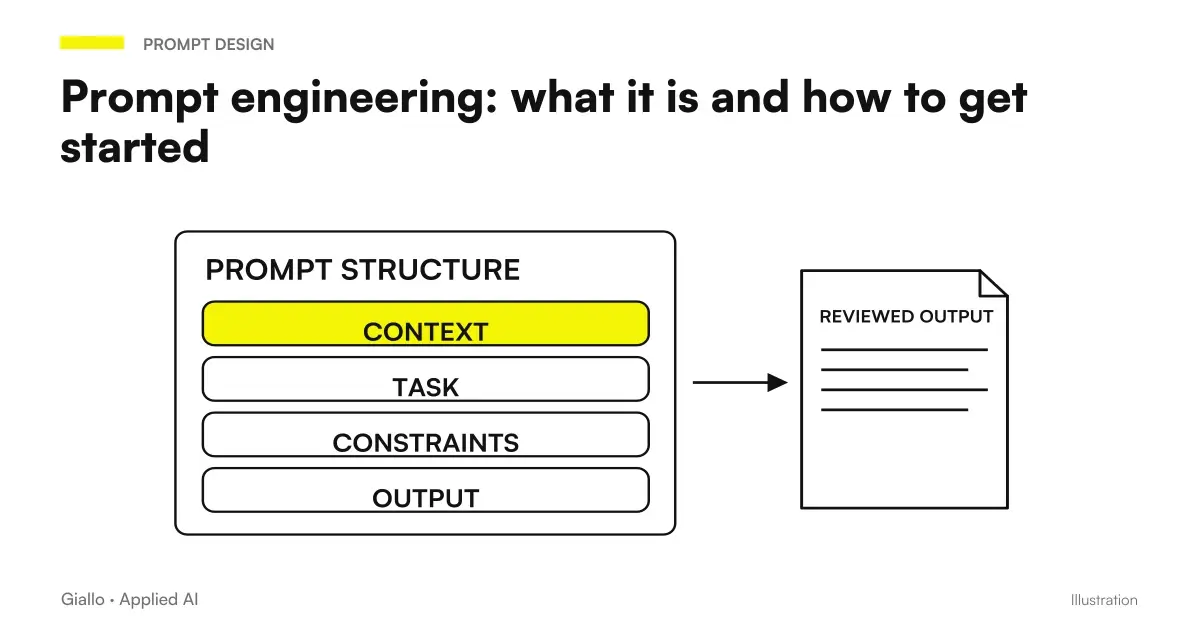 Prompt engineering: what it is and how to get started
 AI Models: Guide to Major Models
 Time to first token: what it is and why it decides the perception of speed
 The levels of reasoning of Claude Opus 5.5: what they are and when to raise them
 AI for businesses: a complete guide to getting started
FAQ
What are AI tokens?
Tokens are the pieces of text into which a language model divides what it reads and writes: whole words, word fragments, spaces and punctuation. The model works only with these pieces, one after another. Tokens measure both the amount of text a model handles in a request and API pricing.
How many words are 1,000 tokens in Italian?
In the test we did with the official OpenAI tokenizer on three company texts, 1,000 tokens were between 576 and 647 Italian words, about 610 on average. The same email in English required fewer tokens. Each manufacturer uses a different tokenizer: for a quote count the tokens with the tool of the supplier you will use.
How much does a million tokens cost?
It depends on the model and whether the tokens are input or output. In October 2026, at standard prices, a million input tokens costs from 0.10 dollars with GPT-6 Luna to 10 dollars with GPT-6 Astra or Claude Fable 5.1, while output can cost up to 50 dollars. Price lists change frequently, so check the official pricing page before preparing a quote.
What is the context window of an AI model?
It is the maximum number of tokens that the model considers in a single request: instructions, previous messages, attached documents and response, reasoning included. In October 2026 the main models of OpenAI, Anthropic and Google come to about one million tokens. Filling it all costs and can make the answers less precise.
Are AI tokens the same as cryptocurrency tokens?
No. Language model tokens are units of text that measure the work and cost of an artificial intelligence. Cryptocurrency tokens are digital tokens registered on a blockchain. They only have the name in common.
How do you count the tokens of a text?
The simplest method is OpenAI's free tokenizer: paste the text and read the token count. For Claude and Gemini, counting uses their respective APIs. For a quick estimate of Italian text, multiply the word count by 1.7, the average from our test, knowing this remains an approximation.
Do tokens also count for images and audio?
Yes. In Gemini models, a small image counts as 258 tokens and audio as 32 tokens per second, according to Google's documentation. Claude divides images into squares with sides of 28 pixels, so a 1000 by 1000 pixel photo counts as 1,296 tokens. Images and audio also take up context and incur charges.