
Gemini 4 Hydrogen for business: use cases, costs and data privacy for an SME
Gemini 4 Hydrogen for business: entry points, 5 SME use cases with costs worked out from the price list, and what Google’s terms say about your data.
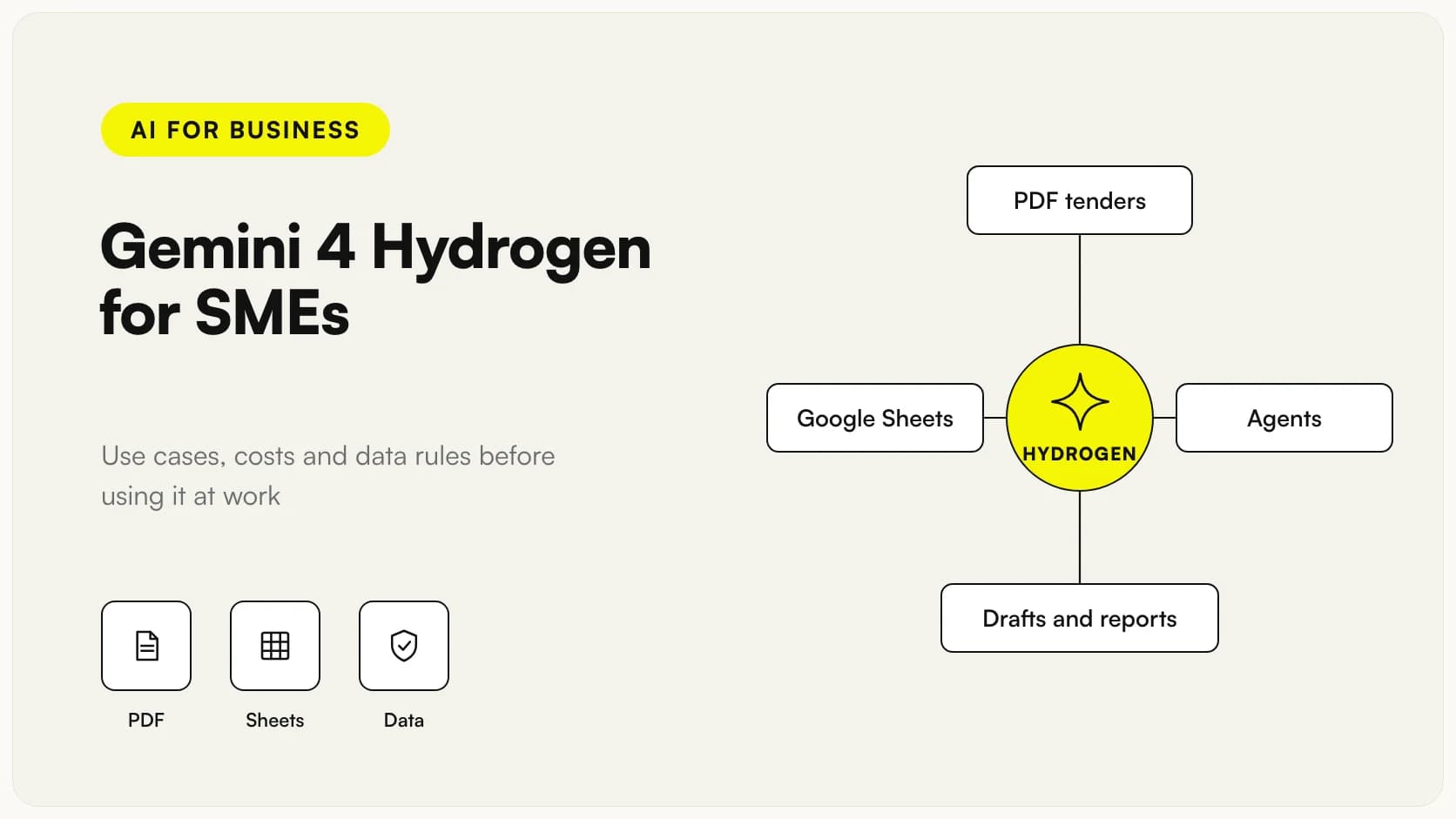
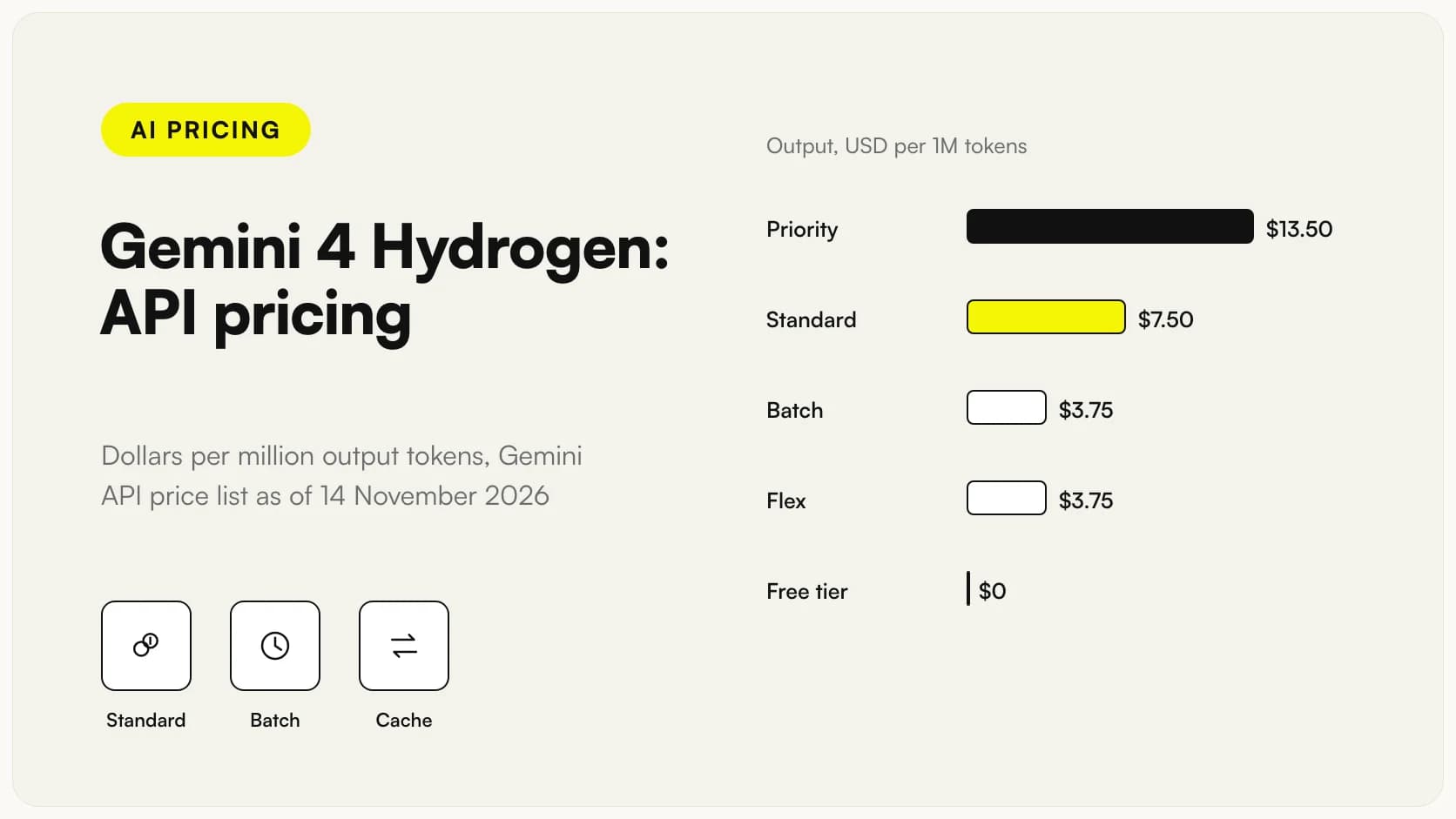
Gemini 4 Hydrogen for business is the model Google presented on 12 November 2026 for fast execution in agentic workflows: an SME meets it in the Gemini app, in Gemini in Google Sheets, in the Gemini API and in Google Search. The API price list shows $1.50 per million input tokens and $7.50 per million output tokens. But an SME does not choose a model: it chooses an entry point, a use case and a boundary for its data.
The information comes from the Google announcement, the developer guide, the price list and the Gemini API terms, consulted on 14 November 2026. The cost examples are our own calculations based on stated assumptions; in the pages consulted Google does not state subscription prices, and we do not write them here.
If you need the technical definition of the model, it is in the guide to Gemini 4 Hydrogen. Here we answer three questions an owner would ask: where you enter, what you can do at a predictable cost, and what the terms say about data.
In summary
- For businesses Google lists three channels: Gemini for business (API or model menu), Google Antigravity and Gemini in Google Sheets for eligible business subscriptions.
- The Standard API price is $1.50 per million input tokens and $7.50 per million output tokens (price list), the same across the whole 1 million-token window; Batch costs half.
- With the token counts assumed in this guide and the prices in the price list, the calculated cases run from about $2 to $15 a month: they are worked examples, not quotes.
- For users in the European Economic Area, the terms for paid services also apply to the free tier, and for apps aimed at these users the terms allow paid services only.
- Google Search uses Hydrogen for all users: the “query fan-out” links to more sites, though Google promises traffic to no one.
- In the pages consulted, Google has not published the country list for the Gemini app for Hydrogen, nor official Italian-language support.
Which entry point should an SME use for Gemini 4 Hydrogen?
An SME can enter through four entry points, and they are not equivalent: a subscription for individuals, Gemini in Google Sheets for people who work in spreadsheets, the Gemini API for those building automations, and Gemini Enterprise Agent Platform for those with data-residency requirements. They differ in who pays, who sees the data and how much control you have.
| Entry point | Who it is for | What Google says |
|---|---|---|
| Gemini App | Individuals who write, summarize and compare | No plan: “Auto or Flash-Lite” chat, with automatic selection that may use Hydrogen. Google AI Plus: Hydrogen in the menu. Pro and Ultra: Hydrogen plus other models (help page, subject to change without notice). Applies to personal accounts; with work or school accounts, availability depends on the Workspace license |
| Gemini in Google Sheets | People who work on spreadsheets, models and forecasts | Available starting with Google AI Pro and Ultra subscribers and for eligible business subscriptions (announcement) |
| Gemini API (AI Studio) | Automations, chatbots, agents, back-office systems | Free and paid tiers; Italy is on the list of countries |
| Gemini Enterprise Agent Platform | Businesses with data-residency requirements | GA launch on 12 November 2026, regions global, us and eu, with data residency and CMEK keys (model page) |
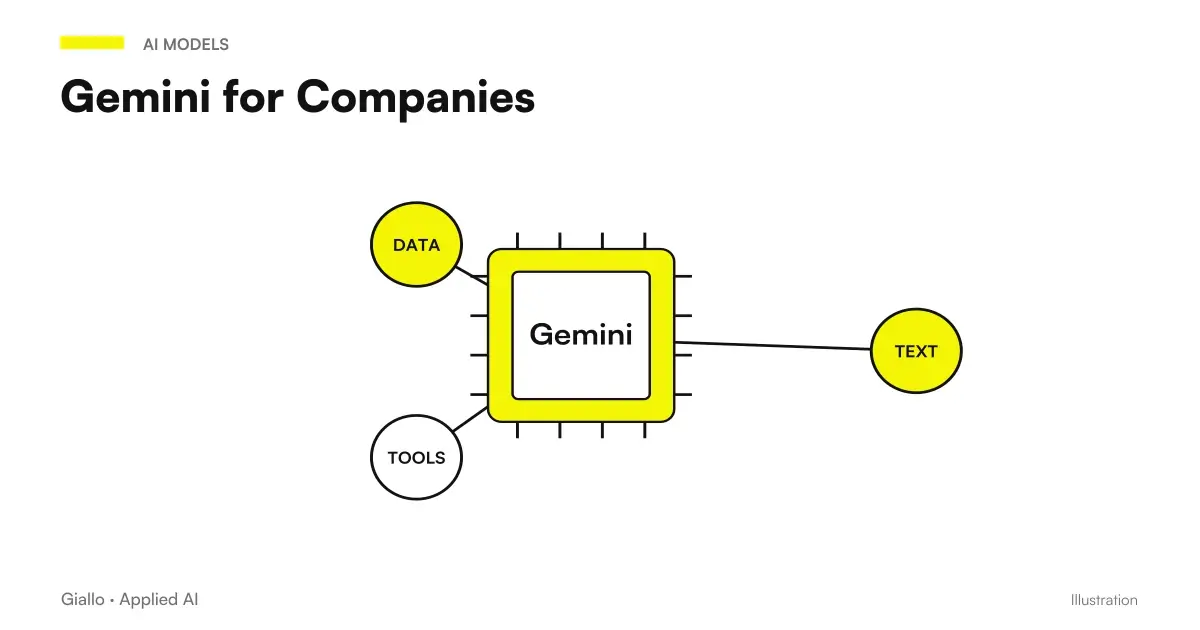
Agent Platform prices are not in the pages we checked, so we do not write them. Antigravity, Google’s tool for developing with agents, is available to paying Google AI Pro and Ultra subscribers and, for businesses, among the Gemini for business channels, according to the announcement: it mainly serves those who develop with agents. The picture for those already using Workspace is in Gemini for Google Workspace, and the overview of products for the enterprise is in Gemini for Companies.
Which use cases hold up for an SME?
The cases that hold up are the ones Google cites as uses of the model: dense documents turned into reports with references, spreadsheets with forecast scenarios, drafts of emails and documents, agents that use tools, page prototypes. For each one we give what is needed, the right entry point and a cost worked out as an example.
There is only one calculation method: tokens × price per million ÷ 1,000,000. At the Standard tier the price list shows $1.50 per million input tokens and $7.50 per million output tokens, with reasoning tokens billed as output. The general method is in how to calculate the cost of an AI API.
An engineering firm that summarizes PDF tender specifications
Google writes that Hydrogen combines a 1 million-token input with an output of up to 1 million, to synthesize dense PDFs, spreadsheets, charts and video into reports with citations (announcement). For an engineering firm this means having it read a specification and getting a sheet with requirements, deadlines and at-risk items, each with a reference to the page.
Worked example, not a quote. Assume 40 specifications a month, each with 60,000 input tokens and 8,000 output tokens, reasoning included. Input: 60,000 × $1.50 ÷ 1,000,000 = $0.09. Output: 8,000 × $7.50 ÷ 1,000,000 = $0.06. Per specification $0.15, for 40 specifications $6.00 a month. With the 50% Batch discount, if the result is not needed right away, $3.00. A technician should verify every reference. The sector is covered in AI for Technical Studies.
A purchasing office that compares quotes in Google Sheets
According to the announcement, with Gemini in Google Sheets Hydrogen helps turn financial data into interactive models that adapt to different forecast scenarios, with results more than 30% faster than previous models in the Sheets canvas (Google’s figure, not re-run by us). For a purchasing office the use is concrete: supplier quotes sit in a spreadsheet, and you ask it to normalize the line items, flag deviations and simulate the effect of a discount.
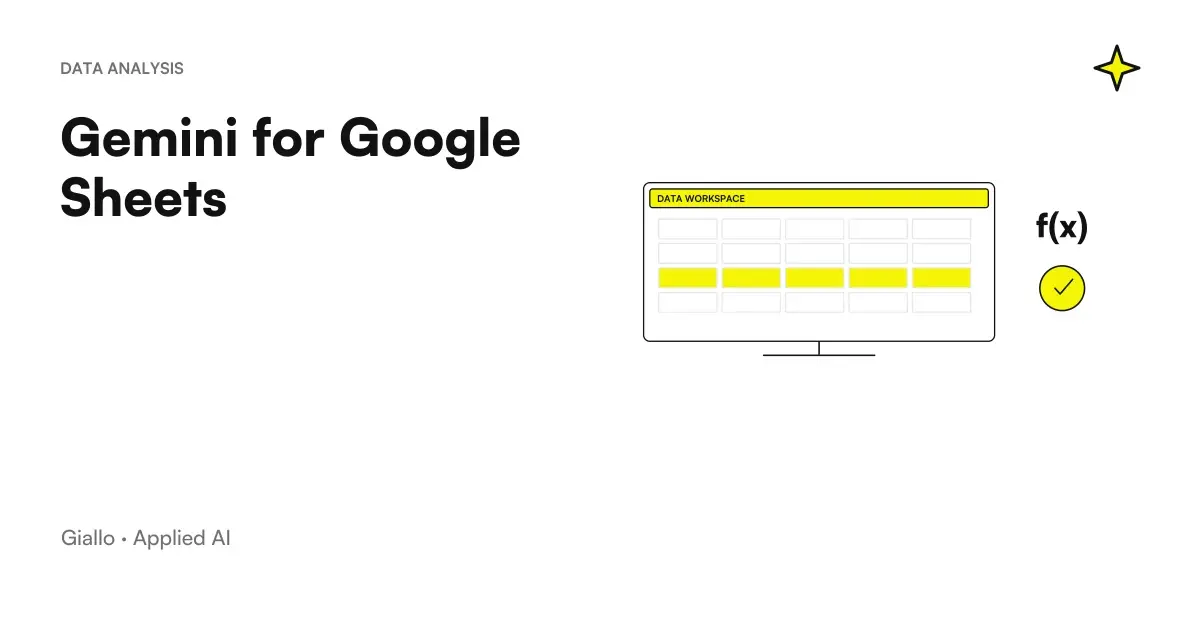
Here the cost cannot be calculated from tokens, because Gemini in Sheets depends on the subscription and Google does not state a per-request price in the price list. If the comparison is instead automated through the API, here is an example: 30 comparisons a month, each with 25,000 input tokens and 5,000 output tokens. Input: 25,000 × $1.50 ÷ 1,000,000 = $0.0375. Output: 5,000 × $7.50 ÷ 1,000,000 = $0.0375. Per comparison $0.075, for 30 comparisons $2.25 a month. The rule remains that numbers that end up in spreadsheets must be checked by a person: Gemini for Google Sheets shows how, while for office workflows there is AI for purchases and suppliers.
Email and document drafts for the whole team
Google describes Hydrogen in the Gemini app as more faithful to the tone, format and rules you specify, so that email drafts, rewrites and documents come back usable on the first attempt. It is the simplest case: in the app the cost is the subscriptions, whose prices we do not state.
Worked example (Standard prices from the price list) for those who automate it with the API: 1,000 drafts a month, each with 3,000 input tokens and 1,000 output tokens. Input: 3,000 × $1.50 ÷ 1,000,000 = $0.0045. Output: 1,000 × $7.50 ÷ 1,000,000 = $0.0075. Per draft $0.012, for 1,000 drafts $12.00 a month. The cost that weighs most is the review before sending.
An agent that uses the company’s tools
Google states that Hydrogen adapts when a tool call fails or a search comes back empty, and cuts made-up claims by more than 5 times compared with Gemini 3.8 Flash (a comparison stated by Google, from the announcement). An agent of this kind reads an order status, consults a price list and prepares the reply for support, who review it.
Worked example. 200 runs a month, each with 30,000 input tokens, of which 24,000 are read from the cache, and 4,000 output tokens. The developer guide describes implicit caching only, with a minimum of 4,096 tokens and a 95% discount on cached tokens, at $0.075 per million. So: 6,000 × $1.50 ÷ 1,000,000 = $0.009; 24,000 × $0.075 ÷ 1,000,000 = $0.0018; 4,000 × $7.50 ÷ 1,000,000 = $0.03. Per run $0.0408, for 200 runs $8.16 a month. Without the cache, with all input at full price: 30,000 × $1.50 ÷ 1,000,000 = $0.045 plus $0.03, that is $0.075 per run and $15.00 a month. Implicit caching is not guaranteed, so the cautious calculation is the second one. The design side is covered in AI agents with Gemini 4 Argon, which has a similar scope.
Page and interface prototypes
Google states that Hydrogen generates more complete, working layouts in fewer requests, and as an example cites an e-commerce storefront built in a single pass in Antigravity, combined with Gemini’s new front-end design skill. For an SME it is useful for testing an idea for a landing page or a form before commissioning it. It does not replace the design of a website, and Antigravity requires a paid Google AI Pro or Ultra subscription or a business channel.
Summary of the example costs
| Case | Assumptions per item (input / output tokens) | Calculation | Monthly Total |
|---|---|---|---|
| PDF tender specifications, Standard | 40 documents, 60,000 / 8,000 | 40 × (0,09 $ + 0,06 $) | 6,00 $ |
| PDF tender specifications, Batch | same data, half price | 40 × 0,075 $ | 3,00 $ |
| Quotes, via API | 30 comparisons, 25,000 / 5,000 | 30 × (0,0375 $ + 0,0375 $) | 2,25 $ |
| Email drafts, via API | 1,000 drafts, 3,000 / 1,000 | 1,000 drafts × ($0.0045 + $0.0075) | 12,00 $ |
| Agent with cache | 200 runs, 30,000 (24,000 cached) / 4,000 | 200 × 0,0408 $ | 8,16 $ |
| Agent without cache | 200 runs, 30,000 / 4,000 | 200 × 0,075 $ | 15,00 $ |
All calculations use the Standard or Batch prices from the Gemini API price list as of 14 November 2026. They are examples: they do not include grounding with Google Search, which after 5,000 free requests a month costs $14 per 1,000, nor VAT, nor integration work. For ongoing spend, see the annotated Hydrogen price list and how much AI costs a business.
What do Google’s terms say about Gemini 4 Hydrogen and privacy?
Google’s terms distinguish between paid and unpaid services, and the difference concerns your data. Here we report what the Gemini API terms, consulted on 14 November 2026, say. This is not legal advice: if the data is personal, the assessment is up to your consultant or your DPO.
| Aspect | Paid services | Unpaid services |
|---|---|---|
| Use of content to improve products | No, according to the terms | Yes |
| Human reviewers | Not indicated | May read, annotate and process inputs and outputs, after disconnecting them from account, key and project |
| Personal Data | Handled under Google’s Data Processing Addendum | Google asks you not to send sensitive, confidential or personal information |
| Logs | Prompts and responses logged for a limited period, only for abuse and legal obligations | Not stated in the section consulted |
For the Gemini API, only requests from a Cloud project with active billing are “Paid Services”. AI Studio counts as one even when free, if the account has access to a project with active billing or is a Workspace enterprise account. The terms also provide that, for applications made available to users in the European Economic Area, Switzerland or the United Kingdom, only Paid Services are to be used, and that in these countries the paid-services terms also apply to the free tier.
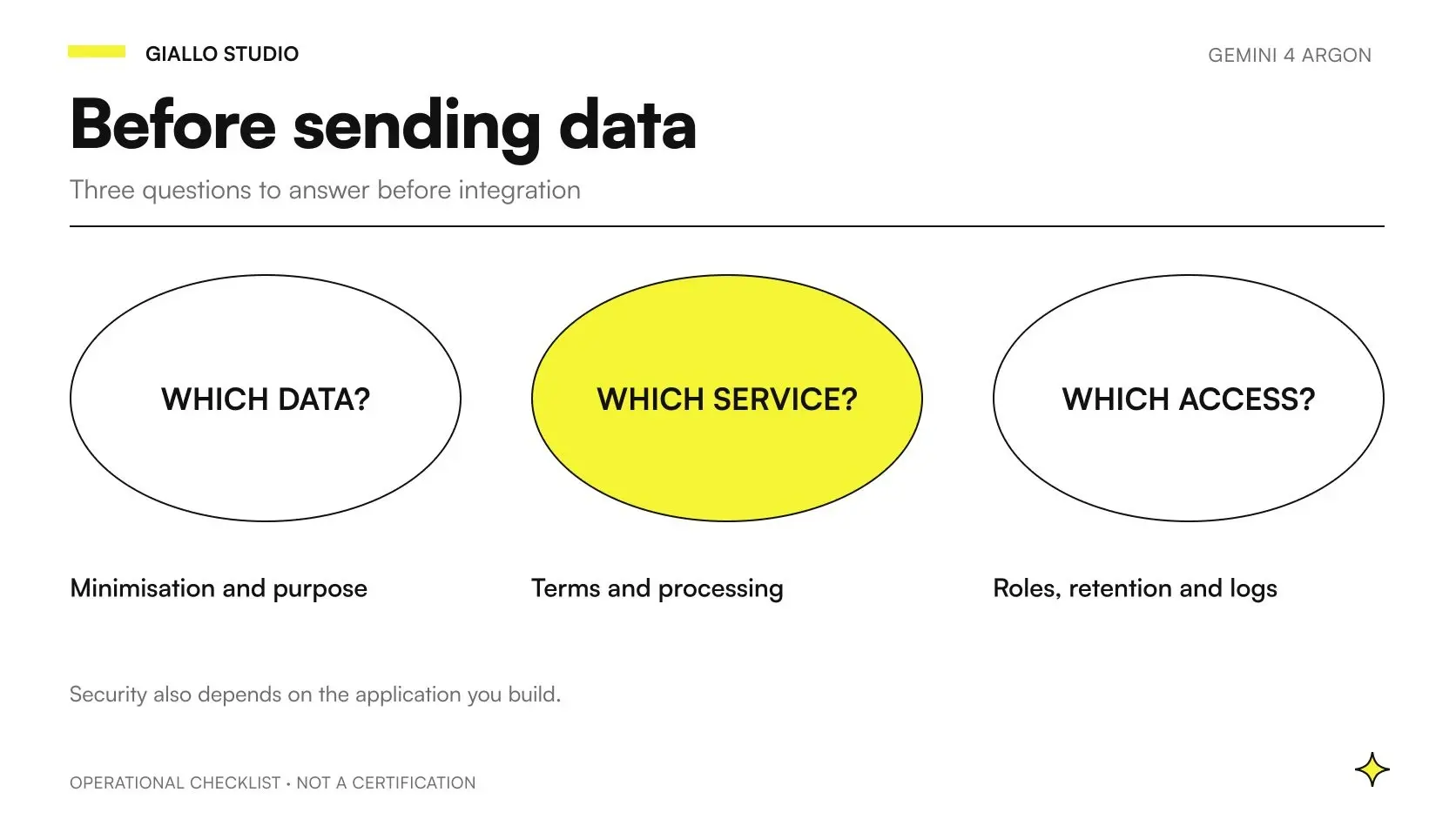
Two details to take to your DPO. First: the terms say data may be temporarily stored in any country where Google or its agents have facilities. Second: on the Agent Platform, the model page lists the multi-region location eu and data-residency features; if where the data is stored is a constraint, this is the route to assess. For the general legal framework there is AI and GDPR, while for the comparison with the previous model the guide is Gemini 4 Argon: privacy and security for businesses.
- Check which channel you really use: app, Sheets or API, and with which account, business or personal.
- For the API, check that requests come from a Cloud project with active billing, and not from the free tier.
- Keep personal data out of tests until the DPO has assessed channel, roles and privacy notice.
- Have the DPO read the additional Gemini API terms and the Data Processing Addendum they refer to.
- Decide whether you need EU data residency: if so, consider the
euregion of the Agent Platform. - Decide who reviews an output before it leaves the company.
- Set a spending cap in the project: the API spending tiers are described in the limits page.
What changes in Google Search for an SME’s website?
Google has made Hydrogen available in Search for all users. The Search post of 12 November 2026 by Robby Stein, VP of Product, Google Search, lists four changes: better understanding of intent, even with multi-part questions or typos; more visual answers, with images and tables; a broader “query fan-out”, meaning more parallel searches on the sub-topics of a question, which leads to a wider set of sites; better understanding across all languages supported by AI Mode.
For the website of a shop or a firm the guidance is cautious: Google publishes no figures on traffic, clicks or rankings, and there is no Italy-specific statement: for languages it says “all supported AI Mode languages”. It is fair to say that pages that answer a multi-part question well have a better chance of being found, not that traffic will rise. What to work on is covered in the best AI tools for SEO.
What has Google not yet published?
In the pages consulted on 14 November 2026, Google does not state four things an SME might want. The list of countries for the Gemini app for Hydrogen. Official Italian-language support: there is only the wording for Search. The standard request and token limits for Hydrogen: the limits page points to AI Studio. The prices on the Agent Platform.
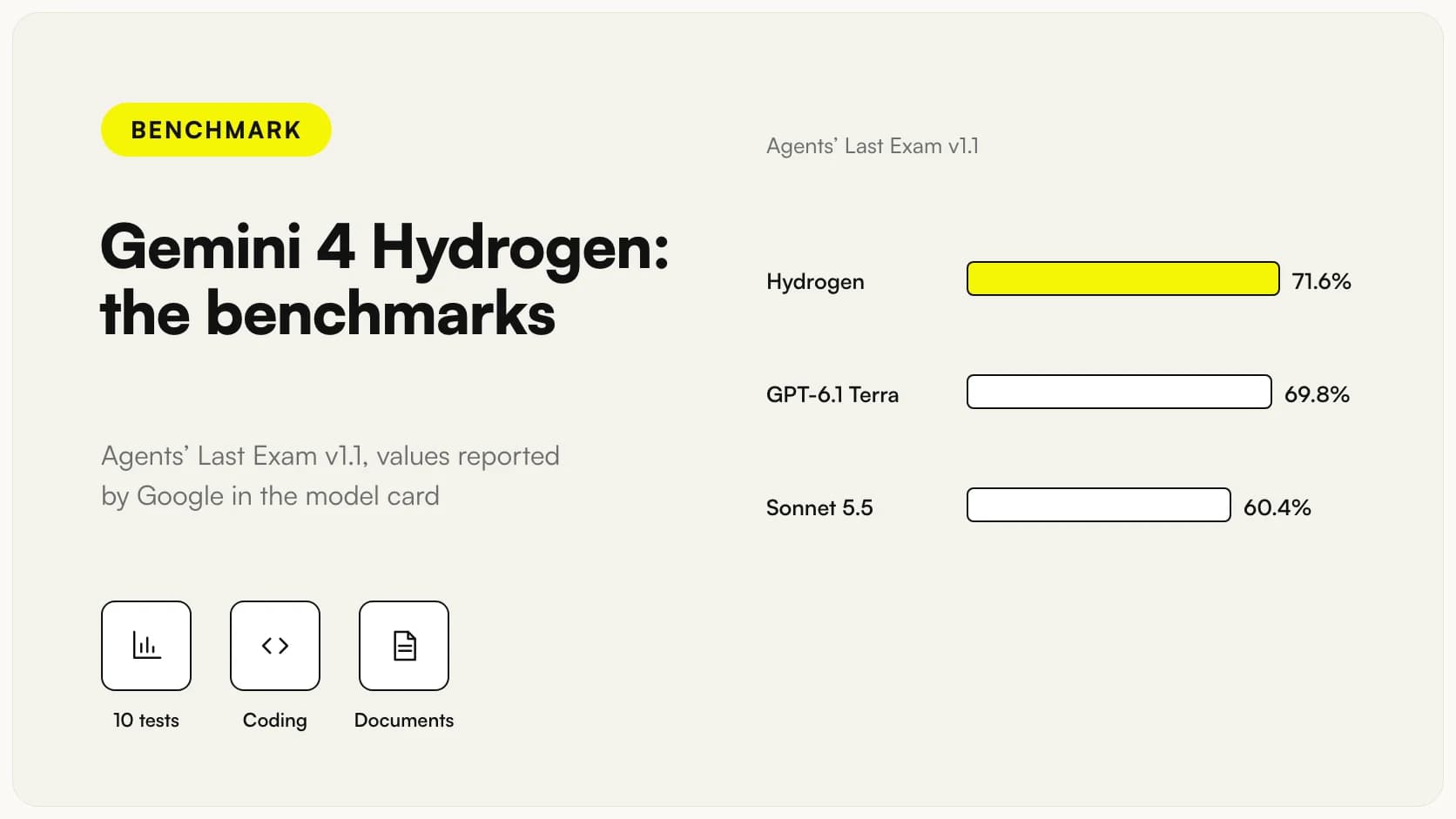
The full safety report is listed as “coming soon” and was not yet published. The model card lists possible hallucinations and occasional slowdowns as known limitations. As for benchmarks, they are stated by Google and not re-run by Giallo; the comparison with other models is in Gemini 4 Hydrogen benchmarks.
Where do SMEs go wrong when bringing Hydrogen into the company?
When it makes sense to start
- There is a repetitive process involving documents or spreadsheets and a person responsible who reviews the output.
- The channel is chosen, the account is a business account and the DPO has read the terms.
- There is a spending cap and a trial on 20-30 real cases.
When it makes sense to wait
- You want to paste customer data into the app without having checked the account and the terms.
- The free tier of the API is used for personal or confidential data.
- You assume a new model will bring more customers, or will fix a messy process on its own.
The four most common mistakes are:
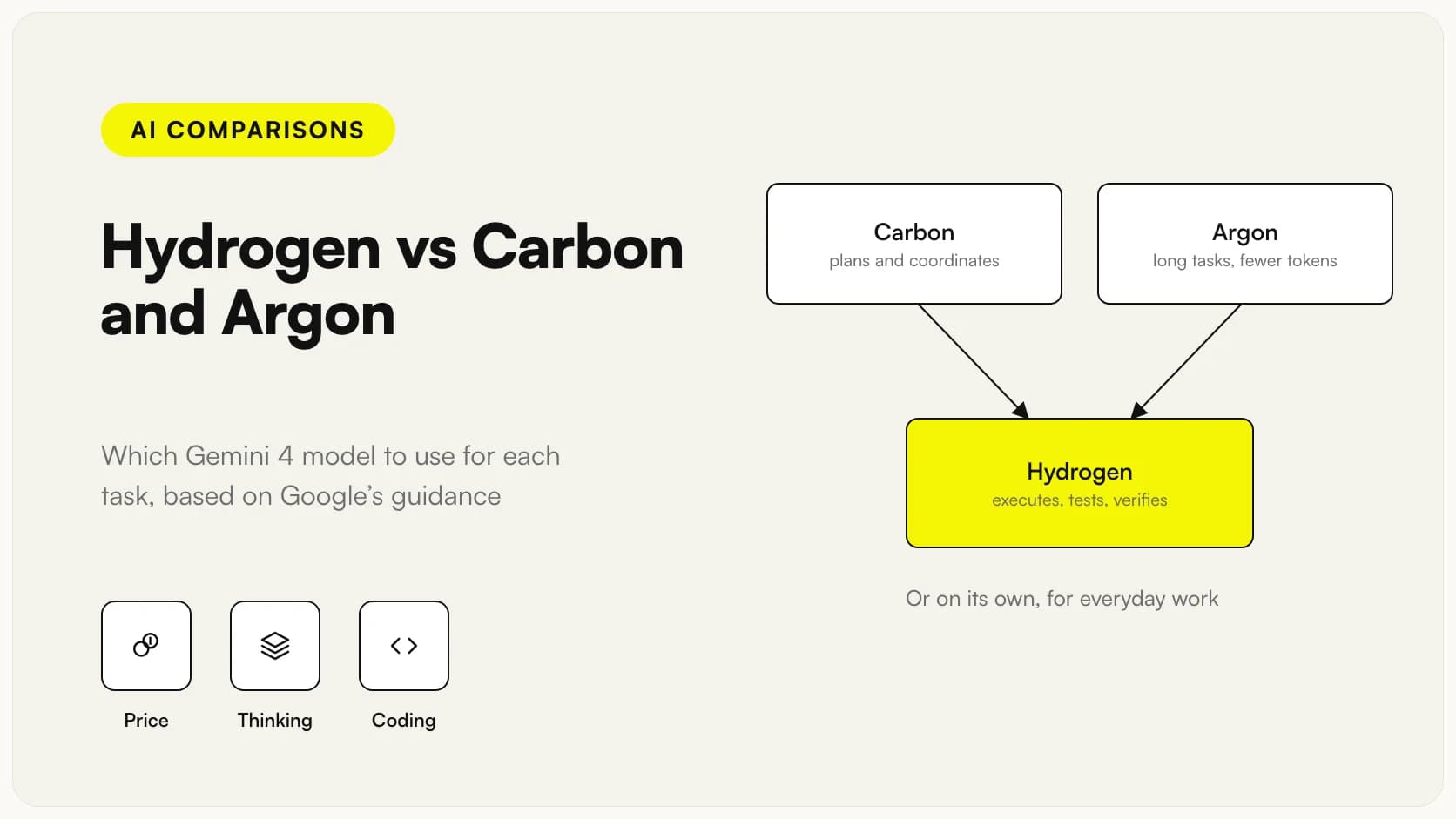
- Choosing the model before the process. Hydrogen is a fast-execution model, not a strategy; if it is unclear what it must produce and who checks it, the result will be vague. To work out whether it is the right model or whether you need the higher tier, the comparison is in Hydrogen vs Carbon and Argon.
- Confusing the app with the API. The app is for people, the API is for automations: they have different costs, accounts and terms, and they do not replace each other.
- Trusting the cost per token. You pay for every token processed, reasoning included, and a high reasoning level uses more. Calculate on real data, not on a ten-line test.
- Forgetting who reviews. With numbers in spreadsheets and citations in reports, the costly error is the one that goes out unchecked.
Where to start on Monday with Gemini 4 Hydrogen
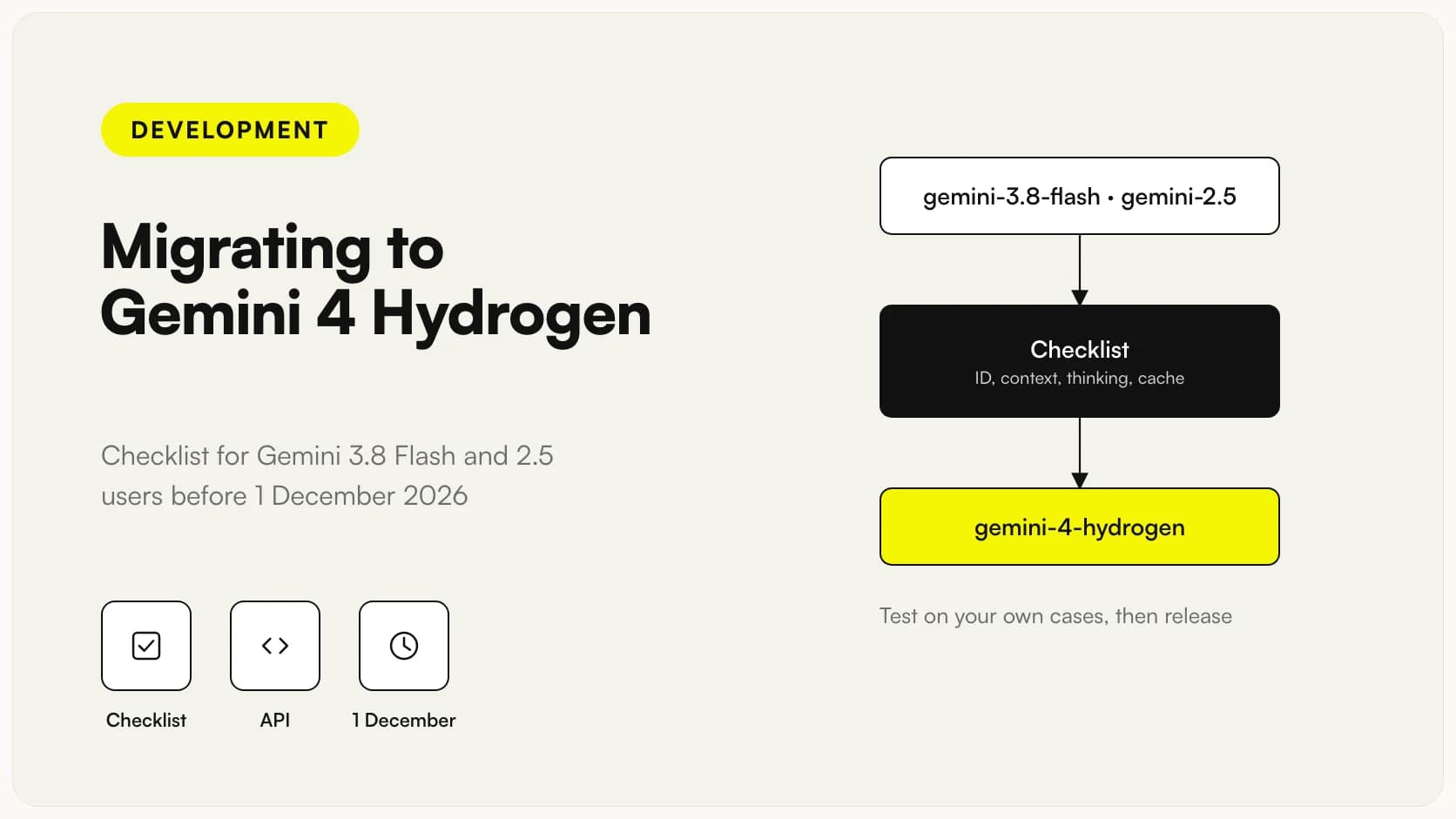
The most useful step is a small one: pick a process involving documents or spreadsheets, define the channel, have the DPO read the terms and try it on 20-30 real cases. At the end of the trial you compare time saved, errors found and the cost calculated, and only then decide whether to extend or change model. If you already have live integrations, you also need to look at the deadlines of 1 December 2026, described in the Gemini 4 Hydrogen migration checklist.
If you would like a second opinion on your case, at Giallo Studio we offer an AI Consulting that starts from one process and a trial on real cases: we choose the channel, count the tokens on your own material and tell you what is needed to bring the data in safely. If your goal is instead an assistant that works with your tools, you can find how we work on AI agents.
Giallo Studio guides: methodology and sources
Want to apply this to your business?In 30 minutes, free of charge: the first process to automate and its estimated return, in writing.
Book the free auditHow we apply it in the company
Related resources
 Gemini 4 Hydrogen benchmarks: how it compares with Claude Sonnet 5.5 and GPT-6.1 Terra
 Gemini 4 Hydrogen vs Carbon and Argon: which Gemini model to choose
 Gemini 4 Hydrogen: What It Is, How It Works, Where to Use It
 Gemini 4 Hydrogen pricing: how much the API costs and how to estimate spend
 Migrate to Gemini 4 Hydrogen: Checklist From Gemini 3.8 Flash and 2.5 Before 1 December
 Gemini for Companies
 Gemini for Google Sheets
 Gemini for Google Workspace
 Gemini 4 Argon privacy and security: a business guide
 AI and GDPR: What a company needs to know before using AI
FAQ
Can Gemini 4 Hydrogen be used in a business?
Yes. Google makes it available to businesses in Gemini for business (through the API or the model menu), in Google Antigravity and in Gemini in Google Sheets for eligible business subscriptions. Announcement of 12 November 2026: before switching it on, check which plan you have and in which product it appears.
Is Gemini 4 Hydrogen free for businesses?
Only in part. The free tier of the Gemini API exists and costs nothing, but on unpaid services Google asks you not to send personal or confidential data. For an app aimed at users in the European Economic Area the terms allow paid services only: at the Standard tier the price list shows $1.50 per million input tokens and $7.50 per million output tokens. In the Gemini app, access depends on the plan (with a work account, on the Workspace license), and users without a subscription get it only through automatic model selection.
Can I give Gemini 4 Hydrogen my customers’ data?
It depends on the channel and should be checked with your consultant or DPO. For the Gemini API, Google’s terms say that on paid services prompts and responses are not used to improve products and are handled under the Data Processing Addendum; on unpaid services Google asks you not to send sensitive, confidential or personal data. For users in the European Economic Area, the paid-services terms also apply to the free tier.
Is Gemini 4 Hydrogen available in Italy?
The Gemini API, yes: Italy is on the list of available countries. For the Gemini app, in the pages consulted on 14 November 2026 Google has not published a country list specific to Hydrogen, and for Google Search it speaks of global availability for all users, without a statement dedicated to Italy.
Does Gemini 4 Hydrogen work in Google Sheets?
Yes, in the form of Gemini in Google Sheets. Google makes it available starting with Google AI Pro and Ultra subscribers and for eligible business subscriptions, and for financial models with forecast scenarios it states results more than 30% faster than previous models. The figure is Google’s and has not been re-run by Giallo.
How much does Gemini 4 Hydrogen cost for an SME?
For the API, the cost depends on tokens. With the numbers assumed in this guide, summarizing 40 PDF tender specifications a month costs $6.00 at the Standard price and $3.00 with Batch. These are worked examples, not quotes: the real cost depends on document length, reasoning level and number of requests. Prices for subscriptions and Workspace are not in the verified sources.
Does Gemini 4 Hydrogen change anything for my company’s website?
It may change how Google Search shows results; it is not a feature you switch on for your site. Google states that Hydrogen improves the “query fan-out” and links to a wider set of sites, but it promises traffic to no one. It is therefore worth keeping content clear and verifiable, without expecting measurable effects.
Should I use Hydrogen or a more powerful model such as Carbon or Argon?
For everyday work Google offers Hydrogen as the fast execution model, and reserves Carbon and Argon for long, hard problems. Hydrogen’s price is lower: $1.50 for input and $7.50 for output, against $4 and $20 for Carbon and Argon from 1 December 2026. The full comparison is in a dedicated article.