
AI in Italian SMEs: the 2026 statistics (Istat, Eurostat, Polimi)
How many Italian SMEs use AI: Istat, Eurostat and Politecnico di Milano AI Observatory data, with tables, sources and a ready-made citation.
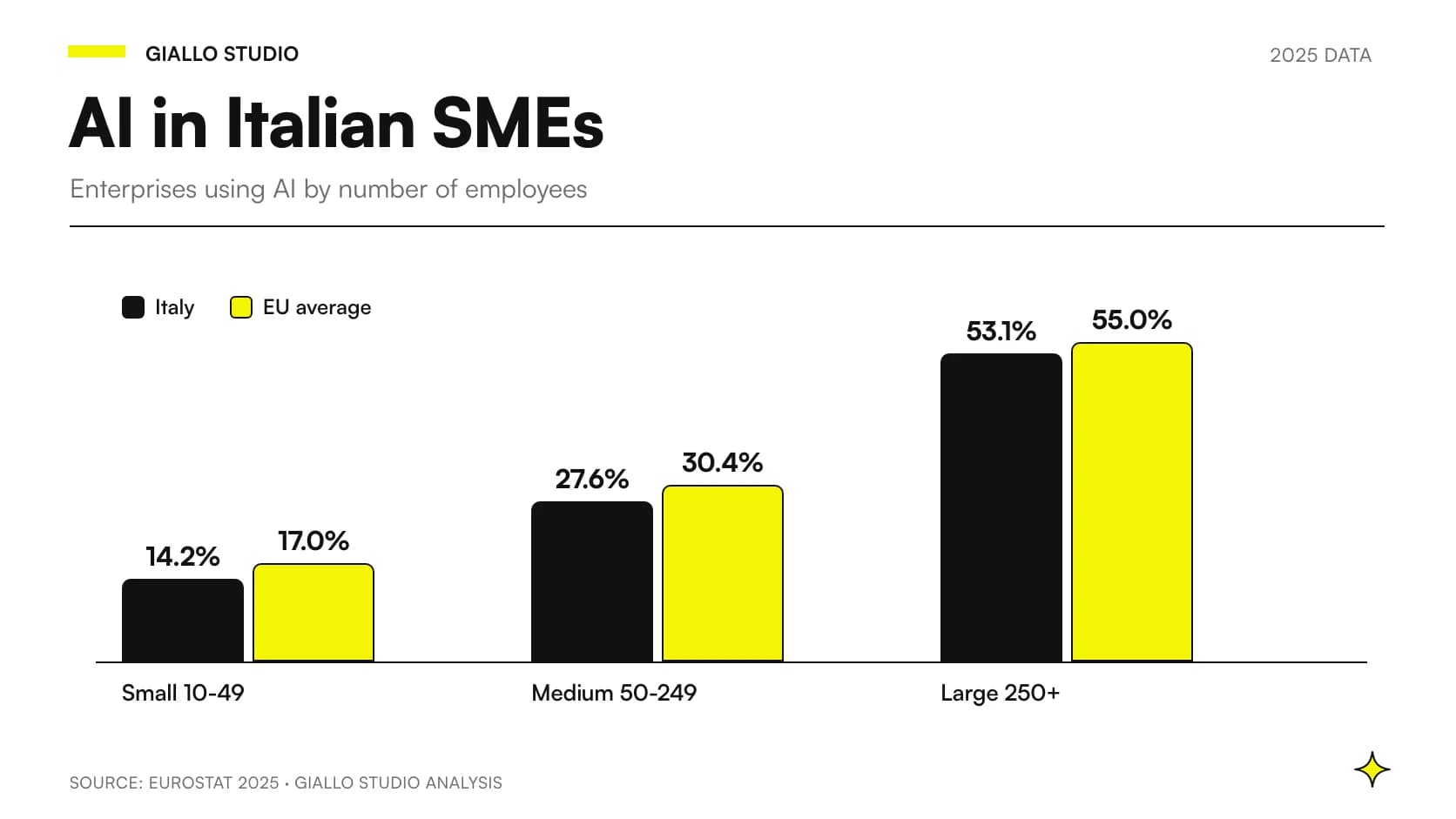
In 2025, 15.7% of Italian SMEs with 10-249 employees use at least one artificial intelligence technology, double the previous year, while among large enterprises the share reaches 53.1%. This is the latest figure from the Istat Enterprises and ICT 2025 survey, published on 15 December 2025. The EU average is 20.0% and Italy ranks 18th out of 27 countries.
This page brings together in one place the official figures on artificial intelligence in Italian SMEs: adoption, European comparison, technologies used, obstacles, market. Every figure sits next to its primary source. Tables that combine different sources, differences and rankings are Giallo Studio's own analysis and are labeled as such. At the end you will find a ready-made sentence for citing the data.
Key figures
- 16.4% of Italian enterprises with at least 10 employees use AI in 2025: up from 8.2% in 2024 and 5.0% in 2023 (Istat).
- 15.7% of SMEs compared with 53.1% of large enterprises: the gap widened from 24.8 to 37.4 points in one year (Istat, difference calculated by Giallo Studio).
- EU average of 20.0% in 2025, with Italy ranking 18th out of 27 (Eurostat, ranking calculated by Giallo Studio).
- 14.2% of Italian small enterprises with 10-49 employees use AI, compared with 17.0% of small enterprises across the EU (Eurostat).
- 58.6% of enterprises that considered AI without adopting it cite lack of skills as a barrier (Istat).
- €1.8 billion is the value of the Italian AI market in 2025, up 50%; SMEs account for 18% of it (Politecnico di Milano AI Observatory).
How many Italian SMEs use artificial intelligence in 2025?
The official source is Istat's annual survey on the use of digital technologies in enterprises with at least 10 employees. In the 2025 edition, the share of enterprises using at least one AI technology rises to 16.4%. In 2024 it was 8.2%, in 2023 5.0%: in two years adoption has more than tripled (Giallo Studio analysis of Istat figures).
The average, however, hides two speeds. In the same survey SMEs (10 to 249 employees) rise from 7.7% to 15.7%, large enterprises (250 employees and above) from 32.5% to 53.1%. Both groups are growing, but large enterprises are growing faster in percentage points: the gap is widening.
| Istat indicator | 2024 value | 2025 value | Source |
|---|---|---|---|
| Companies with at least 10 employees using at least one AI technology | 8.2% of enterprises | 16.4% of enterprises | Istat, Enterprise and ICT 2025 |
| SMEs with 10 to 249 employees | 7.7% of SMEs | 15.7% of SMEs | Istat |
| Large enterprises with 250 or more employees | 32.5% of large enterprises | 53.1% of large enterprises | Istat |
| Gap between large enterprises and SMEs | 24.8 percentage points | 37.4 percentage points | Giallo Studio analysis of Istat data |
Two takeaways. First: in 2025 more than one large enterprise in two uses AI, against just under one SME in six. Second: the SME share doubled in one year, so companies that still use no AI tool are the majority, but they are no longer the norm they were two years ago.
Another Istat figure is the least quoted and perhaps the most useful for seeing where the market is heading. Among enterprises that do not use AI, 11.5% say they have considered using it, compared with 4.6% in 2023. This is the pool of companies that are thinking about it and have not started yet.
How does Italy compare with the European Union?
For the European comparison the source is Eurostat, which publishes the same indicators for every EU country and for three size classes: small (10-49 employees), medium (50-249) and large (250 and above). Note: Eurostat splits SMEs into two classes, while Istat presents them as a single group. The two sets of values must not be added up or mixed.
In 2025 the EU average is 20.0% of enterprises with at least 10 employees, up from 13.5% in 2024, as reported in the Eurostat news release of 11 December 2025. Denmark leads with 42.0%, Romania is last with 5.2%. Ranking the 27 countries by share of enterprises using AI, Italy comes 18th (Giallo Studio analysis of Eurostat data).
| Size class (Eurostat 2025) | Italy vs EU average | Italy's distance from the EU average |
|---|---|---|
| Small enterprises, 10-49 employees | 14.2% vs 17.0% | 2.8 points below |
| Medium-sized enterprises, 50-249 employees | 27.6% vs 30.4% | 2.8 points below |
| Large enterprises, 250 employees and above | 53.1% vs 55.0% | 1.9 points below |
Values: Eurostat, Use of artificial intelligence in enterprises. Distances: Giallo Studio analysis.
Read by size class, Italy's lag is small and almost the same in every band: less than three points. One reason the Italian average stays below the European one is also the structure of the economy, where small enterprises carry a lot of weight. This is Giallo Studio's reading, not a Eurostat conclusion: checking it would require the weight of each class in the total number of enterprises, which this page does not report.
The table also shows something else. In Italy as in Europe, the share of enterprises using AI almost doubles from small to medium-sized companies and almost doubles again from medium to large. Size matters more than nationality.
What is the difference between Istat and Eurostat data?
Istat publishes the Italian data from the survey on the use of digital technologies in enterprises and presents SMEs as a single group of 10 to 249 employees. Eurostat publishes the indicators for every EU country with three size classes. That is why on this page the 15.7% for SMEs always comes from Istat, while the 14.2% for small and the 27.6% for medium-sized enterprises come from Eurostat. The figure for large enterprises, 53.1%, is the same in both sources.
Which AI technologies do Italian companies use?
Among enterprises that use AI, by far the most widespread technology is not the one people talk about most. According to Istat, the leading use is extracting information from text documents, known as text mining.
| AI technology (Istat 2025) | Share among enterprises using AI |
|---|---|
| Extracting information from text (text mining) | 70.8% of enterprises |
| Generative AI | 59.1% of enterprises |
| Speech recognition | 41.3% of enterprises |
| Machine learning | 20.0% of enterprises |
| AI-powered robots | 5.9% of enterprises |
The shares overlap: the same enterprise can use several technologies, so the total exceeds 100%.
Text mining in first place has a concrete explanation. Reading invoices, orders, contracts, emails and delivery notes to pull data out of them is the work that fills the offices of every SME, and many office tools now include features of this kind. Generative AI, second with 59.1%, has mostly arrived through conversational assistants. For a refresher on the terms, start with the introductory guide to artificial intelligence and the one on machine learning explained for businesses.
On business areas, Istat reports marketing and sales (33.1%), administration (25.7%) and research and development (20.0%) as the most frequent. These are the functions with a lot of text to produce or read, where a mistake costs little if someone checks the output.
Why do many SMEs still not use AI?
The data on obstacles refers to a specific population: enterprises that do not use AI but have considered using it. Istat asks them what held them back. The same enterprise can report more than one obstacle.
| Obstacle reported (Istat 2025) | Share among enterprises that considered AI without adopting it |
|---|---|
| Lack of skills | 58.6% of enterprises |
| Unclear legal consequences | 47.3% of enterprises |
| Missing or poor-quality data | 45.2% of enterprises |
| Privacy and data protection concerns | 43.2% of enterprises |
| Costs too high | 43.0% of enterprises |
| Ethical considerations | 25.7% of enterprises |
The main barrier is not price. Almost six in ten of the enterprises that considered AI say they lack the skills, against just over four in ten that mention costs. Next come three obstacles related to rules and data, which often appear together: not knowing what can be done with customer data, not having data in order, worrying about privacy.
A different, non-representative sample points the same way: the CNA report on AI and small businesses of July 2026, based on more than 2,500 responses from member businesses collected in December 2025, finds that 56.7% name understanding what their business really needs as the main obstacle. In the same sample, 19.2% have adopted more than one AI solution. These figures help in understanding micro and small businesses, but they cannot be extended to all Italian enterprises.
A note on method. Istat and Eurostat data cover only enterprises with at least 10 employees. Micro-enterprises with fewer than 10 employees, which make up the vast majority of businesses in Italy, are not included in these percentages. The CNA report does include them, but with a sample of members that is not representative.
How big is the AI market in Italy and how much do SMEs account for?
The Istat and Eurostat surveys count the enterprises that use AI. The Artificial Intelligence Observatory of the Politecnico di Milano measures spending instead: in 2025 the Italian AI market reaches €1.8 billion, up 50%. Generative AI or hybrid projects account for 46% of the value.
| Indicator (Polimi AI Observatory, February 2026) | 2025 value |
|---|---|
| Value of the Italian AI market | €1.8 billion |
| Growth on the previous year | up 50% |
| Share of generative AI or hybrid projects | 46% of the market |
| Share of the market generated by SMEs | 18% of the market |
| Share of the market generated by public administration | 19% of the market |
| Large enterprises with AI projects under way | 71% of large enterprises (59% in 2024) |
| Medium-sized enterprises with AI projects under way | 15% of medium-sized enterprises |
| Small enterprises with AI projects under way | 7% of small enterprises |
| Workers using AI tools | 47% of workers |
The Politecnico uses its own sample and a different definition from Istat: “having AI projects under way” is not the same as “using at least one AI technology”. That is why the Politecnico's 7% of small enterprises and Eurostat's 14.2% do not contradict each other: they measure different things and should not be compared as if they were the same indicator.
The figure on workers, on the other hand, describes something business owners see every day: almost one worker in two uses AI tools. In our experience they often do so with personal accounts and without company rules, which is one reason why the guide to AI and GDPR recommends starting with accounts and rules before choosing tools.
The Bank of Italy points the same way in its Occasional Paper (Questioni di economia e finanza) no. 1005, published in March 2026, which looks at enterprises with at least 50 employees: in 2024 just over 10% used AI, and about a third planned to adopt it within two years. It is another sign of the pool of waiting companies already visible in Istat's 11.5%.
What does Italian law say about artificial intelligence?
Since 10 October 2025 Italy has had a national AI law: Act No. 132 of 23 September 2025, published in Official Gazette no. 223 of 25 September 2025. It sits alongside the European AI Act and covers topics such as employment, the intellectual professions and data protection.
For an SME, the practical effect is that “unclear legal consequences”, the second obstacle in the Istat table at 47.3%, now has one more reference text to read. The European obligations for those who use AI systems are explained in the guide to obligations of the AI Act for SMEs: we do not list deadlines here, because the AI Act timetable is under revision and must be checked against the official text.
What do these figures mean for an SME?
So far, the data. From here on it is Giallo Studio's reading, based on daily work with Italian small and medium-sized businesses: an interpretation, not a statistic.
The lag is about size, not country. Within each size class Italy is less than three points below the European average. An Italian small business is not as far behind a German or French small business as it is behind a large Italian company. The comparison that matters is with competitors of the same size.
The first sensible use is reading documents. Text mining is the most widespread technology among AI users, at 70.8%. For an SME this means starting from the most repetitive office work: extracting data from invoices, orders, quotes and emails. A reasoned list of candidates is on the page about what to automate in an SME.
The main barrier is solved with training, not budget. If 58.6% of those who considered AI stopped because of skills, the first investment is helping two or three people understand what the tools can and cannot do. The guide to training your team on AI explains how to do it in a few weeks, including with funded training plans.
Clean data is worth as much as the tool. 45.2% cite missing or poor-quality data. Before buying anything, it pays to know where customer records, price lists and documents are kept, and who updates them. Without this step, even the best tool produces results that have to be checked by hand.
Estimate costs against today's work. 43.0% worry about costs, but the cost that matters is that of the process you want to lighten. The guide to AI budgets for SMEs and the one on how much AI costs in the company help you do the maths starting from the hours spent today.
- You know which three office processes take the most hours every week.
- You have decided which data must never be entered into AI tools.
- Your staff use business accounts, not free personal accounts.
- At least one person in the company has completed basic AI training.
- You have measured the time and errors of the chosen process before changing it.
If your business ticks three items out of five, you are already in the part of the market the data describes as ready to start. The full path, from roles to the first three months, is in the Practical AI Guide for SMEs; the overall picture with rules and tools is in the Complete AI Guide for Companies.
Where does the data come from and how was it processed?
Every figure on this page comes from a public primary source, consulted on 13 November 2026. Giallo Studio's own analysis is limited to three kinds: differences in percentage points between two values from the same source, Italy's position in the ranking of the 27 Eurostat countries, and placing different sources side by side on the same page with their definitions stated.
| Source | What it measures | Population | Publication date |
|---|---|---|---|
| Istat, Enterprise and ICT 2025 | Use of AI technologies, uses, business areas, obstacles | Italian enterprises with at least 10 employees | 15 December 2025 |
| Eurostat, Use of AI in enterprises | Use of AI by country and size class | EU enterprises with at least 10 employees | December 2025 |
| Politecnico di Milano AI Observatory | Market value, projects under way, use among workers | The Observatory's own sample | February 2026 |
| CNA, AI and small businesses | Adoption and obstacles in micro and small businesses | CNA member businesses, non-representative sample | July 2026 |
| Bank of Italy, QEF no. 1005 | Use and adoption plans | Enterprises with at least 50 employees | March 2026 |
Three rules we followed and recommend to anyone reusing the data. Do not add up values with different definitions: Istat's SMEs (10-249 employees) are not Eurostat's small or medium-sized enterprises. Do not compare “uses an AI technology” with “has projects under way”. Do not extend the results of a members' sample to all enterprises.
How to cite this data?
The data on this page can be freely reused in articles, theses, presentations and reports. For each figure, cite its primary source; for tables, comparisons, differences and rankings, also cite this page.
Ready-made citation
Source: Giallo Studio analysis of Istat, Eurostat and Politecnico di Milano AI Observatory data, giallostudio.it/en/blog/ai-italian-smes-statistics-2026 (updated 13 November 2026).
Online, use a direct link to the page. On paper or in a slide, the full address is enough. We will update the page when Istat and Eurostat publish the 2026 data, keeping the same address: the update date at the top of the page tells you which edition the figures refer to.
If a figure looks wrong or out of date, write to us from the contact page: we will check it against the primary source and correct it, stating the date of the correction.
If you want to understand where your business stands against these figures and which process to start from, we can look at it together through AI consulting for SMEs, or start from the use cases collected on the page AI for SMEs.
Giallo Studio guides: methodology and sources
Want to apply this to your business?In 30 minutes, free of charge: the first process to automate and its estimated return, in writing.
Book the free auditHow we apply it in the company
Related resources
 AI for businesses: a complete guide to getting started
 AI for SMEs: a practical guide to really getting started
 AI budget for SMEs: where to start
 Training the team on AI: what works
 AI Act: what obligations does an SME really have
 What to automate in an SME: the list of the right activities
 AI for car rental: renter fines, contracts and return damage
 AI for driving schools: enrolment, lessons and exam reminders
 AI for dentists and dental practices: recalls, quotes and scheduling
 AI for physiotherapists: bookings, reminders and patients
FAQ
How many Italian SMEs use artificial intelligence?
In 2025, 15.7% of Italian SMEs with 10-249 employees use at least one AI technology, according to the Istat Enterprises and ICT survey published on 15 December 2025. In 2024 the figure was 7.7%. Among large enterprises with at least 250 employees the share is 53.1%.
Is Italy behind Europe on AI in business?
Yes, but not by much within each size class. According to Eurostat, in 2025 20.0% of EU enterprises with at least 10 employees use AI; Italy ranks 18th out of 27 countries (Giallo Studio analysis of Eurostat data). Italian small enterprises are at 14.2% against an EU average of 17.0%, medium-sized ones at 27.6% against 30.4%.
How big is the artificial intelligence market in Italy?
€1.8 billion in 2025, up 50% on the previous year, according to the Artificial Intelligence Observatory of the Politecnico di Milano (February 2026). 46% of the value comes from generative AI or hybrid projects. SMEs account for 18% of the market, public administration for 19%.
Why do Italian SMEs not adopt AI?
Among enterprises that considered AI without adopting it, Istat reports lack of skills as the main obstacle (58.6%), followed by unclear legal consequences (47.3%), missing or poor-quality data (45.2%), privacy and data protection concerns (43.2%) and costs (43.0%).
What do Italian companies use AI for?
Among enterprises that use AI, 70.8% use it to extract information from text, 59.1% for generative AI, 41.3% for speech recognition and 20.0% for machine learning (Istat, 2025). The most frequent business areas are marketing and sales (33.1%), administration (25.7%) and research and development (20.0%).
How can I cite the data on this page?
Cite the primary source of each figure (Istat, Eurostat, Politecnico di Milano AI Observatory, CNA, Bank of Italy) and, for tables, comparisons and calculations, this page with the wording: Source: Giallo Studio analysis of Istat, Eurostat and Politecnico di Milano AI Observatory data, linking to giallostudio.it/en/blog/ai-italian-smes-statistics-2026.