
Machine learning: what it is and how it works
Machine learning explained simply: how it works, learning types, real business examples, differences from AI, limitations and practical uses.
Reading time: 11 min
The Machine Learning (in Italian) machine learning) is the method by which software learns to perform a task starting from the examples, instead of following rules written by hand by a programmer. They are shown thousands of cases already solved — emails already marked as spam, transactions already classified as fraudulent, sales already registered — and the system gets itself the patterns it needs to handle new cases.
It's the technology that's under almost all of the Artificial Intelligence that we use today: spam filters, product recommendations, sales forecasts, speech recognition and even text-generating models. The difference from traditional software is clear: instead of telling the machine how do one thing, you show her many examples of what you want to achieve and let her learn the rule.
In this guide we see what machine learning really is, how it works step by step, what types exist, where it makes sense to use it in an SME and what its concrete limits are.
In summary
- The Machine Learning he learns software from examples: you don't write the rules, he gets them from the data.
- It is a subset of artificial intelligence: AI is the goal, machine learning is the most used method to achieve it.
- The three main types are Supervised (labeled examples), unsupervised (patterns without labels) and for reinforcement (attempts and errors with prizes).
- The Deep Learning is its version based on deep neural networks, more powerful but more demanding in data and computation.
- The quality of the result depends on data quality: Dirty or non-representative data produces unreliable models.
- For an SME the value does not lie in the algorithm, but in the choose a problem with data and a measurable result.
What "machine learning" means
The term Machine Learning indicates the branch of computer science that studies how to make a program improve in performing a task as it is exposed to more data. The classic definition, by Tom Mitchell, says that a program learns if its performance on a task improves with experience. In practice: the more examples he sees, the better he works.
The difference from traditional programming is the heart of everything. In classical software a human writes every rule, one by one. In machine learning, the desired input and output is shown to the system, and the system Gets the rule alone that connects them. This makes it much more suitable for problems full of nuances, where writing all the rules by hand would be impossible.
To understand where it is placed, it is better to have clear boxes one inside the other: the Artificial Intelligence is the largest (the field that wants to make a machine do intelligent tasks); the Machine Learning is within AI (the method of learning from data); the Deep Learning is inside machine learning (the models based on deep neural networks). If you want the overall picture that contains them all, start from the guide on What is Artificial Intelligence.
How Machine Learning Works, Step by Step
Almost all machine learning projects follow the same flow: you start from the data, you train a model, you evaluate it and use it to make predictions about new data. Let's see it as an operational sequence.
- Data collection. We put together the examples: sales history, emails already sorted, transactions, product cards. Without representative data there is no learning possible.
- Preparation and cleaning. Raw data should be cleaned up: missing fields, duplicates, inconsistent formats. This phase, often boring, weighs more than half the actual work.
- Training. An algorithm analyzes examples and adjusts the model's internal parameters as long as it learns to link inputs to the correct outputs.
- Validation. You test the model on data you've never seen, to measure how accurate it really is and not just "by memory" on training data.
- Production (inference). The model receives real new data and produces the forecasts that serve the business process.
- Monitoring. Performance should be kept an eye on over time: if the world changes, the model will "deteriorate" and be retrained with fresh data.
What does it mean to "train a model"
Training a model means finding the parameters that make the inputs connect to the outputs as best as possible. Imagine that you want to predict the price of an apartment from square meters: the model looks for the relationship (more meters, more price) that best suits the real examples. With simple problems the parameters are few; with the Deep Learning They become millions or billions.
A key concept is the generalize: a good model must not only "get right" training examples, but work well on new cases. When it memorizes the starting data and fails on the new ones, we talk about overfitting — one of the most common and insidious mistakes.
How the machine "represents" data
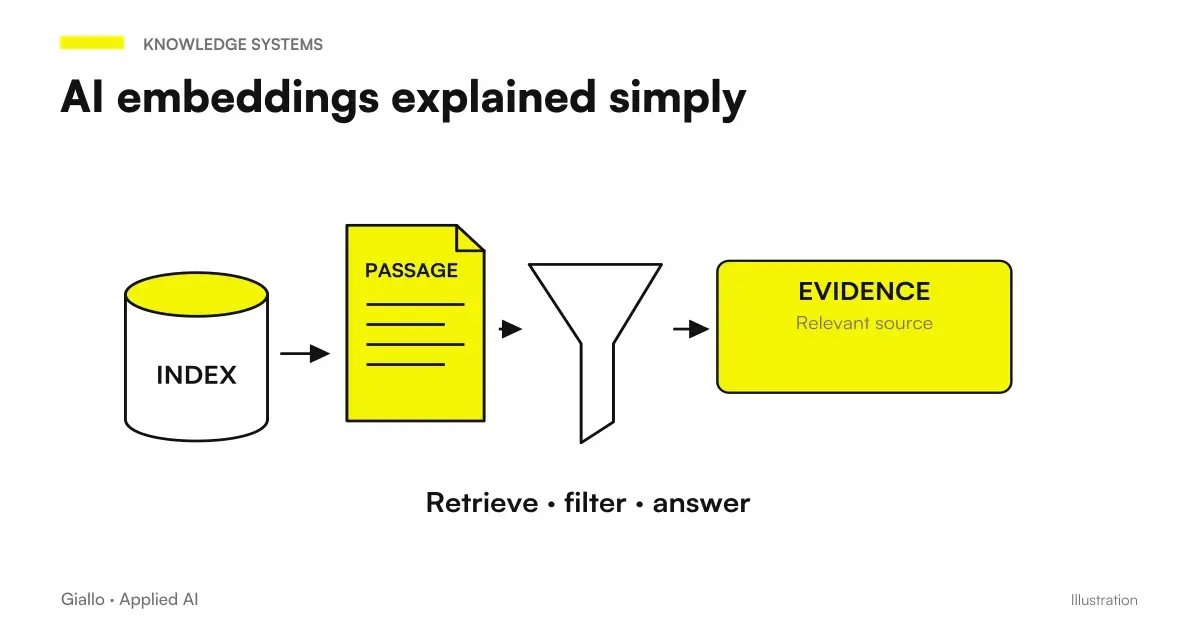
Algorithms do not work on words or images, but on numbers. A text, a customer or a product are transformed into lists of numbers that capture its characteristics. In modern systems this numerical representation is called embedding: this is what allows the model to understand, for example, that "refund" and "return" are close concepts. Understanding this step helps to see why data quality and cleanliness matter so much.
What types of machine learning exist
Not all machine learning works the same way. The main families are distinguished by how the system learns: with examples labeled, without labels, or by attempts. Here are the three most important, with what they do and a business example.
| Type of machine learning | How she learns | Concrete example in the company |
|---|---|---|
| Supervised | From examples already "labeled" with the correct answer | Classify emails in spam/non-spam; predict if a customer will quit |
| Unsupervised | Find groups and schemes with no answers provided | Segment customers by purchasing behavior; find anomalies in data |
| For Reinforcement | For trial and error, with prizes and penalties | Optimizing dynamic pricing; warehouse management or logistics |
| Semi-supervised | Few examples labeled + many unlabeled | Classifying documents when labeling them all by hand costs too much |
In business practice the most frequent case is by far the Supervised: you have a history of cases already solved and you want to predict the next one. Most useful projects — forecasts, classifications, fraud detection — come back here.
Supervised vs Unsupervised: How Do I Choose?
Use learning Supervised when you have a history with the "right answer" already known: past sales, tickets already categorized, customers who have or have not canceled. The goal is to predict that answer on new cases.
Use learning unsupervised when you have no labels and you want discover structure in the data: group similar customers, identify abnormal transactions, understand which products are bought together. It does not provide a known answer: it shows you patterns that you had not seen.
What machine learning is used for in the company
The practical point is this: machine learning serves to make forecasts and classifications on large volumes, where a human would be too slow or inconsistent. It does not replace judgment: it prepares the ground for the person to decide better and faster. The strongest cases for an SME are few and recurring.
- Forecast: estimating sales, demand, stock or cash flows from historical data.
- Classification: Automatically sort emails, tickets and documents into the right categories.
- Anomaly Detection: identify fraud, accounting errors or non-standard behaviour.
- Segmentation: grouping customers by behavior to personalize offers and communications.
- Recommendation: suggest the most relevant product or next action in an e-commerce or CRM.
The common thread is that machine learning works on structured data that your company already produces every day and that often remain unused. The difference with the Generative AI — that of ChatGPT and the like — is that the generative creates new content, while "classical" machine learning predicts and classifies. The two things today often combine in the same stream.
Practical examples
Three realistic scenarios of Italian SMEs, to make the speech concrete.
1. E-commerce — demand forecasting. An online store with 1,200 references wants to avoid both over-stock and stock breaks. A supervised model learns from the sales, seasonality and promotions history, and estimates how many pieces will be needed in the coming weeks for each product. The purchasing manager reviews the estimates and orders with more margin. Typical result: less capital immobilized in stock and less missed sales.
2. Accounting firm — document classification. Hundreds of different documents arrive every day (invoices, F24, contracts, bank statements). A classification model, trained on thousands of documents already archived, recognizes what type it is and proposes the correct folder. The operator confirms or corrects doubtful cases, and those corrections improve the model over time. It is the brick on which the process automation.
3. Service company — customer abandonment forecast. A subscription service provider wants to understand which customers are likely to cancel. A model learns from the historian (frequency of use, open tickets, late payments) and assigns each customer a risk score. The sales team first contacts those at high risk before they leave. Prediction is not a certainty, but it shifts attention to where it matters.
In all three cases machine learning does not "decide": it provides a well-informed estimate, and the person acts accordingly. It is the model that works.
When it makes sense to use machine learning and when not
When it makes sense
- You have a sufficient and fairly clean data history.
- The task is repetitive and high-volume, difficult to handle with fixed rules.
- There are real patterns in the data (the past says something about the future).
- A margin of error is tolerable, or there is a human review on critical cases.
When to Avoid It (For Now)
- You have little data, dirty or unrepresentative of the problem.
- A few clear and stable rules are enough: a rules-based system is simpler and more transparent.
- Every mistake has serious consequences and there is no human control.
- The phenomenon changes all the time and the past does not help predict the future.
Practice rule: without good data there is no useful machine learning. If the data is few or messy, the first investment is not the algorithm but the collection and cleaning. A model trained on poor data produces poor forecasts, but presented with the same confidence as good ones — and that is what makes it dangerous.
Mistakes to Avoid
- Pointing to the model before the data. It always starts with the available data and their quality, not the "fashion" algorithm. Without representative data, no model saves the project.
- Confusing high accuracy with good model. A model that "fits" all training examples but fails on new cases suffers from overfitting: learned by heart, did not generalize. It is always evaluated on data never seen.
- Ignoring biases in data. The model inherits the biases present in historical data: if in the past decisions were distorted, it will reproduce them. On customers, candidates and credit is a concrete risk, even legal.
- Forgetting that the models "get old". A trained model last year may no longer be worth it: market, customers and prices change. Without monitoring and retraining, the forecasts get worse in silence.
- Treating prediction as certainty. Machine learning gives probability, not truth. Important decisions always need human control and an estimation of uncertainty.
How to apply it in the company
Introducing machine learning in a sensible way is a step-by-step path, not a major IT department project. It also applies to an SME without internal data scientists.
- Start with a business demand, not technology. "Which customers are likely to leave?", "How many pieces do I order next month?" A clear question guides everything else.
- Check if you have the data. Is there a usable history? Is it clean and accessible enough? If not, the first step is to organize it, not train anything.
- Define how you measure success. Minimum acceptable accuracy, tolerable error, expected value (hours or costs saved). Without a meter you will not know if it works.
- Start with the simplest model that's enough. Often a classic approach is more transparent, faster and more than sufficient. Complexity is only added if it really serves.
- Keep the human in control and measure again. The model proposes, the person decides and corrects. Those corrections fuel the next improvement.
This is exactly the kind of work that a AI Consulting can accompany: understand if the problem is suitable for machine learning, evaluate data and link the model to real processes. Often the pattern is just a piece, and the value comes in when it enters a process automation or inside a AI Agent acting autonomously on simple cases.
Conclusion
The Machine Learning is the engine of almost all practical AI today: a software that learns from examples to make predictions and classifications, instead of following handwritten rules. Its strength lies in managing volumes and nuances that no fixed rule could cover; its limit lies in depending entirely on data quality and providing probabilities, not certainties. For an SME the advantage does not come from the most sophisticated algorithm, but from choosing a problem with available data, measuring the result and keeping the person where judgment and responsibility are needed. From here you can continue with the deep learning to understand the most powerful models, or with the LLM to see how these principles go all the way to ChatGPT.
AI becomes useful when it enters processes. Giallo Studio helps SMEs and teams build concrete, measurable and sustainable automations — and you can see the experiments applied in The Lab.
Giallo Studio guides: methodology and sources
How we apply it in the company
Related resources
 Artificial intelligence: what it is and how it works
 Deep learning explained simply
 Generative AI: What It Is and Why It Matters
 AI embeddings explained simply
 LLM: What Language Models Are
 Invoice automation with AI: what can be automated?
 Best AI for SEO: Tools to Optimize Content
 Mistakes to avoid with voice AI
FAQ
What is machine learning in simple terms?
Machine learning is a method that allows software to learn how to perform a task from examples, instead of following rules written by hand by a programmer. The system is shown many already-solved cases and derives the patterns for handling new cases on its own.
What is the difference between machine learning and artificial intelligence?
Artificial intelligence is the overall goal: getting a machine to perform 'intelligent' tasks. Machine learning is the method most commonly used today to achieve it, by having software learn from data. All machine learning is AI, but not all AI uses machine learning.
What are the types of machine learning?
The three main types are: supervised learning (learning from already labelled examples, such as spam/non-spam emails), unsupervised learning (finding groups and patterns without labels, such as customer segmentation) and reinforcement learning (learning through trial and error with rewards and penalties, such as robotics and optimisation).
Does machine learning only serve large companies?
No. SMEs mainly use machine learning through ready-made tools: sales forecasting, automatic email and document classification, fraud detection and product recommendations. You do not need a team of data scientists to get started, but you do need to choose a problem with available data and a measurable result.
What is the difference between machine learning and deep learning?
Deep learning is a subset of machine learning that uses neural networks with many layers. It is more powerful for complex data such as images, audio and language, but requires more data and computing power. For many business problems involving tabular data, simpler machine learning models are sufficient and more transparent.
Can machine learning be wrong?
Yes. A model learns from the data it receives: if the data is limited, dirty or unrepresentative, predictions will be poor or biased. It also provides probabilities, not certainties. This is why business processes need accuracy measurements and human checking of critical cases.