
Copyright and AI-generated content
Who owns the rights to AI-generated text and images, what you can use commercially and the risks for an Italian business.
Reading time: 9 min
The question always comes at the same time: the company has generated an image or text with AI, is going to publish it, and someone asks "But can we use it?".
The short answer is that there are two distinct issues which are almost always confused. The first: that content is protected, that is, can I prevent others from copying it? The second: Does that content violate anyone else's rights? They are independent, and the second is the one that can cost.
In summary
- There are two questions: I have rights to this and I'm violating the rights of others. They must be kept separate.
- Copyright protection presupposes a human creative contribution: a totally automatic output hardly satisfies it.
- The conditions of the supplier govern commercial use, but do not delete risk to third parties.
- Responsibility to rightholders rests with Who publishes.
- Risk focuses on prompts that ask for identifiable styles, characters, or brands.
- For the code the specific theme is open source licenses.
First question: is the content yours?
Copyright protects works characterized by a creative contribution of the person. An output generated by a system from an elementary education struggles to fall into that category, because it lacks just the element that the norm wants to protect.
This has a practical consequence that surprises many companies: a purely generated content may not be defensible if someone else reuses it.
The picture changes when human intervention is substantial: selection among many variations, rewriting, editing, structure, adaptation. There the person's activity can be protected, even if part of the process has been assisted.
Second question: Are you violating something?
This is the part that generates litigation, and is independent of the former.
| Situation | Level of risk |
|---|---|
| Generic output on common theme | Low |
| Prompt citing the style of an identifiable living author | High |
| Generation of well-known characters, logos or brands | High |
| Output that reproduces recognizable portions of a work | High |
| Code for distribution | Medium, depends on licenses |
An important practical element emerges: much of the risk is created in the prompt. Asking for "an illustration of a city at sunset" and asking for "an illustration in the style of [author]" lead to the same instrument towards very different risks.
Low Risk Prompt
- Describe subject, atmosphere, colors
- They refer to broad historical currents
- Describe the function of the image
High Risk Prompt
- They cite an identifiable artist or photographer
- They ask for well-known characters or brands
- They ask to replicate a specific work
Who answers if something goes wrong
The point that companies discover late: Responds to those who publish. The rightholder addresses the person who placed the content on the market, not the provider of the instrument.
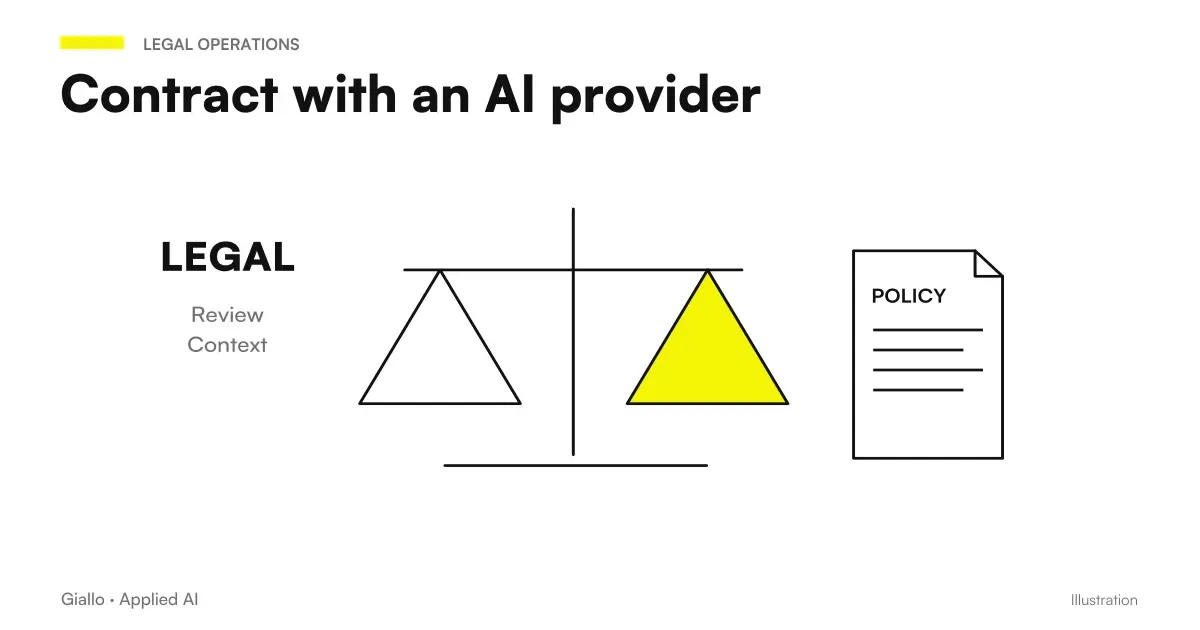
Some providers offer forms of contractual indemnity on certain plans. They are useful but almost always conditioned: they apply if you have used certain functions, if you have not bypassed filters, if the plan is the right one. They should be read before to build a strategy on it — it is one of the points to be verified in contract with an AI provider.
Practical examples
Agency that generates images for a customer's site. Manageable risk if prompts describe scenes and atmospheres. It becomes serious if someone asks for the style of a photographer known to "get that mood". In the contract with the client it is better to clarify who answers for what: often the agency assumes a guarantee that it cannot support.
SMEs publishing articles assisted by AI. Double theme. On the own rights front: if the text is purely generated, it is hardly defensible by copies. On the breach front: the risk is low for original information content. However, the editorial rule always applies — check the facts, because the responsibility for what you say is yours regardless of who wrote the draft.
Software house that uses assistants to write code. The theme is the license. For code intended for distribution a revision and tools of analysis of dependencies and licenses should be considered.
Company that creates its own logo with AI. The case where it's best to stop. A brand is an asset that must be defensible and recordable: it is exactly the scenario in which the uncertain protection of the purely generated output becomes a practical problem.
How to Adjust AI Content in Customer Contracts
If you produce content for others —agency, graphic studio, freelance, software house.the copyright theme ceases to be theoretical and becomes contractual. The customer will ask you, sooner or later, if what you have delivered to him is usable and whose it is.
There are three clauses that need to be clarified:
- Statement of employment. Telling if and how AI was used in production. More and more chapters ask for it explicitly.
- Loaned guarantees. What do you really guarantee: that the content is original? That it does not violate known rights? They are different commitments, and the second is much more sustainable than the first.
- Ownership and use. What the customer can do with the delivered material, taking into account that on purely generated outputs the protection can be uncertain.
The theme that concerns everyone: published content and editorial responsibility
Beyond rights, there is a front that touches on anyone posting AI-assisted content: responsibility for what you claim.
Generated text can contain false statements presented confidently — nonexistent legal references, invented data, quotations never spoken. If you publish it, you are responsible for it. This concerns the accuracy of information rather than copyright, and causes the most concrete reputational harm.
- Always check normative references, figures, and quotes before publishing
- Be wary of very specific statements: they are the ones that the model invents best
- On technical or legal issues, have those who know read it again
- Treat output as a draft of a good intern, not as a ready-made text
The phenomenon is explained in AI hallucinations: what they are and how to avoid them. The practical rule that works best: the AI can write, but the signature remains yours, and by signing responsibility. Those who use AI to produce content in volume should also read prompt engineering: how to get started, because better instructions significantly reduce the amount of checks needed downstream.
Mistakes to Avoid
- Confusing the two questions. ‘The supplier allows me commercial use’ does not mean ‘non-violating rights of third parties’.
- Asking for the style of an identifiable author. It is the most direct way to create an avoidable problem.
- Trusting the indemnity without reading it. Conditions are limited and bound to plan.
- Building a brand on a non-defensible output. It applies to logos, characters, identity elements.
- Not tracking anything. Without a trace of how a content was produced, in the event of a dispute you have no arguments.
How to apply it in the company
- Distinguish Uses: service content (social, drafts, internal materials) and identity assets (brands, characters, key illustrations). The latter deserve caution and review.
- Adjust prompts: no names of living authors, no known characters or brands. A line of policy solves much of the risk.
- Documenta: tool, date, prompt used for important assets. In case of dispute it serves.
- Add Human Work where you want the result to be defensible: selection, editing, adaptation.
- Check Plans of suppliers on commercial use and any manleves.
- Clarify in Contracts with customers who guarantee what on the delivered content.
Point 2 is the one with the best ratio of effort to risk avoided. It should be included in the corporate policy on the use of AI along with data rules.
Always check the official conditions of the services you use: they change frequently and differ between plans.
The specific case of images for the web
For most Italian companies the concrete use is only one: images per site, social and commercial materials. It is worth closing with operational directions for this scenario, which is what comes up every week.
- Describe the scene, never the style of an identifiable person
- Avoid recognizable brands, logos, characters, and faces
- For the company's identity material, have a designer intervene on the output
- Preserve prompt and date for assets that end in campaigns or print
- Check the conditions of the plan you're really using, not the enterprise plan
These five lines cover almost all real use cases of an SME and cost nothing in terms of time. The theme intertwines with the quality of the result: more descriptive and less imitative prompts also produce more original images, as explained in prompt engineering: how to get started and in best AI models for images.
Conclusion
On the copyright of AI content the situation is not a regulatory vacuum, but an area in settling where two solid principles apply: protection follows human input, and responsibility to third parties follows those who publish.
Translated into practice: Use AI freely for service content, add human work where you want defensible rights, and keep others' proper names out of prompts. Three rules that eliminate most problems without slowing down work.
If you want to understand what processes in your company can be automated with AI, Giallo Studio can help you turn the problem into a real workflow.
Giallo Studio guides: methodology and sources
How we apply it in the company
Related resources
FAQ
Is an AI-generated text protected by copyright?
Copyright protection traditionally requires a human creative contribution. Output produced entirely by a system from a minimal instruction is unlikely to meet that requirement. When a person makes a significant contribution to structure, selection, and refinement, however, protection may cover the overall result of that human activity. This is an evolving area: uses with significant economic value require an opinion.
Can I commercially use images generated with AI?
The conditions of use of individual services govern what you can do with the outputs, and many allow commercial use, sometimes with differences between free and paid plans. However, the permission of the provider does not eliminate the risk that the output looks like an existing protected work: they are two distinct issues and should be assessed both.
Do I risk infringing someone else's copyright by using AI?
The risk exists and is real when you expressly request the style of an identifiable author, generate well-known characters or brands, or the output reproduces recognisable portions of existing works. Original, generic output carries a much lower risk. The prompt almost always makes the difference.
Do I have to disclose that content is AI-generated?
The AI Act provides transparency obligations for certain artificially generated content, particularly when it could be mistaken for authentic. Beyond the norm, in many professional contexts declaring it is also a sensible reputational choice. Check the provisions applicable to your specific case.
Who is liable if AI content infringes third-party rights?
The person who publishes it. Companies underestimate this point: liability towards the rights holder rests with whoever puts the content on the market, rather than the tool provider. Some providers offer contractual indemnities for certain plans, but these are limited and conditional: read them beforehand, rather than afterwards.
Does AI-generated code pose similar problems?
Yes, with a specific concern: the risk is the possible reproduction of portions of code covered by open-source licences with particular obligations. For software intended for distribution, it is worth planning a review and, where needed, using licence analysis tools.