
Gemini agent for companies: what Google announced and what to check before using it
Gemini agent for business: capabilities announced by Google, access and tool controls, and what to check about pricing and availability in Italy.
Reading time: 12 min
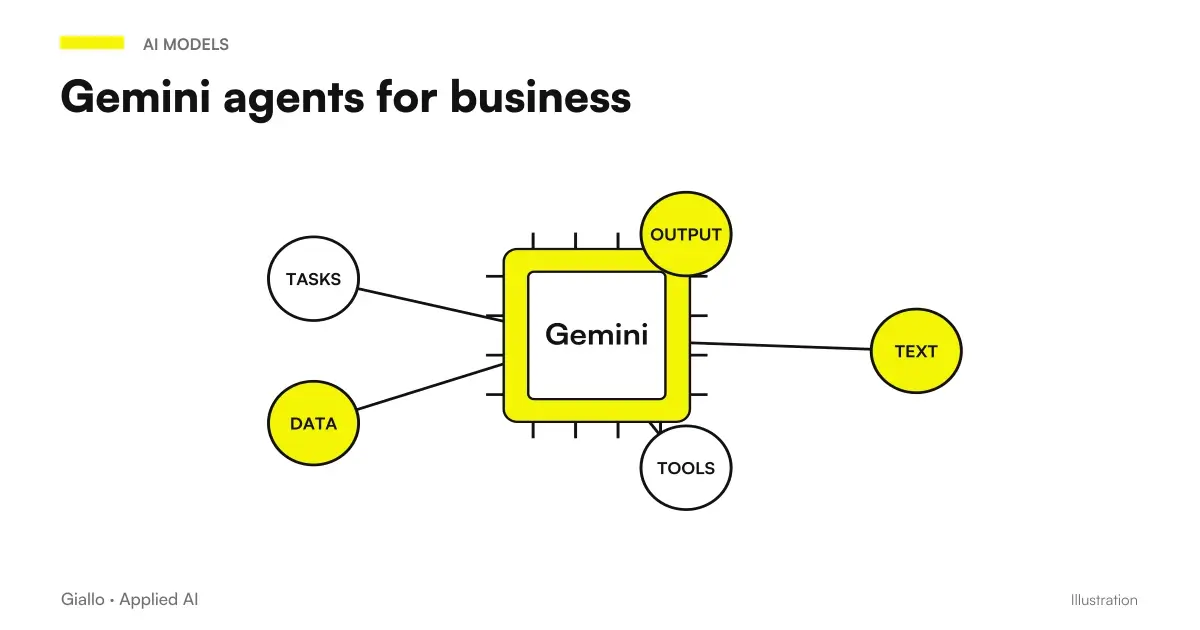
Gemini agent is the agent for the work announced by Google Cloud: it starts with a goal, uses context and tools and can coordinate activities with specialized agents. The decision for an SME is not only whether to prove it, but what work to entrust to it and with what operational boundaries.
The announcement comes from Gemini at Work on October 8, 2026. Google describes persistent cloud execution, integrations, and controls for identity, access, audit, and budget. Prices, necessary plan and exact availability in Italian tenants are not verified: the announced capabilities must be distinguished from what an account can already activate. Google Cloud detailed announcement.
In summary
- Gemini agent is presented as a goal-oriented agent, with context, memory and tools.
- An available integration does not amount to an authorization to act on all data.
- Prices, licenses and access for the individual Italian tenant must be verified.
- A useful test has an expected result, allowed actions and approval steps.
- Quality should be observed on the completed work, not just on the chat response.
What's different than asking Gemini for a text?
A writing request often has an obvious boundary: you ask for a draft and you receive a text to read. A goal-oriented agent may instead have to search for information, choose tools, manage steps, and continue a task. Google presents Gemini agent through context, memory, skills, and coordination with specialized agents. It is a description of the ability of the announced product, not proof that every business process is already covered. Official Google presentation.
This difference changes the way you prepare a test. "Help me with customers" is too generic: it doesn't say which customers, which sources or what outcome is acceptable. ‘Collection of authorised information of a request and preparation of a card to be approved’ makes it possible to observe the work. It can be verified whether data is missing, whether the sources are relevant, and whether the agent stops at the intended point.
Who already knows Gemini for Companies can then read the novelty as a decision on the process. Conversational capabilities remain useful, but the reliability of an activity also depends on access, applications, and rules. A well-written text does not prove that the downstream work was performed correctly.
Which parts of the ad are relevant to an SME?
Persistent cloud execution affects when a task does not run out of immediate response. Memory matters when the system must maintain a context that is useful over time. Tools are of interest when the result requires reading or operating in different applications. Google also includes model choice and administrative controls. These aspects are described in the Cloud Announcement.
For an SME, reading should start with the systems already used. If the work lives mainly in documents, emails and a management system, it is necessary to understand which links are available and which ones require development. If an essential part of the process remains in an unrelated application, the project must predict that step instead of pretending that the agent's demo has already solved it.
Identity, access, audit and budget controls are just as important as visible functions. They must be translated into practical questions: with what identity does the agent operate? Which folder do you read? Who can see his results? How do you stop an activity? Who gets a mistake? The product documentation and its environment must provide answers before assigning it a process with external effects.
How to check Italian access, license and availability?
The first check concerns the concrete tenant, i.e. the environment of the organization. It is not enough for an ad to show a function or for another account to own it. It is necessary to verify access, the required plan, any administrative authorisations and the conditions of the connected services. If these details are not yet available, the decision can remain an evaluation of the process, without declaring that the product is ready for adoption.
It is not possible to indicate a verified price here or to promise access to all Italian SMEs. The sources of the ad have capabilities and direction of the product, but they are not enough to confirm every condition of the individual account. The reference to check is the Google Cloud ad, followed by the commercial and administrative information actually applicable to the organization.
It is useful to separate the cost of the license from the cost of the project. Even when a product is accessible, defining a workflow, preparing sources, connecting a management software and organizing control requires work. The Guide on how much does an AI agent cost helps distinguish these items without turning an ad into a quote. A serious comparison starts with a described task, not the isolated price of a subscription.
What actions to entrust to the agent in the first test?
| Type of activity | Reasonable initial boundary | Evidence to be Observed |
|---|---|---|
| Search for information | Authorized sources and defined scope | Recovered references and declared gaps |
| Preparing a document | Draft submitted for review | Correctness of fields and sources |
| Updating data | Approved test or pass environment | Modified values and the possibility of reconstructing the action |
| Sending Out | Approval before enforcement | Recipient, text and attachments visible to the auditor |
| Coordinating multiple steps | Limited objective and stopping rules | Status of work, errors and interventions required |
This table is a design criterion, not a list of guaranteed functions for each tenant. It serves to decide what you want to try before looking for ways to implement it. An activity without a manager or an authoritative source hardly becomes reliable just because it is assigned to a more capable agent.
Human control must be placed where the decision has consequences. If the person approves only a generic description, but does not see the data that will be modified, the passage is unhelpful. It is better to present proposed result, sources and precise action. The basics of AI Agents for Companies remain valid: delegating a task requires an observable definition of the completed work.
A service company preparing meetings: hypothetical scenario
Let's imagine a service company that prepares meetings with customers using notes, documents and open activities. In this hypothetical scenario the agent would aim to produce a preparation card, reading only the authorized sources for that customer. The result would include open issues, consulted documents, and missing information, without inventing the status of a project.
The test would not automatically include sending to customers or changes to management software. It would first be observed if the card distinguishes a confirmed commitment from a hypothesis discussed in a note. A contact person would compare the result with the sources and report errors that can have consequences in the meeting, such as attributing a request to the wrong person or using an outdated version of the offer.
The team could already use Gemini in Workspace, but the new project would still need to clarify access and responsibilities. The value of the test would be to understand whether the preparation process becomes more orderly and verifiable. One would not infer universal savings from the results declared by the supplier, nor would one present the scenario as a real customer.
A distributor that handles commercial requests: hypothetical scenario
Consider a distributor that receives incomplete requests for products with technical variants. In this second hypothetical scenario the agent could prepare a form of the request and indicate what information is missing before a bid. The sources allowed would be approved catalogue and authorized data, while the decision on the product to be proposed would remain commercial.
The test should include informal names, references to similar products and contradictory annexes. If the customer does not indicate a necessary feature, the correct result could be a question to be sent after review. Guessing the variant would make the flow seem faster but less useful. The card should distinguish provided data, retrieved information, and deductions to be confirmed.
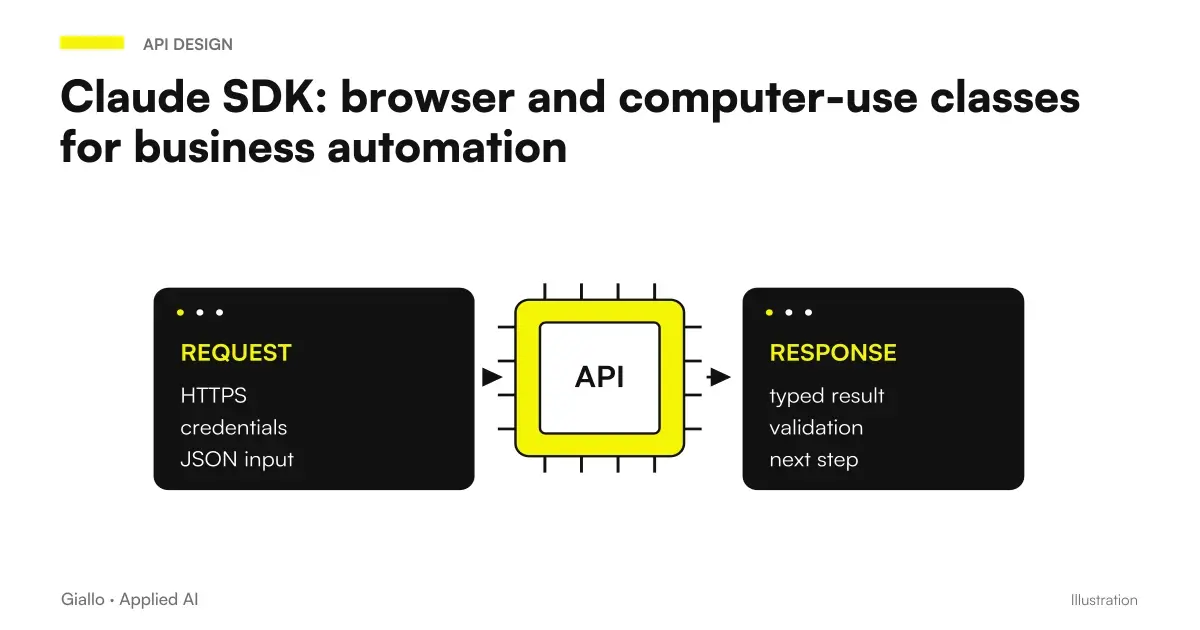
If work requires management software without the necessary integration, that limit should be addressed as part of the project. An alternative option might involve a browser interface, but it would require different evaluations. The article on browser and computer use in the Claude SDK deepens another approach: the link serves to understand the boundary of the tools, without considering the two automatic substitute products.
The officer can find information, but he doesn't know when to stop?
Define events that require a person: missing source, contradictory data, outward action or unexpected change. He prepares examples of these cases and observes behavior. The stop rule must belong to the workflow and controls of the application, not remain just a generic phrase in the target description.
How to control memory, context and sources over time?
Memory can make an agent more useful when it avoids rebuilding a context each time. However, it can retain information that subsequently changes. For this it is necessary to distinguish what belongs to an authoritative source from what is a working note or a preference. The system should be able to recognize a new version and not treat an old conversation as a valid data.
The project should indicate who can correct the context and how to withdraw an information. Even an employee's change of role requires attention: an agent should not continue to show content that that person can no longer consult. The availability of announced administrative controls does not replace evidence of actual behavior in the integrations used.
If the organization already works in other environments, it is better to evaluate where the most reliable context is. Atlassian Rovo with OpenAI, Jira and Confluence It addresses a different ecosystem. The useful comparison is not which brand seems more complete, but which path allows you to recover correct sources, respect accesses and complete the expected work with fewer fragile steps.
Who takes charge of the work left in half?
A persistent activity may encounter an unreachable source, an ambiguous request, or an application that responds unexpectedly. The project must define what the person sees when the work remains incomplete. «Operation failed» may be too little: they serve the passage reached, what was only proposed and what was possibly performed. This allows you to resume the process without duplicating actions.
For the first test, it is also advisable to choose an intervention manager. It doesn't necessarily coincide with who applied for the agent's job. A commercial request may need the technical department; an access problem may require the administrator. If the escalation comes to a generic box with no context, the system transfers the task of reconstructing the whole story to people.
You then need to clarify how to undo or correct an activity. A draft card can simply be rewritten. An update already applied to a management software requires a different procedure. The agent should operate within the boundaries set by the application, while the referent must know how to verify the real state in the recipient system. The agent summary is useful, but does not replace that verification.
These cases should be included in the test along with the requests that succeed. You can simulate a missing source or withdraw an authorization in a controlled environment, observing if the workflow stops and communicates the problem. The ability to interrupt in an understandable way is part of the expected result. Without this criterion, a demo only judges the favorable path and leaves the daily work unanswered when something changes.
The mistakes that a convincing demo can hide
The first is to confuse an announced capability with a feature available in your account. The second is to connect many applications without defining what the agent can do in each. The third is to use broad credentials to simplify the test, postponing the permission issue at the time of production. That problem instead belongs to the feasibility of the process itself.
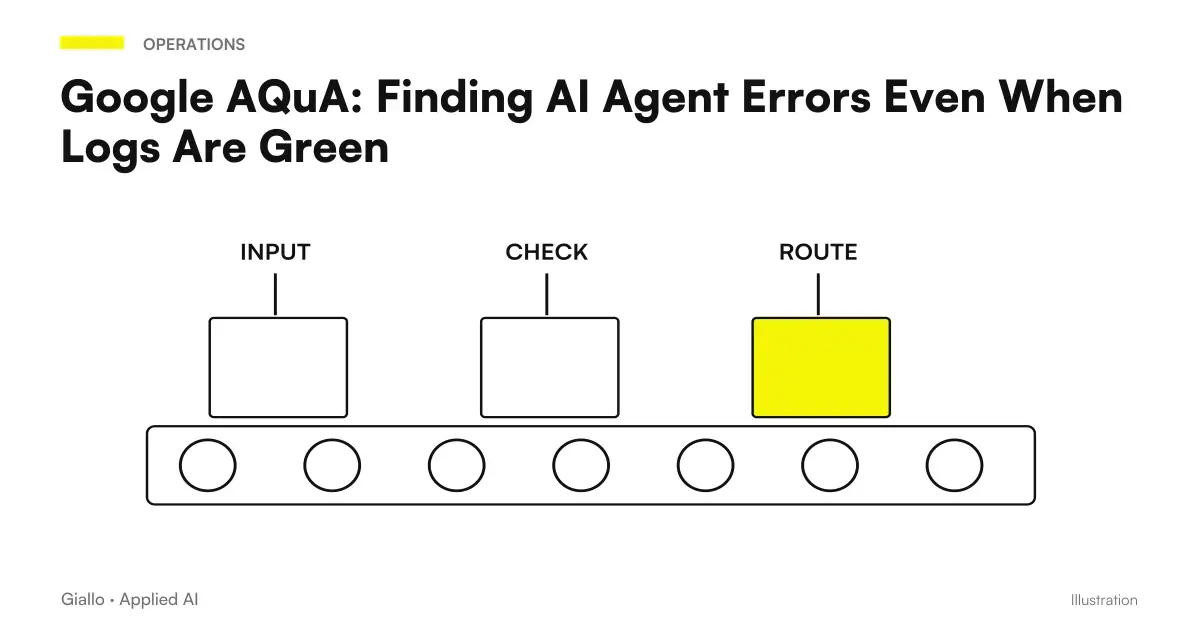
Another mistake is measuring only if the agent arrives at the end. A finished task may contain a wrong source, an unnecessary change, or a circumvented approval. This requires cases where the expected behavior is to ask for clarification or to stop. The diagnosis described for Google's AQuA It concerns precisely the defects that do not emerge from technical logs alone.
Finally, it is not advisable to go directly from a successful trial to a broad process. You have to decide who observes the errors, who updates the sources and what happens when an integration changes. The capabilities announced by Google are the starting point of the evaluation, while the responsibility for adoption requires a workflow that is understandable even to the people who will have to manage it after the first test.
What decision to make before activating other integrations?
Choose a process with a referent, identifiable sources, and a result that can be controlled. Describe the actions allowed, those that require approval, and cases where the agent has to stop. Then verify access, license and integrations on the concrete tenant. If one of these points remains open, the test must make it visible instead of covering it with a generic promise.
We can turn this perimeter into a corporate agent project with integrations and permission control. The first useful delivery is an observable process: objective, sources, proposed actions and criteria to decide whether to proceed. It is on that concrete work that it makes sense to evaluate Gemini agent, keeping distinct the possibilities of the ad and the conditions actually available to the company.
Giallo Studio guides: methodology and sources
How we apply it in the company
Related resources
 Gemini for Companies
 Gemini for Google Workspace
 AI agents for business: when they are useful and how to adopt them
 How much does a custom AI agent cost
 Claude SDK browser and computer use classes: automating business software
 OpenAI and Atlassian expand Rovo: Jira and Confluence in working with AI
 Google AQuA: Finding AI Agent Errors Even When Logs Are Green
 HTTP Hooks: controls for Claude Code
FAQ
What is Gemini agent?
It is the work agent announced by Google Cloud, oriented around goals and able to use context, memory and tools. Google also describes coordination with specialized agents.
Is Gemini agent available for all Italian companies?
This article has not verified exact availability for Italian tenants. Check actual access within your organization’s environment and the required plan.
How much does Gemini agent cost?
A price is not indicated because the conditions required for the individual account are not verified. The cost of the project also includes integrations, source preparation and workflow control.
How does it differ from a chat request?
A goal-oriented agent may require multiple steps and tools to complete a task. The test must then check sources, actions, and result, in addition to the text of the response.
How should you set up an initial business trial?
Choose a limited process with a person responsible for it, authorized sources and an observable result. Define permitted actions, approvals and the situations in which the agent must stop.
Do the announced integrations authorize any action?
No. Technical access and operational authorization are different things. The project must establish identities, permissions, controls and responsibilities for each connected system.