
ROI of an AI project: how to calculate it
Calculate an AI project's return: what to include, what to leave out and why you need baseline measurements before starting.
Reading time: 9 min
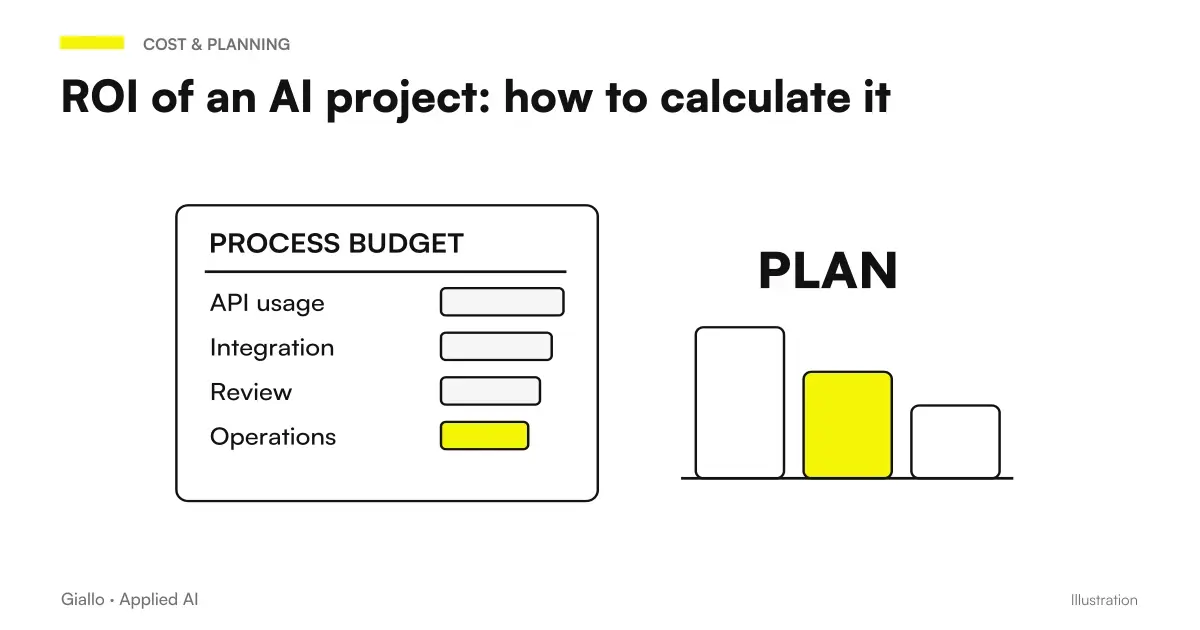
The ROI of an AI project is calculated with an elementary formula. The difficulty is not the calculation: it is having the starting numbers, and almost no company picks them up before they start.
The result is that at the end of the project the evaluation becomes a reconstruction by heart, with positions that depend on how much everyone has grown fond of the work. It is the reason why many AI projects are archived as ‘interesting’ without anyone being able to tell if they have served.
In summary
- The hard part is the starting measure, not the calculation.
- In the cost everything goes: estimate, internal time, data, training, exercise.
- Saved time only counts if it comes reused in a measurable way.
- The Avoided Errors They are often the greatest voice and the most ignored.
- Unquantifiable benefits are listed, not added up.
- Over two or three years of reentry, almost always the chosen process is wrong.
What to put in the two dishes
| Costs | Benefits |
|---|---|
| Estimate of achievement | Hours Released and Re-used |
| Internal analysis and testing days | Mistakes Avoided, Valued |
| Data preparation and remediation | Reduced response times, if they produce value |
| Training and Adoption | Extra managed volume for equal people |
| Annual consumption and hosting | Avoided losses: contacts, cancellations, expired |
| Maintenance and evolution |
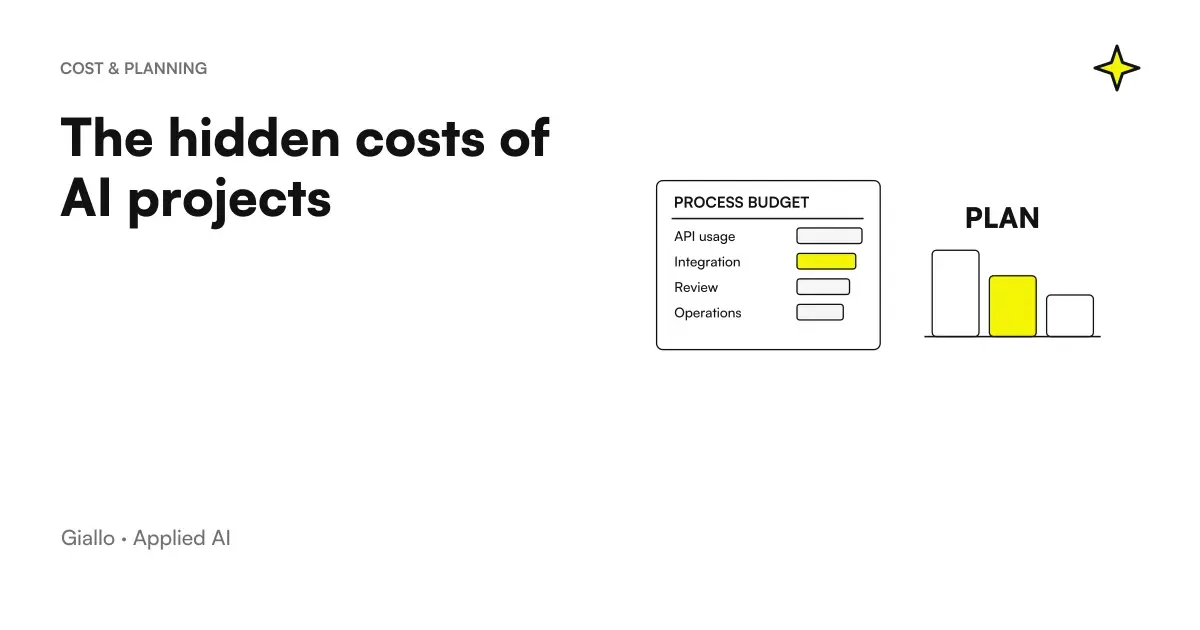
The left column is almost always underestimated because the quote is the only visible entry. The detail of hidden entries is in hidden costs of AI projects.
The number that is always missing
- Choose the process before to choose the solution.
- For a month, measure: how many times it happens, how many minutes it takes, how many errors it produces.
- It values the real business cost of the person who carries it out.
- Also write down the wait times and lost requests, if you can.
- Write the number and date it. It will be your term of comparison.
A month of measurement delays the start of four weeks and makes evaluable everything that comes next. It is the best investment of the project, and it only costs attention.
Mistakes Avoided: The Forgotten Voice
It is often the largest component of the return and hardly anyone calculates it, because it requires an estimate instead of a measurement.
The method is simple: it estimates the average cost of an error in that process. Not only the correction time, but the consequences: a rework, a dispute, a wrong order, a customer leaving.
- How many errors are produced today, in a month
- How much does it cost to make up for one
- How many of these can the system avoid, realistically
- How many new errors could the system introduce
The last point should be included for honesty: an automatic system produces different errors, not zero errors. A calculation that assumes zero is a calculation that will not be believed.
What to Keep Out
There are real benefits that don't go into the account, and keeping them out makes the calculation more solid instead of weaker.
In the calculation
- Hours measured and reused
- Avoided errors with estimated cost
- Managed Volume Plus
- Quantifiable Avoided Losses
Only Listed
- Satisfied customers
- Less stress for the team
- More modern image
- Acquired knowledge
The right column is true and counts, but if you add it up you get a number that no one can dispute and no one believes. Better a more modest and defensible ROI, with the qualitative benefits listed apart.
Practical examples
Passive billing automation. Sixty documents a month, seven minutes a month, company hourly cost known. Annual cost of the process can be calculated accurately. Errors: Two complaints a year about wrong amounts, with estimated cost. The bill is made in ten minutes and is defensible.
Customer Assistant. More complex: the hours saved are clear, but the greatest benefit — demands escaped in the evening instead of two days later — is difficult to value. It is worth calculating the ROI on hours only and quoting the rest separately.
Project evaluated without initial measure. One company automated a process without knowing how much it cost before. At the end of the year, the discussion of "did it help?" was based on impressions, and the project was considered useless — probably wrongly, but without data no one could prove it.
The calculation on a concrete case
It is worth seeing a complete example, because the formula is simple but the way to fill it is not obvious.
A company receives sixty passive bills a month. Each document takes about seven minutes between opening, reading, inserting, and checking. It's seven hours a month, eighty-four a year. Valued at the company cost of the person who takes care of it, you get the annual cost of the process.
To this are added the errors: two disputes a year on misplaced amounts, each with an estimated management cost between lost time and relationship with the supplier.
On the other hand: the estimate of realization, plus the internal days of analysis and testing valued, plus the accommodation of the supplier registry, plus the annual consumption and a maintenance fee.
- Sum avoided, measured annual costs.
- Sums the total cost of the project, including internal entries.
- Divide the second by the first: you get the years of reentry.
- Add the annual recurring cost to the denominator for subsequent years.
Point 4 is the one that is forgotten and that changes the picture on the second year: the benefit is not net forever, it must be curtailed of the exercise.
When ROI is not the right criterion
There are cases where insisting on calculation leads to wrong decisions, and it is worth acknowledging them.
When the problem is continuity — a knowledge concentrated in a person who is about to leave — the value is not a saving of hours but a risk avoided, and it is not calculated in the same way.
When the problem is the Capacity — you can't handle the volume that comes in — the benefit is turnover that you don't do today, not cost that you save.
When the problem is a requirement — an important customer asks for a certain way of working — the question is not how much it makes, but how much it costs not to.
In all three cases the classical calculation underestimates the project. It is worth explicitly declaring it instead of forcing numbers that do not describe the situation.
What to count and what not to count
| Voice | In the calculation | Why |
|---|---|---|
| Hours measured and reused | Yes | They replace a real cost |
| Avoided errors, with estimated cost | Yes, declaring the estimate | Often the Greatest Voice |
| Managed Volume Plus | Yes | Turnover or capacity |
| Unreused Free Hours | No | Benefit, not savings |
| Customer Satisfaction | No, it lists | Not Summable to Numbers |
| Image and modernity | No | Unmeasurable |
The rule: if you don't know where the number comes from, don't put it in the account. A modest and defensible ROI convinces more than a high and questionable one.
Mistakes to Avoid
- Calculating a posteriori. Without initial measure it is a reconstruction.
- Just counting the quote. Inner time is a great voice.
- Assuming zero system errors. It makes the account unbelief.
- Summing the qualitative benefits. It weakens the whole calculation.
- Counting freed hours not reused. It's a benefit, not a savings.
- Ignoring recurring costs. They're changing their second-year bill.
How to apply it in the company
For those working in the Microsoft ecosystem, the Copilot pilot for SMEs applies this comparison to roles, tasks, and output review. The available time remains distinct from the cash savings made.
Before anything else, choose the process and measure it for a month. Five numbers: frequency, minutes, hourly cost, errors, wait times. Date them and put them in a file.
Then, on completion of the project, he remeasures the same five numbers in the same way. The difference is your return, and it is not questionable.
The metrics to follow during are in KPI of an AI project, the cost framework in how much AI costs in the company.
Presenting the calculation to those who decide
The way ROI is presented counts as much as the number, especially in SMEs where decision makers look at the cash register.
It works by presenting it as a replacement for an existing and measured cost, with the clear start numbers and estimates declared as such. It does not work to present it as an investment in innovation, nor to inflate it by including unmeasurable benefits.
An honest presentation also includes the worst case: what happens if the benefit is half that estimated. A project that holds even in that scenario is a defensible project; one that only makes sense in the optimistic hypothesis must be reconsidered before, not after.
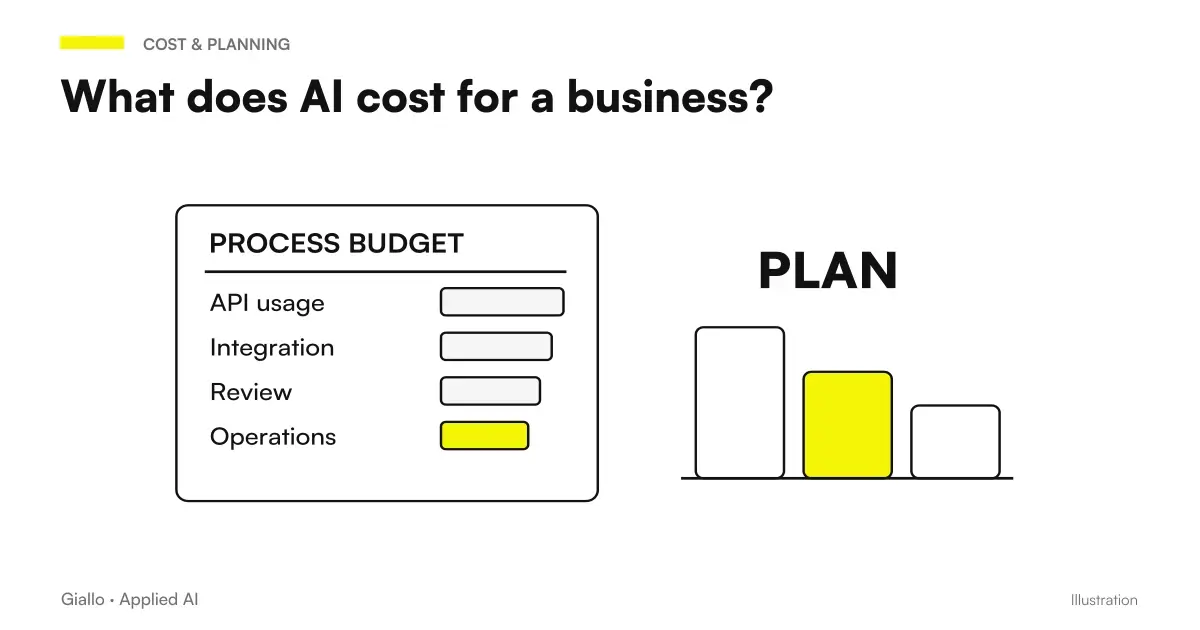
Full cost items are in hidden costs of AI projects, the orders of magnitude in how much AI costs in the company.
Wait for superintelligence or start a pilot?
The economic decision does not require an assumed date of arrival of the ASI. Compare the cost of maintaining the current process with the full cost of a circumscribed test: integration, use, review, exceptions, and maintenance. The Guide superintelligence for SMEs: waiting for it or using AI today? deepens this choice and presents a calculation with explicit hypotheses.
The freed hours describe operational capability. They become economic benefits only if the company can employ them in a useful way or reduce an actual cost, while maintaining the required quality. The example is not a prediction of the result of your project: it is used to identify what data to collect before authorizing an extension.
Conclusion
The ROI of an AI project is not difficult to calculate: it is difficult to calculate after. It all depends on five numbers collected before starting, and those who have them can discuss facts while those who have not discuss impressions.
The discipline it serves is modest —a month of attention —and completely changes the quality of the next decision: whether to extend, whether to stop, whether to change the process.
If you want to understand what processes in your company can be automated with AI, Giallo Studio can help you turn the problem into a real workflow.
Giallo Studio guides: methodology and sources
How we apply it in the company
Related resources
FAQ
How do you calculate the ROI of an AI project?
By comparing the total project cost with the measured value of what it replaces. The formula is simple; the difficult part is having baseline figures, which almost nobody collects before starting. Without them, any retrospective calculation is a reconstruction from memory.
What goes into the total cost?
Not only the estimate: also the internal time of analysis and testing, data preparation, training, and the recurring costs of consumption and maintenance. An ROI calculated on the development cost alone is systematically optimistic.
Is the time saved a real gain?
Only if the time is used for something measurable. If an hour freed up becomes an extra hour on value-adding activities, the gain is real. If it becomes general free time, it remains a benefit but should not be counted as a cost saving: that intellectual honesty makes the calculation credible.
How quickly should the investment pay back?
For automation on a frequent process, the order of magnitude is months. If the calculation says more than two or three years, it almost always means that the chosen process does not have sufficient volumes and it is better to choose another.
How do you account for avoided mistakes?
By estimating the average cost of an error — rework, a dispute or a lost client — and multiplying it by the measured reduction. It is an estimate and must be identified as such, but it is often the largest item, and ignoring it undervalues the project.
What about the unquantifiable benefits?
They must be listed but kept out of the calculation. Faster answers, less stress, more satisfied customers are real benefits that however can not be added to numbers. Mixing them makes the account unassailable and for this reason useless.