
Integrating AI into the systems you already have
Connect AI to existing business software, CRM and archives: requirements, complications and how to assess feasibility.
Reading time: 9 min
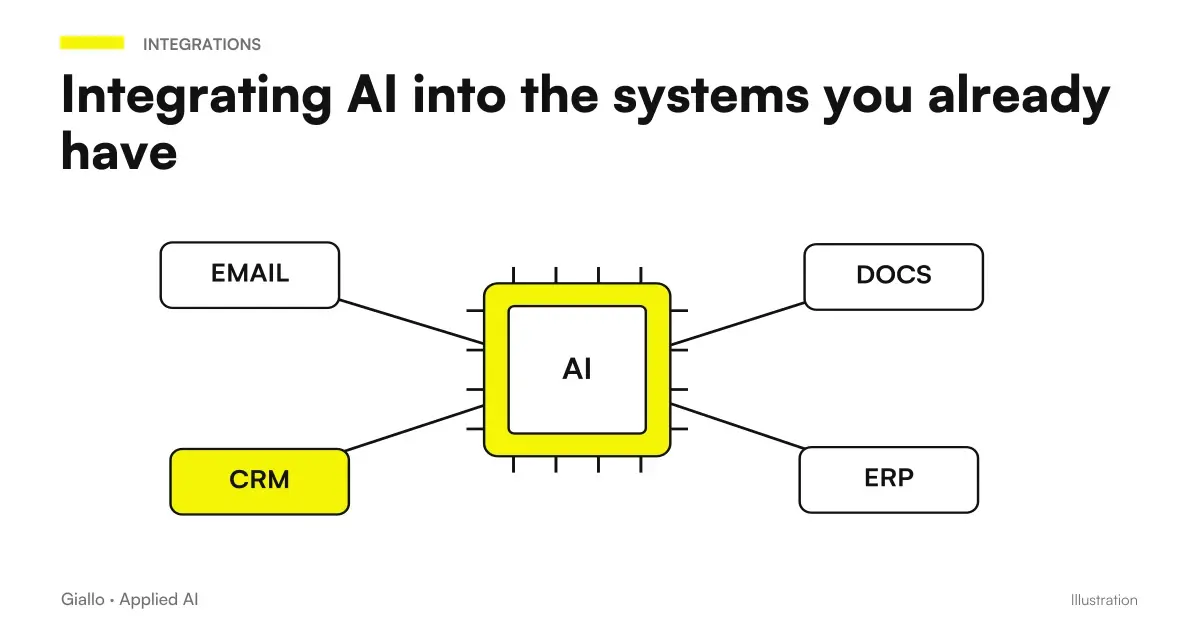
The value of an AI project in the company almost always arises from link to the systems you already have. A disconnected assistant can provide generic information; one connected to the business management software can tell you the status of that customer’s case.
It is also the part that weighs the most on cost and time, and it is the variable that explains most of the differences between seemingly similar estimates.
In summary
- Almost Never Serves change management software to introduce AI.
- Integration is often the Most Expensive Voice of the project.
- Even without modern interfaces it can be done, with more fragile solutions.
- The most frequent obstacle is not technical: it is not knowing how it works The system.
- One or two integrations in the first version, not five.
- Upstream updates break integrations: you have to predict who corrects.
When the management software does not expose the necessary link
The absence of a suitable API requires a choice between supported paths and maintenance costs. For automate a management software without API it is worth checking the provider’s import, export and integrations before operating the interface. The pilot must demonstrate saving, stopping when unexpected conditions occur and restarting the queue, in addition to the click sequence.
The ways to connect, from best to worst
| Mode | Reliability | When it is used |
|---|---|---|
| Documented interfaces of management software | High | Modern or Maintained Systems |
| Undocumented but existing interfaces | Medium | We need discovery work |
| Direct access to the readable database | Medium | If the provider allows it |
| Scheduled exports to files | Low-average | Closed Systems |
| User Interface Automation | Low | Last Beach |
The first three lines cover most real cases. The last two work but are fragile: they break with each update and require continuous maintenance.
The Obstacle No One Predicts
It's not technical: is that often no one in the company knows how the system works.
The management system was installed years ago, customized by someone who's gone, and people use it without knowing what's underneath. When it is necessary to understand where the data is and how it is accessed, the answer is "you have to ask who installed it", and sometimes that provider is gone.
- Who installed and configured the system, and is still reachable?
- Is there any documentation of customization?
- Is the maintenance contract active?
- Does anyone know where the data is physically?
These are four questions to ask. before to ask for quotes. Answers change the estimate more than any other variable.
What to Ask for it to be Decomposed
A quote that writes "integration with your systems" as a single entry is not comparable to anyone else. The information you need:
- What systems, with name and version.
- Which direction does the data travel: read-only, or even writing?
- How often: in real time, every hour, once a day?
- What happens when the downstream system doesn't respond.
- Who corrects if an update breaks the link.
Point 4 is what distinguishes a job done well from a prototype: an integration that assumes that the other system always responds will produce silent errors on the day it does not respond.
Why it's better to start with a few additions
One or two
- Predictable cost
- Fewer breakpoints
- Easier to understand what's not working
- Maintenance contained
Four or five
- Cost growing more than proportionally
- Every upstream upgrade is a risk
- Complicated diagnosis when something breaks
- Long times before the first result
There is, however, a positive aspect that compensates: the first integration is the most expensive. Once the management software is connected for a project, the second project using the same link costs much less. It is a good criterion to choose the first process to automate.
Practical examples
Modern management software with documented interfaces. Linear integration, short time, low cost. It is the best and most common scenario among management software updated in recent years.
Outdated business management software without interfaces. Fixed with scheduled exports: the system reads a generated file every night. Less elegant, working, and with a clear limit — the data is not real-time, which for some uses is acceptable and for others not.
System closed with maintenance expired. The worst case. No one can authorize access, no one knows how it works. Before we talk about AI we need to solve that, and it's a problem that the company already had without knowing it.
In Atlassian environments, the context is distributed between documents and activities. Rovo with OpenAI for Jira and Confluence help to evaluate an internal integration to the ecosystem, verifying permissions, plan and really active functions in their tenant.
For AWS infrastructure, the new MCP Server endpoints in other European regions expand the options for connecting to assistants. The region of the endpoint does not alone demonstrate the residence of every data in the workflow: resources, models and tools called must also be followed.
The Case for Cloud Systems
An increasing share of companies use cloud management software, and the situation is different from that of installed systems.
The advantage is that interfaces almost always exist and are documented: the provider exposes them as part of the service. The disadvantage is that you do not decide when they change, and that access may depend on the plan underwritten.
- Verify that your plan includes access to interfaces
- Check if there are limits on the number of requests
- Ask how much notice the changes are communicated
- Verify where the data resides, for compliance aspects
The second point often surprises: some services limit calls to interfaces, and a system that interrogates management software with each request can exceed that limit unexpectedly. It is a verification to be done at the project stage, not after.
Integration as an asset
It is worth closing with a strategic point that changes the criterion of choice of the first project.
The connection with management software is the most expensive part and, once done, it is reusable. A company that has already integrated its management software to automate invoices can use the same link for the warehouse, for purchases, for reporting, paying each time only the new logic.
This suggests that, for equal immediate convenience, It is best to choose first the project that touches the most central system. It is not a reason to choose a bad candidate, but it is a factor worth putting on the plate when two options equal each other — as described in AI project: how to get started.
Questions to Ask Before Quotations
| Question | To whom | Why the estimate changes |
|---|---|---|
| Are there documented interfaces? | Management software provider | It is the main variable |
| Does our plan include them? | Management software provider | There may be an additional charge |
| Who made the customizations? | Interior | Determine if anyone knows what it's like |
| Is the maintenance contract active? | Interior | It is used to authorize access |
| Where do the data reside? | Supplier | Compliance aspects |
Five phone calls before asking for quotes make estimates much tighter.
Mistakes to Avoid
- Not checking interfaces before obtaining quotations. It changes everything.
- Accepting "integration with your systems" as a unique voice.
- Starting with four integrations. Cost and risk grow more than the benefit.
- Not planning for what happens when the downstream system is down.
- Ignoring who corrects after an update.
- Changing management software to introduce AI. Almost always disproportionate.
How to apply it in the company
Before asking for quotes, make two phone calls: to the management software provider, to ask if there are interfaces and if your contract includes them; and to who made the customizations, to see if it is still reachable.
With those two answers in hand the quotes you will receive will be much more accurate, and you will know in advance whether you are in the simple or the complicated scenario.
The cost framework is in how much does an AI agent cost, the criteria of choice of the supplier in how to choose an AI provider.
When integration is not convenient
There is a case where the correct answer is to give up the link: when the cost of integration exceeds the benefit of the project.
It happens with very closed systems, where the only way is a fragile automation of the user interface, or when the management software provider asks for disproportionate figures to enable access.
In these cases there are two alternatives: a partially manual process, where the system prepares and a person reports the data, or postpone the project until the management software will be replaced for other reasons.
Both are legitimate decisions. The one that doesn't work is forcing a fragile integration: it will cost in maintenance every month and break at the first update, as described in how much it costs to maintain an AI system.
How long does an integration last over time
An aspect that changes the way we evaluate: integrations are not one-off jobs, they are commitments that last.
Any connection to an external system is a point that can break: when the management system is updated, when it changes a format, when a credential expires, when the supplier modifies its interfaces. It is not a design flaw: it is the nature of any system that depends on another.
- Predict who notices when an integration stops working.
- Have the system report the problem instead of silently failing.
- Budget one intervention per year for adjustments.
- Keep the link documentation in an accessible place.
Point 2 is the most important and is almost always neglected: an integration that fails silently produces missing data that no one notices for weeks. The theme of recurring costs is in how much it costs to maintain an AI system and the selection of the first project in AI project: how to get started.
Stop duplicates before propagating a registry
A synchronization can multiply an identity error if two records are merged only because they share an email or similar name. duplicates in CRM with AI requires evidence, review of associations and an explicit decision on the union. The guide proposes a pilot on the proposals, before activating changes in the connected applications.
Conclusion
Integrating AI into existing systems is almost always possible and almost never requires replacing them. The real difficulty is not technological: it is knowing how what you have is done, and finding who can authorize access.
The practical rule: few integrations done well, check first with the management software provider, and with a written answer to what happens when something upstream changes.
If you want to go from testing with ChatGPT to an AI system integrated into business processes, Giallo Studio custom designed agents and automations.
One last practical tip: ask that the part talking to the external systems be kept separate from the rest. It is a technical choice that does not cost anything in the making and that makes future adjustments circumscribed: when the management software changes, you touch a piece instead of the whole system.
Giallo Studio guides: methodology and sources
How we apply it in the company
Related resources
FAQ
Do I have to change my business management software to use AI?
Almost never. Most projects integrate with the existing business management system by reading and writing through its interfaces, or alternatively through file exchange. Changing business management software to introduce AI is almost always disproportionate to the benefit.
What makes integration difficult?
Closed systems without documented interfaces, very old versions, installations customised in non-standard ways, and the absence of someone who knows how the system works. The last point is more common and a greater obstacle than the other three.
Can integration work without APIs?
Yes, with less elegant but functional solutions: scheduled exports, shared folders and direct database queries where permitted. They cost more to maintain and are more fragile, but they are sufficient for many processes.
How many integrations do you need for a typical project?
One or two in most well-planned cases. Each additional integration significantly affects cost and timelines, which is why it is worth starting with a process that requires few.
Is integration the most expensive item?
Often yes, and it almost always accounts for the difference between two quotes. It is worth asking for a breakdown: which systems, which direction the data travels in, and what happens when the downstream system does not respond.
What happens if I update my business management software?
The integration may stop working. This is a normal situation that must be planned for: who fixes it, within what timeframe and at what cost. Properly isolating the part that communicates with external systems keeps these adjustments contained rather than extensive.