
Why AI Projects Fail
Why AI projects fail: the causes are rarely technological. What happens in practice and how to prevent each type of failure.
Reading time: 10 min
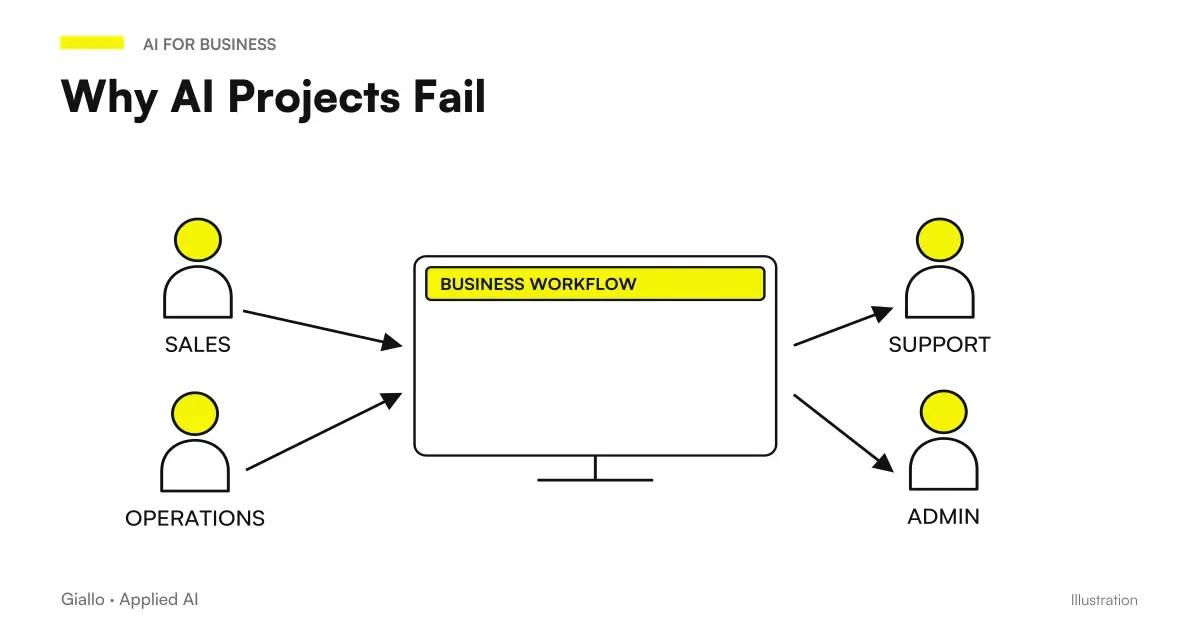
AI projects rarely fail because of technology limitations. They fail for predictable organizational reasons, and failure is almost never an event: it is a slow degradation that no one declares.
First some cases are handled "separately". Then people go back to the old method for convenience. Finally, the system remains on and no one uses it. No one decides to stop him, he simply stops counting.
In summary
- The most frequent cause is the absence of a internal contact person with time.
- Failure is a Slow degradation, not a declared event.
- The early signal is the phrase "We still do that by hand".
- Wrong expectations produce disappointment even in the face of good results.
- Wide perimeter and absence of measurement are the other two main causes.
- Almost all cases are prevented by decisions made earlier, not by technical work.
The six causes, in order of frequency
1. No internal referent with time. The project needs someone to answer the supplier's questions, try the system, collect reports. If that person already has a full-time job and no one has freed them hours, the project lengthens and the result resembles what the supplier envisioned.
2. Perimeter too wide. Ten use cases instead of two. The system comes late, covers many situations badly, and the first impression —the one that matters —is of a tool that often mistakes.
3. No starting measure. At the end of the project the evaluation is an opinion. Even a good result is not demonstrable, and the topic ends with a "not much has been served".
4. The process was confusing. AI doesn't put order: it amplifies what it finds. Automating a process with uncertain rules produces a system with uncertain behaviors.
5. Nobody keeps it. The management system updates, new cases arrive, an integration stops working. Without maintenance the system degrades in months — see how much it costs to maintain an AI system.
6. Wrong expectations. Presented as a transformation of the company, a project that improves a process by forty percent is perceived as disappointing.
Slow degradation, recognize it
Early signals
- "We still do that case by hand"
- Exceptions grow from month to month
- Someone holds a parallel file
- Reports stop coming
Advanced stage
- The system is used by one person only
- No one knows who keeps it anymore
- We talk about "redoing it" instead of correcting it
- Metrics don't look at them
The fourth point of the left column is the most insidious: When reports stop coming it doesn't mean everything's okay. It almost always means that people have stopped expecting them to be resolved.
How to prevent, cause by cause
- Contact: first name, last name and hours vacated before start.
- Perimeter: two use cases in the first version, written.
- Measure: a month of data before touching anything.
- Process: if it is confused, it first settles down and then automates itself.
- Maintenance: to budget from the first day, with a manager.
- Expectations: present it as "this process will work better".
None of these six require technical expertise. They are all organizational decisions made before the start, which is why most failures are preventable at no cost.
Practical examples
Technically successful project, never adopted. System built well, delivered, no format, no referent. At the first difficulty people went back to the previous method. Cost: the whole investment.
Perimeter widened in the race. Left with two use cases, arrived at seven for subsequent requests. Times tripled, average quality dropped, first impression negative. The project was deemed to have failed although the two original cases worked well.
Silent Degradation. Document automation working for a year. Then the management software provider changed an export format, exceptions grew, no one looked at them, and in three months the administration had returned to hand input.
The Failure That Doesn't Seem Such
There is a category of projects that no one considers to have failed and that still produced zero value: those that work perfectly on a process that did not need to be automated.
The system is technically excellent, people use it, quality metrics are excellent. Simply the automated process happened ten times a month and the savings are irrelevant compared to what it cost.
It is a failure of selection, not execution, and it is only prevented with the starting measure: if you had counted how many times it happened and how much it cost, you would have chosen another process.
What to do when a project is going wrong
Recognizing it early is half the job. The other half is knowing what to do, and the options are three.
Reduce the perimeter. If the system works on one part of the cases and not on others, keeping the part that works is almost always better than continuing to pursue total coverage.
Fix the process upstream. If the problem is that the process is confusing, no intervention on the system will solve it. It is time to stop and tackle the cause.
Close. If the chosen process had no volumes or the exceptions dominate, closing soon costs much less than dragging. And the information gained makes the next project better.
What hardly ever works is the fourth option, which is also the most practiced: adding features hoping for better adoption.
The causes at a glance
| Cause | Frequency | Prevention |
|---|---|---|
| No referent with time | Very high | Hours released before start |
| Perimeter too wide | High | Two written use cases |
| No starting measures | High | One Month of Data |
| Confusing process | Medium | Fix before automating |
| No maintenance | Medium | Budget and Responsible |
| Inflated Expectations | Medium | Present it for what it is |
No right-hand column row requires technical expertise or additional budget.
Mistakes to Avoid
- No real-time contact. Cause number one.
- Widening the scope mid-project. Move the target and stretch everything.
- Automating confusing processes. The result is attributed to AI.
- No longer looking at the figures after release. The degradation goes unnoticed.
- Ignoring "we still do it by hand". It is the most reliable early signal.
- Promising transformations. It guarantees disappointment.
How to apply it in the company
Before you start, answer three questions honestly: who will follow it and with how many hours, how many use cases the first version covers, and what is the starting number. If one of the three has no answer, the project already has a cause of active failure.
After release, ask one question each month to those who work there: "What cases do you still do it by hand?". It is the cheapest and most effective diagnostic that exists, and intercepts degradation when it costs little to correct it.
The complete method is in AI project: how to get started, the metrics in KPI of an AI project.
How to communicate a closed project
Closing a project that didn't work is a healthy decision, and the way it's communicated determines if the company can try again.
If it's told how "AI doesn't work", the topic closes for years and even the projects that would make sense won't start. If it's told how "this process wasn't the right candidate, that's what we've learned," there's still a chance to try again.
The difference is not rhetoric: in the first version the cause is technology, in the second it is a correctable choice. And in almost all cases the second version is also the true one.
The method to better choose the next candidate is in AI project: how to get started.
It is worth adding a consideration about timing: almost all of the described failures become visible between the third and sixth months after release. It is the window in which initial enthusiasm has passed, exceptions have emerged and habits are consolidating in one sense or another. Presiding over that window with a few minutes of attention per month is the intervention with the best relationship between effort and saved projects, and it requires nothing more than looking at numbers and asking people a question.
Conclusion
AI projects fail for organizational and predictable reasons: no one to follow them, too wide perimeter, no measures, confusing processes, no maintenance, inflated expectations.
None of these causes is technological, and all of them are prevented by decisions made earlier. The most effective is also the simplest: freeing real time to a person who knows the job, and listen to her when she says something is not working.
If you want to understand what processes in your company can be automated with AI, Giallo Studio can help you turn the problem into a real workflow.
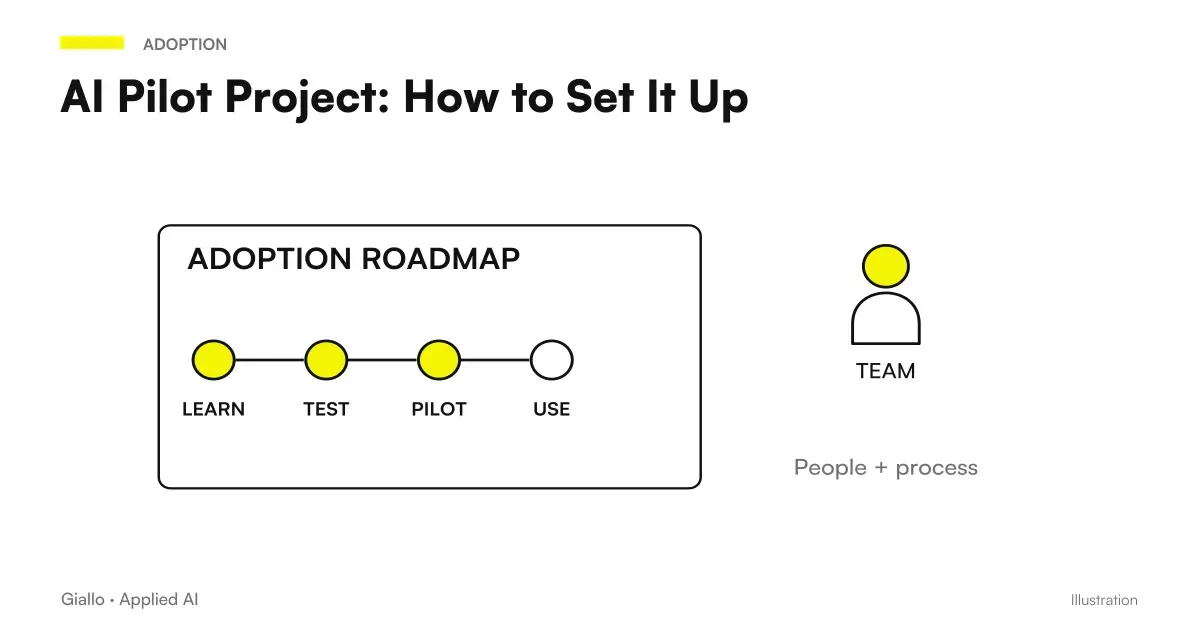
Finally, it is worth saying that an early closed project is not an expensive failure: it is the cheapest way to find out that that process was not the right candidate. Expensive failure is what drags on for a year because no one wanted to make the decision, as described in AI Pilot Project.
Giallo Studio guides: methodology and sources
How we apply it in the company
Related resources
FAQ
What is the most frequent cause of failure?
The absence of an internal contact with allocated time. Not goodwill: time. Projects without someone to answer questions, test the system and collect reports take longer, end up differing from what was needed and are not adopted.
Do projects fail because of technology limitations?
Rarely. In most cases the system works technically and is still abandoned, because no one uses it, because the process has changed, or because there was no way to notice that it had degraded.
What does it mean that a project has failed?
In practice, there is rarely a moment when failure is declared. Far more often, there is a slow deterioration: first a few cases are handled separately, then people return to the old method, and finally the system remains running but nobody uses it.
Can you recover a project that is failing?
Often yes, if you notice early. The early warning sign is the phrase “we still do that manually”: it indicates an uncovered case that is becoming a habit. Intervening at that point costs little; intervening once the habit is established is much harder.
Is the initial expectation the problem?
Often yes. Projects presented as company transformations produce disappointment even when they work well, because the yardstick is unrealistic. A project presented as ‘this process will work better’ is evaluated for what it is.
How do you prevent failure?
With four unexciting things: a narrow scope, a contact with allocated time, a baseline measurement and someone to look at the numbers afterwards. None requires technical expertise, and their absence explains most projects that go wrong.