
Mistral AI: What It Is and Why It Matters
What Mistral AI is: the European model company, open weights versus API access, Vibe (formerly Le Chat), data sovereignty and uses for Italian SMEs.
Reading time: 13 min
Mistral AI is a company French which develops models of artificial intelligence and makes them available in two ways: some with Open Weights (downloadable and installable freely, even in the company) and others as a commercial service via API. It also offers a conversational assistant, Vibe (formerly Le Chat), the European equivalent of ChatGPT. In one sentence: it is the main European Alternative to the major US models (OpenAI, Anthropic, Google) and Chinese models (DeepSeek).
Why does it count for those who work in Italy? For two concrete reasons. The first is the Data sovereignty: Mistral is a company based in the European Union, and for those who process customer data this simplifies compliance with the GDPR compared to suppliers that process everything in the United States. The second is the technical freedom: models with open weights you can host them on your own servers, keeping data inside the company. It is not "the most powerful model in the world" —on that front the US giants stay ahead on average —but for many practical cases it is a serious choice, often cheaper.
In this guide we see what Mistral AI really is, the difference between open weights and APIs, what Vibe is, why Europeanity matters for GDPR and when it makes sense to use it in an SME.
On October 6, 2026, the Mistral Large 4 preview. The guide distinguishes the already announced API access from the expected weight release by the end of October, and explains what requirements to check before planning a private installation.
In summary
- Mistral AI is a French artificial intelligence company: it is the main European alternative to the models of the United States and China.
- It offers two model families: some with Open Weights (downloadable and self-hosting) and others only commercial via API.
- Vibe (formerly Le Chat) is his conversational assistant, similar to ChatGPT, with free version and paid plans.
- The Europeanity helps on data sovereignty and GDPR: fewer complications than transfers to the US.
- It is not the most powerful model ever: the US giants stay ahead of complex reasoning. use case, not the ranking.
- "Open weights" does not mean "pure open source": it always verifies the license of the individual model on the official page.
Who is Mistral AI and why is it mentioned
Mistral AI is a startup founded in France in 2023 by researchers from environments such as Meta and Google DeepMind. In a very short time it has become the most cited European name in the field of language models, attracting substantial funding and the attention of EU institutions, which see it as a continent's response to the domination of OpenAI, Google and Chinese laboratories.
The reason we talk about it so much is not just technical. It is geopolitical and economic. Until now, the most widely used AI models were almost all US or Chinese: this creates a dependency on non-EU suppliers just as AI enters business processes. Having a European company capable of competing means, for those in Europe, having an alternative closer to their own rules — starting from GDPR — and less exposed to international tensions.
To frame Mistral in the full panorama, it is useful to read the Guide to the main AI models, which compares the model families available today.
What Mistral AI does: the two "products" to distinguish
Here is the point that generates the most confusion. Mistral is not one thing: it offers Models (technology) and a assistant (the product for the end user). They are two different levels.
- The Models are the "engine": neural networks trained to understand and generate text (and in some cases images or code). A developer integrates them into software or automation via API, or downloads and hosts them on a server. If you want to understand how this type of model works, start with the guide on LLM, Language Models.
- Vibe is the ready-to-use assistant: open the site or app, write, get answers. It is the one that uses a non-technical person, exactly as ChatGPT uses.
Understanding this distinction avoids the most common mistake: to think that "using Mistral" means one thing. For an employee who writes email it means Vibe; for a company that integrates AI into management software it means the API or self-hosted model.
Open weights vs API: the distinction that really matters
This is the most important distinction to grasp when discussing Mistral, and what sets it apart from OpenAI or Anthropic, which offer only models closed via API.
A Model A Open Weights is a model of which the company publishes the "weights", that is, the numerical parameters that make it work. You dump them, install them on your own infrastructure and run it around the house, with no data coming out. An accessible model only via API Instead, it stays on the server of the provider: you send the request, he answers, and your data passes through his system.
| Criterion | Open weight models | Models only via API |
|---|---|---|
| Where they turn | On your servers (self-hosting) or on the cloud of your choice | On Mistral's servers |
| Where the data goes | Stay in your infrastructure | They transit from the provider's servers |
| Cost | Hardware + technical management (fixed) | Payment on consumption per request |
| Required skills | High (server, GPU, maintenance) | Low (just an API key) |
| Updates | You handle them. | Automatic supplier side |
| When it makes sense | Very sensitive data, high volumes, total control | Quick start, variable volumes, no infrastructure |
Mistral plays on both tables: releases some models with open weights (typically the smaller and more efficient ones) and keeps the top ones commercial. For an SME this is a rare advantage: you can start with the API to do the first tests and, if the data requires it, switch to an open model hosted at home. The theme of hosting a model in its own right is deepened in the guide on Local AI Models.
What is Vibe (formerly Le Chat), Mistral's assistant
Vibe is the new name of Le Chat, Mistral's conversational interface: the way a person uses AI without writing a line of code. Mistral has announced the change on 28 May 2026 and his support page confirms that saved accounts, plans, conversations, and content pass to Vibe, with the same address (chat.mistral.ai) and the same login. It works like the assistants you already know: open a chat, ask a question, get an answer. It covers typical tasks: writing and reviewing texts, summarizing documents, translating, brainstorming, answering questions.
In addition to the name changes the perimeter. Vibe has three modes: Work, an agent on the web and on mobile who completes tasks in multiple steps using the connected apps and tools; Codes, for those who program, from terminal, from VS Code or from the web; Chat, the turn-based conversation you knew, which Mistral plans to close soon by keeping the history in Work mode. According to the product page, Vibe connects to over 100 tools, including email, calendar, Slack, GitHub and Jira, via connectors and MCP protocol.
Vibe exists in one free version and in paid plans for individuals and companies, which unlock more advanced features and higher usage limits. The official pricing currently includes Free, Pro (higher limits and full access to the programming features), Team (a shared workspace for groups) and Enterprise (private installations with custom models and tools). Numbers, features and prices change frequently: for current details, always check the official page rather than trusting benchmarks or price lists that age quickly.
For an Italian user, Vibe’s practical advantage over US assistants is not raw power, but being able to use a European service with well-supported French and English (and decent Italian) for everyday tasks. If you want a method for deciding which assistant to adopt based on your work, read how to choose an AI model.
Why Europeanity Matters: Data Sovereignty and GDPR
This is Mistral's true strength for those working in the EU, and it deserves clarity because it is often misreported.
When you use an AI model via a cloud service, your data (the question, the document, the customer email) comes processed on a server. If that server and that company are in the United States, the obligations of the GDPR on transfers of personal data outside the EU: additional safeguards (contractual clauses, transfer impact assessments) are needed and the issue of access to data by US authorities remains.
With a company and infrastructure European, part of this complexity is reduced: treatment takes place within the EU, under the same regulatory framework. It's not a magic wand — you still have to sign a data processing agreement (DPA), define what you share, and check where the data centers are — but the starting point is simpler.
Mistral writes it in its documentation: by default data is hosted in the European Union, unless you explicitly choose the API endpoint in the United States. The same page warns that, depending on the function used, the data may be transferred temporarily outside the EU, to the places indicated in the sub-processors section of its Trust Center, with the guarantees provided for in Article 46 of the GDPR. Before you decide, read that list.
Where Mistral Helps
- EU-based provider: less friction on non-EU data transfers.
- Self-hosting open-weight models: data doesn't come out of the company.
- Common regulatory framework (GDPR) between you and the provider.
- Concrete alternative to dependence on US or Chinese suppliers.
What remains to be done anyway
- Sign a DPA and verify the real location of the data centers.
- Define which data can be sent and which cannot.
- Do not enter sensitive data in free plans without reading the terms.
- Evaluate the self-hosted version if the data is particularly critical.
For those who treat sensitive data questathink of a firm that manages tax positions or legal practices —this is the difference between "I can use it" and "I have to avoid it". It is a central theme, for example, for AI applied to law firms, where confidentiality is an obligation before even a preference.
Is Mistral more powerful than the US giants? Honesty on capabilities
Honest answer: on average no, not on top models. On the most difficult tasks — complex reasoning, multi-step problems and advanced features — the leading models from OpenAI, Anthropic and Google remain ahead. It is right to know this so as not to build mistaken expectations.
That said, "more powerful" is the least useful question. The right one is "good enough for my task, at the right cost?". And on this Mistral is competitive for many practical cases: writing drafts, classifying texts, summarizing, answering questions about documents, translating. For these jobs the difference from a top model is often not seen, while cost and control over data do.
To choose well, avoid looking at the general classification and reason on three axes: the real difficulty of the task, the sensitivity of the data and the budget. On this method it is also advisable to compare with other open models such as Llama from Meta, to understand which family best fits your case.
Practical examples
Three realistic scenarios of SMEs and Italian professionals, to make the speech concrete.
1. Accountancy firm — confidentiality first. One study wants to use AI to summarize regulations and prepare drafts of responses to customers, but it cannot get tax data out to non-EU servers. It chooses an open-weight Mistral model hosted on a dedicated European server: AI works on documents without anything leaving the controlled infrastructure. The advantage is not the power, it is the Quiet compliance.
2. E-commerce — costs under control. An online store must generate thousands of product descriptions and rank reviews. Volumes are high and data is not sensitive. Use the Mistral API because, on repetitive tasks, it offers a convenient price/quality ratio: it pays on consumption, without managing servers, and keeps the cost per request low.
3. Consulting firm — daily assistant. A small team wants an assistant by email, summary of meetings and first drafts, preferably European. It adopts Vibe into paid plans for everyday work: no technical integration, immediate departure, and reassurance from an EU provider. When a process stabilizes, consider turning it into a Real Automation.
In all three cases the choice arises not from "what is the best model", but from a concrete constraint: confidentiality, cost or simplicity.
Mistakes to Avoid
- Confusing "open weights" with "free and ruleless". Open does not mean unlicensed: some models restrict commercial use or scale. Read the terms before building a product there.
- Choosing Mistral only because it is "European". Europeanity is a real advantage over the GDPR, but it is not enough on its own: if your task requires the absolute top on reasoning, you also evaluate the alternatives and choose on the use case.
- Putting sensitive data in Vibe's free plan. As with any cloud service, free plans have less protective terms of use. On Vibe, your content can end up in model training until Disable option in settings; in Team plans the administrator can do it for the whole organization, in Enterprise plans it is deactivated by default. For customer data you need business plans with treatment agreement (DPA).
- To think that self-hosting is "free". Hosting an open model eliminates consumption costs but requires hardware (GPU), skills and maintenance. It is convenient on high volumes or critical data, not to do two tests.
- Trusting benchmarks and prices found online. Mistral versions, capabilities and price lists often change: always check the official page before deciding, and do not treat an old comparison as a current fact.
How to apply it in the company
Introducing Mistral in an SME is not a big project: it is a three-step choice, driven by your data.
- Start with the data, not the model. Ask yourself: are the data I'm going to give AI sensitive? If so, direct the choice towards self-hosted open weights or European business plans with DPA. If not, the API will suffice and advance.
- Choose the right mode. Vibes for everyday people use; APIs for integrating AI into software or automation; open self-hosted model when data needs to stay in the home.
- Take a small, measurable test. One process, one "before" and one "after" in hours or errors. No revolutions: one confirmation at a time.
- Verify compliance. Signed DPA, clear data center location, rules on what you can share. Especially if you treat customer data.
- Decide whether to extend. If the numbers improve, it widens to other processes; otherwise it changes approach. The right model is the one that solves your case, not the one at the top of the rankings.
Almost no company starts by building from scratch: most integrate a model like Mistral into already existing flows, via AI agents or automations related to email, management software and CRM. It is exactly the job for which there is a AI Consulting: choose the right combination of model, mode and data control for your case, avoiding paying for power you don't need.
If you want to see concrete experiments on models and automations, take a look at The Lab.
Conclusion
Mistral AI It's important not because it beats US giants on pure power —on average it doesn't —but because it offers something they don't give: a company European, models with Open Weights that you can accommodate in the house and a simpler frame for the Data sovereignty and the GDPR. For an Italian SME, this translates into concrete choices: Vibe for everyday work, the API for integrating AI into software, and self-hosting when data must not leave. The right question is not “which model is the most powerful”, but “which one fits my case, at the cost and with the control I need”. From here, you can continue with the guide to open source models and with the method for choose an AI model.
If you want to go from testing with ChatGPT to an AI system integrated into business processes, Giallo Studio custom designed agents and automations.
Giallo Studio guides: methodology and sources
How we apply it in the company
Related resources
 Open Source AI Models: Complete Guide
 Llama AI: what is the open source model of Meta
 How to Choose an AI Model
 AI Models: Guide to Major Models
 Local AI models: when they make sense
 Make vs Zapier vs n8n: which one to choose for your company
 How to Calculate the ROI of an AI Project
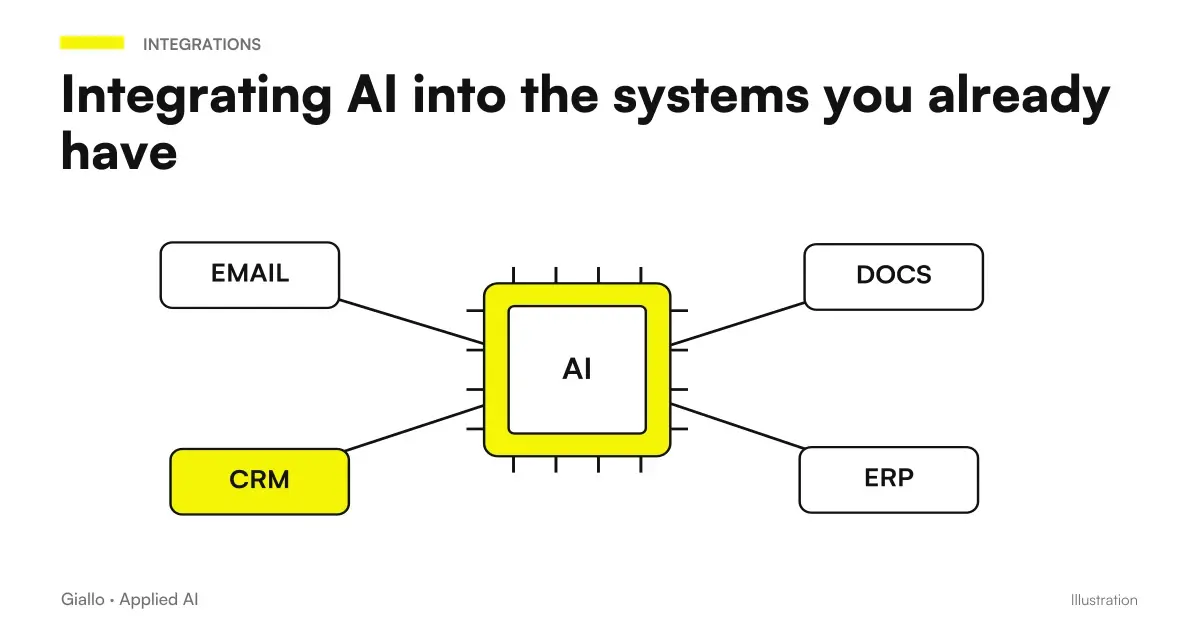 Integrating AI into the systems you already have
FAQ
What is Mistral AI in plain words?
Mistral AI is a French company that develops models of artificial intelligence, both with open weights (downloadable and installable by anyone) and commercial via API. It also offers a conversational assistant, Vibe (formerly Le Chat), similar to ChatGPT. It is one of the main European alternatives to US and Chinese models.
Is Mistral AI open source?
In part. Mistral releases some models with open weights under permissive license (you can download them and use them in the company as well), while other more powerful models are commercial and accessible only via paid API. 'Open weights' does not automatically mean 'full open source': always check the single model license on the official page.
What is Vibe, Mistral's former Le Chat?
Vibe is the new name of Le Chat, Mistral AI's conversational assistant: the French equivalent of ChatGPT or Claude. It lets you chat, write text, analyse documents and use connected tools; it also has a Work mode, an agent for multi-step tasks, and a Code mode for programmers. There is a free version and paid plans for individuals and companies (Pro, Team and Enterprise); check features and prices on the official website because they change frequently.
Why is Mistral AI important to European companies?
Because it is a provider based in the European Union: for those who process customer data, working with a European company and infrastructure simplifies compliance with the GDPR and reduces the complications of data transfers to the United States. In addition, models with open weights can be hosted on their own servers, keeping the data internal.
Is Mistral more powerful than ChatGPT or Claude?
It depends on the task. Among flagship models, the US giants (OpenAI, Anthropic, Google) remain ahead on average in complex reasoning and advanced features. Mistral is competitive in many practical cases, often at lower costs, and has the advantages of open weights and a European origin. The real use case matters when choosing, not the overall ranking.
Can an Italian SME use Mistral AI?
Yes. There are three avenues: using Vibe, Mistral's assistant, for everyday work, integrating models via API into a software or automation, or hosting a model with open weights on its own servers when the data must not leave the company. The choice depends on budget, technical skills and data sensitivity.