
Best AI to do research
Which AI is best for research with cited, verifiable sources? Selection criteria, a practical comparison and when to use each tool. Always check sources.
Reading time: 10 min
The Best AI to do research is not a single universal tool: it is what, for your kind of research, cites verifiable sources, works on up-to-date data and synthesizes without inventing. If you have to investigate a market, map competitors or check an information (fact-checking), the decisive element is not how well the AI writes, but how well it allows you to trace the sources and control them.
That is why the right question is not "what is the best AI ever", but "which AI makes me see where every statement comes from". A tool that summarises brilliantly but cites nothing is useless for serious research: you cannot verify, so you cannot trust it. By contrast, a less elegant tool with inline citations saves you hours precisely because it takes you directly to the pages to check.
In this guide we see the criteria to choose, a Practical comparison between the types of instrument, the concrete scenarios of SMEs and professionals, and the errors to be avoided. For a wider overview of the individual instruments we refer to the guide on best AI models for research; here the goal is to help you decide.
In summary
- For serious research the number one criterion is the cited and verifiable sources: without inline citations you cannot check, so you cannot trust it.
- The tools designed for the research with citations (Perplexity type) read the web in real time and show where each statement comes from.
- The General Assistants (ChatGPT, Claude, Gemini) are great for synthesizing and reasoning on texts you already possess, less reliable as a pure search engine.
- There is no overall winner: the choice depends on how much it matters to be able to verify the sources, the update of the data and the privacy.
- Whatever tools you use, always check the sources original: AI can quote a real page and misinterpret it.
What criteria really matter to choose an AI for research
Before comparing the tools it is necessary to focus on what makes an AI suitable for research. It is not the quality of the prose: it is the Traceability. Here are the criteria that really move the decision, in order of importance.
- Sources cited and verifiable. For each claim, does the tool show which page it comes from, with a link you can open? Inline citations (a number beside the sentence) are worth more than a generic bibliography at the bottom.
- Updating data. Does it read the web in real time or only respond with training data (which has a cut-off date)? For recent facts the difference is decisive.
- Quality of synthesis. Does it sum up multiple sources faithfully, distinguishing facts from opinions, or does it mix everything into one confident response?
- Transparency on limits. When a source is weak or the information is conflicting, does it signal it? An AI that admits uncertainty is more reliable than one that always responds in the same tone.
- Privacy and data processing. If the search touches on confidential data, it counts where it is processed and if it is used for training. For GDPR it weighs the residence of the data.
Keep a simple idea in mind: AI for research does not replace verification, it anticipates it. It gets you to the right sources faster, but the final check remains yours. That is why citations are the number one criterion.
Why citations are worth more than the "perfect answer"
A concise, well-written answer gives a false sense of security. Without sources alongside it, you have no way of knowing whether that number is correct, up to date or invented. With inline citations, however, every claim has a link: in ten seconds you can open the page and check. This is exactly what distinguishes a research tool from a simple text generator. If you want to understand the logic of these tools better, the guide on Perplexity AI: what is it explains how the search with quotations works.
Best AI for Research: Comparison by Tool Type
Among the routes to be assessed, Kimi AI Deep Research puts the link between questions, sources and conclusions at the centre. A well-written summary remains to be checked against the original documents before using it in a decision.
Instead of crowning a product, it is more useful to compare the three families of tools you encounter when looking for an AI for research. Each has a different strength; the "best" is the one that matches your use case.
| Criterion | research AI with citations | Generic Assistant (with web) | Generic Assistant (without web) |
|---|---|---|---|
| Typical example | Perplexity | ChatGPT, Gemini with research | Claude, basic versions |
| Sources quoted online | Yeah, that's his strong point. | Often, but less systematic | No, he replies "by heart" |
| Updated data | Read the web in real time | Only if web mode is active | No, stop at cut date |
| Quality Synthesis | Good, research-oriented | Very good | Very good, but on your texts |
| Ideal for | Market, competitor, fact-checking | Research + mixed reasoning | Synthesis of documents you already have |
| Main risk | Faithful Synthesis but Sources to Check | Incoherent or Missing Quotations | Dated or invented information |
The correct reading of the table is not "win the first column". It is: if source verifiability counts, start with search tools with quotations; if you must above all reason on material that you already own, a generic assistant is fine. Most real searches use both: you search with one, you rework with the other.
When to choose a search tool and when to choose a generic assistant
Choose a research AI with citations when
- You need to investigate a market, a sector, or competitors you don't know.
- You need to check an information (fact-checking) with a source in hand.
- Information changes often and you need recent data.
- You need to deliver a summary with links, not just an opinion.
Choose a generic assistant when
- You already have the documents and want summaries, comparisons or data extraction.
- You need to reason, rewrite, structure more than discover new sources.
- Research is about stable concepts, not recent facts.
- You work on reserved texts and prefer not to question the open web.
In practice the two worlds cross each other: use the search tool to find and quote the sources, then pass the contents to a general assistant for rework them. If you want to see this comparison applied to two specific products, read ChatGPT vs Perplexity and Perplexity vs Google.
Practical examples
Three realistic scenarios of Italian SMEs and professionals, to understand which approach is convenient.
1. Marketing agency — competitor analysis. An account manager needs to prepare an analysis of five competitors for a new client: positioning, public prices and social presence. A research AI with citations quickly gathers an initial map, with a link to every source. The account manager then opens the links, checks prices on the actual websites and discards outdated entries. The value is not “the AI did the analysis”, but “the AI found and cited the sources; the account manager checked and decided”.
2. Professional study — control of regulatory information. A contributor must verify a deadline or reference. Use AI to quickly identify probable sources, but not considers the synthetic answer as definitive: it opens the official source and checks there. On regulatory and tax issues direct verification is not optional. For regulated sectors see dedicated pages, e.g. AI for accountants.
3. E-commerce — market research for a new product. Before cataloging a line, the holder looks for volumes, trends and price range. The research tool gives him an overview with sources; he crosses them with the real data of his management software and with suppliers. AI shortens the exploration phase; the decision is based on verified data.
In all three cases the AI makes the first collection with sources, the person does the verification and decision. It is the model that holds.
How to use it well: the flow in 4 steps
- Formulate a precise question: "public prices of the 5 main CRMs for SMEs in Italy" makes it better than "info on CRMs".
- Always ask for sources: require inline citations and links, not a summary without references.
- Open and Verify at least the sources on which the decision rests: numbers, dates, textual quotations.
- Preserve links verified: a search without traceability is not reusable or defensible.
How to tell if a cited source is reliable
Check three things: who publishes it (an institution, an industry business, an anonymous blog?), the date (a figure from three years ago may be outdated), and whether the AI’s claim actually matches what the page says. If the source is other AI-generated content without its own references, treat it cautiously: you are following a circular citation.
Mistakes to Avoid
- Treating the synthesis as a verified fact. The AI response is a draft with links, not a truth. On numbers, dates and rules the verification on the source is mandatory. The theme is the same as the AI Hallucinations.
- To settle for a tool he doesn't quote. If you cannot open the source, you cannot check it. For serious research, always prefer tools with inline citations.
- Forgetting the date of the data. An AI with no access to the web responds with information that can be stopped months or years ago. For recent facts check that it is reading the web and check the date of the sources.
- Entering confidential data in public tools. For research that touches on sensitive business information, first evaluate how the tool treats data and whether it uses it for training.
- Looking for "the absolute best". The right tool depends on the type of search. Defining the use case well is worth more than chasing a ranking. On this helps the guide how to choose an AI model.
How to apply it in the company
For an SME or a study, AI for research is convenient when it enters a Recurring Process, not as an occasional curiosity. Three activities where it yields more: periodic competitor analysis, market research before a decision, control of information coming from different sources.
The practical point is to give yourself a Internal Rule: the AI collects and cites, a person verifies the sources before the data ends in a document or a decision. Without this rule you risk building choices on unchecked synthesis. When this flow becomes stable and frequent, it makes sense to structure it: connect AI research to the tools you already use and define who verifies what. It is the kind of work that a Process Automation Consulting, to turn an impromptu use into a reliable and repeatable flow.
If you need operational detail on individual models, Which AI benchmarks matter? and ARC-AGI: what it is and why it is talked about.
Conclusion
The Best AI to do research is the one that, for your case, cites verifiable sources, works on up-to-date data and synthesizes without inventing — not a product to crown once and for all. For market research, competitor research and fact-checking, start with research tools that provide inline citations; for reasoning about texts you already have, a general-purpose assistant is more than enough. In every case, the rule stays the same: always check the sources before using a data. For the complete overview of individual tools continue with the best AI models for research.
AI becomes useful when it enters processes. Giallo Studio helps SMEs and teams build concrete, measurable and sustainable automations — also to integrate AI research with source verification in everyday work.
Giallo Studio guides: methodology and sources
How we apply it in the company
Related resources
 Best AI tools by use case: October 2026
 Best AI Models for Research
 Perplexity AI: what it is and how it works
 Perplexity vs Google: response with sources or link list
 ChatGPT vs Perplexity: Research or Generation
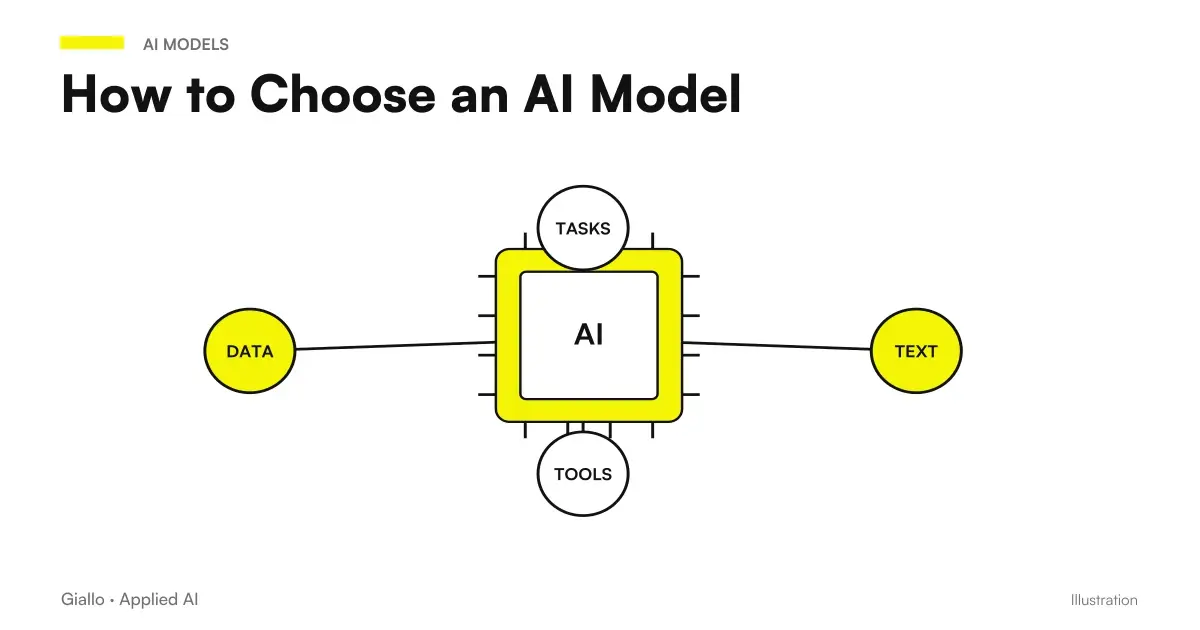 How to Choose an AI Model
 Best AI for CRM: Sales Management Tools
 Best AI for Customer Care: Customer Service Tools
FAQ
What is the best AI for doing research?
There is no absolute winner: it depends on the type of research. For research with cited, verifiable sources (market research, competitors, fact-checking), tools designed for research with inline citations are the most suitable because they show where every claim comes from. For synthesis and reasoning over texts you already have, a general conversational assistant may be enough. The practical rule is to choose according to how much you need to verify the sources.
Can I trust the sources an AI cites?
Only after checking them. An AI can cite a real source but misinterpret it, or attribute a fact to the wrong source. Citations are there so you can open the link and verify it yourself. Treat every number, date or claim as a draft to confirm against the original source, not as an already verified fact.
What is the difference between an AI for search and a search engine?
A search engine returns a list of links for you to read yourself. An AI research tool reads multiple pages for you and synthesises a single answer, citing the sources used. This saves time in the first stage but leaves you responsible for checking that the synthesis is faithful to the sources. The two tools are complementary, not alternatives.
Does AI use up-to-date data when doing a search?
It depends on the tool. AIs designed for research query the web in real time, so they may include recent information. Assistants without web access respond only with the data they were trained on, which has a cut-off date. For research on recent facts always check that the tool is actually reading the web and check the date of the cited sources.
Can I use AI for my company's market research?
Yes, as a starting point for mapping competitors, trends and sources, not as a final report. AI speeds up collection and initial synthesis, but data guiding a business decision must be checked against the original sources. Also avoid entering confidential company data in public tools before checking how they process it.
What AI do I choose for research if data privacy matters?
For research involving confidential data, where the data is processed and whether it is used for training matter. Prefer tools with business plans that exclude training use and, where possible, EU servers or data residency for GDPR purposes. Always check the plan's official terms: they change frequently and differ between free and paid versions.