
Knowledge cutoff: what it means in practice
What a knowledge cutoff is, why models in the same family can have different dates and how to work with newer information.
Reading time: 8 min
The knowledge cutoff is the date beyond which a model has no knowledge gained during training. It is a specification stated in the price lists, often ignored, and that explains a good part of the wrong answers that companies encounter.
The delicate point is not that the model does not know: it is that may not know that he does not know, and answer with confidence about things changed afterwards.
In summary
- Cutoff is the date beyond which the model has no knowledge since training.
- Models of the same family have dates very different.
- The risk is not ignorance: it is the Security on outdated information.
- If you work on your documents, cutoff matters little.
- If you expect knowledge of the recent world, it matters a lot.
- It wanders around providing information, not changing models.
Current dates
From the official price lists, to the date of this article:
| Model | Knowledge cutoff |
|---|---|
| Claude Fable 5.1 | June 2026 |
| Claude Opus 5 | May 2026 |
| Claude Sonnet 5 | January 2026 |
| Claude Haiku 4.5 | February 2025 |
| GPT-6 Astra | 30 April 2026 |
| GPT-5.6 Sol / Terra / Luna | 16 February 2026 |
Sources: platform.claude.com, developers.openai.com — consulted 19 August 2026.
The line that deserves attention is Haiku 4.5: over a year away from the flagship model of the same family. It is the cheapest and fastest model, and it is an excellent choice for tasks that do not depend on knowledge of the world — but must be known.
When Cutoff Doesn't Matter
In most business uses, much less than you think.
Irrelevant Cutoff
- Extracting data from your documents
- Classify requests into your own categories
- Respond on procedures you provide
- Summarize texts you upload
Relevant Cutoff
- Questions about recent regulations
- Information about new products or versions
- Current events
- Prices and lists of third parties
In the left column you carry the information: the model must know how to use it, not know it. It's why an old cutoff model can work just fine on a modern business process.
How to Work Beyond Cutoff
- Provide Information together with the question, instead of taking it for granted.
- For archives, use a system that select and attach the relevant documents.
- Where you need topicality, connect a external source Updated.
- Ask the model for quote Where he got the information from.
- On changing themes, you always predict a human verification.
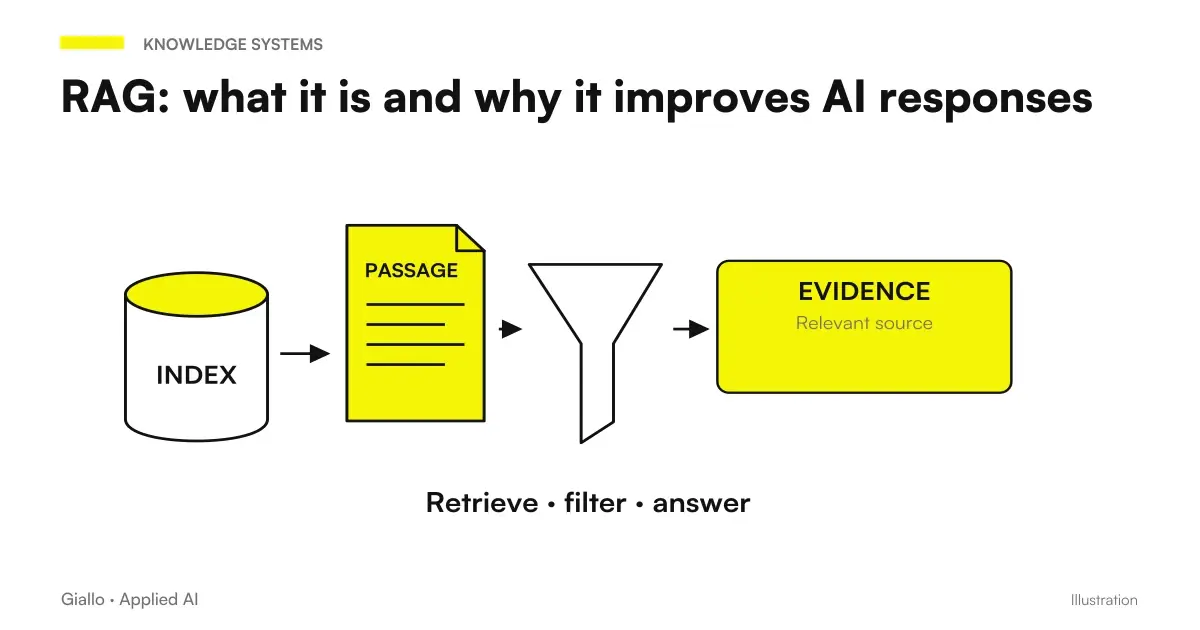
Point 4 is the one that reduces the risk the most: a system that says "according to document X" allows you to control, one that just states no. The mechanism is described in RAG: what is it, and the phenomenon of safe and wrong answers in AI hallucinations: how to avoid them.
Cutoff and model choice
Cutoff is rarely the main criterion, but it becomes straight in a case: when the task requires recent general knowledge and You can't provide it.
In all other cases it is best to choose on cost, quality on task and latency, and resolve the update by providing the information. Choosing a more expensive model just because it has the newest cutoff is almost always an avoidable expense.
Practical examples
Assistant on internal procedures. You give them procedures. An economic model with an old cutoff is fine, and it costs a fraction.
System that responds to regulations. Here the cutoff counts, but the solution is not the most recent model: it is to connect up-to-date normative sources. No cutoff will ever be recent enough for a changing subject.
Extracting data from invoices. Inconsequential cutoff: the document is in front of the model. It is best to optimize on cost and reliability.
Mistakes to Avoid
- Choosing the model for the cutoff. It is rarely the right criterion.
- Expecting him to know recent things. They must be supplied.
- Trusting secure answers on changing issues. Security is not an update.
- Ignoring the cutoff of economic models. It can be very anterior.
- Not asking for sources. It makes it impossible to verify.
- Confusing cutoff and web access. They're different things.
How to apply it in the company
Look at your task and ask yourself: do I provide the necessary information, or do I expect it from him? If you provide it, remove the cutoff from the criteria of choice and evaluate on cost and quality.
If you expect it from him, change the setting: link an updated source instead of chasing the model with the most recent date. It is the only solution that holds up over time.
The overall picture is in how to read AI benchmarks.
What to do when cutoff is a problem
The limit date is not an insurmountable obstacle: it is a constraint that goes around giving the model the information it lacks. The point is to do it in a systematic way rather than hoping it will not serve.
- You provide the updated documents in the context of the request
- Connect the system to a internal source always current
- Ask explicitly for quote the source of every statement
- Instruct the model to state when he does not know
- On regulations and prices, never trust internal knowledge
The fourth point is what makes the difference in the company. A model that answers "this information is not in the documents you provided me" is vastly more useful than one that reconstructs a plausible answer based on how things were a year ago.
The Cutoffs Declared Today
Official documents show different dates even between models of the same family. Verified data on 19 August 2026.
| Model | Cutoff declared | Source |
|---|---|---|
| Claude Fable 5.1 | June 2026 | platform.claude.com |
| Claude Opus 5 | May 2026 | platform.claude.com |
| Claude Sonnet 5 | January 2026 | platform.claude.com |
| Claude Haiku 4.5 | February 2025 | platform.claude.com |
| GPT-6 Astra | 30 April 2026 | developers.openai.com |
| GPT-5.6 (Sol/Terra/Luna) | 16 February 2026 | developers.openai.com |
The Haiku 4.5 line deserves attention: it is over a year older than the others. Nothing changes about a data extraction task, because the information is in the document. On a question that requires knowledge of the world, the difference is substantial.
It is a good example of the general principle: Cutoff only counts for tasks that depend on internal model knowledge. For anything that is based on the documents you provide, it is irrelevant.
How to design around the constraint
In well-made systems, internal knowledge of the model is not used as a source. Its ability to read, link, and rephrase suawhich has no expiration date.is used as the facts come from a controlled, up-to-date document base.
This setting has a valuable side effect: it makes the system verifiable. If each answer cites the document from which it comes, the reader can check. And the cutoff problem, along with much of the problem of invented answers, ceases to exist.
Three cases where the cutoff decides
Assistant on internal procedures. The cutoff is irrelevant. The procedures are yours, you provide them, and the model doesn't need to know anything about the outside world to respond well.
Answers to questions about tax regulations. Here the cutoff is critical. A response based on internal knowledge can refer to changed rules in the meantime, and no one notices because the shape of the response is impeccable. The only acceptable setting is that which forces the model to quote the text it is using.
Analysis of business documents. Cutoff irrelevant to content, relevant only if the document assumes recent external knowledge. In most cases it is not a problem.
The criterion that separates the three cases is always the same: Where the information comes from. If it comes from the document, the date does not count; if it comes from the model, it matters a lot.
Why Cutoffs Are Different Even in the Same Family
It may seem inconsistent for models from the same supplier, available at the same time, to declare limit dates even more than a year apart. The explanation is that each model has its own training cycle: a light model that has remained in the catalog because it continues to do its job well preserves the cutoff of the era in which it was built.
It does not mean it is worse. It means that world knowledge should not be the criterion for choosing it. On classification or extraction tasks, where everything needed is in the supplied document, a model with an older cutoff may be the best choice precisely because it costs less and responds faster.
How to apply it in the company
The operating rule that solves the root problem is one: do not use internal knowledge of the model as a source of facts.
In well-designed systems, the model puts the ability to read, link, and rephrase —which has no expiration date —as the facts come from a document base that you control and keep up to date. With this setting the cutoff becomes almost irrelevant and much of the problem of invented answers disappears.
In practice it means four things: providing updated documents in the context of the request, asking to quote the source of each statement, instructing the model to state when the information is not present, and excluding from the automatic response the categories in which an error would have consequences — regulation, deadlines, amounts, commitments to customers.
The side benefit of this setting is that it makes the system verifiable: if each answer cites the document from which it comes, anyone in the company can check in ten seconds. It is the same discipline described in context window: how much it really matters, applied to actuality instead of length.
If you want an assistant who answers from your updated documents instead of from a model's memory, Giallo Studio custom designed agents and automations.
Three readings to close the picture. If you are still choosing the band, the operating criterion is in when an economic model is enough. For the calculation of real expenditure —the one that includes repeated context, failed attempts and human review —the reference is cost per task or price per token. And when traffic is uneven, the setting that gives the best relationship between quality and cost is described in Mixed model strategy: light and powerful.
Conclusion
The knowledge cutoff is an honest specification that vendors state and that hardly anyone looks at. It matters little when the model works on your data, and it matters a lot when you expect it to know the world today.
The practical rule: don't choose the model for the date, design the system for the information to come to you. It is cheaper and ages better.
If you want to understand what processes in your company can be automated with AI, Giallo Studio can help you turn the problem into a real workflow.
Giallo Studio guides: methodology and sources
How we apply it in the company
Related resources
FAQ
What is knowledge cutoff?
It is the date beyond which the model has no knowledge acquired during training. It does not know about later facts, and if it is not connected to external sources, it may respond inaccurately or state that it is not up to date.
What are the current dates?
They vary by model. As of this article's date, the official documentation gives: Claude Fable 5.1 June 2026, Opus 5 May 2026, Sonnet 5 January 2026, Haiku 4.5 February 2025; GPT-6 Astra April 30, 2026, and the GPT-5.6 models February 16, 2026. Sources: platform.claude.com and developers.openai.com, consulted on August 19, 2026.
Why do models in the same family have different dates?
Because they are trained at different times. A cheaper and older model can have a cutoff much earlier than the top one: in Claude's case, over a year difference between Haiku 4.5 and Fable 5.1.
Does the cutoff matter for business use?
It depends on the task. If the model works on documents you provide, the cutoff is almost irrelevant. It matters when you expect it to know recent facts about the outside world: regulations, products and events.
How do you get around the limit?
By supplying up-to-date information alongside the question or connecting the model to external sources. It is the same principle as document retrieval: the model does not need to know the information already; it needs to know how to use what you give it.
Does the model know what it does not know?
Not always, and that is the main risk. For facts after its cutoff, a model may confidently give outdated information. This is why answers on topics that change must always be checked.