
Generative AI: What It Is and Why It Matters
What generative AI is and why it matters: how it creates text and images, real business examples, limitations and practical ways to use it in an SME.
Reading time: 10 min
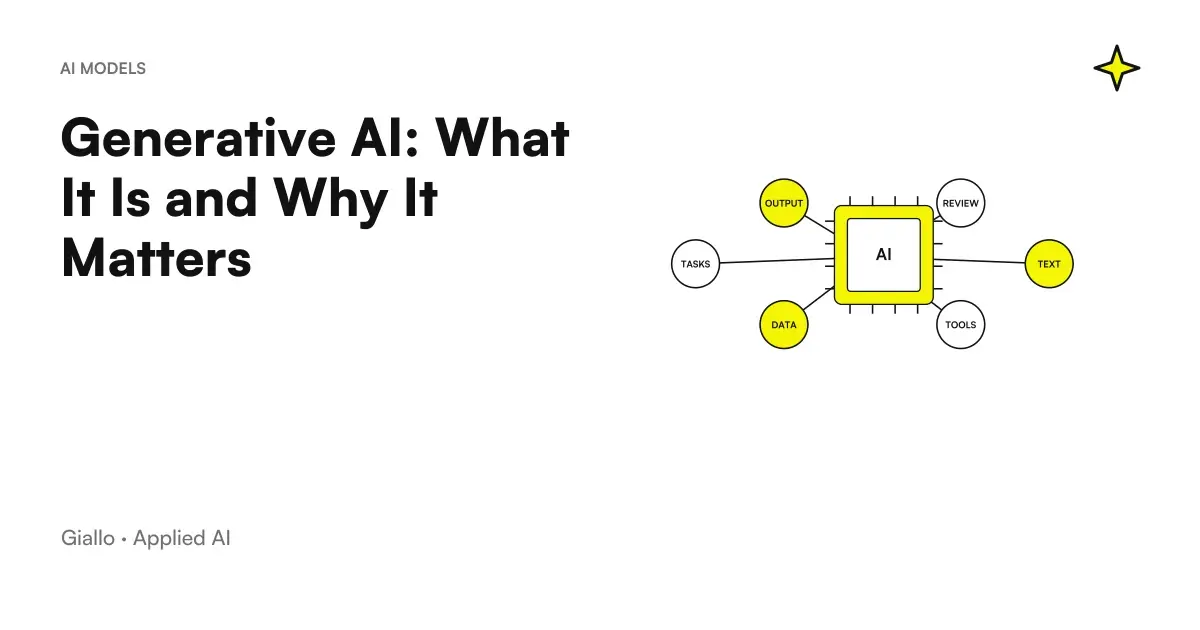
The Generative AI (or generative artificial intelligence) is a type of artificial intelligence that create new content , text, images, audio, video, code — instead of just classifying or predicting existing data. When you ask ChatGPT to write an email, or Midjourney to draw an image, you are using generative AI: the system is not looking for a ready-made answer in an archive, it is composing element after element.
The mechanism, in the text, is surprisingly simple to explain: the model provides for the next word more likely, then the next, and so on, one at a time, until you compose a sentence, a paragraph, a document. It does so by having "read" huge amounts of examples being trained. This explains both its strength — it produces fluid and plausible text on almost any subject — and its main limit: it points to the more likely, not at the certainly true.
In this guide we see what generative AI really is, how it works, what it stands out from traditional AI, where it makes sense to use it in an SME and what mistakes to avoid in order not to get hurt.
In summary
- The Generative AI creates new content (text, images, audio, code) predicting the next most likely item, one piece at a time.
- It is a family Artificial intelligence: traditional AI often ranks or predicts, generative AI produces original outputs.
- The most well-known models for text are the Large Language Models (LLM) as ChatGPT, Claude and Gemini; for Midjourney, GPT Image and Firefly images.
- Produces the most response plausible, not the verified one: it can invent data (hallucinations) and should always be checked on critical points.
- In the company the value comes when you link it to a Real Process and you keep a person reviewing the output, not by using it randomly.
What "generative" means
The keyword is generate. Most of the artificial intelligence that existed before the recent boom was discriminative: learned to distinguish, classify, predict. A model that decides if an email is spam, one that estimates next month's sales, one that recognizes a face in a photo: everyone chooses from options that already exist or calculate a number. They don't create anything new.
The Generative AI takes a different step: starting with a request (a prompt), produces a content that did not exist before. It does not choose an answer from a list, the builds. For the text it does so by predicting one word after another; for the images, starting from random noise and refining it progressively until you get the required figure.
To understand where it is placed: generative AI is a subset of the Artificial Intelligence, built almost always with techniques of Machine Learning and, in particular, of deep learning. All generative AI is AI, but not all AI is generative.
How generative AI works, in practice
Behind the apparent magic there is a repeatable process. It's worth knowing, because it explains both what you can expect and where the system quibbles.
- Training on huge data. The model "reads" billions of examples (texts, images, code) and regulates billions of internal parameters as long as it learns the patterns of language or images.
- The prompt. You provide a request in natural language: "write a follow-up email to a customer who hasn't responded in two weeks".
- Prediction one piece at a time. The model calculates the next most likely element (the word, then the next) taking into account everything that came before, until the answer is completed.
- Output. Get new content, consistent with the request and the style of examples it was trained on.
- Iteration. Refine the prompt, add context or examples, and the quality improves. This is where the prompt engineering.
Because "more likely" doesn't mean "true"
This is the point that changes the way you use the tool. The generative model does not have a database of facts that it consults: it has learned how they combine the words in the texts he saw. When you ask him for a date, price or quote, he gives you the sequence that Sounds right, not necessarily the correct one. When he invents, he does so with the same confidence with which he says true things.
This phenomenon is called hallucination and it is structural, not an occasional bug. It is reduced — not eliminated — by connecting the model to reliable sources and asking it to base its answers on them. We explore the problem and countermeasures in the guide to AI hallucinations and how to avoid them.
Text, images, audio, code: the same idea
Generative AI is not just ChatGPT. The same principle — generate new content by learning from examples — applies to multiple types of output:
- Text: email, reports, descriptions, translations, summaries. They are the Large Language Models (LLM).
- Images: illustrations, mockups, synthetic product photos (Midjourney, GPT Image, Firefly).
- Audio and Voice: vocal synthesis, dubbing, music.
- Code: completion and generation of functions from a description.
Generative vs Traditional AI: What's the Difference
The most useful distinction to keep in mind is this: traditional AI responds to existing data, the generative AI create new data. The table summarizes the practical differences.
| Criterion | Traditional AI (Discriminating) | Generative AI |
|---|---|---|
| What it produces | A category or value (spam/non-spam, sales forecast) | A new content (text, image, code) |
| Typical question | "Is this email urgent?" | "Write me a reply to this email" |
| Output | Choice between known options | Original content, never identical twice |
| Examples | Spam filter, scoring credit, image recognition | ChatGPT, Claude, Midjourney |
| Main risk | Misclassification | Hallucinations, plausible but false content |
| When to Prefer It | Net decision on many cases | Draft, summary, content to be reviewed |
In real projects the two things coexist: often a system uses AI discriminative to understand and sort (this is a complaint, this is an order) and AI generative to produce the response draft. They are not in competition: they are different bricks of the same flow.
What generative AI is for in the company
Here is the concrete value for an SME. Generative AI is not for "doing futuristic things": it is for take away the fatigue of the first draft and to speed up tasks where the starting point weighs more than the final control.
- Content and marketing: first drafts of articles, product descriptions from real data sheet, summaries, translations, social posts.
- Customer support: drafts of answers to frequently asked questions, reformulation of standard answers, summaries of conversations.
- Sales: custom follow-up emails, call summaries, first versions of quotes and proposals.
- Back-office: summary of long documents, extracting information from texts, rewriting minutes and notes.
- Internal knowledge: Answer questions about business documents by linking the model to sources with an RAG-type system, instead of searching by hand.
The common thread: generative AI makes the first version, the person decides and publishes. When this balance is clear, the time saved is real and measurable. For an organic overview on processes, costs and priorities, the guide AI for businesses lines up the most solid use cases.
Practical examples
Three realistic scenarios of Italian SMEs, to get out of the abstract.
1. E-commerce — catalog product descriptions. An online store with 600 items must rewrite the descriptions, now copied from the supplier. Generative AI starts from Real Data Sheet (materials, measurements, use) and produces a draft in the tone of the brand. The manager reviews and publishes. Typical result: the work goes from "writing from scratch" to "correcting", with a consistent catalog in a fraction of the time.
2. Professional study — summary of documents. In a study come contracts and relationships tens of pages long. Generative AI produces a Structured Summary of the key points (deadlines, obligations, amounts), which the professional checks before using it. It does not replace reading on critical steps, but eliminates the first manual skimming on each document.
3. Service company — email and follow-up. The commercial pastes the notes of a call; the AI generates a summary email and a next step proposal in the company format. The person corrects the details and sends. The time for business correspondence drops, and no customer is left unanswered because "there was no time to write".
In all three cases, the same rule applies: AI writes draft, human signs. It is the model that holds in time.
When to use generative AI and when not
When it makes sense
- The task starts from one white page and the first draft costs time.
- There is a human review before using the output.
- The tone and format are known and repeatable (emails, descriptions, summaries).
- A margin of imperfection is tolerable, because someone controls.
When to Avoid It
- You need numbers, dates or exact rules without a linked source and a verification.
- The output goes into production without anyone seeing it again.
- Process personal or confidential data in a public instrument without guarantees.
- You're trying to "put AI" in fashion, without a measurable process behind it.
Practice rule: generative AI is great for draft, bad as a source of truth. Use it where the value is in the starting speed, not where the certainty of the data is needed.
Generative or predictive? Choose based on your case
If your task is produce a content (write, summarize, translate, generate an image) → Generative AI. If you must deciding or estimating across many cases (is it urgent? how much will we sell? is this customer at risk?) → traditional predictive AI. Many real workflows combine the two: first classify, then generate the answer. If you do not know which is needed, start with the result you want, not the tool.
Mistakes to Avoid
- Treating output as truth. Generative AI produces plausible, unverified text. On amounts, deadlines, regulatory references, and customer data, you always need a human control or a related source.
- Entering sensitive data into public tools. Pasting personal customer data into a free chatbot can violate the GDPR and disperse confidential information. Define first what you can and cannot share.
- Expecting me to know your company. A generic model knows nothing about your price lists, processes or customers. It should be guided with context, instructions and, where necessary, your linked documents.
- Vague prompt. "Write something beautiful" produces mediocre results. The more specific you are about target, recipient, tone and constraints, the better the output. It is the heart of the prompt engineering.
- Skipping measurement. Without a "before" and an "after" (hours, errors, response times) you will never know if AI gives you real value or just the impression of modernity.
How to apply it in the company
Introducing generative AI with method is a short and repeatable path, not a big project.
- Find the task that starts from scratch most often. What activity forces you to write from a blank page every day? Emails, descriptions, summaries: start from there.
- Define tone and format. Collect 3-5 "good" examples already written by your team: they will serve to guide the model towards the right style.
- Build the basic prompt or instruction. Target, recipient, constraints, what NOT to do. Reusable on all similar cases.
- Keep the human in control. The model prepares, the person reviews and approves. Always, especially on the content that comes out to the customer.
- Measure and decide. Count hours and corrections before and after. If numbers improve, extend; if not, change approach.
The next step, when the manual draft is no longer enough, is Connect generative AI to your systems: make them read the CRM, update a management software, work inside a stream without copy-paste. It is the jump from "chatbot to use by hand" to AI agents and automation of business processes, where the output does not stay in a chat but enters the real work. If you want to see it applied, some concrete experiments you find them in the The Lab.
Conclusion
The Generative AI It's not magic: it's a statistical system that creates new content by predicting the next most likely element, one piece at a time. This makes it extraordinary for the first draft — texts, images, summaries, code — and fragile as a source of truth, because it points to the plausible, not to the verified. For an SME the advantage comes not from having "AI", but from connecting it to a process that today costs time, keeping a person in control of the output and measuring the before and after. From here you can continue with the Great Language Models that stand behind the generated text, or with the AI Guide for Companies to choose where to start.
If you want to go from testing with ChatGPT to an AI system integrated into business processes, Giallo Studio custom designed agents and automations.
Giallo Studio guides: methodology and sources
How we apply it in the company
Related resources
 Artificial intelligence: what it is and how it works
 LLM: What Language Models Are
 Machine learning: what it is and how it works
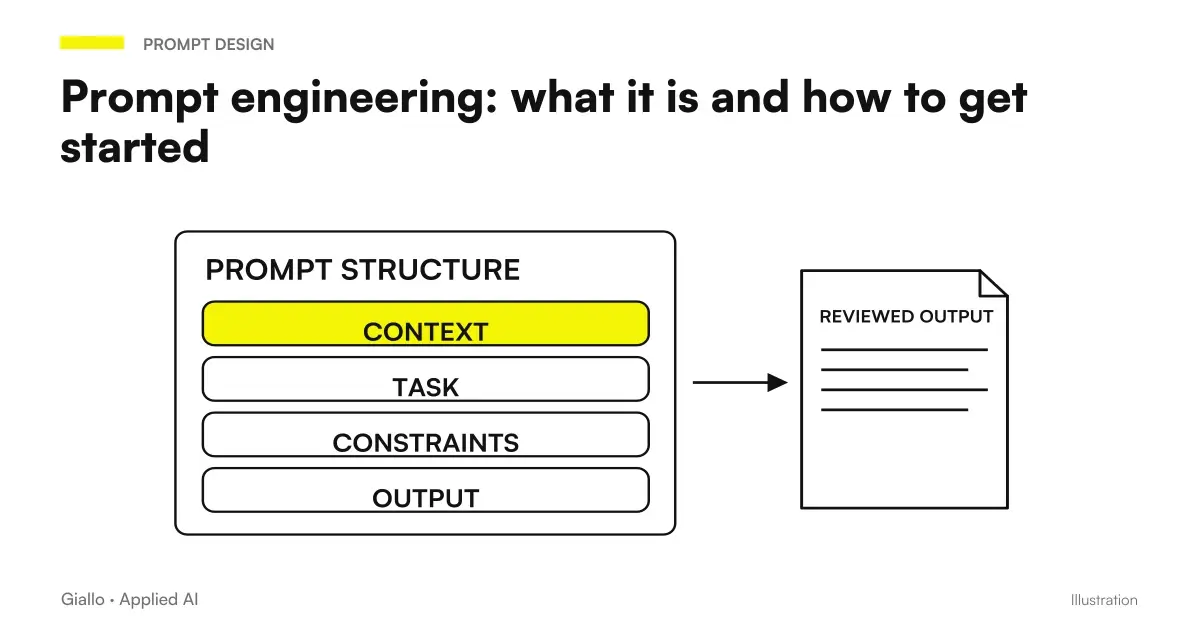 Prompt engineering: what it is and how to get started
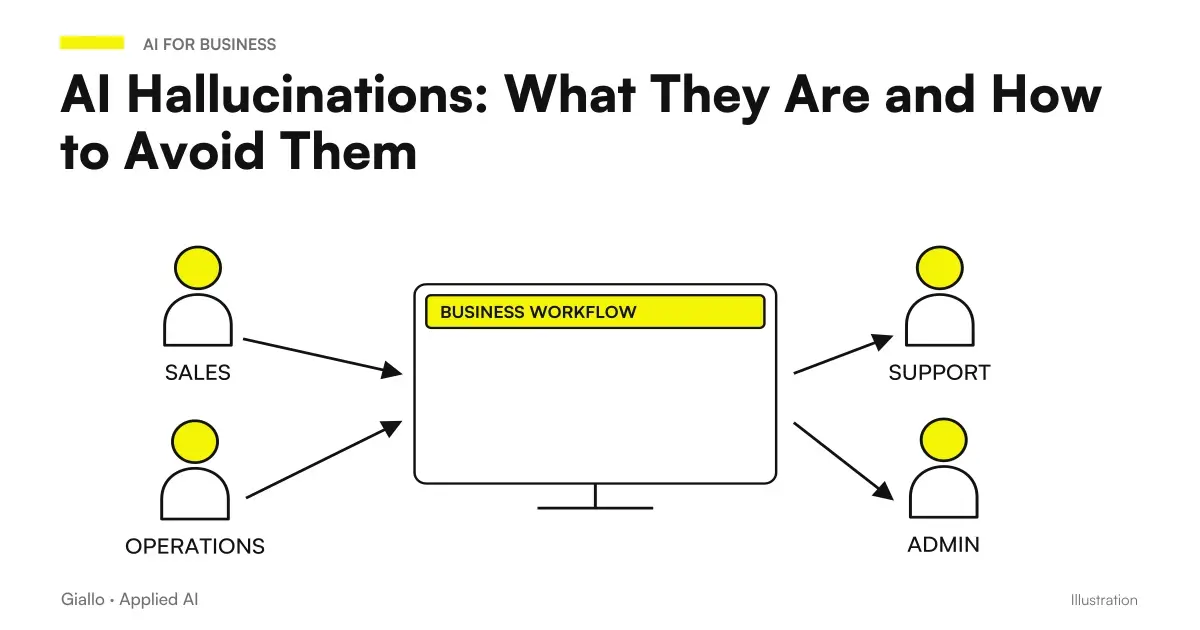 AI Hallucinations: What They Are and How to Avoid Them
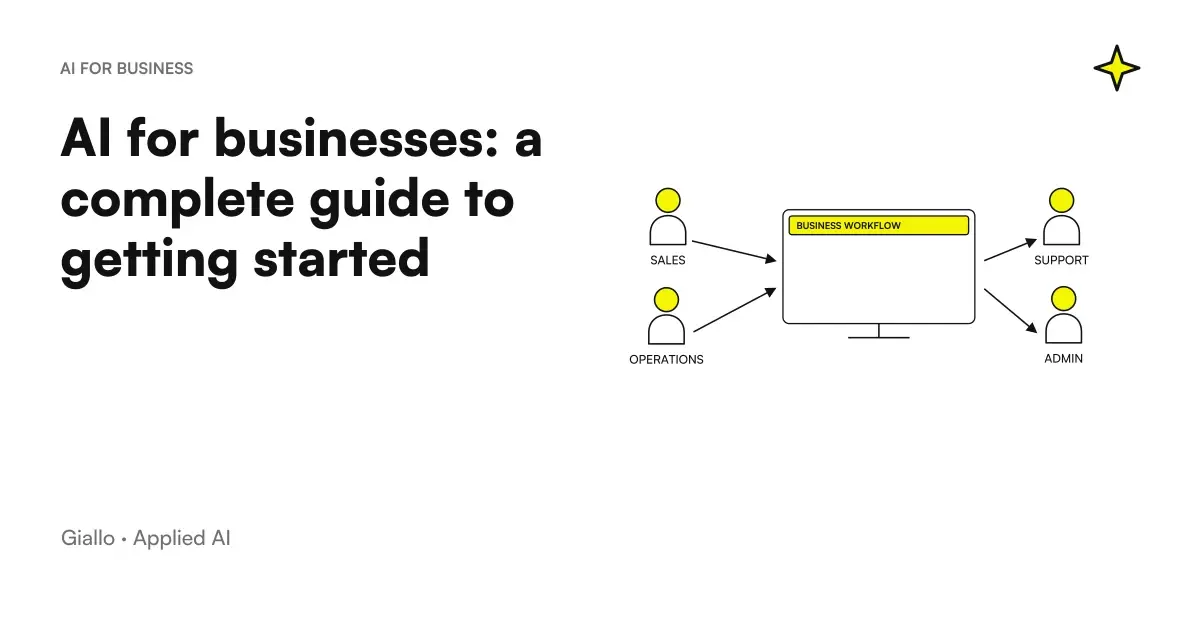 AI for businesses: a complete guide to getting started
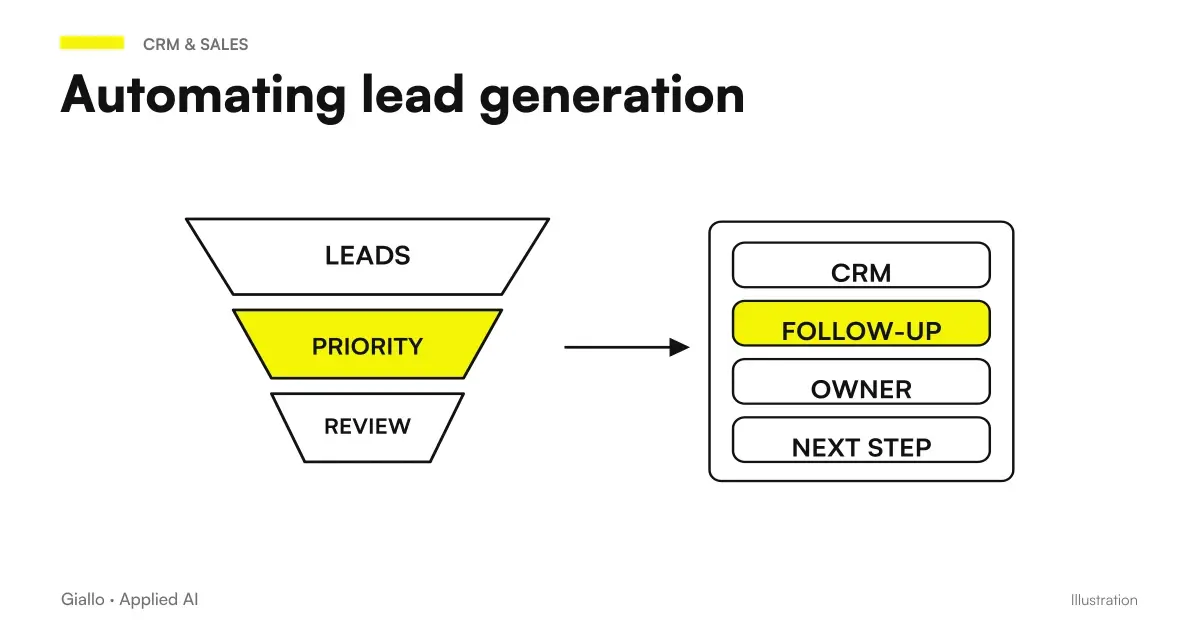 Lead generation automation: how AI populates your CRM
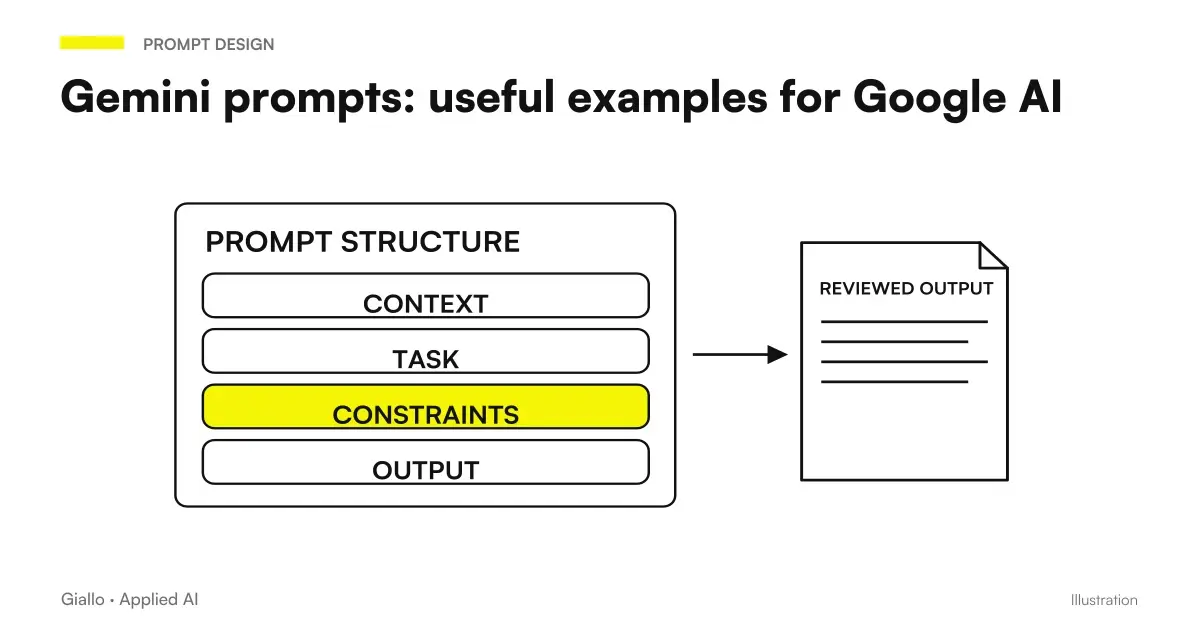 Gemini prompts: useful examples for Google AI
FAQ
What is generative AI in simple terms?
Generative AI is a type of artificial intelligence that creates new content — text, images, audio, code — instead of just classifying or predicting. It works by predicting the next most likely element (the word, the pixel) based on huge amounts of examples seen in training. ChatGPT, Claude, Gemini and Midjourney are examples of generative AI.
What is the difference between generative AI and artificial intelligence?
Artificial intelligence is the broader field; generative AI is one family within it, the one that produces new content. Much traditional AI is predictive or performs classification (estimating sales, recognising faces, or routing tickets): it does not create anything, but chooses between existing options. Generative AI, by contrast, generates original outputs in response to a request.
Can generative AI invent false information?
Yes. It produces the statistically most plausible answer, not a verified one: it can confidently present non-existent data, citations or numbers. These are called hallucinations. That is why content that matters (numbers, regulations and customer data) always needs human verification or a connected source.
Is generative AI really useful for an SME?
Yes, but for specific tasks. It is useful for writing first drafts, summarising documents, answering frequently asked questions, translating, and generating product descriptions. The value comes when you connect it to a real process and have a person review the output, rather than using it randomly just because it is available.
What are the most widely used generative AI tools?
For text: ChatGPT (OpenAI), Claude (Anthropic), Gemini (Google). For images: Midjourney, GPT Image, Firefly. For code: GitHub Copilot and the same language models. Names and versions change often: always check the official page before choosing a paid plan.
Is generative AI secure for business data?
It depends on how you use it. Entering personal or confidential data in a public tool can violate the GDPR and disperse sensitive information. For business use, you need plans with guarantees about data processing, clear rules about what you can share and, where you need them, solutions that keep the data in your perimeter.