
How much does business AI adoption cost?
Business AI costs: tools, consultancy and custom development. Real indicative ranges, what each cost covers and how to assess the return.
Reading time: 9 min
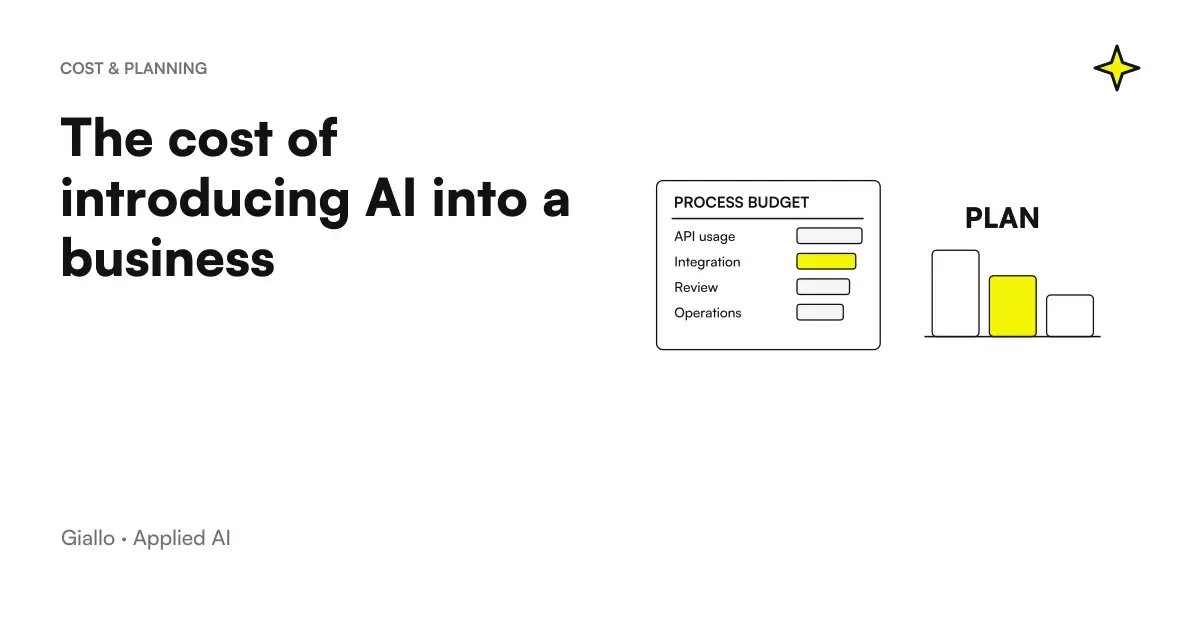
The cost of introducing AI into the company is not a fixed number. It depends on the level of implementation: you can start with a subscription of a few tens of euros per month to use a tailored AI assistant, or face a project of a few thousand euros to automate a process integrated into existing systems. Between these two extremes there is a whole range of options.
What makes it difficult to answer the question "how much does it cost?" is that AI is not a standard product like a management software: it is a set of choices — what tool, how much should be customized, how it integrates with what you already use, who keeps it over time. The budget, as a result, changes radically depending on the answer to these questions.
This guide does not contain precise estimates for individual tools: price lists often change and the right solution varies from company to company. What you find here is a map of the actual cost items, the orientation ranges for each level, and the criteria for estimating a budget that makes sense for your case.
In summary
- There are three levels of AI implementation: ready-made tools, custom configuration, tailored development. Costs and expectations change for each.
- The cost is not just the monthly subscription: it includes consulting, integration, team training and maintenance over time.
- Consumable AI (API) models have varying costs: they grow with use, they must be actively monitored.
- Hidden costs —internal time, process rewrite, adaptation —are often underestimated and can weigh as much as the direct cost of the project.
- ROI is estimated before starting a project, not after: without a measurable baseline, it is impossible to know if the investment worked.
- Starting small with a well-defined flow reduces risk and provides real data to decide whether to scale.
The Three Levels of AI Implementation
Before we talk about numbers, we need to understand at what level we are talking about. SMEs that introduce AI almost always fall into one of three scenarios:
| Level | What it includes | Guideline cost | Who is suitable |
|---|---|---|---|
| 1 — Ready-made instruments | Subscriptions to AI tools already configured (assistants, no-code automation, copilots for documents or email) | A few dozen – a few hundred euros/month per user; check the official price lists of the individual tools | Companies that want to experiment without development, with processes already quite standardized |
| 2 — Custom configuration | Existing tools tailored to your flows, with integration to your systems (CRM, management software, Drive) via API or no-code/low-code platforms | One-time setup cost + monthly tool subscription; varies a lot based on complexity | SMEs with clear processes that want to save hours on specific repetitive tasks |
| 3 — Tailored development | AI agents, advanced automations or purpose-built software, integrated into management software or proprietary systems | Project with variable cost calculated on expected savings; to be assessed on a case by case basis | Companies with complex processes, high volumes or requirements that standard tools do not cover |
These levels are not fixed: many SMEs start at level 1, measure results and then invest in a more advanced configuration. It is a path, not a binary choice.
Ready-made AI tools: subscription costs
Ready-to-use AI tools are the most accessible starting point. These products offer AI features already integrated — assistants for text and documents, no-code automation, and copilots for email or spreadsheets — with monthly or annual subscriptions.
Prices vary a lot from tool to tool and change frequently: for updated data always consult the official website of the product you are interested in. In general, many such tools have:
- A free or trial plan with limited functionality.
- Paid plans that depend on the number of users, the volume of use (messages, documents, processing hours) and the features included.
- Discounts per annual payment compared to the monthly.
The categories of tools most used by Italian SMEs include: AI assistants for text and communication, no-code or low-code automation tools (such as Make, n8n or similar) and copilots integrated into the productivity suites already in use.
Before signing up for a subscription, check two things: how many users will really need it (plans per team multiply the cost), and whether the expected usage volume falls within the limits of the chosen plan or generates additional costs.
To learn more about how to choose between ready-made tools or custom development, read the AI Guide for Companies and the section on AI Agents: What They Are and How They Work.
Tailor-made advice and development: what the cost includes
When ready-made tools are not enough — because the process is too specific, because you have to integrate with a proprietary management system, or because the volume is too high. you enter the territory of consultancy and tailor-made development.
The cost of a custom project typically includes these entries:
Process analysis and design. Before you build anything, you need to figure out what to automate, how the process works today, and where AI can really help. This phase produces a specification document and a realistic estimate of the project. If done well, avoid costly surprises in the course of work.
Development and configuration. It includes building automation or agent, integrating with existing systems (API, webhook, data access), testing, and iterations. It is the most variable cost item: it depends on the complexity of the integration, the quality of the documentation of the systems involved and how many use cases it needs to be managed.
Training and coaching. Even the best system doesn't work if the team doesn't know how to use or control it. The cost of training is often underestimated and then poorly recovered: better to explicitly include it in the project budget.
Maintenance and updating. AI models change, APIs update, business needs evolve. A project does not end at go-live: a recurring cost for maintenance must be provided, at least in the first year.
To understand how to evaluate the return of a project of this type, read how to calculate the ROI of an AI project.
API Costs and Consumption: How Paid Models Work
Many automations and AI agents do not use a fixed subscription, but call models through consumer APIs: you pay for the volume of processed text (measured in "token", the unit of measurement of language models).
To understand what tokens are and why they matter, read the guide on AI tokens.
API costs have some features that it is important to know before starting a project:
They are variable by definition. The more requests you make, the more you pay. In a production stream with high volumes, the "API costs" entry can grow significantly and not linearly compared to initial expectations.
They depend on the chosen model. The most capable models cost more per single request. For many tasks, lighter and cheaper models are sufficient; choosing the wrong model (too powerful for the task, or too weak and therefore necessary to call it several times) inflates costs.
They should be actively monitored. The risk of a poorly designed configuration is out of control consumption — infinite loops, duplicate requests, unnecessary processing. A good project includes expense alerts and maximum limits configured from the start.
For updated price lists, check the official websites of providers directly (OpenAI, Anthropic, Google, and others): prices change frequently, often falling, but do not take for granted the numbers you find in dated articles.
Hidden costs that SMEs forget
- Team internal time. Someone has to test the system, verify the outputs, report errors. This time has a cost, even if it does not appear in any invoice.
- Rewriting ill-defined processes. AI does not improve a confusing process: it amplifies it. If before automating the process is not documented and standardized, the cost of this phase should be included in the budget.
- Training and changes in habits. A team that does not understand how the new system works tends not to use it, or use it badly. Training is not an option.
- Maintenance when changing APIs or models. AI providers often update their models and APIs. Each update may require technical intervention to keep the flow working.
- Under-use for lack of adoption. The worst cost is that of a system that works but is not used. Without an adoption plan, the investment disperses.
- Data management and GDPR compliance. If the AI stream processes personal data of customers or employees, you must verify compliance with the GDPR. To learn more, read the article on AI and GDPR for Business.
How to Estimate a Realistic Budget
Estimating a sensible AI budget requires starting with processes, not tools. The logical path is this:
1. Identify the process to be improved. Which activity steals more hours, generates more errors or creates more bottlenecks? Don't start with AI as a generic solution: start with the concrete problem.
2. Measure the starting point. How many hours does that activity take today? How often? How much error rate? Without a numerical baseline, you won't be able to assess if the project worked.
3. Estimate potential savings. If you automate that process, how much free time? What is the value of that time to the company? This is the maximum cap that makes sense to invest in the project, on the time horizon you have given yourself.
4. Compare with real project costs. Only at this point does it compare expected savings with actual costs: licensing, development, training, maintenance. If the numbers approach on a reasonable horizon (often 6-18 months for automation projects), the project is sustainable.
5. Small parts, measure, then scale. A simple first stream —even if it only frees up a few hours a month —provides real data on cost, usage, and savings. That data is the best argument for deciding whether to invest more.
Practical examples
Scenario 1 — Studio of accountants with ready-made tools
A study with six people spent many hours each week sorting and answering customers' emails with standard questions (deadlines, documents to attach, practical statuses). The solution adopted: an AI assistant configured on the study FAQs, connected to the shared email box via a no-code tool.
Costs incurred: subscription to the automation tool (check the provider's site for the updated price list) + a few hours of initial configuration. Measurable result: significant reduction in time spent on top-level emails, with immediate response to customers during off-office hours. The cost recovered in a few months because the hours savings were quantifiable. To learn more about how automations get into processes, read the article on AI automation: what it is and how it works.
Scenario 2 — Manufacturing SMEs with tailored development
A company with an internal management system received dozens of orders by email from different customers every day, in unstructured formats. The manual process required reading each email, extracting the order data and entering it into the management software.
Solution: a tailor-made AI agent who reads incoming emails, extracts structured data (product, quantity, customer code, date of delivery required) and proposes inclusion in management software with human review before confirmation.
Costs incurred: process analysis, development of integration with management software, testing and team training. The cost was calculated on the expected savings in operating hours, with a recovery horizon defined prior to startup. For similar examples, see the section on examples of AI automation in the company.
When to start with ready tools
- The process is quite standard (emails, documents, texts)
- Want to test AI without high technical commitment
- The initial budget is limited
- You have no proprietary systems to integrate
- You want real data before you invest more
When to invest in custom development
- You have a management system or proprietary system to integrate
- Volume is high and potential savings are significant
- The process is industry-specific and generic tools do not cover use cases
- You have already experimented with ready-made tools and want to scale
- Output quality is critical (expensive errors)
Mistakes to Avoid in the AI Budget
1. Buy before you have defined the problem. Signing subscriptions to AI tools "to see" without a precise use case almost always leads to under-use. The budget is wasted not because the tool is bad, but because there was no measurable goal.
2. Underestimate integration costs. Connecting an AI system to your existing tools almost always takes more time than expected. The older or poorly documented the target system is, the more the integration cost grows.
3. Do not expect maintenance. An automation that works today won't work forever without intervention. AI models are updated, APIs change, business needs evolve. Maintenance should be planned and not ignored until the first error in production.
4. To think that AI systems poorly defined processes. If the current process is chaotic, the AI performs it chaotically but faster. Before automating, the process needs to be documented and standardized — and this has a cost that is often not included in the AI project budget.
5. Don't form the team. A poorly used system produces low quality output and reinforces distrust of AI. Training is not a bonus: it is an integral part of the project.
How to apply it in the company
If you are considering introducing AI, a three-step pragmatic approach reduces risk and provides concrete data for subsequent decisions.
- Map high-impact processes. Identify the three tasks that take the most hours away from the team or generate the most errors. For each, estimate the current cost in hours per week.
- Choose a well-defined pilot process. Select the one with more predictable inputs and verifiable outputs. Avoid starting with exceptional or high-risk processes: the pilot is used to learn, not to demonstrate.
- Start, measure and decide. Implement the simplest solution that solves the problem. It measures real savings after 4-8 weeks of production. Use that data to decide whether to invest in more advanced development or other processes.
To understand how to structure an AI project that really reduces manual work, read the article on how AI reduces manual work in the company. If you want a complete picture of how to evaluate and start an AI project for your SME, the Practical Guide to AI for SMEs It's the right starting point.
If you want to delve into the legal and compliance implications before choosing your tools, the article on AI and GDPR It helps you figure out what to check.
If you need operational detail on individual models, How much you save with a lightweight model, Cheap AI Models Compared and Mixed model strategy: light and powerful.
Conclusion
The cost of introducing AI in the company is not a figure to look for online: it is the result of a precise assessment between the expected savings and the actual cost items of your specific case. Ready-made tools, custom configuration, or custom development have very different cost logics — and the right choice depends on the process, existing systems, and the maturity of the organization in managing change.
What works in common with AI projects is one thing: they start with a measurable problem, not a tool to experiment with.
AI becomes useful when it enters processes. Giallo Studio helps SMEs and teams build concrete, measurable and sustainable automations — starting with process analysis, not the tool catalogue.
To learn more: read how to calculate the ROI of an AI project, or find out what a route of AI consulting for companies.
Giallo Studio guides: methodology and sources
How we apply it in the company
Related resources
 How to Calculate the ROI of an AI Project
 AI consulting for companies: what it is and when it is needed
 AI for SMEs: a practical guide to really getting started
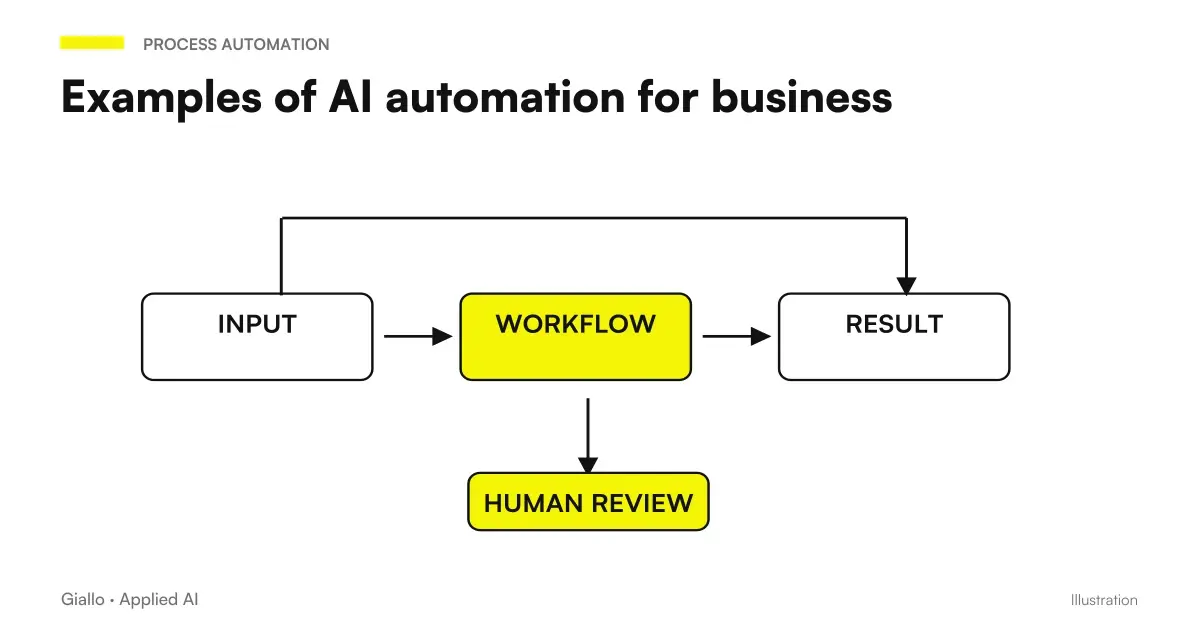 Examples of AI automation in the company: real cases for SMEs
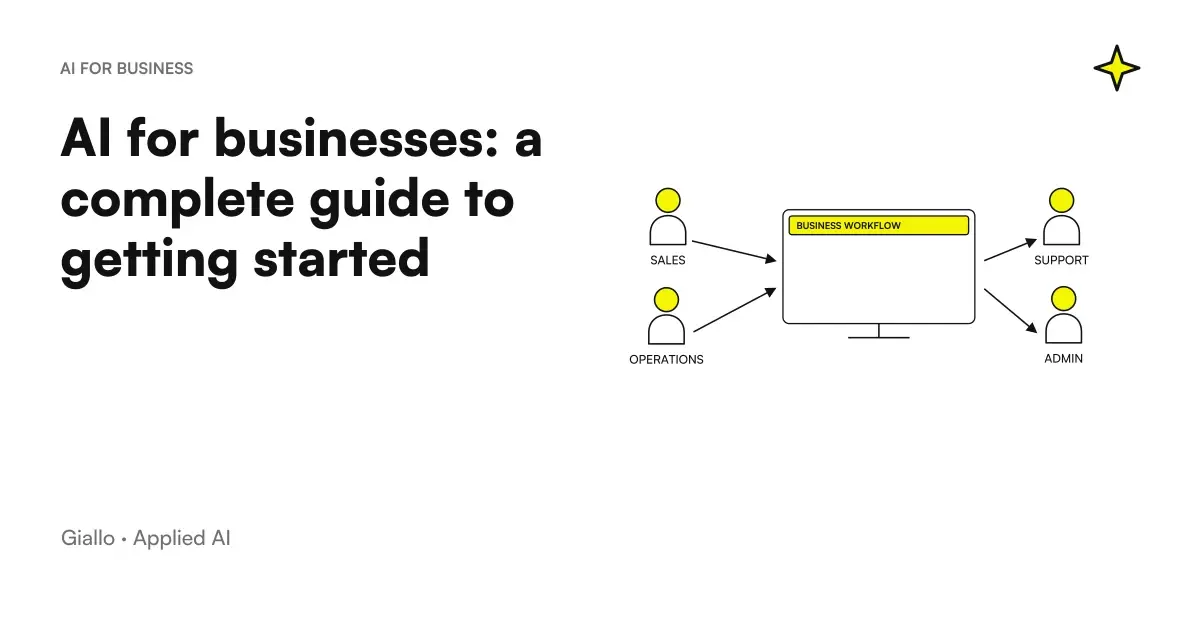 AI for businesses: a complete guide to getting started
 AI for restaurants: reservations, allergens and responses to reviews
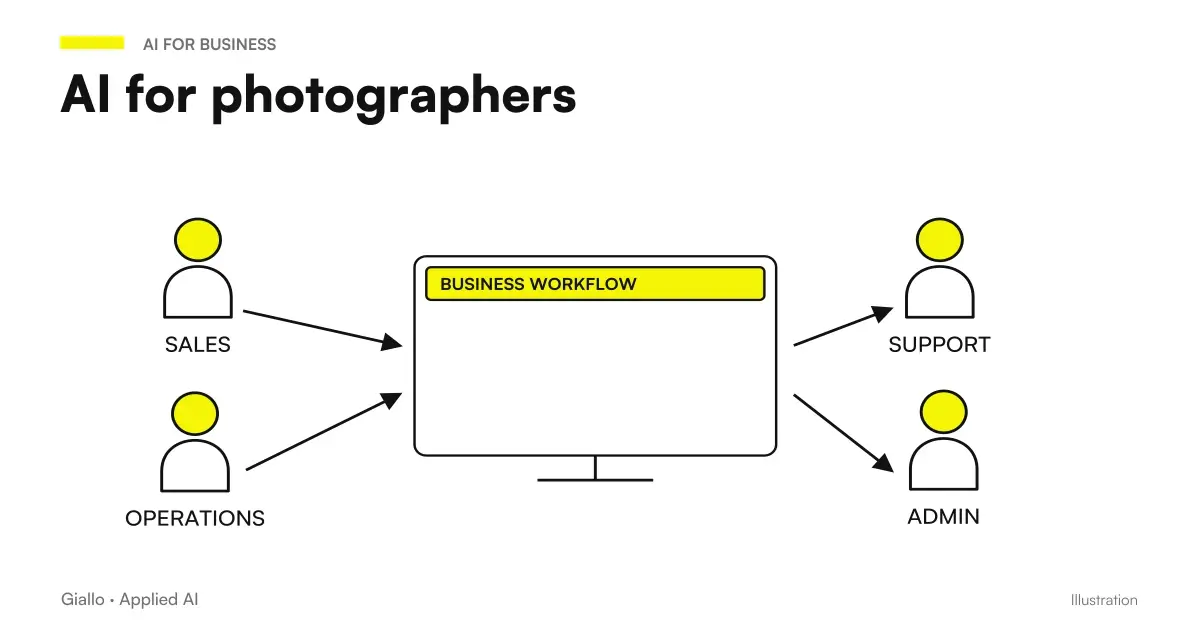 AI for photographers: requests, selection of shots, galleries and image rights
 AI for wellness centres and spas: admissions, gift vouchers and packages
FAQ
How much does it cost to introduce AI into an SME?
It depends heavily on the use case. Ready-made AI tools (assistants, no-code automations) cost from a few dozen to a few hundred euros per month of subscription. Projects with tailored agents or integrations with existing systems have variable development costs that are assessed on a case-by-case basis on the expected savings.
What are the main cost items of an AI project?
The main ones are: licenses of AI tools (monthly subscriptions), consulting or development cost (configuration, integration, training), API costs if you use pay-as-you-go models, and internal team time for testing and changing operating habits.
Can you start with a reduced budget?
Yes. Many processes can be automated with existing tools and basic subscriptions. The mistake is starting with complex projects straight away: it is better to begin with a simple workflow that works and measures the savings, then invest more with evidence in hand.
When does an AI project become economically sustainable?
When the savings in hours (or avoided errors, or new opportunities) exceeds the total cost of the project in a reasonable horizon — typically 6-18 months for mid-size automation projects. The ROI is calculated before, not after.
Are there hidden costs to consider?
Yes: the team’s time to learn and check new workflows, any rewriting of poorly defined processes, maintenance costs when the model or APIs change, and the risk of underuse if there is no internal training.