
GPT-6 Sol and Luna: what they are, where they are used and what changes
GPT-6 Sol and Luna, OpenAI's models from 22 September 2026: uses, access, changes from GPT-5.6 and what the benchmarks show.
Reading time: 17 min
With GPT-6 Sol and Luna OpenAI expanded the GPT-6 family on 22 September 2026, a few weeks after GPT-6 Astra. Sol is designed for complex everyday work, code and agents; Luna for targeted tasks repeated at high volumes. Through the API, they cost $2 (Sol) and $0.10 (Luna) per million input tokens, versus $10 for Astra.
In the launch page OpenAI explains that they have trained them with methods similar to those of Astra, to bring the same progress on professional work, accuracy of facts, code and computer use into faster and less expensive models. Astra remains the most capable model in the house; Sol and Luna serve where work has different rhythms and budgets.
For an Italian company the practical questions are where they are used (in ChatGPT chat, for now, there are not), what happens to those who already work with GPT-5.6 and how much the announced benchmarks are worth. The following facts are verified on the official OpenAI pages on September 23, 2026; names and listings often change, so before deciding always check the official page.
In summary
- GPT-6 Sol is built for complex code and agents, GPT-6 Luna for targeted and repeated work in large quantities.
- Via the API, Sol costs $2 in input and $10 in output per million tokens, Luna $0.10 and $0.50.
- At launch they are in ChatGPT Work and Codex for Plus, Pro, Business, Enterprise and Edu; with Free and Go there is Luna in the desktop app. In the chat they are not there yet.
- GPT-6 Terra does not exist: Codex suggests that GPT-5.6 Terra users switch to Sol.
- Ad benchmarks use as a comparison term Claude Opus 5, not Opus 5.5 released the same day.
- Both have a window of 1,050,000 tokens, 128,000 maximum output tokens and six levels of reasoning, from none to max.
Why OpenAI works alongside Sol and Luna at Astra
GPT-6 Astra came in early September as a top model, and OpenAI keeps it as a first choice for the most challenging projects. But not every summary, extraction or modification to the code justifies the $10 in input and the 50 in output of Astra: Sol and Luna cover those cases with the same generation of techniques, at a fraction of the price.
The official cards describe the two models in one line. GPT-6 Sol is built for complex code and for workflows with agents. GPT-6 Luna is OpenAI's most efficient model, designed for high volumes of well-defined work. The guide to choosing the model by ChatGPT and Codex adds a useful nuance: Sol as a model to be used every day for writing, code and work that requires judgment; Luna for delimited tasks, sorting requests and frequent automations.
| Record | GPT-6 Astra | GPT-6 Sol | GPT-6 Luna |
|---|---|---|---|
| API ID | gpt-6-astra | gpt-6-sol | gpt-6-luna |
| For what OpenAI indicates | The hardest job, from start to finish | Complex code and agents | High volumes of delimited work |
| Input/output per million tokens | 10 $ / 50 $ | 2 $ / 10 $ | 0,10 $ / 0,50 $ |
| Context Window | 1,050,000 tokens | 1,050,000 tokens | 1,050,000 tokens |
| Maximum Output | 128,000 tokens | 128,000 tokens | 128,000 tokens |
| Date limit of knowledge | 30 April 2026 | 20 April 2026 | 18 May 2026 |
| Levels of reasoning | low to max | None to Max | None to Max |
| Source | Astra tab | Sol tab | Luna tab |
The three models read text and images and produce only text. For those with software already in production, two details matter: fine-tuning is not supported on Sol and Luna, and in the Chat Completions API, function calls work only with reasoning set to none, while using tools at higher levels requires the Responses API. If your business management software communicates with OpenAI through Chat Completions, this is the first thing to check.
The leading model is told in GPT-6 Astra: what it is and where it doesn't arrive, its price list in how much GPT-6 Astra costs.
Where to use: ChatGPT Work, Codex and API, not chat yet
At the launch Sol and Luna arrived in ChatGPT Work and in Codex for Plus, Pro, Business, Enterprise and Edu plans. With the Free or Go plan you can use Luna in the desktop app. In ChatGPT chat the two models are not yet available, and OpenAI released the update gradually during September 22 (official announcement).
ChatGPT Work is the mode in which ChatGPT relies on a task with a precise result, to be reviewed: a presentation, an analysis, a recurring update, a file. Official guide to ChatGPT Work It distinguishes it from chat, which remains the tool for answers, explanations and short drafts. Work can use approved files, plugins, and tools, and in the desktop app also local files, applications, and browsers.
| Where | Who it is for | GPT-6 models at launch |
|---|---|---|
| ChatGPT Work and Codex | Plus, Pro, Business, Enterprise, Edu | Sol and Luna (in Enterprise the administrator enables them) |
| ChatGPT desktop app | Free and Go | Luna |
| ChatGPT Chat | All Plans | Not yet available |
| OpenAI API | Who has an API key | gpt-6-sol and gpt-6-luna |
Via API the free tier is not supported and limits grow with account spending, starting with 500 requests per minute (Luna's card). If in the company you use ChatGPT only to write and ask questions, for now nothing changes; the general picture is in ChatGPT for companies.
What changes compared to GPT-5.6, and where Terra ends
The GPT-5.6 family had three bands, and official cards link them to the old sizes of GPT-5. GPT-5.6 Sol roughly corresponds to the model without suffix, GPT-5.6 Terra the "mini", GPT-5.6 Luna to the "nano". The GPT-6 family for now has Astra, Sol and Luna. A GPT-6 Terra does not exist.
The Codex code shows where Terra users are directed. The pull request #47401 of the official repository, which adds the two models to the catalog, proposes to those who use gpt-5.5, gpt-5.6-sol and gpt-5.6-terra to switch to GPT-6 Sol, and to those who use gpt-5.6-luna to switch to GPT-6 Luna. The selections remaining on GPT-5.4 and GPT-5.4 mini, models already retired by Codex, are redirected to Sol and Luna.
The move from Terra to Sol has a price logic: GPT-6 Sol costs $2 per million tokens in input, as much as GPT-5.6 Terra, and 10 in output versus 12 (official pricing). For the same token those who move from Terra to Sol do not pay more. It remains to be measured how many tokens they consume on your cases, because a model that thinks more can produce more output.
| Today you use | Codex | What to Know |
|---|---|---|
| GPT-5.6 Sol | GPT-6 Sol | API price from 4 / 20 $ to 2 / 10 $ per million tokens |
| GPT-5.6 Terra | GPT-6 Sol | Same input price, cheaper output, upper end |
| GPT-5.6 Luna | GPT-6 Luna | API price from $0.20 / $1.20 to $0.10 / $0.50 |
| GPT-5.5 | GPT-6 Sol (Luna with Free and Go) | Exits ChatGPT, Work and Codex on October 14, 2026, stays in APIs |
GPT-5.6 does not disappear immediately: the Codex Models page confirms that Sol, Terra and Luna of generation 5.6 remain available during rollout. The date to mark is October 14, when GPT-5.5 exits ChatGPT, Work and Codex for all plans: those who set it up in scripts, custom agents or scheduled tasks must change it first.
It also shifts the date limit of knowledge, from February 16, 2026 of GPT-5.6 to April 20 of Sol and to May 18 of Luna: two or three months of extra facts, not current events, as explained by knowledge cutoff: what it means in practice. Those who still work on GPT-5.6 find internal comparisons to the old family in GPT-5.6 Sol vs Terra and in Claude Haiku 4.5 vs GPT-5.6 Luna.
The benchmarks declared by OpenAI, with the conditions of each test
All the following numbers come from the launch page; those of the competitors, OpenAI writes, are taken from public reports, using Fable 5 where Fable 5.1 was missing. The comparison term is Claude Opus 5: Claude Opus 5.5 was released on the same day, the September 22, 2026, and in the announcement does not appear.
| Tests | What it measures | GPT-6 Sol | GPT-6 Luna | Declared comparison |
|---|---|---|---|---|
| AutomationBench 1.0.6 | Complete office processes, 47 tools across sales, marketing, operations, service, finance and HR | 33.2% at xhigh, $0.27 per task | At high, 5.4 points above GPT-5.6 Luna with 58% lower cost per task | Opus 5 at max 26.9% and 11.1 times the cost of Sol; Astra at low 30.3% and 3.9 times |
| Agents' Last Exam V1 | Long professional tasks in 55 sub-sectors | 56.4% to max | Not reported | Above the best score of Opus 5, with cost per task lower by 60% |
| FrontierCode 1.1 Main | Code changes ready to join: test, perimeter, style | No issue published | Not reported | Equal to Fable 5.1 at xhigh, much lower cost |
| DeepSWE v1.1 | Long tasks of software engineering on real code | 68.8% to max | 66.6% to max | Fable 5 at xhigh 69.9%, Sol costs about 80% less; Luna comparable to Opus 5 and Fable 5 at medium, with 93% and 96% less |
| OSWorld 2.0 offline | Using the Computer in Long Flows | 60.5% to xhigh | A max exceeds GPT-5.6 Sol (medium) spending ten times less | Opus 5 to medium 60.3%, Sol costs about 80% less |
| Accuracy of the facts, internal test | Mistakes on real chats already reported by users | Errors halved, about, compared to GPT-5.6 Sol | At high levels, on par with GPT-5.6 Sol | Luna gets there by spending about a hundred times less |
Read the table starting with the settings. Each row uses reasoning levels chosen by the tester (Sol at xhigh versus Opus 5 at max on AutomationBench, and versus Opus 5 at medium on OSWorld), and the cost per task depends heavily on that choice: the claimed savings apply to that configuration, not to your usage. On FrontierCode, Sol has no score, only an assessment of parity with Fable 5.1, which cannot be placed in a ranking.
The methodological notes that OpenAI writes under the graphs
On AutomationBench, the cost of Claude Fable 5.1 is underestimated: it excludes fallback calls to Opus 5, which occurred in around 40% of tasks. On OSWorld 2.0, the score is the partial reward on the offline set for the 8 August 2026 version. The factual test uses anonymised ChatGPT conversations in which users had reported an error: difficult cases, not representative of normal use. The OpenAI models were evaluated in a research environment or through the API, so they may respond somewhat differently within ChatGPT (launch page).
Tests under the same conditions for Sol and Claude Opus 5.5 do not exist: OpenAI compares against Opus 5, Anthropic against other models, and the benchmark versions do not match. What can still be said by placing the two tables side by side is in GPT-6 Sol vs Claude Opus 5.5; the figures published by Anthropic are in Claude Opus 5.5: benchmarks and prices. The method of not being fooled by manufacturers tables is in because vendor benchmarks are not comparable.
How they respond: Shorter and clearer on what they have verified
OpenAI says it brought Astra's style of communication to Sol and Luna: more clarity, less jargon, fewer odd phrase turns, fewer low-value details and somewhat shorter average responses without losing substance. The difference, according to the ad, is most noticeable in technical and code conversations.
The example on the launch page is concrete. The same request is given to GPT-5.6 Sol and GPT-6 Sol: rebuild a site in a “bento” style with a scrolling page selector at the top right. GPT-6 Sol’s response says what it checked (desktop, narrow phone screen, browser back button) and does not expose details that are irrelevant to the requester, such as the prompt used to generate illustrations. For someone receiving an agent’s work, that is the part that matters: knowing what was tested and what was not.
Shorter responses, however, have a measured effect. In the appendix of system card dedicated to Sol and Luna, OpenAI reports that on HealthBench the average response length drops by about 45% for Sol and 35% for Luna, and that scores on HealthBench and HealthBench Hard drop along with the length: evaluation grids reward details that a short response does not cover. If you need an exhaustive document, ask explicitly, with the structure and length you expect. Some practical indication is in prompts that work on multiple models.
The cache, i.e. the cost of what an agent rereads
An agent who works for hours refers to the model, at each step, the same instructions, the same definitions of the tools and the context already accumulated. The cache avoids reworking that part and the invoice at a reduced price: for Sol and Luna reading the input from the cache costs 10% of the normal input, i.e. $0.20 instead of 2 for Sol (Sol's card).
With GPT-6 the system gets more reuses without configurations, applies the discount to reused prefixes within 30 minutes and allows to change the level of reasoning or active tools without losing what is already stored (Better prompt caching for GPT-6). The developer has a panel on the input quota served by the cache, a tool that explains the missed explicit reuses and breakpoints. GitHub reports that, out of billions of requests, the share of tokens to be processed from scratch has fallen by more than half.
Dollar accounts are in GPT-6 Sol and Luna prices; how cache is used in programming agents is explained in Codex with GPT-6 Sol.
Launch Curiosity: Eight Verified Details
- The cheaper model knows more recent things. Luna has the limit date of the most advanced knowledge of the family, May 18, 2026, against April 20 of Sol and April 30 of Astra. Usually the cheapest model has the least fresh data.
- Sol can overtake Astra, under certain conditions. On AutomationBench Sol at the xhigh level is 33.2%, Astra at the low level 30.3%, and Astra costs 3.9 times as much per task (announcement). However, they are two different settings.
- Same day as Opus 5.5. OpenAI and Anthropic announced the new models on 22 September: this is why the announcement of Sol and Luna is measured with Claude Opus 5.
- The system card is Astra's. The system card link on the launch page leads to the document of GPT-6 Astra, updated September 22 with an appendix on Sol and Luna. There Sol and Luna are classified as high-capacity in cybersecurity and in the biological and chemical fields, like their predecessors, while Astra is the first OpenAI model at the critical level in cybersecurity.
- No shortcut attempts in the trap test. In a trial on difficult safety issues with a shortcut left on purpose, at the highest level of reasoning and without production protections, GPT-5.6 Sol tried to exploit it in 59.6% of cases; GPT-6 Sol, Luna and Astra never tried it (system card).
- Sol more often notices that he is being evaluated. In Codex's internal traffic simulation the reasoning of GPT-6 Sol shows that it is a test in 4.76% of routes, versus 2.56% of GPT-5.6 Sol and 8.83% of Astra (system card).
- Luna ignores strangers' messages. In a test with a message board left by alleged other agents, GPT-5.6 Sol tried to communicate in 84% of cases where he had found it; Luna never, although he found it less often, in 76% of cases against at least 96% of the other models (system card).
- Less waste. According to the same appendix, GPT-6 models less often reject innocuous requests and add less unnecessary or judgmental warnings, and compared to GPT-5.6 and GPT-5.5 they together improve security on harmful requests and utility on legitimate ones (system card).
Two examples of use in an SME
A job consulting firm. Take a study with ten people and ChatGPT Business, which every month prepares for customers a note on news and deadlines. In ChatGPT Work you can entrust Sol with the whole task: reading the communications collected in the month, crossing them with the list of customers and preparing a draft for each one, indicating the sources used. The signature remains with the consultant, and the model should be instructed to report the doubtful points instead of filling them with assumptions.
An online store with many repetitive requests. An e-commerce that receives hundreds of emails every day about returns, shipments and sizes has a natural candidate in Luna via API, with fixed instructions in cache and a low level of reasoning. Requests that Luna does not safely classify may rise to Sol, the pattern described in Mixed Model Strategy. Which of the two choose task by task is the topic of GPT-6 Sol vs Luna.
Limits to know before changing model
- I'm not in the chat. For now you need Work, Codex or APIs.
- In Enterprise they go on. As long as the administrator does not enable them, no one can choose them.
- Comparisons talk about Opus 5. To decide between Sol and Claude Opus 5.5, the ad numbers are not enough.
- Shorter responses by default. For reports and documents long the length and structure should be asked.
- The threshold of 272,000 tokens. Beyond that amount of input the price of input and cache doubles for the entire request, even if the window reaches 1,050,000 tokens (official pricing).
- No fine-tuning. A model trained on your data does not replace itself with Sol or Luna as they are.
Where to start, in five steps
- Check where you find them. Plan, Work, or Codex; Enterprise serves the administrator.
- Take inventory of what runs on GPT-5.6 and GPT-5.5. Scripts, agents, scheduled tasks, and integrations via API.
- Evidence on the same cases. Thirty or fifty real cases, including the most difficult, with the same criterion of judgment.
- Start at the medium level. It is the default of both models: you only go up where cases fail. What changes between levels is explained in reasoning effort: what changes with regard to.
- It measures the cost per task concluded. The price per token is only the starting point: the method is in price per million tokens, explained.
GPT-6 Sol and Luna do not change the question to ask; they change the answer on price: Sol’s input price is what Terra, the middle tier of GPT-5.6, used to cost. The real work remains choosing the right model for each step and checking the results on your data. If you want to understand which workflows in your company can move to Sol, where Luna is sufficient and where Astra still makes sense, our AI Consulting It starts with the cases you already have in your hand, not the price list.
Giallo Studio guides: methodology and sources
How we apply it in the company
Related resources
 GPT-6 Sol and Luna pricing: API rates, sample calculations and ChatGPT plans
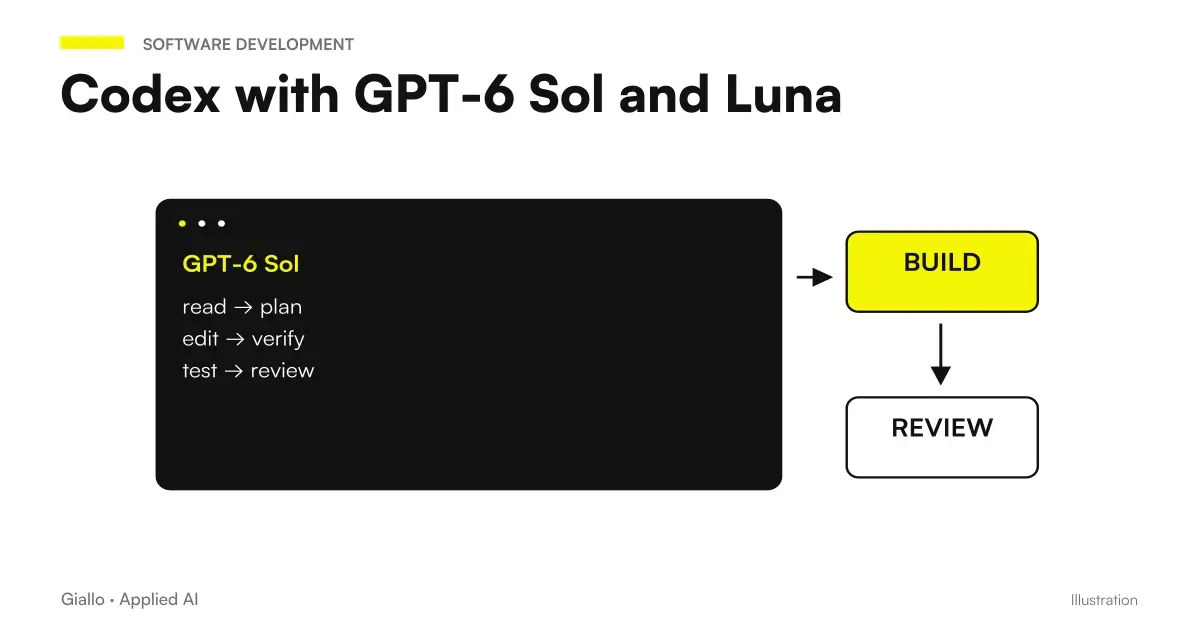 Codex with GPT-6 Sol and Luna: models, reasoning, costs and review
 GPT-6 Astra: what it is, how to use it and its limitations
 GPT-5.6 Sol vs Terra: which makes sense?
 Claude Opus 5.5: what it is, what it changes and who it suits
 Why Vendor Benchmarks Are Not Comparable
 Google Playground: games with AI, access and limits in Italy
 Mistral Large 4: what the preview offers and what to evaluate before using it
FAQ
What are GPT-6 Sol and GPT-6 Luna?
They are two models in the GPT-6 family released by OpenAI on September 22, 2026, alongside GPT-6 Astra. Sol is designed for complex everyday work, coding and agents; Luna for focused tasks repeated at high volumes. OpenAI trained them using methods similar to Astra's, to offer comparable results at a much lower cost.
Can I use GPT-6 Sol in ChatGPT chat?
Not yet. At launch Sol and Luna are available in ChatGPT Work and Codex for Plus, Pro, Business, Enterprise and Edu plans, while with Free and Go you can use Luna in the desktop app. OpenAI writes that the two models are not yet available in chat.
How much do GPT-6 Sol and Luna cost via API?
Sol costs $2 per million input tokens and $10 per million output tokens; Luna costs $0.10 and $0.50. OpenAI presents these as half the promotional prices of GPT-5.6. Reading input from the cache costs one tenth of the normal input price.
What happens to GPT-5.6 Terra?
There is no Terra model in the GPT-6 family. In the Codex catalogue, users of GPT-5.6 Terra are offered a switch to GPT-6 Sol, which has the same input cost as Terra and a lower output cost. GPT-5.6 models remain selectable during the rollout.
Is GPT-6 Sol more powerful than GPT-6 Astra?
No. OpenAI continues to describe Astra as its most capable model and its reference model for computer use. Sol is the lower-cost alternative: on AutomationBench, Sol at the xhigh level outperforms Astra at the low level, but these are two different settings.
Can Sol benchmarks be compared to Claude Opus 5.5?
Not directly. OpenAI compares Sol and Luna with Claude Opus 5 and Claude Fable 5 and 5.1, because Opus 5.5 was released on the same day. Tests comparing the two models under identical conditions, with the same benchmark versions and the same reasoning level, have not yet been published.
Do Sol and Luna have the same knowledge cutoff?
No. According to the official model cards, Sol's cutoff is April 20, 2026 and Luna's is May 18, 2026. Luna, the cheapest model, has the most recent cutoff in the GPT-6 family, even more recent than Astra's.