
Sonnet 5.5 halves cache read cost: how much the API bill changes
Claude Sonnet 5.5 cuts cache-read prices. Measure reuse, writes and cost per result without mistakenly assuming the whole bill halves.
Reading time: 11 min
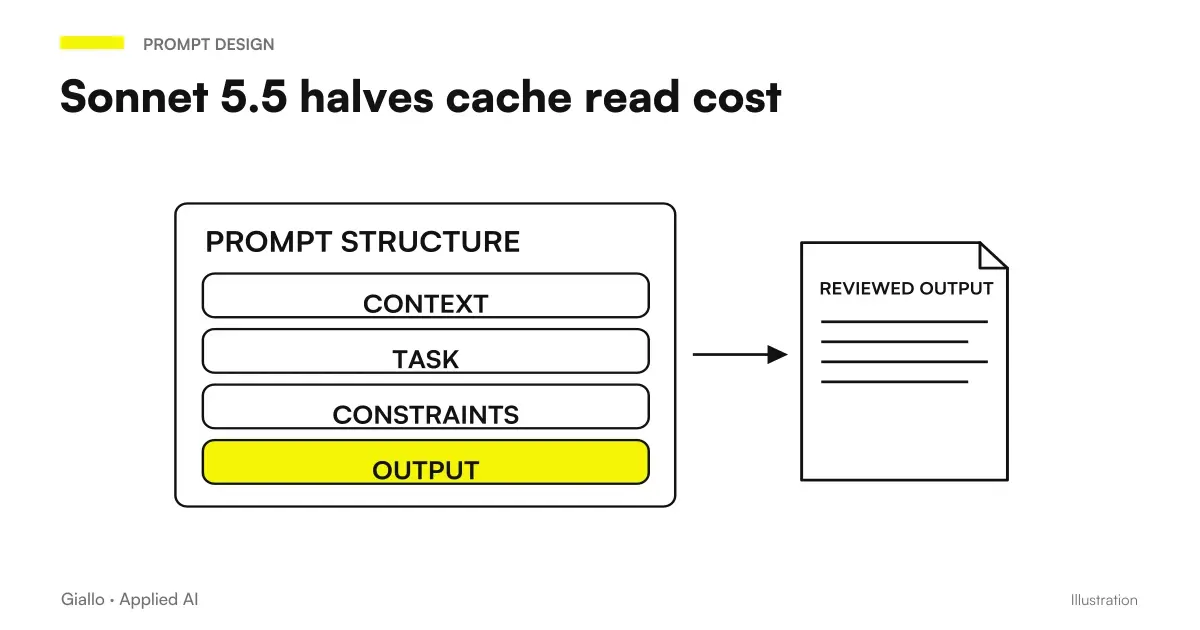
Claude Sonnet 5.5 halves the price of cache readings, not the overall bill of any automation. The modification of October 7, 2026 is reported in release notes Anthropic. It is an economic update of context reuse, not a new model launch and not a change to be attributed to other Claude models.
For an SME, the question is how many requests actually repeat the same instructions or material. An assistant who consults a stable catalog may have a different profile than a process that analyzes ever-new documents. Benefit depends on tokens read from cache, together with cache writes, new input and output that still have to be paid for under the applicable terms.
In summary
- The reduction is about reading Sonnet caches, not all API entries.
- Actual reuse should be observed in consumption, without inferring it from the repetition of the task.
- Scriptures and cache duration affect convenience.
- Stable instructions and data from the individual request should be organized with criteria.
- The economic comparison must maintain unchanged quality and perimeter of the result.
What rates do you read on the official page?
Pricing indicates, in USD per million tokens, 2 per input, 10 per output, 2.50 per five-minute cache write, 4 per one-hour write, and 0.10 per cache read. The reading goes from 0.20 to 0.10 USD, equal to 5% of base price input. Figures, durations and report refer to Official price page Claude, to be rechecked before making a quote.
The lowest price does not mean that all context is always read from the cache. The process must comply with the caching conditions and achieve effective reuse. Even when the material is similar, changes in the structure or reusable part can alter the behavior. The consumption register is therefore more useful than an estimate based only on the apparent length of the documents.
To read the invoice you must distinguish the categories of AI tokens. The new input describes processed content without the benefit of reading; the output is the generated text; the writing prepares the cache and the reading exploits its reuse. They are different voices and should also be kept separate in the economic model of the project.
How much does the cost of a stream really change?
A purely illustrative example: if a process reads from the cache 10 million tokens, the reading voice alone switches from 2 USD to 1 USD, using the rates given in the Official Pricing. The calculation excludes cache writes, new input, output and other costs. It is not an observed client result and does not demonstrate the percentage saving on the complete bill.
If the flow generates long responses, the output can have an important weight even with much reused context. If requests are spaced beyond the useful window, the scriptures may repeat. If the catalog changes often, the reuse may be less than expected. Convenience arises from the combination of these elements, not just the variation in the reading rate.
A valid comparison uses the same sample of work before and after the design change. You must not shorten answers or remove essential checks and attribute all the savings to caching. Quality must remain verifiable: a less expensive result that the operator often rejects may have a higher cost per useful outcome.
Which parts of the context should be kept stable?
A process can distinguish general instructions, reference material, and data from the current request. The instructions describe the task, limits and format of the outcome. The reference contains what is consulted several times, such as a procedure or a catalogue. The specific data concerns the customer, the document or the question that changes. This separation helps to understand where there is a possibility of reuse.
The structure should be designed according to the documentation of the service, without assuming that any repeated text automatically produces a cache reading. It is useful to measure the stable part and observe what happens when an instruction changes or the catalog is updated. A small frequent change can modify the reuse profile and make a configuration designed on static material less useful.
| Content | Possible role in the process | Verification required |
|---|---|---|
| General Instructions | Define behavior and format | Stability and version |
| Catalogue or procedure | Repeated Reference | Updates and Relevance |
| Data of practice | Request specific information | Minimization and correctness |
| Generated response | Result to be checked | Utility and length needed |
| Registered consumption | Evidence of actual reuse | Distinction Between Readings and Writings |
Should the duration of the cache be chosen on the rate of requests?
The choice of window only makes sense with respect to real traffic. A group of close requests may benefit from a configuration other than a process occasionally used. The team should observe when calls arrive and how often the context is repeated, instead of selecting the longest duration for caution. A larger window has a different writing cost in the official conditions.
The useful metric is not the number of requests that resemble each other, but the actual share of reused tokens and the associated total cost. The register can distinguish periods of intense work, intervals without requests and updates of instructions. These events explain why two days with the same number of practices can have different consumptions.
Versions of the material must remain legible. If the catalog is updated, the new information must enter the correct process. Economic convenience does not justify continuing to use outdated data. The control of sources and the validity of context come before the attempt to keep reuse high.
Can a distributor use it for responses to retailers?
Hypothetical scenario. A spare parts distributor prepares drafts of answers to recurring questions. Commercial instructions and a portion of the catalog remain stable, while required code, quantity, and missing information change. The operator checks the draft and confirms availability and conditions in the management software. The model does not promise deliveries based only on descriptive material.
The pilot compares close requests and isolated requests, observing human readings, scriptures, and corrections. It also includes similar codes and updated products. Cache can reduce an economic entry, but the result must still identify the right article and indicate when data is missing. The team measures gross cost per accepted draft, not simply consumption per call.
The benefit should not prompt you to always send the entire catalog if the process can only recover the relevant part. Less unnecessary context can make the task clearer and simplify verification. The choice between targeted recovery and repeated context must be made on the actual work, maintaining the same reference quality.
Can a service company prepare quotes from a price list?
Second hypothetical scenario. A small service company uses a common price list and business rules to prepare drafts of quotes. The specific request changes, while some instructions are repeated. The system proposes lines, exclusions and information to be requested; discounts, special conditions and sending remain with the authorized person. The value is to speed up preparation without creating improper commitments.
The sample includes services outside the price list, unplanned combinations and incomplete requests. The check verifies that the draft does not turn an assumption into a promise. If the operator frequently needs to rewrite the same parts, the problem may concern unclear rules or irrelevant context. Caching does not correct these errors: it makes some of the processed material less expensive.
The cost of an AI agent In fact, it includes much more than the call to the model. In this scenario they count interface, list link, version recording and approval time. The project must show the cost at full capacity before giving the new tariff a decisive effect on the margin of service.
How to record consumption without confusing caches and promotions?
For each group of requests it is better to separate new input, cache write, cache read and output. The report then adds accepted attempts, errors, and results. This reading makes it possible to understand whether the savings come from reuse or from the fact that the pilot has processed shorter inputs. A single sum of consumption does not offer the same evidence.
The Max and Team monthly API credits must be recorded after the gross cost. If they offset the bill, they do not change the technical consumption of the process. Automation can appear free in the trial period and maintain a significant cost when the benefit is not enough. The economic comparison must make both information visible.
Fees from other providers also require separate control. Italy is present in Countries supported by Anthropic, but the pricing quoted here should not be transferred automatically to Bedrock, Vertex or other routes. The contract used by the application must be identified before estimating the invoice.
When is the caching prompt not the first optimization?
If each request contains a new document and almost no common context, the priority can be to reduce unnecessary steps or choose a more circumscribed task. If the main problem is too long an output, the re-use of the input does not directly affect that entry. If the stream repeats calls due to application errors, the process management must be corrected before chasing a discount.
For choices between fixed categories, the OpenAI Decisions API faces a contract other than an open response. It is not an automatic replacement for Sonnet, but an example of why the choice must start with the task. For blocks in peaks, the API Build, Launch and Grow limits Instead, they relate to capacity, a matter distinct from the price of the cache.
The price comparison and models Claude should be read with the official page updated. Historical articles may report the previous rate: they are not the reference for a current quote. The date of the economic information must be explicit when using a value in a decision.
What errors distort the savings estimate?
The first is applying the halving to the entire bill. The second is assuming a cache read every time the task repeats. The third is ignoring cache writes and usage windows. The fourth is comparing two workflows with different quality or volume and attributing all of the change to the rate. Each error can produce an overly optimistic estimate.
An organizational error is not knowing who updates the stable context. If instructions and catalog are changed informally, consumption changes without a legible explanation. Keeping a version of the material allows you to link changes in cost and quality to the choices made, avoiding diagnoses based only on the month's invoice.
Document management can help this discipline. The in-depth study on Google Docs and native Markdown in AI workflows concerns another instrument, but the operational point is to keep clear material and recognizable versions. An ordered format does not guarantee caching; however, it makes it easier to understand what the process is reusing.
Checking before promising savings
Compare the same sample at equivalent quality. Read new input, cache writes, cache reads and output separately. Check the provider’s applicable rate and record credits separately. Observe closely spaced requests, long intervals and context updates. Use the gross cost per accepted outcome as the result, rather than the reduction in one bill line item.
How to read an unexpected drop in cache readings?
The first question is whether the stable material has changed. A new instruction, updated catalog, or different request organization may change the reuse. The second is whether the distances between calls have changed. The third is whether the report is correctly distinguishing readings and scriptures. These checks make it possible to look for the cause without immediately attributing the change to the model.
The team should retain a description of the configuration used for the sample, along with the version of the instructions. No need to store any sensitive content in economic logs. Simply be able to link consumption to a recognizable process and reconstruct relevant changes. When a correction improves quality but reduces reuse, the decision should be made on the cost per useful result, not just the cache indicator.
Finally, an unstable measure should not be turned into a promise to the customer. The estimate can use a prudent interval and clarify what conditions support the calculation. The goal is to make the cost of the service predictable, keeping room for abnormal requests, material updates and additional verifications. The advantage of the new tariff comes into this picture, without becoming the only economic argument.
What outcome should come out of economic verification?
The pilot should show when the reuse works, when it stops and how much it weighs on the overall cost. It must also indicate whether the team can keep the context up to date without introducing errors. A reduction in reading voice is useful, but it only gains value within a process with controlled results and sustainable maintenance.
To understand if repeated instructions and catalogs really represent an opportunity, the work of automation of business processes may start from separate consumption and a sample of demands that operators consider representative.
Giallo Studio guides: methodology and sources
How we apply it in the company
Related resources
 Claude Max and Team monthly API credits: amounts, caps and permitted uses
 OpenAI Decisions API in beta: classify tickets and requests with controllable answers
 OpenAI API limits: Build, Launch and Grow arrive, what changes for automations
 AI tokens: how they are counted and priced in October 2026
 Claude model pricing: API rates and the cost of getting work done
 How much does a custom AI agent cost
 Google Docs now modifies Markdown files: what changes for AI workflows
 Is Kimi AI free? Prices and plans to choose
FAQ
Which Sonnet price is changing?
The price of cache reads changes, not the entire cost structure. New input, output and writes must be examined separately on the official page.
Does the API invoice automatically halve?
No. The benefit depends on the share of tokens read from the cache and the other usage of the process. A workflow with little reuse can see a limited difference.
Is prompt caching used to save ready-made answers?
The theme here is the reuse of the intended context of the service, not a guarantee of recovering an identical response. The prompt structure and model behavior remain relevant.
What processes are candidates for caching?
Those with repeated instructions and context, such as catalogues or relatively stable procedures. Cost-effectiveness should be measured using the tokens actually reused.
Does a third-party provider necessarily apply the same prices?
No. The conditions of third-party providers must be checked separately. This article refers to the official first-party pricing.
How do you rate savings without confusing it with credits?
First record gross usage for new input, reads, writes and output. Show the credit applied separately, so the ongoing cost remains clear.