
Kimi K3.1 Pro vs K3: differences and a verifiable migration
Kimi K3.1 Pro vs K3: documented changes, benchmarks and migration tests. How to compare quality, costs and tools before switching models.
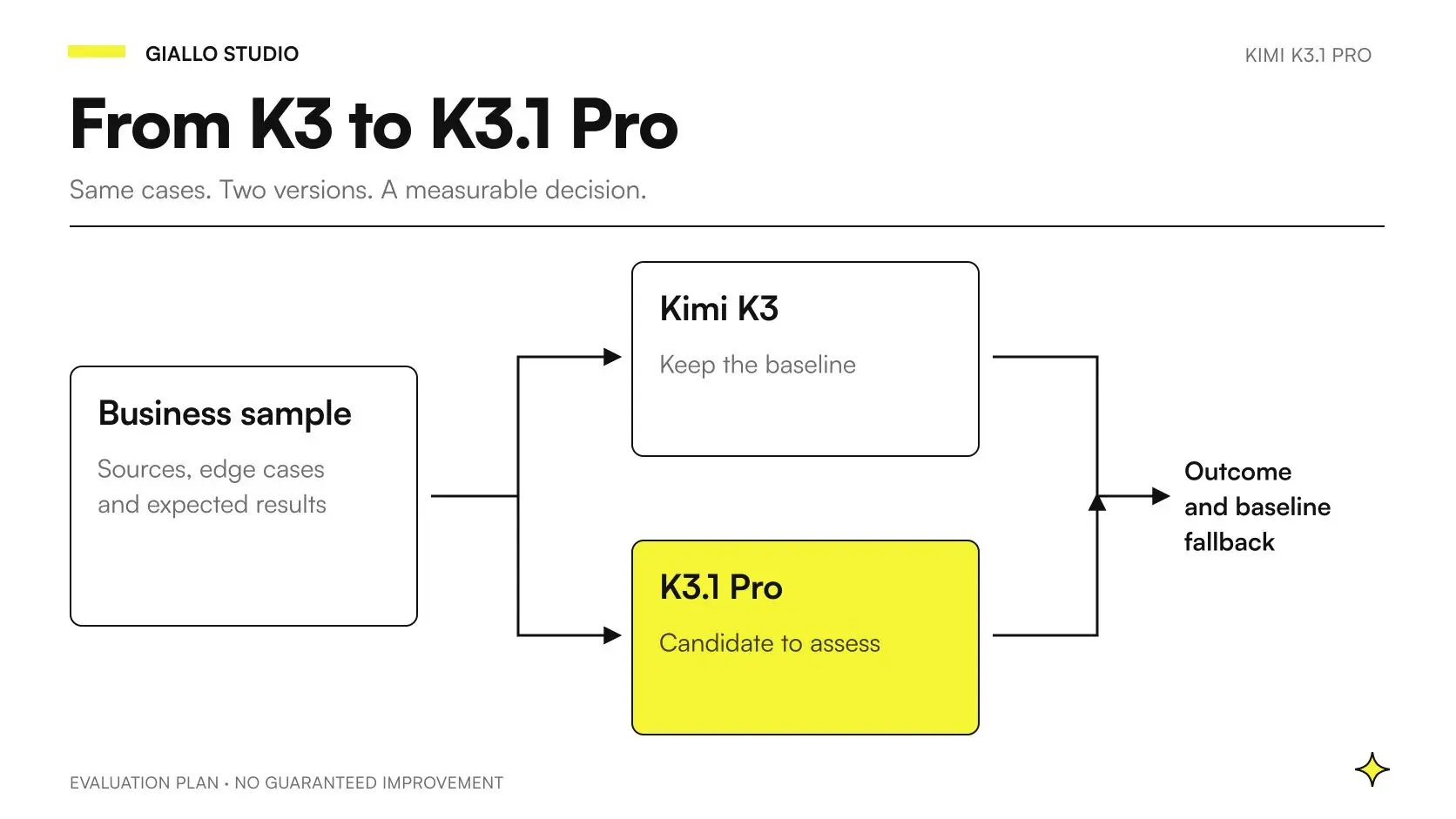
Kimi K3.1 Pro vs K3 compares a newly post-trained version with its earlier base: it does not imply that every integration must change immediately. The useful question is whether K3.1 Pro does a better job of solving an identifiable problem in your process, with acceptable costs and controls. Answering it requires comparable cases and a previous configuration that can be restored.
This guide considers information available and checked on October 24, 2026. The official K3.1 Pro introduction describes the first model in the K3.1 series, derived from post-training K3. The new release warrants an assessment; the vendor's results do not replace a business trial. For an introduction to the product, start with what Kimi K3.1 Pro is.
The approach proposed here supports a decision that can be checked. It is not a test performed by Giallo on your data and makes no promise of savings. Both SME scenarios are hypothetical and illustrate the differences worth observing before approving a switch.
In summary
- K3.1 Pro derives from K3, but differences should be described only where they are documented.
- Long context, vision and tools do not become exclusive new features simply because the version changes.
- The comparison must include the complete current system, rather than just two chat responses.
- A vendor benchmark can guide the test, but it does not establish a financial outcome for the SME.
- Migration must preserve a way back for both the configuration and requests in progress.
What actually changes between K3 and K3.1 Pro?
The verified distinction is the new post-training: K3.1 Pro is not described as a model family unrelated to K3. The vendor attributes improvements to greater investment in this phase. The right approach is to identify which behaviors improve in the published tests and which must be checked in your integration.
Some features carry over. The K3 API guide already documents a one-million-token context, vision, tool calling and reasoning effort. Attributing all of these to the new release would make the change appear broader than the sources establish.
| Aspect | K3 | K3.1 Pro | Implication for the decision |
|---|---|---|---|
| Relationship between versions | Previous model | Post-trained version of K3 | Assess behavior on the same task |
| Long context | Already documented | Claimed 1M context | Capacity alone does not justify switching |
| Vision and tools | Already documented | Documented in the new API contract | Test the integration without inventing a break with the past |
| Benchmark results | Baseline in evaluations that include it | New results published | Separate internal tests, public tests and the business trial |
| Weights for the new release | Separate from the API service | Full weights promised by November 4, 2026 | Do not plan as though self-hosting is already ready |
| Your software's compatibility | Configuration to preserve | To be checked on the chosen channel | Do not infer it from the name or general protocol |
For the new release's availability and parameters, refer to the K3.1 Pro API guide. The table does not claim to list every possible difference: an undocumented aspect remains to be checked and is not automatically classified as absent.
Do the benchmarks justify an immediate upgrade?
No. A benchmark provides evidence within a limited scope; adoption concerns the process. In the internal evaluation Kimi Code Bench 3.0 Long-horizon, the vendor reports 61.2 for K3.1 Pro and 55.95 for K3. The arithmetic difference is 5.25 points, rather than a 5.25% improvement or a measure of time saved in the business. Source: official K3.1 Pro evaluations.
The internal nature of the evaluation matters: task selection and the environment can influence the result. A precise number does not make a test independent. To decide what to investigate further, see the analysis of K3.1 Pro and other LLM benchmarks, which separates metrics and configurations.
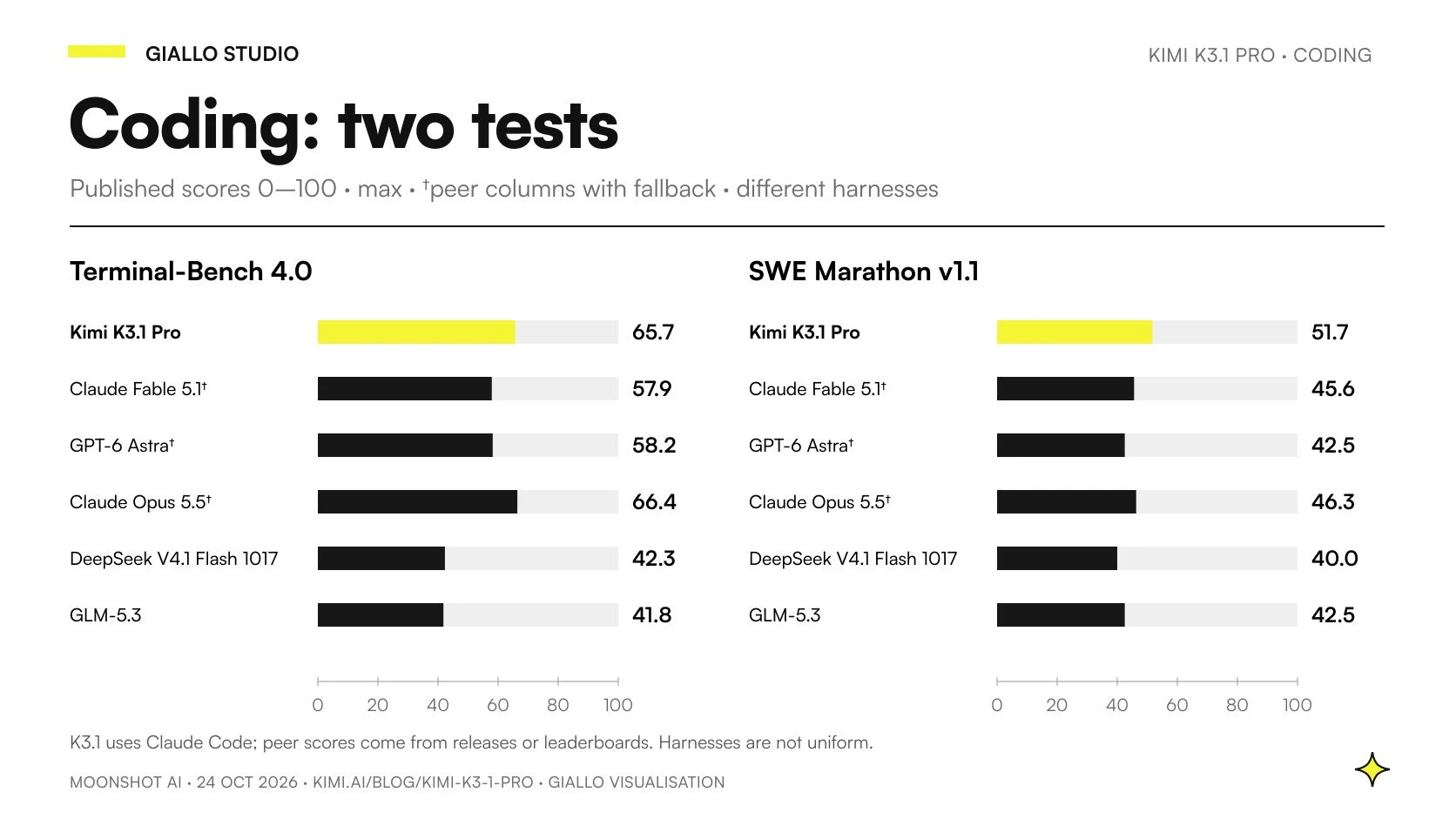
| Model in Moonshot's compilation | Terminal-Bench 4.0 | SWE Marathon v1.1 |
|---|---|---|
| Kimi K3.1 Pro | 65,7 | 51,7 |
| Claude Fable 5.1 | 57,9 | 45,6 |
| GPT-6 Astra | 58,2 | 42,5 |
| Claude Opus 5.5 | 66,4 | 46,3 |
| DeepSeek-V4.1-Flash-1017 | 42,3 | 40,0 |
| GLM-5.3 | 41,8 | 42,5 |
The official Moonshot table declares max and indicates fallback for the proprietary model columns. For Terminal-Bench, Kimi's result uses Claude Code; the other figures are collected from official publications and leaderboards. In SWE Marathon, Kimi and DeepSeek use Claude Code, while the other scores come from the benchmark leaderboard. This is neither an independent replication nor a test in an identical environment.
The two panels should not be averaged: the relative rankings change and the tasks differ. The chart helps position K3.1 Pro among alternative candidates, while the internal K3/K3.1 figure above concerns a different evaluation.
The benchmark points to a specific question: if the current system loses a constraint during a complex task, does the new model retain it better? Answering that requires a test that includes the constraint. If the problem instead comes from an outdated manual or an unstable connector, replacing the model may leave the cause untouched.
What does migration mean in the app, Code or APIs?
Changing the selection in the app changes one person's experience. Changing models in a coding environment also affects tools, instructions and repository management. Changing an API call can affect software used by several operators. These tests have different scopes and should be recorded separately.
The migration must specify the actual channel and identifier. A result obtained in the app does not establish that your business software's backend has the same tools. Similarly, a trial through an intermediary must make clear which service processed the request and which functions it provided.
If you already use Kimi API, preserve a description of the current configuration: requested model, endpoint, instructions, tool schema, file handling and output formats. Without this snapshot, the comparison may attribute a change to the model when it was introduced by code at the same time.
A local deployment requires a different assessment again. As of October 24, the full K3.1 Pro weights are promised for release by 4 November 2026. Do not assume that testing the hosted service confirms the license, memory requirements or compatibility of a future deployment. The available service and the announced weights are separate deliverables. Official announcement.
Which API contract should you check before switching?
In the quickstart, the new identifier is kimi-k3.1-pro, with the variant kimi-k3.1-pro-highspeed. Thinking remains enabled; reasoning_effort admits low, high and max. The guide requires preserving the complete assistant message in subsequent turns and tool calling. Streaming deltas separate reasoning_content from content in the final response. Source: K3.1 Pro quickstart.
These instructions translate into small, observable technical tests. Does the software retain the required messages? Does it associate each result with the right tool? Does it display a complete final response after streaming? A test that only checks for a successful HTTP status does not answer these questions.
For visual inputs, the Vision guide requires an array of parts and documents base64 or file IDs in the official workflow. A client accepting a string containing JSON is not enough. Verify that the model actually receives the visual material and that the output remains linked to the correct file.
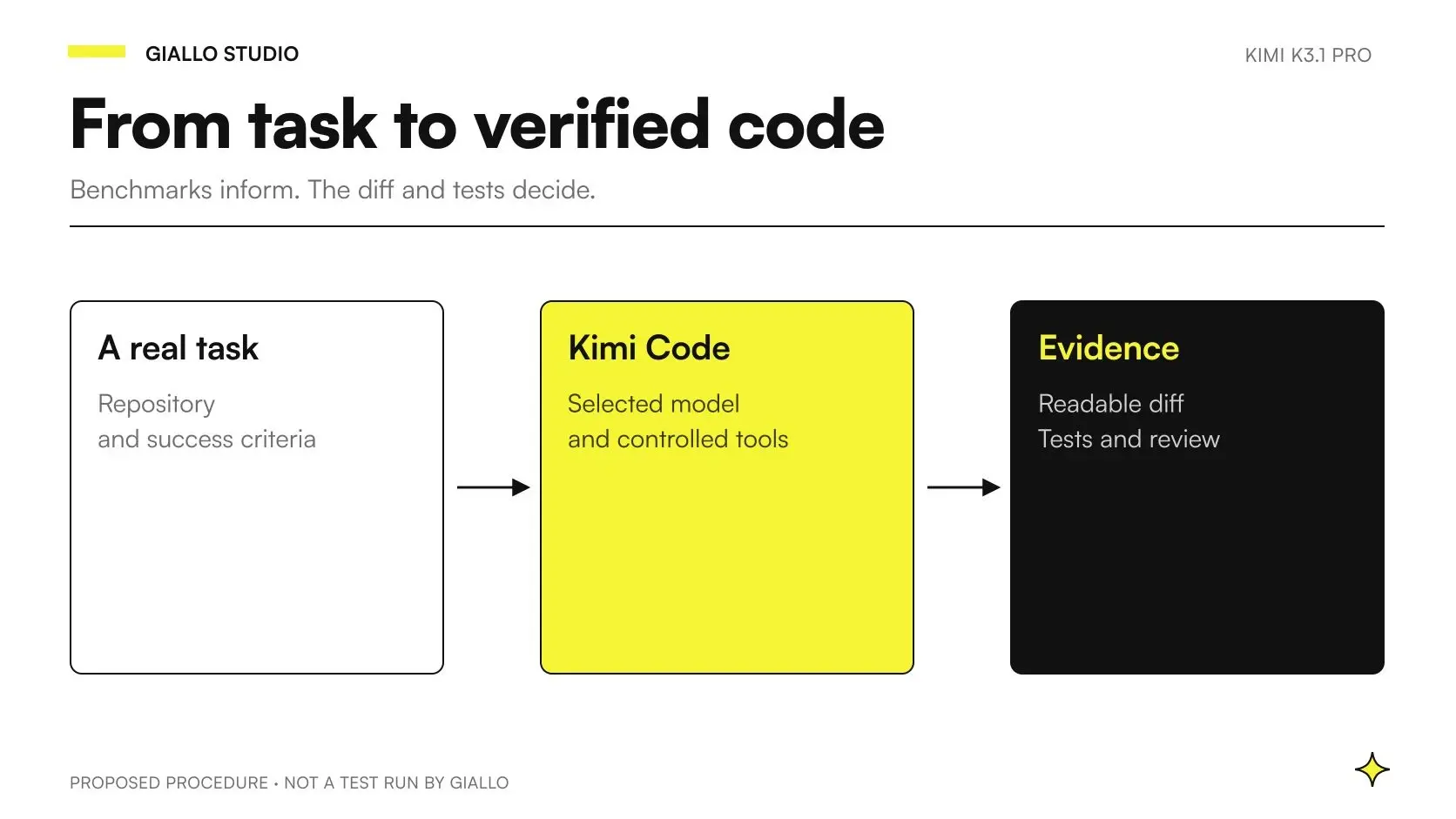
Also review settings copied from other models. The current guide specifies fixed sampling parameters: leaving them in a panel as freely adjustable, effective controls can create false expectations. Record which settings are accepted, ignored or rejected in the selected channel. The guide to K3.1 Pro for coding looks more closely at tests involving development tools.
How do you distinguish a like-for-like comparison from optimization?
Plan two stages. In the first, preserve as much of the current configuration as possible and change the model, adapting only what the new contract requires. This comparison helps identify what changes without immediately introducing a new version of the instructions.
In the second, you can optimize the system for K3.1 Pro: reduce redundant instructions, clarify an unclear schema or change the order of sources. Record these changes as part of a new configuration. If the result improves, the evidence concerns the final combination, not just the model name.
Apply the same principle to the baseline. If K3 gets an old prompt and the new model gets a redesigned workflow, the comparison does not establish which change caused the benefit. You can still choose the better system, provided you describe it as a comparison between systems and include the cost of the changes.
How do you record a test without creating an unmanageable archive?
For each run, retain a case identifier, the configuration version, check results and observed errors. Keep test sources in the authorized location without duplicating confidential data in logs. The reviewer must be able to identify which combination produced the result and repeat it on another case.
Version discipline also prevents a false impression of stability: if you change the instructions after every response, you are no longer evaluating a consistent setup. A configuration must remain fixed long enough to produce comparable evidence.
Which cases belong in an SME trial?
Start with errors you already know. For each one, write down the expected information, the source that supports it and the consequence of an incorrect result. Then add ordinary cases and cases where the correct response is to ask for clarification. A set consisting only of complete requests does not represent a process with incomplete inputs.
For document tests, include different revisions, repeated data with different definitions and missing fields. For tool tests, also include empty results, service errors and unauthorized requests. Evaluate the new release on how it handles these conditions as well as the quality of an ideal response.
Keep some cases separate from prompt changes. This checks whether a fix works beyond the example that suggested it. The size of the set depends on the variety and criticality of the task: we do not propose a universal number that certifies every use.
For each result, separate critical errors, minor corrections and appropriate abstentions. An overall average can hide a rare but important failure. The method for choosing an AI model connects this assessment to requirements before brand preference.
When should you try K3.1 Pro, and when should you keep K3?
It is worth evaluating when the current system has an identifiable shortcoming: lost constraints, difficulty linking sources, errors on complex tasks or high review costs. The objective must explain how an improvement will be recognized without assuming it will occur.
Keeping K3 can be a valid choice if the process already meets the required criteria and the change creates work without an observed benefit. This does not mean giving up on progress; it means ensuring that replacing a component does not become an end in itself.
When to start the comparison
- The current system's errors are identifiable and reproducible.
- Sources and criteria exist for assessing the responses.
- The pilot can proceed without automatically writing operational data.
When to fix the process first
- Nobody has defined what makes the output acceptable.
- The source data is inconsistent or lacks an approved version.
- There is no previous configuration that can be restored.
Migration can also be selective: use the new model for one category of tasks and retain the previous model for others. The software must make routing verifiable. Adding opaque rules for model selection can complicate diagnosis and cost comparisons.
What would a test look like at a technical supplies distributor?
Hypothetical scenario: an electrical supplies distributor in Brescia. The K3-based system drafts comparisons between requests for quotations and approved data sheets. The team wants to find out whether K3.1 Pro retains requirements better when a document contains exceptions or references to different variants.
The pilot uses an authorized test document set with requirements and an expected answer. Both models receive the same source versions. The comparison checks whether each requirement has a documented match, whether missing data remains missing and whether a feature of one variant is incorrectly attributed to another.
Where practicable, the sales representative reviews results without knowing which model produced them. They record corrections and the work needed to reach an acceptable draft. The comparison concerns the fidelity of preparatory material, rather than the ability to decide commercial terms autonomously.
The second phase can improve the instructions for K3.1 Pro while keeping the new configuration separate. If the advantage disappears on held-out cases, there is not yet sufficient evidence for migration. If both versions fail on the same ambiguous document, the source may need to be corrected.
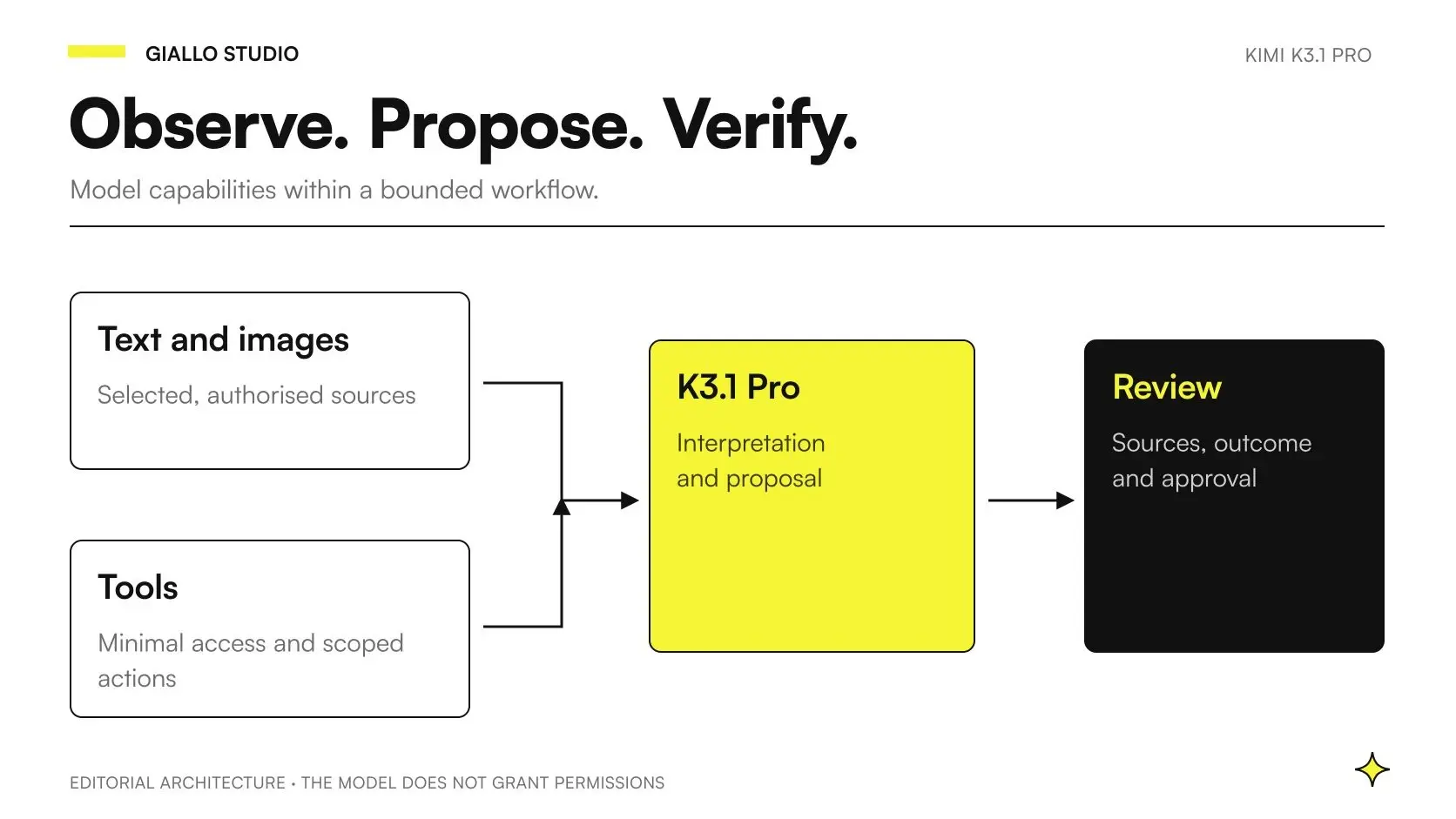
Any rollout begins with drafts for review: no messages sent, orders placed or price lists updated during the trial. Moving to real operations requires checks on permissions and approval, as explained in the guide to K3.1 Pro multimodal agents.
What would a test look like at an administrative services company?
Hypothetical scenario: an administrative services SME in Padua. A K3-based workflow classifies internal requests and prepares a record for the operator. Migration is proposed because the system sometimes confuses the document date with the date of the requested task.
The test uses synthetic or authorized material, with explicitly labeled dates and some deliberately ambiguous cases. The scoring rubric does not reward a long explanation: it checks field assignment, the cited source and behavior when the date cannot be established. A clarification question can be the correct result.
First, compare the two models in the same workflow. Then test a configuration that clarifies field names and definitions. If this also improves K3, the company has an alternative to full migration. The comparison must allow this conclusion rather than being designed to confirm the initial choice.
The manager also assesses the effect on the software: unexpected fields, incomplete responses and repeated attempts. A better response that the business software misinterprets does not produce a better case outcome. Format review and content verification remain separate tests.
Only after the checks should a bounded subset of requests be routed to the new system. No real data is uploaded simply to make the demonstration more convincing. The approach to AI consulting for companies can start by defining the test and the requirement it must meet.
How do you compare costs and speed without misleading numbers?
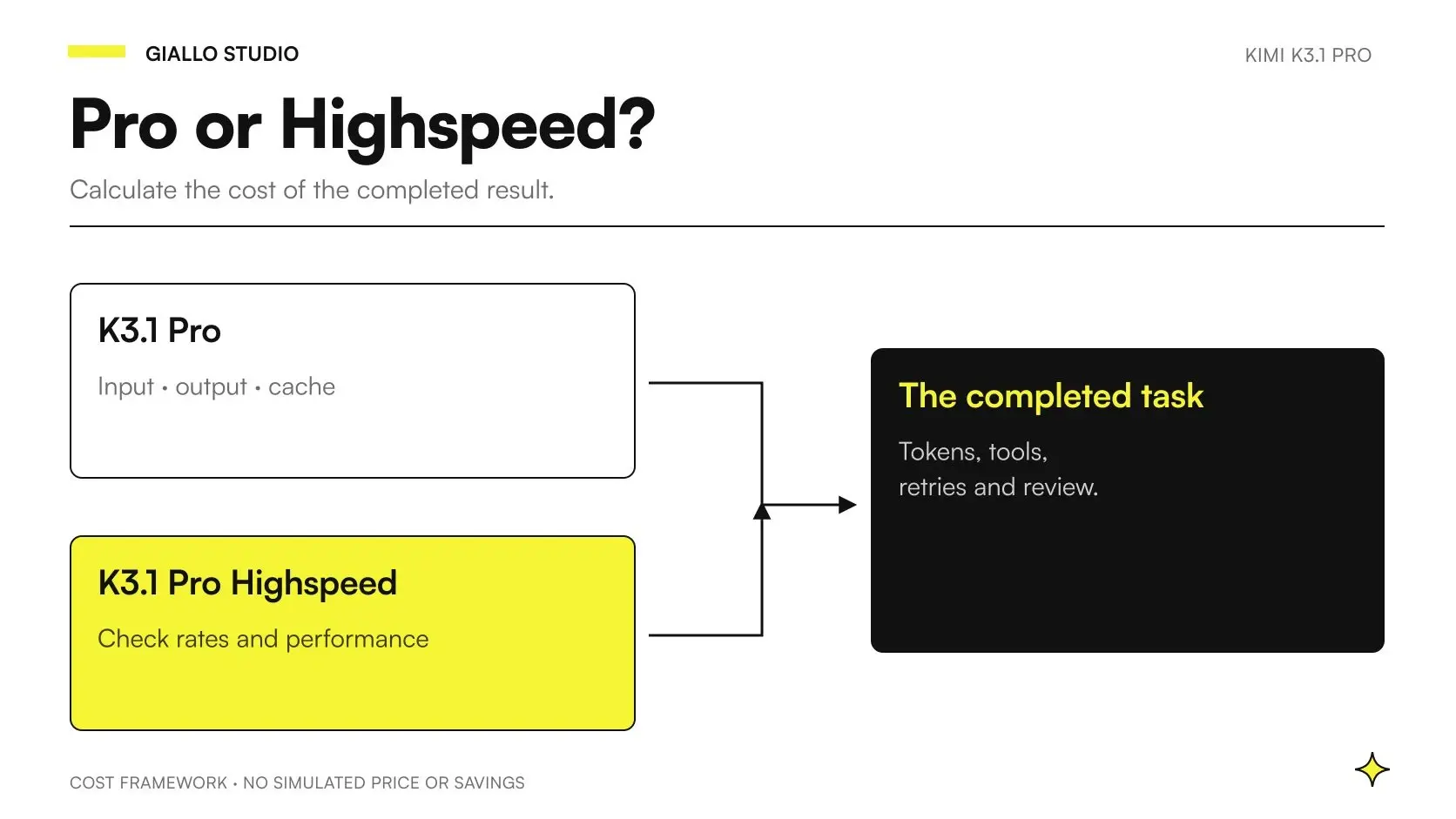
Compare the cost of an accepted result. Include input, output, any billed reasoning, tools, attempts and review effort. A lower rate per token may come with a longer sequence of requests; a faster response may require more corrections.
For Highspeed, the vendor claims output generation is two to three times as fast as K3.1 Pro. This is a claim about the model service, not a guaranteed multiplier for the entire process. Source: official announcement. If business software or review accounts for most of the time, the total duration may change differently.
Measure the model's response time and the case's completion time separately. Also record the wait experienced by the operator and behavior when a request is interrupted. A system should not repeat an action already performed simply because the client stopped waiting.
For rates and differences between channels, see K3.1 Pro pricing and APIs. Always check the official page before estimating a budget: an app subscription and backend usage should not be added together or treated as substitutes without knowing the actual contract.
What should you check about data, files and external services?
Map the data flow in the new configuration. If you add an uploader or intermediary, you have also changed the processing, not just the model. Keep a list of components and the material each receives.
The Kimi Open Platform ZDR policy applies to enterprise customers on request, with exclusions for image/video file uploads, Batch, operational data and third-party services. It does not automatically establish EU residency or GDPR compliance, nor can it be extended to the app or every account.
The technical assessment can begin with synthetic material. Before using real data, check the channel's terms and data processing responsibilities. The earlier guide to Kimi and privacy helps distinguish the products; verification must still refer to the configuration you intend to adopt.
How do you roll out the change and test rollback?
Preserve the complete baseline before making changes. Returning to K3 must also restore the prompt, schemas, parameters and compatible tools. If the new workflow writes a format the old one cannot read, simply changing the model is not enough.
An initial phase can process authorized copies of cases without taking operational actions. The new system can then be enabled for a bounded group of requests while retaining review. These are proposed rollout choices, not automatic Kimi platform features.
Define in advance the reasons to halt expansion: a critical error, lost references, tool calling failures or a cost the process cannot support. The person responsible for the activity must choose the threshold; no universal percentage makes every application safe.
Also test requests already in progress. If you change configurations while a case is underway, it must be clear which version completes it. Restoring the model does not undo a write already made to the CRM or a document already sent: this is why a draft-only pilot makes the decision more reversible.
Which mistakes should you avoid when a new version arrives?
The first is calling everything on K3.1 Pro's specification sheet “new,” even when it was already documented for K3. The second is turning a difference in points into a productivity percentage or financial forecast.
The third is changing the model, sources, tools and prompt at the same time without preserving versions. The fourth is evaluating only easy cases while ignoring the very errors that prompted the comparison. The last is announcing a local deployment based on weights that are still only promised.
A useful comparison can lead to full migration, selective use or retention of the current configuration. All three are valid outcomes when supported by relevant evidence. The choice must remain tied to the process rather than a need to declare a winner.
What first step makes the decision concrete?
Write down one problem with the K3-based system, collect reproducible examples and define an acceptable result. Freeze the current configuration and test the new model without operational effects. Only then compare errors, corrections, cost and service continuity.
For features, return to the K3.1 Pro guide; to interpret the figures, use the benchmark comparison. Both articles help shape the test, while the final decision must rest on the results of your workflow.
To find out whether the new model fixes a specific error in your current system, Giallo prepares AI evaluations with test cases, criteria and configurations that can be restored. The first deliverable can be an evidence-based decision about one process, before changing the entire integration.
Giallo Studio guides: methodology and sources
How we apply it in the company
Related resources
 Kimi K3.1 Pro: what it is, what changes and when to use it
 Kimi K3.1 Pro benchmarks: comparison with other LLMs
 Kimi K3.1 Pro: API pricing, caching and budgets for SMEs
 Kimi K3.1 Pro for coding: configuration and practical tests
 Kimi K3.1 Pro: multimodal agents for business processes
 Kimi K3: model, reasoning and practical limits
 Kimi API: models, prices and Moonshot integration
 ChatGPT vs Grok
Other direct comparisons
The same criteria applied to other model pairs.
- Kimi AI vs Claude: documents, code and costs
- Make vs Zapier vs n8n: which one to choose for your company
- Kimi AI vs ChatGPT: which to choose for work?
- Copilot Chat and Microsoft 365 Copilot: What Changes
- Jev AI vs LLM: how to choose the right model
- Mistral vs Llama: comparison between the two open weight models
- Claude Haiku 4.5 vs GPT-5.6 Luna
- Claude Opus 5 vs Fable 5.1
- Claude Haiku 4.5 vs Gemini Flash-Lite
- Claude Opus 5 vs Gemini 3.1 Pro
- GPT-6 Sol vs Luna: which one to choose and for which jobs
- Claude Opus 5 vs GPT-6 Astra
FAQ
What is the difference between Kimi K3.1 Pro and K3?
K3.1 Pro is the first release in the K3.1 series and is described as a post-trained version of K3 with greater investment in post-training. The vendor reports improvements in its benchmarks. Its value for a business process must be assessed on actual work.
Is K3.1 Pro the first to introduce a one-million-token context?
No. A large context is also documented for K3. It should not be presented as a difference exclusive to K3.1 Pro or as a guarantee of perfect document reading.
Is replacing kimi-k3 with kimi-k3.1-pro enough?
Changing the identifier is just one technical step. Before release, you need to check parameters, messages, streaming, visual inputs, tool calling, error handling and process outcomes.
Do the benchmarks show that I can remove human review?
No. The vendor's published figures describe specific evaluations, sometimes internal, with their own environments and settings. They do not directly measure your operations or justify removing a necessary control.
Does K3.1 Pro Highspeed make the entire workflow faster?
The vendor claims that Highspeed generates output two to three times faster. This does not guarantee the duration of the entire workflow: tools, network traffic, attempts and review all contribute to the total time.
Can I migrate a local deployment to the K3.1 Pro weights immediately?
As of October 24, 2026, the full weights are promised by November 4, 2026, rather than treated as already available. Testing the hosted service does not establish compatibility for a future local deployment.
How do I prepare a return to K3 if the test does not work?
Preserve the previous configuration's model, prompt, parameters, tools and formats. Test the restore with new requests and check how to handle those already in progress. Restoring the model does not undo any actions already performed in business systems.