
Kimi K3.1 Pro for coding: configuration and practical tests
Kimi K3.1 Pro for coding: exact IDs, Code versus API, reasoning and benchmarks. How to test it on a repository while keeping demos separate from verification.
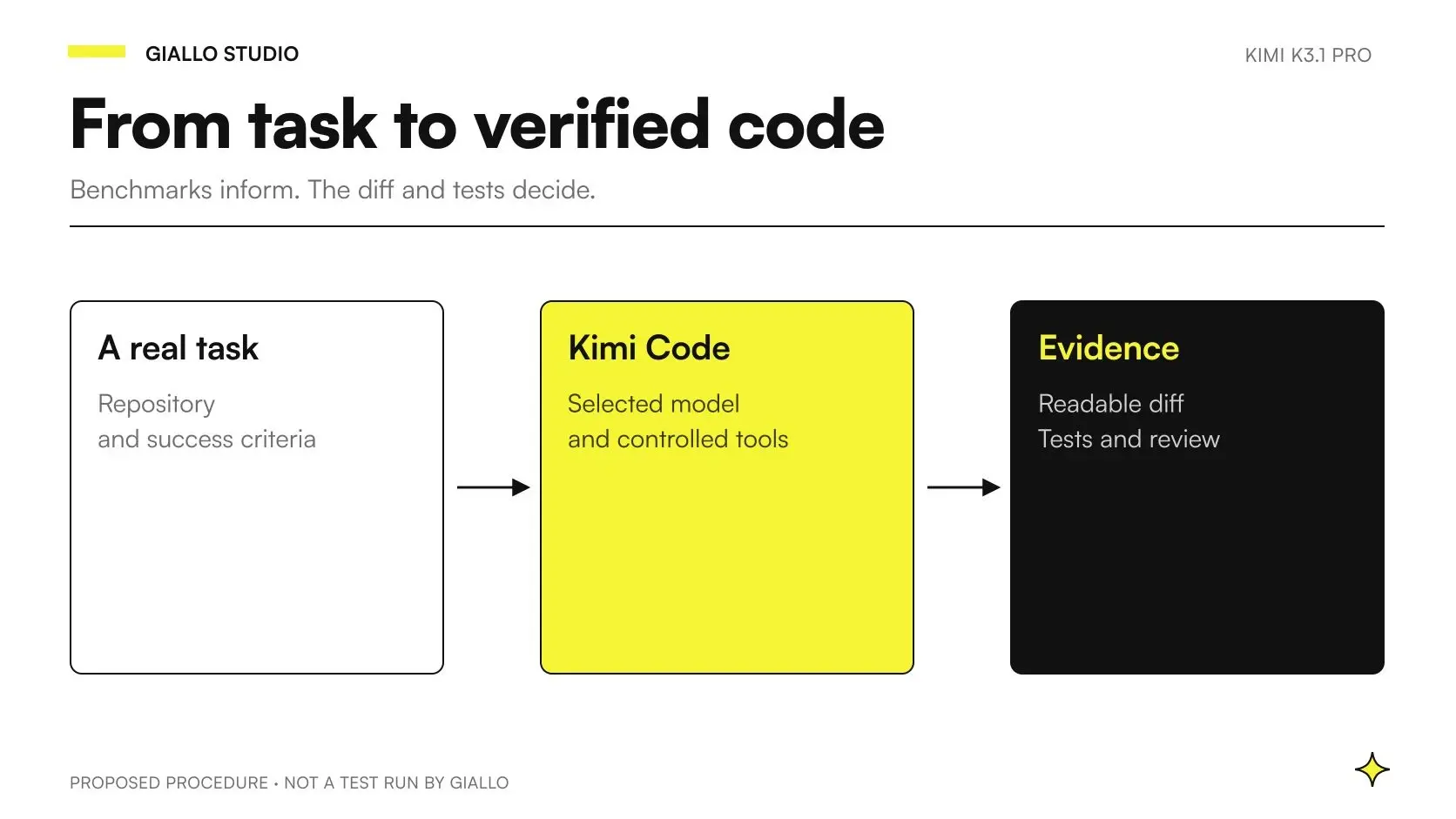
Kimi K3.1 Pro can be used for coding through Kimi Code or by integrating it into an agent via API. Availability was verified as of October 24, 2026. The model helps interpret and produce code; the client lets it read files, use tools and work on the repository. This distinction matters when identifying what you are comparing. Source: official K3.1 Pro announcement, accessed on October 24, 2026.
For an SME, the useful outcome is correct software behavior: an import that preserves data, an accessible screen or an integration that handles errors. A demo of a generated app shows what is possible; work on business software needs to produce a focused, readable and verified change. This guide does not report tests performed by Giallo: it distinguishes documentation, provider benchmarks and illustrative project scenarios.
In summary
- K3.1 Pro identifies the model; Code and API are different channels with their own identifiers and terms.
- The configuration must specify a model, protocol and reasoning level that match the chosen service.
- A large context helps retain references, but you still need to select relevant files and instructions.
- Published benchmarks offer leads for testing; they do not certify the correctness of business software.
- A useful handover includes the diff, the checks actually performed and evidence of the required behavior.
K3.1 Pro for coding: model, agent or application?
A model receives context and produces responses, which may include tool requests. An agent organizes the cycle: it collects a result, updates the context and continues. The client determines the available interface, while the environment determines which operations are possible. These components are connected, but they are not interchangeable.
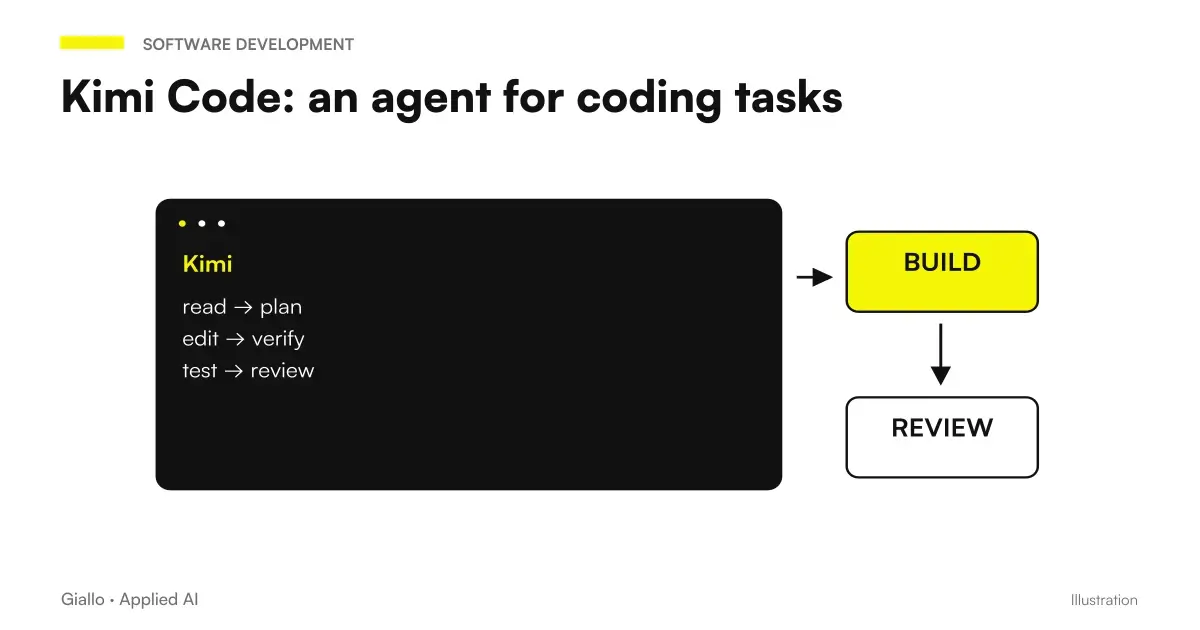
The general guide to K3.1 Pro introduces the model; the guide to Kimi Code describes the development product. The CLI documentation presents it as a terminal agent that can read and edit code, run commands and use feedback. This is why comparing two chats does not necessarily reproduce the work of two agents on the same project. Source: introduction to Kimi Code CLI, accessed on October 24, 2026.
Before choosing, define the task you want to assign to the system. Understanding an existing module mainly requires reading and explanations grounded in the files. Fixing a bug requires reproducing the problem and verifying the patch. Building a new feature also requires decisions about requirements. A prompt that mixes these activities makes it hard to tell whether the session is making progress.
Which IDs should you use in the API and Kimi Code?
The identifiers differ. The international pay-as-you-go platform uses the prefix kimi-; the Code service exposes short IDs. Simply entering “K3.1 Pro” in the technical field and hoping the client chooses correctly is not enough. Sources accessed on October 24, 2026: API quickstart and Kimi Code models.
| Channel | K3.1 Pro | Highspeed variant | International OpenAI-compatible base URL |
|---|---|---|---|
| Pay-as-you-go Kimi API Platform | kimi-k3.1-pro |
kimi-k3.1-pro-highspeed |
https://api.moonshot.ai/v1 |
| Kimi Code | k3.1-pro |
k3.1-pro-highspeed |
https://api.kimi.ai/coding/v1 |
The configuration must combine the credential, endpoint, protocol and model from the same service. A key created in the Code product console and an API platform key should not be considered interchangeable simply because both relate to Kimi. The documentation for using Code through Responses explicitly starts from the Code console. Source: official Responses tool integration, accessed on October 24, 2026. The guide to Kimi API explores the pay-as-you-go route in more detail.
The international domain does not establish where data is stored or whether a selectable European region exists. Those terms need to be checked separately in the contract and the chosen service. The first experiment should use code and data the company is authorized to send, with credentials managed outside the repository's shared files.
How do reasoning, fallback and context work?
In the general-purpose API, reasoning_effort accepts low, high and max, with max as the default. The model keeps thinking enabled. In turns involving tools, the documentation requires preserving the complete assistant message rather than reconstructing it from visible text alone. Source: Reasoning Effort API, accessed on October 24, 2026.
The Code service documents the same three levels but defaults to high. For K3.1 Pro, a request with thinking disabled is rejected. An incorrect model ID, however, may fall back to K2.8 Preview without thinking: receiving a response does not by itself prove that you are using the requested model. Context extends to 1,048,576 tokens on eligible plans; this is not a guaranteed allowance for every account. Source: Code model configuration, accessed on October 24, 2026.
Keep a test record with the channel and actual configuration. When behavior changes, that record helps distinguish a model difference from a client difference. This is especially useful when updating a tool or importing a configuration prepared for another service.
Extended context is not a reason to send every file. A repository often contains generated output, dependencies, logs and copies of material already available elsewhere. Collecting everything can make important references harder to follow. Start with the project instructions, the relevant entry point and pertinent tests; broaden your reading when a concrete dependency emerges.
What do the published coding benchmarks tell us?
Two rows in Moonshot's report help explain why a single ranking is of limited use. The figures below are scores published by the provider, accessed on October 24, 2026, rather than results reproduced by Giallo. Each column must be read within its own benchmark: the percentages do not represent the probability that a change to your business software will be correct. Source: K3.1 Pro report table and notes.
| System reported in the comparison | Terminal-Bench 4.0 | SWE Marathon v1.1 |
|---|---|---|
| Kimi K3.1 Pro, max | 65,7 | 51,7 |
| Claude Opus 5.5, max, with fallback noted | 66,4 | 46,3 |
| GPT-6 Astra, max, with fallback noted | 58,2 | 42,5 |
| Claude Fable 5.1, max, with fallback noted | 57,9 | 45,6 |
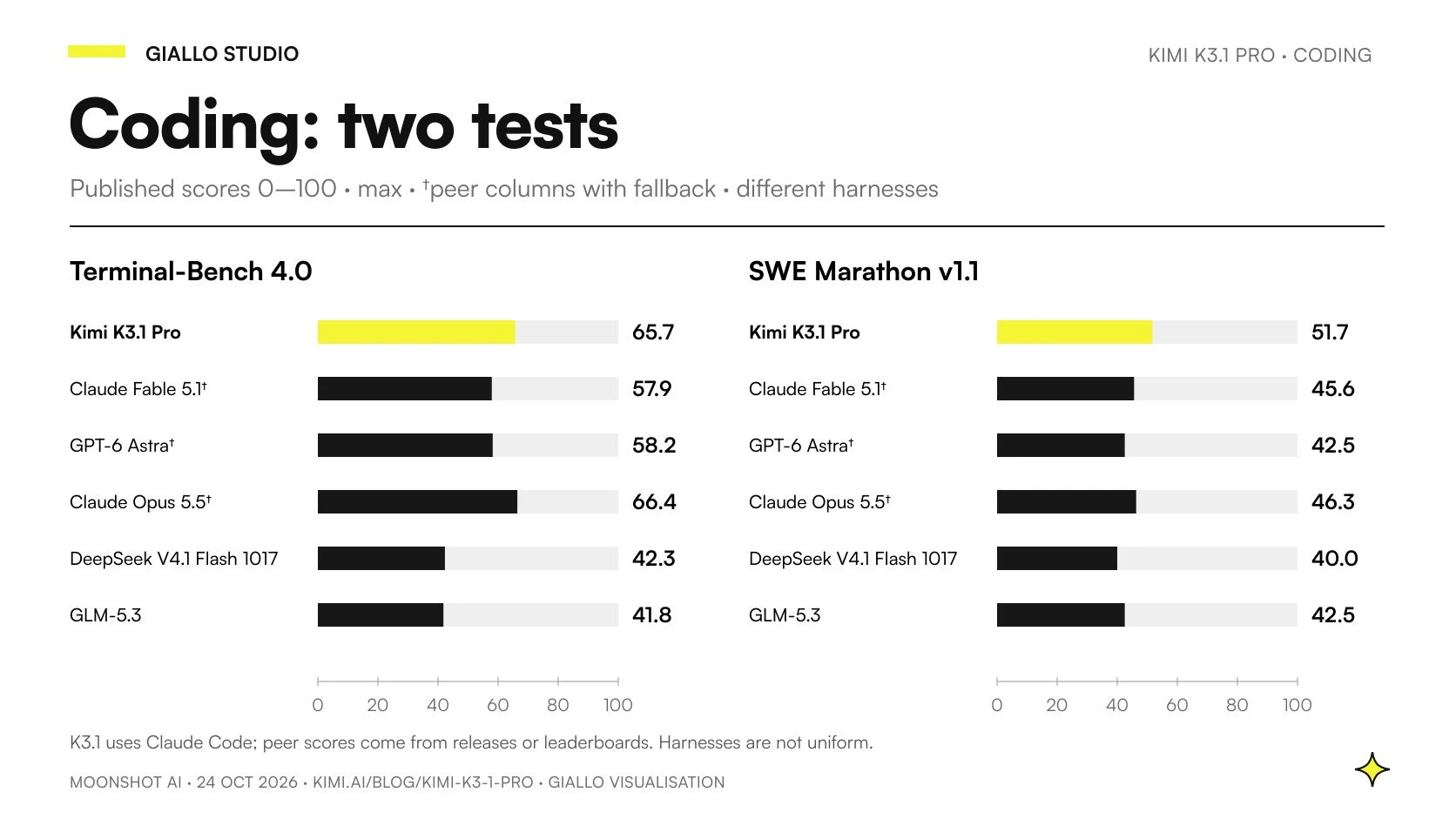
The report evaluates K3.1 Pro in the Claude Code agent environment. For Terminal-Bench, it combines other results from releases and leaderboards; for SWE Marathon, it also uses Claude Code for DeepSeek and takes other scores from the leaderboard. These are therefore comparisons of systems with different provenance and conditions, rather than a controlled experiment with a fully identical environment. These notes are part of the source, not details to remove from the chart.
The comparison suggests activities to test without naming a winner for every project. The guide to K3.1 Pro benchmarks examines the metrics and limitations in more detail. On the company repository, you still need to verify whether the system understands constraints, avoids unrelated changes and leaves a patch the team can maintain.
How do you prepare a test on the company repository?
Choose a small but representative task. A fix with an input that reproduces the problem is often a good starting point: you can identify the error beforehand and the expected behavior afterward. Avoid a request such as “modernize the business software,” which leaves the agent with too many business and technical decisions at once.
Prepare a separate working copy and record its initial state. Existing changes must remain distinguishable from those made during the experiment. If the team uses Git, a dedicated branch lets reviewers compare the proposal against a clear baseline. Release then follows the project's normal process, with authorization separate from local testing.
Collect the commands actually supported for static checks, tests and builds. Also document how to reproduce the behavior in the interface or API. A successful build does not prove that an import preserves the right columns; a test that is not discovered has not passed. The checks must address the requirement as well as finish without errors.
Replace real data with a synthetic sample when it is enough to reproduce the defect. A date-related problem needs formats, time zones and edge cases; it often does not need customer names or complete documents. This also makes the first experiment easier to share with the reviewer.
What kind of brief helps produce a verifiable change?
A useful brief contains the current behavior, desired behavior, constraints and verification steps. It does not need to become an enormous specification. It needs to make clear which result will close the task and which changes require a further decision.
For example, a developer could assign this task:
The order summary excludes orders recorded on the last day of the period. Find the cause using the synthetic sample and existing tests. Preserve the response format and authorization rules. Propose the smallest change and check the period boundaries, including behavior in the project's intended time zone. Report the checks performed and the cases you could not test.
It is a sample brief, not a test performed by Giallo. It gives the agent room to investigate and prevents a screen that merely looks correct after a constraint has been removed from being treated as success. If a business rule is unclear, the system must flag the question rather than decide independently which orders to include.
The agent proposes rewriting the module: how should you decide?
Ask it to connect every change to the observed defect. A rewrite may be justified, but it requires showing that a smaller change cannot preserve the required behavior. Ask for compatibility considerations, edge cases and verification steps. If a limited fix can meet the requirement, keep any code reorganization separate.
How can you test it on an e-commerce importer?
Hypothetical scenario: a professional supplies retailer in Padua. The catalog arrives from a supplier in a structured file. A new export contains codes with leading zeros and descriptions with quotation marks; the importer alters some codes. The team prepares synthetic data that reproduces those characteristics and identifies the expected result for each row.
K3.1 Pro's task is to trace the path from file to record, locate where information is lost and propose a patch. The change must preserve codes as required by the business domain and handle invalid rows without silently turning them into different products. Updating the live catalog remains a subsequent operation.
The test includes a second import of the same sample to check for duplicates and stability. The reviewer compares the expected records, reads the parser changes and checks that a local fix has not changed how other files are handled. If the model proposes a dependency, it must explain how it addresses the problem.
This scenario does not attribute an execution time or a saving to Kimi. It illustrates a task for which the company can define quality. If the patch works, the test result provides a basis for deciding whether to expand usage; it does not prove that the model can handle every future catalog.
How can you use it for technical service management software?
Hypothetical scenario: a maintenance company in Varese. The manager wants a screen that distinguishes jobs waiting for spare parts from those ready to schedule. The challenge goes beyond drawing two columns. The team needs to understand which statuses exist, who can change them and how an incomplete case is displayed.
Before coding, agree on the cases: a job without materials, a spare part that has arrived, a canceled case and an unauthorized user. K3.1 Pro can explore the components and propose a change consistent with the project. The business representative decides what the statuses mean; the model implements the approved behavior within those constraints.
Verification covers the full path: data returned by the service, authorization, rendering, updates and errors. The browser is used to check readability and interaction, while relevant tests should catch the most likely regression. A screenshot alone does not prove that a person without permission cannot change a status.
For an SME, this is a concrete form of collaboration between people who know the process and those responsible for development. The agent can speed up individual operations, while the requirement remains understandable to the team. The quality of the test depends on how precisely the work has been described.
Do images, interfaces and tools work the same way in every client?
No: the model's capabilities and the chosen interface must be checked together. A visual reference can help recreate a screen, but the client must be able to transmit it in a supported format. The guide to using Code through Responses, for example, describes text and images rather than direct video input. Source: Responses integration documentation, accessed on October 24, 2026.
For frontend development, prepare the interface states rather than just the ideal screen: loading, missing data, errors, long content and small viewports. A model may reproduce an attractive reference while overlooking an essential operational state if the brief does not make it visible. Accessibility also needs to be checked through real interactions.
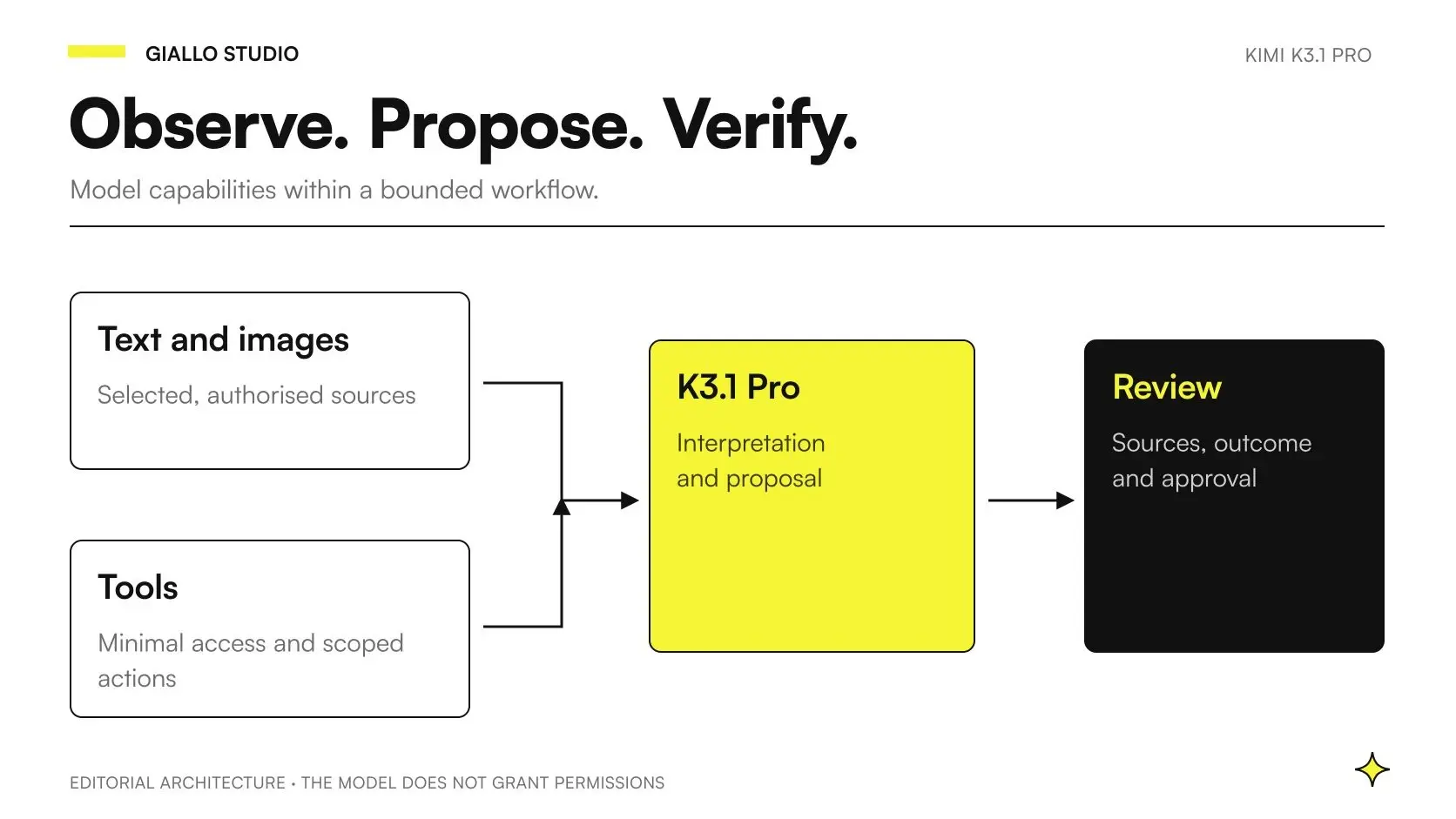
When a project involves image analysis or a sequence of tools, the guide to K3.1 Pro multimodal agents helps separate reading, proposing and executing. The principle also applies to coding: having a tool available does not mean every action it can perform should be authorized.
When should you choose Highspeed, and how do you monitor usage?
Test the Highspeed variant when waiting for the model affects interactive work. If a session spends most of its time on builds, tests or external services, faster generation may make little difference to the total time. Record the complete task, including review and corrections, without turning a provider's speed claim into a promise to the client.
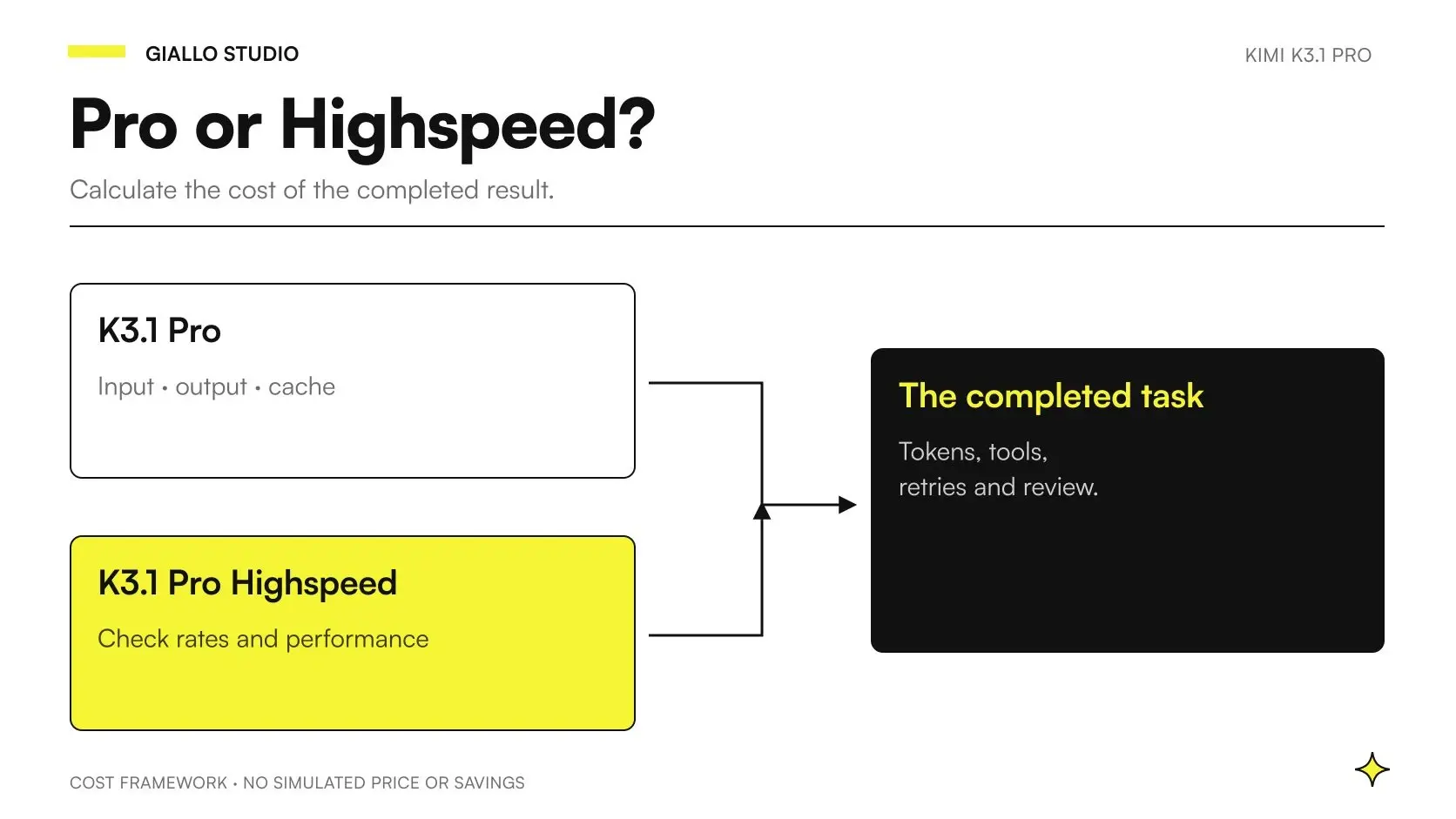
Keep Code product usage separate from API pricing. The guide to K3.1 Pro pricing explains the difference between input, output and caching. A project comparison also needs to show how many proposals are accepted and how much work remains for the reviewer: a cheap but unusable response does not complete the task.
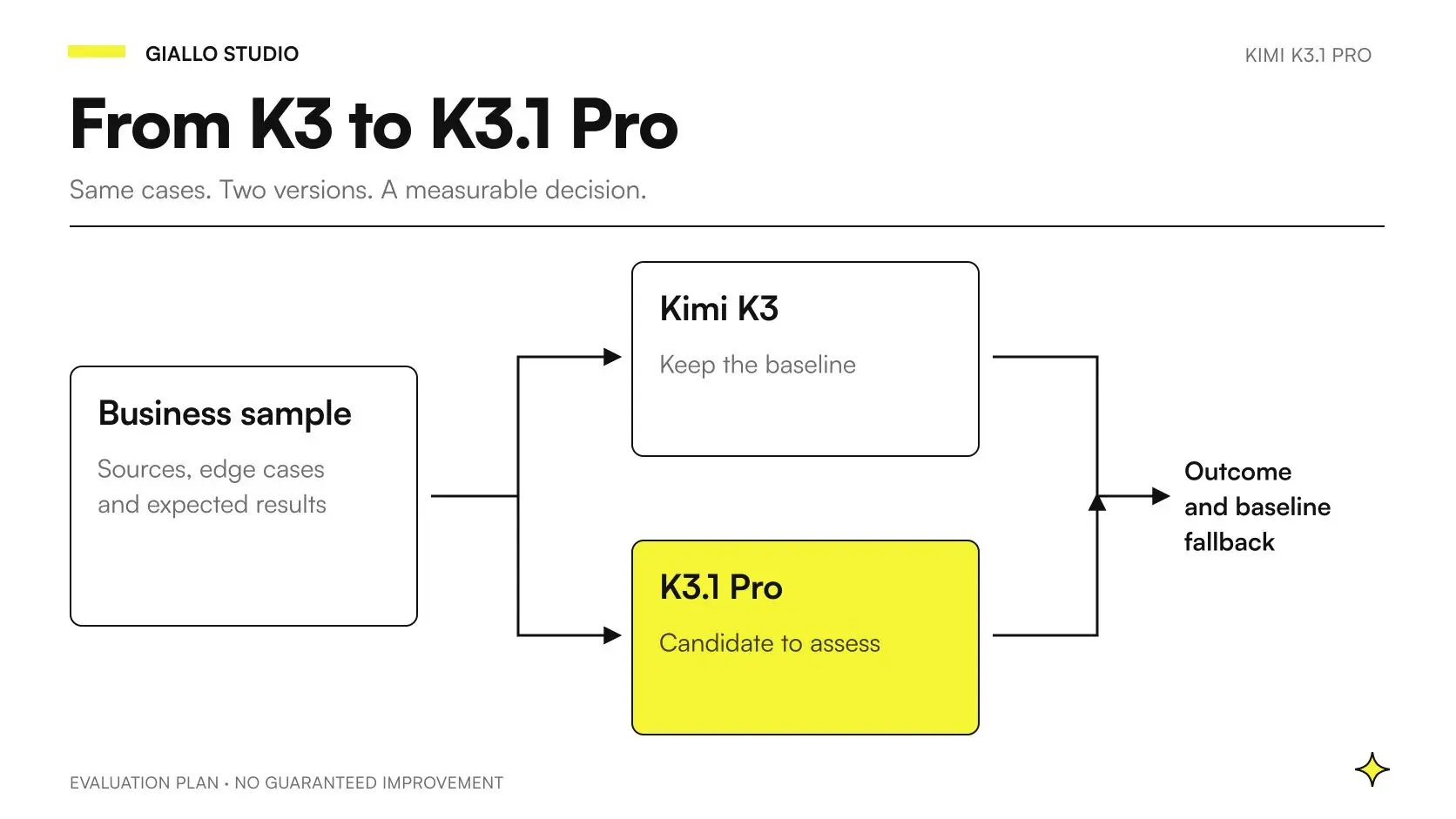
If you are moving from K3, keep a repeatable comparison case and follow the K3.1 Pro migration guide. Keep the requirement and tests stable. Changing the model, framework, dependencies and instructions together makes it impossible to identify which change caused a defect or an improvement.
Which mistakes should you avoid before accepting the code?
The first is treating “I ran the tests” as evidence of verification. Ask which commands were used, what the results were and which behavior they cover. The second is accepting changes to files unrelated to the requirement without a reason. The third is confusing a working interface with correct authorization. The fourth is allowing the experiment to use production data and services directly.
Read the diff from start to finish. A patch may fix the symptom while introducing an unnecessary change to the data format, lockfile or error handling. If the project requires a security review, the model that produced the code does not replace that step. The same standard applies to any other development agent.
Adoption makes sense when the team can repeat the test and maintain the result. Start with a concrete defect, a clear baseline and shared acceptance criteria. If you want to set up this process for business software or an integration, Giallo supports your team in developing custom software. Choose the model within that process, verifying what it delivers.
Giallo Studio guides: methodology and sources
How we apply it in the company
Related resources
 Kimi K3.1 Pro: what it is, what changes and when to use it
 Kimi K3.1 Pro benchmarks: comparison with other LLMs
 Kimi K3.1 Pro: API pricing, caching and budgets for SMEs
 Kimi K3.1 Pro: multimodal agents for business processes
 Kimi K3.1 Pro vs K3: differences and a verifiable migration
 Kimi Code: an agent for coding and development
 Kimi API: models, prices and Moonshot integration
FAQ
Can Kimi K3.1 Pro be used for programming?
Yes. Availability in Kimi Code and via API was verified as of October 24, 2026. Assessing its usefulness for your project requires a precise task, authorized tools and checks on the result it produces.
Are Kimi K3.1 Pro and Kimi Code the same thing?
K3.1 Pro is the model; Kimi Code is the product through which an agent works on a project. The final behavior also depends on tools, instructions, permissions and the client, not just the model.
Which identifier should I use for K3.1 Pro?
It depends on the service. The table in this guide distinguishes the API platform identifier from the Code service identifier; copying the display name or the other channel's ID may produce an error or select an unexpected model.
Can I disable thinking in K3.1 Pro?
The model runs with thinking enabled. For the Code service, the documentation says requests with thinking disabled are rejected, so check the client's actual configuration.
Does Highspeed also make tests and builds faster?
The claimed speed increase applies to the model. Compilation, tool execution and review take the time required by their respective environments; you need to measure the complete task.
Is the maximum context available on every Code plan?
No. The documentation ties access to extended context to the Code service plan. The model's maximum capacity does not establish that your account or client provides it.
Does a good benchmark prove a patch is ready?
No. Published scores describe specific systems and evaluation conditions. A change to business software must meet its own requirements, pass relevant checks and have verifiable behavior.