
Kimi K3.1 Pro: API pricing, caching and budgets for SMEs
Kimi K3.1 Pro and Highspeed API pricing as of October 24, 2026. Input, output and caching explained through hypothetical calculations and business budgeting criteria.
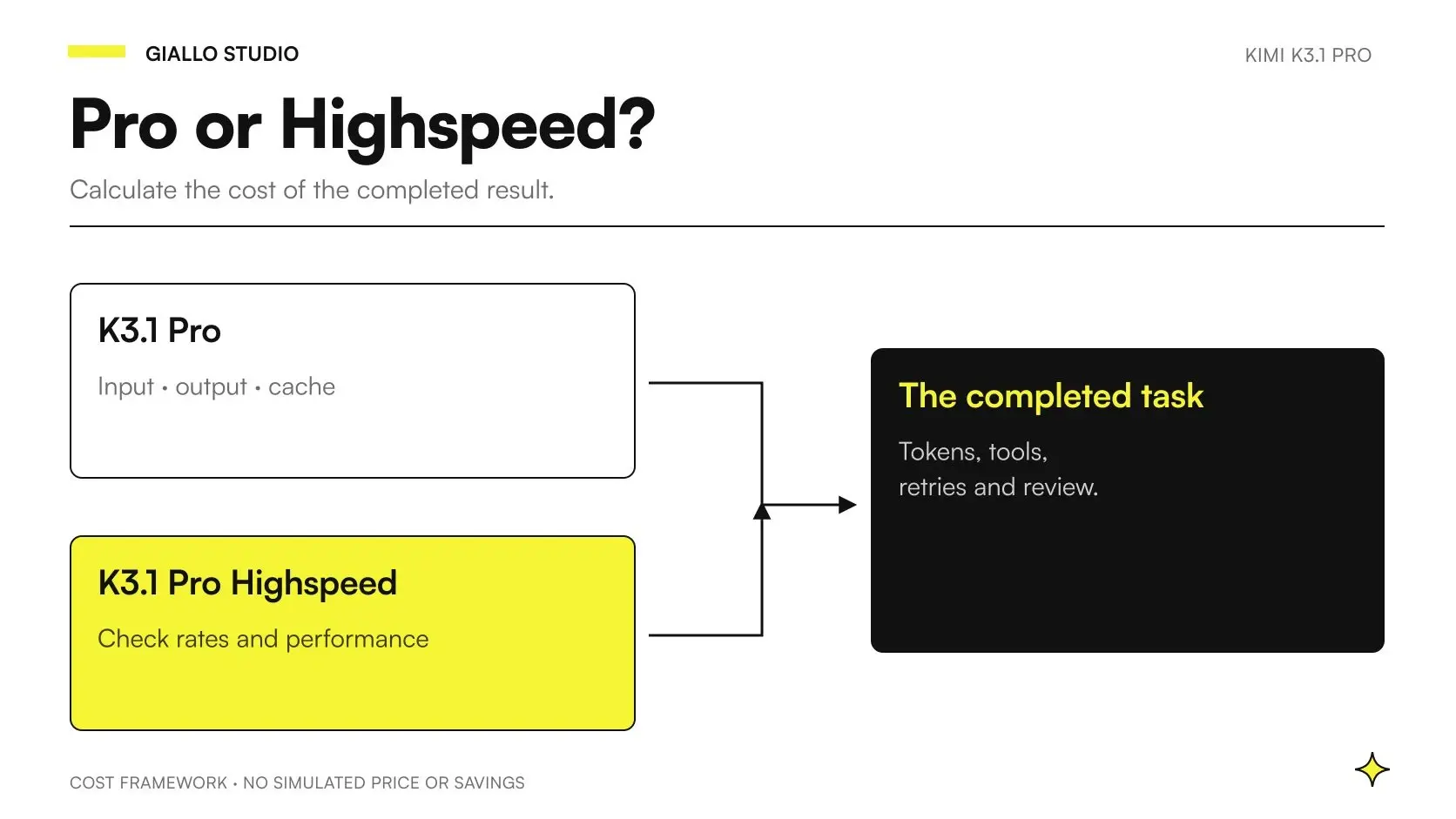
Kimi K3.1 Pro's international API prices, checked on October 24, 2026, are USD 2 per million input tokens and USD 10 per million output tokens. The price list also distinguishes cache writes from cache hits, which matter when software repeatedly sends similar documents or instructions. All rates in this guide come from the international Kimi API Platform, accessed on October 24, 2026.
For an SME, the useful question is how much it costs to complete a task correctly: preparing a technical data sheet, comparing documents or proposing a change to business software. A single task may involve several requests, tools and reviews. The examples below are hypothetical calculations, not measurements of Kimi's performance or project quotes.
In summary
- International API pricing is in dollars per million tokens; the app, membership and Code have separate terms.
- Input, output, cache writes and cache hits must be reconciled with the categories actually recorded by the service.
- Caching can reduce the cost of reused content, but reuse must be observed rather than assumed.
- Highspeed has different rates: evaluate it against the time taken by the complete task and the quality of the accepted result.
- An integration budget also includes tools, infrastructure, error handling and review.
How do API pricing, the Kimi app and Kimi Code differ?
K3.1 Pro is the model. The Kimi app, Kimi Work, Kimi Code and the API are different ways to use it. The guide to Kimi K3.1 Pro explains availability and features; budgeting requires one more step: identifying exactly which product will be purchased and which channel will be used.
The documentation describes inference on the API platform as a pay-as-you-go service, separate from membership and Kimi Code. You therefore cannot take the price of a personal subscription and divide it by a theoretical number of documents to obtain an API cost. Source: official billing explanation, accessed on October 24, 2026.
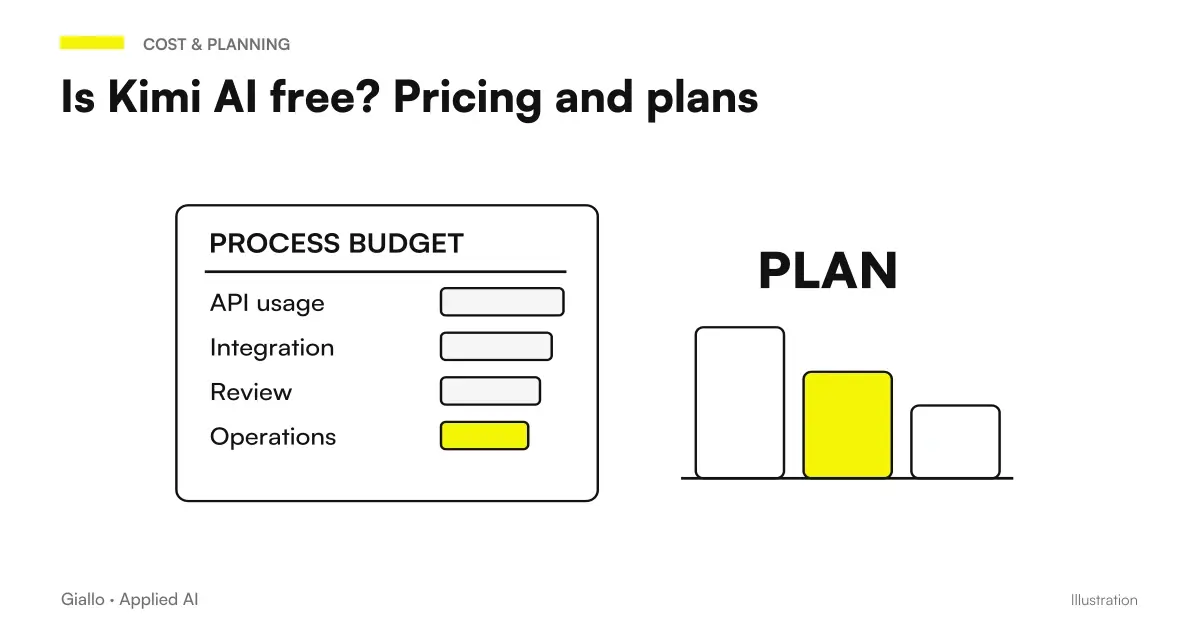
For people using the model manually, what the interface includes also matters: file uploads, work organization and available tools. For those integrating it into a CRM, the relevant factors are calls, limits, response handling and integration software. A commercial proposal should list these items separately so that the business owner can see which costs vary with usage and which support the service.
The geographical distinction also needs to remain clear. Here we use the international price list in USD. We do not convert the Chinese yuan price list into an Italian price: a currency conversion does not establish that the offers are equivalent. An intermediary may also set its own prices, which need to be checked for the channel actually used.
How much do K3.1 Pro, Highspeed and the previous K3 cost?
The table shows US dollars per million tokens. The columns represent usage categories, not four charges to apply simultaneously to every token. The documentation states that prices exclude applicable taxes. Sources, accessed on October 24, 2026: Kimi international price list and billing rules.
| API model | Standard input | Output | Cache write rate shown in the price list | Cache hit |
|---|---|---|---|---|
| Kimi K3.1 Pro | 2 USD | 10 USD | 2 USD | 0,20 USD |
| Kimi K3.1 Pro Highspeed | 4 USD | 20 USD | 4 USD | 0,20 USD |
| Kimi K3 | 3 USD | USD 15 | 3 USD | 0.30 USD |
The comparison shows a difference in rates, not a ranking of value for money. A system that needs more attempts can use more tokens despite a lower unit price. Conversely, a more expensive variant may be worth testing when faster responses change how the operator works. Both factors need to be measured within the same process.
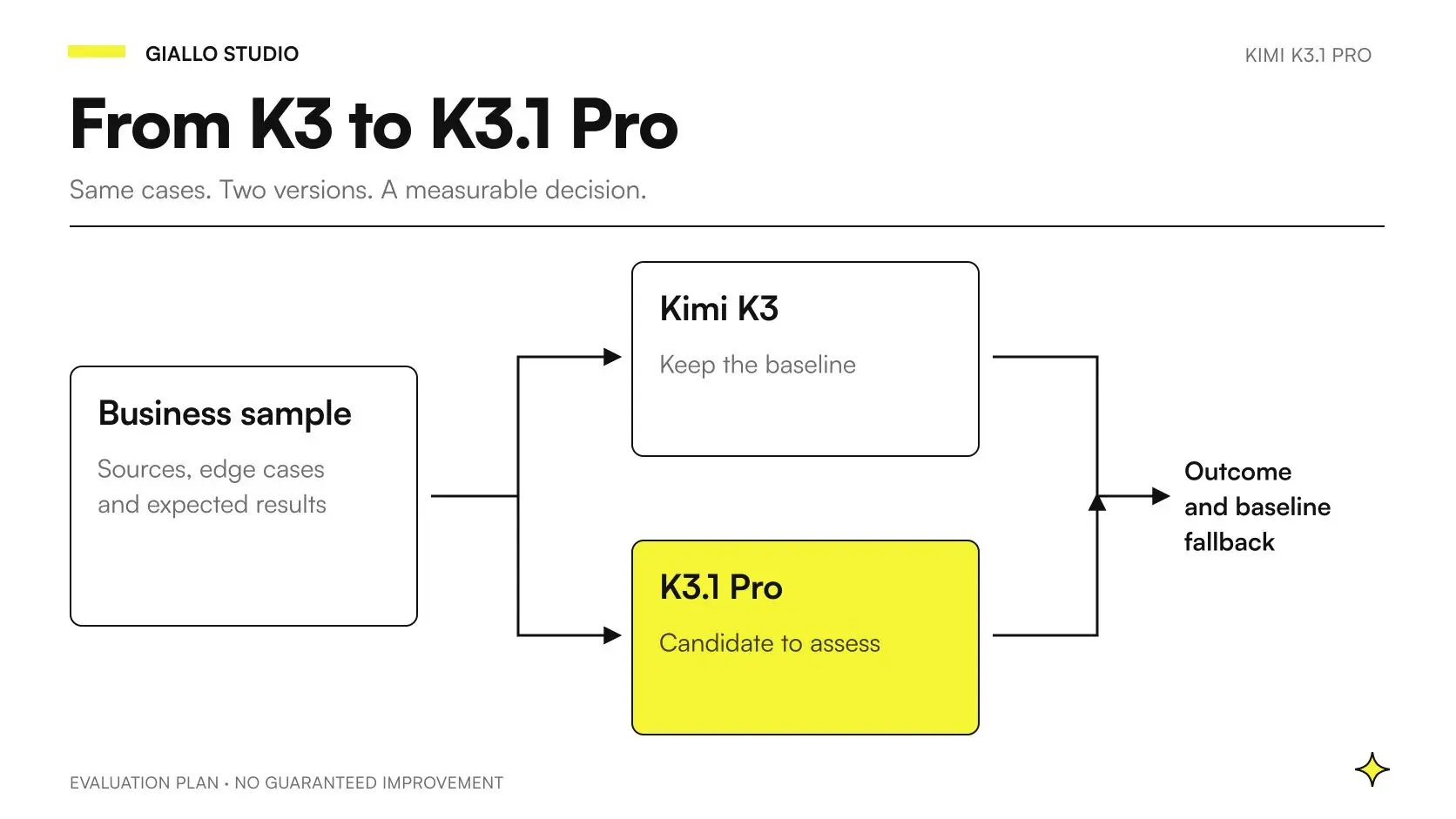
For those who already have a K3 integration, the guide to migrating from K3 to K3.1 Pro helps distinguish configuration changes from a review of behavior. Avoid changing the model, instructions and tools at the same time: doing so makes it difficult to identify the cause of an improvement or an error.
How do you calculate costs without counting the cache twice?
A clear estimate starts with the tokens recorded in each category. Multiply standard input tokens by their rate, cache write tokens by the applicable write rate, cache hit tokens by the reuse rate and output tokens by the output rate. Divide each token quantity by one million. The result describes inference for those requests under the stated assumptions.
The tricky part is double counting. For Chat Completions and Responses, the official guide says cache reads, cache writes and the remaining uncached input are mutually exclusive categories that add up to total input. Do not take the entire input and then add all tokens written to the cache again. The Messages interface exposes different fields. Source: tracking cache usage, accessed on October 24, 2026.
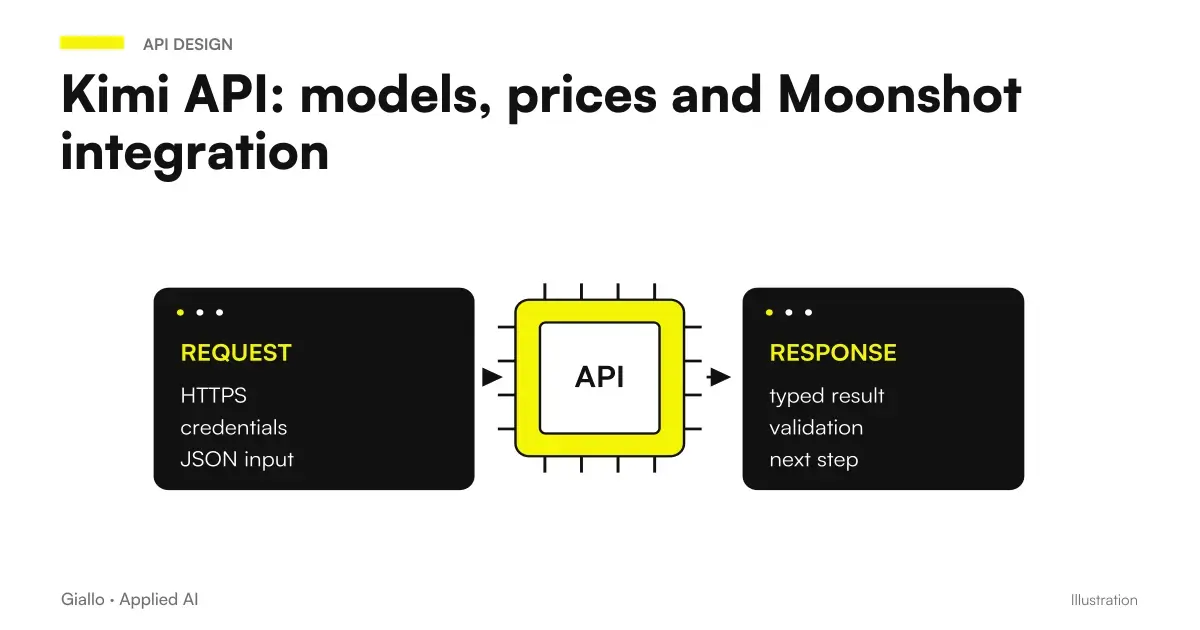
Application usage accounting therefore needs to retain the breakdown, not just a generic figure called “tokens.” The model identifier, channel, price list date and quantities by category make it possible to reconstruct the bill. The explanation of AI tokens helps explain the unit; the guide to Kimi API covers connecting the model to software.
If an integration provider quotes a cost per task, ask which steps it includes. Preparing the document, generating the initial response and correcting it after a failed validation may involve three requests. The user interface may show a single operation while the underlying system carries out more work.
When can caching make a real difference to the budget?
Caching is relevant when stable content is reused: instructions, tool definitions, technical documentation or a shared set of references. The guide describes reuse of identical prefixes, with a default lifetime of five minutes and a one-hour option. Changing the prefix or reusing it after expiry may prevent a cache hit. Source: official caching best practices, accessed on October 24, 2026.
This suggests a simple design choice: separate stable references from the task's variable data. The financial benefit can then be checked against usage. Saying that two requests cover the same subject is not enough: semantic similarity does not make a prefix reusable, and an invented cache hit rate makes the budget unreliable.
The longer lifetime is not automatically the best choice. It depends on the actual intervals between calls and the applicable write rate. The pricing table in the caching guide uses K3 as its example, so we do not infer a one-hour write rate for K3.1 Pro by analogy. Before configuring it, check the current entry in the price list and the console for your chosen model.
The estimate assumes all documents are already cached: what should you ask?
Ask for separate counts for initial processing and reuse. Have the provider specify the interval between requests, which content stays identical and how cache misses are recorded. A prudent budget should remain understandable even when the cache is not used; the observed difference can be added after testing.
How much would preparing a technical data sheet cost?
Hypothetical scenario: a components distributor in Bergamo. The company wants to turn technical documentation into a data sheet for the product manager to approve. To explain the calculation, we assume one request with forty thousand input tokens recorded as cache writes under the standard configuration and two thousand billed output tokens. These quantities are invented: they are not derived from the number of pages or measured usage.
Applying the listed K3.1 Pro rates gives 40,000 / 1,000,000 × USD 2 for the write, plus 2,000 / 1,000,000 × USD 10 for output: USD 0.10 for inference. This is an arithmetic calculation for an explicitly hypothetical example, based on the international price list accessed on October 24, 2026. It assumes those usage categories without adding the same input again.
The cost of the approved data sheet still needs to be measured. The manager might reject a description that confuses the material with its coating, request a correction or need to check a code in the archive. File preparation, the interface and review all have a cost even when the model's bill is small. The example does not demonstrate a business saving.
A useful test compares straightforward and ambiguous documents while keeping the originals visible. The team records which fields are accepted and why others are corrected. This builds the estimate from real work, rather than creating a monthly forecast by multiplying a convenient request chosen for a demonstration.
How does the bill change with several questions about the same dossier?
Hypothetical scenario: a maintenance company in Modena. An operator prepares a technical dossier and asks five questions while checking a quote. To illustrate reuse, we assume eighty thousand shared tokens are written once. Each of the four subsequent reads reuses eighty thousand tokens, giving a total of three hundred and twenty thousand cache hit tokens.
We complete the example with a total of forty thousand standard variable input tokens and ten thousand billed output tokens. The categories are defined for this example, cache hits occur exactly as assumed and there is no other usage. With K3.1 Pro, the calculation is USD 0.16 for writes, USD 0.064 for cache hits, USD 0.08 for standard input and USD 0.10 for output: USD 0.404 in total. Rates: Kimi API Platform, accessed on October 24, 2026.
The lesson is about method: reusing a long prefix and generating a long response affect the bill differently. This is not a forecast for every maintenance dossier. If the operator changes documents, pauses for a long time or the system rebuilds the prefix differently each time, the quantities must be recalculated from observed data.
It helps to associate usage with the task, retaining only the necessary metadata. The person responsible can then understand whether an unusual case cost more because it involved extra documentation, a search or an error that caused repeated attempts. The figure becomes a diagnostic tool rather than a sales promise.
Is Highspeed worth the higher price for a business workflow?
Moonshot says Highspeed offers roughly two to three times the model speed with the same capabilities. This is a provider claim, not an end-to-end measurement by Giallo. It does not mean that an import, a search and human review will together become proportionately faster. Source: official K3.1 Pro announcement, accessed on October 24, 2026.
If someone is waiting at the screen, lower latency may matter. If the task runs in the background, the constraint might be quality, tool capabilities or document availability. Make the choice based on the actual workflow: input, processing, any checks and an accepted result.
Also keep token pricing separate from Kimi Code quotas. These are different commercial measures. The guide to K3.1 Pro for coding covers configuration and use in development. To interpret published results, the benchmark comparison distinguishes scores from evaluation conditions.
Which costs fall outside the model's rates?
A typical integration includes application steps: extracting and organizing data, calling the model, validating the response, showing exceptions and recording the outcome. If an agent uses searches, external services or execution environments, their terms need to be considered separately. The ability to call a tool does not make the entire workflow free.
Maintenance also matters. A model or format can change; a business rule may require a new check; a document may become unreadable. The budget should make clear who handles these changes and what happens when a request fails to produce a usable result. Without that responsibility, the API cost may be precise while the service remains difficult to manage.
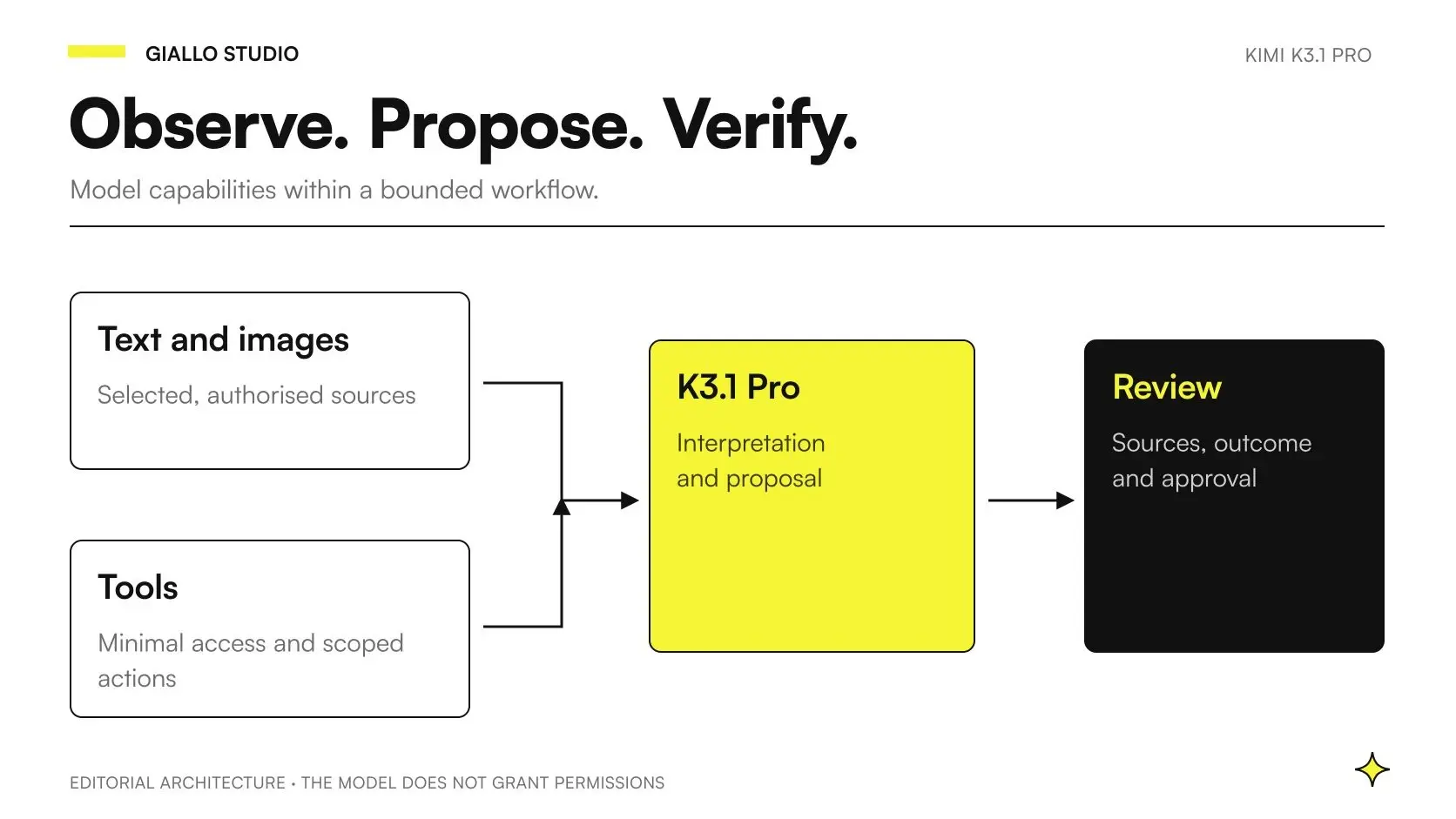
For processes with several steps, it helps to read the guide to multimodal agents with K3.1 Pro. That guide examines the boundary between a proposal and an action. In the budget, that boundary translates into explicit checks, assigned responsibilities and exception handling that fits the business process.
Which mistakes make price comparisons misleading?
The first is comparing input alone. If the workflow generates detailed responses or makes several attempts, output and repetition affect the total. A shorter prompt alone does not address the structure of usage. You need to know which result is accepted and how many requests are needed to obtain it.
The second is adding input, writes and hits without reading the usage accounting rules. The third is applying a cache discount to documents that are not actually reused. The fourth is confusing the price per million tokens with a cost per million words. These are different mistakes, but they have the same effect: a budget that looks precise without representing the work.
Another mistake is using the first successful test as the monthly average. Instead, prepare a sample that includes ordinary and difficult cases. Record rejected results and keep assumed costs separate from observed ones. If prices change, update the rate without rewriting the history of usage already incurred.
How do you set a budget the business owner can monitor?
Choose one task and describe what completing it correctly means. Record quantities by category, outcomes, attempts and tools. Then compare usage with review time and remaining errors. A useful report separates observed figures from estimates, uses the service's currency and states how taxes are treated.
Before expanding the project, clarify who can initiate new requests, which application limits stop an unproductive loop and how exceptions are handled. These are decisions about the service you build and must be checked in the software; they do not follow automatically from the model's name. Costs can then be tied to a process that also makes sense to people who do not read technical API responses.
If you want to turn a document workflow into an integration with understandable usage figures and defined acceptance criteria, Giallo can design the automation with your team. Start with the work to be completed and the sample used to measure it: pricing becomes one part of the budget, tied to results the business can assess.
Giallo Studio guides: methodology and sources
How we apply it in the company
Related resources
 Kimi K3.1 Pro: what it is, what changes and when to use it
 Kimi K3.1 Pro benchmarks: comparison with other LLMs
 Kimi K3.1 Pro for coding: configuration and practical tests
 Kimi K3.1 Pro: multimodal agents for business processes
 Kimi K3.1 Pro vs K3: differences and a verifiable migration
 Kimi API: models, prices and Moonshot integration
 Is Kimi AI free? Prices and plans to choose
FAQ
How much does Kimi K3.1 Pro cost via API?
The international price list checked on October 24, 2026 lists USD 2 per million input tokens and USD 10 per million output tokens. It also lists cache writes at USD 2 and cache hits at USD 0.20 per million tokens. Prices exclude applicable taxes.
How much does Kimi K3.1 Pro Highspeed cost?
As of October 24, 2026, the international price list lists USD 4 per million input tokens, USD 20 for output, USD 4 for cache writes and USD 0.20 for cache hits. The higher speed is a provider claim and does not guarantee an equivalent improvement in the time taken by the entire process.
Does a Kimi subscription include API calls?
Pay-as-you-go API pricing is separate from Kimi membership and Kimi Code. An app subscription should not be treated as API credit unless the purchased product explicitly includes it.
Do cache writes and cache hits cost the same?
No. Cache writes cover tokens recorded as being written to the cache; cache hits cover reused tokens. In Chat Completions and Responses usage accounting, reads, writes and the remaining input are separate categories: your estimate must not charge for the same tokens twice.
Does a one-million-token context always cost a fixed amount?
No. The maximum context is a model capability; the bill depends on the tokens processed and their categories. A smaller request is not automatically billed as though it filled the entire window.
Can I predict monthly costs by counting the words in my documents?
Word counts can help describe the work, but they are not enough for a reliable token estimate. You need observed usage, workflow turns, output, cache reuse and any tools, alongside application costs.
Can prices in yuan be converted to estimate a bill in Italy?
For a project using the international channel, it is better to use its dollar price list directly. Converting the currency of a different regional offer does not establish that access, terms and billing are equivalent.